RESEARCH ARTICLE
Psychometric evaluation of a parent-rating
and self-rating inventory for pediatric
obsessive-compulsive disorder: German
OCD Inventory for Children and Adolescents
(OCD-CA)
Julia Adam
1*, Hildegard Goletz
1, Svenja‑Kristin Mattausch
1, Julia Plück
1and Manfred Döpfner
1,2Abstract
Background: This study assesses the psychometric properties of the German version of the Padua Inventory‑Wash‑ ington State University Revision for measuring pediatric OCD.
Methods: The parent‑rating and self‑rating inventory is assessed in a clinical sample (CLIN: n = 342, age
range = 6–18 years) comprising an OCD subsample (OCDS: n = 181) and a non‑OCD clinical subsample (non‑OCD: n = 161), and in a community sample (COS: n = 367, age range = 11–18 years).
Results: An exploratory factor analysis yielded a four‑factor solution: (1) Contamination & Washing, (2) Catastrophes & Injuries, (3) Checking, and (4) Ordering & Repeating. Internal consistencies of the respective scales were acceptable to excellent across all samples, with the exception of the self‑report subscale Ordering and Repeating in the community sample. The subscales correlated highly with the total score. Intercorrelations between the subscales were mainly r ≤ .70, indicating that the subscales were sufficiently independent of each other. Convergent and divergent valid‑ ity was supported. Participants in the OCD subsample scored significantly higher than those in the non‑OCD clinical subsample and the COS on all scales. In the COS, self‑rating scores were significantly higher than parent‑rating scores on all scales, while significant mean differences between informants were only found on two subscales in the OCD subsample.
Conclusion: The German version of the Padua Inventory‑Washington State University Revision for measuring pediat‑ ric OCD is a promising, valid and reliable instrument to assess self‑rated and parent‑rated pediatric OCD symptoms in clinical and non‑clinical (community) populations.
Keywords: Obsessive‑compulsive disorder, Children, Adolescents, Assessment, Reliability, Validity
© The Author(s) 2019. This article is distributed under the terms of the Creative Commons Attribution 4.0 International License (http://creat iveco mmons .org/licen ses/by/4.0/), which permits unrestricted use, distribution, and reproduction in any medium, provided you give appropriate credit to the original author(s) and the source, provide a link to the Creative Commons license, and indicate if changes were made. The Creative Commons Public Domain Dedication waiver (http://creat iveco mmons .org/ publi cdoma in/zero/1.0/) applies to the data made available in this article, unless otherwise stated.
Background
Obsessive-compulsive disorder (OCD) is a severe mental disorder, characterized by obsessions, compulsive rituals, or both. Its prevalence rate in childhood and adolescence lies at approximately 1 to 4% [1, 2], and up to half of adult
patients diagnosed with OCD report an onset of the dis-order during childhood or adolescence [3]. To identify symptoms and treat the disorder as early as possible, appropriate assessment instruments for pediatric OCD are needed. OCD symptoms lead to a high psychological strain, distress and psychosocial impairment in children and adolescents [4], and considerably interfere with qual-ity of life [5]. These serious consequences of the disorder have encouraged clinicians and researchers to develop new assessment instruments [6].
Open Access
*Correspondence: julia.adam@uk‑koeln.de
1 School of Child and Adolescent Cognitive Behavior Therapy
Several pediatric OCD-specific measures have been developed, which assess the self-report of children and adolescents only [7–10]. Most of these measures showed satisfactory internal consistencies and there is at least some support for their convergent and/or divergent validity. However, there is a need to assess OCD symp-toms as rated by parents and children separately, because younger children may be unable to report their OCD symptoms accurately. Moreover, some children and ado-lescents may not report their symptoms accurately due to shame and embarrassment about their OCD [11]. On the other hand, parent reports may give underestimations because some symptoms (e.g. recurrent thoughts) are more difficult for parents to notice [12].
Overall, correlations between parent ratings and self-ratings have usually been found to be low, both in the assessment of mental health problems in children and adolescents generally (e.g. [13]) and in the assessment of OCD symptoms in particular [11]. Thus, to achieve a comprehensive clinical picture of the disorder, a multi-ple-informant assessment is required.
Therefore, researchers have recently developed ques-tionnaires which encompass both self- and parent reports (child-report version and parent-report version of the CY -BOCS, CY-BOCS-CR, CY-BOCS-PR [14]; Children’s Obsessional Compulsive Inventory, CHOCI/CHOCI-R [15, 16]. Satisfactory internal consistencies have predom-inantly been reported for these questionnaires. However, analyses in a community sample revealed poor internal consistency for the Obsession and the Compulsion sub-scales and the Total scale of the CY-BOCS-CR [17]. Sup-port for convergent and/or divergent validity was found for both instruments. However, only global scores for OCD symptoms or obsessive symptoms and compul-sive symptoms were derived from these rating scales, while scales assessing different domains (e.g. control-ling, washing) are not provided. This is also true for the only self- and parent-rated instrument developed for the German-speaking countries—the SBB-ZWA (Selbstbeur-teilungsbogen für Zwangsspektrum-Störungen and the FBB-ZWA (Fremdbeurteilungsbogen für Zwangsspek-trum-Störungen) [18].
Overall, none of these self-rated or parent-rated scales fulfill the criteria for a well-established assessment tool according to the criteria for evidence-based assessment (EBA; i.e.: reliability and validity must have been pre-sented in at least two peer-reviewed articles by differ-ent investigators [19, 20]. Currently, the clinician-rated Children’s Yale-Brown Obsessive-Compulsive Scale (CY-BOCS [21]) is the only pediatric OCD-specific measure that can be classified as a well-established assessment according to these criteria [22].
In sum, despite the variety of self-report and parent-report forms for the assessment of pediatric OCD symp-toms and severity/impairment, there is, to the best of our knowledge, only one measure, the Obsessive Compulsive Inventory-Child Version (OCI-CV) [7], that focuses on symptom frequency across symptom domains. However, The OCI-CV only exists in a self-report form. Clearly, there is a lack of instruments assessing symptoms across common OCD domains, and there are no measures that record both self- and parent report regarding OCD symptom domains. To gain a comprehensive clinical pic-ture of the child or adolescent, however, the assessment should encompass multiple informants and perspectives.
Therefore, the current study examined an inventory to assess OCD symptoms in children and adolescents across common OCD domains, the OCD-CA (OCD Inventory for Children and Adolescents) [23], which is rated by children and parents separately and is based on the Padua Inventory-Washington State University Revision [24].
The main goals of the study are to: (1) identify the factor structure of the self-report and the parent-report form of the OCD-CA, (2) assess internal consistency of the sub-scales and the Total scale derived from factor analyses, (3) assess the correlations between the subscales for each informant, (4) assess the correlations between parent ratings and self-ratings, and (5) evaluate convergent and divergent and discriminant validity of the scales.
Methods
Instruments
The German OCD Inventory for Children and Adoles-cents (OCD-CA; German: Zwangsinventar für Kinder und Jugendliche; ZWIK [23]) is a modified version of the Padua Inventory-Washington State University Revi-sion (PI-WSUR [24] /PI-WSUR (German translation) [25]). The OCD-CA enables the assessment of pediatric OCD symptoms on different symptom scales. The inven-tory comprises two multidimensional questionnaires: a parent form (target group: parents/caregivers of chil-dren and adolescents aged 6;0–18;11 years) and a self-report form (target group: children and adolescents aged 11;0–18;11 years), which are constructed analogously to one another. Accordingly, both rating forms include the same 36 items assessing various obsessions and compul-sions. Parents or children/adolescents are asked to rate each item on a 5-point scale from 0 (not at all) to 4 (very much).
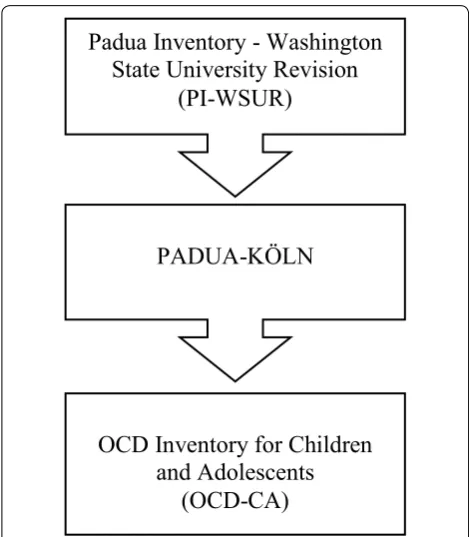
The development of the inventory is described below (see Fig. 1).
[24]). The PI-WSUR is a self-report measure assess-ing obsessions and compulsions in adulthood (applica-ble from the age of 16 years onwards). The instrument includes 39 items, rated on a 5-point scale from 0 (not at all) to 4 (very much) and measuring five OCD-relevant content dimensions: obsessional thoughts about harm to oneself or others, obsessional impulses to harm oneself or others, contamination obsessions and washing com-pulsions, checking comcom-pulsions, and dressing/grooming compulsions. As the PI-WSUR was found to be a valid and reliable questionnaire for the assessment of OCD symptoms in adulthood [24], the German translation of this instrument [25] was used as the basis for the devel-opment of the OCD-CA.
To compile a child-appropriate version, items of the PI-WSUR were transformed and extended concerning the most frequently occurring OCD symptoms in childhood. The item pool was developed through intensive discus-sion within a group of experienced clinical psychologists. Finally, thirty-two items of the German translation of the PI-WSUR were adopted and, in part, slightly changed to make items more suitable for children. For example, the PI-WSUR Item 1 “I feel my hands are dirty when I touch money” was changed to “I feel my hands are dirty when I touch money, books or toys”, and the PI-WSUR Item 18 “I keep on checking forms, documents, checks, etc., in detail to make sure I have filled them in correctly”
was changed to “I keep on checking homework and other documents in detail to make sure I have completed them in correctly”. Seven items of the PI-WSUR were not adopted because they were assessed as not up-to-date or as not child-appropriate (e.g. Item 6 “I avoid using public telephones because I am afraid of contagion and disease” or Item 34 “While driving, I sometimes feel an impulse to drive the car into someone or something”). Furthermore, ten items were newly developed, which refer to repeating compulsions, counting, reassurance-seeking, (un)lucky number, hoarding/saving and not getting ready.
Accordingly, the first draft of a child-appropriate self-rating measure included 42 items assessed on a 5-point Likert scale, equivalent to the adult version. Analo-gously to the self-report form, a parent-report form was developed, including the same items. The self- and
parent-report form were named PADUA-KÖLN. The
PADUA-Köln was evaluated within a pilot study in a clin-ical sample (n = 55, age range 10–17 years). The adopted initial scale of the PI-WSUR Obsessional Impulses to harm oneself or others could not be confirmed through reliability analyses and comparison of means. Besides unsatisfactory internal consistency, comparisons of means showed that patients without OCD, especially those diagnosed with hyperkinetic disorders, had signifi-cantly higher means (self-reported and parent-reported) than patients affected by OCD. As a consequence, the PADUA-Köln was revised by eliminating the correspond-ing six items of the mentioned scale. The new scale was finally named OCD Inventory for Children and Adoles-cents (OCD-CA) (German: Zwangsinventar für Kinder und Jugendliche; ZWIK).
First analyses with the OCD-CA were conducted within a community sample (Waclawiak 2006, unpub-lished) comprising 367 self-reports and 434 parent reports (271 mothers and 163 fathers). Exploratory principal component analyses with varimax rotation (40 patients with OCD were included in the dataset to increase the variance in the sample) yielded a four-factor solution (Additional file 1). Internal consistencies for the self-report form and parent-report form (rated by moth-ers or fathmoth-ers), respectively, were satisfactory to excellent for all subscales: Contamination Obsessions and Wash-ing Compulsions (.86 ≤ α ≤ .93), Checking and Repeat-ing Compulsions (.82 ≤ α ≤ .85), Obsessions concerning harm and injuries of others or oneself (.75 ≤ α ≤ .78), Counting Compulsions and Reassurance-Seeking Com-pulsions and (un)lucky numbers (.77 ≤ α ≤ .85).
The German version of the Children’s Yale-Brown Obsessive-Compulsive Scale (CY-BOCS-D [32]) is based on the English original version of the CY-BOCS, devel-oped by Goodman and colleagues (1986, unpublished scale). The clinician-rated CY-BOCS-D (based on
PADUA-KÖLN
OCD Inventory for Children
and Adolescents
(OCD-CA)
Padua Inventory - Washington
State University Revision
(PI-WSUR)
parent/patient interview) comprises a symptom checklist and a semi-structured rating scale. The 58-item symp-tom checklist serves to assess the presence or absence of a variety of obsessions and compulsions. Symptoms can be summarized into four symptom scales [(1) obses-sions regarding loss of control and religion; (2) checking, harm avoidance and sexual obsessions; (3) contamination and cleaning; (4) repeating, ordering/arranging, hoard-ing and magical thinkhoard-ing] and a total score. The 19-item rating scale serves especially to measure obsession sever-ity, compulsion severity and the total OCD severity as well as to assess OCD-associated (personality) traits and abnormalities.
The OCD severity scale is derived by summing up the responses to the items 1–10, including items 1b and 6b. Items are rated on a 5-point Likert scale ranging from 0 to 4, with higher scores indicating greater symptom severity.
Psychometric evaluations of the CY-BOCS revealed positive results (see “Background”). The CY-BOCS-D symptom checklist and the rating scale displayed accept-able and good internal consistency, respectively. There was also evidence for the validity of the CY-BOCS-D [32]. In the present analyses, the symptom checklist scales and the total OCD severity score of the rating scale were used. Data were collected based on an inter-view with children and adolescents ≥ 11 years old with an OCD diagnosis (OCD subsample, see below).
The German version of the Child Behavior Checklist— CBCL/6-18R [33, 34], originally developed by Achen-bach [35], is a parent-report instrument including 113 items which assess a range of behavioral and emotional problems in children and adolescents rated on a 3-point scale (“0 = not true”, “1 = somewhat or sometimes true”, “2 = very true or often true”). Items are assigned to two broad-band syndrome scales (Externalizing and Internal-izing Problems) and eight syndrome scales. The German version shows good reliability and factorial validity [33, 34]. In the present study, the raw scale scores of the Inter-nalizing and ExterInter-nalizing scales were used.
The German version of the Youth Self Report—YSR/11 -18R [34, 36], originally developed by Achenbach [37], is the equivalent self-report form of the CBCL (described above). The 112-item measure is child/adolescent-based and includes widely identical items to the CBCL. The structure and scales are the same. Research has also dem-onstrated good reliability (internal consistency) and fac-torial validity for the German version of the YSR [34, 36]. In the present study, the raw scale scores of the Internal-izing and ExternalInternal-izing scales were used.
The German Symptom Checklists for Anxiety Disorders and Obsessive-Compulsive Disorders are rated by parents (FBB-ANZ) of patients aged 6 to 18 years and by patients
aged 11 to 18 years (SBB-ANZ). These scales are part of the Diagnostic System for the Assessment of Mental Dis-orders in Children and Adolescents based on the ICD-10 and DSM-IV (DISYPS-II) [38]. All items are rated on a 4-point Likert scale ranging from 0 (“not at all”) to 3 (“very much”). The questionnaires comprise 31 items describing anxiety symptoms and two items describing obsession and compulsion (scales: Separation Anxiety, Generalized Anxiety, Social Phobias, Specific Phobias and Total Scale). Psychometric evaluations of the SBB-/ FBB-ANZ have yielded good results regarding reliability and validity [38]. The present analyses included the total score of the parent- and self-rated questionnaire.
The German Symptom Checklists for Depressive Disor-ders are likewise rated by parents (FBB-DES) of patients aged 6 to 18 years and by patients aged 11 to 18 years (SBB-DES). The rating scales are also part of the Diag-nostic System for the Assessment of Mental Disorders in Children and Adolescents based on the ICD-10 and DSM-IV [38]. The structure, implementation and assess-ment are the same as described for the SBB-/FBB-ANZ. The total score includes 29 items. Psychometric evalua-tions of the SBB-/FBB-DES have also shown good results regarding reliability and validity [38]. Parent-rated and child/adolescent-rated questionnaires (Total Score) were used for the present analyses.
Participants and samples
Table 1 summarizes the demographic characteristics of the OCD subsample, the non-OCD clinical subsample, and the community sample separately for different age groups.
OCD subsample (OCDS)
[38]. Overall, 70 (38.9%) patients also had a comor-bid diagnosis, consisting of tic disorders (F95, n = 19), hyperkinetic disorders (F90, n = 14), major depressive disorders (F32, n = 13), pervasive developmental dis-orders (F84, n = 9), emotional disorders (F93, n = 8) or phobic anxiety disorders (F40, n = 7). In total, the OCD subsample comprised 181 OCD-CA parent reports (for 46 6–10-year olds and 135 11–18-year-olds) and 134 OCD-CA self-reports.
Non‑OCD clinical subsample (non‑OCD)
This subsample comprised 161 children and adoles-cents referred to the same institutions described above (n = 115, 71.4% boys), with ages ranging from 6 to 18 years (M = 11.91, SD = 3.00). The most common diag-noses, primary or comorbid, were tic disorders (F95, n = 118), hyperkinetic disorders (F90, n = 30), emotional disorders (F93, n = 28), phobic anxiety disorders (F40, n = 11), reaction to severe stress and adjustment disor-ders (F43, n = 9), other behavioral and emotional dis-orders with onset usually occurring in childhood and adolescence (F98, n = 9), pervasive developmental disor-ders (F84, n = 7), habit and impulse disorders (F63, n = 4) and mixed disorders of conduct and emotions (F92, n = 4). In total, the non-OCD subsample comprised 161 OCD-CA parent reports (for 64 6–10-year-olds and 97 11–18-year-olds) and 84 OCD-CA self-reports.
Community sample (COS)
The community sample (Waclawiak 2006, unpublished) included 367 school pupils aged 11–18 years (M = 14.29, SD = 2.21; n = 146, 39.8% boys) and their caregivers (either mother or father). The participants were recruited in 11 schools in four different Federal states in Germany (North Rhine-Westphalia, Hesse, Rhineland-Palatinate, Schleswig–Holstein). 1310 OCD-CA self-report and parent-report forms were sent to the 11 schools. Ques-tionnaires that did not meet the criteria regarding miss-ing values < 10% were excluded. In total, 367 OCD-CA self-report forms were included in the dataset (response rate = 28%). Parent forms were only considered if they met the criteria regarding missing values and if the
corresponding self-report form was present. Finally, 367 OCD-CA parent forms were selected for subsequent analysis. The CBCL and YSR were also rated by parents and pupils in the COS.
Data analyses
To examine the factor structure of the OCD-CA in the combined OCD and non-OCD clinical sample (CLIN sample) and the OCD clinical subsample (OCDS), con-firmatory factor analyses for the self-report form and the parent form were conducted separately in both samples in a first step, based on the factor structure previously found in analyses in a community sample (Waclawiak 2006, unpublished) (Additional file 1). Correlation paths between the factors were allowed because Wac-lawiak (2006, unpublished) found intercorrelations ≤ .65 between subscales. The tested model was assessed using x2 test and further fit indices. The x2 test examines the difference between observed and predicted data by the model, with a non-significant result indicating a good model fit. Moreover, as the x2 test is very sensitive to sample size, it was likely to reveal significant results con-sidering the sizes of the assessed samples. Thus, further goodness-of-fit indices employed in comparable studies were computed to assess the model fit: the root mean square error of approximation (RMSEA), standardized root mean square (SRMR), comparative fit index (CFI) and the Tucker-Lewis index (TLI). To judge the goodness of model fit, we used the cut-off criteria proposed by Hu and Bentler [39]: RMSEA ≤ .08, better ≤ .05, SRMR ≤ .11, and CFI/TLI ≥ .80, better ≥ .95. Due to non-normally dis-tributed data, the method of maximum-likelihood esti-mation was applied, using the Bollen-Stine bootstrapping (1000 samples) procedure [40].
The confirmatory factor analyses showed no satis-factory model fit (see results). Therefore, exploratory principal component analyses with varimax rotation, comprising the items of the OCD-CA, were applied in the CLIN, separately for the self-report form and the par-ent form. Beforehand, the data were checked with regard to their suitability for conducting exploratory principal component analyses: The Kaiser–Meyer–Olkin (KMO) and the measure of sampling adequacy (MSA) coefficient Table 1 Description of the samples
Clinical sample (CLIN) Community sample (COS)
OCDS Non-OCD
6–10 years old 11–18 years old 6–10 years old 11–18 years old 11–18 years old
Sample size: N 46 135 64 97 367
were computed, and Bartlett’s test of sphericity was car-ried out [40]. Additionally, as a criterion for extraction, Velicer’s (1976) minimum average partial (MAP) test and parallel analyses according to Horn were conducted to determine the number of components [40, 41].
To make the different samples comparable for further data analyses, age was divided into two groups consist-ing of children aged 6–10 years and adolescents aged 11–18 years (see Table 1). For analyses regarding the OCD-CA scales, raw scale scores were used. The analyses were conducted separately for the CLIN, its OCD sub-sample, and the COS. The non-OCD clinical subsample was only used for group comparison.
Based on the samples, descriptive analyses (means and standard deviations) for the OCD-CA subscales and the OCD Total scale were conducted. Additionally, internal consistency (Cronbach’s alphas) for the subscales devel-oped on the basis of the principal component analyses as well as item-total correlations were calculated. For each informant (parent, child), Pearson product-moment cor-relations were applied for the corresponding subscales of the OCD-CA in the self-report form and the parent form. Moreover, Pearson product-moment correlations were computed to examine the relationships among the scores on the OCD-CA scales and the clinician-rated measure of OCD severity (CY-BOCS-D), the scores on parent- and self-rated measures of depressive symptoms (FBB-/SBB-DES), anxiety symptoms (FBB-/SBB-ANZ) and internalizing and externalizing problems (CBCL/ YSR). ANOVAS and independent and dependent t-tests were used for group comparisons between the different samples, informants and age and gender groups regard-ing the OCD-CA scores (subscales and Total scale).
Results
Confirmatory factor analyses in the CLIN (patients with OCD and patients with other psychological disorders) and the OCDS based on the factor structure found in the analyses of Waclawiak (2006, unpublished) did not reveal any satisfactory model fit. In none of the samples were all cut-off criteria for an acceptable model fit achieved (see Additional file 1).
Thus, exploratory principal component analyses with varimax rotation were conducted on the OCD-CA in the CLIN, separately for the parent form and the self-report form (Additional file 2). Data of the OCD-CA parent form consistently met criteria for conducting a factor analysis (Kaiser–Meyer–Olkin (KMO) = .90, measure of sampling adequacy coefficient: .76 ≤ MSA ≤ .96, Bar-tlett’s test of sphericity: x2= 7077.69, df = 630, p < .001). The MAP test and parallel analysis determined four factors to be extracted. Therefore, an exploratory prin-cipal component analysis extracting four factors was
applied. The four extracted factors (Additional file 2) had eigenvalues greater than 1.95 and explained 54.04% of the variance. The first factor explained 17.40% of the variance (.57 ≤ factor loadings ≤ .88) and included nine items, which describe contamination obsessions and washing compulsions (Contamination & Wash-ing). The second factor explained 14.30% of the vari-ance (.43 ≤ factor loadings ≤ .75) and consisted of 11 items describing obsessions and compulsions concerning catastrophes and injuries (Catastrophes & Injuries). The third factor explained 11.39% of the variance (.36 ≤ fac-tor loadings ≤ .73) and contained seven items describing checking compulsions (Checking); item 22, describing hoarding and saving, also loads highly on this factor. The fourth factor explained 10.96% of the variance (.43 ≤ fac-tor loadings ≤ .69) and contained five items describing ordering/arranging and repeating compulsions ( Order-ing & RepeatOrder-ing). Three further items regarding counting (items 20–21) and not getting ready (item 23) also load highly on the fourth factor. An additional exploratory principal component analysis with four extracted fac-tors excluding items 20–23, which did not fit to any of the described factors in terms of content, showed the same results.
Data of the OCD-CA self-report form also met criteria for conducting a factor analysis (Kaiser–
Meyer–Olkin (KMO) =.88, measure of sampling
contained four items which describe obsessions and compulsions regarding catastrophes and injuries. Item 17 (“count and recount money”) and item 22 (“hoarding and saving”) also load highly on this factor. Although six further items describing obsessions and compul-sions concerning catastrophes and injuries load on the fourth factor, all six actually load higher on other factors.
To sum up, the self-report form showed a less clear factor structure than the parent form. The factor struc-ture of the parent form was broadly found in the self-report (see Additional file 2). For this reason, the factor structure of the parent form was used for scale forma-tion. As items 20–23 (regarding “counting”/“certain number”, “hoarding and saving” and “not getting ready”) did not match to any of the described factors in terms of content, they were not included in any of the subscales but were included in the Total scale.
Exploratory principal component analyses with vari-max rotation were also conducted in the OCDS, show-ing the same factorial solution as described for the CLIN above. Furthermore, exploratory principal axis factoring with varimax rotation also revealed no differences in the results.
To confirm the four-factor solution found in explora-tory factor analyses, confirmaexplora-tory factor analyses were conducted once again. Correlation paths between the factors were allowed. The x2 test was significant for the parent form in the CLIN ( x2
(df=458)= 1503.170, p = .001) and OCDS ( x2
(df=458)= 1024.023, p = .001). Further fit-indices (except for the TLI in the OCDS) indicated an
acceptable factorial validity of the model (CLIN: RMSEA = .08, SRMR = .08, CFI = .83, TLI = .82; OCDS: RMSEA = .08, SRMR = .09, CFI = .80, TLI = .78).
Except for the SRMR (CLIN: .08, OCDS: .09), no fit indices met cut-off criteria for the self-report (CLIN:
x2
(df=458)= 1285.319, p = .001, RMSEA = .09, CFI = .74, TLI = .72; OCDS: x2
(df=458)= 1013.752, p = .008, RMSEA = .09, CFI = .71, TLI = .69).
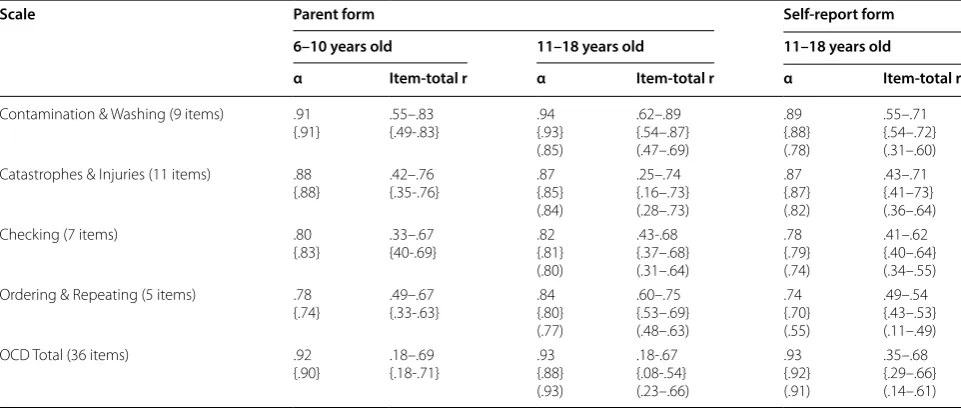
Table 2 shows the internal consistency (Cronbach’s alphas) and the ranges of the item-total correlations for the OCD-CA subscales and the Total scale (parent form and self-report form) across the CLIN, OCDS and COS. The Cronbach’s alpha values of the subscales and the Total scale (regarding both age groups) in the parent form were acceptable to excellent across the samples (CLIN: .78 ≤ α ≤ .94; OCDS: .74 ≤ α ≤ .93; COS: .77 ≤ α ≤ .93).
The self-report form also had acceptable to excellent internal consistency, with the exception of the subscale Ordering & Repeating in the COS (CLIN: .74 ≤ α ≤ .93;
OCDS: .70 ≤ α ≤ .92; COS: .55 ≤ α ≤ .91). Item-total cor-relations were generally satisfactory. Although several items had low item-total correlations (rit < .30), excluding any of these items did not noticeably change the Cron-bach’s alpha.
The intercorrelations of the subscales in the parent form (Additional file 3) yielded different results across the samples. In the CLIN, the subscales showed low to high intercorrelations (.23 ≤ r ≤ .61). All intercorrelations
were significant at a level of .01 (except for the intercor-relation between the subscale Contamination & Washing and the subscale Checking, p < .05). In the OCDS, low and
Table 2 OCD-CA parent form and self-report form: Cronbach’s alphas (α) and item-total correlations, CLIN, {OCDS}, (COS)
Parent-report form: 6–10 years old: n = 110, {n = 46}; 11–18 years old: n = 232, {n = 134}, (n = 367) Self-report form: n = 218, {n = 134}, (n = 367)
Scale Parent form Self-report form
6–10 years old 11–18 years old 11–18 years old
α Item-total r α Item-total r α Item-total r
Contamination & Washing (9 items) .91
{.91} .55–.83{.49‑.83} .94{.93} (.85)
.62–.89 {.54–.87} (.47–.69)
.89 {.88} (.78)
.55–.71 {.54–.72} (.31–.60) Catastrophes & Injuries (11 items) .88
{.88} .42–.76{.35‑.76} .87{.85} (.84)
.25–.74 {.16–.73} (.28–.73)
.87 {.87} (.82)
.43–.71 {.41–73} (.36–.64) Checking (7 items) .80
{.83} .33–.67{40‑.69} .82{.81} (.80)
.43‑.68 {.37–.68} (.31–.64)
.78 {.79} (.74)
.41–.62 {.40–.64} (.34–.55) Ordering & Repeating (5 items) .78
{.74} .49–.67{.33‑.63} .84{.80} (.77)
.60–.75 {.53–.69} (.48–.63)
.74 {.70} (.55)
.49–.54 {.43–.53} (.11–.49) OCD Total (36 items) .92
{.90} .18–.69{.18‑.71} .93{.88} (.93)
.18‑.67 {.08‑.54} (.23–.66)
.93 {.92} (.91)
moderate intercorrelations emerged (.05 ≤ r ≤ .51, par-tially significant at a level of p < .01 or p < .05). High inter-correlations were found in the COS (.55 ≤ r ≤ .71, p < .01). The intercorrelations of the subscales in the self-report form (Additional file 4) yielded similar, comparable results across the samples. Subscales showed moderate to high significant intercorrelations (.32 <= r <=.71, p < .01), with the exception of the subscales Contamination & Washing and Ordering & Repeating in the OCDS (r = .28, p < .01, low and significant correlation).
The correlations between the corresponding OCD-CA subscales and Total scores of the parent form and self-report form (Table 3) were generally moderate to high and significant (.32 ≤ r ≤ .68, p < .01), with the exception
of the correlations of the corresponding subscales Con-tamination & Washing (r = .27, p < .01) and Catastrophes & Injuries (r = .29, p < .01) in the COS, which were signifi-cant but low.
Convergent and divergent validity
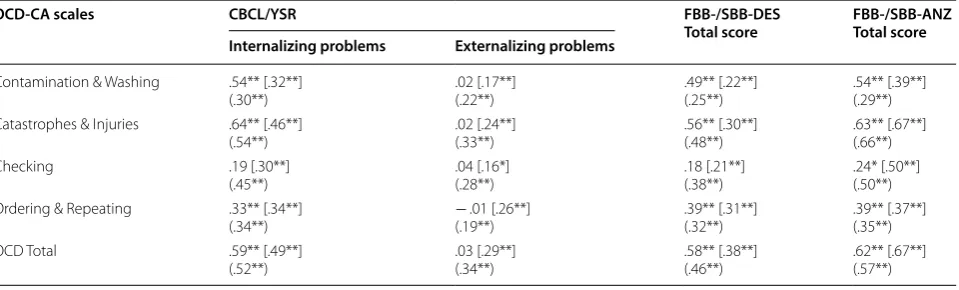
Correlations between the OCD-CA scales of the parent form and self-report form, respectively, and other scales assessing anxiety, depression, and internalizing and externalizing problems in the CLIN (divided into two age groups) are reported in Table 4. Predominantly moder-ate correlations were found between the parent-rmoder-ated/ self-rated OCD-CA Total scores on the one hand and parent-rated/self-rated Internalizing Problems, Anxiety Symptoms and Depression Symptoms on the other, while correlations with Externalizing Problems were lower. The correlations of the OCD-CA subscales with other rat-ings were predominantly close to those of the OCD-CA Total scores, with the exception of the subscale Check-ing, which had mainly lower correlations. Correlations in the other samples (OCDS, COS) were similar (Additional file 5, 6).
Correlations between the self-rated OCD-CA Total score and the clinician-rated CY-BOCS-D Total score were in the moderate range (r = .53) and higher than the correlations between parent-rated OCD-CA scale scores and the CY-BOCS-D Total score, which were not statis-tically significant (Additional file 7). The parent-rated OCD-CA scales correlated with the content-correspond-ing subscales of the CY-BOCS-D Checklist. These corre-lations were statistically significant (p < .05) in the small to moderate range (.23 ≤ r ≤ .69), with the exception of the correlation between the OCD-CA subscale Catastro-phes & Injuries and the CY-BOCS-D Checklist subscale Repeating, ordering/arranging, hoarding and magical Table 3 Correlation between corresponding scales
in the parent and self-report form, CLIN, {OCDS}, (COS)
All correlations significant at p < .01; n = 218, {n = 134}, (n = 367)
Scale r parent-/
self-report
Contamination & Compulsions .68 {.65} (.27) Catastrophes & Injuries .47
{.44} (.29)
Checking .55
{.54} (.32) Ordering & Repeating .53
{.43} (.46)
OCD Total .54
{.44} (.32)
Table 4 CLIN: Correlations between the OCD-CA scales and internalizing and externalizing problems and symptoms
Parent form/(self-report form); CLIN: 6–10 years old and [11–18 years old]
* p < .05, ** p < .01; CBCL: n = 105, FBB-DES: n = 92, FBB-ANZ: n = 69, [CBCL: n = 224, FBB-DES: n = 203, FBB-ANZ: n = 164]; (YSR: n = 210, SBB-DES: n = 199, SBB-ANZ: n = 162)
OCD-CA scales CBCL/YSR FBB-/SBB-DES
Total score FBB-/SBB-ANZTotal score Internalizing problems Externalizing problems
Contamination & Washing .54** [.32**]
(.30**) .02 [.17**](.22**) .49** [.22**](.25**) .54** [.39**](.29**) Catastrophes & Injuries .64** [.46**]
(.54**) .02 [.24**](.33**) .56** [.30**](.48**) .63** [.67**](.66**) Checking .19 [.30**]
(.45**) .04 [.16*](.28**) .18 [.21**](.38**) .24* [.50**](.50**) Ordering & Repeating .33** [.34**]
(.34**) −(.19**) .01 [.26**] .39** [.31**](.32**) .39** [.37**](.35**) OCD Total .59** [.49**]
thinking (r = .12). No significant correlations were found on the non-corresponding subscales. The self-rated OCD-CA scale scores also correlated statistically signifi-cantly (p < .01) in the low to high range (.30 ≤ r ≤ .75) with the content-corresponding subscales of the CY-BOCS-D Checklist. Only two significant correlations were found for the non-corresponding subscales (Additional file 7).
Comparisons of means between samples and informants, age and gender effects
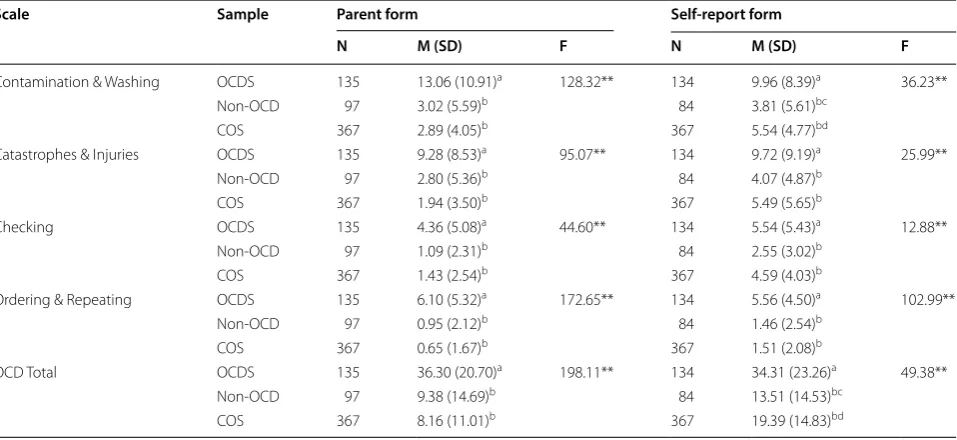
Table 5 presents the mean scores and standard devia-tions of the OCD-CA subscales and Total scale for the OCDS, non-OCD and COS for the age group 11–18 years. ANOVAs (one-way) revealed significant (p < .001) group differences on the OCD-CA Total and subscale scores between these groups. Post hoc com-parisons showed that the OCDS scored significantly higher than the non-OCD and the COS on all scales in the parent form and the self-report form. Additionally, in the self-report form, the COS scored significantly higher (p < .05) than the non-OCD on the scale Con-tamination & Washing and the OCD Total Score.
Within the clinical sample of 6–10-year-old children, parent-rated OCD-CA scores were higher in the OCD subsample than in the non-OCD subsample (Addi-tional file 8).
In the OCD subsample, no significant differences were found between the self-rated and the parent-rated OCD-CA total scores, while in the COS, self-reported OCD-CA total scores and subscale scores were higher
than parent-reported scores. Within the OCD sample, higher parent ratings were found for Contamination & Washing and lower parent ratings emerged for Checking (Additional file 9).
Significant age effects were found within the CLIN (parent form) across all scales except for the scale Ordering and Repeating. Parents of 11–18-year-olds gave higher ratings than parents of 6–10-year-olds. Gender effects only emerged on the scale Checking. Parents of girls provided significantly higher ratings than parents of boys on this scale (Additional file 10). Within the OCD subsample, no age or gender effects were found on the OCD-CA subscales and the Total score, with the exception of the subscale Contamina-tion & Washing (Additional file 11).
Within the CLIN (self-report form), significantly higher ratings for girls than for boys were found on the scales Catastrophes & Injuries, Ordering & Repeating and the OCD Total scale. No significant mean gender differ-ences were found in the COS, with the exception of the subscale Ordering & Repeating in the parent form (Addi-tional file 12).
Discussion
The aim of this study was to examine the psychometric properties of a new parent-rated and self-rated inven-tory for pediatric obsessive-compulsive disorder, the OCD-CA, across a clinical sample comprising an OCD subsample and a non-OCD clinical subsample, as well as a community sample. For the total clinical sample and
Table 5 Comparison of means between clinical OCDS and Non-OCD and COS (11–18-year-olds) (ANOVA)
** p < .001
a,b Samples differ significantly at a level of < .001; c,d samples differ significantly at a level of < .05
Scale Sample Parent form Self-report form
N M (SD) F N M (SD) F
Contamination & Washing OCDS 135 13.06 (10.91)a 128.32** 134 9.96 (8.39)a 36.23**
Non‑OCD 97 3.02 (5.59)b 84 3.81 (5.61)bc
COS 367 2.89 (4.05)b 367 5.54 (4.77)bd
Catastrophes & Injuries OCDS 135 9.28 (8.53)a 95.07** 134 9.72 (9.19)a 25.99**
Non‑OCD 97 2.80 (5.36)b 84 4.07 (4.87)b
COS 367 1.94 (3.50)b 367 5.49 (5.65)b
Checking OCDS 135 4.36 (5.08)a 44.60** 134 5.54 (5.43)a 12.88**
Non‑OCD 97 1.09 (2.31)b 84 2.55 (3.02)b
COS 367 1.43 (2.54)b 367 4.59 (4.03)b
Ordering & Repeating OCDS 135 6.10 (5.32)a 172.65** 134 5.56 (4.50)a 102.99**
Non‑OCD 97 0.95 (2.12)b 84 1.46 (2.54)b
COS 367 0.65 (1.67)b 367 1.51 (2.08)b
OCD Total OCDS 135 36.30 (20.70)a 198.11** 134 34.31 (23.26)a 49.38**
Non‑OCD 97 9.38 (14.69)b 84 13.51 (14.53)bc
the OCD subsample, confirmatory factor analyses were unable to replicate the factor structure found in a com-munity sample in a previous study (Waclawiak 2006, unpublished). Thus, exploratory principal component analysis with varimax rotation was conducted, resulting in a four factor-solution: (1) Contamination & Washing, (2) Catastrophes & Injuries, (3) Checking, and (4) Order-ing & RepeatOrder-ing. Internal consistency was acceptable to excellent for all subscales (except for the self-report subscale Ordering & Repeating in the COS) and for the Total scale across the samples (CLIN, OCDS, COS). Therefore, internal consistency is comparable to that of other OCD-specific assessment instruments examined in OCD patients (e.g. Scahill et al. [21]; Storch et al. [14]). In contrast to the CY-BOCS-CR [17], but in line with the OCI-CV [7, 42–44], good internal consistency was also confirmed in a community sample.
Intercorrelations between the subscales mainly lay at r ≤ .70, with the exception of those between the subscales Catastrophes & Injuries and Checking (r = .71) and Check-ing and Ordering and Repeating (r = .71) in the COS (par-ent form: 11–18 years old), and between Catastrophes & Injuries and Checking (r = .71) in the CLIN (self-report). The intercorrelations of the self-report subscales in the OCD subsample were similar to or higher than those found in analyses of the OCI-CV [42].
Thus, subscales of the OCD-CA are generally suffi-ciently independent of each other [45].
The correlations between the corresponding OCD-CA subscales and Total scale of the parent form and self-report form were generally moderate to high and statisti-cally significant, which is in line with results reported by Shafran et al. [15], Uher et al. [16], and Storch et al. [8].
In the OCD subsample, self-rated and parent-rated corresponding scales only demonstrated significant mean differences on two scales with opposite tendencies, while Storch et al. [8] demonstrated significantly lower self-rated scores than parent-rated scores in an OCD sample. However, significant mean differences between informants were found across all scales in the COS, with children/adolescents providing higher scores than their parents. It might be assumed that children/adolescents from a mainly healthy population have not discussed the assessed OCD symptoms with their parents, while those affected by OCD (and who have already visited outpa-tient departments) are likely to have communicated with their parents about their obsessions and compulsions. This finding might also indicate that some of the symp-toms of OCD (e.g. obsessions) might be more difficult for other people to detect [12].
With regard to convergent validity, the self-reported OCD-CA Total score correlated moderately with the clinician-rated CY-BOCS-D Total Score in the OCD
sample. In other studies, moderate to large correlations between pediatric OCD assessments and the CY-BOCS were only found when the assessed instruments also focused on more global severity assessment, unrelated to the number and type of symptoms (e.g. CHOCI Impair-ment Scale [15]). InstruImpair-ments assessing OCD symptoms in different domains usually found lower correlations with the CY-BOCS Rating Scale Total Score [7, 42, 46]. In contrast, parent ratings on the OCD-CA did not cor-relate with the CY-BOCS-D Total Score. This difference between parent ratings and self-reports on the OCD-CA may be due to the fact that the clinicians rated the CY-BOCS-D primarily based on an interview with the child or adolescent.
The correlations between the OCD-CA scales and the corresponding CY-BOCS-D Checklist scales (also focus-ing on OCD symptom dimensions) were higher than cor-relations with the Total scale of the CY-BOCS-D Rating Scale.
Correlations between the OCD-CA Total scores (par-ent- and self-reported) and measures of internalizing problems, depressive symptoms and anxiety symptoms were predominantly moderate to high across samples, which is in line with other studies [7, 8, 46].
To sum up, correlations between the OCD-CA and the CY-BOCS-D as well as measures of internalizing prob-lems, depressive symptoms and anxiety symptoms pro-vided support for convergent validity.
Discriminant validity of the OCD-CA was confirmed by (negative) low to moderate correlations between the self-report/parent form and the subscale Externalizing Problems of the CBCL and YSR. Other studies found exclusively low correlations between pediatric OCD measures and the subscale Externalizing Problems of the CBCL (e.g. Storch et al. [8]).
Regarding discriminant validity, in line with expecta-tion, the OCD-CA scores in the OCD subsample were significantly higher than those in the non-OCD subsam-ple and the COS samsubsam-ple.
of fit of the model. Accordingly, the factorial validity of the self-report form could not be confirmed. Neverthe-less, based on the parent report model, reliability and validity of the self-report form were confirmed. Overall, internal consistency, factorial validity (for the parent ver-sion only), and convergent und divergent validity of the new rating scale were confirmed. However, the OCD-CA should be examined further by other research teams based on the EBA criteria.
Conclusion
Due to the lack of instruments assessing self-rated and parent-rated symptoms across common OCD domains, this study aimed to evaluate a German version of the Padua Inventory-Washington State University Revision which enables to measure pediatric OCD and records both self- and parent report regarding OCD symptom domains. Accordingly, the OCD-CA supports multiple-informant assessment to achieve a comprehensive clinical picture of the disorder. Overall, the results of the present study show that the OCD-CA is a promising, valid and reliable instrument to assess self-rated and parent-rated pediatric OCD symptoms in clinical and non-clinical (community) populations.
Additional files
Additional file 1. Results from confirmatory factor analyses based on the four‑factor solution by Waclawiak (2006; unpublished). The four‑factor solution found by Waclawiak (2006; unpublished) is illustrated, and results from confirmatory factor analyses based on this four‑factor solution and conducted in the CLIN and OCDS are summarized.
Additional file 2. Exploratory principal component analysis with varimax rotation, four‑factor solution. Results of the four‑factor solution of the OCD‑CA parent‑ and self‑report form are shown.
Additional file 3. Parent form: Intercorrelations between the subscales. Intercorrelations between the OCD‑CA subscales in the parent form across the OCD subsample (OCDS), the combined clinical sample (CLIN) and the community sample (COS) are shown.
Additional file 4. Self‑report form: Intercorrelations between the sub‑ scales. Intercorrelations between the OCD‑CA subscales in the self‑report form across the OCD subsample (OCDS), the combined clinical sample (CLIN) and the community sample (COS) are shown.
Additional file 5. OCDS: Correlations between the OCD‑CA scales and internalizing and externalizing problems and symptoms. Correlations between the OCD‑CA scales of the parent form and self‑report form, respectively, and other scales assessing anxiety, depression, and internal‑ izing and externalizing problems in the OCD subsample (divided into two age groups) are reported.
Additional file 6. COS: Correlations between the OCD‑CA scales and internalizing and externalizing problems. Correlations between the OCD‑CA scales of the parent form and self‑report form, respectively, and other scales assessing internalizing and externalizing problems in the community subsample are reported.
Additional file 7. OCDS: Correlations between the OCD‑CA scales of the parent form/(self‑report form) and the CY‑BOCS‑D. Correlations between
the self‑rated OCD‑CA/parent‑rated OCD‑CA and the clinician‑rated CY‑ BOCS‑D in the OCD subsample of the 11 to 18 years old are reported.
Additional file 8. Comparison of OCD‑CA parent ratings in the OCDS and non‑OCD in children aged 6 to 10 years old. OCD‑CA parent ratings of the 6 to 10 years old children in the OCD subsample and the non‑OCD clinical subsample (patients with other psychological disorders) are compared.
Additional file 9. Comparison of means between self‑ and parent‑report form. In the OCD subsample and the community sample self‑rated and parent‑rated OCD‑CA mean scale scores are compared.
Additional file 10. CLIN: Comparison of means between age groups and gender in the parent form (ANOVA). Results of ANOVA in the combined clinical sample regarding comparison of means between age groups (6–10 years old and 11–18 years old) and gender in the parent form are presented.
Additional file 11. OCDS: Comparison of means between age groups and gender in the parent form (ANOVA). Results of ANOVA in the OCD sub‑ sample regarding comparison of means between age groups (6–10 years old and 11–18 years old) and gender in the parent form are presented.
Additional file 12. Comparison of means between boys and girls. Results of ANOVA in the combined clinical sample, OCD subsample and com‑ munity sample regarding comparison of means between gender in the parent and self‑report form are reported.
Abbreviations
OCD‑CA: OCD Inventory for Children and Adolescents; OCD: obsessive‑com‑ pulsive disorder; CY‑BOCS: Children’s Yale‑Brown Obsessive‑Compulsive Scale; CY‑BOCS‑CR: Child‑report version of the Children’s Yale‑Brown Obsessive‑ Compulsive Scale; CY‑BOCS‑PR: Parent‑report version of the Children’s Yale‑ Brown Obsessive‑Compulsive Scale; CHOCI: Children’s Obsessional Compul‑ sive Inventory; CHOCI‑R: Children’s Obsessional Compulsive Inventory‑Revised; SBB‑ZWA: Self‑rated German Symptom Checklist for Obsessive‑Compulsive and Related Disorders; FBB‑ZWA: Parent‑rated German Symptom Checklist for Obsessive‑Compulsive and Related Disorders; EBA: evidence‑based assessment; OCI‑CV: Obsessive Compulsive Inventory‑Child Version; ZWIK: Zwangsinventar für Kinder und Jugendliche; PI‑WSUR: Padua Inventory‑Wash‑ ington State University Revision; PI: Padua Inventory; CY‑BOCS‑D: German version of the Children’s Yale‑Brown Obsessive‑Compulsive Scale; CBCL/6‑18R: German version of the Child Behavior Checklist; YSR/11‑18R: German version of the Youth Self Report; FBB‑ANZ: Parent‑rated German Symptom Checklist for Anxiety and Obsessive‑Compulsive Disorders; SBB‑ANZ: Self‑rated Ger‑ man Symptom Checklist for Anxiety and Obsessive‑Compulsive Disorders; ICD‑10: tenth edition of the International Statistical Classification of Diseases and Related Health Problems; DSM‑IV: fourth edition of the Diagnostic and Statistical Manual of Mental Disorders; DISYPS‑II: Diagnostic System for the Assessment of Mental Disorders in Children and Adolescents based on the ICD‑10 and DSM‑IV; FBB‑DES: Parent‑rated German Symptom Checklist for Depressive Disorders; SBB‑DES: Self‑rated German Symptom Checklist for Depressive Disorders; OCDS: clinical subsample including patients diagnosed with obsessive‑compulsive disorders; Non‑OCD: clinical subsample including patients diagnosed with other psychological disorders than obsessive‑com‑ pulsive disorders; COS: community sample; CLIN: combined sample including patients with obsessive‑compulsive disorders and other psychological disorders; RMSEA: root mean square error of approximation; SRMR: standard‑ ized root mean square; CFI: comparative fit index; TLI: Tucker‑Lewis index; KMO: Kaiser‑Meyer‑Olkin; MSA: measure of sampling adequacy; MAP: Velicer’s minimum average partial.
Acknowledgements Not applicable.
Authors’ contributions
Funding
This research did not receive any specific grant from funding agencies in the public, commercial, or not‑for‑profit sectors.
Availability of data and materials
The datasets used and/or analyzed during the current study are available from the corresponding author on reasonable request.
Ethics approval and consent to participate
All procedures performed in the study involving human participants were in accordance with the ethical standards of the institutional and/or national research committee and with the 1964 Helsinki declaration and its later amendments or comparable ethical standards.The present study was approved by the ethics committee of the University of Cologne. Informed consent was obtained from all individual participants included in the study.This article does not contain any studies with animals performed by any of the authors.
Consent for publication Not applicable.
Competing interests
JA, MD and HG are authors of the evaluated questionnaire for which they receive royalties from Hogrefe. SKM and JP have no potential competing interests.
Author details
1 School of Child and Adolescent Cognitive Behavior Therapy at the Univer‑
sity Hospital Cologne, Pohligstr. 9, 50969 Cologne, Germany. 2 Department
of Child and Adolescent Psychiatry, Psychosomatics and Psychotherapy, Medi‑ cal Faculty of the University of Cologne, Robert‑Koch‑Str. 10, 50931 Cologne, Germany.
Received: 2 January 2019 Accepted: 12 June 2019
References
1. Douglass HM, Moffitt TE, Dar R, McGee R, Silva P. Obsessive–compulsive disorder in a birth cohort of 18‑year‑olds: prevalence and predictors. J Am Acad Child Adolesc Psychiatry. 1995;34:1424–31.
2. Turner CM. Cognitive‑behavioural theory and therapy for obsessive‑com‑ pulsive disorder in children and adolescents: current status and future directions. Clin Psychol Rev. 2006;26:912–38.
3. Rasmussen SA, Eisen JL. Epidemiology of obsessive–compulsive disorder. J Clin Psychiatry. 1990;56:11–6.
4. Piacentini P, Bergman RL, Keller M, McCracken J. Functional impairment in children and adolescents with obsessive–compulsive disorder. J Child Adolesc Psychopharmacol. 2003;13:61–9.
5. Coluccia A, Ferretti F, Fagiolini A, Pozza A. Quality of life in children and adolescents with obsessive–compulsive disorder: a systematic review and meta‑analysis. Neuropsychiatr Dis Treat. 2017;13:597–608. 6. Sánchez‑Meca J, Rosa‑Alcázar AI, Iniesta‑Sepúlveda M, Rosa‑Alcázar Á.
Differential efficacy of cognitive‑behavioral therapy and pharmacological treatments for pediatric obsessive–compulsive disorder: a meta‑analysis. J Anxiety Disord. 2014;28:31–44.
7. Foa EB, Coles M, Huppert JD, Pasupuleti RV, Franklin ME, March J. Devel‑ opment and validation of a child version of the obsessive compulsive inventory. Behav Ther. 2010;41:121–32.
8. Storch EA, Khanna M, Merlo LJ, Loew BA, Franklin M, Reid JM, et al. Children’s Florida obsessive compulsive inventory: psychometric proper‑ ties and feasibility of a self‑report measure of obsessive–compulsive symptoms in youth. Child Psychiatry Hum Dev. 2009;40:467–83. 9. Berg CZ, Whitaker A, Davies M, Flament MF, Rapoport JL. The survey form
of the Leyton Obsessional Inventory‑Child Version: norms from an epide‑ miological study. J Am Acad Child Adolesc Psychiatry. 1988;27:759–63. 10. Bamber D, Tamplin A, Park RJ, Kyte ZA, Goodyer IM. Development of a short leyton obsessional inventory for children and adolescents. J Am Acad Child Adolesc Psychiatry. 2002;41:1246–51.
11. Canavera KE, Wilkins KC, Pincus DB, Ehrenreich‑May JT. Parent–child agreement in the assessment of obsessive‑compulsive disorder. J Clin Child Adolesc Psychol. 2009;38:909–15.
12. Rapoport JL, Inoff‑Germain G, Weissman MM, Greenwald S, Narrow WE, Jensen PS, et al. Childhood obsessive–compulsive disorder in the NIMH MECA study: parent versus child identification of cases. J Anxiety Disord. 2000;14:535–48.
13. De Los Reyes A, Augenstein TM, Wang M, Thomas SA, Drabick DAG, Burg‑ ers DE, et al. The validity of the multi‑informant approach to assessing child and adolescent mental health. Psychol Bull. 2015;141:858–900. 14. Storch EA, Murphy TK, Adkins JW, Lewin AB, Geffken GR, Johns NB, et al.
The Children’s Yale‑Brown Obsessive–Compulsive Scale: psychomet‑ ric properties of child‑ and parent‑report formats. J Anxiety Disord. 2006;20:1055–70.
15. Shafran R, Frampton I, Heyman I, Reynolds M, Teachman B, Rachman S. The preliminary development of a new self‑report measure for OCD in young people. J Adolesc. 2003;26:137–42.
16. Uher R, Heyman I, Turner CM, Shafran R. Self‑, parent‑report and interview measures of obsessive–compulsive disorder in children and adolescents. J Anxiety Disord. 2008;22:979–90.
17. Godoy A, Gavino A, Valderrama L, Quintero DC, Cobos P, Casado Y, et al. Factor structure and reliability of the Spanish adaptation of the Children’s Yale‑Brown Obsessive–Compulsive Scale‑Self Report (CY‑BOCS‑SR). Psico‑ thema. 2011;23:330–5.
18. Döpfner M, Görtz‑Dorten A. Diagnostik‑System für psychische Störungen nach ICD‑10 und DSM‑5 für Kinder‑ und Jugendliche (DISYPS‑III). Bern: Huber; 2017.
19. Mash EJ, Hunsley J. Evidence‑based assessment of child and adoles‑ cent disorders: issues and challenges. J Clin Child Adolesc Psychol. 2005;34:362–79.
20. Cohen LL, La Greca AM, Blount RL, Kazak AE, Holmbeck GN, Lemanek KL. Introduction to special issue: evidence‑based assessment in pediatric psychology. J Pediatr Psychol. 2008;33:911–5.
21. Scahill L, Riddle MA, McSwiggin‑Hardin M, Ort SI, King RA, Goodman WK, et al. Children’s Yale‑Brown Obsessive Compulsive Scale: reliability and validity. J Am Acad Child Adolesc Psychiatry. 1997;36:844–52. 22. Iniesta‑Sepúlveda M, Rosa‑Alcázar AI, Rosa‑Alcázar Á, Storch EA.
Evidence‑based assessment in children and adolescents with obsessive– compulsive disorder. J Child Fam Stud. 2014;23:1455–70.
23. Goletz H, Adam J, Döpfner M. DZ‑KJ. Diagnostikum für Zwangsstörungen im Kindes‑ und Jugendalter. Göttingen: Hogrefe; 2019.
24. Burns GL, Keortge SG, Formea GM, Sternberger LG. Revision of the Padua Inventory of obsessive compulsive disorder symptoms: distinc‑ tion between worry, obsessions, and compulsions. Behav Res Ther. 1996;34:163–73.
25. Abteilung für Neuropsychologie des Universitätsklinikums Bonn. Padua Inventory‑Washington State University Revised (PI‑WSUR). Deutsche Übersetzung. Bonn: Universität Bonn; 2002.
26. Sanavio E. Obsessions and compulsions: The Padua Inventory. Behav Res Ther. 1988;26:169–77.
27. Sternberger LG, Burns GL. Obsessions and compulsions: psychometric properties of the Padua Inventory with an American college population. Behav Res Ther. 1990;28:341–5.
28. Van Oppen P, Hoekstra R, Emmelkamp PM. The structure of obsessive‑ compulsive symptoms. Behav Res Ther. 1995;33:15–23.
29. Kyrios M, Bhar S, Wade D. The assessment of obsessive‑compulsive phe‑ nomena: psychometric and normative data on the Padua Inventory from an Australian non‑clinical student sample. Behav Res Ther. 1996;43:85–95. 30. Mancini F, Gragnani A, Orazi F, Pietrangeli MG. Obsessions and compul‑
sions: normative data on the Padua Inventory from an Italian non‑clinical adolescent sample. Behav Res Ther. 1999;37:919–25.
31. Goodarzi MA, Firoozabadi A. Reliability and validity of the Padua Inven‑ tory in an Iranian population. Behav Ther. 2005;41:121–32.
32. Goletz H, Döpfner M. Die klinische Beurteilung von Zwangssymptomen bei Kindern und Jugendlichen. Eine Studie mit der Children’s Yale‑Brown Obsessive‑Compulsive Scale (CY‑BOCS‑D). Z Kinder Jugendpsychiatr Psychother. 2018; https ://doi.org/10.1024/1422‑4917/a0006 42. 33. Arbeitsgruppe Deutsche Child Behavior Checklist. Elternfragebogen über
•fast, convenient online submission
•
thorough peer review by experienced researchers in your field
• rapid publication on acceptance
• support for research data, including large and complex data types
•
gold Open Access which fosters wider collaboration and increased citations maximum visibility for your research: over 100M website views per year
•
At BMC, research is always in progress.
Learn more biomedcentral.com/submissions
Ready to submit your research? Choose BMC and benefit from: M, Plück J, Bölte S, Lenz K, Melchers P, Heim K. Köln: Arbeitsgruppe
Kinder‑, Jugend‑ und Familiendiagnostik (KJFD); 1998.
34. Döpfner M, Plück J, Kinnen C, Arbeitsgruppe Deutsche Child Behavior Checklist. CBCL Handbuch‑Schulalter. Manual zum Elternfragebogen über das Verhalten von Kindern und Jugendlichen, (CBCL/6‑18R), zum Lehrerfragebogen über das Verhalten von Kindern und Jugendlichen (TRF/6‑18R) und zum Fragebogen für Jugendliche (YSR/11‑18R). Göt‑ tingen: Hogrefe; 2014.
35. Achenbach TM. Manual for the child behavior checklist/4–18 and 1991 profile. Burlington: University of Vermont, Department of Psychiatry; 1991.
36. Arbeitsgruppe Deutsche Child Behavior Checklist. Fragebogen für Jugendliche; deutsche Bearbeitung der Youth Self‑Report Form der Child Behavior Checklist (YSR). Einführung und Anleitung zur Handauswertung. 2. Auflage mit deutschen Normen, bearbeitet von Döpfner M, Plück J, Bölte S, Lenz K, Melchers P, Heim, K. Köln: Arbeitsgruppe Kinder‑, Jugend‑ und Familiendiagnostik (KJFD); 1998.
37. Achenbach TM. Manual for the youth self‑report and 1991 profile. Burl‑ ington: University of Vermont, Department of Psychiatry; 1991. 38. Döpfner M, Görtz‑Dorten A, Lehmkuhl G, Breuer D, Goletz H. Diagnostik‑
System für psychische Störungen nach ICD‑10 und DSM‑IV für Kinder und Jugendliche‑II (DISYPS‑II). Bern: Huber; 2008.
39. Hu L‑T, Bentler PM. Cut off criteria for fit indexes in covariance structure analysis: conventional criteria versus new alternatives. Struct Equ Mod‑ eling. 1999;6:1–55.
40. Bühner M. Einführung in die Test‑ und Fragebogenkonstruktion. 3rd ed. München: Pearson Studium; 2011.
41. O’Connor BP. SPSS and SAS programs for determining the number of components using parallel analysis and Velicer’s MAP test. Behav Res Methods Instrum Comput. 2000;32:396–402.
42. Jones AM, De Nadai AS, Arnold EB, McGuire JF, Lewin AB, Murphy TK, et al. Psychometric properties of the obsessive compulsive inventory: child version in children and adolescents with obsessive–compulsive disorder. Child Psychiatry Hum Dev. 2013;44:137–51.
43. Rosa‑Alcázar AI, Ruiz‑García B, Iniesta‑Sepúlveda M, López‑Pina JA, Rosa‑ Alcázar À, Parada‑Navas JL. Obsessive Compulsive Inventory‑Child Version (OCI‑CV) in a Spanish community sample of children and adolescents. Psicothema. 2014;26:174–9.
44. Pozza A, Barcaccia B, Dèttore D. The Obsessive Compulsive Inventory‑ Child Version (OCI‑CV): further evidence on confirmatory factor analytic structure, incremental and criterion validity in italian community children and adolescents. Arch Psychiatr Nurs. 2017;31:291–5.
45. Bortz J, Döring N. Forschungsmethoden und Evaluation. Berlin: Springer; 1995.
46. Piqueras JA, Rodríguez‑Jiménez T, Ortiz AG, Moreno E, Lázaro L, Storch EA. Factor structure, reliability, and validity of the spanish version of the Chil‑ dren’s Florida Obsessive Compulsive Inventory (C‑FOCI). Child Psychiatry Hum Dev. 2017;48:166–79.
Publisher’s Note