R E S E A R C H A R T I C L E
Open Access
The nutrition for sport knowledge
questionnaire (NSKQ): development and
validation using classical test theory and
Rasch analysis
Gina Louise Trakman
1*, Adrienne Forsyth
1, Russell Hoye
2and Regina Belski
1,3Abstract
Background:Appropriate dietary intake can have a significant influence on athletic performance. There is a growing consensus on sports nutrition and professionals working with athletes often provide dietary education. However, due to the limitations of existing sports nutrition knowledge questionnaires, previous reports of athletes’nutrition knowledge may be inaccurate.
Methods:An updated questionnaire has been developed based on a recent review of sports nutrition guidelines. The tool has been validated using a robust methodology that incorporates relevant techniques from classical test theory (CTT) and Item response theory (IRT), namely, Rasch analysis.
Results:The final questionnaire has 89 questions and six sub-sections (weight management, macronutrients, micronutrients, sports nutrition, supplements, and alcohol). The content and face validity of the tool have been confirmed based on feedback from expert sports dietitians and university sports students, respectively. The internal reliability of the questionnaire as a whole is high (KR = 0.88), and most sub-sections achieved an acceptable internal reliability. Construct validity has been confirmed, with an independent T-test revealing a significant (p < 0.001) difference in knowledge scores of nutrition (64 ± 16%) and non-nutrition students (51 ± 19%). Test-retest reliability has been assured, with a strong correlation (r = 0.92, p< 0.001) between individuals’ scores on two attempts of the test, 10 days to 2 weeks apart. Three of the sub-sections fit the Rasch Unidimensional Model.
Conclusions: The final version of the questionnaire represents a significant improvement over previous tools. Each nutrition sub-section is unidimensional, and therefore researchers and practitioners can use these individually, as required. Use of the questionnaire will allow researchers to draw conclusions about the effectiveness of nutrition education programs, and differences in knowledge across athletes of varying ages, genders, and athletic calibres.
Keywords:Nutrition knowledge, Sports nutrition, Questionnaire, Measure, Valid, Classical test theory, Rasch analysis
* Correspondence:[email protected]
1Department of Rehabilitation, Nutrition and Sport, School of Allied Health, College of Science, Health and Engineering, La Trobe University, Melbourne 3086, Australia
Full list of author information is available at the end of the article
Background
Appropriate dietary intake can improve athletic per-formance, enhance adaptations to training and augment recovery from exercise [1, 2]. However, athletes have been known to consume diets that do not to meet their energy and nutrient needs [3], and a mismatch between contemporary expert recommendations and athletes’ dietary practices have previously been demonstrated [4]. Nutrition education programs improve nutrition know-ledge [5–7] and higher levels of knowledge are corre-lated with better diet quality [7–9]. Accordingly, professionals working with sports people often provide nutrition advice [10]. Parks et al. [11] reported that the number of dietitians employed by collegiate athletic de-partments has quadrupled since 2010. However, globally there is limited information regarding athletes’access to relevant and appropriate nutrition advice; ostensibly, this may vary according to the level of professionalism of their respective sport and their immediate support net-work. Hamilton et al. [12] reported that elite athletes in New Zealand had higher levels of knowledge than non-elite athletes. In contrast, Andrews et al. [13] found no differences between sub-elite and elite Australian soccer players. Trakman et al. [14] conducted a systematic lit-erature review on nutrition knowledge of athletes and coaches and reported a possible relationship between athletic calibre and knowledge. However, the authors concluded that due to the heterogeneity and poor quality of Nutrition Knowledge Questionnaires (NKQ’s), ath-letes’nutrition knowledge (and the factors that influence this) are difficult to ascertain [0–22]. The poor quality of NKQs is also likely to influence researchers’ability to ac-curately quantify the correlation between knowledge and dietary intake [8, 15] and impact practitioners’ability to evaluate nutrition education programs.
Trakman et al. [14] noted that a key factor affecting the quality of NKQs was a lack of adequate validation. The maximum validation score of a sports nutrition knowledge questionnaire (SNKQ) used with athletes was three out of six. More recently, Furber et al. [16] developed an SNKQ for British track and field athletes undertaking four of the six recommended validation methods; face validity testing and item analysis were not performed. Of note, the rating system used by Trakman et al. [14] was based solely on classical test theory (CTT). The CTT framework focuses on the questionnaire as a whole. It is based on correlations and assumes that all questions are equal indicators of an individual’s nutrition knowledge [17]. A key aspect of CTT is the use of the Cα statistic to measure in-ternal reliability; however, Cαis only suitable for scales with 20 or fewer items and is frequently incorrectly used on much longer questionnaires [18]. Moreover, it is not an inherent property of a questionnaire and
needs to be re-assessed each time a new sample com-pletes the tool [18].
An alternative to CTT is Rasch analysis. Rasch analysis is a technique that was first developed in education, has been utilised to develop psychological assessment tools [19] and health related patient-reported outcomes (HR-PRO) [12, 20], and more recently has been utilised to validate questionnaires that assess knowledge of the en-ergy content of meals and balanced meals [21, 22]. Rasch analysis offers several advantages over CTT; it allows shorter scales with multiple response formats to be de-veloped, and because it does not rely on measures of central tendency, it is said to be more ‘stable’ across varying populations [23]. The aim of Rasch analysis is to create a unidimensional (i.e. assessing one concept) questionnaire. During Rasch analysis it is necessary to test that the questionnaire concurs with the assumptions that (1) difficult items are less likely to be answered cor-rectly, and (2) individuals with higher levels of know-ledge are more likely to answer questions correctly. These expectations are tested by assessing a range of statistics which provide feedback on: the differences be-tween observed and expected responses; whether the dif-ficulty of items is consistent across participants (i.e. whether items are good at discriminating between well-scoring and poor-well-scoring respondents); and whether items are answered consistently on the basis of partici-pant characteristics, such as age and gender. The present study will use a novel method that evaluates items based both on CTT and Rasch analysis. To our knowledge, no SNKQ has been validated using Rasch analysis.
performance, but encourage a prudent approach to sup-plementation [1, 2, 25, 26, 34]. The present study has based questions on these recommendations.
Further to the issues pertaining to the quality and con-tent of existing SNKQ’s, many tools have limited cultural applicability and/or focus on measuring the knowledge of a single sport. This limits the ability of tools to be used to compare knowledge of athletes from different countries and knowledge of athletes between sports.
The aim of this study was to address the deficiencies in existing SNKQ’s by developing a new SNKQ that:
(1)Has been validated using a robust methodology that includes both CTT techniques and Rasch analysis (2)Assesses knowledge of current consensus
recommendations on sports nutrition
(3)Assesses knowledge of all relevant aspects of sports nutrition and is generalizable to multiple sports (4)Is likely to be understood by individuals from
various cultural backgrounds
It was hypothesized that the questionnaire would rep-resent a significant improvement on currently available measures. From a research perspective, a high-quality nutrition knowledge measure will allow for more accur-ate assessment of factors that influence knowledge and a more a more reliable assessment of the impact of nutri-tion knowledge on diet quality. Moreover, for individuals working with athletes, a quality measure is likely to have practical implications, allowing for the evaluation of nu-trition education programs and therefore development of more targeted education strategies that are based on gaps in knowledge.
Methods
Ethics approval and consent to participate
The research was approved (S16/267) by the La Trobe University’s SHE College Human Ethics Sub-Committee (SHE CHESC). Participants in the expert panel review and think-out-loud focus groups read the Participant In-formation Statement and signed the Consent Form. Par-ticipants who were involved in steps six to eight read the Participant Information Statement and provided consent electronically.
Novel eight-step validation process
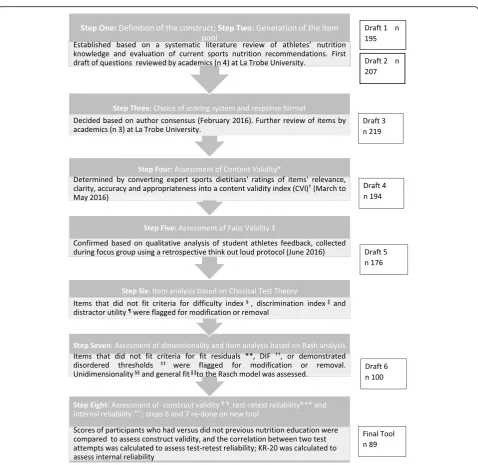
A novel eight-step validation method for the develop-ment of a nutrition knowledge questionnaire was de-signed based on an extensive review of the literature and used to validate this questionnaire [35]. The steps in-clude: (1) Definition of Sports Nutrition Knowledge (2) Generation of items to represent sports nutrition know-ledge (3) Choice of scoring system (4) Assessment of content validity by panel of experts (5) Assessment of
face validity by student athletes (6) CTT analysis: Re-moval of items on the basis of item difficulty, item dis-crimination and distractor utility (7) Rasch analysis: Assessment of dimensionality and removal of item on the basis of not meeting assumptions that difficult ques-tions are less likely to be answered correctly, and well-scoring participants are more likely to answer individual items correctly (8) Assessment of construct validity by comparing nutrition and non-nutrition students; assess-ment of test-retest reliability (consistency over time) by assessing correlation of test on two attempts; and re-checking of steps six and seven. The steps that make this methodology novel are the quantitative assessment of content validity, the assessment of distractor utility (how feasible incorrect multiple choice options are) and the inclusion of Rasch analysis.
Figure 1 provides a summary of the methods and results.
Recruitment
Experts (step four) were recruited using purposive sam-pling between April and May 2016 and student-athletes (step five) were recruited using convenience sampling in June 2016. For steps six and seven, Australian Football League (AFL) Victoria community football players, La Trobe University student-athletes and other recreational athletes were invited to complete the questionnaire via email, Facebook groups, and online athlete forums. Data collection occurred between July 2016 and October 2016. For step eight, La Trobe University undergraduate and postgraduate business, health science and nutrition students were recruited via email and their Learning Management System (LMS) notice boards and recre-ational athletes were invited to participate via email and their team Facebook pages. Data collection took place from November 2016 until January 2017.
Sample size calculations
Statistical analysis
Missing values were assessed for normality using Kolmogorov-Smirnov statistic and compared across par-ticipant characteristics using independent t-test and
ANOVA or Mann–Whitney and Kruskal-Walis, as
appropriate (see Additional file 1: Supplementary Material S1). Total and sub-section scores were assessed for nor-mality using Kolmogorov-Smirnov statistic. Parametric tests (independent t-test; ANOVA) were used for normal data. Where assumptions of normality were violated,
non-parametric tests (Mann–Whitney U test; Kruskal-Wallis) were used. Normal results were reported as mean ± SD, non-normal results were reported as median and IQR. For correlations, Pearson’s r was used for para-metric data, and Spearman’s r was used for non-parametric data. Individuals with and without nutrition education were compared across participant characteris-tics using chi-square test, to account for potential con-founding. Differences in scores based on age, gender, country of birth, level of education, and history of play-ing sports were also assessed.
Results
Participants
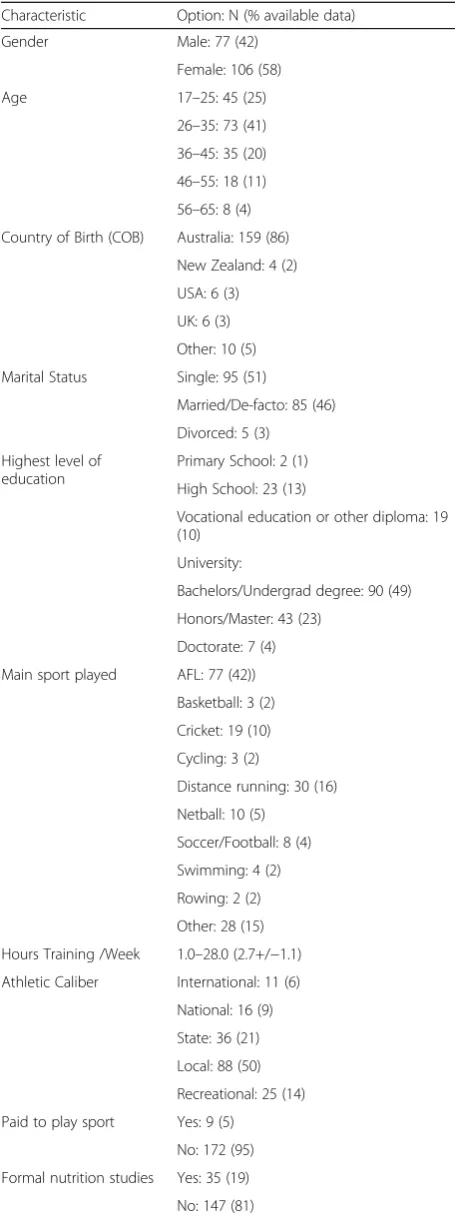
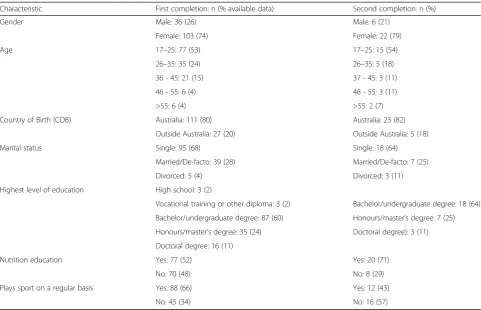
Ten experts were invited to be involved in the content validity assessment. Six sports dietitians agreed to par-ticipate and three of these returned feedback forms; two respondents were Australian and the other was Swiss. They worked in private consultancy, research and educa-tion, and industry. Eight students participated in the retrospective think-out-loud focus group. One student who was unable to attend the session met with the re-searcher on a separate occasion. For the item analysis based on CTT and Rasch scaling (steps six and seven), 462 athletes started the questionnaire; after excluding data with more than 11% missing values (n = 259) and participants who did not meet the eligibility criteria for age (n= 15) there were 188 usable responses (Table 1). For the assessment of construct validity, test-retest reli-ability and re-evaluation of CTT and Rasch parameters (step eight), 287 students and athletes started the ques-tionnaire and there were 181 usable responses, including 28 responses from individuals who had completed the questionnaire on two occasions (Table 2).
There did not appear to be any differences between indi-viduals who completed and did not complete the question-naire (See Additional file 1: Supplementary Material S2).
Individuals who studied nutrition were more likely to be female, have a tertiary education and were younger (See Additional file 1: Supplementary Material S3).
The final questionnaire
Sports nutrition knowledge was defined as “Knowledge of concepts and processes related to nutrition for optimal athletic performance including knowledge of weight man-agement; hydration and fuelling strategies for before, dur-ing and after traindur-ing/performance; supplementation and alcohol use”. The original test plan (see Additional file 1: Supplementary Material S3) follows logically from this. Each correct answer was awarded a point. The final questionnaire had 89 items and six unidimensional sub-sections; weight management (n = 13); macronutrients (n = 30); micronutrients (n = 13); sports nutrition (n= 13); supplements (n= 12) and alcohol (n= 8). The
sports nutrition section covers hydration, the pre-completion meal, nutrition during exercise and recovery nutrition. The item response formats include agree/dis-agree/not sure, multiple choice, and effective/not effect-ive/not sure. The questionnaire is designed to be administered online and includes pictures to reduce re-sponder fatigue. The number of items at each stage of validation is represented in Fig. 1.
Validity
The experts reported that the questionnaire covered all relevant topics and therefore content validity was con-firmed (step four). Most items that were rated poorly for accuracy, relevance, appropriateness and clarity were re-moved (n = 25) although some exceptions were made. The number of items that did not meet the CVI and examples of changes made based on expert’s feedback are included as Additional file 1: Supplementary Material S4.
Student athletes were able to identify what each section was attempting to capture. Where there were issues with wording of questions, items were removed (n = 17) or modified (n= 16), so face validity was confirmed (step five). Examples of changes made based on students’feedback are included as Additional file 1: Supplementary Material S5.
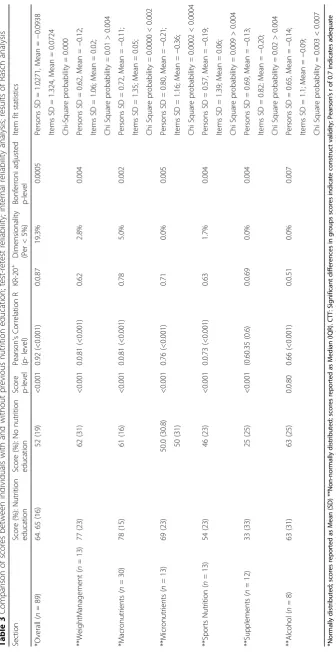
Construct validity was demonstrated (step eight) be-cause there was a significant difference in the total scores for those who had nutrition education and those who did not have nutrition education (P< 0.001) (Table 3). Individuals with nutrition education also scored better across all sub-sections except alcohol (Table 3). No other participant characteristics were found to have a significant effect on scores (See Additional file 1: Supplementary Material S6).
Internal reliability of sub-sections ranged from 0.51 to 0.78 (Table 3). All sections except alcohol achieved or approached adequate values for internal reliability given the number of items in each sub-section. Test test re-liability ranged from 0.35 to 0.81; all sections except sup-plementation achieved or approached adequate values for test-retest reliability (Table 3).
Item analysis based on CTT
Item analysis using CTT was carried out at steps 7 and 8. Most items that did not meet the criteria for item dif-ficulty, item discrimination and distractor utility were re-moved or modified, although some exceptions were made, and the final tool included 15 items that did not meet these criteria. Examples of changes made on the basis of item analysis are included as Additional file 1: Supplementary Materials S7 and S8.
Fit to the rash model
was multidimensional. Eleven items were removed be-cause they were shown to be poor discriminators and/or were answered differently (demonstrated DIF) on the basis of age or gender. With these items removed, the questionnaire as a whole was still mutli-dimensional, but the six sub-sections were shown to be unidimensional (Table 3). Each sub-section also had an adequate mean, SD for the overall item/trait interaction statistics, mean-ing that the expectation that difficult items were more likely to be answered incorrectly and well scoring partic-ipants were more likely to answer questions correctly was met. The chi-square probability for macronutrients, micronutrients and alcohol was significant (Table 3); this occurred because some items that did not meet the Rasch indicator requirements were kept because they were deemed important to assess in an SNKQ.
Discussion
The questionnaire
Due to the limitations with existing SNKQs, researchers have raised concerns regarding the accuracy of previous reports of athletes’nutrition knowledge, and have postu-lated that the relationship between nutrition knowledge and dietary intake may have been misjudged [8, 14, 41, 42]. The aim of this study was to create an SNKQ that tested awareness of current consensus recommenda-tions, was adequately validated and could be used with athletes from a range of sports. The newly developed tool, the Nutrition for Sport Knowledge Questionnaire
(NSKQ), has 89 individual items (44 questions, with some having multiple parts) covering six distinct subsec-tions The questionnaire takes around 25 min to complete and is comparable in length to the GNKQ [40], which has 113 items and the SNKQ developed by Zinn et al. [43], which has 88 items. Since the questions are based on consensus guidelines, several items assess theoretical knowledge. Questions that assess practical knowledge have also been included. The tool is more comprehensive than existing measures as it includes an alcohol sub-section and adheres to a detailed test plan. The questions are based on current guidelines. For ex-ample, rather than ask about carbohydrate requirements as % total calorie intake, we have included a question on requirements in g/kg/day and specified the type (‘ endur-ance’) and intensity (‘moderate to high’) of activity. Table 1Characteristics of participants included in the first item
analysis using CTT and Rasch analysis (n= 188) Characteristic Option: N (% available data)
Gender Male: 77 (42)
Female: 106 (58)
Age 17–25: 45 (25)
26–35: 73 (41)
36–45: 35 (20)
46–55: 18 (11)
56–65: 8 (4)
Country of Birth (COB) Australia: 159 (86)
New Zealand: 4 (2)
USA: 6 (3)
UK: 6 (3)
Other: 10 (5)
Marital Status Single: 95 (51)
Married/De-facto: 85 (46)
Divorced: 5 (3)
Highest level of education
Primary School: 2 (1)
High School: 23 (13)
Vocational education or other diploma: 19 (10)
University:
Bachelors/Undergrad degree: 90 (49)
Honors/Master: 43 (23)
Doctorate: 7 (4)
Main sport played AFL: 77 (42))
Basketball: 3 (2)
Cricket: 19 (10)
Cycling: 3 (2)
Distance running: 30 (16)
Netball: 10 (5)
Soccer/Football: 8 (4)
Swimming: 4 (2)
Rowing: 2 (2)
Other: 28 (15)
Hours Training /Week 1.0–28.0 (2.7+/−1.1)
Athletic Caliber International: 11 (6)
National: 16 (9)
State: 36 (21)
Local: 88 (50)
Recreational: 25 (14)
Paid to play sport Yes: 9 (5)
No: 172 (95)
Formal nutrition studies Yes: 35 (19)
No: 147 (81)
Table 1Characteristics of participants included in the first item
analysis using CTT and Rasch analysis (n= 188)(Continued)
Advice to change diet Yes: 91 (49)
No: 96 (51)
Likewise, in contrast to other existing tools, our hydra-tion queshydra-tion reflects findings that using thirst to judge fluid needs can maximise performance and current rec-ommendations that hydration plans should be tailored to the individual [31, 44]. Moreover, questions on the timing of the pre-completion meal and recovery snack have intentionally been omitted. It is too difficult to as-sess the correct answer to these questions given the in-creasing evidence to support the positive benefits of periodizing nutrition based on the goals of individual sessions and overall training schedule [4, 28].
Validity and reliability
The questionnaire has demonstrated face and content validity based on student-athletes and sports dietitians’ judgements. In contrast to previous tools, the content validity has been assessed quantitatively, using a CVI [36]. Individuals who reported undertaking studies in human nutrition achieved higher scores across all sec-tions, except alcohol, indicating that the questionnaire has good construct validity. The group with a nutrition education were younger and were more likely to be fe-male and tertiary educated. In contrast to previous re-ports, there was no significant difference in performance
based on age or gender [41, 40]. Therefore, the varia-tions in knowledge between groups are unlikely to be due to underlying differences in participant characteris-tics. Test-retest reliability was assessed based on the correlation between individuals’(who repeated the ques-tionnaire) test scores. A limitation of this method is that motivated individuals may upskill between attempts. The average total score was higher for attempt two. Nevertheless, overall test-retest reliability was high, and all sub-sections, except ‘supplements’, achieved (or approached) adequate test-retest reliability. Participants performed most poorly on the supplement section. Therefore, it is feasible that the supplement test-retest result occurred due to participants guessing answers. The overall internal reliability was very high, and the in-ternal reliability of most sub-sections (except alcohol) reached or approached the requisite 0.7 value. As ex-pected, there appeared to be a relationship between the number of items and KR-20. Streiner [18] recommends that KR-20 be interpreted with caution if there are more than 20 items; the overall scale and macronutrient sub-section exceeded this value.
Based on the Rasch analysis, the overall Item/person interaction statistics were adequate, indicating compliance Table 2Characteristics of participants included in Study Two analysis (n= 181)
Characteristic First completion: n (% available data) Second completion: n (%)
Gender Male: 36 (26) Male: 6 (21)
Female: 103 (74) Female: 22 (79)
Age 17–25: 77 (53) 17–25: 15 (54)
26–35: 35 (24) 26–35: 5 (18)
36 - 45: 21 (15) 37 - 45: 3 (11)
46 - 55: 6 (4) 46 - 55: 3 (11)
>55: 6 (4) >55: 2 (7)
Country of Birth (COB) Australia: 111 (80) Australia: 23 (82)
Outside Australia: 27 (20) Outside Australia: 5 (18)
Marital status Single: 95 (68) Single: 18 (64)
Married/De-facto: 39 (28) Married/De-facto: 7 (25)
Divorced: 5 (4) Divorced: 3 (11)
Highest level of education High school: 3 (2)
Vocational training or other diploma: 3 (2) Bachelor/undergraduate degree: 18 (64)
Bachelor/undergraduate degree: 87 (60) Honours/master’s degree: 7 (25)
Honours/master’s degree: 35 (24) Doctoral degree): 3 (11)
Doctoral degree: 16 (11)
Nutrition education Yes: 77 (52) Yes: 20 (71)
No: 70 (48) No: 8 (29)
Plays sport on a regular basis Yes: 88 (66) Yes: 12 (43)
No: 45 (34) No: 16 (57)
with the expectations that difficult questions were less likely to be answered correctly, and individuals who per-formed well overall were more likely to answer individual questions correctly. The questionnaire as a whole was multi-dimensional, but with problematic items removed, each section was shown to be unidimensional. Therefore, sections can be used independently, as required. Where the whole tool is used, sub-sections rather than total score should be reported.
All items were written so that units and food names were generic and likely to be understood by individuals of varying cultural backgrounds; however, additional evaluation is required to confirm the functionality of the tool in groups who differ from the present cohort. The fact that country of birth did not influence scores, and the use of Rasch analysis, which produces questionnaires that are independent of the sample used for validation, give some indication that the tool is likely to also be valid in other groups.
Limitations
A limitation of this study is that we were unable to cal-culate response rates because we distributed the ques-tionnaire using Facebook groups and online athlete forums, making total exposure unclear. The completion rates for step 7 (where item analysis and Rasch analysis was undertaken) were relatively low (~45%), but there did not appear to be any relationship between partici-pant characteristics (other than sport played, country of birth) and completion rate (S2). The completion rate for step eight (~66%) was adequate [45]. The sample size is another potential limitation. For step seven, there were 188 responses for a 176 item measure; for step eight, there were 181 responses for a 100 item measure. The target sample size for both studies was 200. However, there is some evidence to recommend that samples as small as 30–50 are appropriate for CTT [46]. Similarly, Chen et al. [47] modelled Rasch with varying sample sizes and found that stable results can be achieved with samples of around 100.
A limitation of the questionnaire itself is that the length may be prohibitive, especially for athletes balan-cing training and work/study who are often time-poor. In addition, some items were poor discriminators. This was reflected by low item discrimination in CTT and the significant chi-square probability of the micronutrient, macronutrient and alcohol sections. For several ques-tions, the poor item discrimination can be explained by the item’s relatively high or low difficulty index. That is, when a question is answered correctly (or incorrectly) by a large proportion of individuals, the overall range of re-sponses is minimal, and therefore it is hard to achieve a meaningful difference between high and low scoring in-dividuals. Many of these items were kept because they
tested important concepts, providing valuable feedback on gaps in knowledge. Item discrimination is worth re-evaluating using larger samples of predominantly ath-letes (not including nutrition students). Likewise, future studies may focus on creating a short-form tool that can be used for rapid assessment of nutrition knowledge. A short-form tool would be useful in research settings where the correlation between knowledge and other fac-tors is being assessed. A short-form tool may also have utility in the elite setting as a‘screening’tool for profes-sionals working with athletes, i.e. to identify individuals who need nutrition education and extra support.
At present the NSKQ has only been validated in an Australian population. Future studies could focus on val-idation to confirm reliability and validity in other regions.
Strengths
A key advantage of the questionnaire is that it has been validated using a robust methodology. To our know-ledge, this is one of very few NKQ to be assessed against the Rasch Model. Likewise, it is the only tool to assess content validity qualitatively and to assess distractor util-ity - a distractor that is too obviously wrong will signifi-cantly increase the chances of respondents guessing a correct answer; this type of analysis is valuable. Import-antly, the authors have considered the limitations of the statistics and accordingly made decisions that focused on the quality of the overall tool. In addition, the ques-tions (and their correct answers) are based on the most recent evidence and recommendations with regards to sports nutrition; they are generalizable to most sports and enable comparison across disciplines. The tool uses food terms and measurement units that are likely to be understood by athletes from a range of countries. More-over, the tool is detailed and therefore can assess gaps in knowledge. The NSKQ has been designed to be adminis-tered online and can provide participants with immediate feedback with regards to correct answers to questions. This is likely to be especially helpful for athletes who do not have access to professional support. The online format provides unique opportunity to direct participants to rep-utable and relevant resources based on their outcomes.
Conclusions
target their education based on gaps in athletes’ know-ledge. In a team sports setting, the NSKQ may also be useful as a screening tool, to identify players who require additional educational support. Widespread utilisation of the tool in the long-term will allow for more accurate evaluation of nutrition knowledge, education programs and comparisons across athletes of varying genders, ages, education levels, and calibres.
Additional file
Additional file 1: Supplementary Material S1.Methods used for missing variables analysis. In the original design, the demographic questions were asked last; therefore, it was not possible to complete a full assessment of factors that led participants to drop-out. Using available data, missing values (%) were compared across several participant characteristics. The continuous variables age, hours training per week, years playing sport, and country of birth were transformed into categorical variables. Country of birth was transformed into a dichotomous variable (Born in Australia/Not Born in Australia). The dependent variable, missing data, was assessed for normality using the Kolmogorov-Smirnov statistic. Assumptions of normality were violated (Statistic 0.245, df 462,p< 0.001). Therefore non-parametric tests were used; Mann-Whitney was used dichotomous variables (gender [male/ female], being born in Australia [yes/no], being paid to play sport [yes/no], previously having undertaken nutrition studies [yes/no], previously having been given advice to change diet [yes/no]) and Kruskal-Wallis was used for categorical variables with three or more response options (sport played, highest level of education, highest level sport played, years playing sport, hours training).Supplementary Material S2.Relationship between missing values (%) and participant characteristics.Supplementary Material S3.
Original‘Universal Sports Nutrition Knowledge Questionnaire’test plan.
Supplementary Material S4.Summary of items that did not meet the
requisite 0.3 value for CVI.Supplementary Material S5.Examples of changes made to the questionnaire based on the student athletes’ feedback.Supplementary Material S6.Comparison of scores across participant demographics at step 8.Supplementary Material S7.Examples of changes made based on item analysis using classical test theory at step
7.Supplementary Material S8.Examples of changes made to questionnaire
based on CTT and Rasch re-analysis (step 8). (DOCX 36 kb)
Abbreviations
NKQ:Nutrition knowledge questionnaire; SNKQ: Sports nutrition knowledge questionnaire
Acknowledgements
We would like to thank all the participants who were involved in the various stages of the study. A special thanks to the Sports Dietitians who took part in the expert panel review, and to Dr. Brooke Lea Devlin, who contributed to an internal review of an early version of the questionnaire.
Funding
This work was supported by an Australian Government Research Training Program Scholarship (GT).
Availability of data and materials
The data used/and or analyses during the current study are available from the corresponding author on reasonable request. The final version of the UNSQ is available from the corresponding author.
Authors contributions
GT designed the study, drafted the first version of the questionnaire, undertook all data analysis, wrote the majority of the manuscript and oversaw the manuscript preparation. AF assisted with the study design, decision making regarding modifications to the questionnaire, and manuscript preparation. RH assisted with the study design and manuscript preparation. RB is the Chief Investigator of the study, assisted with the study design, decision making regarding modifications to the questionnaire, and manuscript preparation. All authors read and approved the final manuscript.
Ethics approval and consent to participate
The research was approved (S16/267) by the La Trobe University’s SHE College Human Ethics Sub-Committee (SHE CHESC). Participants in the expert panel review and think-out-loud focus groups read the Participant Information Statement and signed the Consent Form. Participants who were involved insteps six to eight read the Participant Information Statement and provided consent electronically.
Consent for publication
No individual’s data has been collected or reported.
Competing interests
The authors declare that they have no competing interests.
Publisher’s Note
Springer Nature remains neutral with regard to jurisdictional claims in published maps and institutional affiliations.
Author details 1
Department of Rehabilitation, Nutrition and Sport, School of Allied Health, College of Science, Health and Engineering, La Trobe University, Melbourne 3086, Australia.2Department of Management and Marketing, La Trobe Business School, College of Arts, Social Sciences and Commerce, La Trobe University, Melbourne 3086, Australia.3Department of Health Professions, School of Health Sciences, Faculty of Health, Arts and Design, Swinburne University of Technology, Hawthorn 3122, Australia.
Received: 16 February 2017 Accepted: 27 July 2017
References
1. Rodriguez NR, DiMarco NM, Langley S. Position of the American dietetic association, dietitians of Canada, and the American college of sports medicine: nutrition and athletic performance. J Am Diet Assoc. 2009;3:509–27. 2. Kreider RB, Wilborn CD, Taylor L, Campbell B, Almada AL, Collins R, Cooke
M, Earnest CP, Greenwood M, Kalman DS, et al. ISSN exercise & sport nutrition review: research & recommendations. J Int Soc Sports Nutr. 2010; doi:10.1186/1550-2783-7-7.
3. Spronk I, Heaney SE, Prvan T, O'Connor HT. Relationship between general nutrition knowledge and dietary quality in elite athletes. Int J Sport Nutr Exerc Metab. 2015;3:243–51.
4. Heikura IA, Stellingwerff T, Mero AA, Uusitalo ALT, Burke LM. A mismatch between athlete practice and current sports nutrition guidelines among elite female and male middle-and long-distance athletes. Int J Sport Nutr Exerc Metab. 2017;4:351–60.
5. Kunkel ME, Bell LB, Luccia BHD. Gem no. 330. Peer nutrition education program to improve nutrition knowledge of female collegiate athletes. J Nutr Educ. 2001;2:114–5.
6. Collison SB, Kuczmarski MF, Vickery CE. Impact of nutrition education on female athletes. Am J Health Behav. 1996;1:14–23.
7. Cholewa JM, Landreth A, Beam S, Jones T, MacDonald CJ. The effects of a sports nutrition education intervention on nutritional status, sport nutrition knowledge, body composition, and performance in NCAA division I baseball players. J Int Soc Sports Nutr. 2015. doi:10.1186/1550-2783-12-S1-P44.
8. Spronk I, Kullen C, Burdon C, O'Connor H. Relationship between nutrition knowledge and dietary intake. Br J Nutr. 2014;10:1713–26.
9. Alaunyte I, Perry JL, Aubrey T. Nutritional knowledge and eating habits of professional rugby league players: does knowledge translate into practice? J Int Soc Sports Nutr. 2015;12:18.
10. Clark KS. Sports nutrition counseling: documentation of performance. Top Clin Nutr. 1999;2:34–40.
11. Parks RB, Helwig D, Dettmann J, Taggart T, Woodruff B, Horsfall K, Brooks MA. Developing a performance nutrition curriculum for collegiate athletics. J Nutr Educ Behav. 2016;6:419–24.
13. Andrews MC, Itsiopoulos C. Room for improvement in nutrition knowledge and dietary intake of male football (soccer) players in Australia. Int J Sport Nutr Exerc Metab. 2016;1:55–64.
14. Trakman G, Forsyth A, Devlin B, Belski R. A systematic review of athletes’ and coaches’nutrition knowledge and reflections on the quality of current nutrition knowledge measures. Nutr. 2016. doi:10.3390/nu8090570. 15. Heaney S, O’Connor H, Michael S, Gifford J, Naughton G. Nutrition
knowledge in athletes: a systematic review. Int J Sport Nutr Exerc Metab. 2011;21:248–61.
16. Furber MJW, Roberts JD, Roberts MG. A valid and reliable nutrition knowledge questionnaire for track and field athletes. BMC Nutr. 2017. doi:10.1186/s40795-017-0156-0.
17. Petrillo J, Cano SJ, McLeod LD, Coon CD. Using classical test theory, item response theory, and Rasch measurement theory to evaluate patient-reported outcome measures: a comparison of worked examples. Value Health. 2015;1:25–34.
18. Streiner DL. Starting at the beginning: an introduction to coefficient alpha and internal consistency. J Pers Assess. 2003;1:99–103.
19. Lambert SD, Pallant JF, Boyes AW, King MT, Britton B, Girgis A. A Rasch analysis of the Hospital Anxiety and Depression Scale (HADS) among cancer survivors. US: Am Psychol Assoc. 2013;25:379–90.
20. Tennant A, Conaghan PG. The Rasch measurement model in rheumatology: what is it and why use it? When should it be applied, and what should one look for in a Rasch paper? Arthritis Care Res (Hoboken). 2007;8:1358–62. 21. Mötteli S, Barbey J, Keller C, Bucher T, Siegrist M. Measuring practical
knowledge about balanced meals: development and validation of the brief PKB-7 scale. Eur J Clin Nutr. 2015. doi:10.1038/ejcn.2015.173.
22. Mötteli S, Barbey J, Keller C, Bucher T, Siegrist M. Measuring practical knowledge about balanced meals: development and validation of the brief PKB-7 scale| NOVA. Univ Newcastle Digit Repository. 2016. doi:10.1038/ejcn. 2015.173.
23. Pallant J. Scale development, Rasch analysis and item response theory. Melbourne Australian consortium for Social & Political Research inc (ACSPRI). Melbourne: ACCPRI; 2016.
24. Potgieter S. Sport nutrition: a review of the latest guidelines for exercise and sport nutrition from the American College of Sport Nutrition, the International Olympic Committee and the International Society for Sports Nutrition. South Afr J Clin Nutr. 2013;1:6–16.
25. Buford TW, Kreider RB, Stout JR, Greenwood M, Campbell B, Spano M, Ziegenfuss T, Lopez H, Landis J, Antonio J. International Society of Sports Nutrition position stand: creatine supplementation and exercise. J Int Soc Sports Nutr. 2007. doi:0.1186/1550-2783-4-6.
26. Goldstein ER, Ziegenfuss T, Kalman D, Kreider R, Campbell B, Wilborn C, Taylor L, Willoughby D, Stout J, Graves BS, Wildman R, Ivy JL, Spano M, Smith AE, Antonio J. International society of sports nutrition position stand: caffeine and performance. J Int Soc Sports Nutr. 2010. doi:10.1186/1550-2783-7-5. 27. International Olympic Comitte. IOC consensus statement on sports nutrition
2010. Int J Sport Nutr Exerc Metab. 2010;1003:552.
28. Burke LM, Hawley JA, Wong SH, Jeukendrup AE. Carbohydrates for training and competition. J Sports Sci. 2011;29(sup1):S17–27.
29. Loucks AB, Kiens B, Wright HH. Energy availability in athletes. J Sports Sci. 2011;29(sup1):S7–S15.
30. Phillips SM, Van Loon LJ. Dietary protein for athletes: from requirements to optimum adaptation. J Sports Sci. 2011;29(sup1):S29–38.
31. Shirreffs SM, Sawka MN. Fluid and electrolyte needs for training, competition, and recovery. J Sports Sci. 2011;29(sup1):S39–46. 32. Slater G, Phillips SM. Nutrition guidelines for strength sports: sprinting,
weightlifting, throwing events, and bodybuilding. J Sports Sci. 2011; 29(sup1):S67–77.
33. Sundgot-Borgen J, Garthe I. Elite athletes in aesthetic and Olympic weight-class sports and the challenge of body weight and body compositions. J Sports Sci. 2011;29(sup1):S101–14.
34. Maughan R, Greenhaff P, Hespel P. Dietary supplements for athletes: emerging trends and recurring themes. J Sports Sci. 2011;29(sup1):S57–66. 35. Trakman GT, Forsyth A, Hoye R, Belski R. Developing and validating a
nutrition knowledge questionnaire: Key methods and considerations. Public Health Nutr. 2017. doi:10.1017/S1368980017001471.
36. Polit DF, Beck CT, Owen SV. Is the CVI an acceptable indicator of content validity? Appraisal and recommendations. Res Nurs Health. 2007;4:459–67. 37. Krueger RA, Casey MA. Focus groups: a practical guide for applied research.
New York: Sage publications; 2014.
38. Parmenter K, Wardle J. Evaluation and design of nutrition knowledge measures. J Nutr Educ. 2000;5:269–77.
39. Faul F, Erdfelder E, Lang A-G, Buchner A. G* power 3: a flexible statistical power analysis program for the social, behavioral, and biomedical sciences. Behav Res Methods. 2007;2:175–91.
40. Parmenter K, Wardle J. Development of a general nutrition knowledge questionnaire for adults. Eur J Clin Nutr. 1999;4:298–308.
41. Heaney S, O’Connor H, Michael S, Gifford J, Naughton G. Nutrition knowledge in athletes: a systematic review. Int J Sport Nutr Exerc Metab. 2011;3:248–61.
42. Spendlove JK, Heaney SE, Gifford JA, Prvan T, Denyer GS, O'Connor HT. Evaluation of general nutrition knowledge in elite Australian athletes. Br J Nutr. 2012;12:1871–80.
43. Zinn C, Schofield G, Wall C. Development of a psychometrically valid and reliable sports nutrition knowledge questionnaire. J Sci Med Sport. 2005;3: 346–51.
44. Goulet ED. Effect of exercise-induced dehydration on time-trial exercise performance: a meta-analysis. Br J Sports Med. 2011; doi:10.1136/bjsm.2010. 077966.
45. Fincham JE. Response rates and responsiveness for surveys, standards, and the journal. Am J Pharm Educ. 2008. doi:0.5688/aj720243
46. Cappelleri JC, Lundy JJ, Hays RD. Overview of classical test theory and item response theory for quantitative assessment of items in developing patient-reported outcome measures. Clin Ther. 2014;5:648–62.
47. Chen W-H, Lenderking W, Jin Y, Wyrwich KW, Gelhorn H, Revicki DA. Is Rasch model analysis applicable in small sample size pilot studies for assessing item characteristics? An example using PROMIS pain behavior item bank data. Qual Life Res. 2014;2:485–93.
• We accept pre-submission inquiries
• Our selector tool helps you to find the most relevant journal • We provide round the clock customer support
• Convenient online submission • Thorough peer review
• Inclusion in PubMed and all major indexing services • Maximum visibility for your research
Submit your manuscript at www.biomedcentral.com/submit