Available Online at www.ijpret.com 13
INTERNATIONAL JOURNAL OF PURE AND
APPLIED RESEARCH IN ENGINEERING AND
TECHNOLOGY
A PATH FOR HORIZING YOUR INNOVATIVE WORKANALYSIS AND SIMULATION OF EFFICIENT ENERGY BUILDING DESIGN USING
ENERGY PLUS
MD ZEYAUL MUSTAFA KHAN, D. BUDDHI
Centre of Excellence-Renewable and Sustainable Energy Studies, Suresh Gyan Vihar University, Jaipur, India-302025
Accepted Date: 24/04/2018; Published Date: 01/05/2018
\
Abstract: - With the expanding interest in energy-efficient building design, whole building
energy simulation programs are increasingly employed in the design process to help architects and engineers determine which design strategies of energy modelling through the Energy Plus to save energy and to create cost-effective building models. The purpose of this research was to investigate the potential of building material and compliance system effectiveness with tools such as AutoCAD, Design Builder and Energy Plus. Whole building energy simulation programs to building model are used for analysis and to compare the results with the both case of Energy Plus building HTML output data. Actual building energy performance and proposed case data are properly analyze for better building energy performance and their Energy Performance Index (EPI). The research of this work is conducted on the government healthcare fully functional building using different tools and Energy conservation building code of 2017. Simulation results indicate the heigher EPI of the proposed case building of the model with respect to actual design of base case model. It is crucial to understand the limitations of different tools in order to achieve successful integrate building performance analysis in early stages of the design process, as well as capabilities of different software programs and their optimization results.
Keywords: Energy Plus, Design
Corresponding Author: MD ZEYAUL MUSTAFA KHAN Access Online On:
www.ijpret.com
How to Cite This Article:
MD Zeyaul Mustafa Khan, IJPRET, 2018; Volume 6 (9): 13-39
Available Online at www.ijpret.com 14
INTRODUCTION
With the increasing demand for more energy-efficient buildings, the constructions industry are faced with the challenge to ensure that the energy performance predicted during design is achieved once a building is in use. Energy simulation tools are increasingly used for analysis of better energy performance of buildings. Next stage of the research is to also compare more robust simulation programs that are applicable for later stages of the design process, such as Design Builder and Energy Plus, which was included in this paper. The intent is also to inform designers and engineers about potential for integrating simulation programs with the design, which would yield accurate predictions to the building performance. This is an essential aspect in design of high-performance buildings and improving the design decision-making process (Given the significant variety of such simulation tools, it is crucial to understand limitations of the complexity of simulations. This project seeks to address the operational performance gap and optimize building performance by identifying inconsistencies in building operation. This is achieved through the combined use of a calibrated simulation model output data and the implementation of a breakout through ECBC code 2017 based on building classification data. A number of alternative breakout detection algorithms are reviewed in comparison to the chosen technique in this paper.Prior to conducting this research, our objective was to find the efficient and beneficial method of seamlessly integrating WBPM into the design process.
The objectives of the present project are:
To compare the results of simulations with measured utility data and identify discrepancies.
To model a building similarly in all the software programs by closely mapping the input parameters.
Reduction in life cycle cost of building operation and Performance enhanced due to better material and efficient equipment.
Increase in EPI of the building and reduction in annual energy consumption.
ECBC- Energy Conservation Building Code (ECBC 2017) is for commercial buildings. “Building”
Available Online at www.ijpret.com 15
Ampere (kVA) and above and is used or intended to be used for commercial purposes; Section 14 (p): prescribe energy conservation building codes for efficient use of energy and its conservation in the building or building complex.
Purpose-To provides minimum requirements for the energy-efficient design and
construction of buildings.
Scope- Applicable to large commercial buildings having (connected load of 100 kW/contract
demand of 120 kVA and above)
New Buildings with- connected load of excess of 100 kW/120 kVA
Energy Performance Index (EPI):
EPI of a building means its annual energy consumption in kilowatt-hours per square meter of the area of the building, which was calculated in the existing or proposed building as per the formula below.
EPI = Annual energy consumption in kilowatt−hours per square meter 𝐴𝑟𝑒𝑎 𝑜𝑓 𝑡ℎ𝑒 𝐵𝑢𝑖𝑙𝑑𝑖𝑛𝑔
SIMULATION SOFTWARE:
Design Builder- Design Builder (Version 5.7.0) workflow is the help window that provides tips
and wizards guiding the user through the creation of the thermal model. This is especially useful to novice users, as it helps them to better understand the concepts of thermal modeling. This building geometry represents the definition of geometry needed for the simulation of the building’s thermal performance. Additionally, one can import DXF files as footprints for the creation of the geometric model as described.
Energy Plus- Energy Plus (Version 8.7.0) uses the best features of the two energy simulation
Available Online at www.ijpret.com 16
MODELING METHODOLOGY Case Study Model Description
The case study of Healthcare building that is used for the study of thermal behavior of Theog, Hospital building, located in Shimla (H.P) of the “Cold climate condition”. The drawings of the site, floor plans of the space, section and envelope details was provided by architectural wing of Himachal Pradesh Public Works Department (HPPWD) for developing thermal model. HPPWD Electrical wing has given details of proposed design for lighting fixtures, HVAC, & Renewable system etc.
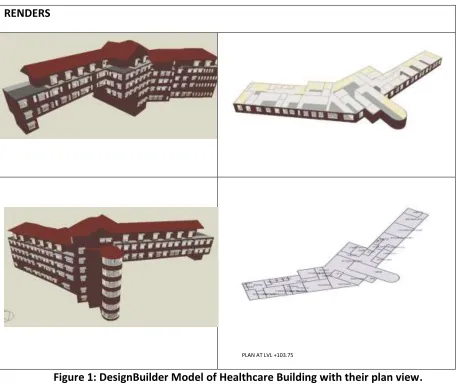
The geometry of the site led to a narrow and hilly topology building design oriented roughly north and south, Designbuilder model with their render images and plan view has shown in below figures.
RENDERS
Available Online at www.ijpret.com 17
A building "surface" is the fundamental element in the building model. In the general sense, there are two types of "surfaces" in EnergyPlus. These are:
1. Heat transfer surfaces
2. Heat storage surfaces
Any surface, which is expected to separate spaces of significantly different temperatures, is defined as a heat transfer surface. Thus, exterior surfaces, such as outside walls, roofs and floors, are heat transfer surfaces. Interior surfaces (partitions) are heat storage surfaces if they separate spaces maintained at the same temperature. The same methodology was applied for zoning while going through the floor plans. Briefly, the models, both proposed and baseline comprise of 121 zones, simplified to enhance speed of the EnergyPlus runtime. One such simplification is to use room multipliers. The average baseline performance for four different orientations was computed using the tools provided in EnergyPlus.
Space Description
Determination of interior lighting power allowance (watts) by the building area method shall be in accordance and illustrated in Table 4.1 and 4.2 of below tables.
Table-1:- Space Description of Healthcare DesignBuilder Model
Area
[m2]
Conditione d (Y/N)
Window Glass Area [m2]
Lighting [W/m2]
People [m2
per person]
Plug and
Process [W/m2] LVLX89.35:ENTRANCEL
OBBY
119.3 7
Yes 0 9.7 10 10
LVLX89.35:RAMP 68.8 No 0 9.7 10 10
LVLX89.35:LIFT1 12.42 No 0 9.7 10 10
LVLX89.35:LIFT2 9.7 No 0 9.7 10 10
LVLX89.35:STAIRCASE 26.37 No 0 9.7 10 10
LVLX92.65:CENTRALHE ATINGROOM
151.4 4
No 19.76 9.7 10 10
LVLX92.65:KITCHEN 31.1 No 4.1 9.7 10 10
LVLX92.65:CORRIDOR 85.69 Yes 12.36 9.7 10 10
LVLX92.65:LIFT2 9.72 No 0 9.7 10 10
LVLX92.65:RAMP 94.99 No 0 9.7 10 10
LVLX92.65:ENTRANCEL OBBY
94.07 Yes 6.95 9.7 10 10
LVLX92.65:LIFT1 13.06 No 0 9.7 10 10
Available Online at www.ijpret.com 18
LVLX92.65:STAIRCASE 27.91 No 2.31 9.7 10 10
LVLX92.65:TOILET 5.02 No 0.76 9.7 10 10
LVLX92.65:WASH 5.05 No 0 9.7 10 10
LVLX92.65:LAUNDARY 27.79 No 4.02 9.7 10 10
LVLX92.65:STORE 17.92 No 2.03 9.7 10 10
LVLX97.15:LIFT1 13.06 No 0 9.7 10 10
LVLX97.15:ENTRANCEL OBBY
94.46 Yes 6.89 9.7 10 10
LVLX97.15:SUNROOM 39.49 Yes 9.44 9.7 10 10
LVLX97.15:STAIRCASE 27.91 No 2.31 9.7 10 10
Area
[m2]
Conditione d (Y/N)
Window Glass Area [m2]
Lighting [W/m2]
People [m2 per person]
Plug and Process [W/m2]
LVLX97.15:RAMP 94.63 No 0 9.7 10 10
LVLX97.15:LIFT2 9.64 No 0 9.7 10 10
LVLX97.15:LOBBY 34 Yes 2.3 9.7 10 10
LVLX97.15:SNCUROOM 106.0
4
Yes 15.99 9.7 10 10
LVLX97.15:WC 48.21 No 9.3 9.7 10 10
LVLX97.15:CORRIDOR 24.02 Yes 4.77 9.7 10 10
LVLX97.15:EXAIM 6.34 No 0 9.7 10 10
LVLX97.15:TOILET 3.59 No 0.87 9.7 10 10
LVLX97.15:PEDIATRICW ARD3
21.75 Yes 2.37 9.7 10 10
LVLX97.15:PEDIATRICW ARD2
41.3 Yes 4.56 9.7 10 10
LVLX97.15:NURSINGST ATION
10.81 Yes 4.02 9.7 10 10
LVLX97.15:PEDIATRICW ARD1
23.33 Yes 2.3 9.7 10 10
LVLX100.45A:ENTRABC ELOBBY
156.9 9
Yes 23.01 9.7 10 10
LVLX100.45A:RAMP 94.67 No 0 9.7 10 10
LVLX100.45A:LIFT2 9.64 No 0 9.7 10 10
LVLX100.45A:SUNROO M
40.63 Yes 9.5 9.7 10 10
LVLX100.45A:STAIRCAS E
27.91 No 2.3 9.7 10 10
LVLX100.45A:LIFT1 13.06 No 0 9.7 10 10
LVLX100.45A:CORRIDO R
59.13 Yes 6.71 9.7 10 10
LVLX100.45A:ASHHELPE R
21.98 Yes 2.33 9.7 10 10
Available Online at www.ijpret.com 19
NTROOM
LVLX100.45A:REGISTRA TIONCOUNTER
10.81 Yes 4.04 9.7 10 10
LVLX100.45A:ASHAGRI HA
44.31 Yes 4.65 9.7 10 10
LVLX100.45A:TOILET2 3.59 No 0.74 9.7 10 10
LVLX100.45A:TOILET1 10.86 No 0.72 9.7 10 10
LVLX100.45A:PSTPRTVS RGCLBDS
88.75 Yes 13.75 9.7 10 10
LVLX100.45A:WC 49.57 No 9.5 9.7 10 10
LVLX100.45B:STAIR1 14.5 No 0 9.7 10 10
LVLX103.75:RAMP 96 No 0 9.7 10 10
LVLX103.75:LOBBY1 60.72 Yes 4.59 9.7 10 10
LVLX103.75:PRELABOU RROOM
50.36 Yes 9.19 9.7 10 10
LVLX103.75:POSTLABO URROOM
55.05 Yes 13.24 9.7 10 10
LVLX103.75:LABOURRO OM
58.31 Yes 14 9.7 10 10
LVLX103.75:STAIRS1 16.9 No 2.28 9.7 10 10
LVLX103.75:ENTRANCEL OBBY
101.1 Yes 6.92 9.7 10 10
LVLX103.75:STAFF 20.55 Yes 4.65 9.7 10 10
LVLX103.75:SEPTICROO M
19.46 Yes 6.89 9.7 10 10
LVLX103.75:ULTRASOU ND
9.33 Yes 2.3 9.7 10 10
LVLX103.75:ECLMROO M
9.59 Yes 2.28 9.7 10 10
LVLX103.75:MCHROOM 16.3 Yes 4.62 9.7 10 10
LVLX103.75:STORE 7.24 No 0 9.7 10 10
Area
[m2]
Conditione d (Y/N)
Window Glass Area [m2]
Lighting [W/m2]
People [m2 per person]
Plug and Process [W/m2]
LVLX103.75:DOCTORRO OM
8.67 Yes 4.47 9.7 10 10
LVLX103.75:TOILET2 5.72 No 1.56 9.7 10 10
LVLX103.75:DUCT1 0.57 No 0 0 0
LVLX103.75:LIFT1 13.06 No 0 9.7 10 10
LVLX103.75:SUNROOM 38 Yes 9.52 9.7 10 10
LVLX103.75:STAIRCASE 27.91 No 2.31 9.7 10 10
LVLX103.75:LIFT2 9.64 No 0 9.7 10 10
LVLX103.75:LOBBY2 9.4 Yes 2.34 9.7 10 10
Available Online at www.ijpret.com 20
LVLX103.75:NDUWARD 55.92 Yes 7.91 9.7 10 10
LVLX103.75:NURSINGD UTYROOM
11.63 Yes 2.29 9.7 10 10
LVLX103.75:MAINOPER ATIONTHEATRE
41.94 Yes 4.02 9.7 10 10
LVLX103.75:CORRIDOR 46.2 Yes 2.31 9.7 10 10
LVLX103.75:CU2 4.22 Yes 2.05 9.7 10 10
LVLX103.75:DU2 3.31 Yes 0 9.7 10 10
LVLX103.75:PANTRY 31.48 No 2.78 9.7 10 10
LVLX103.75:DU1 5.61 Yes 2.01 9.7 10 10
LVLX103.75:CU1 4.09 Yes 2.03 9.7 10 10
LVLX103.75:SCRUBUP 5.11 No 0 9.7 10 10
LVLX103.75:OBSERVATI ONWARD
30.11 Yes 5.39 9.7 10 10
LVLX103.75:MINOROT 28.77 Yes 4.07 9.7 10 10
LVLX103.75:DOCTORDU TYROOM
18.32 Yes 4.3 9.7 10 10
LVLX103.75:TOILET1 3.03 No 1.95 9.7 10 10
LVLX103.75:DUCT2 0.64 No 0 0 0
LVLX103.75:STERLIZATI ONDS
6.2 No 1.99 9.7 10 10
LVLX107.05:CORRIDOR 287.5
3
Yes 43.23 9.7 10 10
LVLX107.05:ATTENDEN TROOM
25.33 Yes 9.29 9.7 10 10
LVLX107.05:WC 13.81 No 1.46 9.7 10 10
LVLX107.05:STORE 30.56 Yes 0 9.7 10 10
LVLX107.05:SPECIALWA RD1
17.19 No 4.37 9.7 10 10
LVLX107.05:PANTRY2 11.46 No 0 9.7 10 10
LVLX107.05:SPECIALWA RD2
17.81 Yes 4.26 9.7 10 10
LVLX107.05:SPECIALWA RD3
13.98 Yes 3.1 9.7 10 10
LVLX107.05:PANTRY3 10.03 No 0 9.7 10 10
LVLX107.05:SPECIALWA RD4
12.83 Yes 3.16 9.7 10 10
LVLX107.05:SPECIALWA RD5
14.86 Yes 3.15 9.7 10 10
LVLX107.05:PANTRY1 4.99 No 0 9.7 10 10
LVLX107.05:STAIR1 11.42 No 2.37 9.7 10 10
LVLX107.05:TOILET3 4.68 No 0.86 9.7 10 10
LVLX107.05:STAFFROO M
Available Online at www.ijpret.com 21
LVLX107.05:STAIRCASE 27.31 No 2.31 9.7 10 10
Area
[m2]
Conditione d (Y/N)
Window Glass Area [m2]
Lighting [W/m2]
People [m2 per person]
Plug and Process [W/m2]
LVLX107.05:RAMP 96.11 No 0 9.7 10 10
LVLX107.05:LIFT1 13.06 No 0 9.7 10 10
LVLX107.05:LIFT2 9.64 No 0 9.7 10 10
LVLX107.05:TOILET2 8.77 No 1.65 9.7 10 10
LVLX107.05:TOILET1 8.74 No 1.48 9.7 10 10
LVLX107.05:DUCT1 0.19 No 0 0 0
LVLX107.05:DUCT2 0.08 No 0 0 0
LVLX107.05:LECTUREHA LL
106.0 3
Yes 0 9.7 10 10
LVLX110.35:LIFT1 11.28 No 0 9.7 10 10
LVLX110.35:PASSAGE 130.4
5
Yes 2.74 9.7 10 10
LVLX110.35:LIBRARY 125.1
7
Yes 1.23 9.7 10 10
LVLX110.35:STAIRCASE 25.36 No 0 9.7 10 10
LVLX110.35:LIFT2 8.45 No 0 9.7 10 10
LVLX110.35:SKILLSTATI ON
29.42 Yes 0 9.7 10 10
Total 4236 m2
Utility Rates
The utility rates for electricity as per tariff rates of Himachal Pradesh are given in Table 1 below:
Table-2: Utility Rates
Type of Utility Unit Price
Electricity Unit Price $ 0.06/ ₹ 3.0 per KWh
BASELINE BUILDING
Available Online at www.ijpret.com 22
Table-3: Baseline Building Envelope/Fabric Minimum Performance Specifications
B
u
ild
in
g
En
velo
p
e
Subject Component
Detail of Performance Criteria as per ECBC 2017 standard
Roof The roof space of the building is to be compliant with:
U= 0.28 W/m2-K (Insulation entirely above deck)
Walls Walls above grade are to be compliant with:
U= 0.34 W/m2-K
Glazing For <40% window to wall ratio, the glazing requirements are:
U = 3.0W/m2-K
SHGCall = 0.62
Shading – No
*Source: Table 5.5 Building Envelope requirements of ECBC 2017 standard
Baseline HVAC system description is specified in Whole Building Performance Method of ECBC 2017 standard as System C: Variable Refrigerant System for buildings with less than or equal to
12,500 m² of conditioned area.
Table-4: Baseline Building HVAC System Min. Performance Specifications
H
V
AC
Systems/Plants Detail of Performance Criteria
as per ECBC 2017 Standard
Name System C
System Type Variable Refigerant Flow System (VRF)
Fan Control Constant volume
Cooling Type Direct expansion with air cooled condenser
Available Online at www.ijpret.com 23
Design
*Source: Baseline HVAC system description as specified in Table 9.2 of Whole Building Performance Method of ECBC 2017 standard
The baseline lighting power density is defined as Building Area Method in Table 5 below:
Table-5: Baseline Building Lighting System Min. Performance Specifications
LPD
Building Type Detail of Performance Criteria
as per ECBC 2017 Standard
Hospital 9.70 (W/m2)
Exterior 0 KW is modelled. (No detail Provided)
*Source: Baseline lighting system description as specified in TABLE 6.2 ‘Interior Lighting Power for ECBC Building – Building Area Method’ of ECBC 2017 standard as below.
PROPOSED DESIGN DESCRIPTION
The project envelope including the glazing is designed to be of well-insulated type and it is a high performing façade with high efficiency double-glazing in order to achieve ECBC compliance.
Available Online at www.ijpret.com 24
Table-6: Baseline Building Envelope component and their layer Description
Sr. No.
Building Component
BAU case Proposed Case BAU case
cost (per Sq.m)
Proposed Case (per Sq.m) 1 Wall Assembly layers (outside to
inside):
a.12mm cement plaster b. 230mm burned bricks c. 12mm cement plaster
Assembly layers (outside to inside):
a. 12mm cement plaster b. 100mm burned bricks c. 25mm air cavity d. 100mm burned bricks e. 12mm cement plaster
982 1532
2 Roof Assembly layers (outside to inside):
a. 10mm CGI Sheet
b.300mm Air Gap Insulation c.100mm RCC slab
d.12mm cement plaster
Assembly layers (outside to inside):
a.10mm CGI Sheet
b.300mm Air Gap Insulation c.100mm RCC slab
d.12mm cement plaster
1182 1182
3 Glazing Single clear 6mm Glass (U-value- 3.0 W/m2K, SHGC-0.62)
Double Glazed Units with U- value and SHGC as 1.8 W/m2K and 0.6 respectively
1050 2125
The proposed design simulation parameters are described in the following below table :
Table-7: Proposed Building Envelope/Fabric Performance Specifications
Bu ildin g E n ve lop e/Fab ric Subject Component
Detail of Technical Specifications
Roof The roof space of the building is proposed to have the following specs: U= 3.27 W/m2-K
Walls Walls above grade are proposed to have the following specs: U= 1.54 W/m2-K
Glazing U = 1.8 W/m2-K SHGCall = 0.6 VLT= 70% Shading – Yes
Table-8: Proposed Building HVAC System Performance Specifications
H
VAC
Systems/Plants Detail of Performance Criteria
Radiators Hot Water Compact Double Panel Radiators Hot water FCU FCU 12000 BTUH, FCU 18000 BTUH
Hot and Cold Split AC units 2 Ton
Available Online at www.ijpret.com 25
The proposed design lighting power density is defined as space by space function method in Table 8 of ECBC 2017 below:
Table-9: Proposed Building Lighting System Performance Specifications
LPD
Building Type Detail of Performance Criteria
Interior* 2.14 KW
Exterior 0 kW is modelled.
*The process loads shall be identical for both benchmark baseline building and the Proposed Building.
Energy Modeling
This report presents the energy savings results from analysis of the differences between proposed design and the code-compliant baseline developed using the Performance Rating Method as defined in section 9 of Energy Conservation Building Code (ECBC 2017).
BEE 3-star rated VRF systems with baseboard heating had proposed in the building to provide occupant comfort. The total overall cooling load calculated for the building is approximately 213 KW. Below table is calculated by taking the results of HTML file of the proposed case of the building model and shown below in their required units. System detail of the whole building model is illustrated in table 5.1 which is shown below.
Table-10: System Details of the Building
System Detail Capacity, TR Area, m2 Primary Zone
Flow, CFM
LVLX89.35:ENTRANCELOBBY 2+ 1 TR 119.37 1356.08
LVLX92.65:CORRIDOR 1+1.5 TR 85.69 1589.15
LVLX92.65:ENTRANCELOBBY 2+1.5 TR 94.07 1801.04
LVLX92.65:SUNROOM 2 TR 40.21 762.79
LVLX97.15:ENTRANCELOBBY 1.5*2 TR 94.46 1525.59
LVLX97.15:SUNROOM 1 TR 39.49 572.09
LVLX97.15:LOBBY 1 TR 34 339.02
LVLX97.15:SNCUROOM 2*2 TR 106.04 1610.34
LVLX97.15:CORRIDOR 1 TR 24.02 444.96
LVLX97.15:PEDIATRICWARD3 1 TR 21.75 233.07
Available Online at www.ijpret.com 26
LVLX97.15:NURSINGSTATION 1 TR 10.81 233.07
LVLX97.15:PEDIATRICWARD1 1 TR 23.33 254.26
LVLX100.45A:ENTRABCELOBBY 2*3 TR 156.99 2542.65
LVLX100.45A:SUNROOM 1.5 TR 40.63 593.28
LVLX100.45A:CORRIDOR 2 TR 59.13 741.6
LVLX100.45A:ASHHELPER 1 TR 21.98 233.07
LVLX100.45A:ATTENDENTROOM 1 TR 34.48 360.2
LVLX100.45A:REGISTRATIONCOUNTER 1 TR 10.81 233.07
LVLX100.45A:ASHAGRIHA 1 TR 44.31 444.96
LVLX100.45A:PSTPRTVSRGCLBDS 3 TR 88.75 1334.89
LVLX103.75:LOBBY1 2 TR 60.72 805.17
LVLX103.75:PRELABOURROOM 2 TR 50.36 847.55
LVLX103.75:POSTLABOURROOM 1+1.5 TR 55.05 1080.62
LVLX103.75:LABOURROOM 1.5*2 TR 58.31 1271.32
LVLX103.75:ENTRANCELOBBY 2+1.5 TR 101.1 1462.02
LVLX103.75:STAFF 1 TR 20.55 254.26
LVLX103.75:SEPTICROOM 1.5 TR 19.46 550.9
LVLX103.75:ULTRASOUND 1 TR 9.33 233.07
LVLX103.75:ECLMROOM 1 TR 9.59 211.88
LVLX103.75:MCHROOM 1 TR 16.3 381.39
LVLX103.75:DOCTORROOM 1 TR 8.67 190.69
LVLX103.75:SUNROOM 2 TR 38 762.79
LVLX103.75:LOBBY2 1 TR 9.4 148.32
LVLX103.75:WAITING 1 TR 9.67 84.75
LVLX103.75:NDUWARD 1.5 55.92 699.23
LVLX103.75:NURSINGDUTYROOM 1 11.63 233.07
LVLX103.75:MAINOPERATIONTHEATRE 1.5 41.94 572.09
LVLX103.75:CORRIDOR 1 46.2 466.15
LVLX103.75:CU2 1 4.22 148.32
LVLX103.75:DU2 1 3.31 127.13
LVLX103.75:DU1 1 5.61 21.18
LVLX103.75:CU1 1 4.09 105.94
LVLX103.75:OBSERVATIONWARD 1.5 30.11 529.71
LVLX103.75:MINOROT 1 28.77 423.77
LVLX103.75:DOCTORDUTYROOM 2 18.32 889.92
LVLX107.05:CORRIDOR 11.5 287.53 5339.57
LVLX107.05:ATTENDENTROOM 2.5 25.33 1017.062
LVLX107.05:STORE 1 30.56 360.2
LVLX107.05:SPECIALWARD2 1.5 17.81 508.53
Available Online at www.ijpret.com 27
LVLX107.05:SPECIALWARD4 1 12.83 423.77
LVLX107.05:SPECIALWARD5 1.5 14.86 593.28
LVLX107.05:STAFFROOM 3 99.83 1525.59
LVLX107.05:LECTUREHALL 3.5 106.03 1758.67
RESULTS & DISCUSSION
Comparison of Results to Actual Building Performance Data
As required by ECBC 2017, the code compliant baseline building model was generated and simulations were run for different orientations of the building (0°, 90°, 180°, 270°) Average of these 4 performance results were computed and determined as baseline building energy performance. Following table represents a comparison of average baseline building energy performance and the proposed annual energy consumption output for Civil Hospital Theog building generated by EnergyPlus.
Table-11 Comparison of Baseline and Proposed Building Annual Energy Consumption by End Use
End Uses STANDARD DESIGN ECBC PROPOSED DESIGN
Electricity (KWh/yr) Diesel Electricity
(KWh/yr)
Diesel Energy Saving %
(KWh) (KWh)
Heating 3,306 - 41,158 - -1144.8%
Cooling 109488.625 - 73180.82 - 33.2%
Interior Lighting 182,710 - 55,574 - 69.6%
Exterior Lighting 5680.665 - 0 - 100.0%
Interior Equipment 148,020 - 168,491 - -13.8%
Exterior Equipment 117489.95 - 135545.4 - -15.4%
Fans 74,313 - 21,465 - 71.1%
Pumps 0 - 5514.62 -
Heat Rejection 0 - 0 -
Humidification 0 - 0 -
Heat Recovery 0 - 0 -
Water Systems 2159.054 - 2415.11 - -11.9%
Total 643,168 503,344 21.7%
Available Online at www.ijpret.com 28
been generated by using whole building performance simulation method mentioned in section 9 of ECBC 2017 for ECBC compliance purpose only)
Weather File
The weather file used in the simulation program is “SHIMLA - IND ISHRAE2 WMO#=42027” because of similar weather profile, keeping the elevation level same as Shimla i.e. 2276m.
Unmet Hours
Table-12: Baseline and Proposed Building Unmet Hours
Baseline Proposed Case
Heating 99 220
Cooling 187 28
Total 286 248
*Source: Baseline and Proposed case HTML data for ECBC Building – Building Area Method’ of ECBC 2017.
ENERGY PERFORMANCE AND COMPLIANCE
The table 5.4 below presents the energy savings resulting from an analysis of the differences between the proposed design and the budget baseline developed using ECBC 2017 Standard.
Table-13: Energy Summary and Comparison by Rates
END USE Base Case Proposed Case Cost Saving %
Electricity Electricity
[Rupees] [Rupees]
Heating ₹ 9,919 ₹ 123,473 -1144.76%
Cooling ₹ 328,466 ₹ 219,542 33.16%
Interior Lighting ₹ 548,131 ₹ 166,723 69.58%
Exterior Lighting ₹ 17,042 ₹ 0 100.00%
Interior Equipment ₹ 444,059 ₹ 505,473 -13.83%
Exterior Equipment ₹ 352,470 ₹ 406,636 -15.37%
Fans ₹ 222,939 ₹ 64,394 71.12%
Pumps ₹ 0 ₹ 16,544
Available Online at www.ijpret.com 29
Humidification ₹ 0 ₹ 0
Heat Recovery ₹ 0 ₹ 0
Water Systems ₹ 6,477 ₹ 7,245 -11.86%
Total End Uses ₹ 1,929,503 ₹ 1,510,031 22%
Figure-2: Comparison Chart of Baseline and Proposed Building Annual Energy Consumption by End-Use
The total amount of energy bill calculated by whole building performance simulation method as defined in ECBC 2017 for the Civil Hospital, Theog building is ₹15,10,031. The percentage cost saving of the proposed building over budget baseline building for circuit house is 22%.
The Energy performance index (EPI) of the proposed Civil Hospital building is shown in Table 5.5 of the below table-14.
Table-14: Energy Summary and Comparison by Rates
Baseline EPI
(kWh/m2/yr)
Proposed case EPI (kWh/m2/yr)
EPI Ratio
NEW HOSPITAL THEOG 151.83 118.82 0.78
Available Online at www.ijpret.com 30
As per the requirements of “Table 9-9 Maximum Allowed EPI Ratios for Buildings in Cold Climate” of Energy Conservation Building Code 2017, the calculated EPI ratio for New Hospital, Theog is 0.78 which is ECBC compliant, provided the mandatory requirements of the ECBC 2017 code are met.
RECOMMENDATIONS
As per the whole building analysis results mentioned earlier, the EPI ratio achieved by proposed New Hospital, Theog Shimla is 0.78 and hence it can be recognized as an ECBC compliant building, provided the project adopts and incorporates following mandatory provisions as per ECBC 2017:
Building Envelope
The following areas of the enclosed building envelope should be sealed, caulked, gasket, or weather- stripped to minimize air leakage:
a) Joints around fenestration and doorframes;
b)Openings between walls and foundations and between walls and roof and
c) Wall panels;
d)Openings at penetrations of utility services through, roofs, walls, and floors;
e) Site- built fenestration and doors;
f) Building assemblies used as ducts or plenums; and
g) All other openings in the building envelope.
Lighting Controls
As per ECBC 2017, 90% of interior lighting fittings in building or space of building larger than 300 m2 shall be equipped with automatic lighting control device (Automatic lighting shutoff). These devices shall function on either:
Available Online at www.ijpret.com 31
b)Occupancy sensors that shall turn off the lighting fixtures within 15 minutes of an occupant leaving the space. Light fixtures controlled by occupancy sensors shall have a wall-mounted, manual switch capable of turning off lights when the space is un-occupied.
A detailed cost analysis for lighting control has been given in section 10 of this report.
Solar Water Heater
To comply with the ECBC2017, Hotels and Hospitals in all climatic zones and all buildings in cold climate zone with a hot water system shall have solar water heating equipment installed to provide for at least 20% of the total hot water design capacity if above grade floor area of the building is less than 20,000 m2.
FEASIBILITY ANALYSIS
To comply with the mandatory provisions of ECBC 2017, the given set of solar heater in below Table 5.6 measures can be incorporated in the project design. The cost of these equipment has been reported along with total cost difference in the current design and ECBC compliant design of Civil Hospital, Theog Shimla, in the following sections for easy understanding.
Table-15: Recommended Solar Water Heater and their Rates
Sr. No Make Image Technology Max.
Capacity (LPD)
Price (INR)
1 Voltaic Solar Water Heater
Active Evacuated Tube Collectors
100 20,475
(www.urjakart.com)
2 1 MF
Energy Solar Water Heater
Active Evacuated Tube Collectors
100 12,597
(www.industrybuying.com)
3 2 Tata Solar Duro FPC Solar
Flat Panel
Collector with thermosyphon
Available Online at www.ijpret.com 32
Heater
Automatic lighting control:
There is a variety of occupancy sensors available in the market as well as on e-commerce websites such as www.amazon.in, few of which is listed in the table 5.7 below:
Table-16: Recommended Motion Sensors and their Rates
Sr. No
Make Technology Max. Load
(W)
Price (INR)
1 3 GLiT GD01 PIR Motion sensor Ceiling Mount
Infra-red technology
1100 549/-
2 4 Walnut Innovations PIR Motion sensor
Infra-red technology
1000 749/-
3 5 Sirius Motion Sensor Switch (PIR)
Dual sensor with motion sense and light sensor (LDR sensor)
1000 549/-
4 6 Blackt:
Microwave/Ra dar Sensor Light Switch Occupancy Body Motion Detector
Microwave motion sensor
1200 786/-
5 7 PIR HVAC-Light Switch
Motion based
occupancy
control for HVAC and Lighting.
For HVAC:
230VAC / 12A
For light:
600W
Incandescent, 120W
fluorescent
2494/-
Available Online at www.ijpret.com 33
Additional cost in proposed building for ECBC compliance: Solar Water Heating
As per section 5.2.9.1, to comply with the ECBC 2017, Hotels and Hospitals in all climatic zones and all buildings in cold climate zone with a hot water system, shall have solar water heating equipment installed to provide for at least 20% of the total hot water design capacity, if above grade floor area of the building is less than 20,000 m2. As per the details provided in the estimate document, the project uses following types of electric geysers:
Sr. No. Quantity Capacity (ltrs)
1 Electric Geyser - 35 liter 9 315
Therefore, Solar hot water demand in the project is:
= 315 x (20/100) = 63 LPD ≈ 100LPD
Considering Tata Solar Duro Flat Panel Collector for cost analysis
Cost of Solar water heater of 100 LPD capacity ranges from ₹20,000 to ₹25,000 *
Cost of installation of Solar water heater = 20% of equipment cost = ₹5,000
Hence, total solar water heater installation cost = ₹25,000 + ₹5,000 = ₹30,000
*anticipated cost as per market survey, actual cost may vary significantly based on local availability.
Automatic lighting controls
As per section 6.2.1.1 of ECBC 2017, 90% of interior lighting fittings in building or space of building larger than 300 m2 shall be equipped with automatic control device. The PIR HVAC-Lighting sensor has been considered for this cost analysis.
No. of zones with lighting fixtures = 114
Available Online at www.ijpret.com 34
Assuming all the spaces have separate lighting fixtures installed, it can be assumed that 114 zones contain 100% lighting fixtures installed in the building. Hence,
No. of Zones where lighting controls are required= 114*0.9 = 103 Zones (90% of total interior lighting fittings). The stairs and lift areas can be given least priority while deciding the installation of lighting control devices as these areas have least occupancy.
Therefore, Total cost of PIR HVAC-Lighting sensor for lighting controls = 103 units x ₹2494 per unit
= ₹2,56,882 + 20% installation costs
= ₹2,56,882 + ₹51,376 = ₹3,08,258
Proposed Building ECBC compliant building
Total Project Cost INR 18,00,00,000 18,00,00,000 + 30,000 +
3,08,258 = INR 18,03,38,258
The total percentage increment in project cost = (3,20,258/ 18,00,00,000) x 100 = 0.19%
*The project may have additional cost for ECBC compliance subject to the design condition of various building components for which details were not available.
7. Conclusion:
Based on the detailed analysis done and presented in this report, it was observed that there are a lot of passive energy efficiency measures applied in the design of this project in order to reduce the energy demand of the building. The most prominent measures adopted are energy efficient envelope like application of rat trap bond in walls to provide better insulation through walls and double-glazed units in windows to reduce heat loss during winters, also passive solar techniques such as shadings have been installed accurately to reduce summer sun incursion inside building. Also highly efficient (92% thermal efficiency) electric boilers of 750 kW capacity and double panel radiators have been used along with fan coil units to satisfy building heating demand.
Available Online at www.ijpret.com 35
Table-17:- Comparison between the EPI of Business As Usual (BAU) building and proposed building design (From html file)
S. N
Differen t areas
BAU energy consumptio
n [kWh/
year]
BAU EPI
(kWh/m2/y
r) BAU energy bill (INR) Intervention s Energy consumption
post EE
implementatio n (kWh)
Energy bill
post EE
implementatio n (INR)
EPI post EE implementatio
n (kWh/m2/yr)
1 Lighting 182,710 65.21 548131.
1
Installation of LEDs
55,574 166722.8 19.83
2 Efficient
Envelop
e and
HVAC
112,795 40.25 338385. 3
Rat trap bond wall and Highly Double-Glazed Glass Panels.
114,339 343015.7 40.81
4 Solar
assisted water heating
2415 0.57 7245 20% Hot water supply by Solar Water Heater
1932 5796 0.46
An analysis of payback on various energy efficiency measures adopted in the proposed design is carried out, the results can be found in the table given below.
Table-18: Cost of EEM interventions and payback S.No Different
areas
cost of EE interventions (INR)
payback on investment (Years)
time taken to carry out intervention
Potential vendors
1 Lighting Controls
3,08,258 1 1 month Philips,
Havels, Osram
3 Solar water heater
30,000 1.5 1 months Tata, Voltaic,
MF Energy
APPENDIX A – Daylighting Compliance
Available Online at www.ijpret.com 36
been attached later in this section to depict daylight distribution in the spaces which is not a part of showing compliance.
This compliance analysis is based on following assumptions:
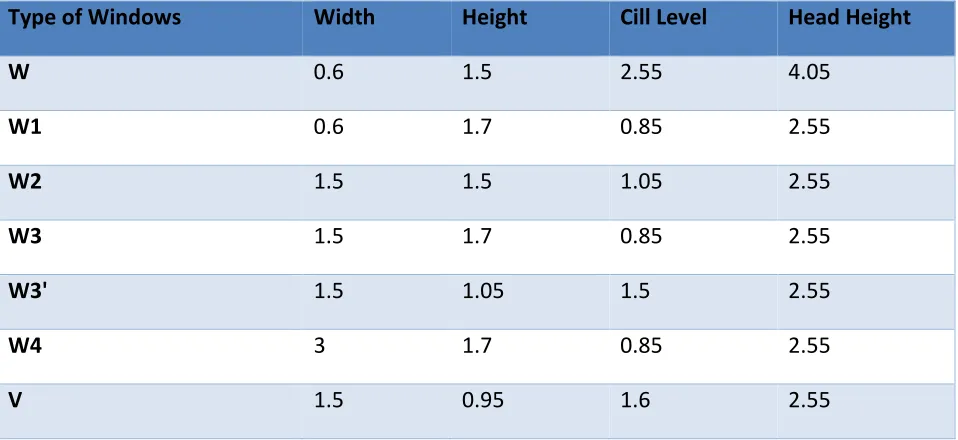
1. It is evident from the plan drawings that following major types of windows are used in the design namely W, W1, W2, W3, W3’, W4 and V, RW & V1, DW.
2. It does not consider the areas with zero occupancy.
Calculations:
Taking conservative height of the window = 1.5 m
Cill Height = 1.05 m
Each Floor Height = 3.5 m
Overhang Height H (From elevation drawing) = 0.88 m
V=Total Floor Height - Cill Height= 3.5 – 1.05 = 2.45 m
Hence,
Projection Factor = H/V = 0.88/2.45 = 0.36
Table A.1: Calculation of Head Height as per Section 4.2.3.2a (i)
Type of Windows Width Height Cill Level Head Height
W 0.6 1.5 2.55 4.05
W1 0.6 1.7 0.85 2.55
W2 1.5 1.5 1.05 2.55
W3 1.5 1.7 0.85 2.55
W3' 1.5 1.05 1.5 2.55
W4 3 1.7 0.85 2.55
Available Online at www.ijpret.com 37
RW 3.35 1.7 0.85 2.55
V1 0.75 0.95 1.6 2.55
DW 2.4 0.75 0.75 1.5
Table A.2: Calculation of minimum distance as per Section 4.2.3.2a (ii)
Type of Windows W W1 W2 W3 W3' W4 V RW V1 DW
Glazing Distance 0.9 1 0.75 1.2 0.8 1.5 0.4 0.1 0.6 0.1
Hence,
Total calculated Daylit area in the building = 2791 m2
Total occupied area in the project = 4236 m2
Percentage of area daylit in the building = 2791 / 4236= 66%
As per table 4.1 of the ECBC 2017, the above-calculated percentage of daylit area in the proposed design of New Hospital, Theog Shimla is 66% which is fulfilling the criteria of an ECBC compliant Healthcare building.
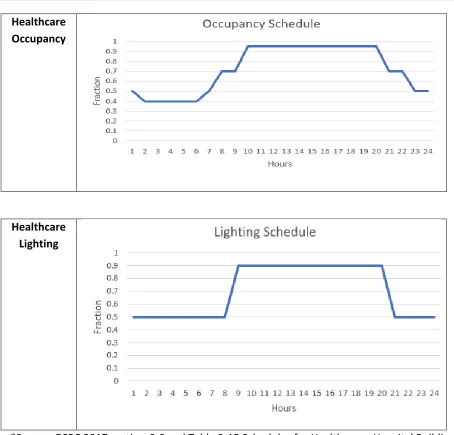
APPENDIX B – SCHEDULES
Available Online at www.ijpret.com 38
Healthcare Occupancy
Healthcare Lighting
*Source: ECBC 2017 section-9.6 and Table 9-15 Schedules for Healthcare - Hospital Buildings (A).
APPENDIX C- LPD CALCULATIONS
Table C: Whole Building LPD calculation
Lighting Wattage (W)
Illuminated Area (sq. mt.)
LPD W/m2
Available Online at www.ijpret.com 39
REFERENCE
1. EnergyPlus, A new Generation Building Energy Simulation Program, Drury B. Crawley, Linda K. Lawrie, Proceedings of Building Simulation '99, Volume 1: 81-88.
2. Building Energy Performance Simulation Tools – a life-cycle and interoperable perspective, Tobias Maile, Martin Fischer, Vladimir Bazjanac, CIFE (Center for Integrated Facility Engineering) at Stanford University.
3. Optimizing Building Energy Simulation Models in the Face of Uncertainty, Dirk Jacob, Sebastian Burhenne, Anthony R. Florita, and Gregor P. Henze, 2009.
4. Campus-Wide Integrated Building Energy Simulation, Willy Bernal, Madhur Behl, IBPSA Building Simulation Conference, International Building Performance Simulation, December 2015.
5. COMSOL Multiphysics for building energy simulation (BES) using BESTEST criteria, D.P.M. Jacobs and A.W.M. van Schijndel, Eindhoven University of Technology, Netherlands, 2015.
6. Modelling the Built Enviorment at an Urban Scale-Energy and Health Impacts in Radiation to Housing, Landscape and Urban Planning, Olympia Zogou, Anastassios Stamtelos, 83(1) (2009) pg no: 39-49.
7. Efficient and Robust Optimization for building energy simulation, Shokouh Pourarian, Jin Wen, Anthony J. Kearsley, Amanda J. Pertzborn, 2012.
8. A BIM-based web service framework for green building energy simulation and code checking, Jack C.P. Cheng, 2014
9. Http://hvacformula.blogspot.in/2008/12/cooling-heating-equations_9167.html