Modified Fatty Acids: Molecular Modeling and Docking
Method for Optimization of Non-Sulfide Ore Flotation
P. M. Solozhenkin1, Sanda Krausz2, O. I. Ibragimova3,*
1Research Institute of Comprehensive Exploitation of Mineral Resources of the Russian Academy of Science
(IPKON the RASci) Kryukovsky Tupik, Moscow, Russia
2University of Petrosani, Petrosani, Romania 3University of Dodoma, Dodoma, Tanzania
Abstract
Fatty acids are known as oxhydryl collectors which are used in practice for non-sulfide ore flotation. However, the selectivity of these collectors is low towards to gangue minerals occurring in the ore. In the present study the introduction of substitutes into the aliphatic chain of fatty acids has been suggested as the way for improvement the selectivity of collectors. Molecular modeling of alkaline earth mineral and modified fatty acid clusters has been performed using Chem Bio 3D and ChemOffice2005 by Cambridge Soft with optimization by MM2. DTF approach has been used to determine HOMO, LUMO and SOMO energies. The occurrence of the classical transfer of charge in bidentate complex with the decrease in charge on the calcium atom of the mineral cluster has been established. The strategy of prognosis of collector activity evaluation (PCAE) has been proposed as a consistent approach to estimate the interaction between a collector and a mineral cluster as a difference of total energy and sum of cluster energy and collector energy. The approach has proved useful in identifying relevant candidates for alkaline earth mineral flotation with modified fatty acids. The strengthening effect of binary mixture of modified fatty acids on flotability of alkaline earth mineralshas been established. To optimize the flotation the combination of oleic acid(OA) and ω - ((N,N-diethyl dithiocarbamato) undecanoic acid (DEDTCUA)has been investigated with the ratio of 1:1. By using this technique the fluorite concentrate has been upgraded up to 96,3% with the recovery of 85,35%.Keywords
Modified fatty acids, Alkaline earth minerals, Molecular modeling, Collector activity evaluation, Flotation1. Introduction
Flotation reagent selection is paramount and test work is necessary to ensure that the optimum reagent regime is utilized. Oxhydryl collectors are principally used for flotation of oxidic minerals (silicates), carbonate materials and oxides. Fatty acids are considered to be widespread oxhydryl collectors for non-sulfide ore flotation. However, the selectivity of these collectors is low towards to gangue minerals occurring in the ore [1]. The introduction of substitutes into the aliphatic chain of fatty acids is one of the ways for improvement the selectivity of collectors. Although the connection between the spatial structure of molecules and the chemical activity of the compounds has been proven, the most troublesome question for researchers remains the estimation of quantitative structure-property relationship. Very little molecular modeling research has been carried out with alkaline earth minerals although these minerals are the most widespread in non-sulfide ores.
* Corresponding author:
[email protected] (O. I. Ibragimova) Published online at http://journal.sapub.org/mining
Copyright © 2017 Scientific & Academic Publishing. All Rights Reserved
Therefore, authors considered that this type of minerals has to be extensively studied. The present study is aimed at representing the computer modeling of fatty acids with long hydrocarbon chain and their derivatives in forecasting and selecting of prospective flotation reagents for minerals of alkaline earth metals.
representatives of oxhydryl collectors with the general formula of R2N - C - S2 - (СН2) 10 – COONa that have been
studied by physical-chemical methods are sodium ω - (N,N-diethyl dithiocarbamato) undecanoate (DEDTCU), sodium ω - (N, N- dibutyldithiocarbamato) undecanoate (DBDTCU).
Modern computational methods and chemical programs allow to find the way of visualizing a three-dimensional model of the molecule and understand the connection between the spatial structure of the molecule and physical properties of the substance as well as its chemical activity for deeper understanding of these interrelations. Molecular modeling has been intensively developed over the past ten years. Significant research on computer modeling of
oxhydryl reagents was carried out in India [8, 9]. The molecular structures of the various collectors were fully optimized in China using density functional theory (DFT) which offered an effective tool in the calculation of the properties and energies of the various collectors [10]. Molecular modeling ofsulfhydryl reagents was carried out in Turkey [11], Finland [12] and Russia [13]. The knowledge generated in these studies can be extremely helpful in selection of collectors with desired properties as well as in designing of new reagents.
2. Methods and Objectives
2.1. Computational Methods
Computational modeling of minerals and reagents was performed using Chem Bio 3D and ChemOffice2005 by Cambridge Soft with optimization by MM2. The semi empirical calculations were provided by MOPAC 2012 in vacuum [14, 15]. Molecular structures of mineral clusters were created. DTF approach was used to determine the optimal molecular structure and calculate atomic charge values, the compositions and energies of HOMO, LUMO and SOMO. The strategy of collector activity evaluation was proposed as a consistent approach to estimate the interaction between a collector and a mineral cluster as a difference of total energy and sum of cluster energy and collector energy [16]:
E = E complex - (E cluster + E collector), eV (1) Complex formation was established with the aid of computational docking technique. The docking method is a search algorithm and a scoring function that predicts the preferable orientation of one molecule to a second to form a stable complex and estimate collecting activity of reagents. The approach was proved useful in identifying relevant candidates for several flotation applications [13].
2.2. Flotation Tests
Different samples of the ore were extracted and the flotation tests in laboratory and industrial flotation cells were conducted. The feed was conditioned with collectors followed by flotation operations.
2.3. Objectives
The objectives of the present study were alkaline earth minerals, such as fluorite, calcite, barite and celestine. Oleic acid (OA) was used as a standard reagent to estimate the effectiveness of oxhydryl collectors studied. Oxhydryl modified collectors which could be prospective reagents for non-sulfide flotation, such as butylxanthatoundecanoic acid (BXUA), ω – (N, N-diethyl dithiocarbamato) undecanoic acid (DEDTCUA) and ω- (N, N- dibuthyldithiocarbamato) undecanoic acid (DBDTCUA), were proposed.
3. Results and Discussion
3.1. Molecular Models of Mineral Clusters
a b
Figure 1. Structural formula (a) and 3D optimized model (b) of the barite mineral cluster
a b
Figure 2. Structural formula (a) and 3D optimized model (b) of the celestine mineral cluster
a b
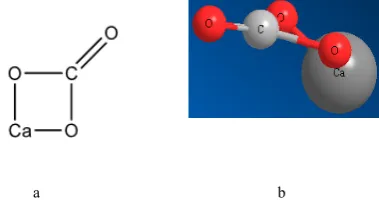
Figure 3. Structural formula (a) and 3D optimized model (b) of the calcite mineral cluster
correspond to chemical formulas as well as the distances between atoms correspond to tabulated data. In the present study the mineral clusters of alkaline earth minerals were created. Figures 1, 2 and 3 show the structural formulas (a) and 3D models (b) of alkaline earth mineral clusters.
Table 1 and 2 represent the information about computer parameters for mineral clusters of fluorite, calcite, barite and celestine.
Table 1. Computer parameters of mineral clusters studied Energy CaF2 CaCO3 SrSO4 BaSO4
Heat of formation,
kJ/mol -705.73 -630.663 -1015.915 -732.803 Total energy,
eV -955.282 -1031.119 -1378.212 -1375.833 Electronic
energy, eV -1312.855 -2544.498 -3894.049 -3863.186 HOMO
energy, eV -13.166 -9.420 -9.490 -8.689 LUMO
energy, eV 0.657 -1.965 -0.288 -0.142
Table 2. Computer parameters of mineral clusters studied CaF2 CaCO3 SrSO4 BaSO4
Charge, e
Ca 1.327146 F -0.663573 F-0.663573
C 0.866645 O -0.826726 Ca 1.332443 O -0.826342 O-0.546020
Sr 1.627575 O -1.181113 O -1.181021 S 2.681875 O -0.974953 O 0.972364
Ba 1.653514 O 1.173378 O -1.172696 S 2.681582 O -0.969523 O -1.019500
Dipole 0 13.904 15.825 21.654
According to Table 1 the values of heat of formation for mineral clusters are decreasing in the following order: CaCO3 > CaF2 > BaSO4 > SrSO4. Moreover, Table 2 shows
that dipole moments are changing in the reverse order: SrSO4 > BaSO4 > CaCO3, which can indicate the
strengthening of Van-der-Waals interactions. It should be noticed that the charge on the calcium atom is less than on barium or strontium which can reflect on the increase of electrostatic interaction between collectors and Ba-Sr-minerals. From the relevant studies conducting on the interaction between minerals and water it was established that the heat of formation was decreased up to -303.6519 KJ/mol for fluorite,- 335.43862 KJ/mol for calcite and -312.1891 KJ/mol for celestine. The charges on Ca and F were reduced as well. The dipole moments obtained were equal to 4.497 for fluorite, -17.628 for calcite and-19.112 for celestine. The values of LUMO energy were positive for fluorite and celestine.
3.2. Molecular Models of Flotation Reagents Clusters
The modified fatty acids with the general formula R2N - C
- S2 - (СН2)10 – COOH, where R – C2H5, C4H9, were studied
and geometrical structures were created. The structure of
BXUA is presented in Figure 4.
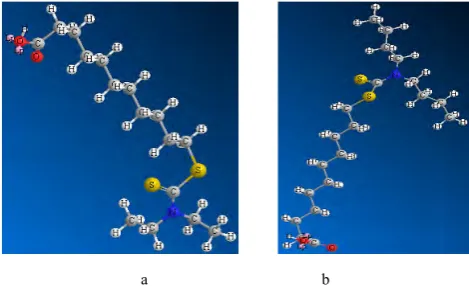
Figure 4. Structural formula of butylxanthatoundecanoic acid (BXUA) Figure 5 shows the optimized 3D models of modified dialkyl thiocarbamato undecanoic acids.
a b
Figure 5. Optimized 3D models of ω - ((N,N-diethyl dithiocarbamato) undecanoic acid (DEDTCUA) (a) and ω - (N, N- dibuthyldithiocarbamato) undecanoic acid (DBDTCUA) (b)
Table 3 contains the computational parameters for flotation reagents studied. Table 3 indicates that the longer the hydrocarbon chain the stronger ¼ van der Waals interaction. The power of van der Waals interaction of three collectors was followed as OA<DEDTCUA<DBDTCUA. These results should take into account for improving the flotation performance.
Table 3. Optimum parameters of collector molecules
Parameter Reagent
OA DEDTCUA DBDTCUA Valence-bonds tensile 1.0032 1.1604 1.3306 Dihedral angles flexure 2.4598 4.9058 5.4514 Flexural tensile correction
coefficient 0.3164 0.4848 0.5408 Internal rotation -1.6081 1.9897 3.3070 Non 1,4 VDW interaction -3.4402 -3.7662 -3.9787 1,4 VDW interaction 10.7999 11.6094 14.7534 Dipole/dipole interaction 1.6872 1.9300 1.8744
Total steric energy,
kcal/mol 11.2182 18.3138 23.2788
3.3. Complex Formation and Prognosis of Collector Activity Evaluation (PCAE)
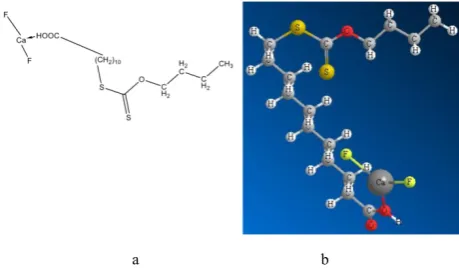
The modified fatty acids attached to mineral clusters such as CaF2, CaCO3, SrSO4, BaSO4 were studied. Figure 6 shows
and bidentate schemes. The bond distances between О (11)-Са(12) and С(1)-О(10) were equal to 1,595 Ǻ and 1,208 Ǻ, respectively, which indicated the strong interaction between the calcium atom and the collector. It was noticed that the normal covalent bond and the back donation covalent bond occured in bidentate complexes. It was obtained that bidentate complex Ca- BXUA had α HOMO/LUMO and β HOMO/LUMO. The oxhydryl collector transfers its HOMO electrons to the metal atom to form the normal covalent bond. In addition the metal atom can transfer some of d-electrons to LUMO of the collector forming back donation covalent bonds which should increase interaction between a collector and a mineral. The results obtained showed the decrease in charge on the calcium atom of the mineral cluster.
a b
Figure 6. Complex of the fluorite cluster with the molecule of
butylxanthatoundecanoic acid (BXUA) attaching to the calcium atom (a) and its optimized geometrical model (b)
The prognosis of collector activity evaluation was calculated to estimate the stability of complex formation. The lower PCAE the stronger the ability of the collector to interact with the mineral cluster. From the relevant studies conducting on PCAE it could be concluded that BXUA possessed the higher collector activity (PCAE=-8134.518 eV) comparing to OA (PCAE= -4866.881eV) for flotation of alkaline earth minerals. The value of PCAE referring to total energy was followed as CaCO3> BaSO4> SrSO4> CaF2
which corresponding to flotation. According to PCAE referring to electronic energy the decrease of prognosis of collector activity evaluation (PCAE) for minerals was in the following order: SrSO4 > BaSO4 > CaCO3 > CaF2.
Based on the PCAE results the synergistic effect of the combination of collectors on alkaline earth ore flotation was established. The sharp decrease of PCAE with the binary mixture of collectors such as OA + BXUA and OA + DBDTCUA was shown. The electronic energy was decreased with the difference of 14048,864 eV(-23007.083 - (-3353.58 -5604.639)) for CaF2 + OA + BXUA comparing to
the same parameter for individual collectors. From the previous discussion it was evident that the combination of collectors was more preferable comparing to the single collector.
3.4. Flotation of Alkaline Earth Minerals and Ores
To optimize the flotation operation the combinations of
oleic acid (OA) and ω – (N,N-diethyl dithiocarbamato) undecanoic acid (DEDTCUA) or ω - (N, N- dibuthyldithiocarbamato) undecanoic acid (DBDTCUA) were investigated with the ratio of 1:1. Application of the binary mixture of OA and DEDTCUA (1:1) allowed to increase the recovery of fluorite as well as the grade of the concentrate. The flotation was performed by using OA (100 g/t) and DEDTCUA (100 g/t) with the feed grade of 23,4% CaF2. By using this technique the fluorite concentrate was
upgraded up to 96.3% with the recovery of 85.35%.
4. Conclusions
Molecular modeling of alkaline earth mineral and modified fatty acid clusters was created. The main physical-chemical parameters were established. The transfer of electrons in the bidentate complex was investigated and occurred with the decrease in charge on the calcium atom of the mineral cluster.
Index PCAE was calculated to analyze the docking activity of modified fatty acids with alkaline metals from mineral clusters. The approach was proved useful in identifying relevant candidates for alkaline earth mineral
flotation with modified fatty acids. The strengthening effect of binary mixture of modified fatty acids on flotability of alkaline earth minerals was established. By application of the combinations of oleic acid (OA) and ω – (N,N-diethyl dithiocarbamato) undecanoic acid (DEDTCUA) or ω - (N, N- dibuthyldithiocarbamato) undecanoic acid (DBDTCUA) (1:1) the fluorite concentrate was upgraded up to 96,3% with the recovery of 85,35%.
REFERENCES
[1] S.M. Bulatovic, Handbook of flotation reagents: chemistry, theory and practice, volume 1: flotation of sulfide ores (Elsevier B.V., Amsterdam), 2007.
[2] O.S. Bogdanov, A.M. Gol'man, I.A. Kakovskij. Physical and chemical bases of the theory of flotation. Edit. / B. N. Laskorin, L. D. Plaksina. V.I. Ryaboy. Oxhydryl reagents. M.: Nauka, 1983.
[3] V.I. Ryaboy. “Intention and classification of flotation reagents”, in Physicochemical Bases of Flotation Theory (Ed: In N Laskorin), (Nauka, Moscow), 1983, 51-57. [4] V.I. Ryaboy, 2008. About superficial reactions flotation
reagents with minerals on the basis of them donor- acceptor of interaction, Ore dressing, No 6, 24-30.
sulphydryl reagents and their derivatives Non-Ferrous Metal Journal. № 7, 11-14.
[7] P. Solozhenkin, O. Solozhenkin. 2012, Computer modeling of fatty acids. Non-Ferrous Metallurgy, 17-21.
[8] Pradip, B. Rai, et al. 2002. Molecular modelling of interactions of alkyl hydroxamates with calcium minerals. J. Colloid Interface Sci. 256: 106.
[9] Pradip, Beena, Rai. 2003, Molecular modeling and rational design of flotation reagents, International Journal of Mineral Processing. 72, 95– 110.
[10] G. Liu, H. Zhong, T. Dai, and L. Xia, 2008. Investigation of the effect of N-substituent’s on performance of thionocarbamates as selective collectors for copper sulfides by ab initio calculations. Miner. Eng. 21:
[11] M. Yekeler, H. Yekeler. 2006, A density functional study on the efficiencies of 2-mercaptobenzoxazole and its derivatives
as chelating agents in flotation processes”, Colloids Surf. A: Physicochemical Engineering Aspects, 286, 121–125. [12] M. Porento, P. Hirva, 2004. A theoretical study on the
interaction of sulfhydryl surfactants with a covellite surface”. Surface Science. 555, 75–82.
[13] P.M. Solozhenkin, 2008, “Molecular design of flotoreagents for non-sulfide ores efficient in flotation”. Non-Ferrous Metalls Journal. № 12, 28-33.
[14] Khel`t`e, Molecular Modeling: Theory and Practice. Moscow; Binom. Laboratory of Knowledge, 2013.
[15] Soloviev, M.E., Soloviev, M.M. Computational chemistry. SOLON Press. 2005.