Available Online at www.ijpret.com
37
INTERNATIONAL JOURNAL OF PURE AND
APPLIED RESEARCH IN ENGINEERING AND
TECHNOLOGY
A PATH FOR HORIZING YOUR INNOVATIVE WORK
RECOGNIZING PRE AND POST SURGERY FACES USING MULTIMODAL
BIOMETRIC APPROACH
MINAL MUN1, PROF. ANIL DEORANKAR2, DR. PRASHANT CHATUR3
1. 1M.Tech. Scholar, Department of Computer Science and Engineering, Government College of Engineering, Amravati, Maharashtra, India
2. Associate Professor, Department of Computer Science and Engineering, Government College of Engineering, Amravati, Maharashtra, India
3. Head of Department, Department of Computer Science and Engineering, Government College of Engineering, Amravati Maharashtra, India
Accepted Date: 27/02/2014 ; Published Date: 01/05/2014
\
Abstract: Variation in pose, expression, illumination, occlusion and aging are the major
problem in face recognition and various algorithms have been proposed to handle these challenges. Except this new problem in face recognition is plastic surgery which changes facial features to large extend. Increasing popularity of plastic surgery and its effect on automatic face recognition has attracted attention from the research community. However, the variations introduced by plastic surgery remain difficult to be modeled by existing face recognition systems and degrade the performances of face recognition algorithm. This paper proposes a new face recognition system using multimodal biometric approach which extracts shape as well as texture feature from the facial image. Further to improve the recognition rate, cascade a periocular biometric.
Keywords: Face Recognition, Multimodal Biometric, Periocular Biometric, Plastic Surgery.
Corresponding Author: MS. MINAL MUN
Access Online On:
www.ijpret.com
How to Cite This Article:
Available Online at www.ijpret.com
38
INTRODUCTION
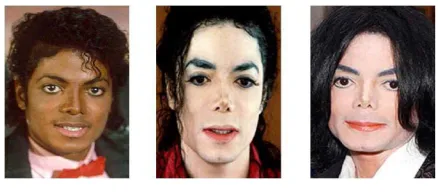
Recently, technology became available to allow verification of "true" individual identity. This technology is based in a field called "biometrics". Biometric access control are automated methods of verifying or recognizing the identity of a living person on the basis of some physiological characteristics, such as fingerprints or facial features, or some aspects of the person's behavior, like his/her handwriting style or keystroke patterns. Since biometric systems identify a person by biological characteristics, they are difficult to forge. Among the various biometric ID methods, the physiological methods (fingerprint, face, DNA) are more stable than methods in behavioral category (keystroke, voice print). The reason is that physiological features are often non-alterable except by severe injury. The behavioral patterns, on the other hand, may fluctuate due to stress, fatigue, or illness. However, behavioral IDs have the advantage of being no intrusiveness. People are more comfortable signing their names or speaking to a microphone than placing their eyes before a scanner or giving a drop of blood for DNA sequencing. Face recognition is one of the few biometric methods that possess the merits of both high accuracy and low intrusiveness. Also, it provides information about Age, gender, personal identity (physical structure), Mood and emotional state (facial expression) and Interest / attentional focus (direction of gaze). However, even after decades of research, face is still an active topic because of the variability observed in face due to illumination[11], pose, expression and occlusion[12]. A new challenge to face recognition is facial plastic surgery[8]. These surgeries alters the facial features to such an extent that human being often struggle to identify a person face after surgery. The Fig. 1 shows an example of the effect of plastic surgery on facial appearances.
Fig. 1 The effect of plastic surgery on facial appearances.
Available Online at www.ijpret.com
39
available and plastic surgery face database contains one pre-surgery image for training and a post-surgery image for testing. This further complicates feature extraction task in face recognition methods.
Also, each facial plastic surgery changes shape or texture of a particular face region[8]. It is very difficult to predict which features are invariant (a region without surgery effects) with unavailable surgery information. The difficulty is further supplemented, when an individual undergoes more than a surgery. The existing face recognition algorithm are good in extracting one of feature from an image i.e. either shape or texture.
The plastic surgery can also be misused by individuals who are trying to conceal their identity with the intent to commit fraud or evade law enforcement. Also this surgery allows the theft or terrorist to freely move around without any fear of being identified by any face recognition system. Again it might lead to rejection of genuine users.
Therefore the proposed method is used to recognition of facial images that have previously undergone some feature modifications through plastic surgery. Under this creating the plastic surgery face database is an important task which contains one pre-surgery image for training and a post-surgery image for testing. In the real world, it is difficult to isolate individuals who have undergone plastic surgery and use special mechanism to recognize them. Therefore, face recognition algorithms should be robust to variations introduced by plastic surgery even in general operating environments. Considering such generality of face recognition, the second non- surgery face database is prepared by appending the plastic surgery face database. Images in the plastic surgery face database are collected from different sources on internet and have noise and irregularities. So some preprocessing done on those images. Then the shape and texture features are extracted from the images and on the basis of that features the classification is done.
Available Online at www.ijpret.com
40
doesn’t have to provide two biometric, since the periocular region is obtain from face image as well as it is not required to processed all the biometric every times i.e. only when face recognition using proposed method fails to match then periocular biometric is used.
The rest of the paper is organized as follows. Section II briefly discusses a few related works from the literature. A brief discussion of proposed approach for face matching with preprocessing, feature extraction, classification and periocular biometrics is provided in Section III. Finally, this paper is concluded with section IV.
I. EXISTING APPROACH
Gaurav Aggarwal, Soma Biswas, Patrick J. Flynn and Kevin W. Bowyer[3], proposed a novel approach to address the challenges involved in automatic matching of faces across plastic surgery variations. In the proposed formulation, they proposed a part-wise sparse representation Approach combined with the popular sparse representation to address the challenge of plastic surgery variations and utilizes images from sequestered non-gallery subjects with similar local facial characteristics to fulfill this requirement. They stated that this sparse representation approach also used for several other biometrics and computer vision problems. One limitation of sparsity-based biometric recognition is, it requires several images per subject in the gallery.
K. R. Singh, Roshni S Khedgaonkar, Swati P Gawande [4], proposed a new approach to find the nearness between the pre plastic surgical face to the post plastic surgical face. They develop a classifier for facial images that have previously undergone some feature modifications through plastic surgery based on near set theory. Their work concerned only geometrically obtained feature values and their approximation using near sets. Once the features will be extracted a feature database will be formed. Using this feature values near set theory provides a method to establish resemblance between objects contained in a disjoint set, that is it provides a formal basis for observational comparison and classification of the objects. One limitation to this approach is, it will recognize the face only after local plastic surgery, but not work in the presence of global plastic surgery.
Available Online at www.ijpret.com
41
information content. The third level of granularity extracts discriminating information from local facial regions. After feature is extracted from that face granules by SIFT and EUCLBP algorithm. Then Multiobjective Evolutionary Approach is use to optimization of weight. Decision is take place on the basis of weight.
II. PROPOSED APPROACH
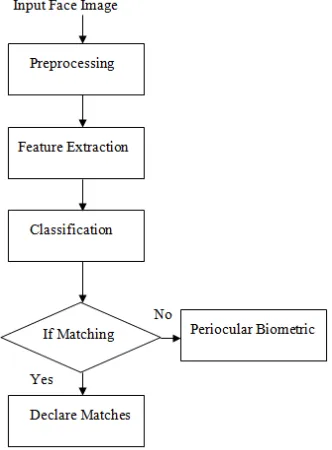
This paper proposes a new multimodal biometric using face and periocular biometric for the recognition of face invariant to plastic surgery. This method makes the use of different features from face and periocular region to match face images before and after plastic surgery. The block diagram of propose method is shown in Fig. 2. Feature is extracted from both face and periocular region with the help of local binary pattern and then dimension reduction is done with the help of PCA. Then for classification Euclidian distance is used. If face is not match, then periocular biometric is performed for face recognition under plastic surgery. The flowchart contains the following steps: Data Collection, Preprocessing, Feature Extraction, Classification, Periocular biometric.
Data collection
Available Online at www.ijpret.com
42
Fig. 2 The block diagram of proposed method
Preprocessing
The feature and information of face image should not be altered by local changes due to noise and illumination error. Hence to satisfy the environmental conditions, preprocessing of the raw data is highly important.
Fig. 3 Alignment process
Available Online at www.ijpret.com
43
uniform. Further alignment is done in which we achieve more accurate localization of face. The result of alignment process is shown in Fig. 3.
1. Feature Extraction
Another phase in face recognition is feature extraction. This is phase where the system does the localizing of the characteristics of face component (i.e. eyes, mouth, nose etc) in an image. In other words, feature extraction is a step in face recognition where the system locates certain points on the face such as corner and centre of the eyes, tip of the nose, mouth, etc. it analyze spatial geometry of differentiate feature of a face. The result of this analyzing is a set of template generated for each face. The template consists of reduced set of data that represent the uniqueness of the face image. This proposed method uses the LBP for extraction of feature from face region.
In this, first extraction of shape free patch is done and then the features are extracted from the shape free patch with the help of local binary pattern operators. The sixty eight shape landmark points for the plastic surgery face database is manually selected for training purpose.
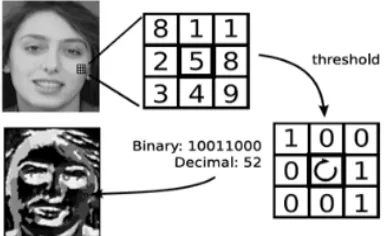
Local binary patterns[5] were introduced by Ojala as a fine scale texture descriptor. In its simplest form, an LBP description of a pixel is created by thresholding the values of the 3 * 3 neighborhood of the pixel against the central pixel and interpreting the result as a binary number. The process is illustrated in Fig. 4.
Available Online at www.ijpret.com
44
Classification
Classification will be executed on the base of defined features i.e. it required some features such as density, texture or shape feature for classification of object. There are various classification techniques available, but I use Euclidean distance [5]. It is used as the classifier to identify which training set image belongs to the given test image. Classification is performed by comparing from each training set image with the test image C using Euclidean distance,
2
=(|| Ctest – Ci ||)2
Where, is a shape texture parameter of the ith face image in training set. Test image is classified as belonging to image i when minimum of is below some chosen threshold value . Threshold value, Θ = 1/2 max(|| Cj – Ci ||) where i and j are images from same class.
Periocular Biometrics
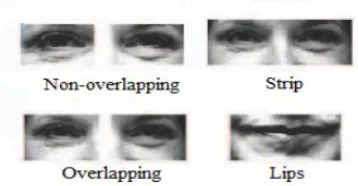
Eye lids, eye brow and eye surrounding area is called as periocular region[2] which is considered to be more discriminative in nature There is no database available with periocular region images. Only way to fetch this is using available face image[7]. Periocular biometric is a process in which the periocular region feature can be used for the classification. Periocular biometrics [7] is performed in three different ways such as overlapping, Non-overlapping and Strip [5]. All this three different types of periocular regions are obtained using four significant points in the eye region and lips are shown in Fig. 5. LBP is used for feature extraction and PCA is used for dimension reduction.
Fig. 5 Different types of periocular regions.
III. CONCLUSION
Available Online at www.ijpret.com
45
using local binary pattern operator. This clearly extract the shape and texture features which represents a face image in more meaningful way than any other feature extractor. The periocular biometric improving the overall system performance.
REFERENCES
1. Himanshu S. Bhatt, Samarth Bharadwaj, Richa Singh, and Mayank Vatsa,” Recognizing Surgically Altered Face Images Using Multiobjective Evolutionary Algorithm”, IEEE Transactions On Information Forensics And Security, Vol. 8, No. 1, January 2013.
2. P.Fasca Gilgy Mary, P.Sunitha Kency Paul, J.Dheeba ,“Human Identification Using Periocular Biometrics,” in International Journal of Science, Engineering and Technology Research (IJSETR) Volume 2, Issue 5, May 2013
3. Gaurav Aggarwal, Soma Biswas, Patrick J. Flynn and Kevin W. Bowyer,”A Sparse Representation Approach to Face Matching across Plastic Surgery” IEEE Workshop on Applications Of Computer Vision (WACV), 2012
4. K. R. Singh, Roshni S Khedgaonkar, Swati P Gawande “A New Approach to Local Plastic Surgery Face Recognition Using Near Sets”, in International Journal of Engineering Science and Technology, NCICT Special Issue, Feb 2011
5. N. S. Lakshmiprabha, J. Bhattacharya, and S. Majumder, “Face recognition using multimodal biometric features,” in International Conference on Image Information Processing. IEEE, 2011, pp. 1–6.
6. R. Singh et al., “Plastic surgery: A new dimension to face recognition,” IEEE Transaction On Information Forensics and Security, vol. 5, no. 3, pp. 441–448, 2010.
7. D. Woodard, S. Pundlik, J. Lyle, and P. Miller, “Periocular region appearance cues for biometric identification,” in CVPR Workshop on Biometrics. IEEE, 2010, pp. 162–169.
8. M. Singh, R. Vatsa and A. Noore, “Effect of plastic surgery on face recognition: A preliminary study,” in IEEE Computer Society Conference on Computer Vision and Pattern Recognition Workshops, CVPR Workshops. IEEE, 2009, pp. 72–77.
Available Online at www.ijpret.com
46
10.Sangeeta Kakarwal, Ratnadeep Deshmukh ,“Wavelet Transform based Feature Extraction for Face Recognition”, in International Journal of Computer Science and Application Issue 2010
11.Harine Sellahewa, Sabah A. Jassim, “Image Quality Based Adaptive Face Recognition”, IEEE Transaction On Instrumentation And Measurement, Vol. 59, No. 4, April 2010
12.Hassen Drira, Boulbaba Ben Amor, Anuj Srivastava, Mohamed Daoudi, Rim Slama,”3D Face Recognition Under Expression, Occlusions, And Pose Variations.”, IEEE Trasaction On Pattern Analysis And Machine Intelligence, Vol. 35, No. 9, September 2013