
Dr.Basu Venkateswara Reddy*
Department of Pharmaceutics, St.Pauls College of Pharmacy, Turkayamjal (V), Hayathnagar (M),
R.R.Dist-501510, Telangana, India Mobile: +91-9866807609 Email: [email protected]
Address for correspondence
Venkateswara Reddy et al. / JGTPS / 6(1)-(2015) 2372 – 2378
FORMULATION DEVELOPMENT AND
IN-VITRO
CHARACTERIZATION OF
FLOATING TABLETS OF DILTIAZEM HCL
INTRODUCTION:
Oral controlled release drug delivery have recently been of increasing interest in pharmaceutical field to achieve improved therapeutic advantages, such as ease of dosing administration, patient compliance and flexibility in formulation. Drugs that are easily absorbed from gastrointestinal tract (GIT) and have short half-lives are eliminated quickly from the systemic circulation. Frequent dosing of these drugs is required to achieve suitable therapeutic activity. To avoid this limitation, the development of oral sustained-controlled release formulations is an attempt to release the drug slowly into the gastrointestinal tract (GIT) and maintain an effective drug concentration in the systemic circulation for a long time. After oral administration, such a drug delivery would be retained in the stomach and release the drug in a controlled manner, so that the drug could be supplied continuously to its absorption sites in the gastrointestinal tract (GIT)1.
These drug delivery systems suffer from mainly two adversities, the short gastric retention time(GRT) and unpredictable short gastric emptying time (GET) which can result in incomplete drug release from the dosage form in the absorption zone (stomach or upper part of small intestine) leading to diminished efficacy of administered dose2,3. Gastro retentive drug delivery is an approach to prolong gastric residence time, thereby targeting site-specific drug release in the upper gastrointestinal tract (GIT) for local or systemic effects. Gastro retentive dosage forms can remain in the gastric region for long periods and hence significantly prolong the gastric retention time (GRT) of drugs4,5.
Prolonged gastric retention improves bioavailability, reduces drug waste and improves solubility of drug that is less soluble in high pH environment i.e. intestine. It is also suitable for local drug delivery in stomach and proximal small intestine6. Diltiazem is a nondihydropyridine (non-DHP) member of the class of drugs known as calcium channel blockers, used in the treatment of hypertension, angina pectoris and some types of arrhythmia7. Diltiazem is well absorbed from the gastrointestinal tract but undergoes substantial hepatic first-pass effect. The absolute bioavailability of an oral dose of an immediate release formulation (compared to intravenous administration) is approximately 40%. Only 2% to 4% of unchanged diltiazem appears in the urine.
The objective of the present investigation was to increase the half life and to decrease the firstpass metabolism of Diltiazem hydrochloride a calcium channel blocker, an anti-hypertensive and anti-anginal drug by formulating it as floating tablets. Gastric floating of diltiazem hydrochloride tablets results from effervescence produced by the reaction between sodium bicarbonate and hydrochloric acid in stomach. Twelve formulations of floating tablets were prepared using direct compression technique with polymer such as Carbapol971(p), carbopol974(p), carbopol930, HPMC K15M, Xanthan gum, Guar gum in different ratios. The evaluation results revealed that all formulations comply with the specification of official pharmacopoeias with respect to general appearance, content uniformity, hardness and friability. All the formulations remained floating for more than 12hours in the simulated gastric contents. Out of all the formulation developed, formulation F4 consisting of Carbopol974 showed in-vitro drug release of 97.82% upto desired time period of 12 hours. The drug release form the formulation was found to be by diffusion.
Key words:Diltiazem, Calcium channel blocker, Floating tablets Carbopol, HPMC k15m, Xanthan gum, Guar gum.
ABSTRACT
B.Venkateswara Reddy*, K.Navaneetha
Department of Pharmaceutics, St.Pauls College of Pharmacy, Turkayamjal (V), Hayathnagar (M), R.R.Dist-501510, Telangana, India
.
Journal of Global Trends in Pharmaceutical Sciences
Journal home page: www.jgtps.com
ISSN: 2230-7346
The plasma elimination half-life of diltiazem is approximately 3.0 - 4.5 h., thus floating tablets of Diltiazem have been prepared so as to increase the bioavailability and decrease the first pass effect.
MATERIALS AND METHODS:
Materials: Diltiazem HCl was obtained as the gift sample from Aarti drug Laboratories, Ltd. Thane. HPMC K15M, carbopol 974(p), carbopol 971(p), carbopol 930(p), guar gum, xanthan gum, sodium bicarbonate, MCC, talc and magnesium stearate were procured from S.D.Fine Chem. Ltd, Mumbai, India.
Methods:
Fourier transforms Infra-Red (FTIR) spectroscopy: FTIR study was carried out to check compatibility of drug with polymers. Infrared spectrum of Diltiazem was determined on fourier transform Infrared Spectrophotometer using KBr dispersion method.
The base line correction was done using dried potassium bromide. Then the spectrum of dried mixture of drug and potassium bromide was run followed by drug with various polymers by FTIR spectrophotometer
Formulation Development:
Floating tablets of Diltiazem were prepared by direct compression method. All the ingredients were passed through sieve no. 200 (75m). Accurately weighed quantities (as given in table-1) of drug and ingredients, were mixed for 15 min and compressed using 8 mm standard flat punches maintaining the individual tablet weight of 300mg.
EVALUATION:
Precompression evaluation8, 9:
The precompression parameters such as bulk density, tapped density, hausner’s ratio, compressibility index and angle of repose were determined as per the specifications for the powder blend of formulations in order to determine the capability of the ingredients to compress as direct compression method is opted for preparing the formulations.
Post compression evaluation8, 9:
Thickness:
The thickness and diameter of tablets were important for uniformity of tablet size. The thickness and diameter of the tablets was determined using a Vernier caliper.
Weight Variation:
To find out weight variation 20 tablets of each formulation were weighed individually using an electronic balance, average weight was calculated and individual tablet weight was then compared with average value to find the deviation in weight (IP. 2007). Specifications of % weight variation allowed in tablets as
For each formulation, the hardness of 6 tablets was determined using the Monsanto hardness tester. The tablet was held along its oblong axis in between the two jaws of the tester. At this point, reading should be zero kg/cm2. Then constant force was applied by rotating the knob until the tablet fractured. The value at this point was noted in kg/cm2.
Friability:
Friability is the measure of tablet strength. This test subjects a number of tablets to the combined effect of shock abrasion by utilizing a plastic chamber which revolves at a speed of 25 rpm, dropping the tablets to a distance of 6 inches in each revolution. A sample of pre weighed tablets was placed in Roche friabilator which was then operated for 100 revolutions. The tablets were then dedusted and reweighed. A loss of less than 1 % in weight is generally considered acceptable. Percent friability (% F) was calculated as follows,
% F = (Initial Wt. - Final Wt. / Initial Wt.) x 100
Drug content uniformity10, 11:
Accurately weighed quantity of the powdered tablet equivalent to 60 mg of the drug was transferred to 100ml volumetric flask. 50 ml of the buffer solution of pH 1.2 was added and mixture was shaken for 10 min and then the volume was made up to 100 ml with the same buffer solution. Mixed solution was filtered through the membrane filter disc with an average pore diameter not greater than 0.45µm. 5ml of the filtrate was diluted to 100ml with same buffer solution and examined under U.V spectrophotometry at 246nm.
Swelling studies:
The extent of swelling was measured in terms of % of weight gained by the tablet. One tablet from each formulation was weighed and kept in petridish containing 50ml of 0.1 N HCL solutions. At the end of specified time intervals tablets were withdrawn from petridish and excess buffer blotted with tissue paper and weighed. The % of weight gained by the tablet was calculated by using the following formula12
Swelling index (%) = M
t– M
0/M
0Buoyancy lag time determination and total Floating time:
The in-vitro buoyancy was determined by the floating lag time. The tablets were placed in a 100 ml beaker containing 1.2 pH acidic buffer. The time required for the tablet to rise to the surface for floating was determined as the floating lag time and further duration of all tablets was determined by visual observation13, 14.
In-VitroDissolution Studies15:
The tablets were placed in the dissolution medium and the apparatus was run. At intervals of 0.5, 1, 2, 4, 6, 8, 10 and 12 hours 5 ml aliquots were withdrawn and replacement was done each time with equal amounts of fresh dissolution medium maintained at same temperature. Each 5 ml aliquot was filtered through Whatman filter paper (No.41). 5 ml of sample was diluted to 10 ml with 0.1N Hydrochloric acid for first 2 hours and then with pH 6.8 phosphate buffers for next 10 hours and absorbance of these solutions was measured by using a UV spectrophotometer. Drug concentrations in the sample were determined from standard calibration curve. The release data were calculated.
D. Release Kinetics:
To study the release kinetics of in-vitro drug release, data was applied to kinetic models such as Zero order, First order, Higuchi and Korsmeyer- Peppas. Data Analysis (Curve Fitting Analysis)
To analyze the mechanism of the drug release rate kinetics of the dosage form, the data obtained were graphed as:
1. Cumulative percentage drug released Vs Time (In-vitrodrug release plots)
2. Cumulative percentage drug released Vs Square root of time (Higuchi’s plots)
3. Log cumulative percentage drug remaining Vs Time (First order plots)
4. Log percentage drug released Vs Log time (Peppas plots)
RESULTS AND DISCUSSION:
Fourier transforms Infra-Red (FTIR) spectroscopy: The spectra for pure Diltiazem and for the physical mixture of Diltiazem and all the polymers were determined to check the intactness of the drug in the polymer mixture using FTIR – Spectrophotometer by disc method.
The comparative FTIR studies of Drug and excipients combination had shown negligible variation in the values as compared with that of only pure form of Drug (figure 1-3). Therefore it implies good compatibility of drug and excipients.
PRE COMPRESSION EVALUATION:
Bulk density of all formulations was in the range of 0.42gm/cc to 0.45gm/cc. Tapped density of all formulations was in the range of 0.57gm/cc to 0.66gm/cc. Carr’s index of all the formulations of with different polymers were between 21.4% and 35.6% respectively, which indicates the flow properties of the powders of all formulations are excellent. Hausner's Ratio of all the formulations of powders with different polymers were between 1.36 and 1.57 respectively which indicates the
flow properties of the powders of all formulations are excellent. The powders with different polymers had an angle of repose ranging from 31.2 to 36.8 indicates that all of the formulations made with carbopol 974 had excellent flow properties. The results are given in the table-3.
POST COMPRESSION EVALUATION:
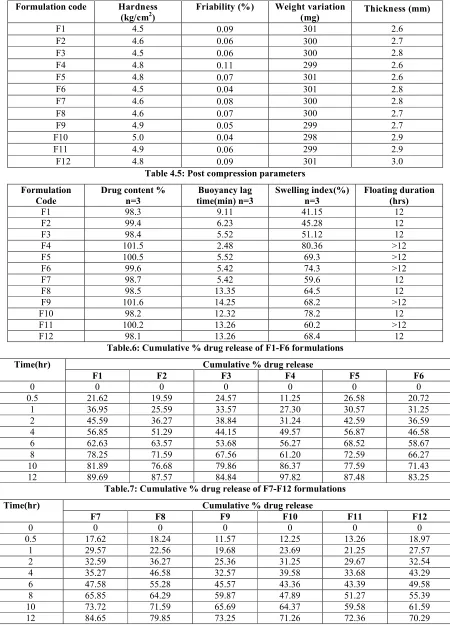
Different formulations were prepared by using different polymers in different ratios. In these formulations weight variation was found to be in the range of 299-301mg. Hardness is in the range of 4.5-5.0kg/cm2. Thickness is about 2.6-3.0mm. Friability is in the range of 0.04-0.11%. The results are given in the table-4.
The values of drug content uniformity are given in the table-5, drug content was found be in the range of 98-101% meets the I.P specifications. The swelling index of the tablet was found to be increasing with increase in the polymer concentration. All the formulations remained floating for 12 hours in the simulated gastric fluid.
In-vitroDrug release:
Formulations F1, F2 were prepared by using Carbopol 971(P) is in the ratio of 1:1 and 1:2 shows drug release is about 89.69%, 87.57% up to 12th hr. Formulations F3, F4 were prepared by using Carbopol 974(P) is in the ratio of 1:1, 1:2 shows drug release is about 84.84%, 97.82% up to 12thhr. Formulations F5, F6 were prepared by using Carbopol 930(P) is in the ratio of 1:1, 1:2 shows drug release is about 87.48%, 83.25% at the end of the 12thhr. Formulations F7, F8 were prepared by using HPMC K15M is in the ratio of 1:1 and 1:2 shows drug release is about 84.65%, 79.85% up to 12th hr. Formulations F9, F10 were prepared by using Xanthan gum is in the ratio of 1:1, 1:2 shows drug release is about 73.25%, 71.26% up to 12th hr. Formulations F11, F12 were prepared by using Guar gum in the ratio of 1:1, 1:2 shows drug release is about 72.36%, 70.29% at the end of the 12thhr. Among all these formulations F4 formulation shows highest amount of drug release upto 12hrs. so it is considerd as the best formulation among all the formulations.
Drug release kinetics:
The results of dissolution data were fitted to various drug release kinetic equations. The kinetics of dissolution data with R² value obtained from formulation F1-F12 is tabulated in Table-8.
Table.1: Formulae for preparing the tablets
Ingredients F1 F2 F3 F4 F5 F6 F7 F8 F9 F10 F11 F12
Diltiazem Hcl 60 60 60 60 60 60 60 60 60 60 60 60
Carbopol 971 60 90 - - -
-Carbopol 974 - - 60 90 - - -
-Carbopol 930 - - - - 60 90 - - -
-HPMC K15M - - - 60 90 - - -
-Xanthan gum - - - 60 90 -
-Guar gum - - - 60 90
Sodium
bicarbonate 75 75 75 75 75 75 75 75 75 75 75 75
Magnesium
stearate 6 6 6 6 6 6 6 6 6 6 6 6
Talc 6 6 6 6 6 6 6 6 6 6 6 6
MCC Q.S Q.S Q.S Q.S Q.S Q.S Q.S Q.S Q.S Q.S Q.S Q.S
Total weight(mg) 300 300 300 300 300 300 300 300 300 300 300 300
Table.2: Specifications of % weight variation allowed in Tablets
Table.3: A comprehensive report on flow properties of Powders
Formulation code
Bulk Density* (g/cc)
Tapped Density* (g/cc)
Hausner Ratio
Compressibility Index%
Angle of Repose(θ)
F1 0.421±0.006 0.577±0.003 1.36 30.7 31.2±0.31
F2 0.422±0.033 0.663±0.004 1.52 35.6 31.6±0.54
F3 0.423±0.006 0.646±0.002 1.57 32.7 35.8±0.95
F4 0.444±0.002 0.623±0.007 1.57 33.8 32.6±0.54
F5 0.436±0.002 0.634±0.005 1.46 32.4 33.4±0.43
F6 0.422±0.004 0.652±0.002 1.55 33.4 35.9±0.45
F7 0.425±0.007 0.632±0.003 1.48 33.9 32.3±0.35
F8 0.443±0.004 0.648±0.001 1.41 34.7 34.2±0.34
F9 0.454±0.003 0.655±0.005 1.43 29.4 32.5±0.52
F10 0.441±0.004 0.648±0.006 1.46 21.4 36.8±0.52
F11 0.438±0.004 0.638±0.004 1.45 32.1 33.1±0.62
F12 0.425±0.008 0.623±0.004 1.42 33.8 32.6±0.54
Average weight of tablets (mg) Maximum percent difference allowed
80 or less 10
More than80 but less than 250 7.5
Formulation code Hardness
(kg/cm2) Friability (%) Weight variation (mg) Thickness (mm)
F1 4.5 0.09 301 2.6
F2 4.6 0.06 300 2.7
F3 4.5 0.06 300 2.8
F4 4.8 0.11 299 2.6
F5 4.8 0.07 301 2.6
F6 4.5 0.04 301 2.8
F7 4.6 0.08 300 2.8
F8 4.6 0.07 300 2.7
F9 4.9 0.05 299 2.7
F10 5.0 0.04 298 2.9
F11 4.9 0.06 299 2.9
F12 4.8 0.09 301 3.0
Table 4.5: Post compression parameters Formulation
Code
Drug content % n=3
Buoyancy lag time(min) n=3
Swelling index(%) n=3
Floating duration (hrs)
F1 98.3 9.11 41.15 12
F2 99.4 6.23 45.28 12
F3 98.4 5.52 51.12 12
F4 101.5 2.48 80.36 >12
F5 100.5 5.52 69.3 >12
F6 99.6 5.42 74.3 >12
F7 98.7 5.42 59.6 12
F8 98.5 13.35 64.5 12
F9 101.6 14.25 68.2 >12
F10 98.2 12.32 78.2 12
F11 100.2 13.26 60.2 >12
F12 98.1 13.26 68.4 12
Table.6: Cumulative % drug release of F1-F6 formulations
Time(hr) Cumulative % drug release
F1 F2 F3 F4 F5 F6
0 0 0 0 0 0 0
0.5 21.62 19.59 24.57 11.25 26.58 20.72
1 36.95 25.59 33.57 27.30 30.57 31.25
2 45.59 36.27 38.84 31.24 42.59 36.59
4 56.85 51.29 44.15 49.57 56.87 46.58
6 62.63 63.57 53.68 56.27 68.52 58.67
8 78.25 71.59 67.56 61.20 72.59 66.27
10 81.89 76.68 79.86 86.37 77.59 71.43
12 89.69 87.57 84.84 97.82 87.48 83.25
Table.7: Cumulative % drug release of F7-F12 formulations
Time(hr) Cumulative % drug release
F7 F8 F9 F10 F11 F12
0 0 0 0 0 0 0
0.5 17.62 18.24 11.57 12.25 13.26 18.97
1 29.57 22.56 19.68 23.69 21.25 27.57
2 32.59 36.27 25.36 31.25 29.67 32.54
4 35.27 46.58 32.57 39.58 33.68 43.29
6 47.58 55.28 45.57 43.36 43.39 49.58
8 65.85 64.29 59.87 47.89 51.27 55.39
10 73.72 71.59 65.69 64.37 59.58 61.59
Table.8: Kinetic model fitting data for all formulations
Formulation Zero-order First -order Higuchi Korsmeyer-peppas Best fit model
Slope R² Slope R² Slope R² Slope R²
F1 0.104 0.872 0.001 0.973 3.191 0.981 0.410 0.973 Higuchi
F2 0.107 0.921 0.001 0.980 3.199 0.998 0.475 0.997 Higuchi
F3 0.098 0.909 0.001 0.959 2.918 0.970 0.370 0.952 Higuchi
F4 0.120 0.952 0.001 0.806 3.487 0.963 0.598 0.955 Higuchi
F5 0.100 0.867 0.001 0.971 3.080 0.984 0.385 0.991 peppas
F6 0.095 0.905 0.000 0.968 2.876 0.989 0.408 0.987 Higuchi
F7 0.101 0.940 0.001 0.946 2.926 0.957 0.446 0.926 Higuchi
F8 0.097 0.921 0.000 0.985 2.898 0.997 0.468 0.993 Higuchi
F9 0.094 0.965 0.000 0.988 2.747 0.982 0.560 0.983 First order
F10 0.083 0.917 0.000 0.949 2.476 0.970 0.484 0.956 Higuchi
F11 0.084 0.945 0.000 0.960 2.475 0.978 0.483 0.977 Higuchi
F12 0.079 0.886 0.000 0.961 2.405 0.986 0.385 0.991 peppas
Figure.1: FT-IR Spectra of Diltiazem
CONCLUSION:
The present research work was carried out to formulate the floating tablets of diltiazem so as to increase its bioavailability and to decrease to first pass effect. Gas generating agent sodium bicarbonate concentration was optimized. Then the formulation was developed by using different concentrations of polymers of various grades of carbopol, HPMC xanthan gum, guar gum as polymeric substance to retard the release of drug. The powder blend of the formulations exhibited excellent flow property, so direct compressions method was found to be suitable for preparing the tablets. Floating lag time was found to be in the range of 2.48 to 14.25 in various formulations and the tablets remained floating for more than 12 hours and the drug is release slowly from the formulations, of all the formulations prepared the formulation F4 was found to be good in all aspects. Thus formulation F4 containing carbopol 974 was optimized and help in improving the bioavailability and decreasing first pass effect of diltiazem.
REFERENCES:
1. H.G. Sivakumar. Floating Drug Delivery System for Prolonged Gastric Residence time: A review. Ind. J. Pharm. Edu, 2004: .311-316.
2. B.N.Singh, H.Kim. Floating drug delivery system an approach to control drug delivery via gastric retention. J. Controlled Release.,2000; 63(7):235-259.
3. B. Venkateswara Reddy, K. Navaneetha, P.Sandeep A. Deepthi. Gastroretentive drug delivery system- A review. Journal of Global Trends in Pharmaceutical Sciences 2013; 4(1):1018-1033.
4. Desai S, Bolton S. A Floating Controlled Release System: In-vitro and In-vivo evaluation, J. Pharm. Res., 1993; 10: 1321-1325.
5. Dr.Jose, Khalid Shah. Gastroretentive Drug Delivery System. Pharmtech., 2003: 165-173. 6. Deshpande A.A, Shah N.H, Rhodes C.T.
Development of a Novel Controlled Release System for Gastric Retention.J. Pharm. Res., 1997; 14(6): 815-819.
7. Thripati K.D, Essential of Medical Pharmacology, 5th edn, New Delhi: 2003; P. 248-49.
8. Subrahmanyam C.V.S, Textbook of physical pharmaceutics, 2nd ed. New Delhi: Vallabh Prakashan: 2001; P.253-261.
9. Aulton M.E, Pharmaceutics: The science of dosage form design, 2nd ed. Churchill Livingstone, London: 2002; P.322-334.
10. R. Narayana Charyulu , Amit B. Patil, Lakshmi Deepika C.H, Prabhakar Prabhu, Shastry C.S. Development of gastro retentive floating matrix tablets of diltiazem hydrochloride. Nitte University Journal of Health Science 2011; 1(1-3): 38-45.
11. A. S. Kulkani, A. B. Pathan, A. P. Mhadeshwar and S. S. Kumbhar. Design and evaluation of floating tablets of diltiazem Hydrochloride. International Journal of Pharma and Bio Sciences 2012; 3(1): 447-453.
12. K. Navaneetha., Basu Venkateswara Reddy. Functionality Comparison between natural and synthetic polymers in development and In-Vitro characterization of gastro retentive floating drug delivery system of atorvastatin calcium. Indo american journal of pharmaceutical sciences 2013; 3:10: 8026-35.
13. Y.Upendar Rao, M.Sambasiva rao, K.Navaneetha, B.Venkateswara Reddy. Formulation and evaluation of gastro retentive floating tablets of atenolol. Indo American journal of pharmaceutical research 2014; 4(3):6138-6146.
14. Basu Venkateswara Reddy, K.Navaneetha. Formulation and characterization of ciprofloxacin Hcl floating tablets. IJPRD 2014; 6(4).1-12.
15. S.Ramkanth, M.Alagusundaram, K. Gnanaprakash. Formulation and Characterization of Floating Tablets of Diltiazem Hydrochloride. Journal of Pharmacy Research 2010; 3(6): 1263-1267.
How to cite this article:
B.Venkateswara Reddy*, K.Navaneetha*: formulation development and In-vitrocharacterization of floating tablets of diltiazem hcl, 6(1): 2372 - 2378. (2015)
![Syntheses and crystal structures of three [M(acac)2(TMEDA)] complexes (M = Mn, Fe and Zn)](data:image/gif;base64,R0lGODlhAQABAIAAAP///wAAACH5BAEAAAAALAAAAAABAAEAAAICRAEAOw==)