Varanasi. S. N. Murthy*
University College of Pharmaceutical
Sciences, Acharya Nagarjuana University,
Guntur – 522 510
Phone: 9866773527
E-mail: [email protected]
Address for correspondenceISSN- 2230-7346
FORMULATION DESIGN, DEVELOPMENT AND CHARACTERIZATION OF
MATRIX TABLETS OF LAMIVUDINE BY USING NOVEL TECHNIQUE FOR
CONTROLLED RELEASE
INTRODUCTION:
The oral route is the route most often
used for administration of drugs. Tablets are
the most popular oral formulations available in
the market and are preferred by patients and
physicians.
In long-term therapy for the treatment
of chronic disease conditions, conventional
formulations are required to be administered in
multiple doses and therefore have several
disadvantages (1). Controlled drug delivery
technology is fast growing because of its many
potential
advantages
like
minimum
fluctuations in plasma drug concentration and
a reduced frequency of dosing when compared
to the conventional dosage forms. Many newer
technologies are also emerging for designing
controlling drug delivery systems with
improved efficiency and
embedment
(2) is one
such novel technique. Lamivudine (Figure.1)
is a potential anti- HIV agent, used for the
long term treatment of HIV-1 infection as well
Extending or controlling the release of highly water soluble drugs
from matrix tablets is always a challenge. The research attempt was aimed to
explore the embedment technique for the development of controlled release
(CR) matrix tablets of highly water soluble drug i.e., lamivudine. Lamivudine
controlled release matrix tablets were developed to prolong drug release time
and prepared by embedment technique by employing anacardium occidentale
tree gum, Moringa oleifera tree gum and delonix regia seed endosperm gum
in different ratios as drug release-retarding polymers. Lamivudine granules
were prepared and evaluated for the angle of repose, bulk density, tapped
density, compressibility index and hausner’s ratio. All the formulations
showed good flow properties. The compressed tablets were evaluated for the
hardness, uniformity of weight, friability, tensile strength, swelling index,
wetting time, drug content and
In-vitro
dissolution studies. All the
formulations were in compliance with pharmacopeial standards. Through
FTIR & DSC studies, it was confirmed that there was no interaction between
drug, polymer and other excipients. Among all the formulations LET10
showed prolong release when compare to the other formulations. The drug
release kinetics followed zero order. The diffusion exponent (n) values are
found to be more than 0.9 (n>0.9) which indicated that the drug release was
predominantly controlled by super case II transport system.
Keywords:
Controlled Release, Lamivudine, Embedment technique,
Moringa oleifera gum, Anacardium occidentale gum, Delonix regia seed
gum.
ABSTRACT
Prameela Rani. A
Varanasi. S. N. Murthy*
University College of
Pharmaceutical Sciences, Acharya
Nagarjuna University, Guntur
Journal of Global Trends in Pharmaceutical Sciences
as for the treatment of chronic Hepatitis B. It
has an elimination half-life of around 5-7
hours (3) Lamivudine requires multiple daily
drug dosage in order to maintain adequate
plasma concentrations. Therefore, it is a
suitable candidate for making controlled
release formulation. Matrix based CR
formulations are the most popular and easiest
to formulate on commercial scale. Extensive
research was published on Lamivudine ER
formulations, some of them are, mucoadhesive
microspheres using Xanthan gum & SCMC
with sodium alginate by ionic gelation method
(4), extended-release matrix tablets using
HPMC K100M & PEO by direct compression
(5); controlled release matrix tablets using
cross-linked sago starch (6); floating
bioadhesive tablets using cellulosic polymers
(7); sustained release matrix tablets using
natural polymers by wet granulation technique
(8); lamivudine CR tablets by using HPMC
derivatives by direct compression (9).
The main objective of the present
research work was to develop CR matrix
tablets of Lamivudine for once–a–day dosing
using natural gums by embedding technique.
The matrix tablets were prepared as of two
batches. In the first batch formulations, natural
gums as the rate controlling polymer, was
incorporated in the increasing quantities. The
second batch formulations contained fixed
quantity of natural polymers (at which the
maximum controlling of the drug release was
observed)
and
the
method
of
granulation/manufacturing was altered i.e., by
using wet granulation and comparing the drug
release profiles of the tablets obtained from
both the techniques.
Fig.1: Structure of Lamivudine
MATERIALS AND METHODS:
MATERIALS:
Lamivudine was a gift sample
from Hetero Drugs Pvt. Ltd., Hyderabad. The
gums
were
collected
from
Bapatla
(anacardium
occidentale
gum),
Tenali
(moringa oleifere gum) & Guntur (delonix
regia seed gum) regions. PVP K30, Lactose,
Talc and Magnesium stearate were purchased
from Merck Specialities Pvt. Ltd., Mumbai,
India.
METHODS:
A) ISOLATION, PURIFICATION AND
CHARACTERIZATION OF NATURAL
GUMS
a) Isolation and purification of natural
gums
Occasionally plant polysaccharides are
available naturally in a relatively pure form.
This is true of the various gums and mucilages
exuded from the bark of trees and also from
the seeds and fruits (10). Such gums can often
be purified by dissolving in water, dialysing to
remove low molecular weight compounds,
precipitating by pouring into ethanol and
collecting and drying.
i)
Delonix regia
seeds endosperm gum
(DR) (11):
Gulmohar seeds (100 g) (delonix regia
seeds) were soaked in 800 mL of warm water
for 24 hr. The water was discarded and the
seeds were immersed in 800 mL of fresh
boiling water for 4–5 hrs. The seeds were then
removed from water, washed and the tegument
broken and separated manually from the seed
coat. The thick transparent cotyledon portion
was separated from the seed coat and the
embryonic axis. The cotyledon portions were
milled and squeezed using several folds of
muslin cloth to separate the marc from the
filtrate. Absolute alcohol was then added to
the filtrate to precipitate the polysaccharide.
The polysaccharide was separated by filtration
and dried in an oven at 60
0C until getting
constant weight. The dried polysaccharide film
was milled and sifted with a #80 to obtain the
flour and was used as gum.
ii)
Anacardium occidentale gum (AO)
(12):
with intermittent stirring for 24 hrs. At the end
of the 24 hr, the dispersion was strained
through a muslin bag and the resulting
mucilage was precipitated by mixing it with
thrice its volume of 96% ethanol. The
precipitated gum was filtered using a filter
cloth, heated in a hot-air oven at 50
0C for 12
hrs and at the end, it was pulverized and
passed through #80 and stored in air tight
container over silica gel for further use.
iii)
Moringa oleifera gum
(MO) (13):
The gummy extracts from the injured
sites of moringa trees were collected, dried,
pulverized and passed through #80. The dried
gum was stirred in distilled water (10 g in
250mL) for around 6-8 hrs at room
temperature using magnetic stirrers. The
Supernatant was obtained by centrifugation
and kept separately, the residue was washed
with water and this water was added to the
separated supernatant. This process was
repeated for 4-5 times. The finally obtained
supernatant was made up to 500 ml with water
and then treated with ethanol by continuous
stirring. The precipitated material was washed
with distilled water and further dried at 50-60
0C in an oven. Later the dried portion was
pulverized and passed through #80 and stored
in an air tight container for further use.
b) Physicochemical characterization of
natural gums (11, 14, 15)
The three natural gums were subjected
to the following characterization studies
.
i) pH determination:
pH was determined by
shaking a 1% w/v solution of the sample
in water for 5 min and the reading were
noted by digital pH meter.
ii) Viscosity Determination:
The viscosity of
1% w/v gum solution was measured using
Brookfield DV-E Viscometer.
iii) Swelling index (SI):
About 1 g of gum
powder was weighed accurately and
transferred to a 100 mL measuring
cylinder. The initial volume of the powder
in the measuring cylinder was noted. The
volume occupied by the gum sediment
was shaken gently and set aside for 24 hrs.
The volume occupied by the gum
sediment was noted after 24 hrs. Swelling
capacity of the gum was expressed in
terms of swelling Index. Swelling Index
was expressed as a percentage and
calculated according to the following
equation:
SI= [Xt- Xo)/Xt ] × 100
Where, Xo is the initial height of the powder
in graduated cylinder,
Xt
denotes
the
height
occupied by swollen gum after 24 hrs.
iv) Water retention capacity:
The contents
from the measuring cylinder from the
above test (SI) were filtered through a
muslin cloth and the water was allowed to
drain completely into a dry 100 mL
graduated cylinder. The volume of water
collected was noted and the difference
between the original volume of the water
and the volume drained was taken as water
retained by the sample referred as water
retention capacity or water absorption
capacity of the gum.
v) Moisture sorption capacity:
Moisture
sorption study was performed using
programmable environmental test chamber
(Remi Labs, Mumbai, India). 1g of
powdered gum was taken in a petri dish
and spread uniformly. Then it was kept in
programmable environmental test chamber
37±1
0C and 100% relative humidity for
two days. The moisture sorption was
calculated by recording weight difference
of the sample before and after exposure to
programmable
environmental
test
chamber.
vi) Preliminary phytochemical screening:
The preliminary phytochemical screening
of gum powder was carried out for the
detection of various phyto constituents.
The presence of carbohydrate (Molisch’s
test), reducing sugar (Fehling’s solution),
alkaloid (Wagner test), gum (Ruthenium
red test), flavonoids (Shinoda test),
steroids (Liberman Burchard test), and
tannins (Ferric chloride test) were
analyzed.
B) DRUG-EXCIPIENTS
COMPATIBILITY STUDIES
a) Fourier transforms infrared
spectroscopy (FT-IR)
by the KBr pellet method and spectra were
recorded in the wavelength region between
4000 cm
-1to 400 cm
-1. The spectra obtained for
the pure drug was compared with that of the
physical mixtures of the drug with polymers.
b) Differential scanning calorimetry (DSC)
The thermal behavior of the drug
alone (lamivudine) and with polymers was
analyzed by using DSC instrument. The drug
and its physical mixture with polymers were
weighed, crimped in aluminum pans and
analyzed at a scanning temperature range from
50 to 400
oC at the heating rate of 10
oC/min
in nitrogen atmosphere [10].
C) DESIGN & DEVELOPMENT OF
CONTROLLED RELEASE MATRIX
TABLETS OF LAMIVUDINE
a) Preparation of matrix tablets using
Embedment method
In this technique, tablets were
prepared in two successive steps.
Step 1: Embedment of the drug in polymer
matrix
The embedment of the drug in
polymer matrix was done by, weighed
quantities of polymer(s), according to the
formulae as shown in the table 3, was
transferred into a porcelain dish. To this,
ethanol was added slowly with continuous
trituration until a smooth paste was formed.
Then the weighed quantities of the drug i.e.,
lamivudine and lactose as diluent, according to
the formulae, were incorporated into the
smooth paste of the polymer(s) by levigation
technique. Then the obtained semisolid mass
was spreaded over the walls of the porcelain
dish and was dried in a hot air oven until
complete drying. Then the dried material was
scrapped and passed through #20. The
granules obtained were studied for their
densities, flow properties and compressibility
prior to the compression.
Step 2: Lubrication & Compression
The above obtained drug entrapped
polymer matrix granules were properly
lubricated with previously screened (through
#100) and weighed quantities of magnesium
stearate and talc. Then the blend was subjected
to compression into tablets weighing 720 mg
each using 10 stage rotary tablet press
equipped with 12 mm round, flat punches. The
obtained tablets were stored properly until
further use.
b) Matrix Tablets using Wet granulation
method
In this method, 2% PVP K30 solution
was used as binder. To prepare the binder, 2g
of PVP K30 powder as slowly added to the
distilled water in 100 mL volumetric flask
with continuous stirring until all of the powder
was dissolved, then made the volume upto 100
mL with distilled water. The mixture was kept
aside for further use.
The drug, polymer(s) and other
excipients were screened (through #80) before
processing and weighed according to formulae
as shown in the table 3. Initially, the drug and
polymer(s) were transferred into a clean
mortar and mixed thoroughly. The powder
mixture was made into wet mass by adding
2% PVP K30 solution as granulation fluid
(binder) and triturated with pestle. Then the
wet mass was passed through sieve #16 and
the obtained granules were subjected to drying
in hot air oven at 60 °C. Then dried granules
were passed through mesh #20. The granules
thus obtained were transferred to a tray.
Magnesium stearate and talc were added and
the blend was subjected to mixing for 5 min.
The lubricated granules were further subjected
to compression. The lubricated granules were
transferred into the hopper of a rotary tablet
press and die volume and hardness of the
tablets were adjusted. The granules were
compressed into tablets weighing 720 mg each
using 10 stage rotary tablet press equipped
with 12 mm round, flat punches. The obtained
tablets were stored properly until further use.
D) EVALUATION OF MATRIX
TABLETS OF LAMIVUDINE
i)
Flow properties
The prepared granules were evaluated for
flow properties. Different tests that were
carried out are angle of repose, bulk density,
tapped density, compressibility index, and
Hausner ratio was calculated. The results were
shown in table-4.
calculate the tensile strength. Tensile
strength of tablets was calculated using the
following formula and the results were
given in table-6.
T= 2F
c/ πd tWhere, F
c- Crushing
strength/Hardness, d – Diameter & t
-Thickness of tablet.
iii)
Friability
Ten tablets were carefully weighed and
loaded into the drum of a friabilator and
operated for 4 min at 25 rpm. Then tablets
were collected, dedusted between tissue towels
and reweighed. Percentage friability was
calculated and given in table-6.
iv)
Weight Variation
Twenty tablets from each batch at random
were taken and weighed. The average weight
was calculated, then each tablet was weighed
individually and weights of each tablet were
noted. The weights of individual tablets were
then compared with the average weight that
was already calculated. The deviation if any in
the weight of individual tablets from the
average weight was checked. If any weight
variation is there, that should be within the I.P
limits. The test was considered correct if not
more than two tablets fall outside the I.P limits
out of twenty tablets taken for the test. Results
were given in the table-6.
v)
Uniformity of Drug Content
5 tablets were taken and grinded to
powder. 100 mg of the drug equivalent
tablet powder was taken and dissolved in 10
mL of methanol and the volume was made
up to 100 mL with distilled water in a 100
mL volumetric flask. Then the solution was
filtered to remove any insoluble matter and
the filtrate was taken, made suitable
dilutions. Then drug content was estimated
by using the UV spectroscopic method and
the drug content was calculated by using the
standard calibration curve. The results were
given in table-6.
vi) In-Vitro
Dissolution Studies
Dissolution studies on each formulation
were performed by using USP type II
apparatus, employing 900ml of 0.1N HCl
for first 2 hrs and followed by phosphate
buffer 6.8 pH as a dissolution medium. The
paddles were operated at a 50rpm and the
temperature was maintained at 37±0.5°C
throughout the experiment. Samples were
withdrawn at regular intervals for 18hrs and
replaced with equal volume of same
dissolution medium to maintain the constant
volume throughout the experiment. Samples
withdrawn at various time intervals were
suitably diluted with same dissolution
medium and the amount of drug released
was estimated by ‘thermo scientific’ double
beam UV – VIS spectrophotometer at
270nm. The dissolution studies on each
formulation were conducted in triplicate and
the average of 3 values were taken for
studies.
vii)
Evaluation of Kinetics
Various dissolution parameters such as
zero order rate constant, first order rate
constant, Higuchi constant and Peppas
constant were
calculated from the
dissolution data obtained from various
formulations. The results were given in
table-5.
RESULTS AND DISCUSSION:
The spectrophotometric method
used for the estimation of lamivudine in the
dissolution medium (0.1N HCl & Phosphate
buffer pH 6.8) were found to be linear and
reproducible. The standard calibration curve
yields a straight line, which shows that the
drug follows Beer’s law in the concentration
range of 2-
14 μg/mL. Reproducibility of the
method was tested by analyzing 6 separately
weighed samples of drug lamivudine. The
results were shown in figures 2. Thus, the
method was found to be suitable for the
estimation of lamivudine in dissolution
medium.
Drug – Excipient compatibility studies:
The
preformulation
studies
performed on lamivudine alone and along with
excipient admixtures were found to be stable
with no physical changes in the color and
amorphous nature.
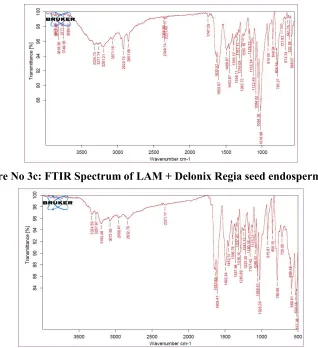
FTIR Studies:
optimized formulations were almost in the
same region of wave number ranging from
3326.95cm
-1to 1160.39cm
-1. It showed that IR
spectrum of lamivudine and excipients
admixtures were having similar fundamental
peaks and pattern. This indicated that there
were no drug excipients interactions in the
formulations.
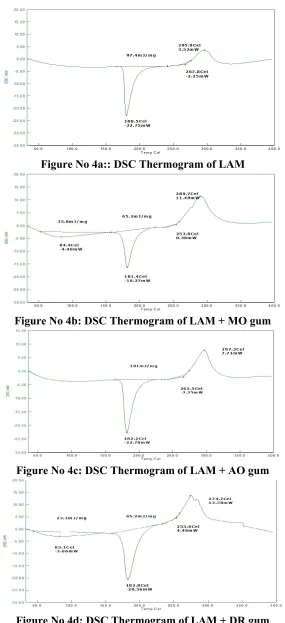
Differential Scanning Calorimetry:
DSC studies of Lamivudine alone and
admixtures with excipients were carried out to
study the interaction between the drug and
excipients used and the results of the study
were shown in figures 4a – 4d. The
DSC
Thermogram of Lamivudine showed sharp
endothermic peak at 180.5
0C. The DSC
Thermograms of drug excipient admixtures
showed sharp endothermic peaks for
Lamivudine with AO gum, MO gum & DR
gum at the temperatures 182.8
0C, 182.2
0C and
181.4
˚C respectively. This indicated that there
were no drug excipients interactions in the
formulations. Based upon these studies
suitable excipients were selected and
Lamivudine controlled release matrix tablets
were formulated.
Physicochemical & Phytochemical
characterization of natural gums:
The
gums
were
kept
for
physicochemical analysis, the results for each
parameter were found to be within the limits
and also satisfy the need of formulations. The
results were given in table 1. The purified
gums that are obtained were subjected to their
phytochemical characterization that is to
evaluate the nature of the gums. All the three
gums passed the molish test, fehlings test and
rheuthenium red test confirming that the three
gums contain carbohydrates, reducing sugars
and gum properties respectively and the results
were shown in the table 2.
Evaluation parameters:
The thickness of the tablets was found
to be in between 4.39-4.52mm and the
hardness was found to be in between 5.02 –
5.78 kg/cm
2. The tensile strength of the tablets
was found to be in between 5.81*10
5–
6.76*10
5N/m
2. The tablets satisfied friability
requirement, as the % friability values were
less than 1% (0.32-0.57). The drug content
estimations showed values in the range of
97.89 to 102.34%, which reflects good
uniformity in drug content among all
formulations. All the tablets passed weight
variation test as the % weight variation was
within the Pharmacopoeia limits of ± 5% of
the weight. All the formulations showed
values within the prescribed limits for tests
like hardness, friability and weight variation
which indicate that the prepared tablets are of
standard quality. These values were shown in
table-6. The results of the in vitro drug release
studies for formulations containing natural
gums were shown in figure-5. Among all the
formulations LET10 formulation showed the
prolonged drug release up to 18 hrs. The
controlled drug release may be due to
increased proportion of polymer. Based on the
release rate constant and % of drug release at
the end of 18 hours the release retarding
capacities of the polymers were arranged in
the following order, Endo sperm gum of
Delonix Regia seeds > Cashew nut tree gum>
Moringa oleifera tree gum. As the
concentration of gum or the rate retarding
polymer increased the drug release from the
controlled release matrix tablets was found to
be decreased in case of all the formulations.
The results were shown in figure-5 & 6.
Table No 1: Physicochemical Properties of Gums
S. No
Property
Delonix regia
seed gum
Anacardium
occidentale tree gum
Moringa oleifera
tree gum
1
pH of 1% w/v
solution
7.6
7.4
6.8
2
Viscosity of 1% w/v
solution
1400cps
1250cps
900cps
3
Swelling index%
700
600
450
4
Water retention
capacity
3.8ml
3.2ml
2.7ml
5
Hydration capacity
1.5±0.03
1.2 ± 0.06
1.3±0.02
6
Moisture sorption
capacity
1.57±0.52
1.44±0.21
1.41±0.32
Table No 2: Phytochemical Analysis of Natural Gums
S. No
Name of the test
Delonix regia
seed
gum
Anacardium
occidentalis
tree gum
Moringa oleifera
tree gum
1
Test for carbohydrates
(Molish test)
+
+
+
2
Test for Gums (Ruthenium
red test)
+
+
+
3
Test for Reducing sugars
(Fehling’s test)
+
+
+
4
Test for Alkaloids
(Wagner test)
-
-
-5
Test for Steroids
(Salkowski test)
-
-
-6
Test for Flavonoids
(Shinoda test)
-
-
-7
Test for Tannins
(Ferric chloride test
-
-
-+ Present, - absent
Table No. 3: Formulae of controlled release matrix tablets of Lamivudine
Formulation Code / Ingredients
(in mg)
LE
T1 LET2 LET3 LET4 LET5 LET6 LET7 LET8 LET9 T10LE T11LE T12LE LWG1 LWG2 LWG3
Lamivudine
300 300 300 300 300 300 300 300 300 300 300 300 300
300
300
DR
gum
100
-
-
200
-
-
300
-
-
400
-
-
400
-
-AO
gum
-
100
-
-
200
-
-
300
-
-
400
-
-
400
-MO
gum
-
-
100
-
-
200
-
-
300
-
-
400
-
-
400
PVP K30
-
-
-
-
-
-
-
-
-
-
-
-
6
6
6
Lactose
306 306 306 206 206 206 106 106 106
6
6
6
-
-
-Talc
7
7
7
7
7
7
7
7
7
7
7
7
7
7
7
Magnesium
stearate
7
7
7
7
7
7
7
7
7
7
7
7
7
7
7
Table No. 4: Flow properties of lamivudine granules
Formn. Code
Results (Avg. ± SD; n=6)
Bulk Density
(g/mL)
Tapped Density
(g/mL)
Carr’s Index
(%)
Hausner’s Ratio
Angle of Repose
(
0)
LET1
0.909 ± 0.008
1.020 ± 0.012
10.688 ± 0.542
1.121 ± 0.017
23.67 ± 0.324
LET2
0.934 ± 0.009
1.039 ± 0.011
10.418 ± 0.871
1.118 ± 0.018
20.08 ± 0.456
LET3
0.910 ± 0.014
1.038 ± 0.013
12.121 ± 0.852
1.140 ± 0.023
23.35 ± 0.843
LET4
0.925 ± 0.012
1.038 ± 0.014
10.766 ± 0.438
1.128 ± 0.021
19.91 ± 0.432
LET5
0.911 ± 0.011
1.028 ± 0.012
11.201 ± 0.652
1.121 ± 0.015
19.46 ± 0.612
LET6
0.935 ± 0.015
1.039 ± 0.016
10.934 ± 0.728
1.111 ± 0.014
20.98 ± 0.651
LET7
0.918 ± 0.013
1.032 ± 0.013
11.236 ± 0.673
1.126 ± 0.016
21.55 ± 0.648
LET8
0.918 ± 0.013
1.023 ± 0.011
12.583 ± 0.743
1.119 ± 0.021
19.08 ± 0.743
LET9
0.943 ± 0.013
1.041 ± 0.015
09.764 ± 0.996
1.106 ± 0.023
19.80 ± 0.721
LET10
0.943 ± 0.013
1.046 ± 0.019
09.167 ± 0.761
1.111 ± 0.016
24.31 ± 0.754
LET11
0.927 ± 0.015
1.029 ± 0.016
09.202 ± 0.732
1.110 ± 0.015
22.29 ± 1.342
LET12
0.932 ± 0.012
1.034 ± 0.011
09.984 ± 0.842
1.109 ± 0.021
23.08 ± 0.650
LET10A
0.929 ± 0.015
1.041 ± 0.015
12.511 ± 0.974
1.121 ± 0.015
21.29 ± 0.874
LET11A
0.938 ± 0.011
1.043 ± 0.018
10.581 ± 0.974
1.118 ± 0.019
24.36 ± 1.632
LET12A
0.917 ± 0.016
1.034 ± 0.018
11.245 ± 0.632
1.129 ± 0.012
24.03 ± 1.182
Table No. 5: Dissolution kinetics of lamivudie CR matrix tablets of all formulations
Formulation
Regression coefficient (R
2) value
Dissolution
rate constant
(%dose/hr)
Peppas ‘n’ value
Zero – order
First – order
Higuchi
LET1
0.991
0.674
0.852
32.46
1.499
LET2
0.993
0.655
0.901
49.11
1.709
LET3
0.955
0.870
0.981
71.83
1.883
LET4
0.991
0.744
0.850
13.54
1.136
LET5
0.968
0.718
0.902
22.54
1.407
LET6
0.995
0.752
0.878
34.12
1.533
LET7
0.994
0.752
0.866
7.51
0.943
LET8
0.997
0.659
0.834
10.34
1.026
LET9
0.984
0.641
0.874
13.71
1.170
LET10
0.999
0.677
0.842
5.65
0.749
LET11
0.998
0.617
0.836
6.47
0.805
LET12
0.996
0.621
0.805
8.41
0.894
LET10A
0.747
0.939
0.990
7.63
1.318
LET11A
0.710
0.902
0.993
8.80
1.375
Table No. 6: Results of various evaluation parameters of lamivudine CR tablets
Formn.
Code
Results (Avg. ± S.D.; n=6)
Thickness
(mm)
Hardness
(Kg/cm
2)
Tensile Strength
(N/m
2)
Weight (mg)
Average
Friability
(%)
Assay
(%)
LET1
4.46 ± 0.012
5.26 ± 0.16
6.144*10
5± 0.041
719.45 ± 0.63
0.47 ± 0.033
100.12 ± 0.52
LET2
4.41 ± 0.023
5.19 ± 0.21
6.168*10
5± 0.031
720.67 ± 0.66
0.55 ± 0.027
101.32 ± 0.46
LET3
4.49 ± 0.026
5.02 ± 0.23
5.841*10
5± 0.045
719.45 ± 0.42
0.57 ± 0.026
102.34 ± 0.24
LET4
4.42 ± 0.021
5.47 ± 0.14
6.474*10
5± 0.044
719.36 ± 0.76
0.44 ± 0.025
98.76 ± 0.42
LET5
4.48 ± 0.017
5.24 ± 0.18
6.024*10
5± 0.041
720.12 ± 0.72
0.43 ± 0.030
99.89 ± 0.32
LET6
4.51 ± 0.013
5.14 ± 0.18
5.967*10
5± 0.051
720.33 ± 0.33
0.52 ± 0.029
101.21 ± 0.11
LET7
4.41 ± 0.011
5.56 ± 0.19
6.515*10
5± 0.054
718.96 ± 0.47
0.41 ± 0.013
99.46 ± 0.14
LET8
4.39 ± 0.011
5.31 ± 0.22
6.247*10
5± 0.051
719.72 ± 0.32
0.36 ± 0.025
98.76 ± 0.46
LET9
4.46 ± 0.019
5.26 ± 0.13
6.126*10
5± 0.049
719.16 ± 0.33
0.46 ± 0.019
98.72 ± 0.34
LET10
4.39 ± 0.012
5.72 ± 0.22
6.761*10
5± 0.043
720.41 ± 0.65
0.39 ± 0.019
100.21 ± 0.11
LET11
4.42 ± 0.018
5.46 ± 0.26
6.468*10
5± 0.054
719.11 ± 0.56
0.31 ± 0.031
97.89 ± 0.62
LET12
4.48 ± 0.022
5.38 ± 0.24
6.212*10
5± 0.055
720.47 ± 0.45
0.43 ± 0.016
99.34 ± 0.22
LET10A
4.52 ± 0.016
5.79 ± 0.15
6.616*10
5± 0.054
719.33 ± 0.49
0.38 ± 0.023
98.22 ± 0.58
LET11A
4.51 ± 0.021
5.54 ± 0.14
6.334*10
5± 0.056
718.56 ± 0.52
0.32 ± 0.024
98.92 ± 0.41
LET12A
4.51 ± 0.014
5.46 ± 0.18
6.268*10
5± 0.059
719.66 ± 0.45
0.42 ± 0.028
102.68 ± 0. 12
Figure No 1: Chemical structure of lamivudine
Figure No 3a: FTIR Spectrum of Lamivudine
Figure No 3b: FTIR Spectrum of LAM + Anacardium Occidentale gum
Figure No 3c: FTIR Spectrum of LAM + Delonix Regia seed endosperm gum
Figure No 4a:: DSC Thermogram of LAM
Figure No 4b: DSC Thermogram of LAM + MO gum
Figure No 4c: DSC Thermogram of LAM + AO gum
Figure No 5: Drug release profiles of lamivudine CR matrix tablets of all formulations
Figure No 6: Drug release profiles of formulations of lamivudne CR matrix tablets
prepared from embedment (LET10, LET11 & LET12) and wet granulation (LET10A,
LET11A & LET12A)
CONCLUSION
The results of the drug release studies
on the prepared matrix tablets revealed that the
embedment technique was more effective for
the efficient incorporation of drug in the
polymer matrix than wet granulation technique
for the preparation of CR formulations to get
the desired control release. Therefore, it can be
concluded that even for the high water soluble
drugs like lamivudine, extended or controlled
release matrix tablets can be effectively
prepared by the embedment technique.
ACKNOWLEDGEMENTS
The authors are thankful to UGC, New
Delhi for providing funds to carry out this
research work and also thankful to Hetero
Drugs Pvt. Ltd., Hyderabad for providing gift
sample of lamivudine.
REFERENCES:
1. Chien YW. Novel drug delivery
systems. In: Chien YW, ed. Oral Drug
Delivery and Delivery Systems. New
York, NY: Marcel Dekker;
1992:193-196.
2. Ho-Wah Hui, Joseph R Robinson,
Vincent HL Lee. Design and
fabrication of oral controlled release
drug delivery systems. In: Joseph R
Robinson, Vincent HL Lee. Editors.
Controlled
Drug
Delivery:
Fundamentals and Applications. 2
nded.
New York: Marcel Dekker Inc; 1987.
p. 380.
4. Parveen A, Syed IA. Formulation and
Evaluation
of
Mucoadhesive
Microspheres
of
Lamivudine.
International
Journal
of
Pharmaceutical Sciences and Drug
Research. 2014; 6(2): 102-108
5. Katakam P, Padala NR, Chandu BR,
Elfituri A, Adiki SK, Kommu R.
Design of lamivudine XR matrix
tablets: Influence of HPMC and PEO
on in vitro drug release and
bioavailability in rabbits. Journal of
Pharmacy Research. 2013 Aug
31;6(8):845-52.
6. Singh AV, Nath LK. Formulation
development and evaluation of
lamivudine controlled release tablets
using cross-linked sago starch. Expert
opinion on drug delivery. 2013
Feb;10(2):173-82.
7. Singh B, Garg B, Chaturvedi SC,
Arora S, Mandsaurwale R, Kapil R,
Singh B. Formulation development of
gastroretentive tablets of lamivudine
using
the
floating
‐
bioadhesive
potential of optimized polymer blends.
Journal
of
Pharmacy
and
Pharmacology.
2012
May
1;64(5):654-69.
8. Apparao P, Prabhakarreddy JV, Raju
J, Shashidher B. Formulation and
evaluation of gum based matrix tablets
of Lamivudine. Der pharmacia sinica.
2011;2(3):176-92.
9. Ravi PR, Ganga S, Saha RN. Design
and study of lamivudine oral
controlled release tablets. AAPs
PharmsciTech. 2007 Oct
1;8(4):167-75.
10. Prajapati VD, Jani GK, Moradiya NG,
Randeria
NP.
Pharmaceutical
applications of various natural gums,
mucilages and their modified forms.
Carbohydrate polymers. 2013 Feb
15;92(2):1685-99
11. Sarangapani
S,
Rajappan
M.
Lansoprazole release from a floating
dosage form based on the natural
polymer of delonix regia. Int J Pharm
Tech Res. 2012;4(3):1085-95.
12. Gowthamarajan K, Jawahar N, Wake
P, Jain K, Sood S. Development of
buccal tablets for curcumin using
Anacardium
occidentale
gum.
Carbohydrate Polymers. 2012 May
16;88(4):1177-83.
13. Panda DS, Ansari SA. Preformulation
study on the gum of Moringa Oleifera.
Malaysian Journal of Pharmaceutical
sciences. 2013 Jul 1;11(2):41-7.
14. Ebere I. Okoye et al, Solid State
Characterization
Of
Anacardium
Occidentale
Gum, Research Journal of
Applied Sciences, Engineering and
Technology; 2012; 4(19): 3709-3716.
15. Mitul T. Patel et al, Assessment of
various
pharmaceutical
excipient
properties of natural
Moringa oleifera
gum,
International
Journal
of
Pharmacy & Life Sciences, 2012,
3(7):
1833-All © 2010 are reserved by Journal of Global Trends in Pharmaceutical Sciences.