Available Online At www.ijpret.com
INTERNATIONAL JOURNAL OF PURE AND
APPLIED RESEARCH IN ENGINEERING AND
TECHNOLOGY
A PATH FOR HORIZING YOUR INNOVATIVE WORK
AN APPROACH TO ENHANCE THE PRIVACY IN CLOUD COMPUTING USING
ACCOUNTABILITY AND STENOGRAPHY
SANDEEP TENGALE
Department of Information Science and Engineering, BLDE College of Engineering and Technology, Bijapur
Accepted Date:
27/02/2013
Publish Date:
01/04/2013
Keywords
Cloud,
Cloud computing,
Eucalyptus,
Maven.
Corresponding Author Mr. Sandeep Tengale
Abstract
Cloud computing is a technology which is considered as the next stage in Internet evolution. The “cloud” in cloud computing can be defined as the set of hardware, networks, storage, services, and interfaces that combine to deliver aspects of computing as a
service. Cloud services include the delivery of software,
Available Online At www.ijpret.com
1. Introduction
Cloud computing is a new trends in Internet
technology which has revolutionized the
Internet in terms of its use and capability.
Cloud computing is like a service on
demand which provides the service to the
end user based on their requirements. It is
called as anytime anywhere service which
allow the users to access and use their data
anytime and anywhere. Cloud computing is
about storing the data and required tools
on the network resources such as servers
and storage devices (cloud) and use it
anytime and at anyplace. The different
format of data can be stored on the cloud,
the different range of tools can be used on
the cloud, from word processing tool to
complex image processing tool. The end
users are not need to have all the tools with
him all the time, he just need to have the
browser to use the tools stored at the
server.
In this paper, we are addressing the issue of
the security and the privacy of the data that
we are storing on cloud server. In this
paper, we are particularly highlighting the
privacy aspect of the data. As the cloud
users are storing sensitive information and
proprietary tools on the cloud, there should
be some technique to handle the security
issues of our data. The usage of cloud will
make our data more transparent to cloud
service provider. There are some
possibilities that the service provider sell
the user data and tools to third party, so
the proposed method will address such an
issue.
Moreover this, as the user requirement
increases gradually the cloud service
providers starts running out of the
resources or the available server are not
capable to handle the requested service
type, in such cases they will hire some third
party servers which is again a
compromising factor to the privacy of the
user data. Disturbance of the security will
affect the cloud user as well as the service
providers. So its better to adopt the
innovative approaches of data security to
the cloud computing to enhance the privacy
of the data. There are different ways to hide
the data such as encryption, cryptography
etc. In the proposed method, we are using
the Stenographic method to hide the user
Available Online At www.ijpret.com
Stenography is a data hiding technique,
which will hide one format of data into
another format i.e. hiding of text data into
image, video or audio without distorting the
container. In the proposed method, we are
hiding the text data into the image of type
JPEG. So that even if the user data is
available to the cloud service provider in
image format, but he will not able get the
sensitive data out of it.
Since the data is stored on the servers
which are neither owned nor controlled by
some service provider, there is always a
fear of losing the control over their data.
Hence we are introducing a highly
decentralized approach which aims to
maintain accountability log in the server in
an executable JAR. The data owner can
access this JAR by authenticating himself to
the service which will list all the users who
access the user data making the data usage
transparent and traceable. This not only
adds access control but also the usage
control. Both method proposed here is
tested on Eucalyptus test bed and on
Heroku cloud using Maven. Eucalyptus is
open source software for cloud
virtualization which allow user to install
required operating system on the cloud and
Heroku is an online service which lets the
users to test their application of the cloud.
The rest of the paper is organized as follows
Section 2 is related work on security of
cloud computing, section 3 is proposed
method, section 4 deals with the
implementation details of proposed
methods and Section 5 is the conclusion of
the paper.
2. Related Work
A. Accountability is one of the factors
that can add more privacy constraint on the
user data. This can be achieve by using an
JAR(Java Archive) file which stores all the
information about the users accessed the
particular data from the cloud. The method
also makes the JAR inaccessible to
unauthorized user. The logging method is
implemented to this JAR file only the
authorized user can access or edit this file
by providing required credentials. The JAR
file is just like a log file which stores the
information such as IP address of the access
user, time of access and the file is a tamper
and damage proof. The file is made
Available Online At www.ijpret.com
less as possible. So as to make the JAR file
accessible to only the authentic user, the
Identity based encryption is used which
uses the public and private key pair.
Whenever any user access the data from
the server, the log file in the JAR gets
updated and it is encrypted with the public
key of the user. User can decrypt this log
file using his private key whenever it is
needed.
B. Stenography
This method uses the novel approach of
Stenography, which uses a secret key to get
access to the image and later it will perform
the stenography. The approach includes
manipulating the bit values of the container
image without distorting much of the image
content. It uses the shift operations such as
left and right shift depending upon the size
of the image. This container image can be
stored or can be sent to different location.
Only the person who knows the
stenography algorithm used to hide can
only able to extract the text from the given
image. This technique has used the .GIF and
.JPEG image as a container to hide the text.
The algorithm is tested with the PSNR
(Peaksignal-to-noise ratio), which indicated
the quality of the container after
application of the Stenography. The PSNR
value is high which indicates the good
quality of the Stenography.
C. Access control in cloud
There are some methods which deal with
how we can control the access to our own
data on the third party server. There are
many issues which need to be addressed
when we are using the data that is stored
on the external sever such as security,
availability and the data control. There are
security issues before the cloud computing
gets into market above that we are making
data more transparent with the use of
cloud technology. The available service like
Gmail and Amazon leverages the
advertising service to third party services
which seeks the user data to provide more
correct ads making the data more
transparent, to cope with such as access, a
novel approach is implemented. Here the
trusted monitor in installed on the server
which audits the data. Trusted Computing
also allows secure bootstrapping of this
Available Online At www.ijpret.com
from) the operating system and
applications. The monitor can enforce
access control policies and perform
monitoring/auditing tasks.
C. Virtualization
There is a method to improve the security
in the cloud computing by using the
virtualization. Cloud computing already
leverages the virtualization for the load
balancing with physical machines. The
concept of virtualization in turn helps in the
easy implementation of the security
procedures. Key kernel is a component that
is actively managing the key in the system
which is prune to get attacked. In order to
monitor the attack, the method is
monitoring the middleware components so
as able to detect any possible modification
to kernel data and code, thus guaranteeing
that kernel and middleware integrity have
not been compromised. The author has
included in the ACPS (Advanced Cloud
Protection System) in a virtual machine
which continuously monitors the cloud
environment from the external attack on
kernel and the middleware and the whole
system is embedded on the Eucalyptus test
bed and OpenECP. Suspicious
guestactivities canbe noticed bythe
Interceptor and recordedbythe Warning
Recorder into the Warning Pool,
wherethepotentialthreatwillbe evaluated
bythe Evaluator component and reported
the administrator.
3. Proposed Method
Here the entire method is divided into two
modules, one as a Stenography method and
another is the accountability method. As
the name indicated Stenography is data
hiding technique and accountability is the
data tracking technique which keeps the
account of user who access the data from
the cloud server. First we look at the
Stenography method used; this method is
tested on the Eucalyptus test bed and
Heroku cloud. Stenography is a java module
which is developed by shifting the image
pixel bits.
Stenography used in this case hides the text
data in the image; here we are using the
JPEG format image to manipulate. Every
image is made up of set of pixel and each
pixel is composed of set of bits which
Available Online At www.ijpret.com
Every pixel of the image in JPEG image is
made up of 8 bits which represents the RBG
component each. Depending on the text we
want to hide, we manipulate these bits by
shifting them in the required direction. The
care should be taken that the image should
not get distracted with this manipulation.
In the proposed technique, we are working
on the individual pixels. Every pixel is made
up of 8 bits, where least significant bit (LSB)
represents lower details of the image where
as the most significant bit(MSB) represent
the higher details of the image which
usually represent the edges and lines in the
image. So here we just manipulate the LSB
so that distortion of image will not take
place.
First we collect the text which has to be
hidden in the image. Then we calculate the
ASCII value of each letter and store in the
form of array. Next calculate the binary
value of the given ASCII value and store
separately in other variable. The bit shift
operations are applied on the pixels of the
image to store the text in it. Here are the
steps to hide the text into carrier image.
The given carrier image is a set of pixel of
particular length and width. First store the
image into the buffer and bring it to the
user space which gives all flexibility to work
directly on the pixels. Take the first letter
from the text which we want to hide, get its
ASCII value and convert into binary format.
Shift the bits in every iteration by some
number and store it in the last bit of the
pixel.
It’s required to have two iteration values,
one to keep track of the number of
iterations we are making and another to
maintain the offset of the image in the user
space. Only the last bit in every pixel is
edited by ANDing the pixel value with the
0XFE.
Now once the text is added to the container
image the data is hidden, we can use this
image to store on the cloud server or it can
be sent to third party. Because it is difficult
to predict the existence of text in the
image, even if it is predicted it’s difficult to
extract. The next operation is to extract the
text form the container image whenever it
is required for use.
The extraction of the text form the image is
Available Online At www.ijpret.com
the length of the text data is not known to
the system, so first 4 bytes of the image is
dedicated to store the length of the text
data that has been hidden in the image.
Depending on the value of length, first the
array of byte of given length is created. In
every iteration the pixel of given image
which is loaded into the user space will be
taken and its LSB will be taken out by
ANDing it with 0001. The offset value will
keep track of the pixel which is under the
process. The LSB value taken will be stored
into the array of bytes which we have
created initially. Now byte value is again
converted back to the character as an
extracted text which is hidden in the image.
Entire method is tested on Heroku using
maven as interpreter. So here we are
controlling the privacy of the user by using
the Stenography.
Another approach to control the privacy is
by using the technique of Accounting. The
accounting will keep track of the user who
has accessed the data stored on the cloud
storage. It uses the public key cryptography
along with the data encryption technique to
carry the task. This module consists of the
two components 1. Logger 2. Log
harmonizer
Logger is a component which is closely
associated with the user data. Whenever
any user tries to access any particular data
available on the cloud storage, the logger
generates the log data and it will be sent to
the log harmonizer. The data in the cloud
has some set of permissions such as read,
modify, download etc. depending on the
operation that is performed on the data the
log file is generated and stored o the log
harmonizer. Now the log harmonizer acts as
the central component which allows the
user to look into the log files generated.
There are two methods by which we can
look into the log i.e Push and Pull method.
Push method is one where the cloud service
provider themselves can send the log files
to the user to keep the user updated about
their data usage. These are beneficial for
those who want regular updates on their
data usage especially organization owners
or it is useful in those cases where the user
data is in heavy use. Pull method is like on
demand service, where the log information
Available Online At www.ijpret.com
Whole procedure is implemented using the
JAR concept of JAVA. JAR files are going to
act like the Logger and the Log harmonizer
on the cloud. Every cluster of data available
on the cloud server has a closely associated
JAR file along with it. So this process is
highly distributed and light weighted too. It
is possible that either cloud service provider
or external party can access or manipulate
the JAR file. So this method encrypts the
JAR file using the public key of the user. The
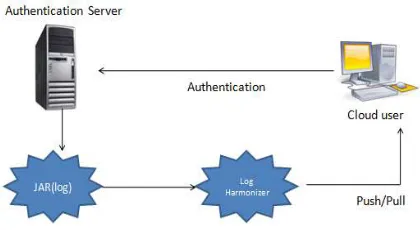
steps are pictorially showed in figure 1
Fig 1: Block for Accountability logger
The procedure starts with the generation of
key pairs by the user and authenticates
himself to the cloud service provider. This
process of decrypting the JAR will take place
automatically as the user logs into the
service. Now user can apply Pull technique
to download this file on to his system to
check the information about all the users
who has accessed the data. So whenever
cloud service provider or the third party
tries to access the user data from the cloud
server the log file will gets updated. The log
file collects the set of information such as
ID, ACT, TIME, Loc, Sig where ID represents
some identity of the user such as IP
address, ACT represents the action that is
performed on the data like read, download
or modify, TIME represents the time of
access of user data, Loc represent the
location of the user from where the access
is been done, this is indirectly dependent on
the IP address of the entity used it and sig
gives the signature of log so that it was
retrieved in case of corruption. These all
information is stored in the log file in the
form of the vector like
ri=<ID,ACT,TIME,Loc,SIG>
As soon as the log record is generated by
the logger associated with the data, the
record get updated into the JAR filed called
Log harmonizer. We can improvise the
security of the JAR file by embedding it with
an external JAR.
This technique will help to implement
Available Online At www.ijpret.com
Copying attack: If any other user such as
cloud service provider themselves or
attacker tries to access or download our
data stored on cloud server, then log file
will be updated with the access
information.
Breaking JAR attack:- Sometimes attacker
may try to break the JAR file which consist
of the access log information so to
manipulate it. But it can be controlled since
the JAR is encrypted with the public key of
the data owner.
Man in middle attack:- This attack is difficult
to take place, because it is only possible at
two points one before the access or after
the access. Since while access is taking
place, it supported by SSL encryption so
attacking in middle is difficult. Accessing it
before or after the use of JAR is not possible
as the JAR is fixed with timestamp, after the
timestamp the JAR will get encrypted again
with the public key of the user.
4. Implementation
We have implemented this method on the
cloud test bed called Eucalyptus and third
party service called Heroku and SalesForce.
First we tested it on Eucalyptus installed on
Ubuntu 11.10 server. On Eucalyptus, an
Eucalyptus certified operating system called
Euca2oolis installed which supports the
virtual machine to run the java application.
Here we are using Maven as the virtual
machine which supports to run the Java
web and simple AWT application.
Stenography and Availability parts are
implemented separately and mounted over
the cloud and tested. First we have a
Stenography module developed AWT which
accepts the text data from the user which
we want to hide and the image which acts
like a container to hide the sensitive data.
Bits of every pixel will be shifted based on
the text data that we are going to hide. First
the text data is converted to its ASCII value
and it converted to binary value. The last bit
of the binary value will be loaded to the last
bit (LSB)of image pixel. Here is the
algorithm
private byte[] bit_conversion(int i)
{byte byte3 = (byte)((i & 0xFF000000)
>>>24); byte byte2 = (byte)((i &
Available Online At www.ijpret.com
& 0x0000FF00) >>> 8 ); byte byte0 =
(byte)((i & 0x000000FF) ); return(new
byte[]{byte3,byte2,byte1,byte0});}
This new byte is will be ANDed with the
image pixel by updating particular pixel in
the image which is updated by an offset
variable.
int b = (add >>> bit) & 1;
image [offset] = (byte)((image[offset] &
0xFE) | b );
We used 0XFE because we want to keep all
15 bits except the last bit.
Next part is taking data out of the container
image, it is exactly the reverse of the hiding
process. Based on the offset value which we
have stored previously, keep tracing the bits
in the pixel to gather all the bits to store it
in an temporary variable, which will be the
text data that we have hided in the
container image.
Result [b] = (byte)((result[b] << 1) |
(image[offset] & 1));
Result is the variable where the given text
data is stored which is retrieved and
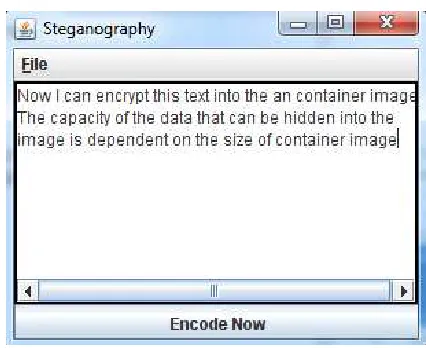
displayed. Figure 2 shown the design of the
design of the Stenography module.
Fig 2: Text to be hiding
Another part is the Accountability, where
we developed a Java Archive file and place
it on the cloud server. We are using a third
party service from SalesForce which carry
the encrypted login part, where we are
using RSA algorithm to encrypt so as to
make the secure login. The data is present
on the server for the image files each
having the set of permission. The JAR is also
present in the encrypted form which gets
decrypted when user login. Means after
login the JAR is open and accessible.
Whatever data that is used by any entity
will be getting logged into the JAR file
continuously, even the data owner access
Available Online At www.ijpret.com
into the log file. This file again gets
encrypted with the public key as soon as
user logs off. The log file available can be
pushed to the user periodically so that they
can get to know about their data access. If
the user wants the data at any point of
time, then he can download the log file with
the pull method. The design of the
Accountability module is shown in following
figure 3, where we can see the list of files
currently residing in the server. The list also
includes the owner of the file and date at
which the file is uploaded. All the files
present in the server are of type .PNG type.
Since the Stenography modules produce the
output in PNG format only. We can also
look at the option for the PULL method to
work which downloads the log file to the
client system
Fig 3: List of files on the server
The client system can access the files in the
server using from the browser via an
application which is capable of opening the
hidden text from the container image. Once
the file is available on the server, the
decrypt application should download the
.PNG image from the server and extract the
text out of it.
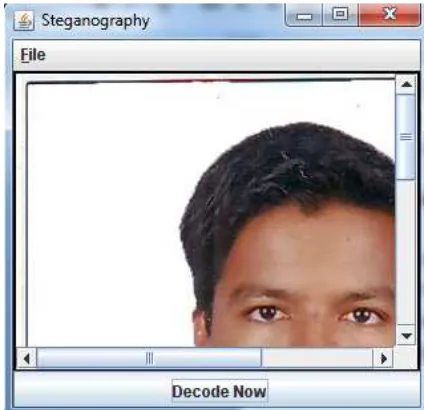
Fig 4: Container Image
This application will extract the text from
image using decode option. This decode
option will get data from pixel with every
iteration of the offset and fetch the last bit
from every pixel. The fetched pixel is
arranged in a byte variable which later
going to form an ACII value. Those ASCII
Available Online At www.ijpret.com
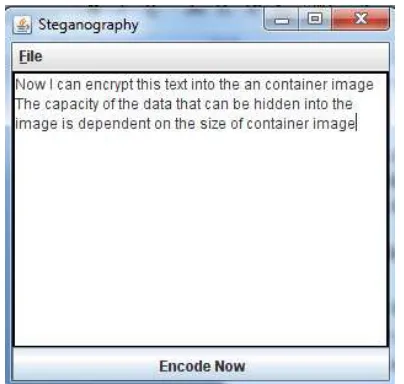
client machine as the user data. The
decoded text is shown in the figure 5.
Fig 5: Decoding the text from Container
image
The only drawback of this system is its
scalability issue. We need to store large
sized images onto the server which
consumes much space. Since scalability
itself is a major issue in all client-server
related service. Because storage
requirements increases with time. Storing a
new image for small amount of text data is
an expensive task. The remedy to this type
of stenography is the store the text data in
the media like video, which has high
capacity to store the text data. But
stenography is best method to control the
privacy in the data, in extension to that we
have added accountability factor which
keeps track of the illegal access of our data
in the cloud platform.
5. Conclusion
Cloud is used by larger firms and an
organization to store the sensitive data,
storing the sensitive data on the unknown
cloud server (which again hires the third
party server to meet the demands) is threat
to privacy of the data. So we can improve
the privacy protection of the data using the
oldest text hiding technique called
stenography because of which the data is
secure even if the data is available, the
attacker will not able to make much sense
form the data. Again to enhance the privacy
of the service, the accountability service is
also been added which will keep track of
the entire user data on the cloud server,
which will present the data owner the
access log who have accessed the data.
Using both the techniques we can keep
track of customer data, enhancing the
Available Online At www.ijpret.com References
1. Smitha Sundareswaran, Anna C.
Squicciarini, “Ensuring Distributed Account
ability for Data Sharing in the Cloud”, IEEE
Transactions on Dependable and Secure
Computing, Vol. 9, No. 4, July/August 2012.
2. Chao-Tung Yang, Wen-Chung Shih,
Guan-Han Chen, Shih-Chi Yu, “Implementation of
a Cloud Computing Environment for Hiding
Huge Amounts of Data”, International
Symposium on Parallel and Distributed
Processing with Applications.
3. Chittaranjan Hota, Sunil Sanka,
“Capability-based Cryptographic Data
Access Control in Cloud Computing”, Int. J.
Advanced Networking and Applications
Volume: 03; Issue: 03; Pages: 1152-1161
(2011).
4. Richard Chow, Philippe Golle, Markus
Jakobsson, ”Controlling Data in the Cloud:
5. Outsourcing Computation without
Outsourcing Control”, CCSW’09, November
13, 2009, Chicago, Illinois, USA.
6. Rosziati Ibrahim and Teoh Suk Kuan,
“Steganography Algorithm to Hide Secret
Message insidean Image”, Computer
Technology and Application Jouranal,
(2011) pp-102-108.
7. Flavio Lombardi, Roberto DiPietro,
“Secure virtualization for cloud computing”
,Journal of Network and Computer
Applications, November 2009.
8. Rolf Blom, An optimal class of symmetric
key generation systems, Proc. EUROCRYPT
84 workshop on Advances in cryptology:
theory and application of cryptographic
techniques, Springer Verlag, NY, USA, 1985,
pp. 335-338.
9. G. Miklau, and D. Suciu, Controlling
access to published data using
cryptography, Proc. 29th VLDB, Germany,