Available Online at www.ijpret.com 1207
INTERNATIONAL JOURNAL OF PURE AND
APPLIED RESEARCH IN ENGINEERING AND
TECHNOLOGY
A PATH FOR HORIZING YOUR INNOVATIVE WORKAN APPROACH FOR E-VOTING SYSTEM USING PREFERENTIAL VOTING
SWAPNIL DHANGARE1, RASIKA DHANDE1, GAURAV KHEDKAR1, SACHIT KHADSE1, VAIBHAV
THOSAR1, PROF. SWAPNIL KHEDKAR2
1. Student of Dept. of IT & CSE, DRGIT&R, Amravati – 444601. 2. Asst. Prof. of Dept. of IT & CSE, DRGIT&R, Amravati – 444601.
Accepted Date: 15/03/2016; Published Date: 01/05/2016
\
0
Abstract: The rapid advancement in information and communications technologies has given rise to new applications that were impossible just few years ago. One of these applications is e-voting. The term “e-voting” is defined as any voting method where the voter’s intention is expressed or collected by electronic means. This paper details the requirements, design and implementation of a generic and secure electronic voting system for ISTE, where voters can cast their votes for representative by giving preference to them, anytime, anywhere and using a number of electronic devices including private computer networks, web, mobile phones and voting results is being calculated by using preferential voting system.
Keywords: ISTE, E-Voting System, three tier architecture, preferential voting.
Corresponding Author: MISS. SWAPNIL DHANGARE Access Online On:
www.ijpret.com
How to Cite This Article:
Swapnil Dhangare, IJPRET, 2016; Volume 4 (9): 1207-1218
Available Online at www.ijpret.com 1208
INTRODUCTION
Available Online at www.ijpret.com 1209
voting process for voters, those having other difficulties in being physically present(having disabilities) at a poll site, increased voter turnout by providing extra voting channels, reduce overtime, the overall cost to the electoral authorities of organizing an election, deliver voting results accurately and more quickly amongst many other benefits. This paper details the requirements, design and working of a generic e-voting system, where voters can cast their votes anytime, from any place and using a number of electronic devices including web and mobile phones. Section 2 details a high-level set of general requirements that an e-voting system must satisfy. Sections 3 describe Literature Reviews on E-voting System. The architecture of an e-voting system that clarifies the stated requirements is presented in section 4. Section 5 outlines description and the implementation of a prototype for the e-voting system. Section 6 describes how preferential voting result is being calculated with example. Finally, section 7 presents some concluding remarks.
II. REQUIREMENTS DEFINITION FOR THE E-VOTING SYSTEM
The process of any voting system, whether electronic or traditional paper ballots or mechanical voting system must satisfy a number of competing criteria. These requirements are divided into two groups, namely, generic and system-specific. The system is to satisfy the following generic requirements:
i. Privacy: After casting a vote, no one should be able to link the voter to this vote;
ii. Authenticity: Only eligible voters can cast their votes;
iii. Integrity/accuracy: Once a voter cast a vote, no alternation to this vote is permitted.
Moreover, all valid votes must be counted, whereas all invalid votes must not be discarded;
iv. Security: Throughout the voting process, a vote can’t be tampered with;
v. Democracy: All eligible voters must be able to vote, one person - one vote and no one can
vote more than once or vote for others.
vi. Verifiability: Voters can independently verify that their votes have been counted correctly
and are included in the final tally.
The system-specific requirements of the framework allow:
Available Online at www.ijpret.com 1210 ii. Accessibility: The system can be accessed by voters from any location using secure Internet
and/or mobile devices;
iii. Availability: The system must have high-availability during an election campaign.
III. LITERATURE REVIEW
Sr. No. References Evaluation Approach
1. Malkawi M., Khasawneh M.,
Al-Jarrah O., (2009)
In this paper authors present a simulation model for a multifaceted online e-Voting system. The proposed model is capable of handling electronic ballots with multiple scopes at the same time.
2. Okediran O. O., Omidiora E. O.,
Olabiyisi S. O., Ganiyu R. A. and Alo O. O., (2011)
In this paper author discuss the security issues associated with remote internet voting. In particular, they examine the feasibility of running national elections over the Internet.
3. Okediran O. O., Omidiora E. O.,
Olabiyisi S. O., Ganiyu R. A. and Alo O. O., (2011)
This paper details the requirements, design and implementation of a generic and secure electronic voting system where voters can cast their votes anytime, anywhere and using a number of electronic devices including private computer networks, web and mobile phones.
4. G.O. Ofori-Dwumfuo and E.
Paatey (2011)
The aim of this study is to design an electronic voting system based upon the electoral process adopted in Ghana.
IV. ARCHITECTURE OF THE E-VOTING SYSTEM
Available Online at www.ijpret.com 1211
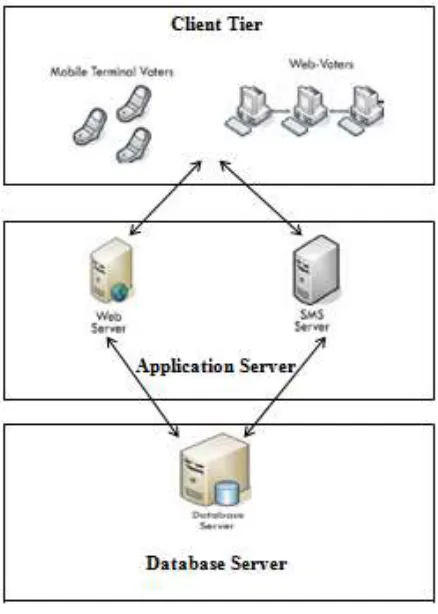
4.1 Client tier
The client tier is made up of the following components:
i. Mobile terminal voters and the mobile network operator: Voting is done through mobile App from which voters can vote to their favourite candidate. Communication between the mobile terminals and the database server is through Web Service provided by Android.
ii. Remote clients’ computers: Remote internet voting is done on the clients’ computers in locations outside the poll sites. The clients’ computers connect to the web server to load the web application over the internet via HTTP. The e-vote is sent to the poll site server via TCP/IP.
iii. Registration Centre and Poll Site Computers: The Registration Centre/Poll Site Computers in practice should be special-purpose computers for voters’ registration and poll site voting. Communication between the Registration Centre/Poll Site Computers and the Poll site server is by TCP/IP.
4.2 Application server tier
The application server tier is made up of
i. Voters use the Mobile App for Voting and also to access the e-voting system. At the lowest level, the SMS server interfaces to GSM modem(s) that Sends notification about election dates, details of candidate, etc. to voter through SMS messages using SMS service provider (mobile operator).
ii. The web server which interfaces the e-voting system to web voters. In addition, it stores the different web page(s) containing the code required to interact with the user as well as the database system.
4.3 Database server tier
Available Online at www.ijpret.com 1212
Fig. 1 Architecture of E-Voting System
V. EVOLVING THE OVERALL SYSTEM ARCHITECTURE
Available Online at www.ijpret.com 1213
ensuring highly availability during the electioneering process. Voters authenticate themselves by login into system with provided username and password. A voter ID and voting code sent to a particular SIM after registration cannot be used on another SIM for voting. The system ensures only one-person, one-vote (democracy) property of voting systems. Voter’s SIM, voting ID and voting codes of a voter intending to cast his/her ballot are matched at every voting attempt to prevent multiple voting. The overall system was developed base on the derived system requirements and on the .NET framework using Visual C#. Web applications were developed using ASP. NET while the data tables at the backend in the database server were developed using MS SQL Server 2012.
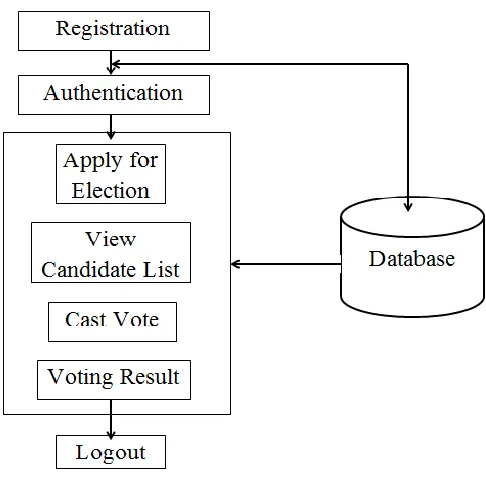
The following flowchart shows client side task and functionality of e-voting system,
Fig. 2 Client Side Flowchart
VI. PREFENCE VOTING SYSTEM
Available Online at www.ijpret.com 1214
Voters must give preference to the all representative.
If voter skip to give preference to one of the candidate then their vote get consider.
At any election where one or more seat is to be filled, every valid ballot paper shall be deemed to be the value of 100, and quota sufficient to secure the return of a candidate at the election shall be determined by using following formula,
Total number of votes
Quota = +1
Number which exceeds by 1 the number of vacancies to filled
Following section describe how preference voting system works,
Voters can write a “1” in the box of the option they prefer most. Then voter can put a “2” in the box of the option they prefer next, and so on.
Voter can rank as many or as few options as they wish, but he/she shouldn’t skip a number or use the same number more than once.
If one representative option gets votes equal to or more than quota of all the first preference votes (that is votes marked "1"), he/she will be selected on the first count.
If no option gets votes equal to or more than quota of the first preference votes, the option with the fewest number “1” votes is dropped and its votes go to the other representative each voter ranked next.
This continues until one representative gets votes equal to or more than quota of the valid votes cast in the first option referendum.
Available Online at www.ijpret.com 1215
Examples:
In this example,
Total number of votes
Quota = +1
Number which exceeds by 1 the number of vacancies to filled
= (100 / 2) + 1 = 51
Example 1:
The Aubergine flag (with 53 votes marked “1”) gets more than quota i.e. 51 for the 1st preference votes and is selected.
Flag option 1st count
Aubergine 53 Selected
Corn 8
Available Online at www.ijpret.com 1216
Tomato 14
Broccoli 5
Total 100 votes
Example 2:
The Aubergine flag (with 45 votes marked “1”) leads after the first vote count but does not have votes equal to or more than quota i.e. 51 of the 1st preference votes. So the flag with the fewest votes marked “1” – the Tomato flag – is dropped and its 11 votes go to the flag options marked “2” by these 11 voters. Aubergine gets seven of Tomato’s 2nd preference votes for a total of 52 votes and is selected as the alternative flag option for the second referendum.
Flag option 1st count 2nd count
Aubergine 45 45+7=52 Selected
Corn 19 19+2=21
Carrot 12 12+1=13
Tomato 11 Eliminated
Broccoli 13 13+1=14
Total 100 votes 100 votes
Example 3:
Available Online at www.ijpret.com 1217
There is still no flag option with 50% or more of the votes. So the flag with the fewest votes – Broccoli – is dropped and its eight votes go to the flag options each voter ranked next. Aubergine receives two of Broccoli’s next preference votes for a total of 44, Corn gets four of these votes for a total of 43 votes and Carrot gets two for a total of 13 votes.
There is still no flag option with votes equal to or more than quota i.e. 51. So the flag with the fewest votes – Carrot – is dropped and its 13 votes go to the flag options each voter ranked next. The Corn flag receives nine of these votes, enough to overtake Aubergine and be selected with 52 votes.
Flag Option 1st Count 2nd Count 3rd
Count
4th
Count
Aubergine 40 40+2=42 42+2=44 44+4=48
Corn 38 38+1=39 39+4=43 43+9=52
Carrot 10 10+1=11 11+2=13 Eliminated
Tomato 5 Eliminated
Broccoli 7 7+1=8 Eliminated
Total 100 votes 100 votes 100 votes 100
CONCLUSION
Available Online at www.ijpret.com 1218
A third concern is the voting system security at national level; how the system could be attacked by hackers and fraudsters, including system administrators Finally, electronic voting systems should be allowed to be scrutinized by experts in systems analysis and design, computer programming and computer system security. This would be the only way to ensure public confidence in such systems.
REFERENCES
1. Malkawi M., Khasawneh M., Al-Jarrah O., “Modeling and Simulation of a Robust E-voting System”. Communications of the IBIMA, Volume 8, 2009. ISSN: 1943-7765.
2. Okediran O. O., Omidiora E. O., Olabiyisi S. O., Ganiyu R. A. and Alo O. O., (2011), “ A Framework for a Multifaceted Electronic Voting System”. International Journal of Applied Science, Philadelphia, USA, vol. 1 No .4 pp 135-142.
3. Okediran O. O., Omidiora E. O., Olabiyisi S. O., Ganiyu R. A. and Alo O. O., (2011), “ A Survey of Remote Internet Voting Vulnerabilities”. World of Computer Science and Information Technology Journal (WCSIT) ISSN: 2221-0741 Vol. 1, No. 7, 297-301.
4. G.O. Ofori-Dwumfuo, E. Paatey, “The Design of an Electronic Voting System”. Research Journal of Information Technology 3(2): 91-98, 2011, ISSN: 2041-3114.