Organized by C.O.E.T, Akola, ISTE, New Delhi & IWWA. Available Online at www.ijpret.com70
INTERNATIONAL JOURNAL OF PURE AND
APPLIED RESEARCH IN ENGINEERING AND
TECHNOLOGY
A PATH FOR HORIZING YOUR INNOVATIVE WORK
AN APPROACH TO PARTITION AND MANAGE DATA SECURITY IN CLOUD
COMPUTING
MISS. SONALI S. DHULE, PROF. P.L.RAMTEKE
1. ME Student in Department of Computer Science and Engineering, H.V.P.M College of engineering and Technology, Amaravati. 2. Associate Professor in, Department of Information Technology, H.V.P.M College of Engineering and Technology, Amaravati.
Accepted Date: 07/09/2016; Published Date: 24/09/2016
Abstract: The advent of the cloud computing paradigm has given rise to many innovative and novel proposals for managing large-scale, fault-tolerant and highly available data management systems. It allows different service providers to distribute many applications as services in an economical way. Therefore, many users and companies have begun using cloud computing. However, they are concerned about their data when they store it on a third party, the cloud. Fears of leakage of sensitive data or loss of privacy make the adoption of cloud services less attractive for organizations. In this project an algorithm is presented to protect a table in a database from any leakage. We have developed a model with a view to offer secure data management capability in cloud databases. The model distributes and scatters the data over the cloud or data center in order to protect it from any leakage. Also, it explains the idea of ending the entire domain of t he sensitive table into the cloud. In addition, to increase security, we design a genetic algorithm to perform the optimal partition. We have conducted extensive simulations. The results show that our method can achieve more than 2X better performance over the execution without partitioning.
Keywords: Data Partitioning, Cloud computing, Security, RSA, Encryption, Decryption
.
Corresponding Author: MISS. SONALI S. DHULE
Co Author: PROF. P.L.RAMTEKE
Access Online On:
www.ijpret.com
How to Cite This Article:
Sonali S. Dhule, IJPRET, 2016; Volume 5 (2): 70-76 PAPER-QR CODE
SPECIAL ISSUE FOR
INTERNATIONAL CONFERENCE ON
“INNOVATIONS IN SCIENCE & TECHNOLOGY:
Organized by C.O.E.T, Akola, ISTE, New Delhi & IWWA. Available Online at www.ijpret.com71
INTRODUCTION
Cloud Computing is the key driving force in many small, medium and large sized companies and as many cloud users seek the services of cloud computing, the major concern is the security of their data in the cloud. Securing data is always of vital importance and because of the critical nature of cloud computing and the large amounts of complex data it carries, the need is even more important. Hence forth, concerns regarding data privacy and security are proving to be a barrier to the broader uptake of cloud computing services. With the potential to significantly decrease costs through optimization and increased operating and economic efficiencies, cloud computing is a great invention. In addition, cloud computing could significantly improve its cooperation, agility, and scale, therefore enabling a truly global computing model over the Internet infrastructure.
1.1 Dimensions of cloud security
1 Identity management
Every enterprise will have its own identity management system to control access to information and computing resources. Cloud providers either integrate the customer’s identity management system into their own infrastructure, using federation or SSO technology, or a biometric-based identification system,or provide an identity management solution of their own.
2 Physical security
Cloud service providers physically secure the IT hardware (servers, routers, cables etc.) against unauthorized access, interference, theft, fires, floods etc. and ensure that essential supplies (such as electricity) are sufficiently robust to minimize the possibility of disruption. This is normally achieved by serving cloud applications from 'world-class' (i.e. professionally specified, designed, constructed, managed, monitored and maintained) data centers.
3 Personnel security
Various information security concerns relating to the IT and other professionals associated with cloud services are typically handled through pre-, para- and post-employment activities such as security screening potential recruits, security awareness and training programs, proactive 4 Privacy
Organized by C.O.E.T, Akola, ISTE, New Delhi & IWWA. Available Online at www.ijpret.com72
1. PROPOSED WORK
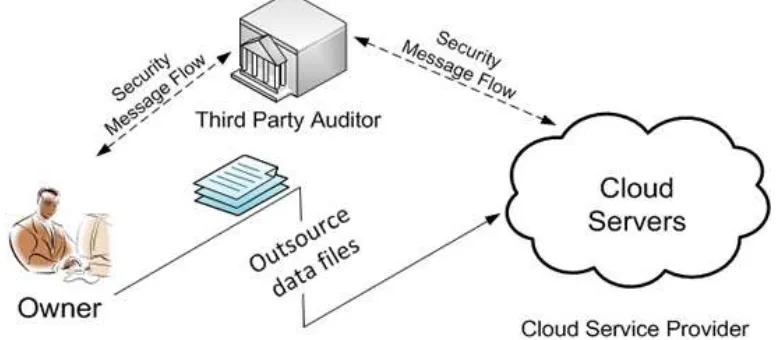
In this paper we describe about System model of Privacy Maintaining using public auditing scheme which provides a complete solution of data files and also integrity checking. The cloud data storage service consists of following different Entities
1. Client (User): Who have to stores large amount files on Cloud server.
2. Cloud Service Provider (CSP): It is separate entity that provides major storage space, resources, and maintenance for user data files.
3. Third Party Auditor (TPA): TPA is another network entity that has knowledge capability that client does not have. This is checking the user outsourced data files without copy of those files. Block of data files performed at User level. Block module accept user input file. When user Browse fileit divided into smaller parts. It helps to store the data effectively in quick manner enhancing easy access to data also when there is need. The original data is complex and there is difficulty in storing it in cloud, so blocking function is used to make the storage easy in cloud. The block of files are encrypted, that is encoded with the public key and stored in cloud.
In our proposed system user will first encrypt data and then Encrypted file divided into block that encrypted block will store on cloud. For encrypting data we are using RSA
Figure 1: TPA in cloud computing for secure Transmission 2.1 Data Partitioning
Algorithm for Partitioning:
1. Select File from local system.
2. File_Name := Retrieve file name from selected file.
3. File_Extension := Retrieve File Extension from selected file. 4. If PARTITION_NOT_EXIST (File_Extension)
4.1Then CREATE_PARTITION (File_Extention)
Organized by C.O.E.T, Akola, ISTE, New Delhi & IWWA. Available Online at www.ijpret.com73 6. File_Name_Letter := FILE_NAME_ALPHABATE (File_Name)
7. If PARTITION_NOT_EXIST(File_Name-Letter)
7.1 File_Count := COUNT_FILE_IN-PARTITION(Current-partition) 7.2If Threshold ≥ File_Count
7.2.1 Then CREATE_PARTITION(File_Name_Letter)
7.2.2 Current_Partition := NEW_PARTITION(File_Name_Letter) 7.3Else STORE_FILE (Current_Partition)
7.4Exit
8. Else Current_Partition:= NEW_PARTITION(File_Name_Letter) 9. File_Name_Letter:= NEXT_FILE_LETTER(File_Name_Letter) 10. GOTO Step 6
2.2 RSA algorithm
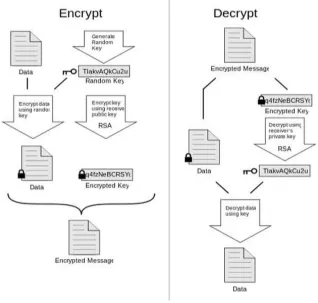
RSA algorithm involves three steps: 1. Key Generation
2. Encryption 3. Decryption
Key Generation:
Before the data is encrypted, Key generation should be done. This process is done between the Cloud service provider and the user.
Steps:
1. Choose two distinct prime numbers a and b. For security purposes, the integers a and b should be chosen at random and should be of similar bit length.
2. Compute n = a * b.
3. Compute Euler’s totient function, Ø(n) = (a-1) * (b-1).
4. Chose an integer e, such that 1 < e < Ø(n) and greatest common divisor of e , Ø(n) is 1. Now e is released as Public-Key exponent.
5. Now determine d as follows: d = e-1(mod Ø(n)) i.e., d is multiplicate inverse of e mod Ø(n). 6. d is kept as Private-Key component, so that d * e = 1 mod Ø(n).
7. The Public-Key consists of modulus n and the public exponent e i.e, (e, n).
8. The Private-Key consists of modulus n and the private exponent d, which must be kept secret i.e, (d, n).
2.2.1 Encryption:
Encryption is the process of converting original plain text (data) into cipher text (data).
Steps:
Organized by C.O.E.T, Akola, ISTE, New Delhi & IWWA. Available Online at www.ijpret.com74 2. User data is now mapped to an integer by using an agreed upon reversible protocol, known as padding scheme.
3. Data is encrypted and the resultant cipher text(data) C is C = me (mod n).
4. This cipher text or encrypted data is now stored with the Cloud service provider.
2.4 Decryption:
Decryption is the process of converting the cipher text(data) to the original plain text(data).
Steps:
1. The cloud user requests the Cloud service provider for the data.
2. Cloud service provider verify’s the authenticity of the user and gives the encrypted data i.e, C.
3. The Cloud user then decrypts the data by computing, m = Cd (mod n).
4. Once m is obtained, the user can get back the original data by reversing the padding scheme.
Figure 2: RSA Algorithm work flow
2. SYSTEM MODEL
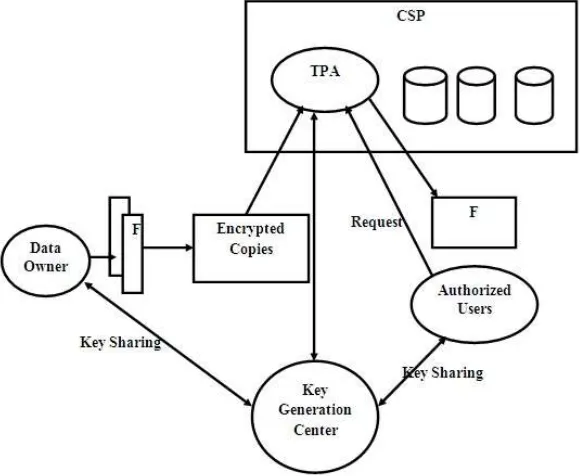
Organized by C.O.E.T, Akola, ISTE, New Delhi & IWWA. Available Online at www.ijpret.com75 other users in cloud. Data accessed from cloud service enables the services in secured manner. The data is partitioned into smaller blocks with file name before encryption for security by generating the public key to encode the data before storage. During the retrieval, the data are decrypted by generating the private key. Remote data integrity checking is used to maintain the data from threats. It also manages the effective storage and retrieval processes.
Figure 3: System Model
To get file list will return file list of a sub domain to cloud client check if sub domain is present or not if not present then return blank else return file list separated by comas. UDP File Store it will receive a file from cloud client and will store at a specified location on datacenter. UDP File Send it will send a file to cloud client at a specified IP address and Port number from specified location on datacenter.
3. CONCLUSION
Organized by C.O.E.T, Akola, ISTE, New Delhi & IWWA. Available Online at www.ijpret.com76 Thus, in our paper, we given solution to the problem as only the registered user can access the data. Even if some intruder (unauthorized user) gets the data accidentally or intentionally if he captures the data also, he can’t decrypt it and get back the original data from it. Hence forth, data security is provided by implementing RSA algorithm.
REFERENCES
1. Rongxing et al, ―Secure Provenance: The Essential Bread and Butter of Data Forensics in Cloud Computing‖, ASIACCS‘10, Beijing, China..
2. R. La‘Quata Sumter, ―Cloud Computing: Security Risk Classification‖, ACMSE 2010, Oxford, USA
3. Mladen A. Vouch, ―Cloud Computing Issues, Research and Implementations‖, Journal of Computing and Information Technology - CIT 16, 2008, 4, 235–246
4. Wenchaoet al, ―Towards a Data-centric View of Cloud Security‖, CloudDB 2010, Toronto, Canada
5. Soren Bleikertz et al, ―Security Audits of Multi-tier Virtual Infrastructures in Public Infrastructure Clouds‖, CCSW 2010, Chicago, USA.
6. Flavio Lombardi& Roberto Di Pietro, ―Transparent Security for Cloud‖, SAC‘10 March 22-26, 2010, Sierre, Switzerland.
7. Wayne A. Jansen, ―Cloud Hooks: Security and Privacy Issues in Cloud Computing‖, 44th Hawaii International Conference on System Sciences 2011.
8. Jinpeng et al, ―Managing Security of Virtual Machine Images in a Cloud Environment‖, CCSW, 2009, Chicago, USA
9. Miranda & Siani, ―A Client-Based Privacy Manager for Cloud Computing‖, COMSWARE‘09, 2009, Dublin, Ireland
10. Dan Lin & Anna Squicciarini, ―Data Protection Models for Service Provisioning in the Cloud‖, SACMAT‘10, 2010, Pittsburgh, Pennsylvania, USA
11. en.wikipedia.org/wiki/Locality_of_reference.
12. informationweek.com/news/storage/security/228300050 219