The Thirty-Third AAAI Conference on Artificial Intelligence (AAAI-19)
Learning to Communicate and Solve Visual Blocks-World Tasks
Qi Zhang,
1Richard Lewis,
2Satinder Singh,
1Edmund Durfee
11Computer Science and Engineering,2Department of Psychology, University of Michigan
{qizhg,rickl,baveja,durfee}@umich.edu
Abstract
We study emergent communication between speaker and lis-tener recurrent neural-network agents that are tasked to coop-eratively construct a blocks-world target image sampled from a generative grammar of blocks configurations. The speaker receives the target image and learns to emit a sequence of dis-crete symbols from a fixed vocabulary. The listener learns to construct a blocks-world image by choosing block placement actions as a function of the speaker’s full utterance and the image of the ongoing construction. Our contributions are (a) the introduction of a task domain for studying emergent com-munication that is both challenging and affords useful anal-yses of the emergent protocols; (b) an empirical comparison of the interpolation and extrapolation performance of training via supervised, (contextual) Bandit, and reinforcement learn-ing; and (c) evidence for the emergence of interesting linguis-tic properties in the RL agent protocol that are distinct from the other two.
Introduction
We are interested in the challenging problem of learning effective communication protocols for collaborative multi-agent settings in which limited bandwidth communication channels can be exploited by agents for task performance, but where no protocols are provided to the agents in
ad-vance. This topic, sometimes called language emergence,
has attracted interest in multiple fields over several decades (we briefly review some of this work below), including re-cent progress in the application of neural networks (NNs). We empirically study language emergence in a two-agent,
speaker-listenerNN-based architecture, where the speaker
observes the task goal and takescommunication actionsthat
sequentially emit symbols, and the listener (never seeing the goal) receives the utterance and acts on the task en-vironment. We investigate the degree to which the agents converge on communication protocols that have interesting linguistic structure, and that can successfully lead the lis-tener to (at least partially) achieve the goal. We compare the
speaker-listener architecture to abaselinearchitecture where
a single-agent both sees the goal and acts on the environ-ment.
Copyright c2019, Association for the Advancement of Artificial Intelligence (www.aaai.org). All rights reserved.
Our work makes three novel contributions to language-emergence research. First, we introduce a collaborative blocks-world construction task involving communication of discrete symbol sequences that is challenging, systemat-ically structured, and affords interesting analyses of the emergent communication. Second, we demonstrate that, when representing speaker and listener policies as recurrent neural networks, how they are trained affects how well their emergent protocols support generalization to unseen uration sizes (defined by the number of blocks in the config-urations). Specifically, we find that using Bandit for training supports greater flexibility in construction to improve perfor-mance over using supervised learning (SL), and that when using reinforcement learning (RL) more structured commu-nication emerges to overcome the harder problem induced by delayed rewards. Third, we demonstrate the emergence of interesting linguistic properties that distinguish the RL-trained agent from the other two. Specifically, we provide evidence for the emergence of subsequences (N-grams) of symbols with a power-law frequency distribution similar to that found in natural human languages, and that are impor-tant in carrying meaning in way that is consistent with some degree of compositionality.
Related Work
Research on language emergence spans many fields. Lin-guistics and cognitive science are particularly interested in the origins of properties of natural human language such as hierarchical structure (Nowak, Plotkin, and Jansen 2000; Nowak, Komarova, and Niyogi 2001; Steels 2003; Kirby, Griffiths, and Smith 2014). The role of evolutionary pro-cesses and pressures in shaping human language remains a controversial topic (Berwick and Chomsky 2015), but a point of agreement among most cognitive scientists and lin-guists is that language to some degree is shaped by the structure of the human cognitive architecture (Bratman et al. 2010). A potential beneficial outcome of computational explorations such as our work is to provide tools for cogni-tive science to explore the implications of agent architecture for emergent linguistic capacities.
NNs learned effective continuous communication through end-to-end backpropagation in several simulated multi-agent tasks. Foerster et al. (2016) proposed a framework with an end-to-end differentiable communication channel that allowed agents to communicate with one-bit messages for solving riddle games. In contrast to our paper, both of these papers did not evaluate the generalization ability of the learned communication protocols to unseen tasks. More recently, Mordatch and Abbeel (2017) grounded discrete communication learning in a multi-agent navigation task with goals given to the agents as disentangled features, and each agent was trained with the auxiliary task of predicting the goals of other agents. Like us, they used the Gumble-softmax technique for end-to-end communication learning, but unlike us, their agents are homogeneous in that they all have the same roles and they share all their parameters. They also emphasize and evaluate different kinds of generaliza-tion than in our experiments (specifically, they generalize to unseen numbers of agents and the presence of distractors).
In another line of work, the communication is learned in the context of two-player referential games wherein one agent has to identify the objects (usually images) referred to by the other agent through a learned language. For example, Lazaridou et al. (2016) allowed for communication with a single discrete symbol, while Havrylov and Titov (2017) al-lowed for variable-length discrete communication. Choi et al. (2018) and Lazaridou et al. (2018) instead took synthetic images as the referential objects, each containing an item of a particular color-shape specification. In these studies the emergent languages were able to generalize to unseen im-ages. Our work explores generalization in settings that re-quire the listener to perform a sequential task that places greater demands on the communication from the speaker to make rich task-relevant discriminations.
The Blocks-World Construction Task
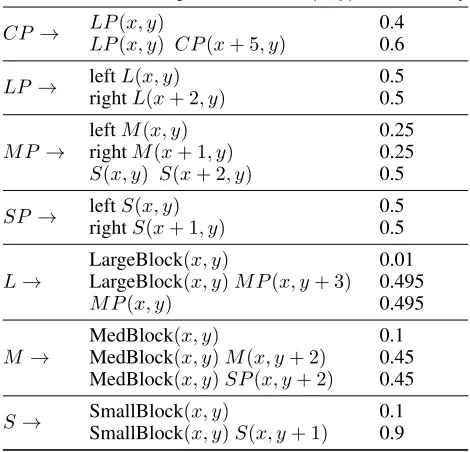
Grammar for generating target configurations. A tar-get configuration is generated by the probabilistic grammarin Table 1 by expanding the rule for aCP (“configuration
phrase”) with(x, y)initialized to(0,0)(lower left corner of
a10×10grid). There are small, medium, and large blocks
of sizes1×1,2×2, and3×3squares. The grammar creates
a variable number of stacks, from left to right, bounded by the width of the environment. Stacks have at most one large block, and a variable number of medium and small blocks, bounded by the environment’s height. Larger blocks never go on smaller ones, and blocks cannot cantilever. Two tow-ers of small blocks can appear over a large block. Figure 1 shows sample target configurations to provide a sense of the range of possible configurations. See Figure 2 for a tree sam-pled from the grammar, and its corresponding target image.
Observations. Observations of the target configuration and of the current work space are as raw (artificially gen-erated) pixel images of the sort seen in Figure 1.
Utterances and Construction Actions. In the two-agent setting, the speaker generates a fixed-length utterance by se-quentially generating symbols from the elements of a fixed
The non-terminal expanded based at(x, y) Probability
CP → LP(x, y) 0.4
LP(x, y) CP(x+ 5, y) 0.6
LP → leftL(x, y) 0.5
rightL(x+ 2, y) 0.5
M P →
leftM(x, y) 0.25
rightM(x+ 1, y) 0.25
S(x, y) S(x+ 2, y) 0.5
SP→ leftS(x, y) 0.5
rightS(x+ 1, y) 0.5
L→
LargeBlock(x, y) 0.01
LargeBlock(x, y)M P(x, y+ 3) 0.495
M P(x, y) 0.495
M →
MedBlock(x, y) 0.1
MedBlock(x, y)M(x, y+ 2) 0.45
MedBlock(x, y)SP(x, y+ 2) 0.45
S→ SmallBlock(x, y) 0.1
SmallBlock(x, y)S(x, y+ 1) 0.9
Table 1: The probabilistic context-free grammar for tar-get configuration generation. LargeBlock, MedBlock and SmallBlock are terminals; the rest are non-terminals.
Figure 1: Sample target images generated from grammar in Table 1. Note the varying number of columns and heights.
vocabulary V of primitive discrete symbols (“a”, “b”,...).
Note that the symbols inV have no predefined meaning;
their meaning gets implicitly grounded/defined during learn-ing based on what actions the learner takes after hearlearn-ing the utterances. A sample utterance is shown immediately above the grid in Figure 2b.
The learner’s action set A contains (30) actions to add
either a small, medium, or large block whose left side is
aligned with a particular columnxin the workspace, where
x ∈ [0,10) is an integer. The y-coordinate of the added
block is determined by simple gravity-like rules: in essence the block drops vertically until it hits another block below
it or to a y of zero if there is no block below it. The
lis-tener also has a special (31st) actionTerminate∈ Ato end
CP
CP
LP
L
MP
M
MedBlock(6,3) right
LargeBlock(5,0) left
LP
L
MP
M
M
SP
S
SmallBlock(2,4) right
MedBlock(1,2) MedBlock(1,0)
right left
0 2 4 6 8 10
0 2 4 6 8 10
1 2
3 4
x5:3x3, x6:2x2, x1:2x2, x1:2x2, terminate f h j i a e c i g d h d f j i
target configuration
Linear ReLU Linear Softmax action probabilities
CNN
current configuration
CNN
Figure 2: (a:top) Configuration tree generated from the grammar. (b:bottom-left) Target configuration rendered from the tree in (a). (c:bottom-right) The single agent ar-chitecture.
L S T M
target configuration
CNN
GS
Concatenation L
S T M GS
L S T M GS
current configuration
CNN
Linear ReLU Linear Softmax
…...
action probabilities
f h i
LSTM
f,h,...,i
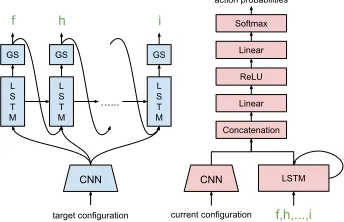
Figure 3: The speaker-listener architecture. The speaker’s modules are in blue and the listener’s modules are in red.
Agent Architectures and Learning
Single Agent Baseline Architecture.Shown in Figure 2c, the single agent gets both the target and current configu-ration images as input. The two images are processed by
shared multiple convolutional layers (i.e., the2CNNs in the
figure use the same weights). The concatenated learned fea-ture encodings of the two configurations are fed into a ReLU layer and then into a softmax layer that produce a distribu-tion over construcdistribu-tion (and terminate) acdistribu-tion probabilities. There are no utterances.
Speaker-Listener Architecture. Shown in Figure 3, the speaker gets the target image as input and outputs a fixed-length sequence of symbols, while the listener gets the full utterance of the speaker as input as well as the current workspace image, and outputs block placement / terminate actions. Note that during training the speaker and listener
NNs are trained end to end as if they were a single NN, i.e., gradients flow from the listener to the speaker; it is during evaluation that they act as separate agents. Both the speaker and the listener use convolutional layers with shared weights to extract high-level features from the observed configu-rations presented as images, and separate LSTM networks for speaking and listening. The speaker’s LSTM recursively takes the encoding of the target configuration and of the pre-vious symbol to produce a distribution over symbols to emit at the next step. A fixed-length sequence of symbols is gen-erated in this way using a Gumbel-softmax (Jang, Gu, and Poole 2016) trick (this allows gradients to pass through from listener to speaker that simply sampling from the softmax over symbols does not allow). The listener receives the entire discrete symbol sequence produced after Gumbel-softmax, and processes it through its LSTM to create an encoding of the speaker’s full sentence. At each time step of acting on the workspace this sentence representation is concatenated with the CNN’s encoding of the current configuration and fed through a ReLU layer into a final softmax layer to pro-duce a distribution over construction (and terminate) actions.
Supervised, Bandit, and Reinforcement Learning
We evaluated three training algorithms on both the baseline and the speaker-listener agents. Note that there are exponen-tially many action sequences because of the partial order over actions that yield the same target image. When using
supervised learning (SL), acanonical correct sequence of
construction actions is used to do the training, where the action sequence builds stacks left to right, and each stack from the bottom up (corresponding to the blocks’ order in a depth first traversal of the configuration’s parse tree). When using (contextual) Bandit, the agents are given a reward of
+1for every construction action that is consistent with the
target configuration and a−1for an action that is
inconsis-tent with the target configuration. When using RL the reward is the same as for Bandit but is accumulated and only made available at the end of the episode to the agents. In both Ban-dit and RL training an episode ends when the agent chooses an action that is inconsistent with the target image.
SL uses the following cross-entropy loss:
LSL=Eos∼Os,ol
0,a∗0,ol1,a∗1,...,a∗T−1 "
−X
t
logπlt(a∗t) #
(1)
whereosis a target configuration uniformly sampled from
the set of possible target imagesOs,{a∗
t} T−1
t=0 is the
super-vised action sequence for os, ol
t is the configuration after
taking the firsttactions, andπtlis the distribution of the
lis-tener’s actions conditioned onol
tand the speaker’s utterance.
The Bandit loss functionLBL =LBandit−λLentropy is
defined via
LBandit=Eos∼Os,ol
0,a0,ol1,a1,··· "
−X
t
rtlogπtl(at)
#
(2)
Ll
entropy =Eos∼Os,ol
0,a0,ol1,a1,··· "
X
t H(πtl)
#
whereHis entropy,λ≥0is the entropy regularization
co-efficient, andrt ∈ {±1}is the reward of the Bandit. Here
ol
tis the configuration after taking the firsttactions, and the
listener’s actionatis sampled fromπtl.
For RL training, we delay the reward signals until the very
end of an episode. Formally, the RL loss function isLRL=
LREINFORCE−λLentropy, andLREINFORCEis defined via
LREINFORCE= (4)
Eos∼Os,ol
0,a0,ol1,a1,··· "
−X
t
logπlt(at)(Rt−b)
#
whereRt=P
T−1 t0=tγt
0
−trRL
t0 is the cumulative reward from
time steptwith discount factorγ= 0.99, andbis the
base-line of REINFORCE which is set to be the average episodic
reward of the previous epoch. Againoltis the configuration
after taking the firsttactions, and the listener’s actionatis
sampled fromπlt.
Experiments: Agent Performance
Our experiments have two primary aims. The first aim is to demonstrate and understand the generalization abilities of the speaker-listener agents by examining their interpola-tion and extrapolainterpola-tion (these terms are defined formally be-low) performance. We contrast the performances obtained via Bandit, SL, and RL training, and use the single-agent as a useful baseline to provide a kind of upper-bound on expected performance of the speaker-listener agents. A sec-ond aim is to understand the emergent communication pro-tocols and how their linguistic properties relate to agent per-formance. We describe the structure of the experiments and report the performance measures in this section, and report on the analyses of the communication protocols in the fol-lowing section.
Experiment Structure
Data generation. We created data sets for our experi-ments by first sampling configurations from the probabilis-tic grammar and populating bins corresponding to configu-ration size (number of blocks) with unique configuconfigu-rations. More specifically, configurations were repeatedly sampled from the grammar up to a maximum of 10,000 unique con-figurations per bin and until the growth in unique urations became very slow. Bins corresponding to config-uration sizes of 8–21 blocks had the maximum of 10,000 unique configurations; bins in the 5–31 size range had 1,000 or more. The maximum configuration size is 40.
Training sets and interpolation-extrapolation testing sets. For each experiment we choose an
interpolation-extrapolation boundary B ∈ {15,25}. All configurations
with number of blocksNsatisfyingN≤B, except for
con-figuration sizes of multiples of 5 are used for training (i.e.,
we trained only on configurationsN ≤B, Nmod 5 6= 0).
All other configurations are used for testing. Specifically,
configurations with N < B, N mod 5 = 0 are used for
interpolation testing, andN > Bfor extrapolation.
Construction action and utterance symbol choice during testing. Unless otherwise noted explicitly, during testing, the speaker selects the next symbol with the maximum prob-ability (breaking ties randomly) to utter and the listener se-lects the next action with the maximum probability (break-ing any ties randomly) to take. The vocabulary size is set to
|V| = 10symbols, the utterance length is set to L = 15
symbols.
Results
Overall performance of interpolation and extrapolation.
We use two measures to assess interpolation and
extrapola-tion performance of all the agents.Full completionmeasures
the empirical probability of completing the target
configura-tion and terminating once it is constructed.Partial
comple-tionmeasures the proportion of the total number of blocks
in the target configuration constructed before the first
incor-rect action (i.e., this degree is defined asn/N, wherenis
the number of blocks correctly added by the agent before the first, if any, mistake). The second measure is more for-giving, but it is informative of how much the agents have learned.
Figures 4a, 4b, 4e, and 4f show the full completion on
testing configurations as a function of target image sizeN
for interpolation-extrapolation boundaryB∈ {15,25}.
Fig-ures 4c, 4d, 4g, and 4h show the partial completion. The graphs summarize the results of five independent runs for
each algorithm at each boundaryB; the shaded region is the
performance range of the five runs, the top solid line is the best run, and the dotted line is the mean.
For the baseline agent (Figures 4a-4d), Bandit and RL training are comparable and both significantly outperform SL. Indeed, the extrapolation of both the best Bandit and the
best RL trained baseline agent is excellent for theB = 25
setting, which itself is an interesting result (previous success on extrapolation in blocks world has required use of rela-tional or other structured representations (Irodova and Sloan 2005)). For the speaker-listener agents (Figures 4e-4h), the
3 training algorithms are roughly comparable at full
com-pletion, but Bandit is better at partial completion (especially evident in Figure 4g). Below we highlight a few empirical conclusions.
Unsurprising advantage of Single Agent. For extrap-olation, the single agent performs overall better than the speaker-listener, and this performance gap is especially large when the configuration size becomes large. This suggests that in this task, it is difficult for the agents to learn to gen-eralize communication about very large numbers of blocks.
Unless explicitly stated otherwise all of the discussion that follows is for the speaker-listener agents.
Explaining the Bandit extrapolation advantage over SL.
0 10 20 30 40 N = number of blocks 0.0
0.2 0.4 0.6 0.8 1.0
full completion
(a) Single agent, full,B= 15
0 10 20 30 40
N = number of blocks 0.0
0.2 0.4 0.6 0.8 1.0
full completion
(b) full,B= 25
0 10 20 30 40
N = number of blocks 0.0
0.2 0.4 0.6 0.8 1.0
partial completion
(c) partial,B= 15
0 10 20 30 40
N = number of blocks 0.0
0.2 0.4 0.6 0.8 1.0
partial completion
SL, best SL, mean Bandit, best Bandit, mean RL, best RL, mean SL, entropy, best SL, entropy, mean B/N
(d) partial,B= 25
0 10 20 30 40
N = number of blocks 0.0
0.2 0.4 0.6 0.8 1.0
full completion
(e) Speaker-listener, full,B= 15
0 10 20 30 40
N = number of blocks 0.0
0.2 0.4 0.6 0.8 1.0
full completion
(f) full,B= 25
0 10 20 30 40
N = number of blocks 0.0
0.2 0.4 0.6 0.8 1.0
partial completion
(g) partial,B= 15
0 10 20 30 40
N = number of blocks 0.0
0.2 0.4 0.6 0.8 1.0
partial completion
(h) partial,B= 25
Figure 4: Full and partial completion on test configurations; X-axis is target configuration size. Points left of the vertical
boundary line are interpolation tests; points right are extrapolation. Top graphs: Single agent architecture. Bottom graphs:
Speaker-listener architecture.Left graphs: Full completion (probability).Right graphs: Partial completion (proportion). Shaded
region is performance range of five runs, top solid line is best run, and dotted line is mean. Shared legend in upper right graph.
5 10 15 20 25 30 35 40
time step within episode 0.0
0.2 0.4 0.6 0.8 1.0
probability
number of blocks = 30
SL Bandit RL
5 10 15 20 25 30 35 40 N = number of blocks 0.0
0.2 0.4 0.6 0.8 1.0
partial completion
partial completion at boundary 25
SL greedy Bandit greedy RL greedy 25/N SL softmax Bandit softmax RL softmax
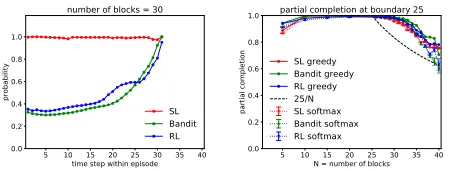
Figure 5:Left:Mean of maximum softmax probabilities for
listener’s actions duringN = 30,B = 25episodes. X-axis
is time step within episode.Right:Partial completion from
greedy sampling (solid) and softmax probabilities (dashed).
SL that follows in the rest of the paper is for training with-out entropy regularization. In the partial completion graphs
(Figures 4c, 4d, 4g, 4h), we also plot the curve ofB/Nfor
N > B. If partial completion exceedsB/N for aN > B,
the agents have learned to communicate about more blocks than they saw during training, instead of constructing only those blocks shared with the training configurations and ig-noring the rest. The best performing Bandit run dominates
B/NforB∈ {15,25}, while SL has runs dominatingB/N
only forB = 25. We conjecture that Bandit learning is
bet-ter at extrapolation than SL because it can exploit the partial ordering over construction actions for a given configuration, while SL cannot. To confirm this conjecture we examined the softmax probabilities according to which the listener se-lects actions, and assessed performance when greedy action selection is replaced with sampling from the softmax. Fig-ure 5 (left) shows the maximum probability of the listener’s softmax-action over time in an episode, averaged over target
configurations withN = 30blocks. (The results correspond
to the learning runs at boundaryB = 25 reported in
Fig-ure 4h above.) For the SL listener, the maximum softmax probability is almost always near one, while for the Bandit listener, it begins below half and then increases over time in an episode, indicating that substantial probability mass is spread over multiple actions. Figure 5 (right) shows par-tial completion when the listener selects actions greedily and when it selects actions by sampling from the softmax. For the SL listener, there is little difference between the two se-lection strategies because the softmax is very sharp. For the Bandit listener, sampling from the softmax results in only modest reduction in partial completion, indicating that the Bandit agents have learned to communicate such that the listener is able to identify more than one correct action for a given time point of the episode. Of course, RL agents have the same flexibility as the Bandit agents in terms of the abil-ity to learn multiple correct actions and unsurprisingly the RL curves in Figure 5 are similar to the Bandit curves. How-ever, RL agents do have a harder problem because of the delayed reward, and this leads to their lower performance.
Evidence of learning the blocks-world domain structure.
Because we have used a grammar to specify the structural regularities of the domain, it is possible to ask to what ex-tent the agents have learned this structure. One way to do this is to ask whether the incorrect construction actions
nev-ertheless are grammaticalin the sense that they result in a
configuration within the generative space of the grammar. Specifically, we analyzed the first incorrect action and found that in all runs for all agents, at least 80% of the incorrect actions were grammatical in this sense; in nearly all runs for
block sizes of<30, the proportion of ungrammatical errors
20% grammatical actions.
Analyses of the Communication Protocols
We now analyze the emergent communication protocols to gain insight into their linguistic properties and how these properties relate to performance. The analyses support four specific claims concerning interesting qualitative differences in the RL agents’ protocol as compared to the other two.
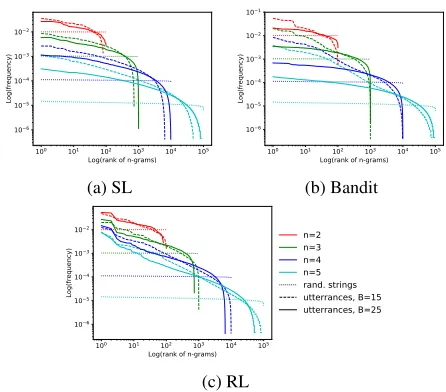
N-gram distributions for the three protocols. The first claim is that the RL agents rely on the reuse of frequent subexpressions to a much greater degree than the other agents. A simple distributional analysis of N-grams in the utterance corpora from the three protocols reveals this dif-ference. Figure 6 plots (log) frequency against (log) rank for all the of N-grams (up to 5-grams) produced by the RL, Ban-dit, and SL speakers. We plot the distributions in this man-ner to assess a possible correspondence with a Zipfian dis-tribution, which is expressed as an approximately log-linear relationship between frequency and rank, a robust statisti-cal regularity of linguistic forms in human languages (in-cluding words and even larger collocations) (Ellis 2002). The dashed lines show what is expected from a distribution of random strings. All agents are reusing subexpressions at much higher frequency than chance, and the approximate log-linear relationship holds up to very infrequent forms. But for the RL agents, the top-ranked N-grams are one to two orders of magnitude more frequent than the correspond-ing rank for the SL agents for both boundary 15 and 25 and for the Bandit agents in the boundary 25 case. In the bound-ary 15 case, the top-ranked N-gram for the RL agents are as frequent as, if not more than, the corresponding rank for the Bandit agents. Thus, RL utterances are much more likely to be composed of longer subexpressions that are reused in other utterances.
Action sequences induced by novel utterances composed of frequent N-grams. The second claim is that these fre-quent subexpressions and their compositions are more im-portant for conveying meaning for the RL agents. We test this claim by examining the action sequences induced by giving the listeners novel utterances composed from a vo-cabulary of frequent N-grams. The listeners take utterances as input and take actions until the first action that results in an ungrammatical configuration; we record the number of grammatical (in the sense of producing a grammatical blocks configuration) actions. Note that this is not a partial completion measure because there is no target configuration, but longer mean grammatical action sequences for a set of utterances indicate that the utterances are able to convey a larger portion of the space of grammatical configurations.
The analysis starts with the K most frequent N-grams,
forn= 2,3,4, and5, to form a vocabulary of4K“words”;
we exploreK = 10,20,30,40,50. We compare the mean
grammatical action sequence length across three utterance types: utterances composed of random strings, utterances
composed of asingleN-gram followed by a random string
of symbols, and utterances composed entirely of a concate-nation of frequent N-grams. An increase in the grammatical
100 101 102 103 104 105
Log(rank of n-grams)
10−6
10−5
10−4
10−3
10−2
Log(frequency)
(a) SL
100 101 102 103 104 105
Log(rank of n-grams)
10−6
10−5
10−4
10−3
10−2
10−1
Log(frequency)
(b) Bandit
100 101 102 103 104 105
Log(rank of n-grams)
10−6
10−5
10−4
10−3
10−2
Log(frequency)
n=2 n=3 n=4 n=5 rand. strings utterrances, B=15 utterrances, B=25
(c) RL
Figure 6: (Log) frequency of N-gram subsequences against (log) frequency rank for N-grams of different sizes (dashed
forB=15, solid forB=25), with the expected distribution of
random strings (dotted).
Table 2: Mean number of grammatical actions induced by length 15 utterances composed of top 20 ranked N-grams, one N-gram with random string suffixes, and random strings.
Cells are in the format ofB = 15/B = 25. All standard
errors are less than 0.01.
SL Bandit RL
N-gram full 8.06 / 6.04 10.11 / 7.24 7.60 / 7.14
One N-gram 7.28 / 6.70 6.26 / 6.58 3.80 / 4.27
Rand. strings 6.29 / 6.34 4.33 / 5.47 3.15 / 2.75
action sequence length across these three types would pro-vide epro-vidence that N-grams and their composition are im-portant conveyors of meaning.
Table 2 summarizes the results for utterances composed
of the top K = 20 N-grams (K = 20 produced the
longest grammatical sequences for all three agents). There is a clear increase for the RL agents across the three ut-terance types, suggesting that the frequent subexpressions are indeed meaningful at multiple positions in the utterance string and when they are composed. (This is not evidence that the subexpressions have a meaning that is independent of position or context; showing this would require more de-tailed analysis but does not bear on the present claim.) The protocols of the SL and Bandit agents have this property in the boundary 15 case, but in the boundary 25 case in which more of the larger configurations are used for training, this property disappears for the SL, and the Bandit has it to a lesser degree.
0 10 20 30 40 50 configuration distance 9
10 11 12 13
utterance distance
SL, B=15 Bandit, B=15 RL, B=15 SL, B=25 Bandit, B=25 RL, B=25
0 10 20 30 40
N = number of blocks 0.0
0.2 0.4 0.6 0.8
reduction in full/partial completion
partial full
Figure 7:Left:Mean utterance similarity measured by edit
distance as a function of configurations similarity measured by edit distance between the canonical action sequences of
sampled pairs. All standard errors are less than 0.02.Right:
Reduction in full and partial completion for the specific case
of RLB=25 one-symbol prefix truncation.
carry meaning than random strings or single N-grams for RL (and to a lesser degree, Bandit) agents suggests that the emergent protocol has some degree of compositional structure: the meaning of an expression is composed of the meanings of subparts of the expression. (Compositionality is thought to be a hallmark of human language, though even in human language, forms such as idioms violate composi-tionality.)
One implication of compositionality is that meaning sim-ilarity and utterance simsim-ilarity will covary, and we test for this relationship as follows. We sample pairs of target con-figurations of 5–15 blocks for boundary 15 and 5–25 blocks for boundary 25, for which the full completion of the agents is near one. We then give these configurations as input to the speaker to generate corresponding pairs of utterances, and measure the mean edit distance between pairwise utterances as a function of the edit distance between the canonical ac-tion sequences of the corresponding pairwise configuraac-tions. Figure 7(left) summarizes the results. For all agents, it is clear that utterance similarity and configuration similarity covary. From boundary 15 to 25, the agents are trained with more of the larger configurations, and the RL utterance pairs become more similar (that is, the edit distance is lower). The SL and Bandit utterance pairs do not have this property.
Prefix and suffix meanings: Robustness to truncation.
Our final claim is that the RL protocol is more robust to pre-fix and sufpre-fix truncation, consistent with another signature of compositionality: parts of expressions are meaningful in isolation, and convey part of the meaning of the whole. More specifically, we probe here to what degree prefixes and suf-fixes of utterances are meaningful to the listener.
Figure 8(left) shows thereductionin partial completion
relative to no truncation when the utterances are truncated
at l < L = 15 and the listener only takes as input the
first l symbols before taking any action. Similarly Figure
8(right) shows the reduction that happens when the utter-ance communicated to the listener drops the first symbol or first two symbols. The performance of all agents is more sensitive to prefix truncation; dropping just the first two sym-bols degrades performance considerably—but the RL agents are the most robust to prefix truncation, followed by Bandit. Both RL and Bandit agents are more robust to suffix
trun-0 10 20 30 40
N = number of blocks 0.0
0.2 0.4 0.6 0.8 1.0
reduction in partial completion
SL Bandit RL
(a) Suffix truncation,B= 15
0 10 20 30 40
N = number of blocks 0.0
0.2 0.4 0.6 0.8 1.0
reduction in partial completion
SL Bandit RL
(b) Prefix truncation,B= 15
0 10 20 30 40
N = number of blocks 0.0
0.2 0.4 0.6 0.8 1.0
reduction in partial completion
SL Bandit RL
(c) Suffix truncation,B= 25
0 10 20 30 40
N = number of blocks 0.0
0.2 0.4 0.6 0.8 1.0
reduction in partial completion
SL Bandit RL
(d) Prefix truncation,B= 25
Figure 8: Effect of truncated utterances. The curves are from
the best SL/Bandit/RL, and show the reduction in partial
completion relative to no-truncation (higher values corre-spond to greater reduction and hence worse performance).
Left:For suffix truncation, the utterances are truncated at 14
(solid), or 10 (dashed)Right:For prefix truncation, we drop
the first one (solid), or two (dashed) symbols.
cation than SL, suggesting that these agents have learned to use prefixes to encode earlier parts of the correct action se-quence.
Interestingly, for the RL agent in the boundary 25 case (see Figure 8d) partial completion when the first symbol is truncated is even higher than that with no truncation for some configuration sizes. However, as Figure 7(right) shows, there is significant reduction in full completion when the first symbol is truncated, verifying that information is spread across the full utterance.
Conclusion
This work presented a new collaborative blocks construction domain for studying emergent communication that is chal-lenging because it demands the speaking agent to express a rich set of task-relevant discriminations for the listening agent to succeed in the complex sequential decision-making task it faces. We demonstrated that it is possible to train speaker-agent recurrent neural nets with supervised, ban-dit, and reinforcement learning algorithms such that all three emergent communication protocols allow the agents to suc-cessfully communicate about blocks configurations of sizes unseen in the test set, including robust interpolation to sizes within the range of the test set, and modest extrapolation to larger sizes. We furthermore provided evidence that the Bandit training generalizes more robustly than SL training by exploiting the partial order over correct action sequences versus the canonical order forced upon SL.
Finally, we took steps to understand the nature of the emergent communication protocols, and how the differences among the three protocols might manifest in performance. Specifically, we provided evidence for the emergence of a Zipfian distribution of N-grams of symbols in all three pro-tocols, but with a qualitatively greater use of frequent N-grams in the RL protocols. We furthermore showed that for the RL protocols the frequent N-grams are more important in conveying meaning, that similar meanings (configurations) yield more similar utterances, and that parts of complete utterances (prefixes and suffixes) more robustly carry parts of the whole meaning. These differences are possible sig-natures of a greater degree of compositionality in the RL protocols.
These qualitative protocol differences and improved ro-bustness to truncation for the RL agents arise despite the fact that the RL agents performed somewhat worse overall on the interpolation and extrapolation measures than the SL and Bandit agents. The overall performance difference is not surprising given the significantly more challenging nature of the delayed reward RL training. But we can only con-jecture that the more robust communication learned by the speaker trained via RL also results from having to overcome the same more challenging delayed RL feedback. Evaluat-ing this conjecture, and applyEvaluat-ing unsupervised learnEvaluat-ing and other induction methods used in human language analysis, remains future work.
AcknowledgmentsWe thank the anonymous reviewers for great suggestions. This work was supported in part by the Air Force Office of Scientific Research under grant FA9550-15-1-0039. Any opinions, findings, conclusions, or recom-mendations expressed here are those of the authors and do not necessarily reflect the views of the sponsors.
References
Berwick, R. C., and Chomsky, N. 2015. Why Only Us:
Language and Evolution. MIT press.
Bratman, J.; Shvartsman, M.; Lewis, R. L.; and Singh, S. 2010. A new approach to exploring language emergence as boundedly optimal control in the face of environmental and
cognitive constraints. InProceedings of the 10th
Interna-tional Conference on Cognitive Modeling, 7–12.
Choi, E.; Lazaridou, A.; and de Freitas, N. 2018. Com-positional obverter communication learning from raw visual
input. arXiv preprint arXiv:1804.02341.
Ellis, N. C. 2002. Frequency effects in language process-ing: A review with implications for theories of implicit and
explicit language acquisition. Studies in Second Language
Acquisition24(2):143–188.
Foerster, J.; Assael, I. A.; de Freitas, N.; and Whiteson, S. 2016. Learning to communicate with deep multi-agent
re-inforcement learning. In Advances in Neural Information
Processing Systems, 2137–2145.
Havrylov, S., and Titov, I. 2017. Emergence of language with multi-agent games: Learning to communicate with
se-quences of symbols. In Advances in Neural Information
Processing Systems, 2146–2156.
Irodova, M., and Sloan, R. H. 2005. Reinforcement learning
and function approximation. InFLAIRS Conference, 455–
460.
Jang, E.; Gu, S.; and Poole, B. 2016. Categorical
reparameterization with Gumbel-softmax. arXiv preprint
arXiv:1611.01144.
Kirby, S.; Griffiths, T.; and Smith, K. 2014. Iterated learning
and the evolution of language.Current Opinion in
Neurobi-ology28:108–114.
Lazaridou, A.; Hermann, K. M.; Tuyls, K.; and Clark, S. 2018. Emergence of linguistic communication from
refer-ential games with symbolic and pixel input. arXiv preprint
arXiv:1804.03984.
Lazaridou, A.; Peysakhovich, A.; and Baroni, M. 2016.
Multi-agent cooperation and the emergence of (natural)
lan-guage. arXiv preprint arXiv:1612.07182.
Mordatch, I., and Abbeel, P. 2017. Emergence of grounded
compositional language in multi-agent populations. arXiv
preprint arXiv:1703.04908.
Nowak, M. A.; Komarova, N. L.; and Niyogi, P. 2001.
Evo-lution of universal grammar.Science291(5501):114–118.
Nowak, M. A.; Plotkin, J. B.; and Jansen, V. A. 2000.
The evolution of syntactic communication. Nature
404(6777):495.
Steels, L. 2003. Evolving grounded communication for
robots. Trends in Cognitive Sciences7(7):308–312.
Sukhbaatar, S.; Fergus, R.; et al. 2016. Learning
multia-gent communication with backpropagation. InAdvances in