125
Copyright © 2017. Vandana Publications. All Rights Reserved.
Volume-7, Issue-5, September-October 2017
International Journal of Engineering and Management Research
Page Number: 125-139
Design and Fabrication of Solar Dryer for Sustainable Livelihoods of
Fisher Women
Debashree Debadatta Behera1, Biswajit Nayak2, Shiv Sankar Das3 1
Sr. Lecturer, Mechanical Department, Centurion University of Technology and Management, Odisha, INDIA 2Associate Professor, Mechanical Department, Centurion University of Technology and Management, Odisha, INDIA
3Lecturer, MBA Department, Centurion University of Technology and Management, Odisha, INDIA
ABSTRACT
Fisherwomen traditionally dry fish in open, often in unhygienic conditions. It results in poor price realization from the market. Application of solar drying technology has the potential for higher value addition of fish products. Accordingly, a solar dryer has been designed and fabricated considering various system parameters such as inlet temperature of air, humidity, moisture carried by air per minute and outlet temperature of air. This dryer is being used by the fisherwomen in coastal area of south Odisha which is involved in technology based and market linked sustainable livelihood security of fisherwomen. The dryer has been designed with a capacity of 20 kg/day fish and is manufactured with aluminium sheet and SS304 grade stainless steel perforated trays. The present initiative relates to an energy efficient solar dryer for drying foods, vegetables, seafood, edibles or organic foods. More specifically, the present set up eliminates moisture and provides sufficient drying in a reliable, hygienic and economic way with all three modes of heat transfer viz., conduction, convection and radiation. Further, the present system eliminates the use of auxiliary heaters by taking advantage of direct sunlight falling over the dryer that is made of a good heat conducting material to heat air within the drying room. The solar drying device comprised of an enclosed means, a drying room, plurality of perforated holders for holding of drying material and a plurality for air blowing means powered by solar energy in order to provide effective removal of moisture. The perforation over the food holders is circular and the holders are spaced at an equal distance from each other within the drying room to facilitate effective air circulation. The air blowing through fan is used to increase the rate of moisture removal and circulation of heated air in the drying room. The entire drying operation takes place by means of direct solar energy falling over the dryer.
Keywords--- Solar energy; Moisture carrying capacity; Relative humidity; PV panel; Hygienic
Nomenclature
=Mass of water to be removed
Mp = Mass of product
Mi = Initial water content in percentage Mf = Final water content in percentage
Relative humidity
Partial pressure of water vapour
Partial pressure of water vapour when the air is fully saturated
Atmospheric pressure
Specific humidity at inlet of dryer Specific humidity at outlet of dryer Mass of dry air in kg/hr
Mass of water vapour RPM of fan
Volume of dry air Volume of water vapour
Velocity of air inside the chamber Velocity of the air at the outlet Volume flow rate
Diameter of the fan
Transverse cross section area of dryer Area of circular hole at outlet Angular velocity
Length of the dryer Width of the dryer
126
Copyright © 2017. Vandana Publications. All Rights Reserved.
I.
INTRODUCTION
Solar drying technology involves exposing food to sunlight, while air flowing past the food to remove the moisture content from the food naturally. The warmer the air, the more moisture it can remove from the food. The present invention relates to an improved solar dryer with improved air movement and warmth increasing the drying efficiency.
We need a more simplified, easy to use, economic and small scale direct solar dryer, which can utilize solar energy for drying food as well as for powering of air blowing units. A drying means which utilize all three modes of heat transfer, conduction, convection and radiation for enhanced drying to take place. The design needs to affordable by the fishers for a better hygienic way of drying food, thereby increasing the market value for their effort.
Fisherwomen in coastal area find it difficult to produce dried fish in a hygienic way. Exiting methods available are expensive (electric drying), unreliable (electricity is not available all the time) and unhygienic (open sun drying). Given the availability of rich solar energy for more than 80 percentage days in a year in coastal area of Odisha, it can be used for drying fish. Hence the present attempt will help fisherwomen in adding higher value to their fish product and in the process getting higher profit.
1.1 Development of Solar Drying
Solar drying is very important application of solar energy. Solar dryers use air collectors to collect solar energy. Solar dryers are used primarily by the agricultural industry. The purpose of drying an agricultural product is to reduce its moisture content to a level that prevents its deterioration. In drying, two processes take place: one is a heat transfer to the product using energy from the heating source, and the other is a mass transfer of moisture from the interior of the product to its surface and from the surface to the surrounding air. Traditionally, farmers used the open-to-the-sun or natural drying technique, which achieves drying by using solar radiation, ambient temperature, relative humidity of ambient air and natural wind .The process (open-to-the-sun), however, has some serious limitations. The most obvious ones are that the crops suffer the undesirable effects of dust, dirt, atmospheric pollution, and insect and rodent attacks. All these disadvantages can be eliminated by using a solar dryer.
All drying systems can be classified according to their temperature range i.e. high temperature range dryer and low temperature range dryer [1]. The solar dryers are classified based on modes of air movement, exposure to insulation, direction of air flow, arrangement of the dryer and status of solar radiation [1]. Kainji Solar Tent Dryer (KSTD) was constructed as an improvement of Doe’s tent and the two solar tent dryers were used to dry fish [1].
Doua1,et al [2] have design and fabricated small-scale drying equipment. These mechanisms are based on the existence temperature gradient or pressure gradient between the entry and the exit of the drying chamber. Khoshmanesh et al [6] investigated a solar dehydrator for the requirements of fish drying process such as minimum moisture content, air temperature, air velocity, etc. Murugappa et al [4] investigated a forced flow type dryer, which consists of air heater, fan and drying chamber for drying food products. YefriChana et al [17] have developed a conventional flatbed dryer has the demerit of having nonhomogeneous drying results.
1.1.1 Passive Solar Dryer
Passive solar dryers are also called natural circulation or natural convection systems. They are generally of a size appropriate for on-farm use. They can be either direct (e.g. tent and box dryer) or indirect (e.g. cabinet dryer). Natural-circulation solar dryers depend for their operation entirely on solar-energy. The box-type is one type of passive solar dryer which consists of a wooden box with a hinged transparent lid. Another type of passive solar dryer iscabinet solar dryer [1].
1.1.2 Active solar cabinet dryers
Active solar dryers are also called forced convection or hybrid solar dryers. Optimum air flow can be provided in the dryer throughout the drying process to control temperature and moisture in wide ranges independent of the weather conditions. The use of forced convection can reduce drying time by three times and decrease the required collector area by 50 %. Consequently, dryer using fans may achieve the same throughput as a natural convection dryer with a collector six times as large [1].
1.2 Design and Fabrication of Solar Dryer
127
Copyright © 2017. Vandana Publications. All Rights Reserved.
of a solar dryer for drying osmotically dehydrated cherrytomatoes is presented [9]. The dryer consists of drying cabinet, heat exchanger, 16-m2 water type solar collector, and water type heat storage unit.David Gudiño-Ayala et al, [16] presents the results of an experimental pineapple (Ananas comosus L.) drying study in a new solar hybrid dryer. The complete solar dryer was comprised of a feed hopper, centrifugal blower, pneumatic conveyor and a transparent structure acting as drying chamber containing a hopper with vortex at the top. Pneumatic conveyor was used to make recirculation of the grain and to perform continuous drying process. Spherical model was used to predict the drying time [17].
1.2.1 Geometric effect
The direction that a solar panel face is referred to as its orientation. The orientation of the solar array is very important as it affects the amount of sunlight hitting the array and hence the amount of power the array will produce. The orientation generally includes the direction the solar module is facing (i.e. due south) and the tilt angle which is the angle between base of the solar panel and the horizontal. The amount of sunlight hitting the array also varies with the time of day because of sun’s movement across the sky. Solar module should be installed so that as much radiation is collected as possible.
The purpose of a dryer is to supply more heat to the product than that available naturally under ambient conditions, thus increasing sufficiently the vapours pressure of the crop moisture. Therefore, moisture migration from the crop is improved. The dryer also significantly decreases the relative humidity of the drying air and by doing so, its moisture-carrying capability increases, thus ensuring sufficient low equilibrium moisture content. In this work the broad objective is to develop an energy efficient solar dryer for drying foods, vegetables, seafood in coastal area of Odisha.
II.
DESIGN AND FABRICATION
In this work the solar dryer has been designed considering various system parameters such as inlet temperature of air, humidity, moisture carried by air per minute and outlet temperature of air. The materials are considered for various parts of the dryer and dryer is fabricated by various processes.
2.1 Design calculations
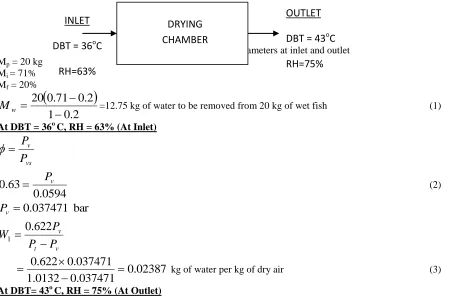
For design calculations the considered dry bulb temperatures (DBT) and relative humidity (RH) at inlet and outlet are shown in figure 3.1. The parameters are considered after a brief study of atmosphere at the coastal area of south Odisha.
Figure 2.1. System parameters at inlet and outlet Mp = 20 kg
Mi = 71% Mf = 20%
=12.75 kg of water to be removed from 20 kg of wet fish (1)
At DBT = 36o C, RH = 63% (At Inlet)
(2)
kg of water per kg of dry air (3)
At DBT= 43o C, RH = 75% (At Outlet)
2
.
0
1
2
.
0
71
.
0
20
wM
vs vP
P
0594
.
0
63
.
0
P
vbar
037471
.
0
vP
v t vP
P
P
W
0
.
622
102387
.
0
037471
.
0
0132
.
1
037471
.
0
622
.
0
INLET
DBT = 36
oC
RH=63%
OUTLET
DBT = 43
oC
RH=75%
DRYING
128
Copyright © 2017. Vandana Publications. All Rights Reserved.
(4)kg per kg of dry air (5)
(6) Assuming 10 hrs./day (in one day to be dried)
Mass of dry air per second, kg/sec
Volume flow rate of dry air,
m3/ sec (7)
(8)
Diameter of duct m =121 mm
Assuming 1.5 m/sec is the velocity of air inside the chamber
Velocity of air inside the chamber
Velocity of air inside the chamber = 0.068 m/sec (9)
2.2 Working principle
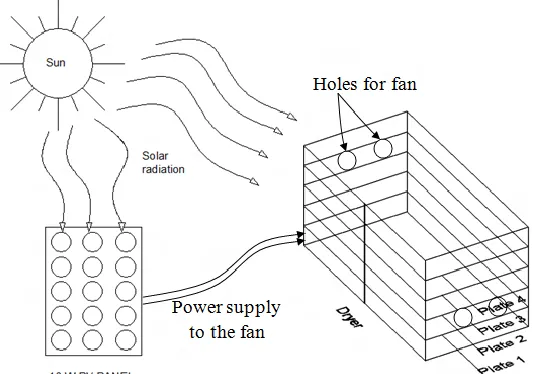
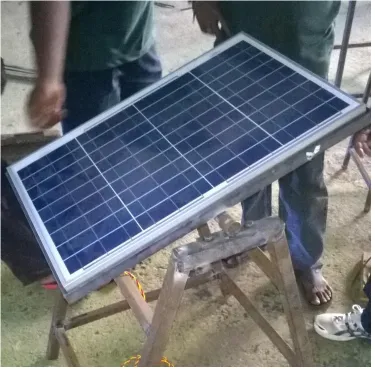
This unit consists of drying chamber and 10 watt solar PV panel for converting solar radiation into electricity (Fig. 2.2). This panel has been integrated with dryer for powering 4 no of 12V DC fan that is two induced draft fan and two forced draft fan. Further solar radiations facilitate the drying operation to take place. Solar radiations fall upon the dryer and heats up the device. The dryer comprises of an enclosed means to open and close
the unit a plurality of food holding means arranged at equal distances. Provisions are made at the side walls of the dryer for a set of air blowing units powered by means of solar photovoltaic cell. Plurality of blowers according to the invention, assist in ingress and egress of air. Off the plurality of blowers at the walls of the dryer a set of blowers (forced draft fans) creates a positive pressure i.e. above the atmospheric pressure are placed at the higher side of the wall to ingress air into the unit across the food
vs v
P
P
08649
.
0
75
.
0
P
vbar
0648
.
0
vP
v t vP
P
P
W
0
.
622
20425
.
0
0648
.
0
0132
.
1
0648
.
0
622
.
0
1 2W
W
M
m
w a
air
dry
of
kg
3
.
684
02387
.
0
0425
.
0
75
.
12
am
hour
per
air
dry
of
kg
4
.
68
10
3
.
684
am
019
.
0
3600
4
.
68
am
v t a a a aP
P
T
R
m
V
510
037471
.
0
0132
.
1
)
36
273
(
287
01901
.
0
01727
.
0
5
.
1
4
2 11
v
d
A
V
121
.
0
d
2 2 1 1v
A
v
A
0
.
121
1
.
5
4
0.25
1 2129
Copyright © 2017. Vandana Publications. All Rights Reserved.
holders, while the another set of blowers (induced draftfan) are placed at the bottom of the wall of dryer to egress air out of the unit. Further the fans provide proper circulation of air within the drying room of the drying unit. According to the design dry air is drawn into the unit by means of set of air blowing units. The dryer being made of a good heat conducting material, transfers heat immediately to the dry air within the unit via convection. Air blowing units; create convective air currents in the
drying chamber, circulating warm air in the entire drying chamber. This warm air, passes across the food holders, through the perforations on the food holders, thereby drawing moisture from the food placed over the holders. The dry, warm air absorbs moisture from the food, becomes saturated moisture laden air. This saturated air is withdrawn from the unit by another set of air blowing units.
Figure 2.2. Schematic diagram of solar drying process using solar dryer
2.3 Physical size of the dryer
Length : 1000mm, Breadth : 500mm, Height : 500mm
Tray dimension : 980mm X 480mm, Tray equally
spaced : 100mm
130
Copyright © 2017. Vandana Publications. All Rights Reserved.
Figure 2.3. Dimensions of the top, bottom and side frame.131
Copyright © 2017. Vandana Publications. All Rights Reserved.
2.4 Specification for fabricationThe dimensions of the solar dryer has been determined based on the system parameters such as flow of air, capacity of dryer and moisture carried by dry air. Capacity of solar dryer: 20 kg
Type of products to be dried: fish No of trays used: 4
Length : 1000mm, Breadth : 500mm, Height : 500mm
Tray dimension : 980mm X 480mm, Tray equally spaced : 100mm
Materials
Body of the dryer: Commercial grade Aluminium (3mm)
Tray : Stainless steel of grade 304 Solar Panel: 10 W Panel (Vikram Solar)
2.5 Budget (BOQ) Proposal for Solar Dryer, Capacity of 20 KG
The broad objective of this Budget proposal is to develop an affordable, reliable and high quality solar dryer to be used for drying raw fish. The prototype is made by aluminium sheets, S.S. sheet, angle bars (Specification given). The total prototype constitute of three broad things
1) Aluminium sheets are cut as per the dimension by shearing machine.
2) The frame and treys are fabricated as per the dimension.
3) Sheets are drilled as per the dimension and joined by riveting process.
4) Trays are drilled for proper airflow, 12V DC fans are fixed in sideways for proper airflow into the system and black paint is applied all over the body.
2.6 Fabrication process
The dryer has been fabricated with the help of aluminium sheets, S.S. Bolts, Angle bars. The various parts of the dryer have been fabricated by various processes. The fabrication is explained below.
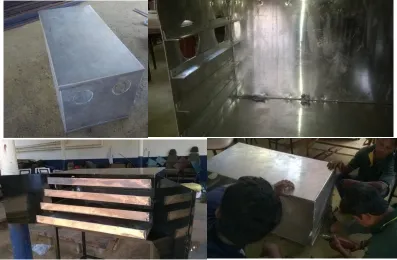
Sheet Metal Cutting: Sheets are cut to the dimension of top and bottom frame, side frame, back supporting frame and four trays by shearing process. The frames are joined by riveting process. Since Aluminum welding process is not available here. To fix the 12V DC fan four holes of diameter 120 mm are made by drilling process. These fans are fixed in sideways for proper airflow into the system. Trays are perforated for proper airflow and placed inside the dryer at equal space. To keep the trays the angle bars are fixed on the side frame of the dryer. The fabrication of different parts of dryer is shown in figure 2.5. The figure 2.6 shows the complete dryer and the solar panel.
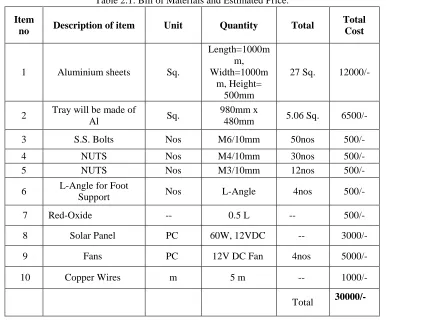
Table 2.1: Bill of Materials and Estimated Price. Item
no Description of item Unit Quantity Total
Total Cost
1 Aluminium sheets Sq.
Length=1000m m, Width=1000m
m, Height= 500mm
27 Sq. 12000/-
2 Tray will be made of
Al Sq.
980mm x
480mm 5.06 Sq. 6500/- 3 S.S. Bolts Nos M6/10mm 50nos 500/-
4 NUTS Nos M4/10mm 30nos 500/-
5 NUTS Nos M3/10mm 12nos 500/-
6 L-Angle for Foot
Support Nos L-Angle 4nos 500/- 7 Red-Oxide -- 0.5 L -- 500/- 8 Solar Panel PC 60W, 12VDC -- 3000/- 9 Fans PC 12V DC Fan 4nos 5000/-
10 Copper Wires m 5 m -- 1000/-
132
Copyright © 2017. Vandana Publications. All Rights Reserved.
Figure 2.5. Fabrication of different parts of solar dryer by various processesFigure 2.6. Dryer and solar panel
2.7 Installation of Photo Voltaic panel
The figure 2.7 shows the solar tracking frame which is installed in order to make the module facing towards the sun at all times. Because the amount of
133
Copyright © 2017. Vandana Publications. All Rights Reserved.
Figure 2.7. The installation of PV panelIII.
RESULTS AND DISCUSSIONS
In this chapter the experiments on the solar dryer have been conducted. 20 kg of different types of fishes have been taken for the experiment.
3.1. Inside Temperature of Dryer
To measure the inside temperature, the dryer is kept in a open field so that the dryer can be exposed to sun
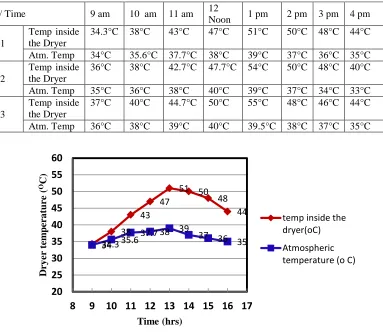
ray. For the experiment the considered parameters are presented in the table 3.1. The experiment is started at 9 am and at every one hour interval the inside temperatures are measured by non-contact type pyrometer. The temperatures obtained from the experiment are shown in the table 3.2.
Table 3.1. Various Parameters Considered for Experiment. Name of the Product Fish (Kana Katha) - Indian Mackerel Zoological Name Rastrelliger Kanagutra
Month May
Starting Hour 9.00 am
Ending Hour 4.00 pm
134
Copyright © 2017. Vandana Publications. All Rights Reserved.
Weight of the fish tested in solar dryer 2000 gm.Weight of the fish tested in Traditional Direct
Sunlight drying 2000 gm.
From the table 3.2 it has been observed that the inside temperature of the solar dryer increases with time, up to 2 pm and then decreases. It happens due to the increase of sun ray and the black coating on the solar dryer. Due to increase in temperature the moisture carrying capacity of the air increases and accordingly the
performance of the dryer increases. With increase in temperature of air the relative humidity reduces and the warm air absorbs moisture from food, become saturated moisture air. The temperature variations are shown in figures 3.1 to 3.3.
Table 3.2. Inside temperature of the solar dryer
Figure 3.1. Temperature measurement in o C inside the dryer on Day-1 34.3
38 43
47 51 50 48 44
34 35.6 37.7 38 39 37 36 35
20
25
30
35
40
45
50
55
60
8
9 10 11 12 13 14 15 16 17
Dry
er
t
em
pera
ture
(
OC)
Time (hrs)
temp inside the dryer(oC)
Atmospheric temperature (o C) Day / Time 9 am 10 am 11 am 12
Noon 1 pm 2 pm 3 pm 4 pm
Day-1
Temp inside the Dryer
34.3°C 38°C 43°C 47°C 51°C 50°C 48°C 44°C
Atm. Temp 34°C 35.6°C 37.7°C 38°C 39°C 37°C 36°C 35°C
Day-2
Temp inside the Dryer
36°C 38°C 42.7°C 47.7°C 54°C 50°C 48°C 40°C
Atm. Temp 35°C 36°C 38°C 40°C 39°C 37°C 34°C 33°C
Day-3
Temp inside the Dryer
37°C 40°C 44.7°C 50°C 55°C 48°C 46°C 44°C
135
Copyright © 2017. Vandana Publications. All Rights Reserved.
Figure 3.2. Temperature measurement in oC inside the dryer as on Day-2Figure 3.3. Temperature measurement in oC inside the dryer as on Day-3
3.2. Temperature variation in Four Trays
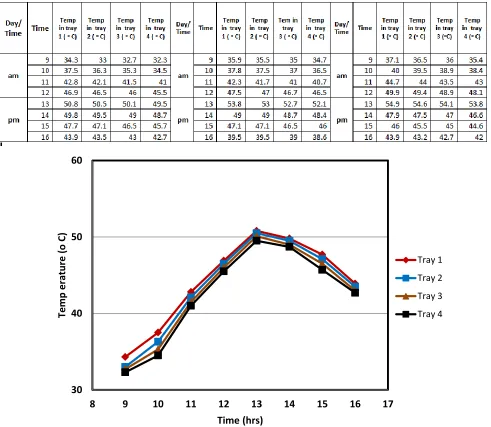
To measure the inside tray temperature, the same parameters shown in table 3.1 have been considered and the temperatures are measured. The temperatures measured from the experiment are shown in the table 3.3. It has been
found that there is a small variation in temperature from tray 1 to tray 4 as per the thermodynamics second law heat always flow from higher temperature to lower temperature.The temperature variations are shown in figures 3.4 to 3.6.
36 38 42.7
47.7 54
50 48
40
35 36
38 40 39 37
34 33
20
25
30
35
40
45
50
55
60
8
9
10
11
12
13
14
15
16
17
Dry
er
t
em
pera
ture
(o
C)
Time (hrs)
Temp inside the dryer (o C)
Atmospheric temperature (o C)
37 40
44.7 50
55
48 46
44
36 38
39 40 39.5 38 37
35
20
25
30
35
40
45
50
55
60
8
9
10
11
12
13
14
15
16
17
Dr
ye
r
temp
e
ra
tu
re
(
o
C
)
Time (hrs)
Temperature inside the dryer (o C)
136
Copyright © 2017. Vandana Publications. All Rights Reserved.
Table 3.3. Different temperature at different traysFigure 3.4. Temperature of Different trays on Day-1
30
40
50
60
8
9
10
11
12
13
14
15
16
17
Temp
erat
ure
(o
C)
Time (hrs)
Tray 1
Tray 2
Tray 3
137
Copyright © 2017. Vandana Publications. All Rights Reserved.
Figure 3.5. Different temperature of trays on Day-2Figure 3.6. Different temperature of trays on Day-3
3.3 Testing of Dryer
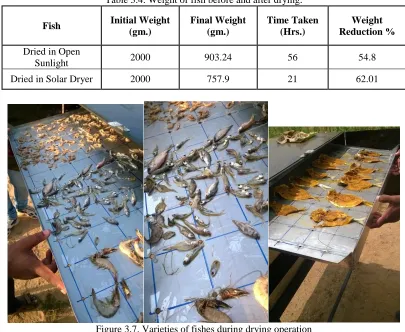
To study the performance of the dryer, varieties of fishes have been dried. The figure 3.7 shows the drying of fish in the solar dryer. The table 3.3 shows the
comparison of weight reduction of fish dried in open sunlight and dried in solar dryer. It can be seen that the percentage of weight reduction is more in case of dryer with a less time.
30
40
50
60
8
9
10
11
12
13
14
15
16
17
Tem
p
e
ratu
re
(o
C)
Time (hrs)
Tray 1
Tray 2
Tray 3
Tray 4
30
40
50
60
8
9
10
11
12
13
14
15
16
17
Te
mpe
ra
tu
re
(
o
C
)
Time (hrs)
Tray 1
Tray 2
Tray 3
138
Copyright © 2017. Vandana Publications. All Rights Reserved.
Table 3.4. Weight of fish before and after drying:Fish Initial Weight (gm.)
Final Weight (gm.)
Time Taken (Hrs.)
Weight Reduction %
Dried in Open
Sunlight 2000 903.24 56 54.8
Dried in Solar Dryer 2000 757.9 21 62.01
Figure 3.7. Varieties of fishes during drying operation
IV.
CONCLUSIONS
Solar dryer according to the design eliminates unhygienic traditional way of drying food in open lands receptive to contaminants. Further the enhanced dryer, eliminates large place for drying, further being provided with holders that has enough capacity for large amounts of food to be dried. The enhanced solar dryer improves drying efficiency resulting in increased market value to the products. Conventional method of drying small prawns has a market value of 350 INR per kg while the solar dried prawns’ sale has 70% over conventional methods pricing up to 450 INR. Solar drying technology involves exposing food to sunlight, while air flowing past the food to remove the moisture content from the food naturally. The warmer the air, the more moisture it can remove from the food. The solar dryer of the present work facilitates quick drying of the material to be dried. It can be seen that the percentage of weight reduction is more in case of dryer with a less time as compare with the fish dried in open sunlight. The temperature inside the drying chamber increases up to 51o C while the atmospheric temperature is 34o C so that the efficiency of the dryer increases. It works throughout the year. It can work at night and during rainy season by burning biomass under the dryer. During
daytime it can be heated up by direct solar radiation. It can be easily assembled and disassembled. It is light weight for transportation purpose and also low maintenance cost.
REFERENCES
[1] Weiss, W. and Buchinger, J. , Solar drying,www.aee-intec.at/0uploads/dateien553.pdf
[2] Doua, P., Kapseu, C. and Kuitche, A. (2014). An Overview of Moisture Removal Mechanisms in Small-scale Dryers. International Journal of Research Studies in Science, Engineering and Technology, 1(3), 18-33. [3] Mohsin, A.S.M., Maruf,N.I.Md., Sayem A.H.M., Mojumdar R.R.Md. and Farhad H. M. S. (2011).Prospect and Future of Solar Dryer: Perspective Bangladesh.IACSIT International Journal of Engineering and Technology, 3(2), 106-134.
[4] Articles on solar drying technology for fish and crop drying by AMM Murugappa Chettiar Research Centre (MCRC), Chennai, 2010.
[5] Julius,O.O., and Funso,O.S. (2009) Adaptation and Improvement of a Simple Solar Tent Dryer to Enhance Fish Drying. Nature and Science, 7(10), 165-170.
139
Copyright © 2017. Vandana Publications. All Rights Reserved.
Fish Drying Process. M.S of Mechanical Engineering,Sharif University of Science and Technology, 28-30. [7] Babagana Gutti, Kiman Silas and Mustafa B. G. (2012). Design and construction of forced/natural convection solar vegetable dryer with heat storage. Journal of Engineering and Applied Sciences, 7(10), 3360-3371. [8] Satyamurty V.V. Applications of Active Solar Energy Systems at Low Temperatures .
[9] Ashish D. Chaudhari and Prof. Sanjay Salve P.(2014). A Review of Solar Dryer Technologies. International Journal of Research in Advent Technology, 2(2), 2321-9637.
[10] Komolafe, C.A., Ogunleye I.O.and Adejumo A.O.D. (2011).Design and Fabrication of a Convective Fish Dryer,The specific Journal Science and Technology,12(1),89-97.
[11] Solar energy utilization by G.D. RAI,khanna publication.
[12] Solar energy, principle of Thermal collection and storage.
[13] HammamLif, B.P.and ELkhadraoui A. Kooli S. Experimental investigation and economic evaluation of a new mixed mode solar greenhouse dryer for drying of red pepper and grape. (2005). International Journal of Research Studies in Science, Engineering and Technology, 3(2), 143-146.
[14] Dilip Jain, PratibhaTewari.(2015). Performance of indirect through pass natural convective solar crop dryer with phase change thermal energy storage. Renewable Energy, 80, 244-250.
[15] Nabnean S., Janjai S., Thepa S., Sudaprasert K.and Songprakorp R. Experimental performance of a new design of solar dryer for drying osmotically dehydrated cherry tomatoes. (2016). International Journal of Research Studies in Science, 94, 147-156.
[16] David Gudiño-Ayala, ÁngelCalderón-TopeteITESO, Periférico Sur Manuel Gómez Morín Pineapple drying using a new solar hybrid dryer.