124
Copyright © 2011-15. Vandana Publications. All Rights Reserved.
Volume-5, Issue-3, June-2015
International Journal of Engineering and Management Research
Page Number: 124-128
Compressive and Flexural Strength Characteristics of Self-Compacting
Concrete with Demolished Concrete
Ravi Shanker Yadav1, Rahul Singh2, Juned Ahmad3, Raj Bandhu Dixit4
1,2
Post-Graduate Student, Department of Civil Engineering, Integral University, Lucknow, U.P, INDIA
3,4
Assistant Professor, Civil Engineering, Integral University, Lucknow, U.P, INDIA
ABSTRACT
This paper investigates the study of workability and durability characteristics of Self-Compacting Concrete (SCC) with Viscosity Modifying Admixture (VMA), and containing Class F fly ash. The mix design for SCC was arrived as per the Guidelines of European Federation of National Associations Representing for Concrete (EFNARC). In this investigation, SCC was made by usual ingredients such as cement, fine aggregate, coarse aggregate, water , mineral admixture fly ash and demolished concrete at various replacement levels (5%, 10%, 15%, and 20%). The super plasticizer used was Glenium B233 and the viscosity modifying agent used was Glenium Stream 2. The experiments are carried out by adopting a water-powder ratio of 0.45. Workability of the fresh concrete is determined by using tests such as: slump flow, V-funnel, L-Box tests.
Keywords--- Self-compacting concrete, Fly ash, Mineral admixture, demolished concrete.
I.
INTRODUCTION
Self-compacting concrete (SCC), requiring no consolidation work at site or concrete plants, has been developed in Japan to improve the durability and uniformity of concrete in 1988 (Okamura and Ouchi, 1999). The mix composition is chosen to satisfy all performance criteria for the concrete in both the fresh and hardened states. There is no standard method for SCC mix design, and many academic institutions as well as admixture, ready-mixed, precast and contracting companies have developed their own mix proportioning methods. As per EFNARC Guidelines for SCC mix design, one of the most important differences between SCC and conventional concrete is the incorporation of a mineral admixture. Thus, many studies on the effects of mineral admixtures on the properties of SCC have been conducted. These studies show the advantage of demolished concrete usage in SCC . Therefore, the
durability of concrete is also increased (Assie et al., 2007). Industrial byproducts or waste materials such as limestone powder, fly ash and granulated blast furnace slag are generally used as mineral admixtures in SCC (Felekoglu et al., 2006; Unal et al., 2006). Thereby, the workability of SCC is improved and the used amount of by-products or waste materials can be increased. Besides the economical benefits, such uses of byproducts or waste materials in concrete reduce environmental pollution (Bosiljkov, 2003). Fly ash is an industrial by-product, generated from the combustion of coal in the thermal power plants. The increasing scarcity of raw materials and the urgent need to protect the environment against pollution has accentuated the significance of developing new building materials based on industrial waste generated from coal fired thermal power stations creating unmanageable disposal problems due to their potential to pollute the environment. Fly ash, when used as a mineral admixture in concrete, improves its strength and durability characteristics. Fly ash can be used either as an admixture or as a partial replacement of cement. It can also be used as a partial replacement of fine aggregates, as a total replacement of fine aggregates and as supplementary addition to achieve different properties of concrete (Jino et al., 2012). Viscosity Modifying Admixtures (VMA) make the concrete more tolerant to variations in the water content of the mix, so that plastic viscosity is maintained and segregation is prevented (EFNARC, 2005).
II.
EXPERIMENTAL
INVESTIGATION
Materials Self-compacting concrete was made of cement, sand, water, fly ash and mineral admixture. 1) Cement: Ordinary Portland cement, 43 Grade conforming to IS: 12269 – 1987.
125
Copyright © 2011-15. Vandana Publications. All Rights Reserved.
3) Coarse aggregate: Locally available crushed blue granite stones conforming to graded aggregate of nominal size 12.5 mm as per IS: 383 – 1970.
4) Mineral admixture: Dry Class F-Fly ash confined as per IS 3812-2000.
5) Demolished Concrete
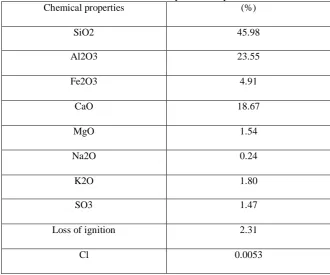
Table 1. Chemical Properties of Fly Ash
6) Chemical admixture: Super plasticizer Glenium- B233 as per EN 934-2 T3.1/3.2.and viscosity modifying agent Glenium stream -2 as per ENC 180VMA.
7) Water: Water used was fresh, colorless, odorless and tasteless potable water free from organic matter of any type.
III.
MIX PROPORTIONS
One control and four SCC mixes with different replacements of demolished concrete were prepared and examined to quantify the properties of SCC. Table 4 presents the composition of SCC mixtures. The replacement was carried out at levels of 5%, 10%, 15% and 20% of coarse aggregate. After iterative trial mixes
the water/powder mass ratio (w/p) was selected as 0.45. The total powder content was varied as 450kg/m3, 500 kg/m3, 530 kg/m3 as iterative values and finally fixed as 530 kg/m3. Some design guidelines have been prepared from the acceptable test methods. Many different test methods have been developed in attempts to characterize the properties of self-compacting concrete. So far, no single method or combination of methods has achieved universal approval and most of them have their adherents. Similarly, no single method has been found which characterizes all the relevant workability aspects. So, each mix design should be tested by more than one test method in order to obtain different workability parameters.
Table 2. Mixture Proportions for Demolished Concrete (kg/m3)
Materials Control D. C.
5%
D. C. 10%
D. C. 15%
D. C. 20%
Cement 318 318 318 318 318
Fly Ash (40%) 212 212 212 212 212
Water/Powder 0.45 0.45 0.45 0.45 0.45
Sand 768 768 768 768 768
Chemical properties (%)
SiO2 45.98
Al2O3 23.55
Fe2O3 4.91
CaO 18.67
MgO 1.54
Na2O 0.24
K2O 1.80
SO3 1.47
Loss of ignition 2.31
126
Copyright © 2011-15. Vandana Publications. All Rights Reserved.
Coarse aggregate 668 635 601 568 534
Demolished Concrete
0 33 67 100 134
Super Plasticizer 0.86 0.86 0.86 0.86 0.86
VMA 0.082 0.082 0.082 0.082 0.082
IV.
WORKABILITY TEST
METHODS
For determining the self-compactability properties; slump flow, T50 time, V-funnel flow time, L-box blocking ratio, U-L-box difference in height tests were performed. In order to reduce the effect of workability loss on variability of test results, fresh state properties of mixes were determined within a period of 30 minutes after mixing. The order of testing was as below, respectively.
1. Slump flow test and measurement of T50cm time;
2. V-funnel flow test; 3. L-box test;
Fresh Properties Slump Flow Test
The slump value plays a major role in SCC. By the value of slump, it is possible to know the effectiveness of flow in SCC; i.e., flowability of SCC under congested reinforcements can be studied at site through this test. The slump values also determine the durability of the mix, segregation and bleeding in the mix. The minimum value of slump is to be 650mm and the maximum value 800 mm for a fresh SCC.
Table 3. Slump Flow Tests for SCC with Demolished Concrete
Mix proportions (%) Slump (mm)
D.C.-0 695
D.C.-5 690
D.C.-10 678
D.C.-15 670
D.C.-20 660
L-Box Test
Using L-box test, the passing ability of SCC beyond the reinforcing bars can be found. The mix having high powder content and lesser coarse aggregate
passes easily through the reinforcing bars. The ratio of H2/H1 is used to indicate the value of the result of L-box. The minimum value of H2/H1 can be 0.8 and the maximum value 1.0.
Table4. L-box Test of SCC with Demolished concrete Mix proportions
(%)
L-Box (H2/H1)
D.C-0 0.920
D.C-5 0.946
D.C-10 0.950
D.C-15 0.953
D.C-20 0.946
V-Funnel Test
V-funnel test is used to find out the flowing ability of the SCC. The test results show that the time taken for a higher replacement is much less due to
fineness in the mix. T he minimum time for the flow of the entire concrete dumped in the V-funnel is 6 sec and the maximum time to fall completely is 12 sec.
Table5. V-Funnel Test for SCC with Demolished Concrete Mix proportions
(%)
V-funnel (Sec)
D.C.-0 9.8
D.C.-5 7.6
D.C.-10 8.5
D.C.-15 7.9
127
Copyright © 2011-15. Vandana Publications. All Rights Reserved.
Table6. Compressive Strength Mix proportions
(%)
Compressive Strength (mpa)
7 days 28 days
D.C.-0 20 30
D.C.-5 19.6 32.8
D.C.-10 19.0 37.89
D.C.-15 18.56 29.34
D.C.-20 17.60 28.67
Table7. Flexural Strength Mix proportions
(%)
Flexural Strength (mpa)
7 days 28 days
D.C.-0 3.85 5.80
D.C.-5 3.09 4.70
D.C.-10 2.79 5.01
D.C.-15 2.00 4.00
D.C.-20 1.70 3.0
V.
CONCLUSION
• In this study, it has been found that with the increase in super plasticizer dosage the workability is increased. So, the required slum value fulfilling the criteria of EFNARC can be obtained.
• For 10% demolished concrete replacement, the fresh properties observe were good as compared to 5%, 10%, 15% an d 20% demolished concrete replacement.
• The dosage of VMA should be properly
designed as it may change the basic criterion of SCC. In other words ,the flowability may fall below 500 mm slump if the dosage of VMA is more than desired.
• Compressive strength loss decreases with the increase in demolished concrete.
REFERENCES
[1] Assie, S., Escadeillas, G. and Waller, V. 2007. Estimates of self-compacting concrete ‘potential’ durability. Construction and Building Materials, 21 (10): 1909- 1917.
[2] ASTM C 143-03. 2003. Standard test method for slump of hydraulic cement concrete, Annual Book of ASTM Standards, 1-8.
[3] ASTM C 494. 1992. Standard specifications for chemical admixtures for concrete, Annual Book of ASTM Standards.
[4] Baoguo, Ma and Huixian, Wang. 2011. Effect of viscosity modifying admixture on the workability of
self- compacting concrete, Advanced Material Research, 306-307: 946-950.
[5] BIS: 12269. 1987. Specification for ordinary Portland cement, New Delhi -Reaffirmed 1999.
[6] Bosiljkov, V.B. 2003. SCC mixes with poorly graded aggregate and high volume of limestone filler. Cem. Concr. Res., 33 (9):1279-1286.
[7] EFNARC. 2005. European guidelines for self-compacting concrete, specification, production and use. May.
[8] Felekoglu, B., Tosun, K., Baradan, B., Altun, A. and Uyulgan, B. 2006. The effect of fly ash and limestone fillers on the viscosity and compressive strength of self-compacting repair mortars. Constr.Build.Mater., 36 (9):1719-1726.
[9] Jino, John, Maya, T.M. and Meenambal, T. 2012. Mathematical modeling for durability characteristics of fly ash concrete. International Journal of Engineering Science and Technology (IJEST).
[10] Nabil, M. and Al-Akhras. 2005. Investigation of the effect of metakaolin (MK) replacement of cement on the durability of concrete to sulfate attack.
[11] Nagataki, S. and Fujiwara, H. 1995. Self-Compacting property of highly-flowable concrete, Second Conference on Advances in Concrete Technology, ACI SP-154, V.M. Malhotra, American Concrete Institute, June, 301-304.
[12] Okamura, H. and Ouchi, M. 1999. Self-compacting concrete-development, present use and future. First International RILEM Symposium on Self-compacting Concrete. Rilem Publications SARL, 3-14.
128
Copyright © 2011-15. Vandana Publications. All Rights Reserved.
[14] Unal, O., Topcu, I.B. and Uygunoglu, T. Use of marble dust in self-compacting concrete. In: Proceedings of V Symposium MERSEM0 2006 on Marble and Natural Stone. Afyon, Turkey, 413-420.
[15] Ye, G., Liu, X., De Schutter, G., Poppe, A.M. and Taerwe, L. 2007. Influence of limestone powder used as
filler in SCC on hydration and microstructure of cement pastes, Cem. Concr. Comp., 29 (2): 94-102.
[16] Yogesh, Aggarwal and Paratibha, Aggarwal. 2008. Self- compacting concrete-Procedure for mix design,
Leonardo Electronic Journal of Practices and