TECHNOLOGY ADOPTION TOWARDS SMEs
MARKETING PERFORMANCE
NURUL AMIRA BINTI IBRAHIM
DECLARATION BY SUPERVISOR
I hereby declare that I have checked this project and in my opinion, this project is adequate in terms of scope and quality for the award of the degree of Bachelor of
Technopreneurship (Honours)
Signature : ……….
Supervisor‘s Name : Prof. Dr Salleh Bin Yahya Date : 25 June 2015
Signature : ……….
TECHNOLOGY ADOPTION TOWARDS SMEs M ARKETING PERFORMANCE
NURUL AMIRA BINTI IBRAHIM
Submitted in Partial Fulfilment of the requirement for the Bachelor of Technopreneurship (Honours)
Faculty of Technology Management & Technopreneurship
Universiti Teknikal Malaysia Melaka
DECLARATION OF ORIGINAL WORK
―I hereby declare that the work of this exercise is mine except for the quotations and summaries that have been duly acknowledge.‖
Signature : ………
Name : ………
DEDICATION
ACKNOWLEDGMENT
At first, I would like to express my sincere gratitude and appreciation to my lovely supervisors, Professor Dr. Salleh Yahya and also my panel, En Albert Feisal for all the support and guidance he had given me for the completion of this research. I am deeply grateful for his guidance towards the final year‘s project whereby his advice and encouragement played an important and major role for the success of this final year project.
Furthermore, I would also like to thank my precious best friends and my fellow course mates for their support and help by giving advice, comment and support me in completing this thesis.
ABSTRACT
In globalisation era, technologies adoptions are really helpful in terms of increasing organization performance. Technologies have been used by large company but for SMEs, technologies adoption still in early stages. These studies are aim to figured out the suitable technologies that can be used to improve marketing performance, the important factors when adopting the technology and identify the impacts of using technology in marketing. Quantitative-exploratory research been selected to study this research. Random sampling of 125 SMEs from random industry has been selected to be respondents for this research. Social Media Technology has shown that this technology is the most give impact towards SMEs Marketing Performance.
Keywords: Small Medium Enterprise, Technology Adoption, Information Communication Technology (ICT), Technology, Marketing mix, marketing
performance, Social Media Technologies, E-Commerce, Mobile Technology,
ABSTRAK
Di dalam era globalisasi, Technology Adoption membantu dari segi meningkatkan prestasi organisasi. Teknologi telah digunakan oleh syarikat yang besar tetapi untuk Industri Kecil Sederhana (IKS) , penggunaan teknologi masih lagi di peringkat awal. Kajian ini bertujuan untuk mencari teknologi yang sesuai yang boleh digunakan untuk meningkatkan prestasi pemasaran syarikat, faktor-faktor penting apabila mengguna-pakai teknologi dan mengenal pasti kesan penggunaan teknologi dalam pemasaran. Penyelidikan kuantitatif-penerokaan telah dipilih untuk mengkaji kajian ini. Persampelan rawak 125 IKS daripada pelbagai industri telah dipilih sebagai responden kajian ini. Sosial Teknologi Media telah menunjukkan bahawa ia memberi kesan yang tinggi terhadap prestasi pemasaran IKS.
TABLE OF CONTENT
CHAPTER TITLES PAGES
DECLARATION ii
DEDICATION iii
ACKNOWLEDGEMENT iv
ABSTRACT v
ABSTRAK vi
CONTENT vii
LIST OF TABLE xii
LIST OF FIGURE xiv
CHAPTER 1 INTRODUCTION 1
1.1Background of Study 1
1.2Problem of Statements 4
1.3Research Questions 5
1.4Research Objectives 5
1.5 Scope of Study 6
1.6Important of Study 6
CHAPTER TITLES PAGES
CHAPTER 2 LITERATURE REVIEW 8
2.1 Small Medium Enterprise 8
2.2 Technology Adoption increase 10
Marketing performance
2.3 Training and Motivation 12
2.4 Marketing Mix Strategy 14
2.4.1 Product 15
2.4.2 Promotion 16
2.4.3 Place 17
2.4.3 Price 18
2.5 Impact of ICT adoption 19
2.6 Summary 20
CHAPTER 3 RESEARCH METHOD 21
3.1 Introduction 21
3.2 Theoretical Framework 21
3.3 Research Framework 23
3.4 Hypothesis 24
3.5 Data Collection 25
CHAPTER TITLES PAGES
3.6 Data Analysis 27
3.6.1 Reliability 27
3.6.2 Profiling 28
3.6.3 Correlation Analysis 28
3.6.4 Multiple Regression Analysis 29
3.7 Summary 30
CHAPTER 4 RESULT AND DISCUSSIONS 31
4.1 Introduction 31
4.2 Descriptive Analysis 32
4.2.1 Gender 33
4.2.2 Age 34
4.2.3 Position 35
4.2.4 Level of Education 36
4.2.5 Number of Employees 37
4.2.6 Length of Business 38
4.2.7 Level of Business Growth 39
4.2.8 Sale and Profit (year) 40
4.3 Reliability Analysis 42
4.4 Descriptive Analysis Independent Variable 43
And Dependent Variable
4.4.1 Correlation between Independent 44
And Dependent variable
4.4.2 Regression between Independent 46
And Dependent Variable
4.4.2.1 Hypothesis 1 47
4.4.2.2 Hypothesis 2 48
4.4.4.3 Hypothesis 3 50
4.5 Descriptive Analysis Independent and 52
Moderating variable
4.5.1 Correlation between Independent 53
And Moderating Variable
4.5.2 Regression between Independent 55
And Moderating Variable
4.5.2.1 Social Media 55
Technology
4.5.2.3 Mobile Technology 57
4.6 Summary 58
CHAPTER 5 CONCLUSION AND 59
LIMITATIONS
5.1 Introduction 59
5.2 Demographic 60
5.3 Conclusion 62
5.4 Limitations 63
CHAPTER 6 RECOMMENDATIONS 64
REFERENCES 65
LIST OF TABLE
TABLE TITLE PAGES
Table 2.1 Summarise definition of SME 8
Table 4.1 Gender of Respondents 33
Table 4.2 Ages of Respondents 34
Table 4.3 Position of Respondents 35
Table 4.4 Level of Education of Respondents 36
Table 4.5 Number of Employees 37
Table 4.6 Length of Business 38
Table 4.7 Level of Business Growth 39
Table 4.8 Sale and Profit (year) 40
Table 4.9 Type of Industry 41
Table 4.10 Reliability Analysis 42
Table 4.11 Descriptive Analysis IV and DV 43
Table 4.12 Correlations IV and DV 44
Table 4.13 Multiple Regression IV and DV 46
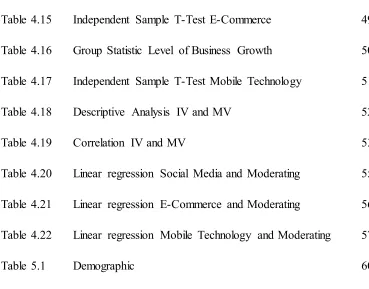
Table 4.15 Independent Sample T-Test E-Commerce 49
Table 4.16 Group Statistic Level of Business Growth 50
Table 4.17 Independent Sample T-Test Mobile Technology 51
Table 4.18 Descriptive Analysis IV and MV 52
Table 4.19 Correlation IV and MV 53
Table 4.20 Linear regression Social Media and Moderating 55
Table 4.21 Linear regression E-Commerce and Moderating 56
Table 4.22 Linear regression Mobile Technology and Moderating 57
LIST OF FIGURE
FIGURE TITLE PAGES
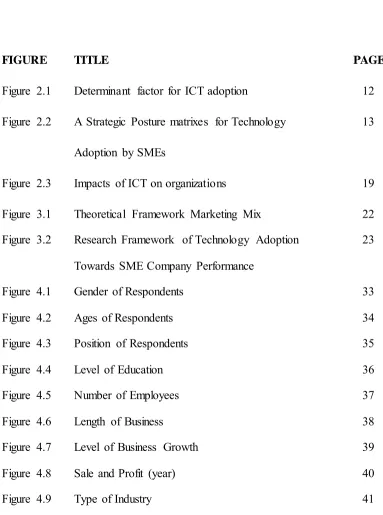
Figure 2.1 Determinant factor for ICT adoption 12
Figure 2.2 A Strategic Posture matrixes for Technology 13
Adoption by SMEs
Figure 2.3 Impacts of ICT on organizations 19
Figure 3.1 Theoretical Framework Marketing Mix 22 Figure 3.2 Research Framework of Technology Adoption 23
Towards SME Company Performance
Figure 4.1 Gender of Respondents 33
Figure 4.2 Ages of Respondents 34
Figure 4.3 Position of Respondents 35
Figure 4.4 Level of Education 36
Figure 4.5 Number of Employees 37
Figure 4.6 Length of Business 38
Figure 4.7 Level of Business Growth 39
Figure 4.8 Sale and Profit (year) 40
[image:16.596.112.495.264.779.2]Chapter 1
Introduction
1.1 Background of study
According to Analysis of the Australian Building and Construction Industries (Competitive Australia), SMEs represent a major business sector in the industrial world and it has been widely recognised that they make a significant contribution to an economy‘s well-being. SME have a role in gaining increasing awareness as to promoting economic growth Esselar et al., (2008).
the nation‘s gross domestic product (GDP) — to adopt technology to boost their efficiency, productivity and competitiveness.
As stated by Stockdale & Standing, (2004) the ability of such marketplaces to facilitate trading over regional and geographic boundaries at low cost and without regard to the size of the firm opens up all markets to broader competition. SMEs just need to spend once to gain much better impact towards their marketing performance. New ways for doing business are developed through the innovative usage of information and communication and internet technologies Jakovic & Galetic (2013).
In organization, marketing is one of the departments that play important role to increase company performance, especially SMEs Company that still new in industry. As stated by Kotler (2009) Marketing is an organizational function and a set of processes for creating, communicating, and delivering value to customers and for managing customer relationships in ways that benefit the organization and its stakeholders. According to J.Brodie et al., (2007) Speculation initially suggested that these developments would lead to a dramatic transformation of marketing, and this would lead to superior business performance.
This technology not only involved ICT only but mobile technology also can be used by SMEs as a technology to increase marketing performance. The expanded demand for mart devices and the heralding of the 4G mobile broadband networks have increased the use of mobile applications and web services, with strengthened competition among advertising industrial players Kim & Lee (2014). This technology can be used especially in service sectors such as Tourism and Hotel. Hotel Web site and mobile applications will not be only a promotion channel, but also an active generator of the hotel business and development.
Internet applications should be encouraged as a major tool while implementing funding projects, marketing promotion and consulting in rural areas Andreopoulou et al., (2013). Kirtis & Karahan (2011) stated that one of the most distinctive ways the firm lowers it is costs is by turning to social media marketing. Firms need to make convenient changes in best-known measures like reducing costs, reducing production capacity and investment, using more with equity capital and improving efficiency (Pearce and Michael, 1997; Zehir, 2005).
SMEs Company in Malaysia has lack the capabilities and market power. It lowers interest in adopting technology to increase their marketing performance. They tend to used traditional marketing strategy rather than adopting technology.
Currently, most of SMEs seems prefer to use traditional marketing strategy to increase their company performance. It doesn‘t said a wrong way for them to keep using traditional way but for SMEs in Malaysia to go global and higher, they need to adopt a technology. SMEs need to move along with other big organization that already adopting a technology in their marketing and others department.
In new globalization era, a lot of technology that already been used by large company to increase their marketing performance. ICT adoption is of technology that most large company used, such as social media, e-commerce, email marketing and etc. All this technology sometime did not required a lot of cost. For example, using social media as a marketing medium, large company used Facebook, Twitter even Instagram to promote their product or service. Therefore, SMEs Company cannot use costing as the reason to not adopting the technology. Some SMEs know that adopting technology in terms to increase marketing performance did not require much costing, but they tend to worry about the risk or the feedback when using it.
1.3 Research Questions
Based on problem statements, few questions have been extracting out to study this problem.
i. What are the suitable technologies that can be used to improve marketing performance for SMEs Company?
ii. What are the important factors for adopting technology?
iii. What are the impacts of using technology in marketing?
1.4 Research Objective
In this research, 3 objectives have been deployed for research always sticks into the scope of study;
i. To identify the suitable technologies that can be used to improve marketing performance.
ii. To examine the important factors when adopting the technology.
The scopes of this study are to identify the suitable technology that can be used by SMEs Company in Malaysia. As by adopting this technology, SMEs Company in Malaysia can improve their marketing performance hence, improving their company performance. Marketing performance can be measure through increase sales, rating of SMEs Company and etc.
The respondents are come from 125 SMEs Company in variety of industry. Geographically I choose Selangor and Melaka to conduct this research because of the time constraint and costing.
1.6 Important of study
Technology Adoption Improve SMEs Marketing Performance. This research gives so much significant towards SMEs in Malaysia, especially the one who new in industry. This new SME Company can adopt the technology that can help them in improving their performance.
The contribution of this research helps SMEs in Malaysia to move forward and global by adopting technology. Show that SMEs in Malaysia can follow along the large company because some technology didn‘t use large cost.
Most SMEs Company afraid in using technology because they taught using technology must invest a lot of money. Previously the answer could be totally yes, but in this era there are technologies that do not involve big cost.
1.7 Summary
Chapter 2
Literature Review
2.1 Small Medium Enterprise
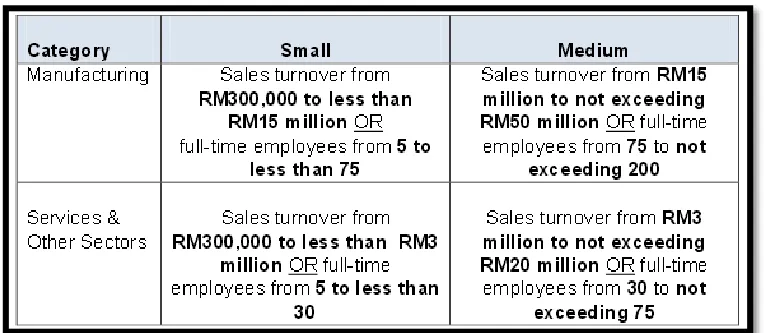
[image:24.596.129.511.551.718.2]According to the SME Annual Report 2013/2014, SMEs has been defined; Manufacturing sector, sales turnover not exceeding RM50 million OR full-time employees not exceeding 200 workers; Services and other sectors, sales turnover not exceeding RM20 million OR full-time employees not exceeding 75 workers.