DOI: 10.9781/ijimai.2016.423
Feature Selection for Image Retrieval based on
Genetic Algorithm
Ms. Preeti Kushwaha
1, Mrs. R.R.Welekar
21
M. Tech scholar, Department of CSE, SRCOEM, Nagpur, Maharashtra, India
2Assistant Professor, Department of CSE, SRCOEM, Nagpur, Maharashtra, India
Abstract — This paper describes the development and implementation of feature selection for content based image retrieval. We are working on CBIR system with new efficient technique. In this system, we use multi feature extraction such as colour, texture and shape. The three techniques are used for feature extraction such as colour moment, gray level co-occurrence matrix and edge histogram descriptor. To reduce curse of dimensionality and find best optimal features from feature set using feature selection based on genetic algorithm. These features are divided into similar image classes using clustering for fast retrieval and improve the execution time. Clustering technique is done by k-means algorithm. The experimental result shows feature selection using GA reduces the time for retrieval and also increases the retrieval precision, thus it gives better and faster results as compared to normal image retrieval system. The result also shows precision and recall of proposed approach compared to previous approach for each image class. The CBIR system is more efficient and better performs using feature selection based on Genetic Algorithm.
Keywords — CBIR, Feature Extraction, Feature Selection, Genetic Algorithm, K-means Clustering, Precision and Recall.
I. I
nTRoducTIonI
nrecent years, continuous development of multimedia technologies,storing high quality of images and digital image collection data are rapidly increasing with social networking (such as facebook, yahoo, Google, etc), storage technologies, academic website, research and development etc to upload images, videos, many possible means. With the use of internet, image capturing devices (scanner, camera, etc) and handheld devices for tremendous collection of digital images is generated every day. The intent for development of many general use of image retrieval system requires efficient searching, browsing and retrieving tools.
In current technologies the acquirement, transmission, stack away, and handling are allow in large collection of database. With the increasing in use of network and multimedia development, users are not gratified with traditional image retrieval. So in recent year, CBIR has become an area of wide interest and source of fast retrieval and exact.
Content based image retrieval is image search technique; automatically extract features (colour, texture, shape, etc) to allow searching relevant images from large image database to given input query image based on similarity in features from query image compared with feature from database. The feature extraction techniques is commonly use in CBIR. There are three feature extractions such as colour feature extraction, texture feature extraction and shape feature extraction. Each feature extraction has several techniques. Colour feature extraction is
low level visual feature. The respective techniques are used in colour extraction such as colour moment, vector quantization, co-occurrence matrix, etc. Texture feature extraction is also low level visual feature. It measures look for visual patterns in images. It describes distribution of image intensity. In texture, many techniques are used like Gabor filter, Tamura features, etc. Shape feature extraction is high level visual feature. It describes surface of an object within images or particular region. It contains two methods, first is external boundary of shape; another is shape of whole region. The respective techniques are edge density (sobel, prewitt, canny,etc), moment invariant, etc.
In CBIR, the problem is which features are relevant in retrieval process that means large number of features is irrelevant. To avoid this problem, feature selection is used to reduce extraneous, excess and noisy data. The main objective of feature selection is find best feature from large feature set. To improve the performance of content based image retrieval system, feature selection which includes optimal features.
Genetic algorithm is an approach of feature selection for best optimal feature subset from large feature set. Genetic Algorithm is found on primal of evolution, natural selection and biology inheritance. Genetic algorithm is used to find optimal or best solutions to computational problem that minimizes or maximizes a particular function. Genetic algorithm works iteratively by using Genetic operators such as Selection, recombination and Mutation.The optimal feature is selected using Genetic algorithm that searches for the best feature subset corresponding to better image retrieval result.
Clustering is collection of articles which are similar between same clusters while dissimilar articles belong to other cluster. By using clustering in CBIR system is reducing the elapsed time of system. Different clustering techniques are used in CBIR such as k-means clustering, hierarchical clustering, SIFT,etc.
The rest of paper is organized as follow: in section 2 describes related work to content based image retrieval using various techniques. Section 3 presents methodology. In section 4 introduced on framework of proposed approach. The experimental result shows in section 5; and last section 6 concludes the paper.
II. R
elATedw
oRkrelevant feature. They used color coherence vector and Gabor wavelets feature extraction technique. For Feature Discrimination, it used maximum entropy method for transforming numerical features with nominal using Class Attribute Interdependence Maximization (CAIM) algorithm. They also analyzed proposed approach by optimizing it with the feature selection using Particle Swarm optimization (PSO) algorithm for extracting the near relevant features. The result showed effectiveness and efficiency of the proposed model is compared with other models using precision and recall. C.V. Rashmi et.al. [7] Views that novel image retrieval using Ant Colony Optimization and Relevance Feedback. The proposed system, feature vector of the image is extracted by calculation of color correlogram, Gabor filter and edge histogram descriptors. In their model, feature selection using ACO technique to optimize the features for speed up retrieval and similarity computation. They used support vector machine (SVM) to improve efficiency of the system by using Relevance Feedback.
Clustering is used in CBIR system, Mit Patel et.al. [7] Describes collection of features or a dataset is divided into similar image classes using clustering and classification. The clustering is done with k-means clustering, and classification is done with fuzzy rule based classification. These algorithms are based on texture and color information. In their proposed model, the result showed accuracy is increases and retrieval time is decreases. They compared with proposed model and normal model.
III. M
eThodologyIn this section, we are introducing methods for new proposed system. As described further the new proposed system is done with three efficient techniques such as
• Three Feature extractions techniques are used for colour, shape, and texture.
• Feature selection using Genetic Algorithm. In this method, we used new fitness function
• Clustering technique
The following new approaches describe below:
A. Feature Extraction
Feature extraction is most valuable operation of CBIR system. It translates the input data into set of features. In this section, we describe three feature extraction techniques which are used in our proposed CBIR system.
1) Color Feature Extraction
Color feature extraction represents different color model such as RGB (Red, Green, and Blue), HSV (Hue, Saturation, and value), CMYK (Cyan, Magenta, yellow), etc.
Color moment represents characterized a color image. There are 3 different color moments: first order is mean, second order is standard deviation, and third order is skewness of color; are extracted from RGB and HSI color spaces to form an 18-dimensional, using the following mathematical formulation:
(1)
(2)
(3)
where, pij is an ith color channel at the jth image pixel.
2) Texture Feature Extraction
Texture feature extraction describes distribution of image intensities. For texture feature extraction a gray level co-occurrence matrix is simple and most extensively used approaches to extract texture feature from an original image. There are four components of GLCM that are used to characterize the texture such as entropy, contrast, energy and homogeneity. The following formulas are given below:
(4)
(5)
(6)
(7)
where, (m,n) represents number of rows and number of columns of the image x.
3) Shape Feature Extraction
Shape describes surface of an object within images or particular region. Edge histogram represents 4 directional edges. The image is subdivided into 4 x 4 sub images i.e. 16 sub blocks. For each of the sub images, compute the histogram by using 4 edge types: vertical,
horizontal, 45ₒ and 135ₒ.
1 -1 1 1 √2 0 0 √2
1 -1 -1 -1 0 -√2 -√2 0
B. Feature Selection using Genetic Algorithm
Genetic algorithm is compute to find solutions to search and optimization problems. Genetic algorithm is used to find optimal or best solutions to computational problem that minimizes or maximizes a particular function. They simulate biological process of natural selection and reproduction to solve for ‘fittest’ solutions. This is called ‘survival of fittest’ used for optimization problems. The basic components to Genetic algorithms are:
1. Initial population of chromosomes: Let m be the number of features. The size of population is N. To create random population P of N number of chromosomes is given below:
P = [C1, C2, …. CN]
2. Fitness function: Standard Deviation is used to evaluate the fitness of each individual population.
3. Selection: Select two parents from population according to their best fitness, which can generate new offspring. It assures that only the best fittest solutions made to generate offspring. 4. Recombination or Crossover: Recombinant the parents to
form new offspring from two parents string, by copying selected bit of each parents.
Fig. 1. Block Diagram of Genetic Algorithm.
C. Clustering
Clustering is collection of articles which are similar between same clusters while dissimilar articles belong to other cluster. In proposed system, we use k-means algorithm. We select the k-means algorithm because it manages the large number of image in cluster. In CBIR system is reducing the elapsed time of system and fast retrieval. Using k-means algorithm, the results are measure by sum of among cluster between every vector and its centroid cluster. To calculate centroid of each cluster using sum of squared error, the given formula below:
(8)
IV. P
RoPoseds
ysTeMHere, we propose new CBIR system using three approaches which are described in previous section. The proposed architecture of CBIR system is shown in below:
Fig. 2. Proposed Architecture of CBIR System.
The working of this system describes in step by step:
• The system will extract feature from images by using color, texture and shape automatically.
• These feature images are store in feature vector database.
• Then, we use feature selection using Genetic Algorithm that searches for the best feature subset from feature vector database.
• We use clustering which contains similar image classes. After that, system will compute distance between query image and centroid cluster to find smaller distance.
• The most similar images will retrieve and shows to the user.
V. e
xPeRIMenTAlR
esulTAndd
IscussIonIn this section, we present a proposed CBIR system which is introduced in previous section. We are considering the new approaches which the enhancement is done. Here is first part of the expected result is present. We introduce database of image that we choose to test our system.
A. Image Database
We use image database in our evaluation is WANG database. It is subset of COREL database. It contains 1000 images in JPEG format. In this paper, 6 classes were taken and each class contains 15 images. The classes are Flowers, Bus, Architecture, Food, Elephant, and Dinosaurs.
B. Performance Measurements
In this section, we perform of the CBIR system can be evaluate in terms of precision and recall. And also compute computational time of each class.
1. Precision: It is defined as ratio of number of relevant images retrieved and total number of images retrieved
If precision value is 1.0 that means result images is retrieved by search was retrieved.
2. Recall: It is defined as ratio of number of relevant images retrieved and total number of images retrieved
C. Expected outcome
Here is expected outcome of each class in terms of precision, recall and computational time (s).
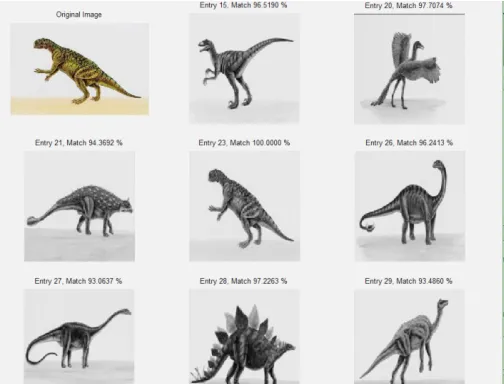
Fig. 4. Feature Selection using Genetic Algorithm based Retrieved images.
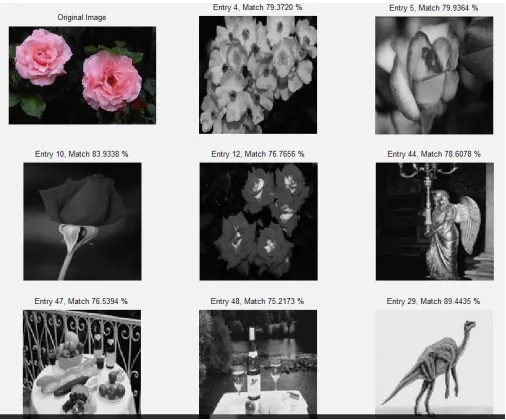
In Fig.3 shows, relevant features and irrelevant features based retrieved images without using feature selection based on Genetic algorithm in CBIR system. In Fig.4 shows, most optimal relevant images using feature selection based on Genetic algorithm.
TAble I
coMPARATIVe AnAlysIsof cbIR AlgoRIThMs bAsedon PARAMeTeRs
Without Feature Selection Feature selection using GA Images Time(s) Precision(%) Recall (%) Time(s) Precision(%) Recall(%)
Architecture 1.94 62 40 1.89 75.8 58
Flowers 1.94 48.2 22.4 1.89 54.12 25.9
Elephant 1.90 43.2 16.8 1.77 58.9 23
Buses 1.96 46.2 27.6 1.74 59.4 35.8
Food 1.90 50.6 30.2 1.85 57.2 50.89
Dinosaurs 1.99 85 82.4 1.94 100 93.36
Table 1 shows feature selection using Genetic Algorithm is compared with without Feature Selection in terms of precision, recall, and computational time. The computational time of feature selection using GA takes less than without feature selection. The performance measure analysis is done for each image class. The highest precision value in dinosaurs contain 85% without feature selection, and after using feature selection based on GA improve precision value contain 100% in dinosaurs image. Recall values contains in the range 22-82% without using feature selection and 23-94% using feature selection based on GA.
Fig. 5.a. Time (s) vs. Image classes in Database.
Figure 5.a shows computational time of each class in database. Blue indicates computational time of system by using feature selection based on GA. Red indicates computational time of system without feature selection. The bar chart shows, by using feature selection based on GA takes less time and fast retrieval. It is more efficient and better performance.
Fig. 5.b. Precision (%) vs. Image classes in Database.
Fig. 5.c. Recall (%) vs. Image classes in Database.
Figure 5.b and Figure 5.c shows, precision and recall of each image class in database. Blue indicates precision and recall of each image class without using feature selection. Red indicates precision and recall of each image class using feature selection based on Genetic Algorithm. The chart shows highest precision and recall of each image class using feature selection based on Genetic Algorithm is better than without feature selection.
TAble II
PRecIsIonfoR PReVIous APPRoAchAnd PRoPosed APPRoAch
Previous Approach Proposed Approach Feature
Extraction SelectionFeature ExtractionFeature SelectionFeature Images Precision (%) Precision(%) Precision (%) Precision (%)
Bus 18.75 58.33 46.2 59.4
Dinosaurs 58.22 100 85 100
Elephant 41.66 51.66 43.2 58.9
Food 41.66 50 50.6 57.2
TAble III
RecAllfoR PReVIous APPRoAchAnd PRoPosed APPRoAch
Previous Approach Proposed Approach Feature
Extraction SelectionFeature ExtractionFeature SelectionFeature Images Recall (%) Recall(%) Recall (%) Recall (%)
Bus 12 28 27.6 35.8
Dinosaurs 28 48 82.4 93.36
Elephant 15.3 20 16.8 23
Food 20 23 30.2 50.89
Average 18.825 32 39.25 50.76
Table 2 and Table 3 are showing the precision and recall of Previous Approach and Proposed Approach for each Image class. The Previous approach contains Texture feature result based on feature extraction and feature selection using Genetic Algorithm; clustering is not used in this approach. The Proposed approach contains Multi Feature (Color, Texture, and Shape) result based on feature extraction and feature selection using Genetic Algorithm; clustering is used in this approach.
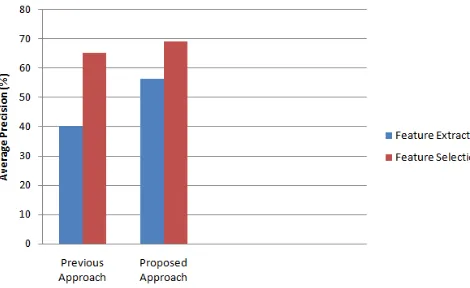
Fig. 6. Average Precision (%) for Previous and Proposed Approach.
Fig. 7. Average Recall (%) for Previous and Proposed Approach.
In figure 6 and figure7 are showing Average precision and Average recall for previous and proposed approaches separately. The blue bar shows feature extraction of previous and proposed approaches; red bar shows feature extraction of previous and proposed approaches.
VI. c
onclusIonIn this paper, we introduce about the CBIR system with different techniques. Different Feature extraction techniques for colour, texture, and shape are used in CBIR system for better image retrieval. The
proposed work is CBIR system based on Feature selection using genetic algorithm for best optimal features from feature set, and also use clustering for reduce elapsed time of system. The experimental result shows feature selection using Genetic Algorithm reduces the time for retrieval and also increases the retrieval precision and recall, thus it gives better and faster results as compared to normal image retrieval system. The CBIR system is more efficient and better performs using feature selection based on Genetic Algorithm. The computational time is reduced. From the result, it is clear that feature selection using Genetic Algorithm is more optimize the searching time in seconds and also shows highest precision and recall of each image class as compared with normal image retrieval system i.e. without feature selection.
In future work, we try to use feature selection based on other optimization algorithm for scale down computational time and provide better accuracy result of CBIR system. It can give better performance of CBIR system. It is also possible to improve performance of retrieval system by relevance feedback.
A
cknowledgMenTI express my sincere gratitude to my guide Mrs. R.R. Welekar, Professor (CSE Department, SRCOEM, Nagpur, India) for her constant help, worthful guidance, and encouragement during the work. I would like thanks to her for showing me some examples related to the topic of my research.
R
efeRences[1] T. Hilda and Dr. R.R. Rajalaxmi, “Effective feature selection for supervised learning using Genetic Algorithm”, IEEE sponsored 2’nd International conference of electronics and communication, 2015 ISSN 4788-7225. [2] Keyuri M. Zinzuvadia, Prof. Keyur N.Brahmbhatt, Prof. Bhavesh A.
Tanawala, “A survey on Feature Based Image Retrieval using classification and Relevance Feedback technique”, International Journal of Innovative Research in Computer and Communication engineering (IJIRCCE),
volume: 03, Issues: 01, 2015, pages: 508-513.
[3] Slimane Benloucif and Bachir Bouchehan,”Impact of feature selection on the performance of content- based image retrieval”, IEEE transaction 2014, ISSN 4799-7508.
[4] Lakshmi P.S, Thusnavis Bella Mary, A.Vasuki, Kolcharam Yadhul, Ansa Saju,“Image retrieval based on feature selection method” International Journal of Research in Engineering and Technology (IJRET), volume: 03, Issues: 07, 2014, pages: 34-38.
[5] Kommineni Jenni, Satria Mandala, “Pre-processing Image Database for Efficient content Based Image Retrieval”, International conference on Advances in Computing, Communications and Informatics, IEEE, Sept-2014, pages: 968-972.
[6] C.V. Rashmi, Sk.Sjida Praveen and G. Prathibha, “A Novel Image Retrieval System Using ACO and Relevance Feedback” International Journal of Advanced Research in Computer science and Software Engineering (IJARCSSE), volume: 4, Issues: 7, 2014, pages: 422-427.
[7] Mit Patel, Kanu Patel, Keyur Bhrahmbhatt, “Feature based Image retrieval based on clustering, classification techniques using low level image features”, International Journal of Advance Engineering and Reasearch Development (IJAERD), volume: 1, issue:5, 2014, pages: 1-9.
[8] Ramandeep Kaur and Ashok Kumar Bathla, “Enhanced Content-Based Image Retrieval Using Cuckoo Search Algorithm”, International Journal of Advanced Research in Computer science and Software Engineering (IJARCSSE),volume; 4, Issue: 9, 2014, pages: 233-241.
[9] P.K.Bhargavi, S.Bhuvana, and Dr.R.Radhakrishnan, “A Novel Content Based Image Retrieval Model Based on the Most Relevant Features Using Particle Swarm Optimization”, Journal of Global Research in Computer Science (JGRCS), vol.: 4, 2013, pages: 25-30.
[11] Afifi A.J., Ashour W.M., “Content-Based Image Retrieval Using Invariant Color and Texture Features”, IEEE Int. Conference on Digital Image Computing techniques and Applications, 2012, pp. 1-6.
[12] Manimala Singha and K.Hemachandran, “Content Based Image Retrieval using Color and Texture”, Signal & Image Processing: An International Journal (SIPIJ), Vol.3, No.1, February 2012, pp. 234-237.
[13] Jayant Mishra, Anubhav Sharma and Kapil Chaturvedi, “An Unsupervised Cluster-based Image Retrieval Algorithm using Relevance Feedback”, International Journal of Managing Information Technology (IJMIT) Vol.3, No.2, May 2011, pages: 10-16.
[14] L.Ladha, T.Deepa, “Feature Selection Methods And Algorithms”, International Journal on Computer Science and Engineering (IJCSE), Vol. 3 No. 5 May 2011.
[15] Rajshree S. Dubey, Rajnish Choubey, Jor Bhattacharjee, “Multi feature Content Based Image Retrieval”, International Journal on Computer Science and Engineering (IJCSE), volume: 2, No. 06, 2010, pages: 2145-2149.
[16] Jianhua Wu, Zhaorong Wei, Youli Chang ,“Color and Texture Feature For Content based image retrieval”, International Journal of Digital Content Technology and its Applications,2010.
[17] D. Joshi, R. Datta, J. Li, and J.Z. Wang, “Image retrieval: Ideas, influences, and trends of the new age”, ACM Comput. Surv., April-2008. [18] Tianzhong Zhao, Jianjiang Lu, Yafei Zhang1, Qi Xiao, “Feature Selection
based on Genetic Algorithm for CBIR”, Congress on Image and Signal processing, IEEE, volume: 02, May-2008, pages: 495-499.
[19] Jonathan E. Rowe, “Genetic Algorithm theory”, ACM GECCO ‘07: Proceedings of the 9th annual conference companion on Genetic and evolutionary computation, July-2007.
[20] Ke-jia Chen, Zhi-Hua Zhou, Hong-Bin Dai, “Enhancing relevance feedback in image retrieval using unlabeled data”, ACM trans. on Information Systems, April-2006.
Preeti Kushwaha, she is student of Master of Technology in Computer science engineering at Ramdeobaba college of Engineering and Management, Nagpur. She has received her Bachelor of Technology degree in Information Technology from the same college. Her area of interest is Image Processing and she published one survey paper in International conference named RICE 2016.