229
Volume-4, Issue-4, August-2014,
ISSN No.: 2250-0758
International Journal of Engineering and Management Research
Available at:
www.ijemr.net
Page Number: 229-235
TCP/IP Based Remote Industrial Thermal Process Monitoring, Logging
and Graphical Plotting Over Ethernet
Megha Goyal1, Parminder Malhotra2 1,2
Doaba Institute of Engineering and Technology, Kharar, INDIA
ABSTRACT
With the advancement of technology, the processes are becoming more and more complex. Due to this increase in complexity, for efficient analysis of process the number of parameters required for data acquisition also increases. In this paper, a data logger for specific application has been designed. The system works around the PIC microcontroller family. The system is designed and developed to measure the temperature with the help of temperature sensors and the result is displayed on PC in graphical form and in numeric value. During the testing, it is verified that there is continuous and correct acquisition of data. This verification is done by using an LCD display. The focus of design is on portability and low power consumption for battery operated applications. The designed system is tested under different conditions: at room temperatures, at low temperatures, at high temperatures. For all these conditions, the system performed accurately.
Keywords-- Introduction, Literature Survey, System
Design and Development, Results, Conclusion, Future Scope and References.
I.
INTRODUCTION
The processes to collect, analyze and store the data for later use is called logging. The human brain and its memory, the nature’s creation, no doubt is the best data logging mechanism. Where there is the need to collect information faster than a human, data loggers can possibly collect the information and in cases where accuracy is essential. A data logger is a device that can be used to store and retrieve the data. Data logging also implies the control of how sensor collects and analyses the data. It is commonly used in scientific experiments and in monitoring systems. Data loggers automatically make a record of the readings of the instruments located at different parts of plant. The type of information recorded is determined by the user A data logger (also data logger or data recorder) is an electronic device that records data over time or in relation to location either with a built in instrument or sensor or via external instruments and sensors. Increasingly, but nor entirely, they are based on a digital processor (or computer). They generally are small, battery powered, portable, and equipped with a microprocessor, internal memory for data storage and sensors. This data loggers interface with a personal computer and utilize software to
activate the data logger and view and analyze the collected data, while others have a local interface device (keyboard, LCD) and can be used as a stand-alone device. One of the primary benefits of using data loggers is the ability to automatically collect data on a 24- hour basis. The logging interval can be set for any period between 10 milli seconds and 24 hours, depending on the data requirement. The readings are written to its 192K memory, which can either stop logging if it becomes full, or wraparound so that the most recent data is not lost. A unit set to log every 5 minutes will take more than 340 days to fill .
A temperature data logger, also temperature monitor, is a portable measurement instrument that is capable of autonomously recording temperature over a defined period of time. The digital data can be retrieved, viewed and evaluated after it has been recorded.
230
II.
LITERATURE SURVEY
N.N Mahzan, A.M Omar, S.Z Mohammad Noor and M.Z Mohd Rodzi (2013) described the design of general data logger system which was able to store data from few input channels and having large memory space. The proposed data logging system was aimed to be able to store plenty quantities of data from analog signal over an extensive period of time so that it will be able to be left unattended for a quite long time. Besides the communication between microcontroller and memory unit are discussed in detail in this paper. The limitation of memory storage is also tested. A prototype of data logger is developed and tested to verify the concept mentioned before [19].
I.G. Saidu, M. Momoh and A.S. Mindaudu (2013) was designed a microcontroller-based temperature monitoring and logging system suitable for use in hospitals. The features include ability to monitor a patient’s temperature on a continuous basis while displaying the instant result on a Liquid Crystal Display (LCD) device. The temperature monitored was logged in a memory device, Electrically Erasable Programmable Read Only Memory (EEPROM), located in the system at every 10 minutes interval and can be interfaced with a computer using USB or RS232 UART device. An ATmega16 AVR is used as the heart of the control and coordination of all the activities of the individual modules. It allowed a doctor at location from the patient to keep track of his patient’s condition while attending to other issues [10].
Md. Abdullah A Mamun, Kenneth Sundaraj, N. Ahmed and Uddin Ahamed (2013) designed and developed a fully automated microcontroller-based data logging system to measure the temperature in a working environment. The system consists of a temperature sensor (LM35), a data logger with a memory card, and a high-performance low-power AVR 8-bit microcontroller (ATMega-8). The system consisted of LCD monitoring device and a computer terminal for storing and displaying the data. In conclusion, the developed system is easy to use, requires no additional hardware, and permits the selection of the amount of data and the time intervals between the data recordings. In addition, the collected data can easily be transferred to a computer via a connected serial port [13]. Vinay Divakar (2013) defined the term data logger as a self-contained, standalone data acquisition system or device. These products were comprised of a number of analog and digital inputs that are monitored, and the results or conditions of these inputs was then stored on some type of local memory. In this paper, a Temperature Data Logging System was designed to record and display temperatures continuously. The characteristics of LM 35 temperature sensor and the hardware required to interface the output of LM 35 to the LPC 2148 is discussed in detail [30].
S. Zhan Wei, W. Chen How, T. Shee Eng, Y. Hou Pin, and K. T. K. Teo (2012) described a wireless data logger with remote control capability via PC. The proposed wireless data logger was developed using microcontroller with analog-to-digital converter (ADC). The design of the portable wireless data logger was compact and light to increase the mobility and usability. Sampled data with time stamp from real time clock (RTC)
module will be stored into SD memory card which was attached to controller board [29].
Sathik, M.Jagabar , A Abdullah and K Yogeshraj (2012) had proposed Modified GSM based data logger system with two way communication. In institution., staff monitoring was predominantly based on manual entries. It required man power and additional cost. Manual entries had greater possibility of error occurrences., so the manual entries were replaced by data loggers. The conventional data loggers are built with fewer features which comprises of finger had proposed a modified model of data logger with microcontroller-GSM interface which possesses two way communications. This device sends a message to the staff prior to the schedule. The finger print of the entering staff was registered in the data logger and it was compared with the database and his or her entry was marked [28].
M.B. Waghmare, Dr. P.N. Chatur (2012) described the Climate as the general weather conditions in the air above the earth such as wind, temperature, humidity and rain. In order to checked this connectivity a stastical analysis between relative humidity and temperature was carried out by analyzing the correlation and linear regression as well as testing the independence between the relative humidity and temperature. Relative humidity, temperature measurement and monitoring were very useful for the purpose of its analysis about variation due to climate change and feature prediction of these values. This paper presents a simple technique in combining analog circuit and digital circuit theory together with programming technique to control the hardware [15].
N. Monoranjan Singh, K.C. Sharma(2012) used A low cost PC based real time data logging system in the laboratories for the measurement, monitoring and storage of the data for slowly varying signals in science and engineering stream. This can be designed and interfaced to the PCs Parallel Port, which is common to all desktop computers or Personal Computers (PCs). Existing PV LED street lighting had not equipped by data logger, therefore monitoring task was done by manually. Prototype developed based on a microcontroller, battery powered, and equipped with internal memory for data storage, and sensors [3].
V.Goulao, R.Paulo, J.Salvado, G.Martins, and A Granjeia (2011) explained a data logger system to monitor the parameters of processes of industrial cooling systems. It results from a straight cooperation between academia and industry in applied research and development. The prototype built and tested fulfils all the requisites and functionalities expected for the system, and allows local and remote data access. Among others, it monitors and keeps parameters on the quality of electrical energy, the oil and gas pressure, the oil and gas temperature, the outside temperature, and other parameters concerning the correct operation and the efficiency of the cooling system. Further work is undergoing prior to turn it into a commercial product [6].
231
to be developed with the use of microcontroller PIC 18F4458 (inbuilt 8 channel ADC), i.e. 4 channels will be used and 4 channel will open in external sensor [2].
III.
SYSTEM DESIGN AND
DEVELOPMENT
For the design and development of the system, the methodology used involves the software and hardware implementation. The actual implementation of the system involves the following steps:
1. System Definition: Broad definition of system hardware including microcontroller and its interface with display, ADC, memory, sensors etc.
2. Circuit Design: Selection of PIC microcontroller and other interfacing devices, as per system definition. Design of hardware circuit and its testing on laboratory kits with some simple microcontroller software routines.
3. PCB Design and Fabrication: Generation of schematic diagrams and the production of circuit board layout data for the procurement of the circuit board.
4. Hardware Modifications: Making any hardware changes found necessary after the initial hardware tests, to produce a revised circuit board schematic diagram and layout.
5. Software Design: Developing algorithm for the system, allocating memory blocks as per functionality, coding and testing.
6. Integration and Final Testing: Integrating the entire hardware and software modules and its final testing for data logging operation.
Thus the complete design is divided into two parts:
Hardware Implementation.
Software Implementation.
3.1 Software Design and Development:
Software design includes developing algorithm for the system, writing the separate routines for different interfacing devices and testing them on the designed hardware. Interfacing of microcontroller with LCD, LM35 etc. has been carried out using various software modules. The control program is written in C language for microcontroller and C# language is used for interconnection between two PC’s. The software is able to show the real time values from the analog channels for immediate analysis. For designing the software for this work; the flow
of software between the hardware components is to be understood first.
Flowchart for complete process is shown in figure 3.2
3.2 Hardware Implementation:
It involves the details of the set of design specifications. The hardware design consists of, the selection of system components as per the requirement, the details of subsystems that are required for the complete implementation of the system and full hardware schematics for the PCB layout. It involves the component selection, component description and hardware details of the system designed.
3.2.1 Component Selection and Description:
Temperature measurement using microcontroller based data logger includes the following components:
1. PIC Microcontroller(16F877A) 2. Temperature Sensor (LM35)
3. Analog to Digital Converter(ADC 0808) 4. Liquid Crystal Display(HD44780)
3.2.2 Hardware details :
232
Figure 3.4 and Figure 3.5 shows the schematic of transmitter and receiver for the implementation of the hardware for this purpose on next page.
IV.
RESULTS
In this system, Temperature measurement is done for any industrial thermal processing. The performance of this system is based on the sensor LM35 on the basis of their accuracy. The accuracy indicates how closely the sensor can measure the actual or real world parameter value. The more accurate a sensor is, better it will perform. The readings are taken under different conditions for some time interval and also plot its graph by using socket programming class TCP/IP. Also the readings are taken at different temperatures in a time interval.
The complete process for this system is divided into two parts:
a) Transmitter b) Receiver
In transmitter we detect the temperature using microcontroller to acquire data from sensor which is there in the field now, data acquired will be subjected to analog to digital conversion in the microcontroller. Then the digital data will be transmitted serially to the local control room using RS 232. The data can be logged in the computer there for records and send parallel to several PC’s which has connected on different locations. The working software on this is Socket programming. Now, the software will upload the data acquired to the internet. And through the internet, the remote user has the facility to access the data.
Figure 3.4 Block diagram of the Transmitter
Figure 3.5 Block diagram of the Receiver
4.1 Transmitter:
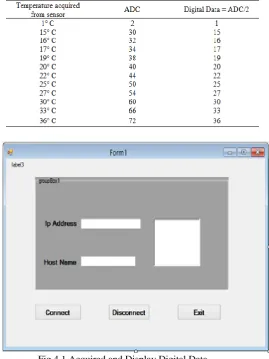
Table 4.1 shows how microcontroller acquire the data from real world and convert data analog to digital in the microcontroller and then this data digital data will be transmitted to host PC via serial cable. Figure 4.1 shows the value of digital data and the connectivity between two PC’s.
Fig.4.1 Acquired and Display Digital Data
4.2 Receiver:
233
for to display the digital data which is acquired by microcontroller and first PC that is host PC and two push buttons are, i.e Online and exit. The online pushbutton tell he is ready to take input from host PC or send a request to host PC and then the connect pushbutton is used to give acknowledge to client PC. After all this process the digital data is displayed on both side and continuously acquire the data from sensor and display its value , and also make its graph at client PC and exit button is used for to come back from the main window or give a stop command to all the process. Table 4.2 shows the results of temperature measurement (°C) taken at Low, Normal and High temperatures at both transmitter (Tx) and Receiver (Rx).
4.2.1 Experimental results taken at low temperature conditions:
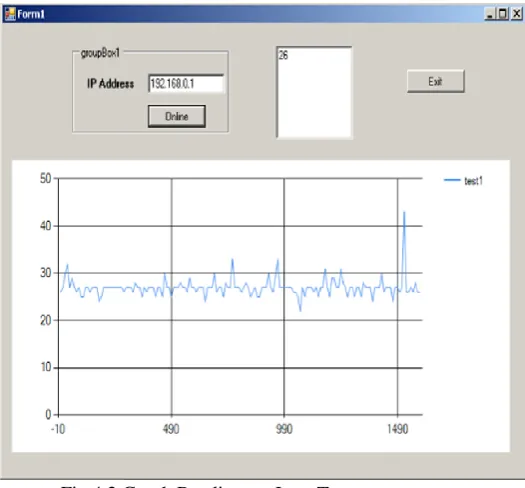
Figure 4.2 shows the graph readings of channel at low temperature after some time intervals. The readings and graph of temperatures obtained from the sensor.
Fig.4.2 Graph Readings at Low Temperature
4.2.2 Experimental results taken under normal conditions:
Figure 4.3 shows the graph readings at normal temperature after some time intervals. The readings and graph of temperatures obtained from the sensor.
Fig.4.3 Graph Readings under Normal Temperature
4.2.3.1 Experimental results taken under high
temperature:
234
Fig.4.4 Graph Readings at High Temperature
V.
CONCLUSION AND FUTURE
SCOPE
5.1 Conclusion
The data logger is an invaluable tool to collect and analyze experimental data, having the ability to clearly present real time results, with sensors. Data loggers used for measuring the temperature might have certain limitations in terms of speed, memory and cost. In this work, an attempt has been done to design a data logger, which is of less cost, portable, very low power consumption, self contained. It is an efficient data logger, which works in real time mode. The reduced number of channels also makes the system simple. The logger can use up to 8 channels of analog to digital converter in performing its task but that will result in increased number of channels.
A step-by-step approach in designing a PIC Microcontroller based system for temperature measurement has been followed. According to the study and analysis of various parts of the system, a design has been carried out. The results obtained from the measurement have shown that the system perform well under all the conditions.
From this work, it is concluded that in this system take milliseconds time to update record. If it is implemented on breadboard except PCB then it takes more time. It is due to RC delay in breadboard. The system baud rate is 9600 in the microcontroller because of this baud rate the speed of overall system comes in the order of few milliseconds. This system gives a small amount of error due voltage conversion process between A/D converter and socket programming.
5.2 Future Scope
The performance of microcontroller based temperature data logger has been found on the expected lines. However, there exists a scope for further improvement in its speed, number of channels, power consumption.
This system can be connected to communication devices such as modems, cellular phone, or satellite terminal to enable the remote collection of recorded data or alarming of certain parameters. The new system will email information based upon a regular schedule of based upon alarms.
The system can be modified with the use of graphical LCD panel so that the analysis is done by the system itself. The number of analog channels can be increased to monitor more sensor outputs.
Moreover, system can be made user friendly by interfacing it with user friendly software and thus can support the post process analysis. There lies the scope to make the system application specific.
The low power requirement of this data logger makes it easy to use. The device can be made to perform better by providing the power supply with the help of battery source which can be rechargeable or non-rechargeable, to reduce the requirement of main AC power.
We can implement this project with higher version of microcontroller like ARM series in which many features is inbuilt.
The communication process between hardware and PC may be parallel port or USB.
The access and display technique may be done by using LabView.
REFERENCES
1.
[1] Andrew J Thompson, John L Bahr and Neil R Thomson : Low power data logger, proceedings of conference department of physics, university of otago, Dunedin. [2] Anuj Kumar, I. P. Singh, and S. K. Sud : Design and Development of Multi-Channel Data Logger for Built Environment, proceeding of the international multiconference of engineers and computer Scientists 2010 vol 2,IMECS 2010, Hong Kong.
[3] A. Purwadi, Y. Haroen, F. Y. Ali, N. Heryana and D. Nurafiat : Prototype development of a Low Cost data logger for PV based LED Street Lighting System, in Electrical Engineering and Informatics (ICEEI), 2011 International Conference on, 2011, pp. 1-5.
[4] B. Niharika, Sayara Sultana, B.Prasanna, L.Harika : Data Logging To Collect And Display Temperature With Time And Day, Gokaraju Rangaraju Institute of Engineering & Technology.
[5] Efficient data compression algorithm for data loggers, measurement equipment and remote data analysis applications : Southeastcon '98. ,1998 IEEE, Print ISBN 0-7803-4391-3.
[6] G. Nkom, H. Musa : Development of a Novel Microcontroller-based data logger, 2nd International Conference on Adaptive Science & Technology 2009. 2. [7] H S kalsi, “Electronic instrumentation”, Tata
McGraw-Hill Ltd., New Delhi, 1999.
[8] I. G. Saidu, M. Momoh and A. S. Mindaudu : Temperature monitoring and logging system suitable for use in hospitals, incorporating gsm text messaging, International Journal of Information Sciences and Techniques (IJIST) Vol.3, No.1, January 2013.
235
System for Environmental Applications. Hydrological Processes 19:1517-1523.
[10] J. Rajmond, Pitica, x, and D : 8 channel configurable data logger for reliability testing and quality assurance, Electronics Technology (ISSE), 2010 33rd International Spring Seminar on, 2010, pp. 255-258.
[11] Md. Abdullah Al Mamun, Kenneth Sundaraj, N. Ahmed and Uddin Ahamed : Design and development of a pc-based automated data logging system for measuring temperature, ARPN Journal of Engineering and Applied Sciences.
[12] M.B Waghmare and Dr. P.N Chatur : Temperature and Humidity Analysis using Data Logger of Data Acquisition System: An Approach, International Journal of Emerging Technology and Advanced Engineering, ISSN 2250-2459, Volume 2, Issue 1, January 2012.
[13] M. Moghavvemi, M. Faruque, N. K. Eng and S. C. Yip. 2001 : A simple low cost data acquisition system for remote sensing of relative humidity and temperature. In: Circuits and Systems, 2001. Proceedings of the 44th, IEEE 2001 Midwest Symposium on. pp. 202-206.
[14] N. Kularatna and B. H. Sudantha : An environmental air pollution monitoring system based on the IEEE 1451 standard for low cost requirements, IEEE Sensors J., vol. 8, no. 4, April 2008, pp. 415 – 422.
[15] N. Monoranjan Singh and K. C. Sharma : Low Cost PC Based Real Time Data Logging System Using PCs Parallel Port For Slowly Varying Signals, Department of Instrumentation & USIC, Gauhati University, Guwahati [16] N N Mahzan, A.M Omar, S.Z Mohammad Noor and M.Z Mohd Rodzi : Design of data logger with multiple SD cards,” Clean Energy and Technology (CEAT), IEEE Conference on, 2013, Print ISBN: 978-1-4799-3237-5,pp. 175 – 180.
[17] National Semiconductor Corporation LM35 datasheet, precision Centigrade temperature sensors, Atmel data book, November 2000 update.
[18] PICmicro™ Mid- Range MCU Family Reference Manual data sheet, CMOS Flash-based 8- bit microcontroller pack microchip’s , 1997 Microchip Technology Inc.
[19] Radek Kuchta, Radimir Vrba : Wireless and Wired Temperature Data System, Second International Conference on Systems Brno University of Technology, Brno.
[20] R Robert and Dedrick, John : An Inexpensive, microprocessor-Based Data Logging System.Haley & Aldrich, New York
[21] Sagarkumar S. Badhiye, Dr. P.N. Chatur, B.V. Wakode : Data Logger System : A Survey, International Journal of Computer Technology and Electronics Engineering (IJCTEE) and National Conference on emerging Trends in Computer Science & Information Technology (NCETCSIT – 2011), ISSN 2249 – 6343, pp. 24 - 26.
[22] Sathik, M.Jagabar , A Abdullah and Yogeshraj, K : Modified GSM based data logger system with two way communication, Emerging Trends in Science, Engineering and Technology (INCOSET), 2012 International Conference on, 2012 IEEE, Print ISBN 978-1-4673-5141-6,pp.74 – 77.
[23] Suman Saha, Md. Tofiqul Islam and M Zakir Hossain : Design of a Low Cost Multi Channel DataLogger, Bangladesh University of Engineering and Technology,
ARPN Journal of Engineering and Applied Sciences, Vol.1, No.1, June 2006.
[24] S. J. Perez, M. A. Calva, R. Castaneda : A microcontroller based data logging System, Instrumentation and Development Vol. 3, Copyright 1997, Journal of the Mexican Society of Instrumentation.
[25] S. Zhan Wei, W. Chen How, T. Shee Eng, Y. Hou Pin, and K. T. K. Teo, : Design and development of a tablet based real time wireless data logger, Global High Tech Congress on Electronics (GHTCE), 2012 IEEE, 2012, pp. 111-116.
[26] The University of Texas at Arlington : Data-Logging & Supervisory Control In wireless Sensor Networks, http://dspace.uta.edu/bitstream/handle/10106/366/umi-117-pdf.
[27] Vinay Divakar : Design and Implementation of Microcontroller Based Temperature Data Logging System, International Journal of Engineering and Advanced Technology (IJEAT) ISSN: 2249 – 8958, Volume-3, Issue-2, December – 2013
[28] V Goulao, R Portugal Paulo, R., J Salvado and G Martins : A new monitoring and data logger system for industrial cooling equipment applications, EUROCON - International Conference on Computer as a Tool (EUROCON), 2011 IEEE,Print ISBN:978-1-4244-7486-8. [29] V Singh : Design and Development of microcontroller Based Temperature and Humidity Controller for Infant Incubator. Patiala, India, Thapar Institute of Engineering Technology.
[30] X Yan, G. Tao, Z. Jie and C. Wei. : Based on single-chip microcomputer temperature and humidity data acquisition system design. In: Electronics and Optoelectronics (ICEOE), 2011 International Conference on. pp. V2-310-V2-313.