
[Cestarolli* 4(12): December, 2017] ISSN 2349-4506
Impact Factor: 2.785
G
lobal
J
ournal of
E
ngineering
S
cience and
R
esearch
M
anagement
REMOVAL OF MICROALGAE FROM WATER MEDIUM BY
ELECTROCOAGULATION PROCESS
Dane Tadeu Cestarolli*, Ana Carolina Piazzi, Larissa Rossi de Oliveira, Bruno Meireles Xavier, Elidia Maria Guerra
* Universidade Federal de São João Del Rei, CAP – Departamento de Química, Biotecnologia e Engenharia de Bioprocessos – Rod MG 443, Km 7 – Ouro Branco, MG, Brazil – 36420-000
DOI: 10.5281/zenodo.1098674
KEYWORDS
:
electrocoagulation, microalgae, water treatment.ABSTRACT
In the present work, the electrocoagulation process using aluminum electrodes was used for removal of microalgae from aqueous solution. The experiments were performed using the following parameters: effect of applied potential; concentration of NaCl; Utilization of salts other than NaCl, in particular (NH4)2SO4 and CaCl2; effect of agitation and flow rate. The main results were: increasing the potential results in increasing of the efficiency microalgae removal. The best concentration of NaCl is 1.0 g/L, and NaCl is a better support electrolyte than the other studied salts. The electrocoagulation of microalgae in this study does not depend on the agitation of the solution or on the continuous flow rate. In the best parameters investigated, high removal efficiency of microalgae was observed, being about 97%.
INTRODUCTION
One of the problems caused by human activities that directly affects water is the process of eutrophication, caused by excess nutrients - mainly nitrogen and phosphorus - in springs, which cause excessive growth of aquatic plants to undesirable levels, causing an imbalance of aquatic ecosystem and progressive degradation of water quality. It can be natural or it can be accelerated by the inadequate disposal of effluents, which are largely derived from agricultural effluents (fertilizers and agrochemicals) as well as municipal and industrial wastewater.
In this way, the eutrophication of lakes, water reservoirs and fish ponds generate negative ecological impacts. In addition to the loss of biodiversity, there is excessive proliferation of microalgae, loss of dissolved oxygen, unpleasant odor of water, alteration in the structure and functioning of the whole aquatic ecosystem and its stability tends to reduce. Another aspect altered by this process is the increase of microalgae and cyanobacteria, which increases the turbidity of water. Thus, there is a need to remove microalgae and cyanobacteria to treat and clarify water [1-5].
The biomass removal techniques most commonly used in reservoirs and tanks are: gravity sedimentation [6], centrifugation [7], chemical flocculation [8] and filtration [9], some of which require intensive use of energy and chemical additives [9, 10-12]. Gravity settling is not suitable to harvest microalgae with small size [13]. In fact, chemical flocculation is very simple, however, the addition of chemical products to flocculate the microalgae introduces undesired substances, which makes it impossible to use it as a co-product, as in the use of animal feed - and even treated water [9, 14-15].
On the other hand, the filtration method has shown that, in laboratory scale is effective, but in large scale presents several problems that make it unfeasible. [9]. In a filtration process the size of the cells is taken into account, since the choice of filter pores is of extreme importance due to the pressure that will be required to force the passage of the liquid through the membrane [15-17]. The maintenance of both pumping and membrane replacement, energy consumption, ranging from 1 - 3 kWh m-3, formation of filter cakes and membrane clogging are the main negative
aspects of this technique, unfeasible [9, 15].
[Cestarolli* 4(12): December, 2017] ISSN 2349-4506
Impact Factor: 2.785
G
lobal
J
ournal of
E
ngineering
S
cience and
R
esearch
M
anagement
coagulation/flocculation of contaminants [18, 19]. The main reactions involved are well known and the various formed hydroxides can act as ligands to bind the pollutant molecule [20].In this study, experiments were performed to examine the effects of the several parameters of EC process (such as initial concentration, applied potential, pH, time of electrocoagulation and the amount of NaCl) in the removal of microalgae from aqueous medium. The best conditions were then combined to optimize the process of electrocoagulation.
MATERIALS AND METHODS
Freshwater mixture of Scenedesmus quadricauda, Chlamydomonas reinhardi and Scenedesmus SP were used in this study. This species were obtained from samples of a lake in the city of Ouro Branco, state of Minas Gerais, Brazil. After collection, the samples (10,0 L) were submitted to nutrients culture according to Inthorn et. al. [21] and maintened at 25 OC under cool white fluorescent light. The culture was continuously aerated whit air at a flow
rate of 5 L min-1 and the microalgae growth was measured by counting the cell numbers.
The electrocoagulation system consisted of an rectangular glass bath cell with 1.0 L capacity. Four aluminum electrodes (two anodes and two cathodes) with dimension of 30 cm2 each one (3.0 cm wide and 10.0 cm long)
were used for the experiments. These electrodes were interconnected by bi-polar mode. A digital DC power supply (ICEL model) was used for potential control, providing 0-15 V (0-5 A) with potentiostatic operational option. The experiments were carried out in batch and continuous stirring, for the studies of the influence of the applied potential, as well as the concentration of conductive ionic salt (NaCl). Two other types of salts were investigated as electrolytic solution, (NH4)2SO4 and CaCl2. The electrocoagulation process was also studied without agitation
and in a continuous process (flow rate= 1,25 mL/min).
The electrocoagulation of microalgae samples (1.0 L) were experimentally investigated, in order to determine the suitable operating conditions for treatment. As the staining of the eutrophic effluent is closely linked to the growth of microalgae, since there is a correlation between the amount of cells and absorbance, a UV/VIS spectrophotometer Shimadzu model UV-3600 was used to evaluate the color removal of the aqueous medium at a wavelength with the best absorbance of the microalgae culture (maximum absorbance = 600 nm). In order to evaluate the removal color efficiency RC (%) the following formula was used:
RC (%) = {Abs0 – Abs / Abs} x 100
were Abs0 is the initial absorbance of the sample without treatment and Abs is the absorbance after the electrochemical treatment.
RESULTS AND DISCUSSION
Efficiency of algae removal as a function of applied potential
The applied potential is responsible for the coagulant production rate, which can increase the amout of Al3+ (aq)
[Cestarolli* 4(12): December, 2017] ISSN 2349-4506
Impact Factor: 2.785
G
lobal
J
ournal of
E
ngineering
S
cience and
R
esearch
M
anagement
0 20 40 60 80 100
0 20 40 60 80 100
R
C
(%
)
Time/ min
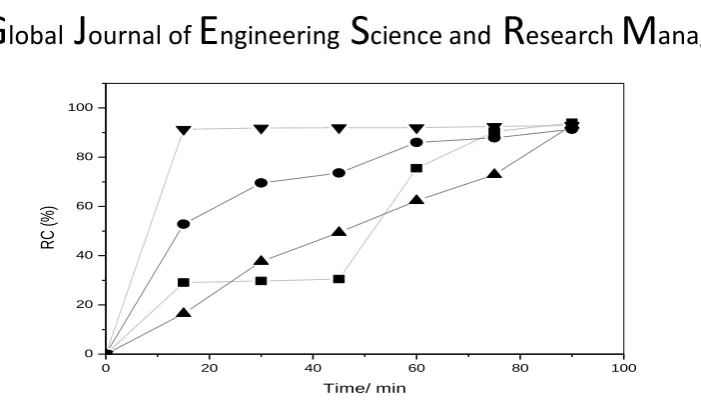
Figure 1: Effect of applied potential on the removal efficiency of algae removal. ▼ = 13.0 V; ● = 5.0 V; ▲= 8.0 V and ■ = 3.0 V. [NaCl] = 1,0 g/L ; Electrolysis time = 90 min.
The algae removal, measured as efficiency percentage (RC%), showed the following results: RC(%) = 93.9 % for 3.0 V; RC(%) = 91.4 % for 5.0 V; RC(%) = 96.5 % for 5.0 V and RC(%) = 96.8 % for 13.0 V.
As we can see in figure 1, after approximately 80 minutes all the studied potentials presented a higher removal of algae efficiency, however at 13.0 V the efficiency was obtained more quickly, in approximately 18 minutes. This phenomenon occurs because more dissolved species of aluminum are electrogenerated at higher potentials, resulting in an increase of hydroxide formation, such as Al(OH)3 and Aln(OH)3n species. Considering the similar
results after 80 minutes and also considering the excess of electrical energy consumption for higher potentials, the value of 8.0 V was used in the following studies.
Efficiency of algae removal as a function of concentration of NaCl as supporting electrolyte
The NaCl is commonly used as the conducting medium in the electrolysis processes. Figure 2 shows the RC(%) as a function of NaCl concentration under constant applied potential:
0 10 20 30 40 50 60
0 20 40 60 80 100
R
C
(%
)
Time/min
[Cestarolli* 4(12): December, 2017] ISSN 2349-4506
Impact Factor: 2.785
G
lobal
J
ournal of
E
ngineering
S
cience and
R
esearch
M
anagement
The table 1 resumes the obtained results:Table 1: Effect of initial NaCl concentration on the RC(%) of algae. (Applied potential = 8.0 V. Electrolysis time: 90 minutes):
[NaCl] g/L RC(%)
1 95,62
2 86,25
3 91,21
As can be seen from table 1, an increase in NaCl concentration does not result in a better efficiency in algae removal. In fact, it was found in the literature [23] that the RC(%) remained the same with increasing of NaCl concentration. Besides this fact, it is also known that a higher concentration of Cl- ions can produces the corrosion
of anode and cathode, which is a disadvantage [24].
Efficiency of algae removal as a function of concentration of (NH4)2SO4 and CaCl2 as supporting electrolyte
In order to evaluate the effect of other types of salts on efficiency removal (RC%), (NH4)2SO4 and CaCl2 were
also used in the concentration of 1.0 g/L. The results are presented in Table 2:
Table 2: Effect different salts on the RC(%) of algae. (Applied potential = 8.0 V. Electrolysis time: 90 minutes):
Salt RC(%)
NaCl 95,62
(NH4)2SO4 97,55
CaCl2 99,27
Although Table 2 showed similar results in terms of (RC%), it should be taken into account that the salt (NH4)2SO4
resulted in a marked corrosion of the aluminum electrodes. The CaCl2, on the other hand, left the solution more
turbid, by a possible interaction of this salt with the hydroxides of the aluminum formed. Based on these results, it was chosen to use NaCl as support electrolyte in the studies.
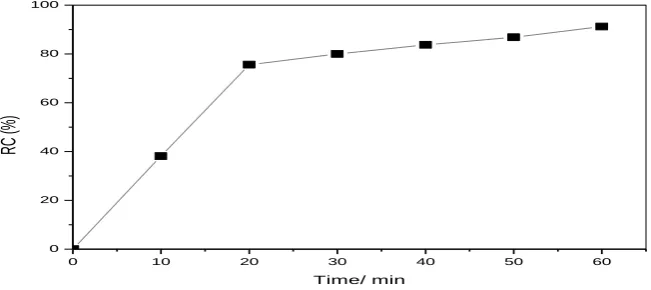
Efficiency of algae removal as a function of agitation of algae solution on the electrocoagulation process All previous studies were performed under continuous agitation. In order to explore the influence of agitation on the efficiency of the process, the figure 3 shows an electrolysis performed without any kind of agitation of the algae solution.
0 10 20 30 40 50 60
0 20 40 60 80 100
RC
(%
)
Time/ min
[Cestarolli* 4(12): December, 2017] ISSN 2349-4506
Impact Factor: 2.785
G
lobal
J
ournal of
E
ngineering
S
cience and
R
esearch
M
anagement
As can be seen from figure 3, agitation is not an important parameter in removal efficiency. Without any stirring of the solution, the RC% value obtained was 92.3%.Efficiency of algae removal as a function of continuous process
Electrocoagulation studies are usually carried out in a batch process, as it takes a certain period of time for the hydroxides generated in solution to come into contact with the material to be electrocoagulated, in this case, the microalgae. However, to investigate the effect of the continuous flow of the aqueous effluent in the electrocoagulation process, an electrolytic flow was performed with 1.25 mL / min, shown in the figure 4:
0 10 20 30 40
0 20 40 60 80 100
R
C
(%
)
Time/ min
Figure 4: Electrolysis performed in flow rate of 1.25 mL/min during electrocoagulation; [NaCl] = 1.0 g/L ; Electrolysis time = 40 min; Applied potential: 8.0 V.
As can be verified through figure 4, the RC% was 86.02% after 40 minutes of electrolysis. This result indicates that, although continuous flow can be used, its use does not result in a better removal efficiency of microalgae.
CONCLUSION
The process of removal of microalgae through the electrocoagulation process was investigated by several parameters. It has been observed that increasing the potential increases the value of RC%. However, considering the corrosion process of the electrodes, the best value obtained was the potential of 8.0 V in 90 minutes of electrocoagulation. Regarding the support electrolyte, it was observed that a small concentration (1.0 g / L) of NaCl is sufficient for a value of RC% = 95.62%. NaCl is better for this process than other investigated salts, such as (NH4)2SO4 and CaCl2, where higher electrode wear and turbidity of the solution were observed, respectively.
Furthermore, it was concluded that this process does not depend on the agitation of the solution and that the flow system does not offer advantages over the batch system.
ACKNOWLEDGEMENTS
This study was conducted at Universidade Federal de São João Del Rei. We also thank the FAPEMIG, CAPES and CNPQ foundations.
REFERENCES
1. CARPENTER, C. S.; CARACO, N.F.; CORREL, D. L.; HOWARTH, R. W.; SHARPLEY, A. N.; SMITH, V. H. Nonpoint Pollution of Surface Waters with Phosphorus and Nitrogen. Issues in Ecology, number 3. 1998
[Cestarolli* 4(12): December, 2017] ISSN 2349-4506
Impact Factor: 2.785
G
lobal
J
ournal of
E
ngineering
S
cience and
R
esearch
M
anagement
3. CONLEY, D. J.; PAERL, H. W.; HOWARTH, R. W.; BOESCH, D. F.; SEITZINGER, S. P.; HAVENS,K. E.; LANCELOT, C.; LIKENS, G. E. Controlling Eutrophication: Nitrogen and Phosphorous. Science vol.223, Fevereiro de 2009.
4. HELSINKI COMMISSION. Eutrophication in the Baltic Sea - An integrated thematic assessment of the effects of nutrient enrichment in the Baltic Sea region. Baltic Sea Environment Proceedings nº 115B, 2009.
5. MACEDO, C. F.; SIPAÚBA-TAVARES, L. Eutrofização e qualidade da água na piscicultura: consequências e recomendações. Bol. Inst. Pesca, São Paulo, 36 (2): 149 – 163, 2010.
6. Depraetere, O., Pierre, G., Deschoenmaeker, F., Badri, H., Foubert, I., Leys, N., Markou, G., Wattiez, R., Michaud, P., Muylaert, K., 2015. Harvesting carbohydrate-rich Arthrospira platensis by spontaneous settling. Bioresour. Technol. 180, 16–21.
7. Chen, C.L., Huang, C.C., Ho, K.C., Hsiao, P.X., Wu, M.S., Chang, J.S., 2015. Biodiesel production from wet microalgae feedstock using sequential wet extraction/transesterification and direct transesterification processes. Bioresour. Technol. 194, 179–186.
8. Reyes, J.F., Labra, C., 2016. Biomass harvesting and concentration of microalgae scenedesmus sp cultivated in a pilot phobioreactor. Biomass Bioenerg. 87, 78–83.
9. ABDELAZIZ, A. E. M.; LEITE, G. B.; HALLENBECK, P. C. Addressing the Challenges for Sustainable Production of Algal Biofuels: II. Harvesting and Conversation to Biofuels.Environmental Technology, 2013. Vol. 4. Nos. 13-14, 1807-1836.
10. Kim, K., Shin, H., Moon, M., Ryu, B.G., Han, J.I., Yang, J.W., Chang, Y.K., 2015. Evaluation of various harvesting methods for high-density microalgae, Aurantiochytrium sp KRS101. Bioresour. Technol. 198, 828–835.
11. Kim, K., Shin, H., Moon, M., Ryu, B.G., Han, J.I., Yang, J.W., Chang, Y.K., 2015. Evaluation of various harvesting methods for high-density microalgae, Aurantiochytrium sp KRS101. Bioresour. Technol. 198, 828–835.
12. SUALI, E.; SARBATLY, R. Conversation of Microalgae to Biofuel. Renewable and Sustainable Energy Reviews 16 (2012) 4316 – 4342.
13. Park, J.B.K., Craggs, R.J., 2010. Wastewater treatment and algal production in high rate algal ponds with carbon dioxide addition. Water Sci. Technol. 61 (3), 633–639.
14. Pan, G., Chen, J., Anderson, D.M., 2011. Modified local sands for the mitigation of harmful algal blooms. Harmful Algae 10 (4), 381–387.
15. VANDAMME, D.; FOUBERT, I.; MUYLAERT, K. Flocculation as a Low-Cost Method for Harvesting Microalgae for Bulk Biomass Production. Trends in Biotechnology (2013) Vol. 31. Nº4, p 233 – 239. 16. GRIMA, E. M.; BELARBI, E-H.; FERNÁNDEZ, F. G. A.; MEDINA, A. R.; CHISTI, Y. Recovery of Microalgal Biomass and Metabolites: Process Options and Economics.Biotechnology Advances 20 (2003) 491 – 515.
17. BRENNAN, L.; OWENDE, P. Biofuels from Microalgae – A Review of Technologies for Production, Processing, and Extractions of Biofuels and Co-Products. Renewable and Sustainable Energy Reviews 14 (2): 557-577. 2009.
18. Manoel V. B. Gonçalves, Stela C. De Oliveira, Bruna M. P. N. Abreu, Elidia M. Guerra and Dane T. Cestarolli Int. J. Electrochem. Sci., 11 (2016) 7576 – 7583
19. M. Mechelhoff, G. H. Kelsall and N. J. D. Graham, Chemical Eng. Science, 95 (2013) 301. 20. N. Daneshvar, A. Oladegaragoze and N. Djafarzadeh, J. Hazard. Mater., 129 (2006) 116.
21. INTHORN, D.; SIDTITOON, N.; SILAPANUNTAKUL, S.; INCHAROENSAKDI, A. Sorption of mercury, cadmium and lead by microalgae. Sciense Asia, 28: 253-261, 2002
![Figure 4: Electrolysis performed in flow rate of 1.25 mL/min during electrocoagulation; [NaCl] = 1.0 g/L ; Electrolysis time = 40 min; Applied potential: 8.0 V](https://thumb-us.123doks.com/thumbv2/123dok_us/8888497.1823801/5.595.152.447.267.428/figure-electrolysis-performed-electrocoagulation-nacl-electrolysis-applied-potential.webp)
