Vol. 5, No. 4, 2013 Article ID IJIM-00280, 8 pages Research Article
Fully fuzzy linear programming with inequality constraints
S. H. Nasseri ∗ † , E. Behmanesh ‡ , F. Taleshian§ , M. Abdolalipoor ¶, N. A. Taghi-Nezhad ∥
————————————————————————————————–
Abstract
Fuzzy linear programming problem occur in many fields such as mathematical modeling, Control theory and Management sciences, etc. In this paper we focus on a kind of Linear Programming with fuzzy numbers and variables namely Fully Fuzzy Linear Programming (FFLP) problem, in which the constraints are in inequality forms. Then a new method is proposed to fine the fuzzy solution for solving (FFLP). Numerical examples are providing to illustrate the method.
Keywords: Fuzzy numbers; Linear programming; Fuzzy linear programming; Membership function; Ranking function.
—————————————————————————————————–
1
Introduction
T
hgramming is proposed by Zimmermann [e first formulation of Fuzzy Linear Pro-16]. Thereafter, many authors considered various types of the fuzzy linear programming problems and proposed several approaches for solving these problems [3, 5, 9, 12, 4, 13, 15]. In all of the above mentioned works, those cases of fuzzy lin-ear programming have studied in which not all parts of the problem were assumed to be fuzzy, e.g., the right hand side, constraint coefficients∗Corresponding author. [email protected]
†Department of Mathematics, University of Mazan-daran, Babolsar, Iran.
‡Department of Mathematics, University of Mazan-daran, Babolsar, Iran.
§Department of Mathematics, University of Mazan-daran, Babolsar, Iran.
¶Department of Mathematics, University of Tabriz, Tabriz, Iran.
∥Department of Mathematics, University of Mazan-daran, Babolsar, Iran.
or the objective function coefficients were fuzzy but the variable were not fuzzy. The fuzzy lin-ear programming problems in which all the pa-rameters as well as the variables are represented by fuzzy numbers are known as Fully Fuzzy Lin-ear Programming (FFLP) problems. Some au-thors [1, 2, 7, 6] have proposed different meth-ods for solving FFLP problems with inequality constraints. All of these methods are based on replacing fuzzy linear programming problems by crisp linear programming problems and then the obtained crisp linear programming is solved to find the fuzzy optimal solution of the FFLP prob-lems with inequality constraints. In this paper we propose a new method for finding the fuzzy solution of FFLP problems with inequality con-straints. This paper is organized in 5 sections. In the next section some basic definitions and arith-metic of fuzzy numbers are reviewed. In Section3
formulation of FFLP problems and application of ranking function for solving FFLP problems are discussed. In Section 4 the new method is
posed. To illustrate the proposed method some numerical examples are presented in Section 5. Finally conclusion and some suggestion are given in Section6.
2
Preliminaries
In this Section, we review some necessary nota-tions and defininota-tions of the fuzzy set theory in which will be used in this paper [8,10,11]:
2.1 Basic definitions
Definition 2.1 Let R be the real line, then a fuzzy set A in R is defined to be a set of ordered pairs A = {(x, µA(x)) | x ∈ R}, where µA(x) is called the membership function for the fuzzy set. The membership function maps each element of R to a membership value between 0 and 1.
Definition 2.2 The support of a fuzzy set A is defined as fallow:
supp(A) ={x∈R |µA(x)}.
Definition 2.3 The core of a fuzzy set is the set of all points x in R with µA(x) = 1.
Definition 2.4 A fuzzy set A is called normal if its core is nonempty. In other words, there is at least one point x∈R withµA(x) = 1.
Definition 2.5 The
α–cut or α–level set of a fuzzy set is a crisp set defined by
Aα={x∈R |µA(x)> α}.
Definition 2.6 A fuzzy set A onR is convex, if for any x, y∈R and λ∈[0,1], we have µA(λx+
(1−λ)y)≥min{µA(x), µA(y)}.
Definition 2.7 A fuzzy number a is a fuzzy set on the real line that satisfies the condition of nor-mality and convexity.
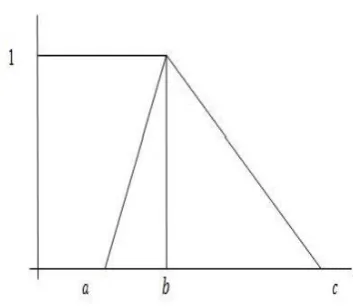
Definition 2.8 A fuzzy number A˜ =⟨a, b, c⟩ on R is said to be triangular fuzzy number, if its membership function is given as follows:
˜
a(x) =
x−a
b−a, x∈[a, b] x−c
b−c, x∈[b, c]
0, o.w.
We denote a triangular fuzzy number a˜ by three real numbers s, l and r as ˜a = ⟨a, b, c⟩, whose
meaning are defined in Figure 1. We also denote the set of all triangular fuzzy numbers withF(R).
Figure 1: Triangular fuzzy numbers.
Definition 2.9 A fuzzy triangular fuzzy number
˜
A = ⟨a, b, c⟩ is sad to be nonnegative triangular fuzzy number iff a≥0.
Definition 2.10 Tow triangular fuzzy numbers
˜
A = ⟨a, b, c⟩ and B˜ = ⟨e, f, g⟩ are equal if and only if a=e, b=f and c=g.
2.2 Fuzzy Arithmetic
In this Subsection arithmetic operations between two triangular fuzzy numbers defined on uni-versal set of real numbers R, are reviewed: Let
˜
A = ⟨a, b, c⟩ and ˜B = ⟨e, f, g⟩ be two triangular fuzzy numbers. Then:
˜
A+ ˜B =⟨a+e, b+f, c+g⟩
−A˜=⟨−c,−b,−a⟩,
˜
A−B˜ =⟨a−g, b−f, c−e⟩,
˜
a≤˜b if and only if a≤e, b≤f, c≤g,
and for any ˜B =⟨e, f, g⟩ ≥0 we define:
˜
A×B˜≃
⟨ae, bf, cg⟩, a≥0
⟨ag, bf, cg⟩, a <0, c≥0
⟨ae, bf, ca⟩, c <0
3
Linear Programming
In this Section we first define the model and then the application of ranking function for solving FFLP problems is presented.
3.1 Definition of Model
Linear programming is one of the most frequently applied operations research technique. A lin-ear programming problem may be defined as the problem of maximizing or minimizing a linear function subject to linear constraints. The con-straints may be equality or inequality. Any linear programming model representing real world situ-ations involves a lot of parameters whose values are assigned by experts. However both experts
and decision maker frequently do not precisely know the value of those parameters. It is useful to consider the knowledge of experts about the parameters as fuzzy data. In the conventional approach value of the parameters of linear pro-gramming models must be well defined and pre-cise. However, in real world environment, this is not a realistic assumption. In the real life prob-lems there may exists uncertainty about the pa-rameters. In such a situation the parameters of linear programming problems may be represented as fuzzy numbers. The fuzzy linear programming problems in which all the parameters as well as the variables are represented by fuzzy numbers are known as Fully Fuzzy Linear Programming (FFLP) problems. In this paper we deal with the solution of the problems with inequality con-straints. Fully fuzzy linear programming FFLP problems with m fuzzy inequality constraints and n fuzzy variables may be formulated as follows:
(p1) : maximize (or minimize) ˜CT ⊗X˜
s.t.
˜
A⊗X˜ ≤˜b
˜
X is nonnegative f uzzy number
where ˜CT =
[
˜
Cj
]T
1×n, ˜A= [˜aij]m×n, ˜b=
[
˜bi]
m×1
and ˜X= [˜xj]1×n.
3.2 Application of Ranking Function for Solving FFLP Problems
The fuzzy optimal solution of FFLP problem (p1)
will be a fuzzy number ˜X if it satisfies the follow-ing characteristics:
(i) X˜, is nonnegative fuzzy number
(iii) If there exist any nonnegative fuzzy number ˜
X′
such that ˜A⊕X˜′ ≤˜b , then
R( ˜CT ⊗ X˜) > R( ˜CT ⊗ X˜′) (in case of maximizing problem) and
R( ˜CT ⊗ X˜) < R( ˜CT ⊗ X˜′) (in case of minimizing problem).
Remark 3.1 Let X˜ be a fuzzy optimal solution of FFLP problem (p1). if there exists a fuzzy numberY˜ such that,
(i) Y˜, is non negative fuzzy number
(ii) A˜⊕Y˜ ≤˜b fuzzy set,
(iii) R
(
˜
CT ⊗X˜
)
=R
(
˜
CT ⊗Y˜
)
then Y˜ is said to be an alternative fuzzy optimal solution of (p1).
4
Proposed Method to Find the
Fuzzy
Optimal
Solution
of
FFLP Problems
In this Section a new method is proposed to find the fuzzy optimal solution of FFLP problem [1]. The Steps of the proposed method are as follows:
Step 1: Substituting C˜T =
[
˜
Cj
]T
1×n,
˜
A= [˜aij]m×n, ˜b=
[
˜bi]
m×1 and ˜X = [˜xj]1×n, the
FFLP problem may be written as follows:
maximize (or minimize)
n
∑
j=1
˜
Cj⊗x˜j
s.t.
∑n
j=1˜aij⊗x˜j ≤˜bi, ∀i= 1, . . . , m
˜
xj is nonnegative f uzzy number
(4.1)
Step 2: If all the parameters ˜Cj, ˜aij, ˜bi and
˜
xj, are represented by triangular fuzzy numbers ⟨pj, qj, rj⟩,⟨aij, bij, cij⟩,⟨bi, gi, hi⟩ and ⟨xj, yj, zj⟩
respectively then the FFLP problem obtained in Step 1, may be written as:
max(or min)
n
∑
j=1
⟨pj, qj, rj⟩ ⊗ ⟨xj, yj, zj⟩
s.t.
∑n
j=1⟨aij, bij, cij⟩ ⊗ ⟨xj, yj, zj⟩
≤ ⟨bi, gi, hi⟩, ∀i= 1, . . . , m
⟨xj, yj, zj⟩ is nonnegative f uzzy number
(4.2)
Step 3: Assuming ⟨aij, bij, cij⟩ ⊗ ⟨xj, yj, zj⟩ = ⟨mij, nij, oij⟩, the FFLP obtained in Step 2, may
be written as follows:
max (or min) R
∑n
j=1
⟨pj, qj, rj⟩ ⊗ ⟨xj, yj, zj⟩
s.t.
∑n
j=1⟨mij, nij, oij⟩
≤ ⟨bi, gi, hi⟩, ∀i= 1, . . . , m
⟨xj, yj, zj⟩ is nonnegative f uzzy number
(4.3)
Step 4: Using arithmetic operations de-fined in Subection 2.2 and Definition 2.4 the fuzzy linear programming problem obtained in Step 3, is convert into the following problem:
max(or min) R
∑n
j=1
⟨pj, qj, rj⟩ ⊗ ⟨xj, yj, zj⟩
s.t.
∑n
j=1mij ≤bi, ∀i= 1, . . . , m
∑n
j=1nij ≤gi, ∀i= 1, . . . , m
∑n
j=1oij ≤hi, ∀i= 1, . . . , m
yj−xj ≥0, zj−yj ≥0
(4.4)
Step 5: Find the optimal solution xj, yj
and zj by solving the problem 4.4 in Step 4.
Step 6: Find the fuzzy optimal solution by putting the values of xj, yj and zj in
˜
xj =⟨xj, yj, zj⟩.
Step 7: Find the fuzzy optimal value by putting ˜xj in
∑n
j=1C˜j⊗x˜j.
5
Numerical Examples
In this Section, we utilize some examples to illus-trate the solution method proposed in this paper. Then compare our method to Kumar, Kaur and Singh approach [7].
Example 5.1 Let us consider the following FFLP problem and solve it by the proposed method:
max Z = (⟨1,2,3⟩ ⊗x˜1⊕ ⟨2,3,4⟩ ⊗x˜2)
s.t.
⟨0,1,2⟩ ⊗x1˜ ⊕ ⟨1,2,3⟩ ⊗x2˜ ≼⟨1,10,27⟩
⟨1,2,3⟩ ⊗x1˜ ⊕ ⟨0,1,2⟩ ⊗x2˜ ≼⟨2,11,28⟩ (5.5)
Where x˜1 and x˜2 are non-negative triangu-lar fuzzy numbers. Let x˜1 = ⟨x1, y1, z1⟩ and
˜
x2 = ⟨x2, y2, z2⟩. Then the given FFLP problem may be written as follows:
maxZ =
(⟨1,2,3⟩ ⊗ ⟨x1, y1, z1⟩ ⊕ ⟨2,3,4⟩ ⊗ ⟨x2, y2, z2⟩)
s.t.
⟨0,1,2⟩ ⊗ ⟨x1, y1, z1⟩ ⊕ ⟨1,2,3⟩ ⊗ ⟨x2, y2, z2⟩≼⟨1,10,27⟩
⟨1,2,3⟩ ⊗ ⟨x1, y1, z1⟩ ⊕ ⟨0,1,2⟩ ⊗ ⟨x2, y2, z2⟩≼⟨2,11,28⟩
(5.6)
According to Step 3 of proposed method, the above problem can be written as follows:
maxZ =R(⟨x1,2y1,3z1⟩ ⊕ ⟨2x2,3y2,4z2⟩)
s.t.
⟨0, y1,2z1⟩ ⊕ ⟨x2,2y2,3z2⟩≼⟨1,10,27⟩
⟨x1,2y1,3z1⟩ ⊕ ⟨0, y2,2z2⟩≼⟨2,11,28⟩
(5.7)
Using the ranking function that is addressed in Section 2.1, the FFLP obtained in current step, may be written as follows:
maxZ =R ⟨x1+ 2x2,2y1+ 3y2,3z1+ 4z2⟩
s.t.
⟨x2, y1+ 2y2,2z1+ 3z2⟩≼⟨1,10,27⟩
⟨x1,2y1+y2,3z1+ 2z2⟩≼⟨2,11,28⟩
(5.8)
The problem (5.9) and the fuzzy arithmetic that is mentioned in Section 2.2 yield:
s.t.
x2≤1
y1+ 2y2 ≤10
2z1+ 3z2≤27
x1≤2
2y1+y2 ≤11
3z1+ 2z2≤28
x1, x2, y1, y2, z1, z2 ≥0
(5.9)
This problem is a conventional linear pro-gramming problem. The optimal solution of this problem is obtained as follows:
⟨x1, y1, z1⟩=⟨2,4,6⟩
⟨x2, y2, z2⟩=⟨1,3,5⟩
Thus x˜1 =⟨2,4,6⟩ and x˜2 =⟨1,3,5⟩ is the fuzzy optimal solution of FFLP problem (5.5). By sub-stituting these fuzzy numbers in objective function the fuzzy optimal value is obtained as follows:
Z∗ =⟨1,2,3⟩ ⊗ ⟨2,4,6⟩ ⊕ ⟨2,3,4⟩ ⊗ ⟨1,3,5⟩
=⟨2,8,18⟩ ⊕ ⟨2,9,20⟩=⟨4,17,38⟩
Therefore Z∗ = ⟨4,17,38⟩ is the fuzzy optimal solution of problem (5.5).
Example 5.2 Now consider FFLP problem that is defined as follows:
maxZ = (⟨1,6,9⟩ ⊗x1˜ ⊕ ⟨2,2,8⟩ ⊗x2˜ )
s.t.
⟨0,1,1⟩ ⊗x1˜ ⊕ ⟨2,2,3⟩ ⊗x2˜ ≽⟨4,7,14⟩
⟨2,2,3⟩ ⊗x˜1⊕ ⟨−1,4,4⟩ ⊗x˜2≼⟨−4,14,22⟩ ⟨2,3,4⟩ ⊗x1˜ ⊖ ⟨1,2,3⟩ ⊗x2˜ =⟨−12,−3,6⟩
(5.10)
Where x1˜ and x2˜ are non-negative triangu-lar fuzzy numbers. Let x˜1 = ⟨x1, y1, z1⟩ and
˜
x2 =⟨x2, y2, z2⟩. Then the given FFLP problem
may be written as follows:
maxZ =
(⟨1,6,9⟩ ⊗ ⟨x1, y1, z1⟩ ⊕ ⟨2,2,8⟩ ⊗ ⟨x2, y2, z2⟩)
s.t.
⟨0,1,1⟩ ⊗ ⟨x1, y1, z1⟩ ⊕ ⟨2,2,3⟩
⊗ ⟨x2, y2, z2⟩≽⟨4,7,14⟩ ⟨2,2,3⟩ ⊗ ⟨x1, y1, z1⟩ ⊕ ⟨−1,4,4⟩
⊗ ⟨x2, y2, z2⟩≼⟨−4,14,22⟩ ⟨2,3,4⟩ ⊗ ⟨x1, y1, z1⟩ ⊖ ⟨1,2,3⟩
⊗ ⟨x2, y2, z2⟩=⟨−12,−3,6⟩ (5.11)
According to Step 3 of proposed method, the above problem can be written as follows:
maxZ =R (⟨x1,6y1,9z1⟩ ⊕ ⟨2x2,2y2,8z2⟩)
s.t.
⟨0, y1, z1⟩ ⊕ ⟨2x2,2y2,3z2⟩≽⟨4,7,14⟩ ⟨2,2,3⟩ ⊗ ⟨x1, y1, z1⟩ ⊕ ⟨−1,4,4⟩
⊗ ⟨2x1,2y1,3z1⟩ ⊕ ⟨−1z2,4y2,4z2⟩
≼⟨−4,14,22⟩
⟨2x1,3y1,4z1⟩ ⊖ ⟨x2,2y2,3z2⟩
=⟨−12,−3,6⟩
(5.12)
Using the ranking function that is addressed in Section (2.1) and fuzzy arithmetic that is men-tioned in Section (2.2), the FFLP obtained in cur-rent step, may be written as follows:
s.t.
2x2 ≥4
y1+ 2y2≥7 y1+ 2y2≥7 z1+ 3z2 ≥14 2x1−z2≤ −4
2y1+ 4y2 ≤14
3z1+ 4z2 ≤22 2x1−3z2 =−12
3y1−2y2 =−3
4z1−x2= 6
x1, x2, y1, y2, z1, z2 ≥0
(5.13)
This problem is a conventional linear program-ming problem. The optimal solution of this prob-lem is obtained as follows:
⟨x1, y1, z1⟩=⟨0,1,2⟩
⟨x2, y2, z2⟩=⟨2,3,4⟩
Thus x˜1 =⟨0,1,2⟩ and x˜2 =⟨2,3,4⟩ is the fuzzy optimal solution of FFLP problem (5.10). By substituting these fuzzy numbers in objective func-tion the fuzzy optimal value is obtained as follows:
Z∗ =⟨1,6,9⟩ ⊗ ⟨0,1,2⟩ ⊕ ⟨2,2,8⟩ ⊗ ⟨2,3,4⟩
=⟨0,6,18⟩ ⊕ ⟨4,6,32⟩=⟨4,12,50⟩
Therefore Z∗ = ⟨4,12,50⟩ is the fuzzy optimal solution of problem (5.10). In [7], authors solve the FFLP problem (5.5) and (5.10), by a differ-ent approach and derived the same results. They convert each of these FFLP problem with inequal-ity constraints to a FFLP problem with equalinequal-ity constraints by introducing slack variablesi. Then these crisp linear programming problems should be solved to find the fuzzy optimal solution of the FFLP problems with inequality constraints 5-1 and 5-2, respectively.
6
Conclusion
In this paper a new method is proposed to find the fuzzy optimal solution of FFLP problems with inequality constraint by representing all param-eters as triangular fuzzy numbers. By using the proposed method the fuzzy optimal solution of FFLP with inequality constraints, occurring in real life situation, can be easily obtained. To
illustrate the proposed method some numerical example are solved and the obtained results are compared with other approaches.
References
[1] T. Allahviranloo, F. H. Lotfi, M. K. Kiasary, N. A. Kiani and L. Alizadeh, Solving fully fuzzy linear programming problem by the rank-ing function, Appl. Math. Sci. 2 (2008) 19-32.
[2] J. Buckley and T. Feuring, Evolutionary al-gorithm solution to fuzzy problems: fuzzy lin-ear programming, Fuzzy Sets and Systems 17 (2000) 35-53.
[3] M. Delgado, J. L. Verdegay and M. A. Vila,
A general model for fuzzy linear programming, Fuzzy Sets and Systems 29 (1989) 21-29.
[4] D. Dubois and H. Prade, System of linear fuzzy constraints, Fuzzy Sets and Systems 13 (1982) 43-52.
[5] S. C. Fang and C. F. Hu,Linear programming with fuzzy coefficients in constraint, Camput. Math. Appl. 37 (1999) 63-76.
[6] S. M. Hashemi, M. Modarres, E. Naserabadi and M. M. Naserabadi, Fully fuzzified linear programming, Solution and duality, J. Intell. Fuzzy Syst. 17 (2009) 253-261.
[7] A. Kumar, J. Kaur and P. Singh,Fuzzy opti-mal solution of fully fuzzy linear programming problems with inequality constraints, Interna-tional Journal of Mathematical and Computer Sciences 6 (2010) 37-41.
[8] N. Mahdavi-Amiri, S. H. Nasseri and A. Yaz-dani Cherati, Fuzzy primal simplex algorithm for solving fuzzy linear programming prob-lems, Iranian Journal of Operational Research 2 (2009) 68-84.
[10] S. H. Nasseri, and A. Ebrahimnejad,A fuzzy primal simplex algorithm and its application for solving flexible linear programming prob-lems, European Journal of Industrial Engi-neering 4 (2010) 327-389.
[11] S. H. Nasseri and N. Mahdavi-Amiri, Some duality results on linear programming prob-lems with symmetric fuzzy numbers, Fuzzy In-formation and Engineering 1 (2009) 59-66.
[12] H. Rommelfanger, R. Hanuscheck and J. Wolf, Linear programming with fuzzy objec-tive, Fuzzy Sets and Systems 29 (1989) 31-48.
[13] M. Sakawa and H. Yana, Interactive deci-sion making for multi-objective linear frac-tional programming problems with fuzzy pa-rameters, Cybernetics Systems 16 (1985) 377-397.
[14] T. Shaocheng, Interval number and Fuzzy number linear programming, Fuzzy Sets and Systems 66 (1994) 301-306.
[15] H. Tanaka and K. Asai, Fuzzy linear programming problems with fuzzy numbers, Fuzzy Sets and Systems 13 (1984) 1-10.
[16] H. J. Zimmermann, Fuzzy programming and linear programming with several objective functions, Fuzzy Sets and Systems 1 (1978) 45-55.
S. H. Nasseri (Ph.D, Sharif Univer-sity of Technology, Tehran, Iran) is Vice Chairman of Iranian Opera-tions Research Society and Board of Iranian Fuzzy Systems Society. Since 2009, he is jointed to de-partment of mathematics and com-puter sciences, University of Mazandaran, Babol-sar, Iran. His research interests include opera-tions research and fuzzy mathematical program-ming.
E. Behmanesh is a Master student at the department of mathematics, University of Mazandaran, Babol-sar, Iran. Her research interests include operations research and fuzzy mathematics. She is work-ing fuzzy mathematics, schedulwork-ing especially, pipeline scheduling.
Fatemeh Taleshian holds mas-ter degree in applied mathemat-ics from University of Mazan-daran, Babolsar, Iran. Her re-search interests include operations research and fuzzy mathematics. She is working fuzzy mathematics, scheduling especially, pipeline scheduling.
Nemat Allah Taghi Nezhad was born in 1986 in Gorgan, Islamic Republic of Iran. He received his B.Sc. degree in pure mathemat-ics from Semnan University, Iran, in 2008, and his M.S. degree in ap-plied Mathematics, Operations Re-search field in 2011 from Amirkabir University of Technology, Tehran, Iran. He is now a PhD student of applied Mathematics, Operations Re-search field at Mazandaran University.