ISSN: 2334-2986 (Print), 2334-2994 (Online) Copyright © The Author(s). All Rights Reserved. Published by American Research Institute for Policy Development DOI: 10.15640/jea.v3n1a12 URL: http://dx.doi.org/10.15640/jea.v3n1a12
Occupants’ Perception of a Concrete Shell Building
Julia Mundo-Hernández
1, Ma. Cristina Valerdi-Nochebuena
2& Jorge Sosa-Oliver
3Abstract
Thin concrete shells have been developed since the beginning of the 20th century. They are strong in both
compression and tension allowing covering long-span buildings with a very thin concrete shell structure. Their interior environment has been hardly analysed specially from the occupants’ point of view. Understanding occupants´ environmental perception of an existing concrete shell building will provide useful lessons to architects and engineers when designing new space structures. This paper aims to show how occupants´ perceive a concrete shell building located in the Faculty of Architecture at the University of Puebla, Mexico. The building comprises 4 lecture rooms, offices, a computer room and cafe. It was built in 1969 and designed by architect Jorge Belches-Landero. Building users were asked about their perception towards the building´s thermal, lighting and acoustic environment, functionality and aesthetics. Findings demonstrate the importance that the interior environment of a concrete shell construction has in order to ensure the adequate performance of people’s activities, and its influence on their mood and behaviour. Most people find the building too hot and dull; they feel sleepy and uncomfortable. However, they recognise the building as an iconic and beautiful structure.
Keywords: Post-occupancy evaluation, concrete shell buildings, environmental perception, users
satisfaction
1. Introduction
Post occupancy evaluation studies (POE) consist on systematic evaluations of buildings once they have been occupied for a certain period of time, usually no less than 12 months. This type of studies have been developed since the 1930s, however the term Post Occupancy Evaluation has been used since the 1970s mainly in the United Kingdom and the USA (Leaman, A., 2003). Traditionally POEs have represented a voluntary work from designers, clients, users and project developers. Detection and rapid solution to problems that could cause discomfort to users or trouble for developing their activities are among the advantages of using POE methods in occupied buildings no matter if they are old, new or recently refurbished constructions. In addition, POE assessments allow the anticipation of problems while improving the design of new buildings. POEs are being widely used for all types of buildings in countries like the United States, the United Kingdom, Australia and France due to the useful and accurate results obtained (Preiser, W. & Nasar, J, 2008). The correct use of this method and its wider implications if results are included and compared against established data bases will save time and money while securing the delivery of good quality, functional, sustainable and comfortable projects.
1
Associate Professor, Department of Architecture, Universidad de las Américas Puebla. Sta. Catarina Mártir s/n, San Andrés
Cholula, Puebla, Mexico, 72810. Email: [email protected]. +52 222 2293143, Fax +52 222 2293144.
2
Professor, Faculty of Architecture, Benemérita Universidad Autónoma de Puebla (BUAP), CU, Puebla, Pue. 72570, Mexico. Email: [email protected]
3
In general, those characteristics need to be accomplished in any project, but they become essential in projects designed in developing countries where time, money and building quality are crucial factors for the conclusion of projects that could improve people’s life. The design of educational buildings is always important due to the social implications of delivering good quality education and its impact on the economy and development of society. There is no question about the relationship between a good designed building and its influence on people´s activities and use of it (Webb, A., 2006) (Hygge, S. & Knez, I., 2001). The issue here is to find out which factors and how they influence users´ activities, mood and learning experiences. The main objective of this research is to know the users´ perception towards the interior environmental quality, functionality and aesthetics of an educational building with an innovative structural solution. Results presented in this paper involve only the environmental perception of the occupants of the case study building, commonly known as La Monja (the Nun) because of the roof shape. However, the whole research project includes the assessment of other aspects through a users´ survey and a focus group. Other stage of the project requires an environmental evaluation of the building through field measurements of temperature, lighting, reflectance of materials, acoustics and CO2 levels. The final aim is to create a database with information obtained through post-occupancy assessments of other university buildings.
2. Description of The Building
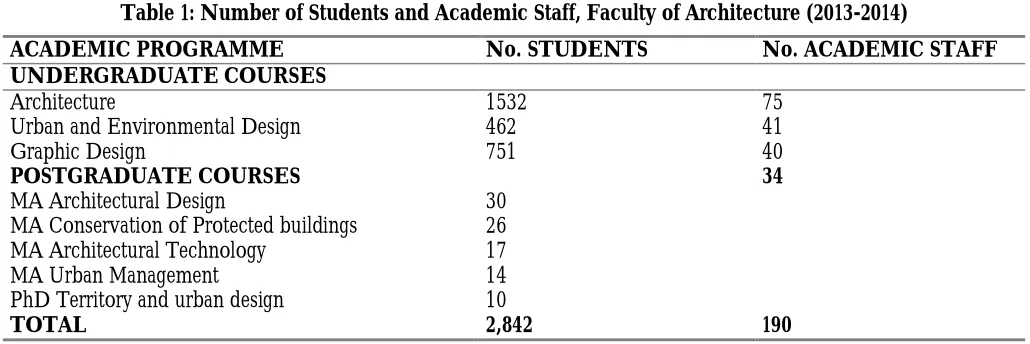
La Monja Cultural Centre was built in 1969 and designed by architect Jorge Belchez-Landero. It is located in the University Campus of the University of Puebla, in Mexico. La Monja was specifically designed to serve the Faculty of Architecture, which at that time had around 800 students and only one academic programme: a bachelor degree in Architecture. Today the Faculty of Architecture comprises 10 buildings (FABUAP, 2014), 2842 students, 190 academic staff and 36 administrative staff. The following table shows the number of students and number of academic staff per programme during the 2013-2014 academic year.
Table 1: Number of Students and Academic Staff, Faculty of Architecture (2013-2014)
ACADEMIC PROGRAMME No. STUDENTS No. ACADEMIC STAFF
UNDERGRADUATE COURSES
Architecture 1532 75
Urban and Environmental Design 462 41
Graphic Design 751 40
POSTGRADUATE COURSES 34
MA Architectural Design 30
MA Conservation of Protected buildings 26
MA Architectural Technology 17
MA Urban Management 14
PhD Territory and urban design 10
TOTAL 2,842 190
La Monja is a two-storey square plan building covered by four concrete shell structures joined by a central translucent dome. It has a construction area of 1,250 m2 and it is located right in the heart of the Architecture Faculty,
La Monja was designed as an exhibition centre with an open plan area on the ground floor and four seminar rooms on the first floor. The main original access was located on the ground floor where a central stair was situated right in the middle of the floor creating a double height lobby (figure 7). Unfortunately during a refurbishment made in the 1990´s decade the main staircase was demolished and a new access was built. The new stair links the building with other buildings of the Faculty from an open square area to the first floor lobby of La Monja and down to the ground floor, which no longer acts as a main area in the building. In addition, a pyramidal shaped polycarbonate structure was placed on the first floor right under the dome (figure 8). The translucency of this structure seems to create a lot of environmental problems in a climate such as Puebla´s: latitude: 18o N, altitude: 2,108 m, temperate
climate with average annual temp. = 17oC, maximum annual temperature = 26oC, and minimum annual temperature
The last refurbishment work in La Monja was made in 2005. It included the renovation of floors, lamps and the installation of new IT equipment in the first floor seminar rooms and an air conditioning system in one of those seminar rooms. Recently, a computer room with 23 workstations for graphic design students was built and the cafeteria on the ground floor was redecorated. Some offices that integrate the Architecture Programme Academic Direction have been temporarily placed on the ground floor facing West and Southwest orientations.
Figure 10 (left): 1st floor Seminar Room 1. Figure 11 (middle): Exterior view of computer room with air conditioning system. Figure 12 (right): Interior of the multi-purpose room, ground floor. (Photos: J. Mundo,
2008)
3. Previous Work
Several proposals have been made to improve the interior environment in the building. One of the most significant in terms of the environmental analysis of the building is presented here. In 2006 a group of researchers and students of the Architectural Technology Master course developed a proposal for the improvement of the micro-environment of La Monja (Morales Hernández, J. L., et al, 2006). The main objective of this work was to create environmental comfort in the building through the use of passive systems and at the same time decreasing its energy consumption. According to the authors the main thermal problem of the building is caused by heat gain obtained through the main roof: the dome and the concrete shells. The translucent material of the dome, the small thickness of the concrete shells and lack of ventilation inside the seminar rooms and on the first floor lobby produce uncomfortable temperature levels.
Their proposal consist on (figure 13):
1. Replacement of the ground floor glass walls for a double façade system with double glazing and natural ventilation.
2. Dome: use of translucent material with low heat transmittance and high reflectance. 3. Bigger opening dimensions at the top of the dome to produce a stack effect for ventilation.
4. Substitution of the fixed glass walls in the lobby of the first floor for glass openings that could be permanently open to allow fresh air access and the circulation of hot air towards the opening on the dome.
5. Replacement of fixed windows inside all seminar rooms for openable ones to allow natural ventilation. 6. Create holes on the low section of the seminar rooms’ walls allowing the entrance of fresh air.
7. Green roofs on top of the concrete shell structures to perform as thermal mass, producing also a nice green view. 8. Covering exterior walls of seminar rooms with wooden panels to absorb heat protecting the existing brick walls
from over heating.
9. Placement of an interior garden and fountain on the central area of the ground floor to cool down the interior through water evaporation.
This research is a well thought and sensible approach to improve La Monja´s interior environment. In order to apply some of the aspects proposed it would be necessary to test the environmental performance of the building with the proposed changes using a 3D computer model. Moreover, carrying out an environmental assessment of the existing building conditions through field measurements of temperature, light, acoustics, CO2 levels, wind direction, etc. will provide the researchers and building managers information to support the changes required.
4. Methodology
This research has been developed using a qualitative approach through the design and application of two very similar questionnaires, one for students and another one for academic and non-academic staff (Oppenheim, A. N., 1966) (Hygge, S. and Lofberg, H. A., 1997) (Gillham, B, 2000) (Mundo-Hernández, J., 2013). The fifty questions that comprise the questionnaire were divided into three sections:
1. General Information: enrolment course, age, previous experience as students in any other course, time working
2. Environmental perception: main environmental factors to be considered when designing an educational
building, type of building preference: with windows or completely enclosed, respondents were asked if they have notice direct solar radiation in La Monja, lighting preferences for their activities, thermal, lighting and acoustic environment in the building, ventilation in La Monja, presence of glare, how the interior environment affects their mood, influence of the concrete shell roofs on the interior environment and user’s response to environmental discomfort.
3. Functionality and aesthetics: suitability of a concrete shell roof for an educational building, access to the
building, signalling, furniture, IT equipment, aesthetics of the concrete shell structures, the building as a representative construction for the Faculty and main advantages and disadvantages of using a concrete shell structures for covering an educational building.
This paper mainly reports results obtained from the Environmental Perception section of the questionnaire due to the vast amount of information available. From the third section, results are presented essentially regarding the aesthetics and suitability of the concrete shell structures. The questionnaire was distributed during the first two weeks of April 2014, which is one of the busiest periods of the Spring Term. April is one of the hottest months in Puebla with the highest solar radiation: 6.4 kWh/m2 per day (Conae, 2008). Results were analysed using the statistical software SPSS. Students answered 494 questionnaires representing 17% of the total number of enrolled students, while 32 were answered by Faculty staff, which also represents 17% of the total number of academic and non-academic staff. 44% of staff respondents have worked for the University for more than 25 years, which means that most of the people working in the Faculty have seen and lived the changes made to the case study building throughout the years.
5. Results
Regarding the gender of respondents, 66% of staff are male while the number of male and female students is almost equal (51% and 49% respectively) (figures 14c and d). Most of staff respondents belong to the Architecture College (50%) as it is shown in figure 15a. The percentage distribution of respondents by course during the Spring Term 2014 is shown below. The majority (58%) of students study Architecture followed by Graphic Design with 29%; while master students represent around 3% of the student population (figures 15a & b).
All respondents reported to have been inside La Monja, therefore it is possible to assume that they have experienced the building and are able to state an opinion about it. Most of respondents, both staff and students, spend 2 hours in each visit, which is the duration of most lectures. Nonetheless, most of academic and non-academic people stated being in the building everyday, while the majority of students said they visit it once a week. In general, most respondents visit La Monja between 8am and 1pm, 42% of staff and 69% of students. During this time all seminar rooms located on the first floor are usually booked, they are used for lectures and also for special events like seminars, short courses and viva voce examinations.
In relation to solar radiation presence in La Monja, 78% of staff declared to have seen sunlight in the building. None of them said sunlight has none influence on their activities, on the contrary, 88% of staff stated that sunlight affects moderately and a lot their activities (Figure 19). In addition, 62% of students reported to have noticed the presence of solar radiation in the building; within those people most of them (84%) said sunlight interferes in some way (from a little to a lot) with their activities (Figure 20). Here it is possible to distinguish three reasons for the different answers given by staff and students:
1. Staff are more experienced as designers and lecturers, therefore they are able to identify more quickly some problems that could occur in buildings in general;
2. Staff have experienced La Monja longer than students;
3. Students are, in general, more tolerant to uncomfortable situations.
People stated to have seen direct solar radiation mainly in the lobby area of the first floor of La Monja (68% of students and 47% of staff). This area is located right under the dome and it provides access to four terraces through big glass walls.
These ideas include:
a. In general, most of the people believe the interior environment of the building is bad or very bad, while an important number of respondents think it is neither bad nor good (neutral). Only 9% of staff thinks the environment is good. Here it is possible to distinguish a more critical response towards the building’s environment from staff than from students; this is probably due to the experience of staff as designers and as buildings occupants.
b. Regarding daylight quality and availability, around 30% of both type of respondents consider it as good. However, one third of the staff stated that the quality of daylight is bad/very bad for the activities they perform in the building.
c. Most of respondents answered “neutral” when they were asked about the electric light in the building, therefore, it seems that they are satisfied with the current type of lighting and/or they are not very concerned about it. In addition, an important number of students (34%) and staff (39%) think it is good.
d. Users believe the acoustics of the building is not too bad while others believe it is good/very good. Most of them think the shape of the concrete shells contribute to the quality of the acoustics of La Monja, particularly in the seminar rooms which are located underneath the concrete shells. This is an important consideration since having good acoustics is essential in seminar rooms. On the other hand, some people reported to have bad acoustics in the multiple use area on the ground floor, particularly when it is divided into smaller rooms and all are used at the same time.
e. Temperature and ventilation are the environmental aspects that were rated by most staff and students as very bad and bad. Their answers were probably influenced by the time of the year when the questionnaire was applied (April 2014) since springtime is the warmest time of the year in Puebla. Nevertheless, users were not in La Monja when they answered the questionnaire, hence they might have responded according to their memory of the building with hopefully a little more objective point of view. Open comments in the questionnaire include several statements regarding poor ventilation and high temperature as a consequence of the first element plus the high thermal and light transmittance of the translucent material that covers the central dome. Another feature that has been mentioned as a cause of the high temperatures inside the building are the concrete shell roofs, since occupants believe concrete absorbs heat and reflects it into the interior of the building, while at the same time the shape of the concrete shells produce low height ceilings in the seminar rooms making the space feel more crowded and warm.
Furthermore, respondents were asked to choose an adjective that best describes the aesthetics of the concrete shell roofs that cover La Monja. Most of students and staff selected “different” followed by beautiful (mainly staff=24%) and innovative (Figure 29). This proves that this type of structure with almost 40 years old still gives the impression of being an innovative and beautiful architectural solution according to occupants of the building. Finally, in order to confirm people’s impression of the building as an emblematic construction of the Faculty (a drawing of La Monja is used as the Faculty´s logo) they were asked whether the building is an iconic structure or not. Answers from staff and students were very similar; nearly all respondents believe La Monja is a representative structure of the Architecture School (Figure 30).
6. Conclusions
A series of conclusions can be obtained from this study:
La Monja Cultural Centre is an iconic building, which has served for educational purposes for almost 40 years. It is still a very important building for the Faculty of Architecture and people find it beautiful and original.
The original design of La Monja did not take into account environmental comfort aspects, probably as a result of the importance given to the formal expression and aesthetics of the building. Being the latter an accomplished aspect of the architectural design.
Due to the symbolic importance of the building, its architectural quality, but more importantly the space deficit of the School, the improvement and refurbishment of La Monja results imperative. However, any proposal must be carefully thought and modelled in order to renovate La Monja into a functional, sustainable building whilst preserving its original features and structure. Materials and design concepts shall be a contemporary answer to the current use of La Monja focused to improve users comfort and space utilization.
Main environmental problems of La Monja reported by its occupants include: lack of natural ventilation, high interior temperatures, dull lighting, lack of outside views and blinding glare when walking from a seminar room (dark atmosphere) to the first floor lobby or to outside where daylight levels are high.
Concrete shell structures are with no doubt very original structures that most people find attractive. Nonetheless, choosing a concrete shell structure or any other innovative structure as an architectural solution must be a carefully made decision. That decision should involve 3D environmental modelling of the proposal and an analysis of its visual and environmental impact.
References
Aan het Rot, M., Moskowitz & Young. (2008) “Exposure to bright light is associated with positive social interaction and good mood over short time periods: A naturalistic study in mildly seasonal people” Journal of Psychiatric Research, 42, 4, pp. 311-319.
CONAE “Irradiación global media en la República Mexicana”. [On line] Available: http://www.conae.gob.mx (April 7, 2008).
FA-BUAP (2014) Office of the Administrative Secretary. Faculty of Architecture, Benemérita Universidad Autónoma de Puebla, annual records.
Gillham, B. (2000) Developing a questionnaire. London: Continuum.
Hygge, S. & Knez, I.(2001)“Effects of noise, heat and indoor lighting on cognitive performance and self-reported affect”. Journal of Environmental Psychology, 21, pp. 291-299.
Hygge, S. & Lofberg, H. A. (1997)“User evaluation of visual comfort in some buildings of the Daylight Europe Project”. Proceedings of Right Light, 4th European Conference on Energy Efficient Lighting, Copenhagen, 2,
pp. 69-74.
Leaman, A., (2003) “Post-occupancy evaluation”. UK: GAIA Research Sustainable Construction Continuing Professional Development (CPD) Seminars.
Morales-Hernández, J. L., Avila-Trujeque, J. A., et al. (2006) “Propuesta de mejoramiento del microclima del edificio La Monja, FABUAP”. 1er Foro de Ingeniería Maestría de Tecnologías en Arquitectura, BUAP, Mexico. Mundo-Hernández, J. (2013) “Fabric membranes for daylight control in buildings”. Germany: Scholars´ Press.
Preiser, W. & Nasar, J. (2008) “Assessing Building Performance: its Evolution from Post-Occupancy Evaluation”, Archnet-IJAR, International Journal of Architectural Research, Vol. 2, Issue: 1, March 2008, pp. 84-99. SMN, CONAGUA.(2014)Climate information of Puebla City. [On line] Available:
http://smn.cna.gob.mx/index.php?option=com_content&view=article&id=178&tmpl=component (November 5, 2014).