Medical Journal of the Islamic Republic of Iran (MJIRI)
Med J Islam Repub Iran. 2018(22 Sep);32.89. https://doi.org/10.14196/mjiri.32.89
The effectiveness of PMT program on parent-child
relationship in parents with ADHD children: A randomized
trial
Zahra Maddah1, Mahdieh Ghalenoee2*, Jamileh Mohtashami2, Mohamad Amin Pourhoseingholi3,
Roghayeh Esmaieli4, Vahid Naseri-Salahshour5
Received: 15 Dec 2017 Published: 22 Sep 2018
Abstract
Background: Attention deficit hyperactivity disorder (ADHD) is the most common neurobehavioral disorder in children that creates problems in parents-children relationships. Improving familial and social interactions of these children needs mental and social inter-ventions, and parents’ management training (PMT) program is one of these interventions. The present study aimed at determining the effectiveness of PMT program on parent-child relationship of parents with ADHD children.
Methods: Through an experimental research, 40 parents with ADHD children were selected based on purposeful sampling. A total of 20 parents were randomly placed in intervention group and received 8 sessions of intervention course (60 minutes per session) and the other 20 parents were grouped in the control group and received no training intervention. Research tools included a researcher-designed demographics questionnaire and Parker’s Bonding Instrument (PBI). Data were collected at pretest, posttest, and follow- up stages and analyzed using descriptive and covariance analysis.
Results: The results revealed that PMT program was significantly effective in reducing excessive support and increasing parent care index in parents with ADHD children (p<0.05).
Conclusion: The results of the present study supported the effectiveness of PMT program on parent-child relationship of the parents with ADHD children.
Keywords: Parents management training program, Parents, Parent-child relationship, Mental health, Psychology, ADHD
Copyright© Iran University of Medical Sciences
Cite this article as:Maddah Z, GHalenoee M, Mohtashami J, Pourhoseingholi A, Esmaieli R, NaseriSalahshour V. Surveying the effectiveness of PMT program on parent-child relationship in parents with ADHD children. Med J Islam Repub Iran. 2018(22 Sep);32:89. https://doi.org/10.14196/mjiri.32.89
Introduction
The health status of the next generation of the society de-pends on the health condition of children today. Studies on psychological health and children’s adaptation could be helpful in improving growth and fertility of children during their adulthood. Failure to deal with growth issues in chil-dren results in irrevocable damages to psychological health of the child and the society (1). Common disorders in chil-dren are usually categorized as internalized and external-ized disorders. The latter is expressed in the form of behav-iors such as aggression, opposition, hyperactivity, and im-pulsiveness, which are rather extrovert including ADHD, conduct disorder, and oppositional defiant disorders.
Inter-nalized disorders include childhood anxiety and mood dis-orders (2).
Discussions on ADH D as the most common behav-ioral disorder in children are ongoing (3) so that it has drawn the attention of psychologists and psychotherapists (4). The disorder is featured with deficit of attention, hy-peractivity, and impulsiveness, and it is highly prevalent and stable (3). ADHD children encounter problems such as learning disabilities and social and emotional problems (5), which result in educational performance loss, family stress, and conflictual relationships with peers (6).
Epidemiologic studies have shown that prevalence of ADHD in Iran and the world is about 2% to 18%. During ______________________________
Corresponding author: Mahdieh GHalenoee, [email protected]
1. Student Research Committee, School of Nursing and Midwifery, Shahid Beheshti
Uni-versity of Medical Sciences, Tehran, Iran
2. Psychiatric Nursing Department, School of Nursing and Midwifery, Shahid Beheshti
University of Medical Science, Tehran, Iran
3. Gastroenterology and Liver Diseases Research Center, Research Institute for
Gastro-enterology and Liver Diseases, Shahid Beheshti University of Medical Sciences, Tehran, Iran
4. Geriatric Nursing Department, School of Nursing and Midwifery, Shahid Beheshti
University of Medical Science, Tehran, Iran
5. School of Nursing and Midwifery, Arak University of Medical Science, Arak, Iran
↑What is “already known” in this topic:
Children with attention deficit hyperactivity disorder (ADHD) in Iran do not routine screening for psychiatric disorders.
→What this article adds:
Since ADHD is significantly related to mental health and qual-ity through parental education (PMT) can help parents and chil-dren effectively.
Patients referred to Saveh-based consultation centers
http://mjiri.iums.ac.ir
Med J Islam Repub Iran. 2018(22 Sep); 32:89.
2
1998 and 2009, prevalence of ADHD among 5 to 7 year- old American children increased from 6.9% to 9% (7). Studies in Iran have shown that prevalence of ADHD in graders, juveniles, and adults is 7% to 8%, 5%, and 2.5%, respectively (8). Inconsistency of prevalence statistics of the disorder in different countries may be due to differences in diagnosing methods (1). In the 1890s, it was believed that brain trauma and damages in the frontal lobe are to blame for ADHD. Some believe that genetic factors affect the disorder at different age ranges. Recent studies have highlighted the role of hereditary talent so that risk of hav-ing ADHD children in parents with the same disorder is 57% (9). Birth damages, malnutrition, and using special medicine during pregnancy are of other factors effecting development of ADHD (9). The disorder influences the performance of the child in the family, society, and school and it results in negative reactions in family members, peers, and school staff; these feedbacks, in turn, result in loss of self-esteem, incompetence, communicational prob-lems, anxiety, depression, and delinquency (10, 11). Treat-ment protocol for this disorder ranges from direct and sin-gle intervention treatment to complicate multiple interven-tions. Currently, the most effective interventions are drug therapy (stimulating drugs), parents’ behavioristic training programs, class-based interventions, and summer treatment courses. Biofeedback, neurofeedback, food diet, allergy therapy, and game therapy are also recommended, but these interventions have gained less support (12). Parent manage-ment training is a social non-drug intervention with proven effects and notable influence on attenuating behavioral and communicational disorders of ADHD children (13). Throughout the intervention, parents are trained to increase their positive interactions with children and decrease their conflicting and dictatorial interactions (14). PMT was in-troduced in 1997 by Barkly in which the therapist teaches the parents about strategies to manage children’s behaviors (15). Psychologists in the recent decades have put notable emphasis on child- caregiver relationships. The relation-ship between child and parent has a notable effect in the development of their personality and behavior and it helps them to differentiate desirable and undesirable behaviors in the family.
This is done by offering reward for desirable behaviors and imposing punishment for undesirable behaviors (16). Families with ADHD children are usually characterized by problematic child-parent relationships (8). Child-parent in-teraction treatment is a training program that is categorized as a behavioral approach and includes working with the parents and children. The therapist acts as a facilitator and guides the parents throughout their interactions with the child (17). Because ADHD is not completely curable, the best approach is to manage or intervene in the disorder. Be-cause of their influence and close contact with children, parents play a prominent role in implementing behavioral interventions in natural environment of children. Thus, PMT has gained a key role in therapeutic treatments for ADHD children (18). Training parents improves child up-bringing behavior of parents, cuts stress in parents, and de-creases child’s destructive behaviors (19). Despite the re-sults of several studies indicating the effectiveness of PMT
on decreasing symptoms of the disorder in the child and decreasing parents’ stress, Enebrink et al., (2012) and Wells et al. (2010) have reported that the intervention did not affect ADHD children. While studies in this field have reported inconsistent results on the effectiveness of PMT on ADHD, no study has been specifically conducted on the effects of PMT on child-parent relationship. Therefore, this study was an attempt to determine the effects of PMT on child-parent relationship in parents with ADHD children.
Methods
Data
An experimental study was conducted with control and intervention groups. This study aimed at determining the effects of PMT based on Barkley’s PMT model on child-parent relationship in child-parents with ADHD children.
Study population comprised of all parents with ADHD children referred to state consultation centers in Saveh, Iran (2016). The participants were selected at 2 stages; at first, the participants were selected purposefully, and then they were randomly grouped into 2 groups. Those parents that met the inclusion criteria were selected at first, and they were randomly grouped into intervention and control groups. Number of participants with β= 0.8 and α= 0.05 was obtained to be 34, and by assuming 15% leave rate, 40 participants were selected. Data were collected using 2 questionnaires: (a) a researcher designed demographics questionnaire and (b) Berkley's parental bonding instru-ment (PBI). The latter consisted of 4 questions about the child (age, gender, ADHD term, any specific physical dis-ease) and 10 questions about the parent (age/education/ job of parents, number of children with ADHD, parents’ neu-ropsychological disease record, neuneu-ropsychological medi-cation record, and any experience and participation in sim-ilar classes). The former questionnaire was designed by Parker, Tupling, and Brown in 1979 and included 25 state-ments, and 2 subscales of care (12 questions), and excessive support (13 questions).
The statements were scored based on Likert’s four-point scale (very high = 0, relatively high = 1, relatively low = 2, very low = 3), and statements 1, 5, 6, 8-13, 17, 19, and 20 were inversely scored. Maximum score of care and exces-sive support subscales were 36 and 39, respectively. Higher score means that the parents are sympathetic, warm, under-standing, and friendly; they are usually with their children, tend to talk to them, and understand them. On the other hand, lower score indicated that parents that are cold in their relationship and tend to desert their child are not active and fail to show enough attention to their child.
At one extreme of the control scale are parents that can be described as excessive supporter, cause of dependency, cause of child’s underdevelopment, intrusive, and control-ler. On the other extreme are parents who tend to give au-tonomy to their child. High score in control scale means excessive control, which is one of the main risk factors.
Some findings indicate that low score in this term indi-cates parents’ indifference attitudes. The initial investiga-tion by Parker's validity using Cronbach's alpha for care subscale, High scores and low scores in the over sponsors of the aftercare refer to the link problem. PBI has a high
convergent validity (0/81) and is independent of mood states. According to the results of the factor analysis of the main elements of this inventory in Iran, results from a four-factor content protection status and validity and reliability (the range of 0/72 to vary from 850), and this questionnaire is reported to be satisfactory (32). Having a letter of recom-mendation issued by the Faculty of Nursing and Midwifery and Higher Education Dept. of Shahid Beheshti University of Medical Sciences and permission from authorities of Saveh-based state consultation centers, the researchers re-ferred to the centers. They attended the centers every day except Fridays from 8 A.M to 1 P.M. A total of 40 parents with ADHD children were selected and briefly introduced to the study and purpose. Afterwards, they were asked to sign a letter of consent for participation before being grouped randomly in intervention and control groups (n = 20). Contact information of the participants was collected to arrange the first session of the intervention. PBI ques-tionnaire was filled out by all the participants before the in-tervention, after the intervention (immediately after the last session, and at the follow- up stage 1 month after the last session). Intervention program included 8 sessions (Two 60-minute sessions per week). The participants had a five 10- minute break in each session. The training program was implemented as follows:
Session 1: Reliable and clear information about signs of attention deficit, hyper activity, and impulsiveness was pro-vided.
Session 2: The 4 factors models of children-parent con-flict and behavior management principles were discussed.
Session 3: The parents were trained to pay attention pos-itively to acceptable social behaviors and neglect improper behaviors during “special game time.”
Session 4: The parents were trained about how to codify a reward system at home using scoring or coupon system.
Session 5: The parents were trained about how to use coupons to punish misbehaviors or disobediences and small breaches of regulations.
Session 6: The parents were trained about how to use deprivation and negative support in the case of negligence of the regulation including bad-mouthing, aggressiveness, and destruction.
Session 7: The parents were trained how to deal with
children in public spaces (eg, malls, restaurants, and mosques). They codified plans to use social intensifier, coupon, cost of response, and deprivation of support in pub-lic situations.
Session 8: Future problems, cooperation with school au-thorities, dealing with side problems such as uncontrolled urinate and defecation were discussed.
Statistical analysis
Data were described using frequency distribution, mean, standard deviation, and percentage. Kolmogorov-Smirnov (KS) test was used to check normality assumption and t test was used for data analysis. To control interrupting varia-bles, covariance analysis in frequent measurement model was used. All the analyses were performed in SPSS (v.21) and p<0.05 was set as statistically significant.
Results
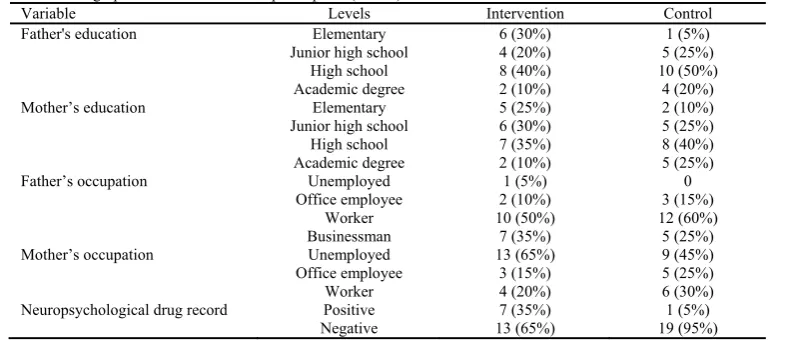
Table 1 lists demographics of the participations. In total, 40 parents with ADHD children participated in the study; average ages of males and females in the control group were 41 and 37.30 years, respectively; and these figures in the intervention group were 41.95 and 36.10 years. Table 2 lists descriptive information of the variables including mean and standard deviation scores. The table lists descrip-tive specifications of the variables at pretest, posttest, and follow- up stages based on the groups. Covariance analysis was used to examine the effect of training the parents on parent-children relationship. Covariance analysis enabled us to examine the effects of the intervention (pre- and post- test). Covariance analysis was used to provide a clearer pic-ture of the effects of intervention on the participants. In other words, by observing the main effect on the group, the author determines whether the change in the dependent variable in the intervention group is significant or not. Ta-ble 3 demonstrates the main effects of the research varia-bles. As listed and because F value at the follow- up stage for excessive support (9.58) and care (3.846) was signifi-cant (p<0.05), the intervention had a signifisignifi-cant effect. Thus, parents’ care given to their children in the interven-tion group increased and excessive support decreased after the intervention. Table 4 demonstrates a summary of vari-ance analysis (with frequent measurement plan). According Table 1.Demographics information of the participants (n = 34)
Variable Levels Intervention Control
Father's education Elementary
Junior high school High school Academic degree
6 (30%) 4 (20%) 8 (40%) 2 (10%)
1 (5%) 5 (25%) 10 (50%)
4 (20%)
Mother’s education Elementary
Junior high school High school Academic degree
5 (25%) 6 (30%) 7 (35%) 2 (10%)
2 (10%) 5 (25%) 8 (40%) 5 (25%)
Father’s occupation Unemployed
Office employee Worker Businessman
1 (5%) 2 (10%) 10 (50%)
7 (35%)
0 3 (15%) 12 (60%)
5 (25%)
Mother’s occupation Unemployed
Office employee Worker
13 (65%) 3 (15%) 4 (20%)
9 (45%) 5 (25%) 6 (30%) Neuropsychological drug record Positive
Negative
7 (35%) 13 (65%)
1 (5%) 19 (95%)
Patients referred to Saveh-based consultation centers
http://mjiri.iums.ac.ir
Med J Islam Repub Iran. 2018(22 Sep); 32:89.
4
to the results, F value of excessive support (7.335) was sig-nificant (p<0.05). It is notable that F value was not signifi-cant for the other variable (care).
Discussion
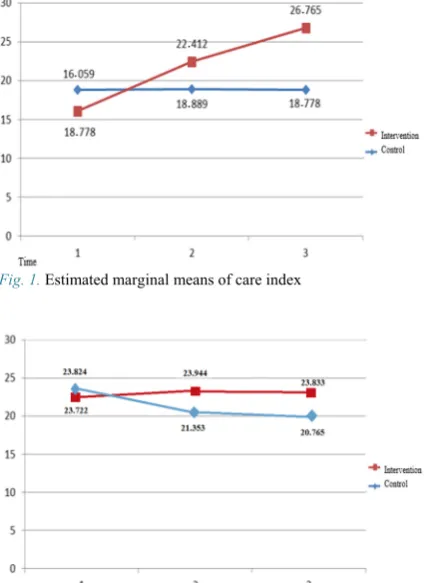
The effects of PMT on child-parent relationship in par-ents with ADHD children referred to Saveh-based state consultation centers in 2016 were examined. The findings revealed that child-parent relationship score increased after the intervention so that the highest score was observed one month after the intervention. No significant difference was found between the control and intervention groups at pre-test stage; however, postpre-test and follow- up stages showed an increase in the mean scores of care and excessive sup-port in the intervention group. This indicates a significant effect of the intervention. Therefore, it can be concluded that PMT had a positive effect in child-parent relationship of the parents with ADHD (after the intervention and 1 month after the intervention). The results here are con-sistent with Khanjani et al. (2014). The study revealed a re-lationship between good parent-child rere-lationship and higher level of self-esteem and psychological health. On the other hand, being separated from parents and poor parent-child relationship were negatively and discretely related to low self-esteem, depression, and aggressive behavior. Moreover, Alizadeh (2014) found that PMT had a positive effect on child upbringing skills, better child management, and decrease of ADHD signs. The role of PMT, in this re-gard, is undeniable as it is the main requirement for improv-ing child-parent relationship. Tiano and McNeil (2011) found that PMT program improved child-parent relation-ship in the parents with ADHD children. Thus, one may imply that PMT program creates changes in parents’ atti-tudes and is a key factor in improving social, cognitive, and emotional aspects of children with ADHD. To examine the effectiveness of behavior management education on stress Fig. 1. Estimated marginal means of care index
Fig. 2.Estimated marginal means of extreme support
Table 2.The statistical characteristics of the research variables in the pre-test, post-test and follow-up tests were segregated from the study group
Intervention Control
Time Indicator Average The standard deviation Average The standard deviation
pre-test Care index Extreme support
18.55
24.00
6.692
5.037
16.75
23.40
5.848
4.728
Post-test Care index Extreme support
24.00
18.65
5.037
6.523
22.11
20.89
5.212
4.497
Confidence
In-terval Care index
Extreme support
24.10
18.78
5.025
6.404
26.72
20.67
4.599
2.223
Table 3.Care index
One month after training Immediately after training
Before training Group
26.7 22.4
16.05 Intervention
17.7 18.8
18.7 Control
8.9 3.5
1.7 Δ*
* Confidence Interval
Table 4. Extreme support
One month after training Immediately after training
Before training Group
20.7 21.3
23.8 Intervention
23.8 23.9
23.7 Control
3.6 2.5
0.1 Δ*
* Confidence Interval
of parents with ADHD children, Tahmasian et al. (2011) found that the intervention was effective in improving child-parent relationship, decreasing stress and anxiety, and increasing self-esteem in children. Chronis et al. (2012) studied the effects of PMT on the decrease of behavioral problems caused by ADHD and found that training the par-ents decreased behavioral problems in these children. Den-forth et al. (2010) reported consistent results. Narimani et al. (2013) noted that PMT improved educational motivation in ADHD children. ADHD students suffer from learning problems and find it hard to concentrate on issues that result in developing a sense of failure and loss of educational mo-tivation.
Using PMT and motivation and attention incentives, the parents convey the idea to their children and they can grab the attention of their parents and reward them by focusing on their homework.
Moreover, paying attention to positive characteristics of children improves self-confidence of the children, and this would be the start point for learning improvement and increasing the internal motivation of children. These find-ings are consistent with Shamaiezade and Ahmadi (2011), Ejei et al. (2012), Rossiter and Lavaque (2010), Mccart and Priester (2011), Kurdistani et al. (2014), and Arjmand (2011). Their studies have shown that through improving caregiving capability of parents and preparing the ground for efficient education, PMT leads to improvement of qual-ity of life of all family members and decrease of psycho-logical health of parents and ADHD children. Additionally, all the noted studies have shown that PMT improved the welfare of parents with ADHD children. Some studies have reported inefficiency of PMT on decreasing signs of hyper-activity and improvement of child-parent relationship (eg, Enebrink et al., 2012; Wells et al., 2010). Therefore, our results are consistent with the most of the studies in this field.
Conclusion
Thus, continuous PMT intervention is essential. PMT creates a ground for more cooperation, improvement of mood condition, decrease of psychological symptoms, and better social and family interaction in adulthood lives of ADHD children. Thereby, PMT as a non-drug intervention could be highly effective when used along with drug inter-vention to achieve such skills as cognitive, behavioral, emotional, and social skills. Future works may survey the effects of PMT on child-parent relationship of parents of children with other psychological disorders or the effects of other interventions on improvement of child-parents rela-tionship of parents with ADHD children. Moreover, elabo-ration on the perception and experience of parents with PMT can be a subject for future studies
Acknowledgement
This study was based on an MSc thesis of nursing ap-proved by Shahid Beheshti University of Medical Sciences. The authors express their appreciation and gratitude to the vice chancellor for research of Education and Research Faculty of Shahid Beheshti University of Medical Sciences,
the honorable masters of Nursing and Midwifery School, Parents and all those who helped us painstakingly to con-duct this study.
Conflict of Interests
The authors declare that they have no competing interests.
References
1. Alzaben FN, Sehlo MG, Alghamdi WA, Tayeb HO, Khalifa DA, Mira AT, et al. Prevalence of attention deficit hyperactivity disorder and comorbid psychiatric and behavioral problems among primary school students in western Saudi Arabia. Saudi Med J. 2018;39(1):52-58. 2. Sadock B, Sadock V, Rezaei M. Translation. Summary of psychiatry
and behavioral sciences clinical psychiatry Kaplan Sadock. Tehran, Publishers: Arjmand. 2014. (Persian)
3. Linda J. Pfiffner and Lauren M. Haack. Behavior Management for School Aged Children with ADHD. Child Adolesc Psychiatr Clin N Am. 2014;23(4):731–746.
4. Bussing R, Mason DM, Bell L, Porter P, Garvan C. Adolescent out-comes of childhood ADHD in a diverse community sample. J Am Acad Child Adolesc Psychiatry. 2010 Jun 30;49(6):595-605.
5. Katz N. Adult self-ratings of the DSM-IV-TR symptoms of attention-deficit/hyperactivity disorder: An item response theory perspective. The Florida State University; 2011.(Persain)
6.Carmona S, Proal E, Hoekzema EA, Gispert JD, Picado M, Moreno I, et al. Ventro-striatal reductions underpin symptoms of hyperactivity and impulsivity in attention-deficit/hyperactivity disorder. Biol Psychi-atry. 2009 Nov 15;66(10):972-7.
7. Akinbami LJ, Liu X, Pastor PN, Reuben CA. Attention Deficit Hyper-activity Disorder among children aged 5-17 years in the United States, 1998-2009. NCHS data brief. Number 70. Centers for Disease Control and Prevention. 2011 Aug.
8. SHokohi Yekta M, Motavallipoor, A. Attention-Deficit/Hyperactivity Disorder. J Mind Behav. 2014;4(6):45-53.
9. Hansen S, Meissler K, Ovens R. Kids together: a group play therapy model for children with ADHD symptomology. J Child Adolesc Couns. 2009 Dec 1;10(4):191-211.
10. Lifford KJ, Harold GT, Thapar A. Parent–child relationships and ADHD symptoms: a longitudinal analysis. J Abnorm Child Psychol. 2008 Feb 1;36(2):285-96.
11. SHefaat A, Tire seraj A, Danesh poor M, Hajiyan M, Khademlou M. Prevalence of attention deficit / hyperactivity disorder among high school students in the oity of Sari. J Mazand Univ Med Sci. 2013; 23(104): 12-18.
12. Gorji Y. Compare the effectiveness of behavior modification methods combining both parents and teachers and to reduce the symptoms of at-tention deficit hyperactivity disorder and primary school students. Knowledge and Research in Applied Psychology. 2009;7(23):1-22. 13. Esmaeilinasab M, Alizadeh H, Ahadi H, Delevan As. Comparing the
effectiveness of behavioral parent training with the approach of adler and reduce the severity of symptoms of conduct disorder in children. J Except Child. 2009;37(10): 227-236.
14. Enebrink P, Hogstrom J, Forster M, Ghaderi A. Internet-based parent management training: A randomized controlled study. Behav Res Ther. 2012 Apr 30;50(4):240-9.
15. Starck M, Gruenwald J, Schlarb A. Occurrence of ADHD in parents of ADHD children in a clinical sample. Dove press. 2015;12:581-8. 16. Koushan M, Vaghei S, Complier. Psychiatric nursing mental health 2.
2th ed. Andishe- rafi, Publisher; 2015.
17. Rossler, W. Psychiatric rehabilitation today: an overview. World Psy-chiatry. 2006;5(3):151-57.
18. Mohammad pour E, Kasaei F. Family functioning in children with at-tention-deficit/hyperactivity disorder. 2013; 84(9):1864-65.
19. Danforth J. Training parents of children with comorbid attention-defi-cit/ hyperactivity disorder and oppositional defiant disorder. helping parents prevent and solve problem. 2010.
20. KHanjani Z, Amini S, Malek As, Hashemi T. Parent management training to improve ADHD in children. Evol Psychol. 2014;10 (39):321-311.
21. Tiano JD, McNeil CB. The inclusion of fathers in behavioral parent training: A critical evaluation. Child Fam Behav Ther. 2011 Dec
Patients referred to Saveh-based consultation centers
http://mjiri.iums.ac.ir
Med J Islam Repub Iran. 2018(22 Sep); 32:89.
6
12;27(4):1-28.
22. Tahmasiyan K, KHoramabadi R, CHimeh N. Behavior management Training on parental stress in mothers of children with autism. develop-mental psychology. J Iran Psychol. 2010; 8(21):277-269.
23. Ejei J, Lavasani M, Malahmadi A, Khezri A. The ali model between perceived parenting styles, achievement goals, self-efficacy and aca-demic achievement. J Psychol. 2012;2(3):284-301.
24. Shamaeizadeh P, Ahmadi A. The effect of regular instruction to par-ents on family relationships and academic achievement of high school students in Isfahan City. 2011.
25. Kordastani D. The impact of parental education on public health in mothers of children with attention deficit/ hyperactivity disorder and ex-ternalizing problems these children. J Biol Syst. 2014;8(3):279-286. 26. Farmand A. Positive and beneficial drug combination therapy group
program parenting symptoms of children with attention deficit / hyper-activity disorder 3-12 years compared with each of this-parenting styles. Am J Educ. 2011;18(17):165-186
27. Narimani M, Shahali A, Kiyamarsi A. Parent management training on academic motivation. Journal of school psychology. 2013;3(4):128-142.
28. Barkley RA, DuPaul GJ, McMurray MB. Comprehensive evaluation of attention deficit disorder with and without hyperactivity as defined by research criteria. J Consult Clin Psychol. 2009 Dec;58(6):775. 29. Chronis AM, Chacko A, Fabiano GA, Wymbs BT, Pelham WE.
En-hancements to the behavioral parent training paradigm for families of children with ADHD: Review and future directions. Clin Child Fam Psychol Rev. 2012 Mar 1;7(1):1-27.
30. Hockenberry MJ, Wilson D. Wong's nursing care of infants and chil-dren. Elsevier Health Sciences; 2014 Jan 30.
31. McCart MR, Priester PE, Davies WH, Azen R. Differential effective-ness of behavioral parent-training and cognitive-behavioral therapy for antisocial youth: A meta-analysis. J Abnorm Child Psychol. 2011 Aug 1;34(4):525-41.
32. Behzadi, B; Sarvghadi, Cirrus, Samani Siamak. (2015). Confirmatory factor analysis on the Persian version of Parental Bonding Scale Parker. Psychological methods and models, Issue VI, winter 1390 (98-81).(Per-sain)
33. Rossiter DT, La Vaque TJ. A comparison of EEG biofeedback and psychostimulants in treating attention deficit/hyperactivity disorders. J Number Theory. 2010 Jun 1;1(1):48-59.