ISSN: 2334-2986 (Print), 2334-2994 (Online) Copyright © The Author(s). 2014. All Rights Reserved. Published by American Research Institute for Policy Development
Building Information Modelling Adoption: An Analysis of the Barriers to Implementation
Robert Eadie1, Henry Odeyinka2, Mike Browne2, Clare McKeown2
and Michael Yohanis2
Abstract
The UK Government has set a target date for the adoption of Building Information Modelling (BIM) by 2016. Despite the many benefits identified in literature there are also barriers to be overcome but there is little by way of research ranking the importance of each. To enable informed decision making during the implementation process this research provides a ranking of barriers. The study gathered information via a web-based survey from the top 74 United Kingdom based main construction contractors. The findings demonstrated that the barriers are reduced in importance after BIM adoption as the major hurdle of initial investment has been overcome reducing the “Fear” factor”. The two most important barriers to implementing BIM overall are “Scale of Culture Change Required/Lack of Flexibility” and “Lack of supply Chain Buy-in”. The low ranking awarded to “Lack of management support” and “Other Competing Initiatives” show the priority implementation is given in industry.
Keywords: Building Information Modelling, BIM, Use of BIM, Ranking Barriers to BIM implementation
Introduction
Building Information Modeling (BIM) has been defined as “Computer Aided Design (CAD) paradigm” producing “a set of interacting policies, processes and technologies generating a methodology to manage the essential building design and project data in digital format throughout the building's life-cycle” (Succar, 2009).
1
School of the Built Environment, University of Ulster. Email:[email protected]
Phone +44 2890368590
2
However, Arayici and Aouad, (2010) show it goes further throughout the building lifecycle and can be used for facilities management. Efficiency and Reform Group, (2011) state BIM has been promoted by Governments as a means of promoting collaboration and reducing fragmentation in the construction industry. However, Khosrowshahi and Arayici (2012) in providing a roadmap for BIM adoption show that there are still obstacles to be overcome.
The UK Government BIM strategy is making Level 2 BIM mandatory for all publicly-funded projects from 2016 onwards. This is to produce collaboration among the construction design team and reduce the fragmentation in the construction industry identified in Government reports (Wolstenholme et al, 2009; Egan, 1998; Latham, 1994). The BIM Industry Working Group (2011) state in the UK the levels of BIM are:-
Level 0 – Unmanaged CAD probably 2D, with paper (or electronic paper) as the most likely exchange mechanism.
Level 1 – Managed CAD in 2 or 3D format using BS1192:2007 with a collaboration tool providing a common data environment, possibly some standard data structures and formats. Commercial data managed by standalone finance and cost management packages with no integration.
Level 2 – Managed 3D environment held in separate discipline “BIM” tools with attached data. Commercial data managed by an Enterprise Resource Planning application (ERP). Integration on the basis of proprietary interfaces or bespoke middleware could be regarded as “pBIM” (proprietary). The approach may utilise 4D programme data and 5D cost elements as well as feed operational systems.
Level 3 - Fully open process and data integration enabled by web services compliant with emerging IFC / IFD standards, managed by a collaborative model server. Could be regarded as iBIM or integrated BIM potentially employing concurrent engineering processes.
While the literature identifies the barriers to the adoption of BIM within organisations it does not rank the importance of each relative to each other. This study aims to rank the relative importance of each of the barriers for BIM adoption identified from an extensive literature review.
Justification for the Study
With the targets above having been set by the UK government new adopters need to be aware of what must be overcome during the process. The importance of each barrier is therefore vital to adopters as a tool to determine where to focus their energy as they seek to implement BIM. The findings of this study will allow adopters to consider the worst barriers during the implementation process and adopt a strategy to overcome these. It was also hypothesised that users would rank the barriers to BIM differently than those who are yet to implement it.
Barriers for Bim Adoption
Lack of Senior Management Support
Ruikar et al, (2005) suggest a number of reasons why senior managers are reluctant to introduce new technologies and processes into their organisations. However, management support for the introduction of new technologies and processes is essential if the benefits are to be realised. Arayici et al (2011) suggest a bottom-up approach with "learning by doing" is a more efficient means of BIM implementation and dealing with resistance to change rather than top-down approach. However, they do suggest that successful implementation is as much about people and process as it is about the software and hardware used. They acknowledge that a Knowledge Transfer Partnership (KTP) was put into place to start the process. This shows “buy-in” from senior management.
It can also be difficult for senior management personnel with financial expertise, to identify the monetary value of BIM implementation (Giel et al, 2010). It is common to carry out Return On Investment (ROI) calculations when considering a purchase that has clearly identifiable costs and benefits (Azhar,2011; Giel et al, 2010; Glautier and Underdown, 2001; Roberts, 2004). This was investigated under two barriers called “Lack of Senior Management Support” and “Doubts about ROI/Lack of Vision of Benefits”.
Cost of Implementation (Software and Training)
Implementing BIM necessitates organisations to purchase the pertinent software and hardware and train their staff in the use of that software. The impact of that cost may vary according to the financial standing of the organisation. The high front-end cost of implementing BIM has been seen to act as a significant barrier to uptake within the construction industry (Azhar et al, 2011; Thompson and Miner, 2010; Crotty, 2012; Efficiency and Reform Group, 2011; Giel et al, 2010; Yan and Damian, 2008). However, Aranda-Mena et al, (2008), disagree indicating using case study research to indicate “consistent disagreement” with a position of high implementation costs associated with resources and expenses. In this context the evidence of the potential of BIM to reduce re-work, delays and ultimately cost, has not gone unnoticed by professionals in industry (Ahmad et al, 2010; BIMhub, 2012; Barlish and Sullivan, 2011; Costain Group, 2012; Hardin, 2009). However, construction is as much about business as it is about building (Fellows et al, 1983; Lowe and Leiringer, 2006). Therefore it is essential for those with commercial responsibilities within a contracting organisation to investigate the business case for implementing BIM (Autodesk, 2007; Giel et al, 2010). BIM however, is not just a software package, but also a process (Arayici et al, 2011b; Dickinson, 2010; Gu and London, 2010). While the process results in a beneficial outcome, Thompson and Miner (2010) show that the cost of its implementation must be paid for as well. Software packages need updates and therefore it is also necessary to consider the fact that BIM software packages will periodically need updated, which is an added cost (Lee et al, 2012).
There is, however, a real fear that as software houses attempt to increase their market share in these areas of BIM by offering increasingly comprehensive packages, at some point in the future, one particular brand may attain total market dominance. If this were to happen, it would render obsolete software packages that many companies had invested heavily in (Dell and BD+C, 2012). Companies considering investing in a BIM-ready ICT infrastructure must factor redundancy, and the cost of software and hardware upgrades into their IT plans (Ahmad et al, 2010). This will not however, guarantee protection from the risk of obsolescence. The costs were segregated into two barriers for investigation “Cost of Training” and “Cost of Software”.
Scale of Culture Change Required
Other Competing Initiatives
Another factor which acts as a barrier to BIM up-take is the number of on-going initiatives that organisations are already engaged in. In the UK Government Construction Strategy (Cabinet Office, 2012), BIM is only one of 13 major initiatives that impact construction organisations. The others in the accompanying Action Plan, published in July 2011, identify a variety of undertakings to reform industry practice (in both the financial and construction elements), reduce waste and drive better value for money from procurement of construction. Construction clients are increasingly setting quality, health and safety, and environmental performance targets as contractual obligations (Harris and McCaffer, 2006; Kezner, 2004). In order to maintain or attain their status as competent in these areas, contractors are regularly involved in training and assessment activities, in order to become accredited by the relevant bodies (Harris and McCaffer, 2006). This represents a significant resource commitment to organisations in terms of finance and time, and to add the introduction of a new technology which requires such a culture change may just not make business sense to senior management.
Lack of Supply Chain Buy-in
Without this, the concept of collaboration is a farce, and BIM, instead of streamlining communication in the supply chain, will act as a barrier (Azhar et al, 2011). The more organisations involved the greater the difficulty as the variety of software programmes increases the further down the supply chain collaboration is required. Further, if the investment in BIM software represents a financial burden to large main contractors, it could potentially be financially out of reach for their sub-contractors. The technological maturity of companies in the supply chain is vital as many do not possess the technology or know-how to take advantage of such innovations without significant financial and human-resource investment (Aouad et al, 2006). This can be a significant barrier to implementation of BIM from a project standpoint.
Staff Resistance and ICT Literacy
A study by Mitchell and Demian (2006), on the implementation of construction project extranets CPEs, commented that it is common to encounter a resistance to change from staff. Distinct staff resistance to the adoption of new technologies and processes can also be witnessed (Ruikar et al, 2005; Wilkinson, 2005). This is the case especially when staff consider that they have been given insufficient training, and/or that the technology may threaten their employment (Ruikar et al, 2005; Griffiths et al, 2000). Arayici et al [5] conclude that the construction industry has been slow to tackle this resistance to change. Aouad et al (2006) further indicate a lack of skilled BIM operatives in the industry as a significant barrier to BIM adoption. Arayici et al (2009) suggest that a skill gap has arisen due to BIM implementation.
Legal Uncertainties
For commercial reasons all parties agreed to settle out of court, splitting the multi-million dollar costs between them (Matthews, 2011). No legal precedent was therefore set, and the construction industry still awaits case law in regard to BIM. Oluwole (2011) identifies the following legal issues with BIM: duty of care including ownership and intellectual property and contractual arrangements including jurisdiction, virtual enterprising, recognition, taxation laws and government policies. Christensen et al (2007) identify authenticity as a major legal barrier for BIM while Race (2012) identifies product liability risks. Each of these will be examined in detail.
2.7.1 Ownership and Intellectual Property
The first legal issue raised by Oluwole (2012) relates to ownership. If the owner of the BIM application for the project was the client, they may claim ownership of the data and documents therein, as they are paying for the design. Conversely, designers will claim that their designs remain their own intellectual property. If a designer considers that they have lost competitive advantage through the client passing on information they may wish to pursue this in court. Determining who that party may be is not necessarily a simple process, especially as the industry moves towards fully-integrated Level 3 BIM (Udom, 2012). The UK BIM Industry Working Group (2011) recognised this as a problem and suggested that the ownership of copyright should generally reside with the author, not the individual who commissions it. Chao-Duivis (2009) disagrees arguing that the model is combined work, and therefore, the intellectual property right (IPR) or ownership should be treated as being similar to the output of conventional teamwork. However, there is no case law to support this position and this will remain a difficulty until a court makes a decision on a case and a precedent is set. The UK BIM Industry Working Group (2011) further state that this should not be a long term barrier to BIM adoption and simple solutions should be sought. Furneaux and Kivvits (2008) suggest that governments should be addressing these issues.
2.7.2 Contractual Arrangements
BIM solutions can be used to support the facilities management of the completed construction project, (Lewis et al, 2010). In many cases the facilities management is passed to an organisation other than the one that carried out the construction. This changeover of liabilities and responsibilities provides an opportunity for confusion and uncertainty.
2.7.3 Product Liability Risks
Due to the possibility of repeated and uncontrolled use of design documents by clients, the BIM Model may come to be legally viewed as a "product", thus giving rise to product liability risks (Race, 2012). This could potentially mean that the old system whereby constructors or designers are relieved of liability for construction or design defects after six years, when contracts are “under hand” or twelve years “under deed”, could become obsolete. This could result in contractors or designers being held liable for defects included in the BIM model almost indefinitely (Race, 2012; UK Parliament, 1980). The use of BIM is similar to contract alliancing, used in Australia and New Zealand for large infrastructure and public projects which requires a waiver of all liability claims (Cleves and Mayer, 2011). They suggest the risk of litigation among the principal participants including the client can be removed by this waiver. However, many clients will be reluctant to provide such a waiver.
2.7.4 Professional Indemnity Insurance
A designer in a construction project must ensure that their design work is covered by Professional Indemnity insurance (Wallbank, 2011). Wallbank (2011) further identifies two reasons why insurers are reluctant to cover construction organisations in this regard:
• They feel that they are covering liabilities which are impossible to accurately predict at the inception of a project;
• They are concerned that, should a claim arise, there may be blurring of the delineation of responsibilities between parties to contract.
2.7.6 Authenticity
Furneaux and Kivvits (2008) state that it is relatively simple to amend or fake digital records, or change dates, times or other metadata associated with them that if challenged, courts may disregard the evidence altogether or place less weight on it than on paper records. The issue is whether the integrity of the record can be established (Christensen et al, 2007). Further, in the case of an email or communication sent over a BIM system or extranet, although the record can be proved to have been sent and even proved to have been sent from a particular machine, it is not necessarily so easy to prove which person actually sent it. In cases such as this, the evidence would be considered inadmissible by the courts (Christensen et al, 2007). This issue could cause some alarm to construction teams who rely heavily on the software system to keep their records.
For the purposes of this study the various legal aspects of BIM have been combined under the title “Legal Uncertainties”.
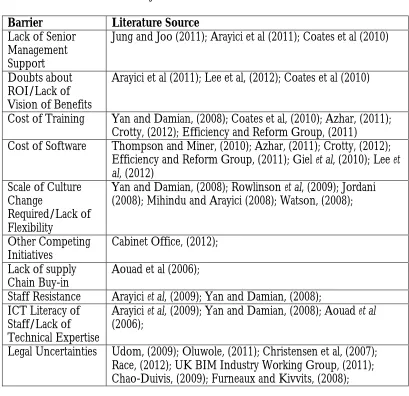
Summary of the identified Barriers for BIM
Table 1: Summary of the Literature on Barriers for BIM
Barrier Literature Source
Lack of Senior Management Support
Jung and Joo (2011); Arayici et al (2011); Coates et al (2010)
Doubts about ROI/Lack of Vision of Benefits
Arayici et al (2011); Lee et al, (2012); Coates et al (2010)
Cost of Training Yan and Damian, (2008); Coates et al, (2010); Azhar, (2011); Crotty, (2012); Efficiency and Reform Group, (2011) Cost of Software Thompson and Miner, (2010); Azhar, (2011); Crotty, (2012);
Efficiency and Reform Group, (2011); Giel et al, (2010); Lee et al, (2012)
Scale of Culture Change
Required/Lack of Flexibility
Yan and Damian, (2008); Rowlinson et al, (2009); Jordani (2008); Mihindu and Arayici (2008); Watson, (2008);
Other Competing Initiatives
Cabinet Office, (2012);
Lack of supply Chain Buy-in
Aouad et al (2006);
Staff Resistance Arayici et al, (2009); Yan and Damian, (2008); ICT Literacy of
Staff/Lack of Technical Expertise
Arayici et al, (2009); Yan and Damian, (2008); Aouad et al (2006);
Legal Uncertainties Udom, (2009); Oluwole, (2011); Christensen et al, (2007); Race, (2012); UK BIM Industry Working Group, (2011); Chao-Duivis, (2009); Furneaux and Kivvits, (2008);
Methodology
Each organisation in the “Construction Index Top 100, 2011” (The Construction Index, 2011) was contacted. Pre-notification identified that the classification of construction companies used by the Construction Index allowed the inclusion of firms other than main contracting organisations, such as large sub-contracting organisations and multidisciplinary consultancy firms. In total, 74 out of the 100 companies listed were main contracting organisations, all of which were contacted. A response was received from 30 organisations. Bartlett et al (2001) indicated for a population size of 100, and considering that the data is continuous in nature, the minimum sample size is 46. This shows that the minimum number of completed questionnaires that would provide a valid sample is the 30 achieved as Bartlett’s method assumes a 65% return rate. Bartlett et al, (2001) states this provides an alpha of 0.1 and a t of 1.65 and thus the margin of error to be produced by following this method has a 10% chance of being greater than 3%. The responses received were from a range of individuals at management level within the organisations. Eighteen responses were from those who had implemented BIM and twelve from those who had not.
The standard method of ranking the barriers of BIM utilising mean rank analysis and the relative importance index (RII) formula to establish the respondent’s ranking on each of the BIM barriers was adopted.
RII is defined by the following formulae:-
( ) = ∑
(0 ≤ ≤ 1)
Where:
W is the weighting given to each element by the respondents. This will be between 1 and 5, where 1 is the least significant impact and 5 is the most significant impact;
A is the highest weight; and
When the RII was carried out on the data obtained from the survey questionnaire there were some barriers which scored identically. In order to differentiate between barriers in terms of rank, consideration of the level of rank: the number of respondents scoring 4 or more, and those scoring 3 were noted. In some cases, it was still not possible to differentiate between the barriers using this approach; thus it was decided to give joint rankings when the scores were the same.
A comparison was carried out between those who had implemented BIM practices and those who had not using the Rank Agreement Factor (RAF).
RAF is defined by the following formulae:-
2 , 1 , 11
i i N iR
R
N
RAF
The maximum RAF (RAFmax) is calculated as shown below:
2 , 1 , 1max
1
R
Rj
N
RAF
i N i Where;Ri,1 is the rank of item i in group 1, Ri,2, is the rank of item i in group 2,
N is total number of items, which is the same for each group, Rj,2 is the rank of item j in group 2, and;
j = N – i + 1.
Percentage Disagreement (PD) between the two groups is the ratio RAF to RAFmax, and it can be determined using the equation shown below:
The Percentage Agreement between the rank orders obtained from the two groups can then be calculated as shown below:
PA = 100 – PD
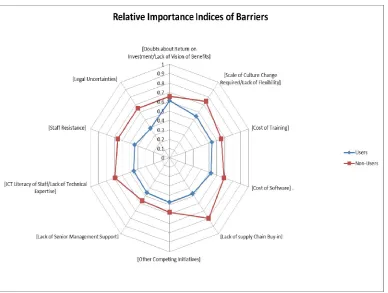
A higher RAF value shows that the agreement between the two groups is weaker. A RAF value of zero indicates a complete agreement. To provide further elucidation the barriers were then plotted on a spider diagram (Figure 1).
Findings Providing Ranked BIM Barriers
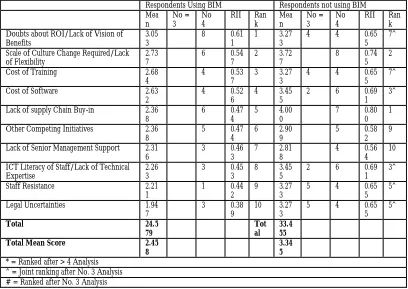
The barriers were analysed using Mean rank analysis (Mean – Table 2) and Relative Importance Index (RII – Table 2). Where the result produced a similar score the ranking was segregated using the largest number of values ranked 4, then the largest number of values ranked 3. The results are tabulated in Table 2.
Table 2: Ranked BIM Barriers
Respondents Using BIM Respondents not using BIM
Mea n
No = 3
No ≥
4
RII Ran
k Mea n
No = 3
No ≥
4
RII Ran
k Doubts about ROI/Lack of Vision of
Benefits
3.05 3
8 0.61
1
1 3.27
3
4 4 0.65
5 7^
Scale of Culture Change Required/Lack of Flexibility
2.73 7
6 0.54
7
2 3.72
7
8 0.74
5 2
Cost of Training 2.68
4
4 0.53
7
3 3.27
3
4 4 0.65
5 7^
Cost of Software 2.63
2
4 0.52
6
4 3.45
5
2 6 0.69
1 3^
Lack of supply Chain Buy-in 2.36
8
6 0.47
4
5 4.00
0
7 0.80
0 1
Other Competing Initiatives 2.36
8
5 0.47
4
6 2.90
9
5 0.58
2 9
Lack of Senior Management Support 2.31
6
3 0.46
3
7 2.81
8
4 0.56
4 10
ICT Literacy of Staff/Lack of Technical Expertise
2.26 3
3 0.45
3
8 3.45
5
2 6 0.69
1 3^
Staff Resistance 2.21
1
1 0.44
2
9 3.27
3
5 4 0.65
5 5^
Legal Uncertainties 1.94
7
3 0.38
9
10 3.27
3
5 4 0.65
5 5^
Total 24.5
79
Tot al
33.4 55 Total Mean Score 2.45
8
3.34 5
The figures in Table 2 show that those who had not used BIM perceived the barriers as more important than those who had, with a total score of 33.455 compared to the User respondents’ score of 24.579. The barriers may not be perceived as important by those respondents who have already implemented BIM as they have overcome the major hurdle of initial investment. It shows that once familiarity with BIM software and processes are achieved that the barriers do not appear to be as insurmountable. This hypothesis is supported by the ranking of the top four barriers as selected by the Non-users, “Lack of supply Chain Buy-in”, “Scale of Culture Change Required/Lack of Flexibility”, “ICT Literacy of Staff/Lack of Technical Expertise” and “Cost of Software” (1st to 3rd place respectively). The latter two were ranked in joint 3rd place. This indicates that the first three all have to do with skills and availability of expertise. Once the adoption of BIM has taken place these are overcome and those with experience are either trained or brought into the organisation negating the effect of these barriers. Those who had already implemented BIM ranked the same barriers 5th, 2nd, 4th and 8th respectively.
The top three barriers as perceived by those already using BIM were “Doubts about ROI/Lack of Vision of Benefits”, “Scale of Culture Change Required/Lack of Flexibility” and “Cost of Training”. Experience has changed the discernment in relation to the rankings provided. However, still to the fore are barriers that could be overcome by promotion of BIM.
Conversely, the three least important barriers for those who already implemented BIM, in order of importance were, “Legal Uncertainties”, “Staff Resistance” and “ICT Literacy of Staff/Lack of Technical Expertise”. Contributory factors may be that there have been little by way of case law which impacts on BIM, staff have already adopted the procedures so any resistance has faded and they have already up skilled to implement BIM. This is indicated by the reduced ranking for the above barriers.
The importance of this support is shown in the lowly rank given to other competing initiatives demonstrating that the adoption of BIM within the organisation is being provided with a semblance of priority to enable the Government objectives of Level 2 BIM adoption by 2016 to be achieved.
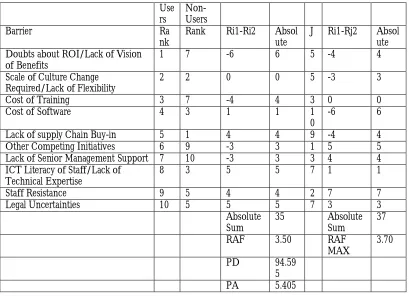
Table 3: RAF, PD and PA values for BIM Barriers
Use
rs
Non-Users
Barrier Ra
nk
Rank Ri1-Ri2 Absol ute
J Ri1-Rj2 Absol ute Doubts about ROI/Lack of Vision
of Benefits
1 7 -6 6 5 -4 4
Scale of Culture Change Required/Lack of Flexibility
2 2 0 0 5 -3 3
Cost of Training 3 7 -4 4 3 0 0 Cost of Software 4 3 1 1 1
0
-6 6
Lack of supply Chain Buy-in 5 1 4 4 9 -4 4 Other Competing Initiatives 6 9 -3 3 1 5 5 Lack of Senior Management Support 7 10 -3 3 3 4 4 ICT Literacy of Staff/Lack of
Technical Expertise
8 3 5 5 7 1 1
Staff Resistance 9 5 4 4 2 7 7 Legal Uncertainties 10 5 5 5 7 3 3
Absolute
Sum
35 Absolute Sum
37
RAF 3.50 RAF MAX
3.70
PD 94.59 5
PA 5.405
The figures in Table 3 indicate that the rank agreement factor between the two groups is 3.50 and the RAFmax is 3.70. This produces a Percentage Disagreement (PD) of 94.595% and a Percentage Agreement of only 5.405%. This result strongly supports the hypothesis that BIM adopters change their views on the most significant barriers to BIM subsequent to implementation by ranking them differently than those yet to adopt BIM.
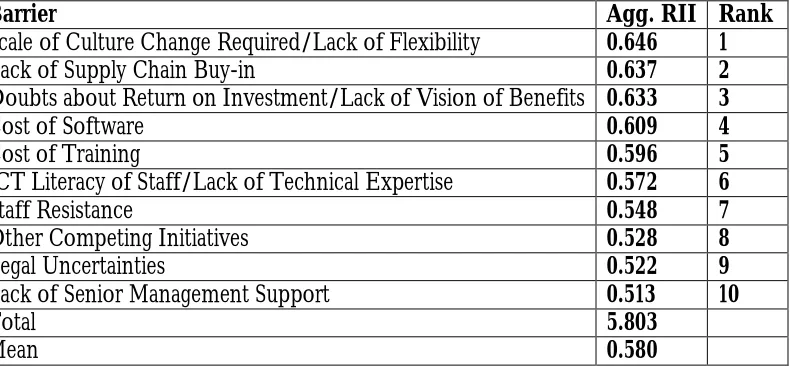
Table 4: Overall Ranking for BIM Implementation Barriers
Table 4 provides an overall ranking from the combination of the two groups. This indicates that “Scale of Culture Change Required/Lack of Flexibility” is the greatest barrier to BIM adoption. “Lack of supply Chain Buy-in” and “Doubts about Return on Investment/Lack of Vision of Benefits” are ranked second and third overall respectively, with the cost barriers relating to software and training following. This indicates that organisations are unsure as to their own capabilities and those in their supply chain. It highlights the importance of training and promotion of the benefits of BIM to enable the cultural and skills change to take place. The closer the RII value gets to 1 the more important the barrier is. The difference in Users and Non-Users perceptions of the importance of BIM barriers is illustrated graphically in Figure 1.
Barrier Agg. RII Rank
Scale of Culture Change Required/Lack of Flexibility 0.646 1
Lack of Supply Chain Buy-in 0.637 2
Doubts about Return on Investment/Lack of Vision of Benefits 0.633 3
Cost of Software 0.609 4
Cost of Training 0.596 5
ICT Literacy of Staff/Lack of Technical Expertise 0.572 6
Staff Resistance 0.548 7
Other Competing Initiatives 0.528 8
Legal Uncertainties 0.522 9
Lack of Senior Management Support 0.513 10
Total 5.803
Figure 1: RII values for Users and Non-Users of BIM
Figure 1 displays a visual summary of the comparison between those who had already implemented BIM and those who were still to use BIM. Figure 1 represents just how much more important the barriers appear to those who have not implemented BIM in general. All of the barriers were deemed to be greater to those yet to use BIM. The barrier relating to “Doubts about Return on Investment / Lack of vision of Benefits” was ranked the closest between users and non-users. This indicates that the perception of the importance between the two groups did not reduce much upon implementation. It indicates that there may be work still to be done as far as promoting the benefits of BIM. The barrier ranking which showed the greatest variance between the users and non-users was “Lack of Supply Chain Buy-in”. This shows that despite initial concerns prior to BIM adoption there is a general willingness on the part of the supply chain to adopt BIM once the commitment for implementation to proceed has been achieved.
One suggested that a lack of knowledge was probably main reason for not fully adopting BIM to date. This was already investigated under the “Lack of Technical Expertise” barrier. The next comment related to ownership and liability which was investigated under “Legal Uncertainties”. Two organisations suggested that “Procurement Routes” and the speed of procurement on fast track Design and Build schemes was a barrier. They considered that this resulted in using “tried and tested” methods rather than having to take time and rethink the process. Fear of the unknown, anticipated learning curve length and the ability to take a project through from inception were the last three barriers identified. This reinforces the findings in relation to the barriers to BIM adoption, in that, the “Fear” factor is reduced on adoption and while barriers are perceived greater prior to adoption in the main they reduce substantially once BIM is implemented.
Conclusions
Building Information Modelling (BIM) in the latest UK government strategy has been set a deadline of 2016 on all government projects. Without implementing BIM organisations will not be accepted onto UK government projects as they will lose out at the tender stage. With this increased pressure through the government strategy and in light of the many advantages of BIM adoption, such as its innovative way of conceptualising, managing, designing and constructing the project, in addition to managing it as an asset through to demolition, organisations are seeking to implement it in order to survive. However, if successful implementation is to take place there are a number of barriers to be overcome. This paper identified ten barriers to BIM adoption from literature and ranked these in order of importance. In addition two respondents, when identifying additional barriers indicated “Procurement Route” and speed of procurement on fast track Design and Build schemes. Fear of the unknown, anticipated learning curve length and the ability to take a project through from inception were the last three additional barriers identified.
Acquaintance with the BIM software and processes breaks down barrier importance. This hypothesis is supported by the ranking of the top four barriers as selected by the Non-users, the first three all have to do with skills and availability of expertise. Once BIM is implemented these aspects are surmounted and the effect of experience negates their effect.
The top three barriers as perceived by those already using BIM were “Doubts about ROI/Lack of Vision of Benefits”, “Scale of Culture Change Required/Lack of Flexibility” and “Cost of Training”. Experience has changed the discernment in relation to the rankings provided. However, still to the fore are barriers that could be overcome by promotion of BIM.
Conversely, the three least important barriers for those using BIM related to legal issues where the lack of effect of case law impacting on BIM contributed to its low ranking, staff having already implemented BIM are no longer resisting and have already up skilled to implement BIM. This is indicated by the reduced ranking for these barriers. For non-BIM users the lowest barriers in the ranking demonstrated that senior management were committed to BIM adoption. This commitment is further seen in the low rank given to other competing initiatives.
The difference in ranking between users and non-BIM users is further emphasised by the Percentage Disagreement (PD) value of 94.595% and a Percentage Agreement of only 5.405%. This finding strongly supports the original hypothesis of this paper; respondents who have already adopted BIM will change their perceptions as to the most important barriers to BIM by ranking them differently than those who are yet to implement it.
This demonstrates that despite initial concerns prior to BIM adoption there is a general willingness on the part of the supply chain to adopt BIM once the commitment for implementation to proceed has been achieved.
This paper reinforces the importance of BIM to the UK construction industry as a whole yet clearly indicates that different stakeholders within the large contractor sector will have differing barrier perspectives, depending upon their level of corporate BIM maturity. It is also clear from the research that to successfully overcome the barriers in the implementation of BIM, a company must attend to the softer issues surrounding internal 'change management' in addition to the harder technical issues.
References
Ahmad, I., Sein Maung, K. and Panthi, Kamalesh. (2010). Challenges of Integration and ICT's Potentials in the Globalised Construction Industry. Proceedings of PICMET '10: Technology Management for Global Economic Growth (PICMET), 18-22 July 2010, Phuket, Thailand, 1-7.
Aouad, G., Wu,S., and Lee, A. (2006), nDimensional Modeling Technology: Past, Present, and Future, Journal of Computing in Civil Engineering, 20(3): 151-153.
Aranda-Mena,G., Crawford, J., Chevez, A. & Froese, T. (2009), Building information modelling demystified: does it make business sense to adopt BIM?, International Journal of Managing Projects in Business, 2 (3), 419-434.
Arayici, Y., Coates, P., Koskela, L., Kagioglou, M., Usher,C.,and O'Reilly K. (2011), Technology adoption in the BIM implementation for lean architectural practice, Automation in Construction, 20 (2), March 2011, 189-195.
Arayici, Y., Khosrowshahi, F., Marshal Ponting, A. and Mihindu, S., (2009), Towards Implementation of Building Information Modelling in the Construction Industry, Fifth International Conference on Construction in the 21st Century (CITC-V) “Collaboration and Integration in Engineering, Management and Technology” May 20-22, 2009, Istanbul, Turkey, Retrieved from
http://usir.salford.ac.uk/20702/2/Towards_Building_Information_Modelling_Pape r_Engineering_Management_and_Technology_Conference_in_IStanbul.pdf . Arayici, Y and Aouad, G (2010), Building information modelling (BIM) for construction
lifecycle management, Construction and Building: Design, Materials, and Techniques, Nova Science Publishers, NY, USA, 99-118.
Autodesk User Group International (AUGI), 2012. How Revit Structure Benefits the Construction Estimator. Retrieved from: http://www.augi.com/library/how-revit-structure-benefits-the-construction-estimator .
Azhar, S., (2011), Building Information Modelling (BIM): Trends, Benefits, Risks and Challenges for the AEC Industry, Leadership and Management in Engineering, 11(3), 241-252.
Bartlett, J., Kotrlik, J. and Higgins, C. (2001), Organisational research: determining
appropriate sample size in survey research, Information Technology, Learning, and Performance Journal, 19(1), 43–50.
Breetzke, K. and Hawkins, M., (2009), Project Extranets and e-procurement: user perspectives, RICS, London, UK.
Bentley, (2012), About BIM, Retrieved from: http://www.bentley.com/en-US/Solutions/Buildings/About+BIM.htm .
BIMhub, (2012), Benefits of BIM, Retrieved from: http://www.bimhub.com/level-up-bim/paas/ .
BIM Industry working Group (2011). A report for the Government Construction Client Group Building Information Modelling (BIM) Working Party Strategy Paper, Retrieved from http://www.bimtaskgroup.org/wp-content/uploads/2012/03/BIS-BIM-strategy-Report.pdf .
Cabinet Office (2012), Government Construction Strategy, One Year On Report and Action Plan Update, Retrieved from
http://www.cabinetoffice.gov.uk/resource-library/government-construction-strategy .
Chao-Duivis, M. (2009), Legal Implications of Working with BIM.(Juridische implicaties van het werken met BIM), Instituut voor Bouwrecht, Tijdschrift voor Bouwrecht nr. 3, The Hague, March 2009. 44. [in Dutch].
Christensen, S., McNamara, J. and O'Shea, K., (2007), Legal and contracting issues in electronic project administration in the construction industry. Structural Survey, 25(3/4), 191 - 203.
Cleves, J. and Meyer, R. (2011), No-Fault Construction.s Time Has Arrived, Retrieved from http://www.dbllaw.com/wp-content/uploads/No-Faults-Construction-Time-Has-Arrived-Construction-Lawyer-Article-Summer-2011.pdf .
Coates, P., Arayici, Y., Koskela, L. and Usher, C. (2010), The changing perception in the artefacts used in the design practice through BIM adoption , in: CIB 2010, 10/5/10 - 13/5/10, University of Salford UK.
Costain Group, (2012). Annual Report 2011: Engineering Solutions to meet national needs, Costain Group PLC, Maidenhead, UK.
Crotty, R., (2012), The Impact of Building Information Modelling Transforming Construction. 1st ed. Taylor and Francis, London, UK.
Dell & BD+C, (2012), Future-Proofing BIM, Netsian Technologies Group, Phoenix, USA. Dickinson, J., (2010), BIM: What, Why and How, National Resaerch Council Canada,
Ontario, Canada.
Eadie R., Perera S. and Heaney G. (2010). Identification and Ranking of E-Procurement Drivers and Barriers for Construction Organisations and ranking of these from the perspective of Quantity Surveyors, Journal of Information Technology in Construction, ITcon , 15, 23-43, Retrieved from http://www.itcon.org/2010/2 Eastman, C., Teicholz, P., Sacks, R. and Liston, K., (2011), BIM Handbook: A Guide to
Building Information Modelling. 2nd ed. John Wiley and Sons Inc, New Jersey, USA. Efficiency and Reform Group,(2011), Government Construction Strategy, Cabinet Office,
London, UK.
Egan, J., (1998). Rethinking Construction, Department of Trade and Industry (DTI), London, UK.
Furneaux, C. and Kivvits, R. (2008) BIM – implications for government, CRC for Construction Innovation, Brisbane, Australia.
Glautier, M.W.E and Underdown, B. (2001). Accounting Theory and Practice. 7th ed. Pearson Education. Edinburgh, UK.
Giel, B., Issa, R.R.A. and Olbina, S., (2010) Return on investment Analysis of Building Information Modelling in Construction. Nottingham, Nottingham University Press. Griffiths, A., Stephenson, P. and Watson, P., (2000), Management Systems for Construction.
Pearson Education Limited, Harlow, UK.
Gu, N. and London, K.., (2010). Understanding and Facilitating BIM Adoption in the AEC Industry. Automation in Construction, 19(1), 988-999.
Hardin, B., (2009), BIM and Construction Management. 1st ed. Wiley Publishing Ltd, Indiana, USA.
Harris, F., McCaffer, R. and Edum-Fotwe, F , (2006), Modern Construction Management, 6th ed, Blackwell, Oxford, UK.
IEEE Standards Board, (1990), IEEE Standard Glossary of Software Engineering Terminology. Institute of Electrical and Electronic Engineers, New York, USA. Jordani, D. (2008), BIM: A Healthy Disruption to a Fragmented and Broken Process, Journal
of Building Information Modelling, Spring 2008, 24-26.
Jung,Y and Joo, M. (2011) Building information modelling (BIM) framework for practical implementation, Automation in Construction, 20(2), March 2011, 126-133.
Kerzner, H., (2004), Project Management, 9th ed., John Wiley and Sons Inc., New Jersey, USA.
Khosrowshahi, F. and Arayici, Y. (2012), Roadmap for implementation of BIM in the UK construction industry, Engineering, Construction and Architectural Management, 19(6), 610 – 635.
Langford, D. &. Male. Stephen.,(2001). Strategic Management in Construction. 2nd ed. Blackwell Science, Oxford, UK.
Latham, M., (1994), Constructing the Team. London, Her Majesty's Stationary Office (HMSO), London, UK.
Lee, G., Harrison, K. and Won, J.,(2012). Economic Impact of BIM-Assissted Design Validation. Automation in Construction, 22(1), 577 - 586.
Lewis, A., Riley, D. & Elmualim, A., (2010), Defining High Performance Buildings for Operations and Maintenance. International Journal of Facility Management, 1(2), 1-16.
Lowe, D. and Leiringer, R., (2006), Commercial Management of Projects, 1st ed., Blackwell Publishing, London, UK.
Martin, R., 2012. Building Information Modeling Market to Reach $6.5 Billion Worldwide by 2020, Forecasts Pike Research, Retrieved from
http://www.marketwatch.com/story/building-information-modeling-market-to-reach-65-billion-worldwide-by-2020-forecasts-pike-research-2012-05-08 . Matthews, D. (2011), First Ever BIM Legal Case in the US, Retrieved from
Mihindu, S. and Arayici, Y. (2008), “Digital construction through BIM systems will drive the re-engineering of construction business practices”, Proceedings of the International Conference Visualisation, IEEE Computer Society, Los Alamitos, CA. 9-11 July 2008, 29-34.
Mitchell, A. & Demian, P. (2006). Barriers that Influence the Implementation of UK Construction Project Extranets. Retrieved from
http://homepages.lboro.ac.uk/~cvpd2/PDFs/134_Barriers%20That%20Influence %20the%20Implementation%20of%20UK%20Constru.pdf .
Moon, H., Choi, M., Kim, S. and Ryu, S., (2011), Case Studies for the Evaluation of Interoperability Between a BIM Based Architectural Model and Building Performance Analysis Programs, International Building Performance Simulation Association, Sydney, Australia.
Oluwole, A. (2011) A preliminary review on the legal implications of BIM and model ownership, Journal of Information Technology in Construction (ITcon), 16, pg. 687-696, available online at http://www.itcon.org/2011/40 (accessed January 2013). Pniewski, V., (2011), Building Information Modelling (BIM) Interoperability Issues: in Light
of Interdisciplinary Collaboration. 3rd ed. Collaborative Modelling Ltd, London, UK. Race, S., (2012), BIM Demystified. 1st ed. London: RIBA Publishing, UK.
Roberts, J., (2004), The Modern Firm. 1st ed., Oxford University Press, Oxford, UK.
Rowlinson, S., Collins, R., Tuuli, M. & Jia, Y., (2009), Implementation of Building Information Modeling (BIM) in Construction: A Comparative Case Study, Proceedings of the 2nd International Symposium on Computational Mechanics and the 12th International Conference on the Enhancement and Promotion of Computational Methods in Engineering and Science, Hong Kong‐ Macau (China), 30 November–3 December 2009, AIP Conf. Proc. 1233, 572-577.
Ruikar, K., Anumba, C., and Carrillo, P. (2005), End-user perspectives on use of Project Extranets in construction organisations, Engineering, Construction and Architectural Management, 12(3), 222-235.
Succar, B. (2009), Building information modelling framework: a research and delivery foundation for industry stakeholders, Automation in Construction, 18 (3), 357–375. Thompson, D. and Miner, R., (2010), Building Information Modeling - BIM: Contractual
Risks are Changing with Technology, Retrieved from
http://aepronet.infinityit.com/Guest%20Essays/GE%20-%202006_09%20-%20Building%20Information%20Modeling.pdf .
Udom, K., (2012), Building Information Modelling, Retrieved from
http://www.thenbs.com/topics/bim/articles/bimMappingOutTheLegalIssues.asp . UK Parliament, (1980). Limitation Act 1980, HMSO, London, UK.
Wallbank, B., (2011), BIM and Professional Indemnity Insurance, Graphisoft, Woking, UK. Watson, A. (2010), BIM – A driver for change. Proceedings of the International Conference
on Computing in Civil and Building Engineering, (Ed. Tizani, W.), University of Nottingham, Retrieved from
http://www.engineering.nottingham.ac.uk/icccbe/proceedings/pdf/pf69.pdf . Wilkinson, P., (2005), Construction Collaboration Technologies: The Extranet Evolution. 1st
ed. Taylor & Francis Oxon, UK.
Yan, H. and Damian P., (2008), Benefits and Barriers of Building Information Modelling, Retrieved from
http://homepages.lboro.ac.uk/~cvpd2/PDFs/294_Benefits%20and%20Barriers%2 0of%20Building%20Information%20Modelling.pdf .