Original article
1: Varastegan Institute for Medical Sciences, Mashhad, Iran. 2: Pardis Clinical and Genetic Laboratory, Mashhad, Iran.
www.RBMB.net
A Description of Reference Ranges for
Organic Acids in Urine Samples from
A Pediatric Population in Iran
Fatemeh Keyfi
1, 2, Zoltan Lukacs
3, Abdolreza Varasteh*
1, 2, 4Abstract
Background: Organic acids refer to a family of compounds that are intermediates in a variety of
metabolic pathways. Many organic acids are present in urine from clinically normal individuals. Elevated levels of urine organic acids cause to the organic acidurias, disorders in which some metabolic pathways in organic acid metabolism are blocked. The present work identified major and minor urinary acidic metabolites in normal subjects, and their quantitative ranges in a pediatric population of Iran.
Methods: Two hundred and fifty-one healthy subjects, including 132 males and 119 females, from 2 days
to 15 years of age were enrolled. Urinary organic acids were extracted from urine with organic solvents and identified and quantified by gas chromatography-mass spectrometry.
Results: The results provide a foundation on which to check results for patients with potentially
abnormal organic acidurias. By this method 98 organic acids were identified in a pediatric population of Iran.
Conclusions: The present work identifies and quantifies major and minor urinary metabolites
excreted by normal subjects. We also analyzed urine from 30 patients with organic acid metabolism abnormalities and compared the concentrations of specific organic acids with those from urines of normal individuals.
Keywords:Gas chromatography/mass spectrometry, Iran population, Normal individuals, Urine
organic acid analysis, Urine organic acids range
Introduction
Approximately 50 diseases have been described in which an inherited single enzyme defect causes a high concentration of acidic metabolites in the blood or urine. Dysfunction in any protein complex that involves the absorption, transportation, activation, and/or application of a vitamin can result in an elevated urinary organic acid (1). With this in mind, organic acid concentrations in urine can serve as markers to diagnose the numerous genetic metabolic disorders known as organic acidurias (2). Organic acids refer to a family of compounds that are intermediates in a variety of metabolic pathways
including glycolysis and citric acid cycle metabolites, fatty acid oxidation, ketone metabolites and cofactors, and markers of detoxification (3, 4). Many organic acids are present in urine from clinically normal individuals (5). Elevated levels of urine organic acids cause to the organic acidurias, disorders in which some metabolic pathways in organic acid metabolism are blocked. An analysis of urinary organic acids is usually a key test in the assessment of patients with doubtful genetic disorders of organic acid metabolism and is frequently used in the diagnosis of persons with possible genetic disorders of
mitochondrial fatty acid metabolism, amino acid disorders, and disorders of mitochondrial oxidative phosphorylation. Disorders of organic acid metabolism have various clinical presentations and ages of onset. Some of the common presentations include lethargy, fasting intolerance, myalgia, myopathy, exercise intolerance, cardiomyopathy, and various types of developmental or neurological disabilities such as seizures or vision deficits (6, 7).
Gas Chromatography/Mass Spectrometry (GC/MS) is the most reliable method for urine organic acid analysis (8). Its primary asset is that it allows precise and simultaneous quantification of different compounds in samples. It has contributed greatly to the understanding of many disease states. GC/MS was initially developed for qualitative purposes, and quantitative analytical criteria have seldom been extensively studied, if at all (9-11). Clearly, an encyclopedic analysis such as this compounds the potential information on the physiological and pathophysiological situation of different metabolic pathways and their interrelationships in the body, and may provide clinical relevant information for patient care (12, 13).
Knowledge of biological variation allows evaluation of population-based reference ranges. For example, it would be useful to know that a result found in a patient would likely differ from that of a healthy individual. The present work identified major and minor urinary acidic metabolites in normal subjects, and their quantitative ranges in a pediatric population of Iran.This could provide age-dependent reference intervals for laboratory staff and physicians using current methods and equipment, as currently available data is rather dated.
Materials and Methods
SubjectsTwo hundred and fifty-one healthy subjects, including 132 males and 119 females, from 2 days to 15 years of age were enrolled. All of them were referred to our laboratory for organic acid analysis, and their results were normal. All procedures followed were in accordance with the ethical standards of the committee on human experimentation MUMS (Mashhad University ofMedical Science). Informed consent was obtained from all patients for being included in the study.
Chemical, Reagents and instrument
In this study chemicals and reagents with highest purity available were purchased. Pentadecanoic acid
(PDA) and 0- (2,3,4,5,6-Pentafluorobenzyl)
hydroxylamine hydrochloride (PFBH) were obtained from Sigma-Aldrich. Tetramethylsilane (TMS) Tri-Sil (BSA: pyridine) from Thermo Scientific was used as the derivatizing reagent. Ethyl acetate and n-Hexane was from Merck Millipore. We use a Clarus 500 GC-MS from PerkinElmer with an Agilent fused silica column 30 m x 0.25 mm x 0.25 µm.
Extraction, Derivatization, and Gas chromatography The organic acids were extracted from urine by organic solvent extraction and then identified and quantified by GC/MS. Initially, the urinary pH was adjusted to 2 to 5, 50 µl of 50 mg/ml pentafluoro benzyl hydroxylamine-hydrochloride solution were added, and the sample was incubated at room temperature for one hour. Subsequently, the pH was adjusted to 1 by dropwise addition of HCl. The acidic sample was extracted two times with 4 ml of ethyl acetate by vortexing the sample and centrifuging at 700 x g for 5 min. The organic supernatant layers from each extraction were transferred to a second vial, 25 µl of pentadecanoic acid (PDA) used as an internal standard were added, and the solution was evaporated to dryness under nitrogen at 40 °C. Finally, the sample was silylated by adding 100 µl of tetramethylsilane (TMS), vortexed, and incubated at 60 °C for 30 min. After the sample cooled to room temperature, 500 µl of hexane were added and the sample was analyzed by GC/MS. The temperatures
for the injectors and detectors were 250 and 300 oC,
respectively. The GC temperature program was as follows: initial temperature was 70 °C, held for 4 min, increased to 180 °C at a rate of 20 °C/min, then to 200 °C at a rate of 4 °C/min, held for one min and finally to 275 °C at a rate of 3 °C/min and held for 10 min (8, 14).
Statistical Analysis
Statistical analysis was performed using SPSS version 16. The compounds were identified and their concentration ranges were determined for all individuals.
Results
Analysis of normal urines
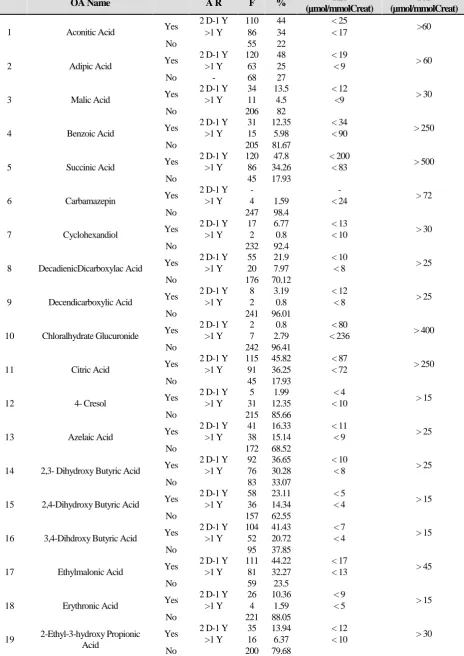
We identified 98 compounds in urine samples from 251 healthy subjects. Compounds detected in 60-80% of the samples were Aconitic Acid, AdipicAcid, Succinic Acid, Citric Acid, 2,3- Dihydroxy Butyric Acid, 3,4-Dihdroxy Butyric Acid, Ethylmalonic Acid, Glycolic Acid, Hippuric Acid, Homovanillic Acid, 4-Hydroxy Benzoic Acid, 3-4-Hydroxy Isobutyric Acid, 2-Hydroxy Glutaric Acid, 4-2-Hydroxy Phenyl Acetic Acid, 3-Methyl Adipinic Acid, Methyl Succinic Acid, Methylmalonic Acid, 2-Methyl-3-Hydroxy Butyric Acid, Octendicarboxylic Acid, Oxalic Acid, 2-Oxoglutaric Acid, 5-Oxoproline, Pimelic Acid, Suberic Acid, VanillylMandelic Acid, Lactic Acid and Pyruvate. Compounds detected in 20-60% of the samples included Malic Acid, Benzoic Acid, Decadienic Dicarboxylic Acid, Azelaic Acid, 2,4-Dihydroxy Butyric Acid, 2-Ethyl-3-hydroxy Propionic Acid, Fumaric Acid, Glutaric Acid, Hydroxy Malic Acid, 3-Hydroxy Adipic Acid,4-Hydroxy Hippuric Acid, HydroxyDecadicarboxylic Acid, 5-Hydroxy Hexanoic Acid, Hydroxy-methyl Glutaric Acid, 3-Hydroxy Phenyl Acetic Acid, 4-3-Hydroxy Phenyl Lactic Acid, 3-Hydroxy Propionic Acid, (3-hydroxy phenyl)-3-Hydroxy Propionic Acid, 3-Hydroxy Isovaleric Acid, 2-Hydroxy Isovaleric Acid, Furan-2,5-Dicarboxylic Acid, 5-Hydroxymethyl-2-FuranoicAcid, 3-Methyl-4-Hydroxy Benzoic Acid, Phenyl Acetic Acid, PhenylLactic Acid and Phosphoric Acid.
Compounds detected in 0.5-20% of the samples
included Carbamazepin, Cyclohexandiol,
Decendicarboxylic Acid, Chloralhydrate
Glucuronide, 4- Cresol, Erythronic Acid,
2-Furoylglycin, Hexenoic Dicarboxylic Acid,
Homogentisic Acid, 2-Hydroxyadipinic Acid, 3-Hydroxy Benzoic Acid, 3-3-Hydroxy Butyric Acid, 4-Hydroxy Butyric Acid, 2-4-Hydroxy Butyric Acid, 3-Hydroxy Hippuric Acid, 5-3-Hydroxy Indole Acetic Acid, 3-Hydroxy Adipic Acid Lacton, 2-Hydroxy-3 methyl-Valeric Acid, Hydroxy Phenyl Pyruvate, 4-Hydroxy Phenyl Propionic Acid, 2-4-Hydroxy Valeric Acid, Levulinic Acid, Mevalonic, N-acetylaspartate,
3-Methyl Glutaric Acid,
(methyl-4-hydroxyphenyl) Hydroxy Propionic Acid,
3-Methyl-4-Hydroxy-Phenyl Lactic Acid,
Oxoadipinic Acid, Oxo-3-Methylvaleric Acid, 2-Oxoisocapronic Acid, Palmitic Acid, Stearic Acid, Uracil, 4-Hydroxy Cyclohexyl Carbonic Acid,
3-Methyl Glutaconic Acid, Urate, 2-
HydroxyIsocapronic Acid,
HydroxyDecadicarboxylic Acid, Tricarballylic Acid, Tartaric Acid, Malonic Acid, Phenobarbital, Lauric Acid,4-Hydroxy Cyclo Acetic, Mandelic Acid, and 2-Hydroxy Isobutyric Acid. Frequency, percentage (number of urines in which the compounds were detected), range of concentration, and pathogenical area of these compounds are listed in Table 1. A typical chromatogram of urinary organic acids from a normal individual is shown in Figure 1(Fig.1)..
Fig 1.A typical GC-MS chromatogram of urinary organic acids from a normal individual. The compounds noted in the figure are TMS-derivatives of the following compounds: 1: Lactic acid, 2: Glycolic acid, 3: Oxalic acid, 4: 3-hydroxy butyric acid, 5: Urea, 6:Phosphoric acid, 7: Succinic acid, 8: Pentafluorobenzyl hydroxyl amine, 9: Pyruvic acid, 10: 2-hydroxy glutaric acid, 11: 4-hydroxy phenyl acetic acid, 12: Tartaric acid, 13: Aconitic acid, 14: Homovanilic acid, 15- Citric acid, 16: Hippuric acid, 17: (hydroxyphenyl)-hydroxyl propionic acid, 18: 3-methoxy-4- hydroxyl mandelic acid, 19: Internal standard, 20: 2-oxoglutaric acid, 21: 4-hydroxyl hippuric acid.
Table 1. Frequency, percentage and range of concentration of compounds in normal urine
PA (µmol/mmolCreat) RR
(µmol/mmolCreat) %
F A R OA Name
>60 < 25
44 110 2 D-1 Y Yes
Aconitic Acid
1 >1 Y 86 34 < 17
22 55 No
> 60 < 19
48 120 2 D-1 Y Yes
Adipic Acid
2 >1 Y 63 25 < 9
27 68
-No
> 30 < 12
13.5 34 2 D-1 Y Yes
Malic Acid
3 >1 Y 11 4.5 <9
82 206 No
> 250 < 34
12.35 31
2 D-1 Y Yes
Benzoic Acid
4 >1 Y 15 5.98 < 90
81.67 205 No
> 500 < 200
47.8 120 2 D-1 Y Yes
Succinic Acid
5 >1 Y 86 34.26 < 83
17.93 45
No
> 72
-2 D-1 Y Yes
Carbamazepin
6 >1 Y 4 1.59 < 24
98.4 247 No
> 30 < 13
6.77 17 2 D-1 Y Yes
Cyclohexandiol
7 >1 Y 2 0.8 < 10
92.4 232 No
> 25 < 10
21.9 55 2 D-1 Y Yes
DecadienicDicarboxylac Acid
8 >1 Y 20 7.97 < 8
70.12 176 No
> 25 < 12
3.19 8
2 D-1 Y Yes
Decendicarboxylic Acid
9 >1 Y 2 0.8 < 8
96.01 241 No
> 400 < 80
0.8 2 2 D-1 Y Yes
Chloralhydrate Glucuronide
10 >1 Y 7 2.79 < 236
96.41 242 No
> 250 < 87
45.82 115 2 D-1 Y Yes
Citric Acid
11 >1 Y 91 36.25 < 72
17.93 45
No
> 15 < 4
1.99 5
2 D-1 Y Yes
4- Cresol
12 >1 Y 31 12.35 < 10
85.66 215 No
> 25 < 11
16.33 41
2 D-1 Y Yes
Azelaic Acid
13 >1 Y 38 15.14 < 9
68.52 172 No
> 25 < 10
36.65 92
2 D-1 Y Yes
2,3- Dihydroxy Butyric Acid
14 >1 Y 76 30.28 < 8
33.07 83
No
> 15 < 5
23.11 58
2 D-1 Y Yes
2,4-Dihydroxy Butyric Acid
15 >1 Y 36 14.34 < 4
62.55 157 No
> 15 < 7
41.43 104 2 D-1 Y Yes
3,4-Dihdroxy Butyric Acid
16 >1 Y 52 20.72 < 4
37.85 95
No
> 45 < 17
44.22 111 2 D-1 Y Yes
Ethylmalonic Acid
17 >1 Y 81 32.27 < 13
23.5 59 No
> 15 < 9
10.36 26
2 D-1 Y Yes
Erythronic Acid
18 >1 Y 4 1.59 < 5
88.05 221 No
> 30 < 12
13.94 35
2 D-1 Y Yes
2-Ethyl-3-hydroxy Propionic Acid
19 >1 Y 16 6.37 < 10
79.68 200 No
> 30 < 14
22.31 56
2 D-1 Y Yes Fumaric Acid 20 < 7 11.95 30 >1 Y 65.74 165 No > 12 < 4 0.8 2 2 D-1 Y Yes 2-Furoylglycin 21 < 4 1.19 3 >1 Y 98 246 No > 20 < 8 30.28 76
2 D-1 Y Yes Glutaric Acid 22 < 5 15.54 39 >1 Y 54.18 136 No > 45 < 14 46.25 116 2 D-1 Y Yes Glycolic Acid 23 < 16 36.65 92 >1 Y 17.13 43 No > 500 < 158 21.11 53
2 D-1 Y Yes Hippuric Acid 24 < 253 25.9 65 >1 Y 52.99 133 No > 15 < 5 18.72 47
2 D-1 Y Yes
Hexenoic Dicarboxylic Acid 25 -0.399 1 >1 Y 80.88 203 No -0.399 1 2 D-1 Y Yes Homogentisic Acid 26 ->1 Y -99.6 250 No > 25 < 14 49.4 124 2 D-1 Y Yes Homovanillic Acid 27 < 8 36.25 91 >1 Y 13.55 34 No > 5 < 5 2.39 6
2 D-1 Y Yes 2-Hydroxyadipinic Acid 28 ->1 Y 97.6 245 No > 20 < 10 13.55 34
2 D-1 Y Yes
Hydroxy Malic Acid 29 < 7 11.95 30 >1 Y 74.5 187 No > 15 < 10 36.25 91
2 D-1 Y Yes
3-Hydroxy Adipic Acid 30 < 5 5.58 14 >1 Y 58.17 146 No > 30 < 6 2.79 7
2 D-1 Y Yes
3-Hydroxy Benzoic Acid 31 < 8 8.37 21 >1 Y 88.84 223 No > 50 < 12 30.28 76
2 D-1 Y Yes
4-Hydroxy Benzoic Acid 32 < 16 23.11 58 >1 Y 46.61 117 No > 150 < 63 11.15 28
2 D-1 Y Yes
3-Hydroxy Butyric Acid 33 < 55 3.19 8 >1 Y 85.66 215 No -0.399 1 2 D-1 Y Yes
4-Hydroxy Butyric Acid 34 ->1 Y 99.6 250 No > 25 < 8 5.58 14 2 D-1 Y Yes
2-Hydroxy Butyric Acid 35 < 8 1.19 3 >1 Y 93.23 234 No > 60 < 28 35.46 89
2 D-1 Y Yes
3-Hydroxy Isobutyric Acid 36 < 15 28.68 72 >1 Y 35.86 90 No > 45 < 11 3.98 10 2 D-1 Y Yes
3-Hydroxy Hippuric Acid 37 < 18 12.35 31 >1 Y 83.66 210 No > 50 < 15 19.92 50
2 D-1 Y Yes
4-Hydroxy Hippuric Acid 38 < 20 17.93 45 >1 Y 62.15 156 No > 50 < 25 25.1 63 2 D-1 Y Yes HydroxyDecadicarboxylic Acid 39 < 10 3.98 10 >1 Y 70.92 178 No
> 50 < 19
45.42 114 2 D-1 Y Yes
2-Hydroxy Glutaric Acid 40 < 8 30.28 76 >1 Y 24.3 61 No > 15 < 6 17.53 44
2 D-1 Y Yes
5-Hydroxy Hexanoic Acid 41 < 3 6.37 16 >1 Y 76.09 191 No > 8 < 8 4.38 11 2 D-1 Y Yes
5-Hydroxy Indole Acetic Acid 42 < 6 1.59 4 >1 Y 94.02 236 No > 40 < 15 15.54 39
2 D-1 Y Yes
3-Hydroxy Adipic Acid Lacton 43 < 7 1.19 3 >1 Y 83.27 209 No > 40 < 16 36.25 91
2 D-1 Y Yes 3-Hydroxy-3-methyl Glutaric Acid 44 < 6 13.15 33 >1 Y 50.6 127 No > 30 < 5 2.39 6
2 D-1 Y Yes
3-Hydroxy Phenyl Acetic Acid 45 < 11 23.11 58 >1 Y 74.5 187 No > 300 < 104 52.99 133 2 D-1 Y Yes
4-Hydroxy Phenyl Acetic Acid 46 < 87 39.84 100 >1 Y 7.17 18 No > 100 < 28 27.09 68
2 D-1 Y Yes
4-Hydroxy Phenyl Lactic Acid 47 < 8 8.37 21 >1 Y 64.54 162 No > 60 < 15 1.99 5
2 D-1 Y Yes
4-Hydroxy Phenyl Pyruvate 48 ->1 Y 98.01 246 No > 15 < 5 10.76 27
2 D-1 Y Yes
3-Hydroxy Propionic Acid 49 < 3 8.37 21 >1 Y 80.88 203 No > 100 < 16 10.76 27
2 D-1 Y Yes 3-(3-hydroxy phenyl)-3-Hydroxy Propionic Acid 50 < 31 27.89 70 >1 Y 61.35 154 No -0.399 1 2 D-1 Y Yes
4-Hydroxy Phenyl Propionic Acid 51 ->1 Y -99.6 250 No > 80 < 24 17.53 44
2 D-1 Y Yes
3-Hydroxy Isovaleric Acid 52 < 12 11.15 28 >1 Y 71.31 179 No > 20 < 6 17.53 44
2 D-1 Y Yes
2-Hydroxy Isovaleric Acid 53 < 5 7.17 18 >1 Y 75.3 189 No -0.399 1 2 D-1 Y Yes
2-Hydroxy Valeric Acid 54 ->1 Y -99.6 250 No > 50 < 11 12.35 31
2 D-1 Y Yes Furan-2,5-Dicarboxylic Acid 55 < 11 18.33 46 >1 Y 69.32 174 No > 80 < 24 15.94 40
2 D-1 Y Yes 5-Hydroxymethyl-2-Furanoic Acid 56 < 21 22.31 56 >1 Y 61.75 155 No > 7 < 7 0.8 2 2 D-1 Y Yes Levulinic Acid 57 ->1 Y -99.2 249 No > 25 < 8 43.82 110 2 D-1 Y Yes
3-Methyl Adipinic Acid 58 < 5 32.67 82 >1 Y 23.5 59 No > 18 < 6 30.28 76
2 D-1 Y Yes
Methyl Succinic Acid 59 < 6 27.49 69 >1 Y 42.23 106 No
> 40 < 11
31.47 79
2 D-1 Y Yes Methylmalonic Acid 60 < 6 19.92 50 >1 Y 48.6 122 No -0.399 1 2 D-1 Y Yes Mevalonic 61 ->1 Y -99.61 250 No > 50 < 5 9.96 25 2 D-1 Y Yes N-acetylaspartate 62 < 16 0.797 2 >1 Y 89.24 224 No > 12 < 4 4.38 11 2 D-1 Y Yes
3-Methyl Glutaric Acid 63 < 3 3.58 9 >1 Y 92.04 231 No > 50 < 13 1.59 4
2 D-1 Y Yes
3-(3-methyl-4-hydroxyphenyl) 3-Hydroxy Propionic Acid 64 < 9 9.56 24 >1 Y 88.85 223 No > 20 < 7 32.27 81
2 D-1 Y Yes 2-Methyl-3-Hydroxy Butyric Acid 65 < 5 23.5 59 >1 Y 44.23 111 No > 100 < 29 5.58 14 2 D-1 Y Yes 3-Methyl-4-Hydroxy Benzoic Acid 66 < 10 11.55 29 >1 Y 82.87 208 No > 8 < 5 2.39 6
2 D-1 Y Yes 3-Methyl-4-Hydroxy-Phenyl Lactic Acid 67 ->1 Y 97.61 245 No > 40 < 14 46.21 116 2 D-1 Y Yes Octendicarboxylic Acid 68 < 7 20.72 52 >1 Y 33.07 83 No > 80 < 30 45.42 114 2 D-1 Y Yes Oxalic Acid 69 < 18 32.27 81 >1 Y 22.31 56 No > 25 < 5 1.19 3
2 D-1 Y Yes 2-Oxoadipinic Acid 70 < 5 1.19 3 >1 Y 97.6 245 No > 5 < 2 1.19 3
2 D-1 Y Yes 2-Oxo-3-Methylvaleric Acid 71 < 5 0.8 2 >1 Y 98.01 246 No > 500 < 136 38.25 96
2 D-1 Y Yes 2-Oxoglutaric Acid 72 < 46 25.1 63 >1 Y 36.65 92 No > 2 < 2 0.8 2 2 D-1 Y Yes 2-Oxoisocapronic Acid 73 ->1 Y 99.2 249 No > 20 < 9 31.87 80
2 D-1 Y Yes 5-Oxoproline 74 < 5 22.71 57 >1 Y 45.42 114 No > 5 < 5 2.39 6
2 D-1 Y Yes Palmitic Acid 75 0.4 1 >1 Y 97.21 244 No > 50 < 11 10.76 27
2 D-1 Y Yes
Phenyl Acetic Acid 76 < 10 8.37 21 >1 Y 80.88 203 No > 20 < 6 24.31 61
2 D-1 Y Yes
Phenyl Lactic Acid 77 < 4 6.77 17 >1 Y 68.92 173 No > 15 < 5 30.28 76
2 D-1 Y Yes Pimelic Acid 78 < 5 19.52 49 >1 Y 50.2 126 No > 30 < 7 4.78 12 2 D-1 Y Yes Stearic Acid 79 < 8 4.78 12 >1 Y 90.44 227 No
> 30 < 12
41.03 103 2 D-1 Y Yes Suberic Acid 80 < 10 11.95 30 >1 Y 47.02 118 No > 30 < 12 48.6 122 2 D-1 Y Yes VanillylMandelic Acid 81 < 5 27.49 69 >1 Y 23.91 60 No > 200 < 60 35.86 90
2 D-1 Y Yes Lactic Acid 82 < 50 32.67 82 >1 Y 31.47 79 No > 60 < 31 15.14 38
2 D-1 Y Yes Phosphoric Acid 83 < 14 17.53 44 >1 Y 67.33 169 > 100 < 32 32.67 82
2 D-1 Y Yes Pyruvate 84 < 15 19.52 49 >1 Y 47.81 120 No > 50 < 20 7.57 19 2 D-1 Y Yes Uracil 85 < 10 2.39 6 >1 Y 90.04 226 No > 30 < 20 2.39 6
2 D-1 Y Yes
4-Hydroxy Cyclohexyl Carbonic Acid 86 < 18 5.98 15 >1 Y 91.63 230 No > 30 < 9 11.55 29
2 D-1 Y Yes
3-Methyl Glutaconic Acid 87 < 14 5.98 15 >1 Y 82.47 207 No > 8 < 4 2.79 7
2 D-1 Y Yes Urate 88 -0.4 1 >1 Y 96.81 243 No > 8 < 3 0.8 2 2 D-1 Y Yes
2- Hydroxy Isocapronic Acid 89 ->1 Y 99.2 249 No > 10 < 10 1.19 3
2 D-1 Y Yes HydroxyDecadicarboxylic Acid 90 ->1 Y 98.81 248 No > 30 < 12 4.38 11 2 D-1 Y Yes Tricarballylic Acid 91 < 4 2.79 7 >1 Y 92.83 233 No > 20 < 4 5.18 13 2 D-1 Y Yes Tartaric Acid 92 < 4 2.79 7 >1 Y 92.03 231 No > 14 < 14 0.8 2 2 D-1 Y Yes Malonic Acid 93 ->1 Y 99.2 249 No -0.4 1 2 D-1 Y Yes Phenobarbital 94 ->1 Y 99.6 250 No 0.4 1 2 D-1 Y Yes Lauric Acid 95 ->1 Y 99.6 250 No > 3
-2 D-1 Y Yes
4-Hydroxy Cyclo Acetic acid 96 < 3 2 >1 Y 249 No > 80 < 74 6 2 D-1 Y Yes Mandelic Acid 97 < 64 2 >1 Y 243 No > 20 < 9 7 2 D-1 Y Yes
2-Hydroxy Isobutyric Acid 98 -1 >1 Y 243 No
OA Name=Organic Acids Name, AR= Age Range, F=Frequency, %= Percent, RR= Reference Range, PA= Pathgenical Area, Creat=Creatinine, D=Day, Y=Year,
Analysis of abnormal urines
In addition to the urines from healthy individuals, we also analyzed 30 abnormal urines from patients with
methylmalonic aciduria, propionic aciduria,
ethylmalonic aciduria, glutaric aciduria, maple syrup urine disease (MSUD), and isovaleric aciduria as described above.
Urine from 30 patients with methylmalonic aciduria (MMA, OMIM 251000) contained 35-3717 µmol/mmol Creatinine of methylmalonic acid, which were 3-330 folds greater than the normal levels found in our study. Also methylcitrate, which was not present in the urine of normal individuals, was found in the MMA patients.
Urine from five patients with propionic aciduria (PA, OMIM 606054) contained 28-115 µmol/mmol Creatinine of 3-hydroxy propionic acid, which was 5-23 fold greater than that in normal levels.
Urine from three cases with ethylmalonic acidurea contained 65-197 µmol/mmol Creatinine ethylmalonic acid, which were 3-12 folds greater than normal levels.
Urine from three patients with glutaric aciduria (OMIM 231670) contained 415-2800 µmol/mmol Creatinine glutaric acid and 7-116 µmol/mmol Creatinine of 3-Hydroxy glutaric acid. The glutaric acid concentrations 51-350 fold greater than normal levels. 3-hydroxy glutaric acid is not seen in normal individuals.
Urine from the patient with isovaleric aciduria (IVA, OMIM 243500) contained 2556 µmol/mmol Creatinine of isovaleryl glycine and 162 µmol/mmol Creatinine of 3-hydroxy isovaleric acid.The concentration of 3-Hydroxy isovaleric acid was 6-12 folds greater than normal. Isovaleryl glycine is not seen in normal individuals.
Urine from three patients with MSUD (OMIM 248600) contained 20-2600 µmol/mmol Creatinine of 2-hydroxy isovaleric acid, 10-80 µmol/mmol Creatinine of 2-hydroxy isocapronic acid, and 190-1905 µmol/mmol Creatinine of 3-hydroxy butyric acid. These values were 3-30 folds greater than normal.
Discussion
Most often, laboratories do not quantify organic acids, or they express semi-quantitative results equivalents of an internal standard. Sweetmann considered that errors in quantitative results as great
as 50% would be acceptable for the diagnosis of inherited disorders but the error for organic acids should be <20%. In our opinion, lower analytical errors are desirable for some differential diagnoses, and for the diagnoses of patients having moderate hyper excretions. Moreover, essential biological
variables such as the normal excretion
concentrations and their variations according to age, genetic factors, and nutritional status have yet to be unequivocally established (12).
Dagleish et al. proposed the use of gas chromatography for the study of the trimethylsilyl and methyl esters of organic acids extracted from physiological fluids, and reported data on a wide range of synthetic reference compounds including butyric acid; di- and tri-carboxylic acids; hydroxy acids and keto acids; polyhydroxy and alicyclic compounds such as glycerol, inositol, quinic acid, shikimic acid, ascorbic acid, and sugar alcohols; aromatic hydroxy and acidic compounds, both benzenoid and indolic; sesquiterpenes; steroids; glycine conjugates; mercapturic acids; and glucuronides (15).
Tanaka et al. analyzed samples from 50 normal subjects and showed that compounds detectable in essentially all urines are succinic, adipic, p-hydroxyphenylacetic, hippuric, and citric acids (8). They used PDA as a qualitative and quantitative internal standard, as described in this study.The benefit of using pentadecanoic acid as an internal standard is that it elutes later than the organic acids; therefore, it does not overlap with them in the GC/MS elution.
In a similar study, Lawson AM et al. was studied the qualitative pattern of urinary organic acids in normal persons. Oxalic acid, sulfate, benzoic acid, phosphate, succinic acid, 4-deoxytetronic acid, 3-oeoxytetronic acid, 2-deoxytetronic acid, 5-hydroxymethyl-furoic acid, tetronlc acids, 2-oxoglutaric acid, 4-hydroxyphenylacetic acid, tartaric acid, 2-deoxypentonic acid, aconitic acid, hippuric acid, citric acid, glucono-1,5-Iactone, glucuronic acid and gluconic plus glucaric acids were identified in urine from normal persons. In addition, small amounts of lactic, pyruvic, methylmalonic, oxalic, 3-hydroxybutyric, and furan-2,5-dicarboxylic acids were also found (16). This finding is consistent with our study, but we
quantify major and minor urinary metabolites excreted by normal subjects.
Chalmers et al. assessed variations of urinary organic acids excretion in normal persons and the effects of alterations in dietary combination on these metabolites. They found that dietary alterations produced small changes in the excretion patterns of these metabolites. Alteration in ranges of compounds excreted in urine for the normal population depend more on individual metabolic variations. These findings provide a basis for determination of the normal ranges (17).
Christou et al. proposed the use of gas chromatography for the determination of ten free organic acids by GC-MS with the aim to creation a method for organic acid profiling in human urine. This method was used to the quantitative analysis of urinary organic acids in hospitalized children (18).
Conclusion
Routine GC-MS is acceptable for quantifying urinary organic acids. With the extraction method described here, urinary organic acids were analyzed both qualitatively and quantitatively. This method also made it possible to establish a more accurate concentration range of organic acids in urine than was
previously available. From the above results, we suggest that this efficient method will be suitable for the quantitative analysis of organic acids for diagnoses and follow-up studies of patients with new or ill-defined disorders in most clinical laboratories. For successful quantification, one must ensure a constant fragmentation by use of adequate internal standards and perform external calibration. Generally, isotope standards would be preferable for an exact quantitation but this is not feasible for all acids (19, 20). Therefore, a single standard for diagnostic purposes and follow-up is acceptable. Standardization of this method would allow comparisons of values from different labs.
Our studies showed a diverse range of compounds; in addition to the previously recognized urinary organic acids, most of the compounds identified in our study had not been previously reported in a pediatric population of Iran.
Acknowledgment
This research was supported and funded by the Metabolic Department, Pardis Clinical and Genetic Laboratory, Mashhad, Iran.
All authors declare they have no conflicts of interest.
References
1. Kuhara T. Diagnosis and monitoring of inborn
errors of metabolism using urease- pretreatment of urine, isotope dilution, and gas chromatography- mass spectrometry. Chromat. 2002 Dec; 781(1-2): 497- 517.
2. Greter J, Jacobson CE. Urinary Organic Acids:
Isolation and Quantification for Routine Metabolic Screening. Clin Chem. 1987 Apr; 33 (4): 473- 80.
3. Song YZ, Li BX, Hao H, Xin RL, Zhang T, Zhang
CH, et al. Selective screening for inborn errors of metabolism and secondary methylmalonic aciduria in pregnancy at high risk district of neural tube defects: A human metabolome study by GC-MS in China. Clin Biochem. 2008 May; 41 (7-8): 616- 20.
4. Wajner M, Coelho DM, Ingrassia R, Oliveira
AB, Busanello ENB, Raymond K, et al. Selective screening for organic acidemias by urine organic acid GC–MS analysis in Brazil: Fifteen-year experience. Clinica Chimica Acta. 2009 Feb; 400 (1-2): 77- 81.
5. Lord RS, Nelson-Dooley C, Morris C, Bralley
JA. Weekly biological variability of urinary organic acids. N A J Med Sci. 2012 Jul; 5 (3): 148-56.
6. Verhaghe BJ, Llevere MF, DeLeenheer AP.
Solid-Phase Extractionwith
StrongAnion-ExchangeColumnsfor Selective Isolationand
Concentration of Unnary Organic Acids. Clin Chem. 1988 Jun; 34 (6): 1077- 83.
7. Wasant P, Liammongkolkul S, Kuptanon C,
Vatanavicharn N, Sathienkijakanchai A, Shinka T. Organic acid disorders detected by urine organic acid analysis: Twelve cases in Thailand over three-year experience. Clinica Chimica Acta. 2008 Jun; 392 (1-2): 63- 8.
8. Tanaka K, West-Dull A, Hine DJ, Lynn TB,
Lowe T. Gas-Chromatographic Method of Analysis for Urinary Organic Acids. II. Description of the Procedure, and Its Application to Diagnosis of Patients with Organic Acidurias. Clin Chem. 1980 Dec; 26 (13): 1847- 53.
9. Duez P, Kumps A, Mardens Y. GC-MS
profiling of urinary organic acids evaluated as a
quantitative method. Clin Chem. 1996 Oct; 42 (10): 1609-15.
10. Kumps A, Duez P, Genin J, Mardens Y. Gas
Chromatography–Mass Spectrometry Analysis of Organic Acids: Altered Quantitative Response for Aqueous Calibrators and Dilute Urine Specimens. Clin Chem. 1999 Aug; 8 (45): 1297- 1300.
11. Suh JW, Lee SH, Chung BC. GC-MS
determination of organic acids with solvent extraction after cation-exchange chromatography. Mol Pathol Genet. 1997 Dec; 43 (12): 2256- 61.
12. Sweetman L. Organic acid analysis. In:
Hommes FA., editors. Techniques in diagnostic human biochemical genetics. A laboratory manual. New York, Wiley-Liss, 1991; pp 143-76.
13. Hoffmann G, Aramaki S, Blum-Hoffmann E,
Nyhan WL, Sweetman L. Quantitative analysis for organic acids in biological samples: batch isolation
followed by gas chromatographic-mass
spectrometric analysis. Clin Chem. 1989 Apr; 35 (4): 587-95.
14. Rinaldo P. Organic acids. In: Blau N, Duran M,
Gibson KM. Laboratory guide to the methods in biochemical genetics. Berlin, Heidelberg, Springer, 2008; pp 137- 70.
15. Dagleish CE, Horning EC, Horning MG, Knox
KL, Yarger K. A gas-liquid- chromatographic procedure for separating a wide range of metabolites occurring in urine or tissue extracts. Biochem. 1966 Dec; 101 (3): 792-810.
16. Lawson AM, Chalmers RA, Watts RWE.
Urinary organic acids in man. I. Normal patterns. Clin Chem. 1976 Aug; 22 (8): 1283-87.
17. Chalmers RA, Healy MJR, Lawson AM, Watts
RWE. Urinary organic acids in man.II. Effects of individual variation and diet on the urinary excretion of acidic metabolites. Clin Chem. 1976 Aug; 22 (8): 1288-91.
18. Christou C, Gika HG, Raikos N, Theodoridis G.
GC-MS analysis of organic acids in human urine in clinical settings: a study of derivatization and other analytical parameters. J Chromatogr B Analyt Technol Biomed Life Sci. 2014 Aug;964 (1): 195-201.
19. Hyman DB, Saunders AM, Tanaka K. A rapid
spot test for urinary methylmalonic acid collected onion-exchange filter paper. Clinica ChimicaActa. 1983 Aug; 132 (3): 219- 27.
20. Inoue Y, Kuhara T. Rapid and sensitive method
for prenatal diagnosis of propionic acidemia using stable isotope dilution gas chromatography–mass spectrometry and urease pretreatment. J Chrom. 2002 Aug; 776 (1): 71- 7.