[Kavitha S N* 6(6): June, 2019] ISSN 2349-4506
Impact Factor: 3.799
G
lobal
J
ournal of
E
ngineering
S
cience and
R
esearch
M
anagement
MULTIMODAL BIOMETRIC IDENTIFICATION WITH THE AID OF ADVANCED
TRANSFORMS AND RANDOM FOREST CLASSIFIER
Kavitha S N*, Dr. S C Prasanna Kumar
* Assistant Professor, R V College of Engineering
Professor, R V College of Engineering
DOI: 10.5281/zenodo.3263767
KEYWORDS
:
Biometric system, bilateral filtering, image segmentation, random forest classifier.ABSTRACT
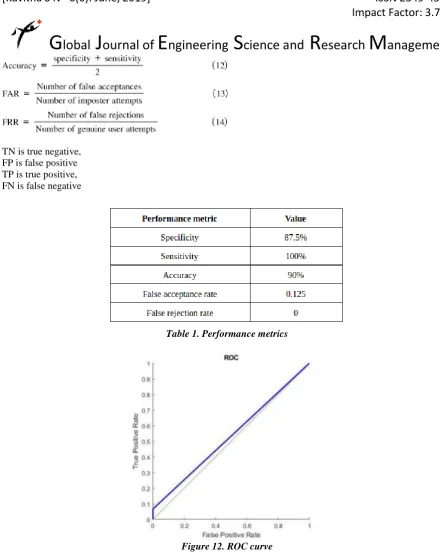
Many of the existing biometric systems are unimodal, i.e. they identify using only any one of the characteristic features like a fingerprint, palmprint, voice, face etc. Hence this paper aims to develop a biometric identification system which is multimodal with the help of advanced transforms and random forest classifier. The use of multiple biometrics reduces the system error rate. The developed biometric system will use the iris, fingerprint and palmprint data to identify the individual. Noise reduction in the data is achieved using bilateral filtering for all the three, i.e. iris, fingerprint and palmprint database whereas three different segmentation techniques of cellular automata, threshold-based segmentation and canny edge detection are used for iris, fingerprint and palmprint respectively. The features are extracted using wavelet and geometric-based method for iris and GLCM method for both finger and palm prints and a random forest classifier is used in the data classification process. After the evaluation of the performance metrics in the developed system, 90% accuracy, 100% sensitivity and nil false rejection rate are obtained.
INTRODUCTION
Recognition of a person depending on the characteristics like fingerprints, voice, iris, hand geometry etc. is known as biometry [1],[2]. Nowadays biometric technologies have become the basis for a broad range of secured solutions for personal verification and identification [3]. The increasing breaches in security, transaction frauds has resulted in high demand for safe technologies to identify and verify the individuals. The biometric schemes work in two modes viz. identifying and verifying modes [4]. The identification system will search the complete template database for a match and identify the person while the authentication system will validate the individual’s identity by comparing it with his/her template [5].
The uniqueness of the hand and fingerprints has attracted a lot of attention to biometric systems based on hand-geometry, palm print, fingerprints [6]. In [7] the author proposed a fingerprint recognition system using Minutiae score matching method in the block filter used for fingerprint thinning scans the images at the boundary thereby preserving the quality of the image and extract minutiae from the thinned image. The author in [8] proposed a novel representation of palmprint. The proposed method used an ordinal measure which unified several existing palmprint algorithms to form a general framework. A matching algorithm using palm prints was developed in [9] which could recognise latent and partial prints in full palm prints database. An illustration of projective-invariant of the features of the hand proposed was non-contact, peg-free and non-intrusive [10]. But all the above-discussed methods are unimodal. A multimodal biometric scheme is better when compared to the unimodal system. The main advantage of a multimodal system is that they use multiple biometric traits which improves the performance of the system in many aspects like noise, accuracy, universality, resistance, spoof attacks and reduces the degradation of performance in applications which have a huge database.
[Kavitha S N* 6(6): June, 2019] ISSN 2349-4506
Impact Factor: 3.799
G
lobal
J
ournal of
E
ngineering
S
cience and
R
esearch
M
anagement
LITERATURE REVIEW
The existing multimodal biometric systems(BS) use many characteristic features of a person like a fingerprint, knuckle print, palm print, voice, iris, face recognition etc. for the identification and authentication process. the authors of [11] a BioID, a multimodal identification system which used vocal, facial and lip features for the identification of people. With three modalities the system achieved higher accuracy as compared to the single-feature systems. [12] Presented a method for the authentication process using finger knuckle and finger geometry. The finger knuckle bending produced a texture pattern that was highly unique and made the proposed system a distinct biometric identifier. A verification system that utilized images of the skin in the process of recognition was developed by the author of [13]. The characteristics of different chunks of the hand are extracted, and the decision is taken based on the level of matching score. [14]
[15] Addressed two multimodal BS for verification that was based on fingerprint, hand geometry and palm print. The other model used a wavelet transform for extracting features from fingerprint and palm print. [16] Proposed a new multimodal BS which used the features of eigenfinger and eigenpalm with the application of fusion at the matching score level. A bimodal BS which uses the fusion of shape of hand and characteristics of palm texture was developed [6]. This scheme was convenient since both the features extracted could be acquired from a digital camera. The experimental results of the study demonstrated through the majority of the characteristics are useful in the prediction of an individual’s identity, only a small subset of these features are required for developing an accurate identification model.
[18] Developed a multimodal BS for the identification process using palm, knuckle and finger geometry. The features were fussed on a decision level with a simple and feasible AND rule. The non-existence of correlation between the various levels of the features and the independence of the matches ensured improvement in the system efficiency. [19] presented a template-level fusion algorithm for a unified biometric descriptor. The proposed system obtained results for several common databases. The segmented regions (ROIs) are used for matching the fingerprints. The scholars [20] designed a multimodal BS for identification that sequentially combined the fingerprint and iris traits in the identification process. The system in this paper reduced the identification time, maintained high accuracy thus improving the user convenience. The comparative analysis with the existing systems proved the proposed system to be a better one. [22] Provided insights into the ongoing research in the domain of multimodal biometrics. The paper introduced a new technique of biometric fusion using social, behavioural, physiological, components of humans and also recognised the suitable candidates for the developing social biometrics.
RESEARCH METHODOLOGY
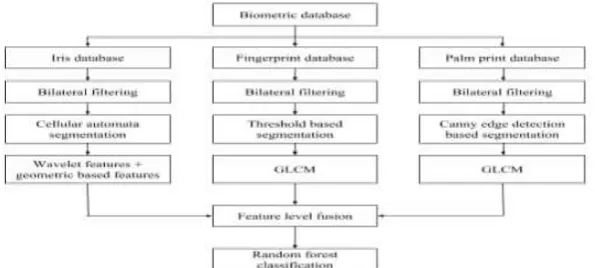
The research proposes a multimodal BS which uses iris, fingerprint and palm print for the identification process. Figure 1 illustrates the block diagram of the multimodal BS which involves four necessary steps viz, preprocessing, segmentation, feature extraction and classification. Presented a biometric model which used iris and fingerprints for the process of recognition. The system was evaluated by using a database of greyscale fingerprints and eye images.
[Kavitha S N* 6(6): June, 2019] ISSN 2349-4506
Impact Factor: 3.799
G
lobal
J
ournal of
E
ngineering
S
cience and
R
esearch
M
anagement
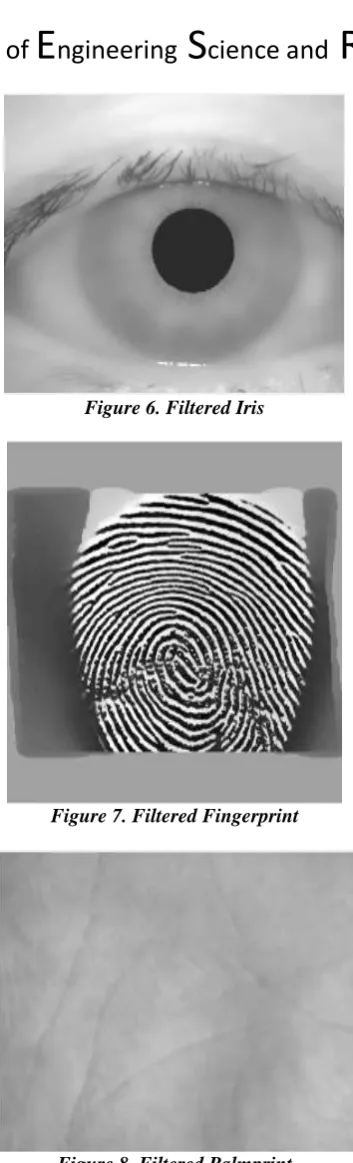
Preprocessing:The data is collected from http://biometrics.idealtest.org/login.do for the iris and palmprint, from http://bias.csr.unibo.it/fvc2004/download.asp for the fingerprint. The collected data is preprocessed using bilateral filtering technique to reduce the noise and enhance image quality. This technique is applied to all three databases. The process of bilateral filtering uses a non-linear combination of the nearby images smoothens the images and preserves the edges (Tomasi, Manduchi, 1998). It is a simple non-iterative method that combines grey colours depending on the similarity of photometry and closeness of the geometry. The weighted average of the pixels is considered by the bilateral filter. The intensity and spatial distance determine the weights. Hence through this, the noises are removed, and the edges are preserved. At the pixel location, ‘a’ the output of the filter is calculated using the relation given below.
(1)
Where 𝜎𝑟∧ 𝜎𝑑= fall-off weights in intensity and spatial domain N(a) = spatial neighborhood of P(a)
Z = normalization constant given by
(2)
Segmentation
Segmentation is the process of segregating a digital image into many segments (set of pixels) to simplify the image representation such that it is easy to analyze. The techniques of segmentation are contextual or non-contextual in nature. The non-contextual techniques do not consider the spatial relationships between the features of the images and group pixels together while the contextual segmentation considers these factors. Three different segmentation techniques are used for the three databases collected.
For iris cellular automata segmentation technique is used. For this a window with >3 and <7 cells were considered for the transformation of central pixel to “alive” regardless of its previous state.
For fingerprint threshold based segmentation technique was used. The considered threshold value was 0.2.
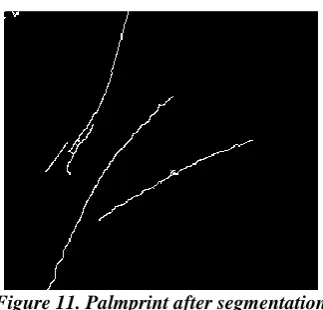
For the palmprint canny edge based detection segmentation technique was used.
Feature extraction:
Feature extraction using discrete wavelet transform is the extraction of characteristics from a signal on various scales proceeding by successive high pass and low pass filtering. The characteristics of the type of input to the classifier is obtained from the extracted features. The features are extracted using wavelet and geometric based features for the iris and grey level co-occurrence matrix (GLCM) for palmprint and fingerprints.
Wavelet and geometric based feature extraction for Iris
Wavelet transform can be used to analyse the signals which are not stationary so that different frequency signals can be used for different resolutions. Dilation and translation operation is used for the derivation of wavelets from mother wavelets. The varying size of the window in wavelet transform gives good resolution with respect to time. The wavelet used is dB1 and the wavelet features considered are mean, variance, entropy and geometric features considered are area and perimeter.
Wavelet transform is computed using equation 3.
[Kavitha S N* 6(6): June, 2019] ISSN 2349-4506
Impact Factor: 3.799
G
lobal
J
ournal of
E
ngineering
S
cience and
R
esearch
M
anagement
Wherex(t) = analysed signal a = dilation coefficient b = shifting coefficient
(4) Where 𝜓(𝑡) represents wavelet.
For a dataset X =𝑥1, 𝑥2…… 𝑥𝑛 mean is
(5)
Variance, a measure of statistical dispersion is Var(X) = E[(X-𝜓) 2] (6)
Entropy of each level is
𝐸𝑁𝑇𝑖= ∑𝑁𝑗=1𝐷𝑖𝑗2𝑙𝑜𝑔(𝐷𝑖𝑗) 2 (7) Where i = 1,2 ….l and N = No. of coefficients.
Grey level co-occurrence matrix (GLCM) for palmprint and fingerprints
The spatial dependance of grey levels in an image is computed using GLCM. the number of columns and rows present in GLCM is same as the number of grey levels in an image [24]. Co-occurrence matrices are derived in four spatial orientations such as 0o, 45o, 90o and 135o. Additional matrix is constructed as the average of previous matrices. Contrast and correlation are the features being considered. The contrast equation is given by
(8)
And the correlation texture which determines the grey levels linear dependence on the pixels in the neighborhood is given by
(9)
Feature Fusion:
Feature fusion is the process of integrating the feature sets that correspond to the multiple modalities. Integrating at this level results in better recognition process because the feature sets consist of better information about raw biometric data when compared to the final decision or match score. However there are some difficulties to achieve this practically due to the below mentioned reasons.
The multiple modality feature sets might be incompatible.
The relation among the feature spaces in biometric systems is unknown.
Linking of two feature vectors might give the feature vector whose dimension is large and will result in ‘curve of dimensionality’ problems.
[Kavitha S N* 6(6): June, 2019] ISSN 2349-4506
Impact Factor: 3.799
G
lobal
J
ournal of
E
ngineering
S
cience and
R
esearch
M
anagement
The main aim is combining the vectors such that they yield a different vector Z which is a better representation of the individual.Classification
Random forest classifier (RFC) is used for the classification process. It is a technique in which decision trees are combined to predict the output. The RFC contains a cluster of tree-structured classifiers. The classifier generates the trees. The steps to be followed to generate the trees are
A bootstrap sample is taken from the original data and the root node of the tree will contain this sample.
At every node of the tree, predictor subset is selected randomly. The tree is grown as large as possible with no pruning.
Given below is the algorithm of a random forest classifier.
For w = 1; T : a bootstrap sample 𝐿𝑊 is created by selecting randomly from P samples.
For each variable m that is sampled𝑧𝑘, k= 1;....; m best split 𝑢𝑘is found.
The best split 𝑢 is chosen from k= 1;....; m. This variable 𝑣𝑏𝑒𝑠𝑡is identified at the point where 𝑐 splits the node.
All the data entries i = 1;....;m in the parent node are split to left and right descendant node based on value of 𝑣𝑏𝑒𝑠𝑡𝑖 is greater than or less than 𝑐 i.e if 𝑣𝑏𝑒𝑠𝑡𝑖 < 𝑐 then observations are transferred to left node and to right node if 𝑣𝑏𝑒𝑠𝑡𝑖 ≥𝑐 .
All the above steps are repeated on all the nodes such that a tree 𝑇𝑎of maximum size is formed.
RESULTS AND ANALYSIS
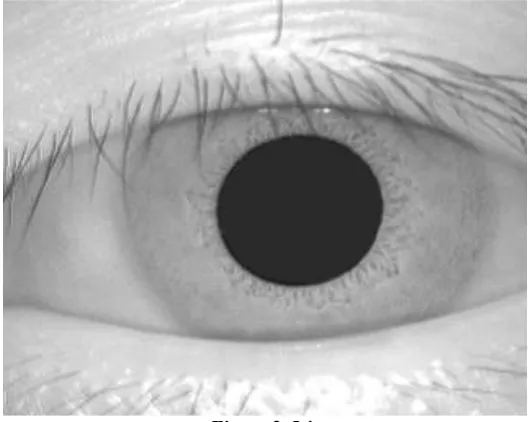
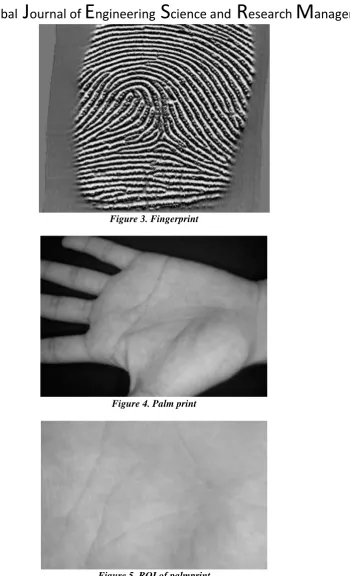
The experimentation of multimodal biometric identification is conducted on the processor Intel (R) Core (TM) i3 Lenovo platform with 3GHz main a processor speed and 8 GB memory. The proposed system is developed in Matlab 2017b. The images of iris, fingerprint and palmprint considered as input that are obtained from the database is shown in figures 2 to 4. For palm print the region of interest (ROI) is chosen and shown in figure 5. The sizes of the iris, fingerprint and ROI palmprint images are 280 x 320, 480 x 300, 521 x 311 respectively.
[Kavitha S N* 6(6): June, 2019] ISSN 2349-4506
Impact Factor: 3.799
G
lobal
J
ournal of
E
ngineering
S
cience and
R
esearch
M
anagement
Figure 3. Fingerprint
Figure 4. Palm print
Figure 5. ROI of palmprint
[Kavitha S N* 6(6): June, 2019] ISSN 2349-4506
Impact Factor: 3.799
G
lobal
J
ournal of
E
ngineering
S
cience and
R
esearch
M
anagement
Figure 6. Filtered Iris
Figure 7. Filtered Fingerprint
Figure 8. Filtered Palmprint
[Kavitha S N* 6(6): June, 2019] ISSN 2349-4506
Impact Factor: 3.799
G
lobal
J
ournal of
E
ngineering
S
cience and
R
esearch
M
anagement
Figure 9. Iris after segmentation
Figure 10. Fingerprint after segmentation
Figure 11. Palmprint after segmentation
After the process of segmentation the features of mean, variance, entropy and the geometric features of area and perimeter are extracted for the iris. For palm and finger prints features of contrast and correlation are extracted.
[Kavitha S N* 6(6): June, 2019] ISSN 2349-4506
Impact Factor: 3.799
G
lobal
J
ournal of
E
ngineering
S
cience and
R
esearch
M
anagement
TN is true negative, FP is false positive TP is true positive, FN is false negative
Table 1. Performance metrics
Figure 12. ROC curve
CONCLUSION
[Kavitha S N* 6(6): June, 2019] ISSN 2349-4506
Impact Factor: 3.799
G
lobal
J
ournal of
E
ngineering
S
cience and
R
esearch
M
anagement
REFERENCES
1. J. Pichard, J. Hebrard, P. Chilliard, "Biometrie humaine et anthropologie" - Vol 22, N° 1-2, Janvier - Juin 2004, pp. 33-40
2. Damien Dessimoz, Jonas Richiardi, Christophe Champod et Andrzej Drygajlo, "Multimodal Biometrics for Identity Documents", Research Report PFS 341-08.05 (Version 2.0), UNIL and EPFL, 2006. 3. Besbes, F., Trichili, H., & Solaiman, B. (2008, April). Multimodal biometric system based on fingerprint
identification and iris recognition. In 2008 3rd International Conference on Information and Communication Technologies: From Theory to Applications (pp. 1-5). IEEE.
4. Newham, E. (1995). The biometric Report.
5. Hong, L., & Jain, A. (1998, January). Integrating faces and fingerprints for personal identification. In Asian Conference on Computer Vision (pp. 16-23). Springer, Berlin, Heidelberg.
6. Kumar, A., & Ravikanth, C. (2009). Personal authentication using finger knuckle surface. IEEE Transactions on Information Forensics and Security, 4(1), 98-110.
7. Raja, K. B. (2010). Fingerprint recognition using minutiae score matching. arXiv preprint arXiv:1001.4186.
8. Sun, Z., Tan, T., Wang, Y., & Li, S. Z. (2005, June). Ordinal palmprint representation for personal identification. In null (pp. 279-284). IEEE.
9. Jain, A. K., & Feng, J. (2009). Latent palmprint matching. IEEE Transactions on pattern analysis and machine intelligence, 31(6), 1032-1047.
10. Zheng, G., Wang, C. J., & Boult, T. E. (2007). Application of Projective Invariants in Hand Geometry Biometrics. IEEE Trans. Information Forensics and Security, 2(4), 758-768.
11. Frischholz, R. W., & Dieckmann, U. (2000). BiolD: a multimodal biometric identification system. Computer, 33(2), 64-68.
12. Kumar, A., & Ravikanth, C. (2009). Personal authentication using finger knuckle surface. IEEE Transactions on Information Forensics and Security, 4(1), 98-110.
13. Hao, Ying, Tan, Tieniu, Sun, Zhenan, Han, Yufei, 2007. Identity verification by using handprint. In: Proceedings of the ICB 2007 Lecture Notes. Springer, pp. 328– 337.
14. Besbes, F., Trichili, H., & Solaiman, B. (2008, April). Multimodal biometric system based on fingerprint identification and iris recognition. In 2008 3rd International Conference on Information and Communication Technologies: From Theory to Applications (pp. 1-5). IEEE.
15. Yang, F., & Ma, B. (2007, July). Notice of Retraction Two Models Multimodal Biometric Fusion Based on Fingerprint, Palm-Print and Hand-Geometry. In Bioinformatics and Biomedical Engineering, 2007. ICBBE 2007. The 1st International Conference on (pp. 498-501). IEEE.
16. Ribaric, S., & Fratric, I. (2005). A biometric identification system based on eigenpalm and eigenfinger features. IEEE transactions on pattern analysis and machine intelligence, 27(11), 1698-1709.
17. Kumar, A., & Zhang, D. (2006). Personal recognition using hand shape and texture. IEEE Transactions on image processing, 15(8), 2454-2461.
18. Zhu, L. Q., & Zhang, S. Y. (2010). Multimodal biometric identification system based on finger geometry, knuckle print and palm print. Pattern Recognition Letters, 31(12), 1641-1649.
19. Conti, V., Militello, C., Sorbello, F., & Vitabile, S. (2010). A frequency-based approach for features fusion in fingerprint and iris multimodal biometric identification systems. IEEE Transactions on Systems, Man, and Cybernetics, Part C (Applications and Reviews), 40(4), 384-395.
20. Elhoseny, M., Essa, E., Elkhateb, A., Hassanien, A. E., & Hamad, A. (2017, September). Cascade multimodal biometric system using fingerprint and Iris patterns. In International Conference on Advanced Intelligent Systems and Informatics(pp. 590-599). Springer, Cham.
21. Gavrilova, M. L., Ahmed, F., Azam, S., Paul, P. P., Rahman, W., Sultana, M., & Zohra, F. T. (2017). Emerging trends in security system design using the concept of social behavioural biometrics. In Information Fusion for Cyber-Security Analytics(pp. 229-251). Springer, Cham.
22. Tomasi, C., & Manduchi, R. (1998, January). Bilateral filtering for gray and color images. In Computer Vision, 1998. Sixth International Conference on (pp. 839-846). IEEE.
[Kavitha S N* 6(6): June, 2019] ISSN 2349-4506
Impact Factor: 3.799
G
lobal
J
ournal of
E
ngineering
S
cience and
R
esearch
M
anagement
24. Tang, L., Niemeijer, M., Reinhardt, J. M., Garvin, M. K., & Abràmoff, M. D. (2013). Splat featureclassification with application to retinal hemorrhage detection in fundus images. IEEE Transactions on Medical Imaging, 32(2), 364-375.
25. Hall-Beyer, M. (2017). GLCM Texture: A Tutorial v. 3.0 March 2017.