Introduction
Cochlear implantation can improve verbal skills and provide better communication in
deaf children. Case to case differences in speech learning, prolonged follow up and poor evaluating methods made it difficult to assess speech perception after cochlear Medical Journal of the Islamic Republic of Iran.Vol. 20, No.4, 2007, pp.184-191
Speech development and auditory performance in children
after cochlear implantation
M. Bakhshaee, MD.1, Sh. M. R. Sharifian, MD.2, M. M.Ghasemi, MD.3, M.Naimi,MD.4, and T. Moghiman 5
Department of Otorhinolaryngology-Head and Neck Surgery, Imam Reza Educational Hospital, Mashad University of Medical Sciences, Mashad, Iran.
Abstract
Background: The aim of this study was to determine the auditory performance
of congenitally deaf children and the effect of cochlear implantation (CI) on speech intelligibility.
Methods: A prospective study was undertaken on 47 children in a pediatric
terti-ary referral center for CI. All children were deaf prelingually and were younger than 8 years of age. They were followed up until 5 years after implantation. Auditory per-formance was assessed by using the categories of auditory perper-formance (CAP) scale and speech intelligibility rating which evaluated the spontaneous speech of each child before and at frequent intervals for five years after implantation.
Results: Pre-lingually deaf children showed significant improvement in auditory
performance after implantation. Six months after implantation 91% of children had the ability to respond to speech sounds. At the end of year one, 96% of children could discriminate speech sounds and 84% of children who reached the three year interval could understand common phrases without lip-reading. After cochlear im-plantation, the difference between the speech intelligibility rating increased signifi-cantly each year for 3 years (p<0.05) and did not plateau up to 5 years after implan-tation. The changes in auditory performance and speech development were parallel.
Conclusion: The results indicated the ability of cochlear implantations to
signifi-cantly improve auditory receptive skills and subsequently speech development in young congenitally deaf children.
Keywords: Auditory performance, Speech intelligibility, Cochlear implantation,
Outcome.
1.Corresponding author, Assistant Professor of Head and Neck Surgery, Department of Otorhinolaryngology-Head and Neck Surgery, Imam Reza Educational Hospital, Mashad University of Medical Sciences, Mashad, IR. Iran.
Tel: +98 511 844 63 32, Fax: +98 511 841 34 92, Cell Phone: +98 915 512 36 67, Email: [email protected]
2. Otorhinolaryngologist-Head and Neck Surgeon, Department of Otorhinolaryngology-Head and Neck Surgery, Imam Reza Educa-tional Hospital, Mashad University of Medical Sciences, Mashad, Iran.
3. Otorhinolaryngologist-Head and Neck Surgeon, Department of Otorhinolaryngology-Head and Neck Surgery, Quaem Educational Hospital, Mashad University of Medical Sciences, Mashad, Iran.
This scaling is the best criterion for the as-sessment of auditory performance after cochlear implantation in children [1,2]. CAP consists of eight different scores which range from complete deafness (no reaction to sounds) to good verbal commu-nication (answer to phone call)[2]. These tests evaluate the actual daily verbal and auditory skills in children so they can be used for showing the child’s hearing im-provement during follow up. These tests are repeatable with test to test validity and with a very simple interpretation even for inexperienced persons.
From another aspect, implantation has been reported to be associated with im-provements in speech perception [4] and speech production. The speech intelligibili-ty rating (SIR) was developed in 1989 and used as a framework to rank the child’s spontaneous speech into one of five hierar-chic categories [6,7]. SIR is not a perform-ance test and was designed as a time-effec-tive global outcome measure of speech pro-duction in real-life situations. Although studies have shown that speech perception improves after cochlear implantation [8]; the rate at which intelligible spoken lan-guage develops is less well documented and its acquisition has been seriously chal-lenged by critics of implantation. However, intelligible speech remains a hope of many parents who submit their children to cochlear implantation [9]. To reply to crit-ics and counsel parents, there is a com-pelling need to study a clearly defined large group of children after cochlear
implanta-tory performance before and after cochlear implantation and monitor the improvement of auditory-verbal function in deaf children and at the same time document the devel-opment of intelligible speech in a group of young implanted children up to 5 years af-ter their implantation.
Methods
We studied 47 deaf children who under-went cochlear implantation in the cochlear implantation center of Khorasan in an ex-clusive pediatric cochlear implantation program. A comprehensive audiologic as-sessment was undertaken identifying each child’s best-aided thresholds, thus provid-ing firm evidence of lack of hearprovid-ing aid benefit.
All patients were congenitally deaf and before surgery a 3-6 month course of audi-tory rehabilitation by hearing aid gave no result. The rehabilitation team made a de-tailed evaluation of the child’s communica-tion, social and educational needs. Six cas-es who had additional disorders (including cerebral palsy, learning disorder and atten-tion deficit hyperactivity disorder) and one patient with Nucleus implantation that was not possible to activate all electrodes (be-cause of mechanical obstruction) were ex-cluded from the study. From the forty seven consecutive children who met the inclusion criteria, 36 and 11 children received the Nucleus multichannel cochlear and MED-EL implant, respectively; and all electrodes of implants were active after surgery.
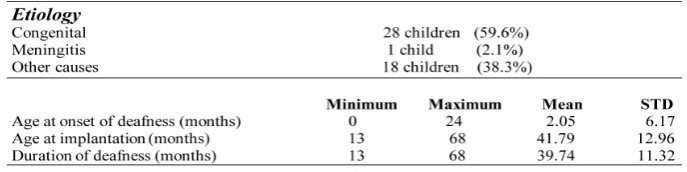
CAP scaling was used to assess auditory performance before and after surgery. They were also programmed with the speech processing strategy recommended at the time and were upgraded with new encoding strategies as they became available. Pre-implant assessments were undertaken on 47 children; who were all present in our program during the first two years but this number was 32, 14 and 9 in the following years (3, 4, and 5-year intervals). A summa-ry of the children’s demographic details is listed in Table1.
The criteria used for SIR are described in Table 2. Each assessment was undertaken by the child’s own implantation team in the familiar environment of the child’s own home or school. To maintain consistency in scoring, the evaluations for each child were done by the same speech and language therapist in each interval. Preliminary stud-ies of the inter-observer reliability have given a high correlation coefficient of 0.9
and further validation of the SIR score in progress.
The SIR is a noncontiguous scale and therefore, a nonparametric statistical analy-sis (Mann-Whitney U-test) was used to compare the results at each interval. Statis-tical significance was accepted at the p<0.05 level.
Results
The mean age was approximately 42 months at the time of implantation (min 13 and max 68 months). CAP scoring was done 6 months after surgery. The results of auditory performance assessment are shown in Table 3.
Only ten patients of our 47 cases were aware of environmental sounds before sur-gery (stage 1 according to CAP). 91% of children were able to respond to speech voices six months after surgery (stage 2). After 1, 2, 3, 4 and 5 years following the
Table 1. Demographic details of all the subjects included in the study.
Table 2. Criteria used to categorize children using the Speech Intelligibility Rating (SIR). Connected speech is intelligible to all listeners.
Child is understood easily in everyday contexts.
Connected speech in intelligible to a listener who has a little experience of a deaf person's speech. Connected speech is intelligible to a listener who concentrates and lip-reads.
Connected speech is unintelligible.
Intelligible speech is developing in single words. When context and lip-reading cues are available.
Connected speech is unintelligible. Prerecognizable words in spoken language. Primary mode of communication may be manual
implantation, approximately 1%, 27%, 30%, 43% and 55% had the ability to call a familiar person, respectively.
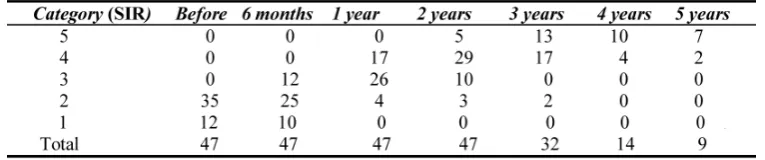
The results of SIR before and for each of the 5 years after implantation are summa-rized in Table 4. Before cochlear implanta-tion, the median and mode rating was cate-gory 1 (preverbal, gestural, or sign based communication). Six months later, this had become category 2 (unintelligible connect-ed speech with some single words identifi-able) and at the end of year one, intelligible connected speech to a listener who concen-trated and read lips (category 3) was the av-erage rating. By the 2 and 3-year interval, category 4 (intelligible speech to a listener with a little experience of deaf speech) was the median and mode of SIR. Five years af-ter cochlear implantation, the improvement continued with the median and mode being the highest rating of category 5 (intelligible speech to all listeners) (Fig.1). The increase in ratings each year until the third year was
statistically significant (from pre-implanta-tion to year 1, p=0.000; from year 1 to year 2, p=0.000; and from year 2 to year 3, p=0.000).The difference between years 3 to 4 and 4 to 5 were not statistically signifi-cant (p> 0.05).
The children’s auditory performance and speech development under the age of 4 was significantly better than those over 4 at the time of implantation (p<0.05).
Three children did not meet the expected intelligible speech development. One child had a family history of hearing loss and low parental motivation and cooperation and two had central auditory processing disor-der (CAPD). Interestingly, the auditory performance was lower than expected in the same three cases.
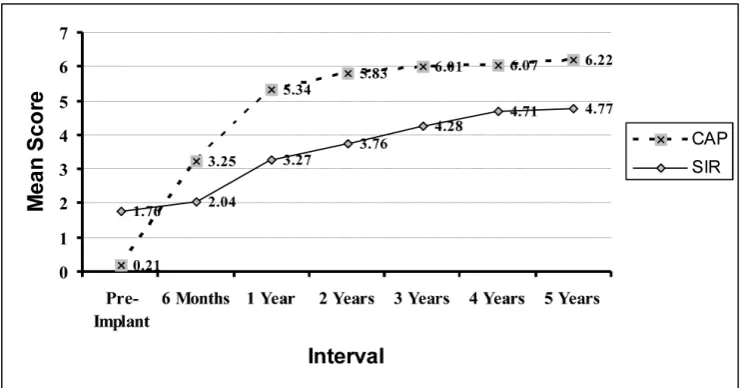
It’s also important to note that the changes of CAP scale and SIR were significantly correlated (p<0.05) (Fig. 2).
Authors have shown better outcome from the point of auditory performance and
Table 3. 5 - Years follow up of auditory performance after cochlear implantation.
SIR: Speech Intelligibility Rating
speech intelligibility in congenitally deaf children who had cochlear implantation in early childhood comparing to those operat-ed in adulthood.
Many authorities doubted that congeni-tally deaf children would have the central processing mechanisms to enable them to hear speech through an implantation device and to then produce intelligible spoken lan-guage. However, several studies have testi-fied to the ability of these devices to en-hance speech perception and speech pro-duction of profoundly deaf children, with
benefits extending to congenital as well as to post-lingually deaf children [10,12].
Age at the implantation time has a sig-nificant effect on auditory and subsequent speech development. Govaertis et al. planned a trial in 2002 to evaluate the results of cochlear implantation according to the pa-tient’s age. 20-30% of cochlear implanta-tions that were performed after 4 years, 66% of those between 2-4 years and 90% of those before 2 years of age became al-most normal in auditory performance ac-cording to CAP scale after 3 years of follow
Fig.1. The median, mode and mean speech intelligibility ratings (SIR) at each of the yearly intervals.
Fig. 2. Mean CAP and SIR score of patients during follow up.
seen in those children who underwent sur-gery before the age of four while poor results were reported in those who were operated after that. So, screening tests for auditory disorders and early auditory rehabilitation in deaf children is essential to get an opti-mal result after implantation.
Children with other disorders had poor improvement even in early cochlear im-plantation; therefore we excluded them from the study (the mean CAP score in this group was lower than the rest). Yang et al. studied 26 children in 2004 to compare re-sults of cochlear implantation between nor-mal deaf children and those with other dis-orders such as cerebral palsy. The mean CAP score 1 and 2 years after surgery were 3.93 and 5.86 in the normal group and 2.5 and 4.17 in those with cerebral palsy or other mental anomalies, respectively [14]. All the patients who used cochlear device continuously were more successful in learning communicational skills. Lack of mental disorders has an important role in auditory development and IQ, speech per-ception and verbal improvement; therefore this item should be considered as a major criterion beside age, in selecting patients [15].
Archbold also reported that 80% of chil-dren were able to perceive daily speech without lip reading (stage 5) 3 years after surgery (like us) and 40% were able to per-ceive normal daily speech without lip read-ing (stage 6) [5].Our results have also been close to this study.
According to all results and in
compari-years after surgery in his patients, which is lower when compared to our trial [11].
The results indicated that cochlear im-plantation and later auditory rehabilitation might lead to improvement of auditory per-formance and better perception of speech in deaf children.
Speech intelligibility studies have been constrained by small study groups, short follow-up periods, varying ages (mixing children and adolescents or adults), and in-complete data collection of each child’s progress at every interval.
The children studied by Tobey et al, [16] varied in age from 2.4 to 17.8 years. Daw-son et al [17] studied 11 children whose ages at implantation ranged from 8 to 20 years. Osberger et al [18] studied 29 cases over a 4-years period, but the children en-tered the study not from the time of implan-tation but at different intervals, resulting in varying numbers of children at each inter-val. Because of these limitations in data collection, it has been difficult to compare results over time and to interpret and gener-alize any trends that may be emerging.
The assessment of speech intelligibility relies on the listener’s perception of what has been said by the speaker. To ensure ob-jectivity, some studies have used predeter-mined language samples that must be elicited from the child. This has inherent difficulties.
First, the judgments must be made by a person with equal familiarity with the speech of deaf children and the number of presentations of each case to the listener
must be limited to avoid recognition. Second, the child must have the necessary language skills to be able to produce the required speech sample. In the current study, it was decided to use a “real life” descriptive rat-ing scale because it was a practical clinical measure that could be readily applied to a large group of young deaf children over time.
In addition, this approach circumvented the many difficulties presented by obtain-ing measures of intelligibility ratobtain-ing in more laboratory – type settings [19]. One other study [20] successfully used a 10-point speech intelligibility rating scale, but the individual gradings were not defined precisely.
The current study systematically fol-lowed the development of speech intelligi-bility in a group of prelingually deaf chil-dren over a 5-year period. Uniformity of rating was promoted by having the same speech and language therapist assessing a child throughout his time in the program. Given the strict entry criteria and full data collection, it is highly probable that the re-sults can be generalized and reproduced with other prelingually deaf children re-ceiving a cochlear implantation before the age of 6 years.
The result of this study show that the children’s speech intelligibility continued to develop over the 5-year period. The dif-ference in ratings improved significantly each year for 3 years after implantation.
Although this was not statistically signif-icant between the 3, 4 and 5-year interval (probably an affect of sample size), there was a clear underlying trend toward im-proved speech intelligibility.
The need for a long period of cochlear implantation use before the emergence of intelligible speech was identified. To date,
beyond 5 years of age. Such studies are clearly needed because the development of speech intelligibility does not plateau 5 years after implantation with many chil-dren having not yet reached their full speech intelligibility by this stage.
Conclusion
The results show that auditory performance would be improved significantly in most children who undergo cochlear implanta-tion surgery especially before the age of four. We predict that 90% of these cases will be able to perceive daily speech with-out lip reading five years after surgery. On the other hand, the current study clearly shows the development of speech intelligi-bility parallel to improvement of auditory perception, even in children who were con-genitally deaf, and rebuffs those critics who doubted that prelingually deaf implanted children could ever develop these invalu-able communication skills.
Acknowledgement
The authors wish to acknowledge Mo-hammad Reza Tale, the audiologist and Hamid Tayarani, speech pathologist for their kind assistance during this study.
References
1. Archbold S, Lutman ME, Marshall DH. Cate-gories of Auditory Performance. Ann Otol Rhinol Laryngol Suppl 1995; 166:312-4.
2. Archbold S, Lutman ME, Nikolopoulos T. Cat-egories of auditory performance: inter-user reliabil-ity. Br J Audiol 1998; 32(1):7-12.
3. Nikolopoulos TP, Archbold SM, O’Donoghue
skills in children implantationed by age five. Ear & Hearing 2003; 24(1) Suppl: 36S-45S.
6. Dyar D. Monitoring progress. The role of a speech and language therapist. In: McCormick B, Archbold S, Sheppard S, editors. Cochlear implan-tations for young children. London: Whurr; 1994. pp. 237-68.
7. Parker A, Irlam S. Speech intelligibility and deafness: the skills of listener and speaker. In: Wirz SL, ed. Perceptual approaches to communication disorders. London: Whurr Publishers; 1995. pp. 56-83.
8. Uziel AS, Reuillard-Artieres F, Sillon M, Vieu A, Mondain M, Piron JP. Speech-perception per-formance in prelingually deafened French children using the nucleus multichannel cochlear implant. Am J Otol 1996; 17(4):559-68.
9. Kelsay DM, Tyler RS. Advantages and disad-vantages expected and realized by pediatric cochlear implant recipients as reported by their par-ents. Am J Otol 1996;17(6):866-73.
10. Nikolopoulos TP, O’Donoghue GM. Cochlear implantation in adults and children. Hosp Med 1998; 59(1):46-9.
11. O’Donoghue GM, Nikolopoulos T, Archbold SM, Tait M: Congenitally deaf children following cochlear implantation. Acta Otorhinolaryngol Belg 1998; 52(2):111-4.
12. Waltzman SB, Cohen NL, Gomolin RH, Green JE, Shapiro WH, Hoffman RA, et al. Open-set speech perception in congenitally deaf children using cochlear implants. Am J Otol 1997; 18(3):342-9.
13. Govaerts PJ, De Beukelaer C, Daemers K, De Ceulaer G, Yperman M, Somers T, et al. Outcome of cochlear implantation at different ages from 0 to 6 years. Otol Neurotol 2002; 23(6):885-90.
14. Yang HM, Lin CY, Chen YJ, Wu JL. The au-ditory performance in children using cochlear im-plants: effects of mental function. Int J Pediatr Otorhinolaryngol 2004; 68(9):1185-8.
15. Robinson K: Implications of developmental plasticity for the language acquisition of deaf
chil-port on speech production of cochlear implant users. Ear Hear 1995; 16(6):551-61.
18. Osberger MJ, McConkey Robbins A, Todd SL, et al. Speech production skills of children with multichannel cochlear implantations. In: Hochmair-Desoyer IJ, Hochmair ES, editors. Advances in cochlear implantations. Vienna: Manz; 1994. pp. 503-8.
19. Vidas S, Hassan R, Parnes LS. Real-life per-formance considerations of four pediatric multi-channel cochlear implant recipients. J Otolaryngol 1992; 21(6):387-93.
20. Tye-Murray N, Spencer L, Woodworth GG. Acquisition of speech by children who have pro-longed cochlear implant experience. J Speech Hear Res 1995; 38(2):327-37.