Volume 65, 2019, Pages 54–67 GCAI 2019. Proceedings of the 5th Global
Conference on Artificial Intelligence
A Declarative Method for
Dynamic Multi-Agent Path Finding
Aysu Bogatarkan, Volkan Patoglu, and Esra Erdem
Sabancı University, Faculty of Engineering and Natural Sciences, ˙Istanbul, Turkey {aysubogatarkan,vpatoglu,esraerdem}@sabanciuniv.edu
Abstract
The multi-agent path finding (MAPF) problem is a combinatorial search problem that aims at finding paths for multiple agents such that no two agents collide with each other. We study a dynamic variant ofMAPF, calledD-MAPF, which allows changes in the environment (e.g., some existing obstacles may be removed from the environment or moved to some other location, or new obstacles may be included in the environment), and/or changes in the team (e.g., some existing agents may leave and some new agents may join the team) at different times. We introduce a new method to solve
D-MAPF, using answer set programming.
1
Introduction
The Multi-Agent Path Finding (MAPF) problem aims to find a plan for multiple agents to reach their destinations in a certain environment with static obstacles, subject to some constraints on the maximum or the total plan length. Every agent can be considered as a dynamic obstacle for other agents. Therefore, the obstacles and the agents lead to some constraints for the executability of the plan: agents cannot pass through obstacles, and agents cannot collide with each other. Although single-agent shortest pathfinding can be solved in polynomial time [6],MAPF (with constraints on the plan length) is an intractable problem [25] due to the latter constraint that no two agents can be in the same location at the same time. Yet,MAPFhas been studied in various domains, such as robotics [16], video games [28], autonomous aircraft towing vehicles [22], traffic control [7] and autonomous warehouse systems [33].
During the execution of a computed plan forMAPFin a dynamic environment (e.g., a warehouse that is not completely autonomous), changes may occur: existing obstacles may be removed from the environment or moved to some other location in the environment, existing agents may leave the environ-ment, or new agents may be included in the team with new tasks. Then the goal is to find a new solution for the new team of agents in the modified environment. We call this problemDynamic Multi-Agent Path Finding Problem (D-MAPF). Note thatD-MAPFinherits the intractability ofMAPF, subject to the constraints on plan lengths.
With this motivation, we propose a novel method to solveD-MAPF, using Answer Set Programming (ASP) [21,24,17,2,3] (based on answer sets [10,12]). The main idea (and novelty) of this method is, instead of replanning for all the agents right away, torevise and augmentthe existingMAPFsolution: (revise) try to schedule the waiting times of existing agents as they traverse the rest of their paths, (augment) while computing paths for the new agents within a given makespan (i.e., the length of the plan). In this way, the paths for the existing agents can be re-used as part of the new plan. As observed by our experimental evaluations, the re-use of plans as proposed by our method improves the computational efficiency in timings significantly compared to replanning.
2
R-MAPF: Revising and Augmenting MAPF
D-MAPFcan be viewed as a generalization ofMAPFin a dynamic environment, that considers what changes in the environment, such as adding new agents, removing some of the existing agents, adding or removing obstacles or changing their locations, as well as what does not change, such as the itineraries of existing agents. We propose to solve D-MAPFby revising and augmenting the existing MAPF
solution.
Let us first introduce some concepts and notation before we define the problem of revising and augmenting an existingMAPFsolution (calledR-MAPF).
Atraversalf of a pathP=hw1, w2, . . . , wniin a graphGwithin some timet(t∈Z+) is an onto function that maps every nonnegative integer less than or equal totto a vertex inP, such that, for every wiandwjinPand for everyx < t, iff(x) =wiandf(x+1) =wj, thenwj =wiorwj=wi+1.
We denote byf(P)a traversalf of a pathP (within timet). We denote byPAthe collection of
pathsP for every agent in A, and byhP,fiA the collection of pairshPi, fi(Pi)iof paths and their
traversals for every agentaiinA.
Letfiandfjbe traversals of two different pathsPiandPj, respectively, in a graphGwithin some
timet. We say that the traversalsfiandfjdo not collide with each otherwithin timetif,
• for every timesx, x0≤t, the following holds: iff
i(x) =fj(x0)thenx6=x0(i.e., if the same vertex
is visited by pathsPiandPj, then it should be visited at different times — no two agents can be
at the same location at the same time);
• for every timex<t, the following holds: iffi(x) =fj(x+1)thenfi(x+1)6=fj(x)(i.e., an edge
cannot be visited by pathsPiandPj in reverse directions at the same time — no two agents can
swap their locations at the same time).
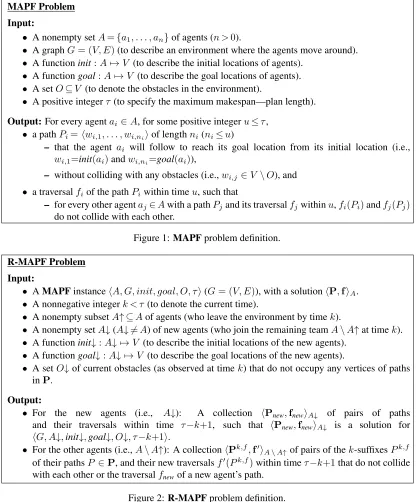
MAPFproblem can be defined as in Figure1. AMAPFinstance can be characterized by a sextuple
hA, G, init, goal, O, τi, and its solution by a collectionhP,fiAof pairs of pathsPiand their traversals
fi(Pi)within some timeu≤τfor agentsaiinA.
For a pathP=hv1, . . . , vniand its traversalf(P)within timeu, and a nonnegative integerk≤u,
thek-suffixofP with respect tof (denotedPk,f) is the subsequencehvi, . . . , vnisuch thatvi=f(k).
Intuitively, thek-suffix of a pathPdescribes the part of the path visited after timek(included). For a collectionhP,fiAof pairs of paths and their traversals, we denote byP
k,f
A the collection of
k-suffixes of paths inPAwith respect to their traversals inhP,fiA.
Let us now define theR-MAPFproblem as in Figure2, subject to theobstacle assumption:
The currently observed obstacles are not on the paths of the existing agents.
MAPF Problem Input:
• A nonempty setA={a1, . . . , an}of agents (n >0).
• A graphG= (V, E)(to describe an environment where the agents move around).
• A functioninit:A7→V (to describe the initial locations of agents).
• A functiongoal:A7→V (to describe the goal locations of agents).
• A setO⊆V (to denote the obstacles in the environment).
• A positive integerτ(to specify the maximum makespan—plan length).
Output:For every agentai∈A, for some positive integeru≤τ,
• a pathPi=hwi,1, . . . , wi,niiof lengthni(ni≤u)
– that the agent ai will follow to reach its goal location from its initial location (i.e.,
wi,1=init(ai)andwi,ni=goal(ai)),
– without colliding with any obstacles (i.e.,wi,j ∈V\O), and
• a traversalfiof the pathPiwithin timeu, such that
– for every other agentaj∈Awith a pathPjand its traversalfjwithinu,fi(Pi)andfj(Pj)
do not collide with each other.
Figure 1:MAPFproblem definition.
R-MAPF Problem Input:
• AMAPFinstancehA, G, init, goal, O, τi(G= (V, E)), with a solutionhP,fiA.
• A nonnegative integerk < τ (to denote the current time).
• A nonempty subsetA↑ ⊆Aof agents (who leave the environment by timek).
• A nonempty setA↓(A↓ 6=A) of new agents (who join the remaining teamA\A↑at timek).
• A functioninit↓:A↓ 7→V (to describe the initial locations of the new agents).
• A functiongoal↓:A↓ 7→V (to describe the goal locations of the new agents).
• A setO↓of current obstacles (as observed at timek) that do not occupy any vertices of paths inP.
Output:
• For the new agents (i.e., A↓): A collection hPnew,fnewiA↓ of pairs of paths
and their traversals within time τ−k+1, such that hPnew,fnewiA↓ is a solution for
hG, A↓,init↓,goal↓, O↓, τ−k+1i.
• For the other agents (i.e.,A\A↑): A collectionhPk,f,f0i
A\A↑of pairs of thek-suffixesPk,f
of their pathsP∈P, and their new traversalsf0(Pk,f)within timeτ−k+1that do not collide with each other or the traversalfnewof a new agent’s path.
Figure 2:R-MAPFproblem definition.
3
Solving D-MAPF using ASP
Since the agents do not disappear once they reach their locations,R-MAPFmay not be always solvable even when the correspondingD-MAPFis solvable [31]. For that reason, we introduce an algorithm for
D-MAPF, based on our solution toR-MAPFusing ASP.
3.1
Our Algorithm
D-MAPFtakes as input (as inR-MAPF) the current locations and goal locations of the new agents, the updated environment, and theMAPFinstance and solution for the existing agents. It aims to find a solution (as inMAPF) that consists of paths and their traversals for all current agents, ensuring that no agent collides with the obstacles or the other agents, and respecting the original maximum makespan. Note thatD-MAPFis more general thanR-MAPFsince it does not require the re-use of the existing paths. Therefore, a solution toR-MAPFis a solution toD-MAPF, but a solution toD-MAPF(e.g., found by replanning) may not be a solution toR-MAPF.
Our solution is based on the formalization ofR-MAPF, subject to the obstacle assumption, as an ASP program. According to this ASP program, the waiting times of the existing agents are scheduled relative to their paths within a given makespan, while paths and their traversals are computed for the new agents within that given makespan. Meanwhile, it is ensured that there are no collisions with obstacles or between robots.
Our algorithm forD-MAPFutilizes the ASP formalization ofR-MAPFas follows.
1. During the execution of a givenMAPFplan according its traversal, if a new obstacle is detected that is on the path of an existing agent, then that agent is considered as a new agent along with other new joining agents. This step ensures that the obstacle assumption is satisfied.
2. A solution toR-MAPF, subject to the obstacle assumption, is computed using the ASP program with an ASP solver, like CLINGO[9], within the makespan of the givenMAPFplan.
3. If a solution cannot be found, the algorithm tries to find a solution toR-MAPFby increasing the makespan incrementally until the given maximum makespan is reached.
4. If a solution still cannot be found, then the algorithm applies replanning: it solvesMAPFfor all agents by minimizing the maximum makespan.
Figures 3–6 present an example to illustrate the overall idea.
3.2
ASP Formalization of R-MAPF
Let us describe our ASP program that formalizesR-MAPF. We refer the reader to relevant sources [12,
1,11] for the syntax and semantics of programs in ASP. In the following, we use the mathematical representation of programs, so the lowercase letters (in the arguments of predicates) denote schematic variables, whereas the uppercase letters denote constants.
Notation. Consider the following notation about the input:
• the roads in the environment (viewed as a graphG) are described by atoms of the formedge(x, y)
— there is a road from locationxto locationy;
• aMAPFsolution (i.e., the plan being executed) is described by atoms of the formpath(a, t, x)
— existing agentais expected to be at locationxat time stept;
• the maximum makespan of theMAPFplan being executed isT;
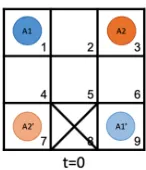
Figure 3: Initially, two agents are atA1andA2; their goals are to reachA10andA20.
Figure 4: A solution toMAPFinstance described in Fig. 3:A1starts at 1, moves to 2, 3, 6, and reaches 9; andA2starts at 3, moves to 6, 5, 4, reaches 7.
Figure 5: While executing the plan shown in Fig. 4, at time stept= 1, another agentA3joins the team with goalA30. A solution to thisD-MAPFinstance is computed, and a path forA3is found, as shown above:A1is at 2, moves to 3, 6, 9;A2is at 6, moves to 5, 4, 7;A3starts at 9, moves to 6, 5, 2.
Figure 6: While executing the plan shown in Fig. 5, at time stept= 2, another agentA4joins the team with goalA40 . A solution to thisD-MAPFinstance is computed. No solution is found witht = 4,
so the makespan is increased by 1. The new solution with makespant= 5is found by scheduling the waiting times ofA1,A2andA3, and by computing a path forA4, as shown above:A1is at 3, waits at 3, then moves to 6,9;A2is at 5, waits at 5, then moves to 4,7;A3is at 6, waits at 6, then moves to 5,2; A4starts at 7, moves to 4, 1, and waits at 1.
• the verticesxoccupied by obstacles observed at time stepKare described by atoms of the form obstacle(x);
Revise the plans for existing agents. Potential waiting schedules for existing agents are generated over the rest of their plans starting from their current positions, to obtain new traversals of the remaining parts of their paths.
First, the current and the goal locations of every existing agenta∈(A\A↑)are identified:
goal(a, x)←path(a, T, x) (a∈(A\A↑)). init(a, x)←path(a, K, x) (a∈(A\A↑)).
Suppose that the new plan is described by atoms of the formplan new(a, t, x). A new plan for every existing agenta∈(A\A↑)then should start at its current location at timeK:
plan new(a, K, x)←init(a, x) (a∈(A\A↑)).
At every time stept−1(K≤t−1≤T−1), every existing agentamay either wait at its locationx, or move to the next locationy(visited afterx) according to its existing path:
1{plan new(a, t, x); plan new(a, t, y) : path(a, t1, y),path(a, t1−1, x),edge(x, y), K≤t1}1← plan new(a, t−1, x) (a∈(A\A↑), K+1≤t≤T).
Note that the paths of the existing agents are utilized inside the choice rules and thus lead to more intelligent generation of new traversals, compared to the straightforward approach of generating many new plans and then eliminating the ones that do not characterize traversals of existing paths. In that sense, this is a novel and elegant contribution from the modeling perspective.
As new traversals are generated, we can add theMAPFplan of existing agents as a constraint to generate a different waiting schedule for them.
Augment with plans for new agents. For every new agenta∈A↓, plans are generated recursively as suggested by [8]:
plan new(a, K, x)←init(a, x) (a∈A↓).
1{plan new(a, t, x); plan new(a, t, y) : edge(x, y)}1←
plan new(a, t−1, x). (a∈A↓, K+1≤t≤T)
These new plans, described by atoms of the formplan new(a, t, x)for every agenta, should char-acterize paths. Due to the cardinality constraint above, there is an outgoing edge from their initial locations.
There should be an incoming edge to their goals to make sure every agent reaches its goal:
← {plan new(a, t, y) :edge(x, y),goal(a, y)}0 (a∈A↓, K+1≤t≤T).
To ensure that the plan of a new agentaends at the goal, i.e., there is no outgoing edge from the goal, we further add the following constraints:
←plan new(a, t, x),plan new(a, t+1, y),edge(x, y),goal(a, x) (a∈A↓, K≤t≤T).
No collisions. Now that we have generated new plans for all agents, that characterize paths, we need to ensure that there are no collisions.
No two agentsa1anda2are at the same vertexxat the same timet.
No two agentsa1anda2swap their locations at the same time.
←edge(x, y),plan new(a1, t, x),plan new(a2, t, y),
plan new(a1, t−1, y),plan new(a2, t−1, x) (a16=a2, K+1≤t<T).
No agentavisits a vertexxcontaining an obstacle:
←plan new(a, t, x),obstacle(x) (K≤t≤T).
Optimizations. While revising the existing plans and augmenting new plans, our formulation takes into account an upper bound for the makespan, so as to minimize the makespan in our algorithm for
D-MAPF. We can consider further optimizations. For instance, with the following weak constraints, total waiting time (for all agentsa) can be minimized:
∼
←−plan new(a, t, x),plan new(a, t+1, x),not goal(a, x).[1@1, a, t]
4
Experimental Evaluations
We have implemented ourD-MAPFalgorithm described in Section3.1, based on the ASP formalization ofR-MAPFexplained in Section3.2, using Python 2.7.3 and CLINGO4.5.4, and performed experiments on a Linux server with dual 2.4 GHz Intel E5-2665 CPUs and 64 GB memory. Recall that our algorithm tries to re-use the plans of the existing agents by scheduling their waiting times, to allow the new agents to reach their destinations.
We have compared our algorithm that makes use of the previously computed plans with the replan-ning approach that computes new plans for all agents, by means of some experiments, to observe the trade-off between computation time and solution quality. Recall that in the replanning approach, when some changes are noticed in the team or the environment, a newMAPFinstance is created by the cur-rent locations and goal locations of both the existing and the new agents, and the updated environment, and a solution is computed for this instance. If no solution is found, then the makespan is incremented as in our algorithm until the given maximum makespan.
Note that replanning does not re-use the plans of the existing agents, so we expect to observe from our experiments that the replanning approach may not be computationally as time-efficient as our algo-rithm. On the other hand, our algorithm tries to re-use the paths of the existing agents, so we expect to observe that the quality of solutions (characterized by their makespans) computed by our algorithm may not be as good as the quality of solutions computed by the replanning approach. Let us investigate these questions.
For experimental evaluations, we have generated randomMAPFinstances over various grid sizes for 20 agents:10×10,20×20,30×30,40×40,50×50. For eachMAPFinstance, we have computed a solution whose makespan is smaller than some given value less thanT. Then, we have generated
D-MAPFinstances, by extending the team with 1–5 new agents. For convenience, it is assumed that each agent is added at timet= 0, and there are no obstacles. The results are presented in Table1.
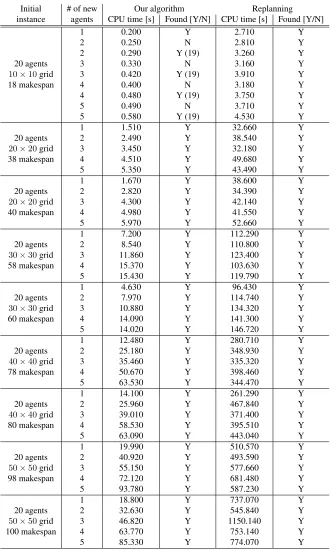
Table 1: Experimental evaluations: Our algorithm vs. Replanning.
Initial # of new Our algorithm Replanning instance agents CPU time [s] Found [Y/N] CPU time [s] Found [Y/N]
1 0.200 Y 2.710 Y
2 0.250 N 2.810 Y
2 0.290 Y (19) 3.260 Y
20 agents 3 0.330 N 3.160 Y
10×10grid 3 0.420 Y (19) 3.910 Y
18 makespan 4 0.400 N 3.180 Y
4 0.480 Y (19) 3.750 Y
5 0.490 N 3.710 Y
5 0.580 Y (19) 4.530 Y
1 1.510 Y 32.660 Y
20 agents 2 2.490 Y 38.540 Y
20×20grid 3 3.450 Y 32.180 Y
38 makespan 4 4.510 Y 49.680 Y
5 5.350 Y 43.490 Y
1 1.670 Y 38.600 Y
20 agents 2 2.820 Y 34.390 Y
20×20grid 3 4.300 Y 42.140 Y
40 makespan 4 4.980 Y 41.550 Y
5 5.970 Y 52.660 Y
1 7.200 Y 112.290 Y
20 agents 2 8.540 Y 110.800 Y
30×30grid 3 11.860 Y 123.400 Y
58 makespan 4 15.370 Y 103.630 Y
5 15.430 Y 119.790 Y
1 4.630 Y 96.430 Y
20 agents 2 7.970 Y 114.740 Y
30×30grid 3 10.880 Y 134.320 Y
60 makespan 4 14.090 Y 141.300 Y
5 14.020 Y 146.720 Y
1 12.480 Y 280.710 Y
20 agents 2 25.180 Y 348.930 Y
40×40grid 3 35.460 Y 335.320 Y
78 makespan 4 50.670 Y 398.460 Y
5 63.530 Y 344.470 Y
1 14.100 Y 261.290 Y
20 agents 2 25.960 Y 467.840 Y
40×40grid 3 39.010 Y 371.400 Y
80 makespan 4 58.530 Y 395.510 Y
5 63.090 Y 443.040 Y
1 19.990 Y 510.570 Y
20 agents 2 40.920 Y 493.590 Y
50×50grid 3 55.150 Y 577.660 Y
98 makespan 4 72.120 Y 681.480 Y
5 93.780 Y 587.230 Y
1 18.800 Y 737.070 Y
20 agents 2 32.630 Y 545.840 Y
50×50grid 3 46.820 Y 1150.140 Y
100 makespan 4 63.770 Y 753.140 Y
solution with makespan 19 in 0.290 seconds. Meanwhile, when two agents join the team, the replanning approach finds a new solution with makespan 18 in 2.810 seconds.
From these results, we observe the strengths and the weaknesses of our approach (as expected), showing the trade-off between computation time and solution quality. Our algorithm finds solutions significantly faster than the replanning approach. On the other hand, the replanning approach may find solutions with slightly shorter makespans.
Computation times vs. number of new agents. Let us now consider theD-MAPFinstance on a grid of size50×50, which starts with aMAPFsolution of makespan 98. When 1 new agent joins the team, our algorithm computes a solution with makespan 98 in 19.990 seconds (reusing the existingMAPF
solution) whereas the replanning approach takes 510.570 seconds since it has to plan for every agent. When 2 agents join, our approach computes a solution with makespan 98 in 40.920 seconds, whereas the replanning approach takes 493.590 seconds. When 4 agents join, our approach computes a solution with makespan 98 in 72.120 seconds, whereas the replanning approach takes 681.480 seconds.
From these results, we observe that the underlying idea of reusing existing solutions may be quite efficient in terms of computation time, in particular, when the number of existing agents is much larger than the number of new agents.
As more agents join the team, the computation times increase in general for both approaches. The growth rate of the computation time of our algorithm is greater than that of the replanning approach. This observation is not surprising: Since our algorithm computes new paths and their traversals for the new agents, the computation time increases as the number of new agents increases; since the replanning approach computes new paths and their traversals for all agents, the computation time increases as the number of all agents increases. The increase in the number of new agents is larger than the increase in the number of all agents.
Computation times vs. grid sizes. Finally, let us also consider the scalability of these two approaches as the grid gets larger. We can observe from the experimental results that the computation times increase for both approaches, and that the growth rates are similar.
Larger instances with obstacles. It is important to note that the results illustrate the usefulness of our revise and augment approach (i.e., solvingR-MAPFas part of our algorithm forD-MAPF): for most of the instances, no replanning is done as part ofD-MAPFalgorithm (i.e., Step 4 of the algorithm) if we allow a slight increase of the maximum makespan.
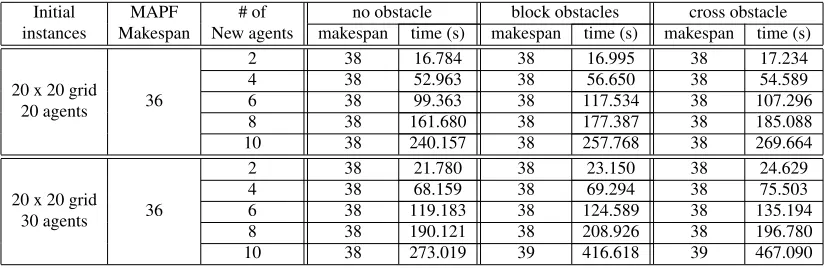
These observations do not change even when we increase the number of new agents (e.g., when 50% more agents join the team) and/or include obstacles on the grid (e.g., where 4 blocks of 4x4 square obstacles are placed on a grid of size 20x20 as in Figure7(a), or a large cross obstacle placed on a grid of size 20x20 dividing the grid into 4 rooms with narrow door passages in between as in Figure7(b)), as can be seen in Table2.
Similar observations can be made in Table3for instances with more obstacles (e.g., where 30 blocks of 2x2 square obstacles are placed on a grid of size 20x20 as in Figure7(c), or a large cross obstacle with narrow door passages and 20 blocks of 2x2 obstacles are randomly placed on a grid of size 20x20 as in Figure7(d)).
(a) 4 uniformly placed 4x4 obstacles (c) 30 randomly distributed 2x2 obstacles (d) Cross obstacle with narrow passages and 20 randomly distributed 2x2 obstacles (b) Cross obstacle with narrow passages
Figure 7: Four different environments (grids of size 20x20) used in our experiments: (a) 4 blocks of 4x4 square obstacles are placed on the grid, (b) a large cross obstacle is placed on the grid dividing it into 4 rooms with narrow door passages in between, (c) 30 blocks of 2x2 square obstacles are randomly placed on the grid, (d) both a large cross with narrow passages and 20 blocks of 2x2 square obstacles are placed on the grid.
Table 2: Experimental results on a 20x20 grid without obstacles, with block obstacles as in Figure7(a), and with a cross obstacle as in Figure7(b).
Initial instances MAPF Makespan # of New agents
no obstacle block obstacles cross obstacle makespan time (s) makespan time (s) makespan time (s)
20 x 20 grid 20 agents 36
2 38 16.784 38 16.995 38 17.234
4 38 52.963 38 56.650 38 54.589
6 38 99.363 38 117.534 38 107.296
8 38 161.680 38 177.387 38 185.088
10 38 240.157 38 257.768 38 269.664
20 x 20 grid 30 agents 36
2 38 21.780 38 23.150 38 24.629
4 38 68.159 38 69.294 38 75.503
6 38 119.183 38 124.589 38 135.194
8 38 190.121 38 208.926 38 196.780
10 38 273.019 39 416.618 39 467.090
Further remarks on reusability of existing plans. Recall that the main motivation of our revise and augment algorithm forD-MAPFis to be able to reuse the existing plans while trying to keep the makespan as small as possible. For that purpose, we can try to minimize the waiting time for each existing agent so that they do not lengthen the traversals of their paths and thus the makespan. With
Table 3: Experimental results with more obstacles as in Figures7(c) and (d).
Initial Instances
# of New Agents
30 randomly distributed 2x2 obstacles Cross with 20 random 2x2 obstacles MAPF makespan time(s) MAPF makespan time(s)
20x20 20 agents 2 32 32 5.345 25 25 5.201
4 32 10.826 25 7.468
6 32 33.166 25 11.609
8 32 53.223 25 29.007
10 32 82.527 25 44.907
20x20 30 agents 2 32 32 7.143 25 25 5.118
4 32 19.062 26 19.553
6 32 40.716 26 37.548
8 32 63.402 26 74.474
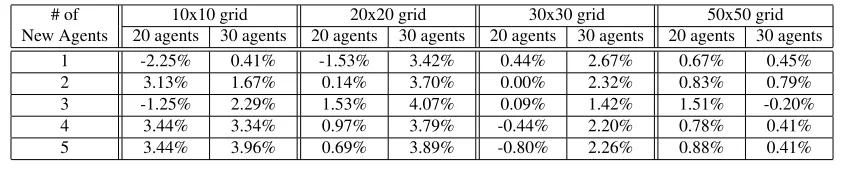
such an optimization, as in the results discussed above, we observe in Table4 that the reusability of existing plans is high (i.e., the makespan does not change in most of the cases) and the percentage of change in the total plan length is small. Despite no change in the makespan and small changes in the total plan length, note thatD-MAPFinstances still require revisions of existing plans.
Table 4: Change in the total plan length of the existing agents.
# of New Agents
10x10 grid 20x20 grid 30x30 grid 50x50 grid
20 agents 30 agents 20 agents 30 agents 20 agents 30 agents 20 agents 30 agents
1 -2.25% 0.41% -1.53% 3.42% 0.44% 2.67% 0.67% 0.45%
2 3.13% 1.67% 0.14% 3.70% 0.00% 2.32% 0.83% 0.79%
3 -1.25% 2.29% 1.53% 4.07% 0.09% 1.42% 1.51% -0.20%
4 3.44% 3.34% 0.97% 3.79% -0.44% 2.20% 0.78% 0.41%
5 3.44% 3.96% 0.69% 3.89% -0.80% 2.26% 0.88% 0.41%
5
Related Work
There are several problems that are related toD-MAPF, although they are different in general.
MAPF. There are mainly two kinds ofMAPFsolvers: some of them use search-based problem solv-ing (mostly based on a variant of A* search), and some of them use declarative problem solvsolv-ing.
For instance, Silver [27] introduces an incremental method where the paths of agents are computed one by one with A* [13]; once a path is found for an agent, it is considered as an obstacle for other agents. Luna and Bekris [18] propose to compute the paths of agents independently, and then resolve the conflicts (i.e., when two agents collide with each other) with respect to some push-and-swap rules (e.g., there should be at least two free vertices in the graph). Chouhan and Niyogi [5,4] propose a similar solution where the paths are computed independently; but the conflicts are resolved differently by assigning priorities to agents. Other search-based algorithms, like [7,32,15], also compute paths independently; in case a collision occurs, it is resolved by replanning one of the conflicting agents’ route. Sharon et al. [26] propose a different method that performs a search on a tree based on the conflicts between agents.
The declarative methods reduceMAPFto some formalisms (e.g., ILP, SAT, ASP) and use general problem solvers to find plans. Yu and Lavalle [34] modelMAPFas a network flow problem and use an ILP solver to optimize the makespan (the time when the last robot reaches its goal) or the distance (the total distance traveled by all robots). Surynek et al. [29,30] reduceMAPFto SAT and use a SAT solver to optimize the makespan or the sum of costs. Erdem et al. [8] modelMAPFas a logic program and use an ASP solver to optimize the makespan or the distance.
Considering that part ofD-MAPFincludesMAPF, it is not surprising that our ASP-based solution forD-MAPFbuilds upon Erdem et al.’s ASP-based solution forMAPF, for computing paths for the new agents. Though, the idea of replanning the waiting times of existing agents and the part of our ASP program that decides which existing agent should wait for how long and where meanwhile, are novel.
D-MAPF (thus our ASP-based solution) is similar in that it schedules the waiting times of the existing agents. On the other hand, it does not pose a constraint about the latter assumption, so an existing agent does not have to visit a location before another existing agent although their paths suggest otherwise. For instance, in the example above, it is not required thatr1visitsvbeforer2.
TAPF and G-TAPF. Target Assignment and Path Finding problems (TAPFandG-TAPF) [19,23] are variants of MAPF: they aim to partition the agents into teams of agents, assign some goals to each team, and solveMAPF. Although this problem is different, Nguyen et al.’s solution toG-TAPF
is related since it also utilizes ASP in the spirit of Erdem et al.’s [8] solution for MAPF. However, like Erdem et al.’s [8] solution, Nguyen et al.’s solution to G-TAPFdo not consider changes in the environment. Our solution forD-MAPFdoes.
MAPD. Like TAPF and G-TAPF, Multi-Agent Pickup and Delivery (MAPD) [20] also involves assignment of tasks (i.e., pick up and delivery) to agents but over time, so it requires an online solution. WhileMAPDhas a dynamic aspect of emerging new tasks, it does not allow the team or environment to change (e.g., no existing agent leaves, no new agent joins, no new obstacle appears). On the other hand,D-MAPFallows for changes in the team or environment, but does not allow new tasks over time.
Online MAPF. OnlineMAPF[31] considers the addition of new agents to the team while a plan is being executed, but no other changes in the team or environment (e.g., no existing agent leaves, no new obstacle appears). Moreover, it is assumed that agents disappear when they reach their goal and that new agents may wait before entering their initial location in the environment. These assumptions relax theD-MAPFproblem: the new agents may enter the environment one at a time, and they provide more space for the other agents when they disappear.
To solve online MAPF with these assumptions, Svancara et al. investigate algorithms that rely on replanning (e.g., for all agents) and conflict-resolution (e.g., planning for the new agents one at a time ignoring others, and then resolving conflicts by replanning). Our approach does not accommodate such assumptions and tries to find a solution forD-MAPFby revising the schedules of the plans of existing agents while augmenting the plans of new agents; replanning is triggered only when revising and augmenting is not sufficient to find a solution.
6
Conclusion
While executing aMAPFplan in a dynamic environment, new agents may join the team whereas some may leave, and the environment may change by new obstacles. In such cases, we need to solve a variation ofMAPF, which we callD-MAPF.
We have proposed a declarative solution toD-MAPF, based on the idea of re-using the existing solution forMAPF(i.e., re-using the paths of the existing agents and scheduling their waiting times to obtain their new traversals, instead of computing new paths and traversals for them) while computing new plans for the new agents. We have realized this method using advantages of ASP: the guidance provided by the generate-and-test representation methodology, the special constructs and capabilities (such as aggregates, weak constraints, choice rules, and recursive definitions), and the efficient ASP solver CLINGO.
References
[1] Chitta Baral.Knowledge Representation, Reasoning, and Declarative Problem Solving. Cambridge University Press, New York, NY, USA, 2003.
[2] Gerhard Brewka, Thomas Eiter, and Miroslaw Truszczynski. Answer set programming at a glance. ACM Commununications, 54(12):92–103, 2011.
[3] Gerhard Brewka, Thomas Eiter, and Miroslaw Truszczynski. Answer set programming: An introduction to the special issue.AI Magazine, 37(3):5–6, 2016.
[4] Satyendra Singh Chouhan and Rajdeep Niyogi. DMAPP: A distributed multi-agent path planning algorithm. InProc. of AI, pages 123–135, 2015.
[5] Satyendra Singh Chouhan and Rajdeep Niyogi. DiMPP: a complete distributed algorithm for multi-agent path planning.J. Exp. Theor. Artif. Intell., 29(6):1129–1148, 2017.
[6] E. W. Dijkstra. A note on two problems in connexion with graphs.Numer. Math., 1(1):269–271, 1959. [7] Kurt M. Dresner and Peter Stone. A multiagent approach to autonomous intersection management. J. Artif.
Intell. Res. (JAIR), 31:591–695, 2008.
[8] Esra Erdem, Doga Gizem Kisa, Umut Oztok, and Peter Schueller. A general formal framework for pathfinding problems with multiple agents. InProc. of AAAI, 2013.
[9] Martin Gebser, Benjamin Kaufmann, Roland Kaminski, Max Ostrowski, Torsten Schaub, and Marius Thomas Schneider. Potassco: The Potsdam Answer Set Solving Collection.AI Communications, 24(2):107–124, 2011. [10] M. Gelfond and V. Lifschitz. The stable model semantics for logic programming. InProc. of ICLP, pages
1070–1080. MIT Press, 1988.
[11] Michael Gelfond and Yulia Kahl.Knowledge Representation, Reasoning, and the Design of Intelligent Agents: The Answer-Set Programming Approach. Cambridge University Press, New York, NY, USA, 2014.
[12] Michael Gelfond and Vladimir Lifschitz. Classical negation in logic programs and disjunctive databases.New Generation Computing, 9:365–385, 1991.
[13] Peter E. Hart, Nils J. Nilsson, and Bertram Raphael. Correction to ”a formal basis for the heuristic determi-nation of minimum cost paths”.SIGART Newsletter, 37:28–29, 1972.
[14] Wolfgang Hoenig, T. K. Satish Kumar, Liron Cohen, Hang Ma, Hong Xu, Nora Ayanian, and Sven Koenig. Multi-agent path finding with kinematic constraints. InProc. of ICAPS, pages 477–485, 2016.
[15] Renee Jansen and Nathan Sturtevant. A new approach to cooperative pathfinding. InProc. of AAMAS, pages 1401–1404, 2008.
[16] Jae-Yeong Lee and Wonpil Yu. A coarse-to-fine approach for fast path finding for mobile robots. InProc. of IROS, pages 5414–5419, 2009.
[17] Vladimir Lifschitz. Answer set programming and plan generation.Artificial Intelligence, 138:39–54, 2002. [18] Ryan Luna and Kostas E. Bekris. Efficient and complete centralized multi-robot path planning. InProc. of
IROS, pages 3268–3275, 2011.
[19] Hang Ma and Sven Koenig. Optimal target assignment and path finding for teams of agents. InProc. of AAMAS, pages 1144–1152, 2016.
[20] Hang Ma, Jiaoyang Li, T. K. Satish Kumar, and Sven Koenig. Lifelong multi-agent path finding for online pickup and delivery tasks. InProc. of AAMAS, pages 837–845, 2017.
[21] Victor Marek and Mirosław Truszczy´nski. Stable models and an alternative logic programming paradigm. In The Logic Programming Paradigm: a 25-Year Perspective, pages 375–398. Springer Verlag, 1999.
[22] Robert Morris, Corina S. Pasareanu, Kasper Søe Luckow, Waqar Malik, Hang Ma, T. K. Satish Kumar, and Sven Koenig. Planning, scheduling and monitoring for airport surface operations. InPlanning for Hybrid Systems, Papers from AAAI Workshop., 2016.
[23] Van Nguyen, Philipp Obermeier, Tran Cao Son, Torsten Schaub, and William Yeoh. Generalized target assignment and path finding using answer set programming. InProc. of IJCAI, pages 1216–1223, 2017. [24] Ilkka Niemel¨a. Logic programs with stable model semantics as a constraint programming paradigm.Annals
[25] Daniel Ratner and Manfred K. Warmuth. Finding a shortest solution for the n×n extension of the 15-puzzle is intractable. InProc. of AAAI, pages 168–172, 1986.
[26] Guni Sharon, Roni Stern, Ariel Felner, and Nathan R. Sturtevant. Conflict-based search for optimal multi-agent pathfinding.Artif. Intell., 219:40–66, 2015.
[27] David Silver. Cooperative pathfinding. InProc. of AIIDE, pages 117–122, 2005.
[28] Trevor Scott Standley and Richard E. Korf. Complete algorithms for cooperative pathfinding problems. In Proc. of IJCAI, pages 668–673, 2011.
[29] Pavel Surynek. On propositional encodings of cooperative path-finding. InProc. of ICTAI, pages 524–531, 2012.
[30] Pavel Surynek, Ariel Felner, Roni Stern, and Eli Boyarski. Efficient SAT approach to multi-agent path finding under the sum of costs objective. InProc. of ECAI, pages 810–818, 2016.
[31] Jiri Svancara, Marek Vlk, Roni Stern, Dor Atzmon, and Roman Bartak. Online multi-agent pathfinding. In Proc. of AAAI, 2019.
[32] Ko-Hsin Cindy Wang and Adi Botea. Fast and memory-efficient multi-agent pathfinding. InProc. of ICAPS, pages 380–387, 2008.
[33] Peter R. Wurman, Raffaello D’Andrea, and Mick Mountz. Coordinating hundreds of cooperative, autonomous vehicles in warehouses.AI Magazine, 29(1):9–20, 2008.