Iran University of Medical Sciences
____________________________________________________________________________________________________________________ 1. Associate Professor, Medicinal Research Center, Shahrekord University of Medical Sciences, Shahrekord, Iran. [email protected]
2. (Corresponding author) Assistant Professor, Department of Community Medicine, Shahrekord University of Medical Sciences, Shahrekord,
Iran. [email protected]
3. Associate Professor, Department of Infectious Diseases, Shahrekord University of Medical Sciences, Shahrekord, Iran. [email protected]
Sequence-based genotyping of hepatitis B virus in general
popula-tion
Ali Karimi1, Ma’soumeh Moezzi2, Reza Imani3
Received:3 August 2014 Accepted:4 October 2014 Published:27 January 2015
Abstract
Background:Hepatitis B Virus (HBV) causes acute and chronic liver disease worldwide. HBV has eight geno-types (A to H) which is the reflection of its genome with their characteristic geographical distribution. Each genotype could have different pathogenic and therapeutic characteristics. There have been few records on HBV genotyping in general population from our region. This study aimed to determine hepatitis B genotypes using sequencing in the general population of Shahrekord, a Southwestern region of Iran.
Methods: A total of 3000 serum samples (cluster sampling method) were enrolled from general population tested for HBsAg using ELISA. Using appropriate extraction kit, HBV DNA was extracted from HBsAg posi-tive samples and each was subjected to nested PCR for detection of HBV DNA. Finally, using sequencing, the samples were used for HBV genotyping. Data were analyzed by SPSS 19 using descriptive statistics, chi square, and Fisher’s exact test. P-value < 0.05 was considered as the level of significance.
Results: Out of 3000 serum samples, 40 (1.3%) were positive for HBsAg. HBV DNA was detected in 10 out of 40 (25%) of the samples studied. Genotype D was the predominant HBV type found in all of these 10 HBV positive samples.
Conclusion: Genotype D is probably the predominant HBV type in our region. Keywords: Chronic hepatitis B, nested polymerase chain reaction, genotyping.
Cite this article as:Karimi A, Moezzi M, Imani R. Sequence-based genotyping of hepatitis B virus in general population.Med J Islam Repub Iran2014 (27 January). Vol. 29:165.
Introduction
One of the most important health prob-lems worldwide is hepatitis B virus (HBV) infection. There are about 400 million per-sons who are chronically infected by this virus. Chronic carriers are exposed to the development of complications arising from hepatitis B infection, resulting in cirrhosis, hepatocellular carcinoma, liver failure or death (1, 2). HBV genotype is one of the most important factors that influence the outcome of infection (2, 3). Based on se-quence divergence in the entire genome, HBV has been classified into at least 8 genotypes (A–H) that differ >8% from each other at the nucleotide level (2).
Re-cently, an additional provisional genotype (I) isolated from Southeast Asians (4) and a variant were also candidate as the tenth genotype J (5). Most genotypes can be split into subgenotypes that differ >4% from each other, such as HBV-A1 and HBV-A2 (6, 7).
As specific clinical associations with each genotype become increasingly appar-ent, HBV genotyping is becoming more and more important (6). It has been shown that HBV origin, course of infection, the severity of the disease (6-8), prognosis and response to antiviral treatment (7, 9), pat-terns of serological reactivity and replica-tion of the virus (7) are mainly genotype
2 MJIRI, Vol. 29.165. 27 January 2015
dependent. Thus, understanding genotype distribution is important for epidemiologic characterization of HBV transmission and to control infection (10).
Geographic distribution of HBV geno-types regarding regional host population and endemicity have been widely consid-ered. Accordingly, HBV/B and HBV/C are predominant in most parts of Asia, includ-ing China and Japan (11). Genotypes A, D and F are prevalent among the five geo-graphic regions of Brazil. Genotype A was most prevalent in the United States (12) while the most common HBV genotype in Canada was B (13). Genotypes E and F are confined to Africa and the Americas (14). HBV/G has a global distribution, and HBV/H was first revealed in Central Amer-ica (15). HBV genotypes I and J have been sporadically reported from Asia and Japan, respectively (4, 5). Genotype D is also pre-dominant in the Middle East, including Iran (16).
Iran located in an intermediate endemic region for chronic HBV infection with prevalence rate of 2-8% (17). But, studies show improvement and prevalence transi-tion from moderate to low (0.1-2%), due to vaccination in recent years (18,19). Geno-type D has been reported as the predomi-nant genotype in different regions of Iran (20-27). In our region, although there are some reports regarding HBV infection among chronically infected patients (27-29), there has been no report of HBV geno-types in general population. Therefore, this population-based study was aimed to de-termine HBV genotypes in general popula-tion of Chaharmahal va Bakhtiari, south-western Iran.
Methods
Serum samples
This is a descriptive, cross-sectional and population-based study. The sample popu-lation consists of rural and urban adults over 15 years in Chaharmahal va Bakhtiari province. The sample size was decided to include 3000 individuals based on statisti-cal advice, national prevalence of hepatitis
B and the province population, confidence interval 95%, and relative error 25%. Sam-pling method was clustering. The clusters were selected from seven counties of the province. Totally, 3000 serum samples were collected from healthy individuals in normal population.
The inclusion criteria were being 15 years and over and consent to participate. For taking blood sample, written consent was obtained from the participants. The study holds ethics code of 90-2-6 obtained from the University Ethic Committee. For HBsAg test, Delaware Kit (Common Mar-ket) was used.
PCR amplification and detection of HBV DNA
HBV DNA was extracted from the HBsAg positive serum samples using an extraction kit (QIAamp MinElute Virus Kits, Qiagen, Germany) and subjected to nested PCR according to the manufactur-er's instructions using appropriate primers and positive control provided by kit (Plas-ma-Serum HBV PCR Detection Kit, Nor-gen-Canada). Strict measures were adopted to prevent any contamination. An aliquot of water was used as negative control. Samples were considered positive if they yielded at least two positive results in two different reactions and were considered negative when there were two negative re-sults in two different reactions. To detect PCR product, the PCR products were ana-lyzed by electrophoresis through a poly-acrylamide gel, stained with silver nitrate and photographed.
HBV sequencing and phylogenetic analy-sis
Detection of HBV genotypes was per-formed using sequencing. For sequencing, the PCR products were purified by Exo SAP-IT kit (USB Corporation, Ohio, USA) according to the manufacturer´s instruc-tion. Sequencing reactions were performed using 1-5μl purified PCR products, 1μl BigDye reaction mix (Life Technologies, Applied Biosystems, Darmstadt, Germany)
and 0.5μM of the HBV primers, with the same primers as those used for PCR ampli-fication of pre-S region. The sequences ob-tained were compared with published se-quences from the same genomic region of 8 HBV genotypes available in National Center for Biotechnology Information (NCBI) GenBank. Alignment was per-formed using CLUSTAL W in MEGA 5 software. The phylogenetic tree reconstruc-tion was carried out using Maximum Com-posite Likelihood method and MEGA 5 software (Ibis therapeutics Carlsbad, Carlsbad, CA, USA). This method is a new genotyping strategy established by Ma et al in Shenyang, China (30). Data were ana-lyzed by SPSS 19 using descriptive statis-tics, chi square, and Fisher’s exact test. P< 0.05 was considered as the level of signifi-cance.
Results
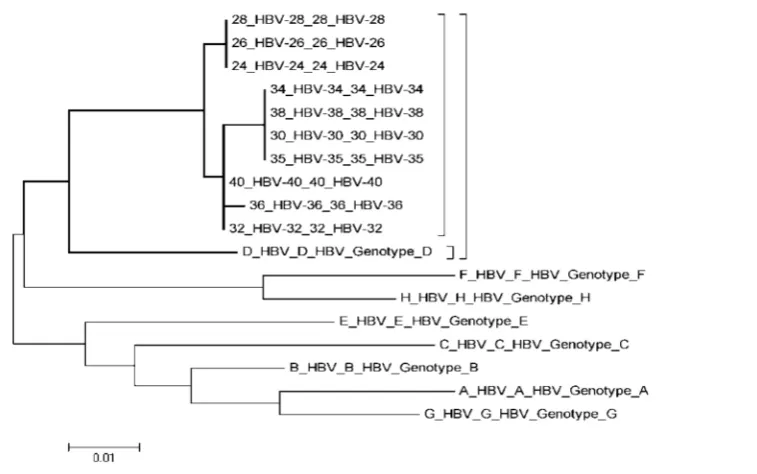
Out of 3000 serum samples obtained from healthy individuals, 40 (1.3%) were positive for HBsAg using ELISA (data not shown). Ten out of 40 (25%) were positive for HBV DNA using nested PCR (Figure 1). Demographic characteristics are shown in Table 1. Chi square and Fisher’s exact tests revealed no significant difference be-tween these cases and HBV PCR negative individuals. The results of sequencing method showed that genotypes D was the predominant HBV type found in all of
the-se 10 HBV positive samples (Figs. 2 and 3).
Discussion
This is the first study aimed to evaluate the distribution of HBV genotypes in the general population of a Southwestern prov-ince of Iran, Charmahal va Bakhtiari. Based on a sequence divergence of 8% or greater of the entire genome sequences or a sequence divergence of 4.2% of the S ge-nome sequences, HBV includes at least eight genotypes (A-H) (2) with two addi-tional genotypes recently named I and J
Table1. Demographic characteristics of patients with positive PCR for DNA Number(%)
Gender Male 5 (50%)
Female 5 (50%)
Age (years) 15-24 1 (10%)
25-34 3 (30%)
35-44 1 (10%)
45-54 2 (20%)
55-64 3 (30%)
Marriage Status married 6 (67%)
single 2 (22%)
widow 1 (11%)
Place of residence Urban 7 (70%)
Rural 3 (30%)
Education Uneducated 1 (10%)
Reading 5 (50%)
Diploma and higher degree 4 (40%)
Vaccination status vaccinated 3 (30%)
Unvaccinated 7 (70%)
Fig. 1. Polyacrylamide gel electrophoresis of the reac-tion, products of nested PCR and a 50 KB DNA mark-ers. The second round of amplification products (1-8), the positive (PC), the negative controls (NC), and mo-lecular weight marker (M) are shown.
4 (4,5,31). There have been a number of re-ports indicating that most HBV genotypes are restricted to geographical regions and associated with a host population around the world, while others tend to have a worldwide distribution, or still remain un-known (3,4). Just as with the genotypes, the distribution of HBV subgenotypes is also distinctly geographic (8,9). It has been suggested that polymorphism, transmis-sion, mutation and the evolutionary history of HBV have led to the above outcomes.
Different biological and epidemiologic behaviors have been attributed to HBV genotypes (6). Accordingly, they are close-ly associated with outcome of chronic liver disease, antiviral response, severity of the diseases, and disease time course. There-fore, detection and monitoring of HBV genotypes are very important to clarify the pathogenesis, route of infection and viru-lence of the virus and also in epidemiologic setting (7-9).
Studies of the distribution of HBV
geno-Fig. 2. Phylogenetic tree constructed with MEGA version5.05 software using the Maximum Likelihood method. Tree constructed based on 348 bp fragments from 10 HBV amplicon and 8 genotype of HBV obtained from NCBI database. Genotype of samples is closed with HBV genotype D.
Fig. 3. Phylogenetic tree of 348 bp fragments from 10 HBV isolated in the studied population and 8 standard genotypes from NCBI database. Tree constructed with DNAstar megalign software. Genotype of samples is closed with HBV geno-type D.
types have largely been conducted among patients with chronic hepatitis B (CHB) from Iran (26). However, limited studies carried out to determine genotypes of this virus in Iranian general population (24). Accordingly, this is the first study aimed to understand the overall distribution of HBV genotypes in general population from a Southwestern province of Iran. Our results identified genotype D as the predominant genotype in this region. These findings are concordant with those of the previous stud-ies conducted in the different regions of the country where only genotype D was de-tected in CHB patients (26). Although in this study, HBV genotype D was detected in apparently healthy individuals in the general population, all these results, to-gether, from different regions, confirm that genotype D may be the only genotype cir-culating in this country both in CHB pa-tients and most probably in the general population. This result is also consistent with other published reports from other countries of the Middle East (16,25) indi-cating predominance of this genotype in this region of the world.
It has been suggested that HBV geno-types have a characteristic geographic dis-tribution and are closely related to the pro-cess of human evolution and migration (16,25). It was found that genotype D is the predominant HBV genotype in South Asia and the Middle East including India, Af-ghanistan and Iran (16) and is dominant in most parts of Europe (25). Historically, Ar-ians who firstly colonized to the North of the Caspian Sea migrated to Iran, India, and Europe. Therefore, there is a possibil-ity that the population of this colony has been infected with genotype D before their migration and then transmitted the virus to the following generations after their migra-tion. Thus, this may be the best explanation for the prevalence of genotype D in India, Iran and most parts of the Europe. In coun-tries with high levels of immigration in the Europe and North America a variety of genotypes are being reported (24) which may depict the impact of immigration on
HBV genotype distribution. Also, the dom-inancy of this genotype in Iran and the neighboring countries (25) may indicate immigration among these countries which results in circulation of this genotype among these populations.
The clinical outcomes of the individuals infected with HBV of genotype D are still controversial. It has been suggested that it causes severe chronic liver diseases more frequently than other genotypes (1,3,16); it causes high risk of provoking fulminant hepatitis as well. However, there are some reports indicating HBV genotype D is re-lated to acute self-limited hepatitis (9). Fur-thermore, HBV genotype D has been found in the majority of asymptomatic carriers (84.2%) and has not been found in patients with liver cirrhosis; hepatocellular carci-noma is lower in genotype D (17). No as-sociation between HBV of genotype D and distinct clinical phenotypes has been found in the Turkish population infected with HBV (16). Based on our findings, appar-ently no clinical symptoms were seen in the infected healthy individuals. From the-se results, together, it may be concluded that the infection caused by genotype D mainly is mild and/or asymptomatic.
Conclusion
The results of this study may provide useful regional epidemiologic information. However, as these results cannot be gener-alized for all Iranian population, a large scale, nationwide study should be done to determine HBV genotypes in general popu-lation of Iran.
Acknowledgments
This paper was obtained from a research project, funded by Deputy of Research and Technology of Shahrekord University of Medical Sciences (grant number: 1446). Hereby, we gratefully thank Shahrekord University of Medical Sciences for funding this work.
References
1. Günther S. Genetic variation in HBV
6 MJIRI, Vol. 29.165. 27 January 2015
tion: genotypes and mutants. J Clin Virol. 2006; 36:S3-S11.
2. Schaefer S. Hepatitis B virus taxonomy and hepatitis B virus genotypes. World J Gastroenter-ol. 2007;13(1):14-21.
3. McMahon BJ. The influence of hepatitis B vi-rus genotype and subgenotype on the natural histo-ry of chronic hepatitis B. Hepatol Int. 2009; 3(2): 334-42.
4. Yu H, Yuan Q, Ge SX, Wang HY, Zhang YL, Chen QR, et al. Molecular and phylogenetic analyses suggest an additional hepatitis B virus genotype "I". Plos One. 2010;5(2):e9297.
5- Tatematsu K, Tanaka Y, Kurbanov F, Sugauchi F, Mano S, Maeshiro T, et al. A genetic variant of hepatitis B virus divergent from known human and ape genotypes isolated from a Japanese patient and provisionally assigned to new genotype J. J Virol. 2009;83(20):10538-47.
6. El IA, Khaled A, Mahmoud OM, Saleh AF, Baioumi EA. Prevalence of HBV genotypes in Egypt among hepatitis patients. J Am Sci. 2010;6(11):185-90.
7. Dokanehiifard S, Bidmeshkipour A. Study of hepatitis B virus (HBV) genotypes in Kermanshah province, west of Iran. J Biol Sci. 2009;1:113-20.
8. Eftekhari Y, Kazemi Arababadi M, Hakimi H, Rezazadeh Zarandi E. Common HBV genotype in southeastern Iranian patients. Arch Iran Med. 2010; 13(2):147-9.
9. Zhu CT, Dong CL. Characteristics of general distribution of hepatitis B virus genotypes in Chi-na. Hepatobiliary Pancreat Dis Int. 2009;8(4):397– 401.
10. Holmberg SD. Molecular epidemiology of health care-associated transmission of hepatitis B and C viruses. Clin Liver Dis. 2010;14:37–48.
11. Kao JH, Chen PJ, Lai MY, Chen DS. Hepati-tis B virus genotypes and spontaneous hepatiHepati-tis B e antigen seroconversion in Taiwanese hepatitis B carriers. J Med Virol. 2004;72(3):363-9.
12. Mello FC, Souto FJ, Nabuco LC, Villela-Nogueira CA, Coelho HS, Franz HC, et al. Hepati-tis B virus genotypes circulating in Brazil: molecu-lar characterization of genotype F isolates. BMC Microbiol. 2007;7:103.
13. Ghany MG, Perrillo R, Li R, Belle SH, Janssen HL, Terrault NA, et al. Characteristics of Adults in the Hepatitis B Research Network in North America Reflect Their Country of Origin and Hepatitis B Virus Genotype. Clin Gastroenter-ol HepatGastroenter-ol. 2014.
14. Norder H, Courouce AM, Coursaget P, Echevarria JM, Lee SD, Mushahwar IK, et al. Ge-netic diversity of hepatitis B virus strains derived worldwide: genotypes, subgenotypes, and HBsAg subtypes. Intervirology. 2004;47(6):289-309.
15. Arauz-Ruiz P, Norder H, Robertson BH, Magnius LO. Genotype H: a new Amerindian genotype of hepatitis B virus revealed in Central
America. J Gen Virol. 2002;83(Pt 8):2059-73. 16. Baig S, Siddiqui A, Chakravarty R, Moatter T. Hepatitis B virus subgenotypes D1 and D3 are prevalent in Pakistan. BMC Res Notes. 2009;2:1.
17. Alavian SM, Fallahian F, Lankarani KB. The changing epidemiology of viral hepatitis B in Iran. J Gastrointestin Liver Dis. 2007;16(4):403-6.
18. Alavian SM, Hajarizadeh B, Ahmadzad-Asl M, Kabir A, Bagheri-Lankarani K. Hepatitis B Vi-rus Infection in Iran: A Systematic Review. Hepat Mon. 2008;8(4):281-94.
19. Moezzi M, Imani R, Khosravi N, Pourheidar B, Ganji F, Karimi A. Hepatitis B seroprevalence and risk factors in adult population of Chaharma-hal and Bakhtiari province in 2013. Hepat Mon. 2014;14(5):e17398.
20. Amini-Bavil-Olyaee S, Tacke F, Alavian SM. HBV Subgenotypes D1, D2, D-del! Are 'Old' Genotyping Methods Interpreted Correctly? Hepat Mon. 2013;13(7):e13048.
21. Amini-Bavil-Olyaee S, Sarrami-Forooshani R, Adeli A, Sabahi F, Abachi M, Azizi M, et al. Complete genomic sequence and phylogenetic re-latedness of hepatitis B virus isolates from Iran. J Med Virol. 2005;76(3):318-26.
22. Mojiri A, Behzad-Behbahani A, Saberifirozi M, Ardabili M, Beheshti M, Rahsaz M, et al. Hep-atitis B virus genotypes in southwest Iran: molecu-lar, serological and clinical outcomes. World J Gastroenterol. 2008;14(10):1510-3.
23. Bahramali G, Sadeghizadeh M, Amini-Bavil-Olyaee S, Alavian SM, Behzad-Behbahani A, Adeli A, et al. Clinical, virologic and phylogenetic features of hepatitis B infection in Iranian patients. World J Gastroenterol. 2008;14(35):5448-53.
24. Merat S, Rezvan H, Nouraie M, Jamali A, Assari S, Abolghasemi H, et al. The prevalence of hepatitis B surface antigen and anti-hepatitis B core antibody in Iran: a population-based study. Arch Iran Med. 2009;12(3):225-31.
25. Jazayeri SM, Carman WF. Evolution of HBV Genotype D in the Middle East and South Asia. Hepat Mon. 2009;9(1):9-11.
26. Alavian SM, Keyvani H, Rezai M, Ashayeri N, Sadeghi HM. Preliminary report of hepatitis B virus genotype prevalence in Iran. World J Gastroenterol. 2006;12(32):5211-3.
27. Karimi A, Hoseini SM. Seroprevalence of Hepatitis B and C Virus and HIV Markers among Blood Donors from Shahre-Kord, Iran (2004-2006). Kuwait Med J. 2008;40:279-81.
28. Karimi A, Mokhtarian K. Evaluation of vac-cine induced immunity to hepatitis B Virus among health Care workers in a university hospital in Iran. Kuwait Med J. 2010;42:202-4.
29. Karimi A, Imani R. Prevalence of HBsAg, HCV and HIV antibodies among intervenous drug users in Shahre-Kord, Iran. J Isfahan Univ Med Sci. 2007;8:10-14.
30. Ma Y, Ding Y, Juan F, Dou XG. Genotyping the hepatitis B virus with a fragment of the HBV DNA polymerase gene in Shenyang, China. Virol J. 2011;8:315.
31. Tong W, He J, Sun L, He S, Qi Q. Hepatitis
B virus with a proposed genotype I was found in Sichuan Province, China. J Med Virol. 2012; 84(6): 866-70.