DOI: 10.1534/genetics.105.052738
A Functional Module of Yeast Mediator That Governs the Dynamic Range of
Heat-Shock Gene Expression
Harpreet Singh, Alexander M. Erkine,
1,2Selena B. Kremer,
1Harry M. Duttweiler,
Donnie A. Davis, Jabed Iqbal, Rachel R. Gross and David S. Gross
3Department of Biochemistry and Molecular Biology, Louisiana State University Health Sciences Center, Shreveport, Louisiana 71130-3932
Manuscript received October 21, 2005 Accepted for publication January 20, 2006
ABSTRACT
We report the results of a genetic screen designed to identify transcriptional coregulators of yeast heat-shock factor (HSF). This sequence-specific activator is required to stimulate both basal and induced transcription; however, the identity of factors that collaborate with HSF in governing noninduced heat-shock gene expression is unknown. In an effort to identify these factors, we isolated spontaneous extragenic suppressors ofhsp82-DHSE1, an allele ofHSP82that bears a 32-bp deletion of its high-affinity HSF-binding site, yet retains its two low-affinity HSF sites. Nearly 200 suppressors of the null phenotype ofhsp82-DHSE1 were isolated and characterized, and they sorted into sixexpressionwithout heat-shockelement (EWE) com-plementation groups. Strikingly, all six groups contain alleles of genes that encode subunits of Mediator. Three of the six subunits, Med7, Med10/Nut2, and Med21/Srb7, map to Mediator’s middle domain; two subunits, Med14/Rgr1 and Med16/Sin4, to its tail domain; and one subunit, Med19/Rox3, to its head domain. Mutations in genes encoding these factors enhance not only the basal transcription of hsp82-DHSE1, but also that of wild-type heat-shock genes. In contrast to their effect on basal transcription, the more severeewemutations strongly reduce activated transcription, drastically diminishing the dynamic range of heat-shock gene expression. Notably, targeted deletion of other Mediator subunits, including the negative regulators Cdk8/Srb10, Med5/Nut1, and Med15/Gal11 fail to derepresshsp82-DHSE1. Taken together, our data suggest that the Ewe subunits constitute a distinct functional module within Mediator that modulates both basal and induced heat-shock gene transcription.
W
HEN exposed to thermal or chemical stress, or-ganisms respond by vigorously transcribing genes encoding heat-shock proteins (HSPs). HSPs func-tion as molecular chaperones and protect the cell— along with ubiquitin, proteases, metallothioneins, and antioxidant enzymes—from damage caused by the expression of misfolded proteins. In the yeast Saccha-romyces cerevisiae, the expression of heat-responsive genes is stimulated by the sequence-specific transcrip-tional activator heat-shock factor (HSF) Hsf1 (ScHSF) (Sorger and Pelham1988; Nieto-Soteloet al.1990; Sorger1990). In response to metabolic, oxidative, or osmotic stress, the transcription of a number of HSP genes is additionally enhanced by the gene-specific acti-vators Msn2/Msn4 and Skn7 (Boy-Marcotteet al.1998; Tregeret al.1998; Gaschet al.2000; Raittet al.2000; Amoros and Estruch 2001; Kandror et al. 2004). Nonetheless, the only activator known to promote basalheat-shock gene transcription is HSF (McDanielet al. 1989; Parkand Craig1989; Erkineet al.1996). Whether this basal expression is an indirect consequence of HSF’s role in establishing and maintaining a nucleosome-remodeled (‘‘nucleosome-free’’) structure over the tran-scription start site (Grosset al.1993; Erkineet al.1996), or whether HSF plays a more direct role in recruiting transcriptional coactivators under noninducing con-ditions, is unknown.
HSF is of additional interest, given that it can activate its target genes in the absence of several key general transcription factors (GTFs). These include Taf9 (TAFII17,
constituent of both SAGA and TFIID), Med17/Srb4 and Med22/Srb6 (both subunits of Mediator), TFIIA, Kin28 (TFIIH kinase), and even the C-terminal domain (CTD) of the large subunit of RNA polymerase II (Aponeet al. 1998; Leeand Lis1998; McNeilet al.1998; Moqtaderi et al.1998; Chouet al.1999). Moreover, activated HSF has been shown to mediate gene-wide histone displace-ment and can do so in the absence of prominent chromatin remodeling (Swi/Snf), histone modification (Set1, Gcn5), and transcriptional elongation (Paf1) complexes (Zhaoet al.2005). These observations sug-gest the possibility that HSF uses a novel route for transcriptional activation of its target genes, a notion
1These authors contributed equally to this work.
2Present address:Division of Basic Biomedical Sciences, University of
South Dakota, 414 E. Clark St., Vermillion, SD 57069-2390.
3Corresponding author: Department of Biochemistry and Molecular
Biology, Louisiana State University Health Sciences Center, 1501 Kings Highway, Shreveport, LA 71130-3932. E-mail: [email protected]
supported by artificial recruitment experiments. The latter has led to the suggestion that HSF’s C-terminal activation domain can activate transcription via the Rgr1 subcomplex of Mediator (Leeet al.1999).
Mediator is an evolutionarily conserved transcrip-tional coregulator, composed of 25 subunits in yeast, that integrates signals from sequence-specific activators and repressors to the general transcriptional machinery (GTM) (reviewed in Malikand Roeder2000; Myers and Kornberg 2000; Rachez and Freedman 2001; Boube et al.2002). Originally described as an activity in fractionated yeast extracts that stimulated both basal and activator-dependent transcription (Kelleheret al. 1990; Flanaganet al.1991), Mediator physically inter-acts with the pol II CTD and under certain conditions copurifies with the 12-subunit core pol II as a holoen-zyme (Koleskeand Young1994). Its association with pol II is reversible: it binds tightly to the hypophos-phorylated, recruitment-competent pol IIa isoform, but very weakly (if at all) to hyperphosphorylated, elonga-tion-competent pol IIo (Svejstrupet al.1997). This is consistent with findings, bothin vivoandin vitro, that Mediator remains at the promoter following escape of pol II (Pokholok et al. 2002), where it may serve to facilitate reinitiation (Yudkovskyet al.2000). In addi-tion, at several yeast promoters, recruitment of Media-tor has been found to precede that of pol II (Bhoite et al. 2001; Cosma et al. 2001; Bryant and Ptashne 2003), demonstrating that it can exist free of RNA polymerasein vivo. Mediator has been shown to associ-ate exclusively with the UAS ofGALgenes and does so independently of pol II and GTFs (Kuraset al.2003).
Biochemical and electron microscopic analysis of yeast Mediator have indicated the presence of three discrete domains: the ‘‘head,’’ composed of Med6, Med8, Med11, Med17/Srb4, Med18/Srb5, Med19/ Rox3, Med20/Srb2, and Med22/Srb6; the ‘‘middle,’’ composed of Med1, Med4, Med7, Med9, Med10/Nut2, Med21/Srb7, and Med31/Soh1; and the ‘‘tail,’’ com-posed of Med2, Med3/Hrs1, Med5/Nut1, Med14/Rgr1, Med15/Gal11, and Med16/Sin4 (Boube et al. 2002; Beveet al.2005). A kinase module, composed of Cdk8/ Srb10, CycC/Srb11, Med12/Srb8, and Med13/Srb9, loosely associates with the 21-subunit core Mediator complex (Liu et al. 2001). Biochemical isolation of a stable Rgr1 subcomplex, consisting of subunits of the middle and tail domains, has also been described (Lee and Kim1998).
Each domain of Mediator appears to be directly targeted by sequence-specific regulators. For example, the MED17/TRAP80 subunit of Drosophila Mediator, ortholog of the head domain subunit Srb4, has been shown to engage in direct interaction with Drosophila HSF (Parket al.2001). Likewise, mammalian MED17/ TRAP80 is specifically targeted by p53 and VP16 (Ito et al.1999). On the other hand, the mammalian middle domain subunit, MED1/TRAP220, is targeted by
nu-clear receptors (Itoet al.2000). Three subunits of the yeast tail domain, Gal11, Med2, and Hrs1 (constituting the ‘‘Gal11 module’’), physically interact with the Gcn4 activation domainin vitroand contribute to the recruit-ment of Mediator at Gcn4-regulated promoters (Zhang et al.2004). Other subunits may be targets of corepres-sors. Srb7 binds the global yeast repressor Tup1, both in vivoandin vitro, and an Srb7 mutation that obviates Srb7–Tup1 interactions derepresses Tup1-regulated genes inS. cerevisiae(Gromollerand Lehming2000). Specific subunits within Mediator also may interact with GTFs such as TBP, TFIIB, TFIIE, or TFIIH (Sakuraiand Fukasawa2000; Kanget al.2001).
Consistent with their physical interactions, genetic analysis suggests that individual Mediator subunits can act as either positive or negative regulators of transcrip-tion (reviewed in Carlson 1997). For example, the yeast Gal11 and Rox3 subunits are required for Gal4 activation of galactose-inducible genes (Suzuki et al. 1988; Brownet al.1995), Nut2 for Gcn4-mediated ac-tivation of amino acid biosynthetic genes (Han et al. 1999), and Med11 for MFa2 transcriptional activation (Hanet al.1999). Similar activator-specific functions of individual subunits have been described for Drosophila Mediator, including a role for MED23 in heat-shock gene expression and MED16 in lipopolysaccharide gene expression (Kim et al. 2004). In addition, the tail subunits of yeast Mediator have been shown to repress transcription of specific genes, including HO, SUC2, PHO5,GAL1, andIME1(Stillman et al.1994; Piruat et al. 1997; Tabtiang and Herskowitz 1998; Han et al. 2001; Nishizawa 2001). The kinase module has also been shown to negatively regulate transcription, either via Cdk8/Srb10 phosphorylating the pol II CTD prior to formation of the preinitiation complex (PIC) (Hengartneret al.1998) or by its directly phosphory-lating DNA-bound activators, thereby leading to their ubiquitin-mediated proteolysis or export from the nu-cleus (Chiet al. 2001). Subsequent to PIC formation, Mediator enhances Kin28 phosphorylation of the pol II CTD at Ser5 (Guidi et al. 2004), suggesting a way in which Mediator may positively regulate gene transcrip-tion. These and other observations point to a complex role for Mediator as an integrator of intracellular signals.
collaborates with HSF in governing the dynamic range of heat-shock gene expression.
MATERIALS AND METHODS
Yeast strain construction: Strain employed in genetic screen: To place HIS3 under the regulation of the hsp82-DHSE1 promoter, we used oligonucleotide-directed mutagenesis (Norrander et al. 1983; Grosset al. 1993) to introduce a
syntheticXhoI site at position6 relative to the ATG initiation codon ofhsp82. The template was anEcoRI fragment of hsp82-DHSE1 [spanning 1362–11543 (wild-type coordinates)] cloned into M13mp18. The mutation was confirmed by sequencing and theEcoRI fragment was subcloned into the URA3integrating vector, pRS306. TheHIS3ORF (11–1663), PCR amplified and appended withXhoI sites, was then ligated into the XhoI-opened pRS306 construct, creating pHD102. The construct was linearized at the unique StuI site within
the URA3 gene and targeted to the ura3-1 locus of the hsp82-DHSE1 recipient strain, KEY102, creating HDY1002 (see Table 1).
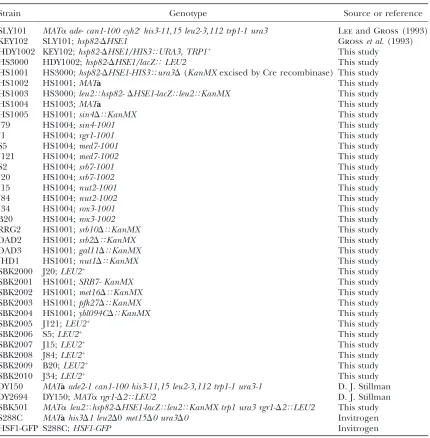
To fuse the hsp82-DHSE1 promoter to lacZ, hsp82-DHSE1 spanning nucleotides 806–1309 (relative to the initiating AUG codon) was PCR amplified and appended withSmaI and PstI sites. This fragment was cloned into the integrating vector YIp366, fusinghsp82-DHSE1with thelacZORF at codon 8. The resultanthsp82/lacZfusion was thus composed of 103 amino acids encoded by HSP82, 13 amino acids encoded by the multicloning site, and 1016 amino acids encoded bylacZ. The hsp82/lacZconstruct, linearized at the uniqueAflII site within the LEU2 gene, was then transformed into HDY1002. In-tegration into theleu2-3,112locus was confirmed by genomic PCR, creating HS3000. Strains HS1001 and HS1003 were con-structed by one-step gene disruptions in HS3000 ofURA3and LEU2, respectively, usingKanMX-loxPas described (Guldener
et al.1996). TheKanMX(Kanr) gene was excised in HS1001 by ectopically expressed Cre recombinase (Guldener et al.
TABLE 1
Yeast strains
Strain Genotype Source or reference
SLY101 MATaade- can1-100 cyh2rhis3-11,15 leu2-3,112 trp1-1 ura3 Leeand Gross(1993)
KEY102 SLY101;hsp82-DHSE1 Grosset al.(1993)
HDY1002 KEY102;hsp82-DHSE1/HIS3TURA3,TRP11 This study
HS3000 HDY1002;hsp82-DHSE1/lacZTLEU2 This study
HS1001 HS3000;hsp82-DHSE1-HIS3Tura3D(KanMXexcised by Cre recombinase) This study
HS1002 HS1001;MATa This study
HS1003 HS3000;leu2Thsp82-DHSE1-lacZTleu2TKanMX This study
HS1004 HS1003;MATa This study
HS1005 HS1001;sin4DTKanMX This study
J79 HS1004;sin4-1001 This study
J1 HS1004;rgr1-1001 This study
S5 HS1004;med7-1001 This study
J121 HS1004;med7-1002 This study
S2 HS1004;srb7-1001 This study
J20 HS1004;srb7-1002 This study
J15 HS1004;nut2-1001 This study
J84 HS1004;nut2-1002 This study
J34 HS1004;rox3-1001 This study
B20 HS1004;rox3-1002 This study
RRG2 HS1001;srb10DTKanMX This study
DAD2 HS1001;srb2DTKanMX This study
DAD3 HS1001;gal11DTKanMX This study
JHD1 HS1001;nut1DTKanMX This study
SBK2000 J20;LEU21
This study
SBK2001 HS1001;SRB7- KanMX This study
SBK2002 HS1001;met16DTKanMX This study
SBK2003 HS1001;pfk27DTKanMX This study
SBK2004 HS1001;ybl094CDTKanMX This study
SBK2005 J121;LEU21
This study SBK2006 S5;LEU21
This study
SBK2007 J15;LEU21 This study
SBK2008 J84;LEU21 This study
SBK2009 B20;LEU21
This study SBK2010 J34;LEU21
This study DY150 MATaade2-1 can1-100 his3-11,15 leu2-3,112 trp1-1 ura3-1 D. J. Stillman DY2694 DY150;MATargr1-D2TLEU2 D. J. Stillman
SBK501 MATaleu2Thsp82-DHSE1-lacZTleu2TKanMX trp1 ura3 rgr1-D2TLEU2 This study
S288C MATahis3D1 leu2D0met15D0 ura3D0 Invitrogen
1996). HS1002 and HS1004,MATaderivatives of HS1001 and HS1003, respectively, were generated by galactose-induced expression of HO endonuclease of parental strains harboring pJH132 (GAL1/HO-URA3-CEN; gift of James Haber, Brandeis University).
Other strains: To construct an hsp82-DHSE1/lacZ rgr1-D2 double-mutant strain, we crossed DY2694 (generously pro-vided by David Stillman, University of Utah) with HS1004. Diploids were selected on media lacking uracil and leucine and then sporulated. Tetrads were dissected and three spores harboring bothrgr1-D2andhsp82-DHSE1/lacZwere identified. All three were assayed for lacZ expression using a liquid b-galactosidase (b-gal) assay (see below) and found to exhibit comparable expression levels. One of them, SBK501, was em-ployed in this study. To construct asin4Dknockout of HS1001, we used theKanMX-loxPgene disruption method as described above, creating HS1005.
Selection of His1
revertants:Independent 5-ml cultures of strain HS1004 were grown overnight at 30°to saturation in 1% yeast extract, 2% peptone, and 2% glucose supplemented with 0.04 mg/ml adenine (YPDA). A total of 100–200ml of the saturated culture were spread onto synthetic medium lacking histidine and containing 1.5 mm3-aminotriazole (3-AT) and
incubated for 6–10 days at 30°. Use of 3-AT, a competitive in-hibitor of IGP dehydratase (HIS3gene product), was necessary to prevent growth of the HS1004 parental strain in the absence of a suppressing mutation. Mutagens were avoided to mini-mize the possibility of generating multiple mutations. On some plates, a large number of colonies of varying sizes were observed while on other plates no colonies were present. Colonies of varying sizes were picked and restreaked on 1.5 mm
3-AT plates lacking histidine to confirm growth of revertants. Using this method,.1000 His1
revertants were generated. Screening forlacZ expression:Each of the revertants was screened for expression of the hsp82-DHSE1/lacZ gene to confirm that the mutation affectedhsp82-DHSE1transcription and that it was acting intrans. Master plates of His1
revertants were constructed and used in XGAL assays. On average, only one in five revertants turned blue relative to the parental strain [XGALBlue(XGALB) phenotype] and thus, by definition, har-bored an extragenic suppressor mutation.
Scoring of secondary growth phenotypes: To facilitate cloning of the suppressor gene by plasmid complementation (see below), His1
XGALBsuppressors were evaluated for the presence of growth phenotypes. The following phenotypes were tested: slow growth at 30° on YPDA (Slg); inability to
grow on YPDA at 37°(temperature sensitivity, Ts); inability
to grow on YPDA at 15° (cold sensitivity); inability to grow on synthetic media lacking either inositol (Ino) or inorganic
phosphate (Pho); sensitivity to 300 mm urea (Us), 6%
ethanol (Es) 3% formamide (Fs), or 5 mmcaffeine (Caf)
(all added to YPDA); and inability to grow on YPG (1% yeast extract, 2% peptone, 3% glycerol) (Gly).
Determination of recessivity: His1
XGALB mutants were backcrossed to HS1001, a MATa Leu1
Ura counterpart of
HS1004 (see Table 1). Diploids were selected onHis,Leu syn-thetic medium and scored for theirb-gal (XGAL) and secondary growth phenotypes. In all cases, both primary and secondary phenotypes were complemented, demonstrating recessivity.
Sorting of suppressors into complementation groups: Suppressors with selectable growth phenotypes were crossed toMATaLeu1
Uraspores of each complementation group
(obtained by dissection of sporulated diploids derived from HS1001 backcrosses of a representative member). Ura1
Leu1 diploids were scored for retention of the XGALBphenotype (and, when ambiguous, the growth phenotype as well); those that did were considered members of that particular comple-mentation group.
Cloning of suppressors by plasmid complementation and confirmation by genetic linkage: EWE1: Spontaneous His1 XGALBmutant J79, exhibiting a strong Inophenotype, was
streaked on medium containing 1.0 mg/ml 5-fluoroorotic acid (FOA) to select a spontaneous FOAR(ura3) mutant. The
resultant strain, termed J79u, was transformed with a YCp50-based S. cerevisiae genomic DNA library (Rose et al. 1987).
Ura1, Ino1transformants were selected. Plasmids were then isolated from two transformants, and their inserts were se-quenced (Iowa State University DNA Sequencing and Syn-thesis Facility) using YCp50-specific primers straddling the unique BamHI site (forward primer: CTGCTCGCTTCGC TACTTGG; reverse primer: CGATATAGGCGCCAGCAACC). The genomic inserts consisted of overlapping fragments (5 kb in length) derived from chromosome XIV (spanning coor-dinates 204,917–210,464 and 204,993–210,339); both encom-passedSIN4. To demonstrate that the complementing activity was conferred bySIN4, we PCR amplified theSIN4ORF and its flanking upstream region and cloned the resultant fragment into pRS316. TheSIN4construct was then transformed into J79u and shown to complement both Inoand XGALB phe-notypes. The XGALBphenotype of two other members of this complementation group, J73 and G128, was also fully com-plemented by theSIN4plasmid. To confirm thatEWE1isSIN4, we deleted SIN4 and assayed the b-gal phenotype of the resultant strain, HS1005. It exhibited robust XGALBand liquid b-gal phenotypes (see Figure 3 below), thereby demonstrating thatEWE1isSIN4.
EWE2:Spontaneous suppressor J1 was transformed with the YCp50-based genomic library as above and selected for Ts1 transformants onUra. Three different plasmids, containing overlapping inserts (spanning coordinates 274,710–286,266, 274,104–282,500, and 273,213–278,613 of chromosome XII) and encompassingRGR1, were isolated. To further strengthen the possibility that the mutation was in fact inRGR1, J1 and two other members of theEWE2complementation group, J14 and J22, were crossed to anrgr1-D2 strain (Liet al.1995) (DY2694,
gift of David J. Stillman, University of Utah). The resultant diploids retained the XGALBand Ts
phenotypes, indicating noncomplementation. In contrast, crossing of DY2694 to S5, S2, and J15, members of the complementation groupsEWE3, EWE4, andEWE5(see below), as well as to the parental strain HS1004, resulted in complementation (XGALW). Confirma-tion that theEWE2isRGR1came from the observation that an engineered deletion of the C-terminal domain of Rgr1 (creat-ing strain SBK501 as described above) conferred a strongb-gal1 phenotype (see Figure 6A).
EWE3:Spontaneous suppressor S5 was transformed with the YCp50-based genomic library as above and selected for growth at 30°on synthetic complete medium lacking uracil and con-taining 300 mmurea (Us1phenotype). Transformants were
screened for complementation of the XGAL phenotype (XGALW), and five candidates were identified. Restriction analysis of plasmids isolated from these indicated the presence of two distinct, but overlapping inserts. They were both se-quenced and found to span coordinates 65,248–70,216 and 64,636–71,484 of chromosome XV, a locus containingMED7. MED7was therefore PCR amplified, cloned into pRS316, and transformed into S5. It was found to fully complement both XGALBand Usphenotypes. To further strengthen the
pos-sibility thatEWE3isMED7, we used homologous recombina-tion to replacePFK27(located 622 bp away fromMED7), with theKanMXmarker in strain HS1001, creating strain SBK2003. SBK2003 was then crossed to SBK2005 and SBK2006, isogenic LEU21
(KanS) derivatives of spontaneous suppressors J121 and S5, respectively. KanR, Ura1
XGALBphenotypes, thereby demonstrating that the mutation is tightly linked toMED7.
EWE4: Spontaneous suppressor S2 was transformed with YCp50 library as described above, and Us1 transformants selected. Seven were screened for their XGAL phenotype, and four showed complementation (XGALW). Three plasmids were isolated; restriction analysis indicated the inserts were related although not identical. One was sequenced and spanned coordinates 1,072,800–1,080,059 on chromosome IV. As this region encompassedSRB7, we amplified the gene and its regulatory region by PCR, cloned the product into pRS315, and transformed the resultantSRB7construct into S2. We observed that it fully complemented the Usphenotype
and partially complemented the XGALB phenotype. To strengthen the possibility thatEWE4isSRB7, we used homol-ogous recombination to target the KanMX marker 100 bp downstream of SRB7 in strain HS1001, creating strain SBK2001. SBK2001 was then crossed to SBK2000, an isogenic LEU21derivative of the spontaneous suppressor J20, and KanR, Ura1 diploids were selected, sporulated and dissected. In all cases (47 four-spore viable tetrads assayed), kanamycin resistance segregated opposite Slg and XGALB phenotypes, thereby demonstrating that the mutation is tightly linked to SRB7.
EWE5:As forEWE3andEWE4, spontaneous suppressor J15, bearing a Us growth phenotype, was transformed with the
YCp50 genomic library and complementation of its Us
phe-notype was tested at 30°. A single transformant that could grow on synthetic complete medium lacking uracil and containing 300 mmurea was identified; itslacZphenotype was similarly
complemented (XGALW). Curing of the plasmid on FOA restored Us
and XGALBphenotypes. The plasmid was iso-lated and sequenced and found to contain an insert of 10.8 kb (coordinates 869,847–880,543 on chromosome XVI). As this region encompassedNUT2, we PCR amplified the gene and its 59-flank and cloned it into pRS315. Leu1
transformants were found to be Us1
and XGALW, consistent with EWE5 being NUT2.To further strengthen this possibility, we used homol-ogous recombination to replaceMET16(located 444 bp away fromNUT2) with theKanMXmarker in strain HS1001, creat-ing strain SBK2002, and linkage analysis was conducted as described forEWE3(44 four-spore viable tetrads assayed). Kanamycin resistance segregated opposite Slg and XGALB phenotypes, thereby demonstrating that the mutation is tightly linked toNUT2.
EWE6:Spontaneous His1
XGALBsuppressor J34 (represen-tative of a complementation group of 33 members) was trans-formed as above. Transformants capable of complementing the Tsphenotype of J34 were selected. Plasmids were isolated
from four Ts1
transformants; two distinct plasmids were isolated on the basis of their restriction digestion pattern. Their inserts were sequenced and found to be15 kb in size, overlapping and derived from chromosome II (spanning coordinates 32,706–47,972 and 31,877–46,717). Both encom-passedROX3. ROX3was therefore PCR amplified and cloned into pRS316, and the resultant construct was transformed into J34. It complemented both Ts and XGALB phenotypes, implicatingEWE6as beingROX3.To strengthen this possibil-ity,YBL094C(located 491 bp away fromROX3) was replaced with KanMX, creating strain SBK2004, and this strain was crossed to SBK2009 and SBK2010, LEU21
derivatives of the spontaneous suppressors B20 and J34. Resultant diploids were selected, sporulated, and dissected (45 four-spore viable tetrads assayed). Kanamycin resistance segregated opposite Slgand XGALBphenotypes, thereby demonstrating that the mutation is tightly linked toROX3.
b-Galactosidase measurements: XGAL plate assays: To screen for suppressors and score dissected spores for lacZ
expression, we used either a highly sensitive, nonlethalb-gal plate assay as described (Duttweiler1996) or a
nitrocellu-lose filter lift assay (Vojteket al.1993).
ONPG liquid assays:Cultures were grown at 30°in YPDA to an A600of 0.3–0.7 and then split into two portions. One was
maintained at 30° (noninduced) and the other was heat-shocked at 39°for 45 min. The latter was then returned to 30° for 20 min to permit efficient export and translation oflacZ mRNA. At this point, cells were harvested and the activity of b-gal was determined from clarified extracts using this equation: units¼(10003A420)/(t3V3A600), where A420is a measure
of the absorbance of the ONPG reaction, A600is a measure of
cell density, t is time in min, andv is volume in milliliters (Ausubelet al.1995).
Microscopy: GFP images were collected with an Olympus AX70 microscope using a 41001 filter set (Chroma Technology, Brattleboro, VT), a 3100 numerical aperture 1.25 Olympus objective equipped with a Bioptechs (Butler, PA) objective heater, and a CoolSNAP HQ charge-coupled device camera (Roper Scientific, Duluth, GA).
Northern blot hybridization:Northerns were performed as described (Erkine and Gross 2003). The SSA4-specific
hybridization probe was generated by linear amplification of a PCR fragment generated using forward primer 11827– 11848 (relative to ATG) and reverse primer11922–11901. All other probes were as previously described (Erkine and
Gross 2003; Zhao et al. 2005). Hybridization signals were
detected on a Storm 860 PhosphorImager and quantified using ImageQuant 1.11 software.
Chromatin immunoprecipitation:Chromatin immunocipitation (ChIP) assays were performed as described pre-viously (Sekinger and Gross 2001), employing a polyclonal
(rabbit) antibody raised against recombinant GST–ScHSF (Erkineet al. 1996). Promoter-specific primers forSSA4
(coor-dinates relative to ATG) were forward,450–425, and reverse, 65–93. All other primer pairs were as previously described (Sekingerand Gross2001; Erkineand Gross2003).
RESULTS
in vitroand in vivo(Sorger et al.1987; Jakobsenand Pelham1988; Grosset al.1990; Erkineet al.1995, 1999; Giardina and Lis 1995; Sekinger and Gross 2001; Hahnet al.2004) (see Table 3 below). In line with this, targeted mutagenesis of high-affinity HSEs severely re-duces the basal transcription ofHSP82,HSC82, andSSA1 (McDaniel et al.1989; Parkand Craig1989; Gross et al.1993; Erkineet al.1996).
Demonstration of the constitutive nuclear localiza-tion and DNA binding of yeast HSFs raises the queslocaliza-tion of what represses its potent N- and C-terminal activation domains in the absence of stress. Several ‘‘masking’’ do-mains have been identified. These include an N-terminal repressor domain (Sorger1990), a region that overlaps the DNA-binding and trimerization domains (Nieto -Sotelo et al. 1990; Bonner et al. 1992; Chen and Parker 2002), and a heptapeptide sequence termed CE2 located adjacent to the C-terminal activation do-main ( Jakobsenand Pelham1991). While these have been traditionally thought to physically interact with one or both activation domains, the possibility of al-ternative or additional mechanisms of repression, in-cluding the recruitment of corepressors, has not been ruled out. Recently, a role for protein kinase A in main-taining HSF in a repressed state, at least with respect to its regulation ofHSP12andHSP26, has been reported (Fergusonet al.2005).
To identify additional proteins that might collaborate with HSF in regulating noninduced heat-shock gene transcription, we devised a genetic screen to isolate extragenic suppressors that restored expression to an hsp82 allele bearing a deletion of its high-affinity HSF site. This 32-bp mutation, termedDHSE1 (Grosset al. 1993), markedly diminishes affinity of the hsp82 pro-moter for HSF both in vitroand in vivo(Erkineet al. 1999; Sekinger and Gross 2001). Notably, two low-affinity HSEs are retained at this allele that are weakly occupied by HSF (Sekinger and Gross 2001). Dele-tion of HSE1 also obviates formaDele-tion of the DNase I hypersensitive (DH), nucleosome-free region charac-teristic of the wild-type promoter (Gross et al.1993). In place of the DH site—which, despite its accessibil-ity, is occupied by histones under noninducing con-ditions (Zhao et al. 2005)—are two stably positioned nucleosomes, one centered over the mutated UAS and the other centered over the core promoter (Nuc-2 and Nuc-1, respectively) (Gross et al. 1993; Venturi et al. 2000). Accompanying this structural transfor-mation is a 100-fold drop in noninduced transcription (Grosset al. 1993). Promoter chromatin architecture of wild-type and mutant hsp82 alleles is illustrated in Figure 2A.
Experimental strategy: To select for suppressors of the null expression phenotype ofhsp82-DHSE1, we fused the mutant promoter to theHIS3coding region (in a nonrevertiblehis3background), integrated the chime-ric gene into the genome, and selected for spontaneous His1revertants. In addition, to ensure the presence of an extragenic mutation, we integrated a second chromo-somal reporter gene,lacZ, regulated by the same
hsp82-DHSE1promoter, and screened His1
revertants forb-gal expression. We also targeted theDHSE1 mutation to the gene’s native locus using a similar integration strategy (summarized in Figure 2B), creating the strain termed HS1004 (see Table 1).
We selected .1000 independent His1
revertants. Roughly 1 in 5 of these restored expression of the inte-gratedhsp82/lacZreporter (as indicated by an XGALB phenotype in plate assays), consistent with the pres-ence of an extragenic suppressing mutation. We scored suppressors for conditional growth phenotypes, includ-ing temperature sensitivity; cold sensitivity; inositol or phosphate auxotrophy; and sensitivity to ethanol, caf-feine, and formamide. We also tested suppressors for enhanced sensitivity to urea (Us), which to our
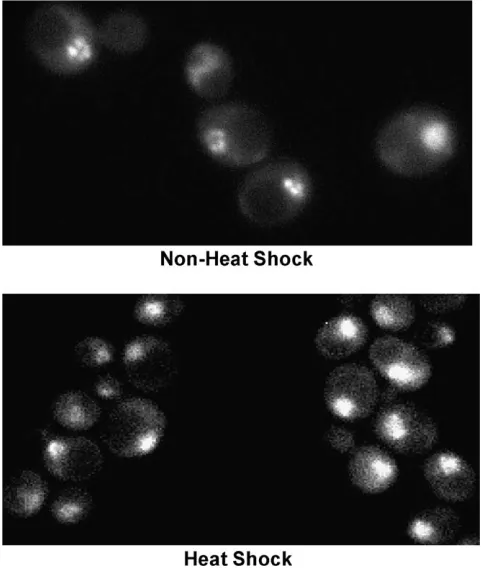
knowl-edge has not been previously examined (S. cerevisiae growth phenotypes reviewed in Hampsey 1997). We reasoned that protein-folding defects arising from spon-taneous mutations might be exacerbated by exposure to low concentrations of urea, a protein denaturant that should readily enter cells, given its small size. Indeed, a number of suppressors displayed enhanced sensitivity to 300 mmurea. Interestingly, Ussuppressors typically did not exhibit impaired growth on 3% formamide, Figure 1.—HSF localizes to the yeast nucleus under both
sensitivity to which is thought to also result from folding defects (Aguilera1994).
Suppressors were backcrossed to an isogenic strain of the opposite mating type (HS1001); all were found to be recessive. They were then sorted into complementation groups, and a representative of each, chosen on the basis of the strength of its primary (b-gal) and secondary (growth) phenotypes, was used to clone the wild-type allele from a yeast genomic library by plasmid comple-mentation. To confirm the assignment of each suppres-sor gene, we performed genetic linkage analysis or,
alternatively, engineered a mutation directly into it and assayed theb-gal phenotype of the resultant strain (see materials and methods).
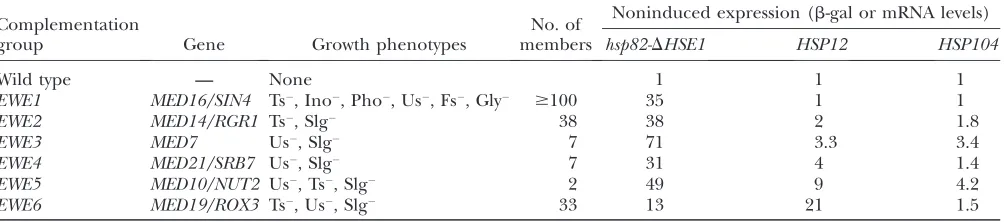
Suppressors of the hsp82-DHSE1 null transcription phenotype encode components of Mediator: All sup-pressors sorted into one of six complementation groups, termed EWE1-6 (for expression without heat-shock element). Strikingly, the genes represented by these complementation groups encode subunits of a single protein complex, pol II Mediator. Two of the six genes, EWE1/SIN4 and EWE2/RGR1, encode subunits of Mediator’s tail domain; three others, EWE3/MED7, EWE4/SRB7, and EWE5/NUT2, encode subunits of its middle domain; and the sixth,EWE6/ROX3, encodes a subunit in the head domain (summarized in Table 2). To quantify the effect of the suppressor mutations on hsp82-DHSE1expression, we measuredb-gal levels of a representative allele from each complementation group. As expected, the suppressing mutations enhanced noninducedhsp82-DHSE1expression, and in most cases quite substantially (30- to 70-fold; Figure 3A, solid bars; summarized in Table 2). The mutations also increased heat-shock-induced b-gal levels, but far less markedly (1.8- to 3.5-fold; open bars). As a consequence, the sup-pressors reduced the dynamic range of expression of hsp82-DHSE1 from 20-fold to, in most cases, ,2-fold (Figure 3B).
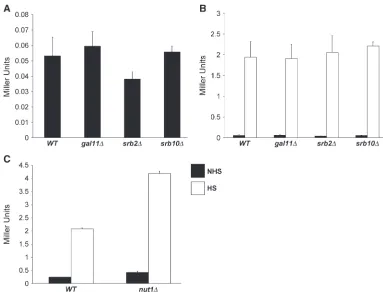
Mutations in other subunits of Mediator fail to rescue the hsp82-DHSE1 null transcription phenotype: Given the scope of the selection and the large size of several complementation groups (three containing.30 members each; Table 2), it seemed possible that we had saturated the screen. Yet our selection failed to pull out either SRB10 or GAL11, which encode well-character-ized negative regulatory subunits of Mediator. Indeed, Cdk8/Srb10, located in the loosely associated kinase module, negatively regulates transcription via its ability to phosphorylate both the CTD (Hengartner et al. 1998) and gene-specific activators (Chiet al.2001), as discussed above. Additionally, Cdk8/Srb10 may play a role in Tup1-mediated repression (Kuchin and Carlson1998). Gal11, located in the tail module, has been shown to negatively regulate transcription of genes such asSUC2andSOL4(Hanet al.2001), as well as of artificial promoter fusions (Nishizawa 2001). There-fore, as Cdk8/Srb10 and Gal11 are encoded by non-essential genes, we constructed isogenic srb10D and gal11Dderivatives of the parental strain. We also deleted SRB2, which encodes a nonessential subunit of the head domain, and NUT1, which encodes a tail domain sub-unit that negatively regulates the expression of oxidative phosphorylation genes (Beveet al.2005). However, as shown in Figure 4A, deletion ofSRB10,GAL11, orSRB2 fails to enhance the low basal expression of
hsp82-DHSE1; its induced expression is likewise unaffected (Figure 4B). The nut1D mutation was found to have a modest (approximately twofold) stimulatory effect Figure2.—Structural phenotypes ofhsp82alleles and
sup-pressor screen strategy. (A) Chromatin structure of the wild type and mutant hsp82 promoter. At the wild-type allele, HSF occupies HSE1 prior to heat shock, and all three HSEs following it. Its promoter nucleosomes are highly remodeled (DNase I hypersensitive) under non-heat-shock conditions and displaced, along with ORF nucleosomes, upon heat shock (depicted) (Zhaoet al.2005). At thehsp82-DHSE1allele, HSF
onhsp82-DHSE1transcription (Figure 4C), considerably less than the spontaneous suppressors. Therefore, Gal11, Srb10, and Nut1, despite their ability to nega-tively regulate the transcription of many genes, are functionally distinct from Ewe subunits, as is the head subunit Srb2.
Mediator mutations derepress the basal transcrip-tion of wild-typeHSP genes:We next investigated the effects of the suppressors on wild-type heat-shock gene expression. In addition to HSP82, the chaperone-encoding genesHSP12,HSP26,HSP104, andSSA4are regulated by HSF (Halladay and Craig 1995; Lee et al.2002; Fergusonet al.2005). And, as summarized in Table 3, the promoter regions of these genes are occupied by HSF even under noninducing conditions (see also Hahnet al. 2004). Nonetheless, they exhibit interesting differences in their regulation (e.g., see Ferguson et al. 2005), and their transcription might be affected by theewesuppressors in distinct ways. As shown in Figure 5, basal HSP mRNA levels generally increased in the presence of each ewe mutation. For instance, suppressor J34, harboring a spontaneous mutation inrox3, strongly enhanced the basal transcript levels of HSP12 and HSP26 (21-fold and 4.5-fold, re-spectively). J15, bearing a spontaneousnut2mutation, enhanced the noninduced expression of all four genes (3- to 9-fold), as did themed7suppressor S5 (2- to 3-fold). Furthermore, thesrb7suppressor S2 derepressedHSP12 basal transcription 4-fold.
Other suppressor/gene combinations were not as striking, such as those involving the sin4 suppressor HS1005 and thergr1suppressor J1 (Figure 5, Table 2, and data not shown). Nonetheless,rgr1-D2, encoding a C-terminal deletion of Rgr1 ( Jianget al.1995; Liet al. 1995), not only strongly derepressed thehsp82-DHSE1/ lacZreporter (Figure 6A, solid bars), thereby demon-strating thatrgr1-D2is abona fide ewesuppressor, but also significantly enhanced the basal transcription of wild-type heat-shock genes (Figure 6C). As was true for the
spontaneousewemutants, individual heat-shock genes respond somewhat differently to thergr1-D2mutation: HSP12, moderately occupied by HSF (Table 3) and coregulated by Msn2/Msn4 (Gaschet al.2000), is only weakly derepressed, whereasHSP82, strongly occupied by HSF, is strongly derepressed, as is HSP104, whose transcription is coregulated by HSF and Msn2/Msn4 (Tregeret al.1998; Grablyet al.2002). Coupled with a dramatic reduction in induced transcription (Figure 6D), HSP genes exhibit a severely compromised dynamic range of expression in context of the rgr1-D2mutation (Figure 6E). This defect is also evident for the
hsp82-DHSE1/lacZreporter (Figure 6B). We note that the spon-taneousewemutants have a comparatively weak effect on induced HSP mRNA levels (e.g., compare rgr1-1001 in Figure 5 withrgr1-D2in Figure 6).
ewesuppressors also derepress non-heat-shock gene expression: Finally, to investigate whether the ewe mutations might also derepress the basal transcription of non-HSPgenes, we assayedPHO5transcription under repressing (phosphate-rich medium) conditions. Like that ofhsp82-DHSE1, thePHO5promoter is assembled into an array of sequence-positioned nucleosomes (Almerand Horz1986). Under repressing conditions, its principal activator, Pho4, is phosphorylated by the Pho80/Pho85 cyclin–CDK complex, thereby sequester-ing it in the cytoplasm (Kaffmanet al. 1998). Under these same conditions, the Pho2 transcriptional activa-tor weakly associates with thePHO5promoter, although its presence does not lead to significant transcription (Nouraniet al.2004). Thus, noninducedPHO5 resem-bleshsp82-DHSE1in two ways: the nucleosomal state of its promoter and the constitutive presence of a gene-specific activator. And, as shown in Figure 7, spontane-ous mutations in srb7 and med7 modestly derepress PHO5 basal transcription (2.2- and 3.0-fold, respec-tively). The other suppressors had less of an effect. In other experiments, we observed that none of the sup-pressors detectably derepressedACT1(data not shown; TABLE 2
Summary ofEWEsuppressor screen
Complementation
group Gene Growth phenotypes
No. of members
Noninduced expression (b-gal or mRNA levels)
hsp82-DHSE1 HSP12 HSP104
Wild type — None 1 1 1
EWE1 MED16/SIN4 Ts, Ino, Pho, Us, Fs, Gly $100 35 1 1
EWE2 MED14/RGR1 Ts, Slg 38 38 2 1.8
EWE3 MED7 Us, Slg 7 71 3.3 3.4
EWE4 MED21/SRB7 Us, Slg 7 31 4 1.4
EWE5 MED10/NUT2 Us, Ts, Slg 2 49 9 4.2
EWE6 MED19/ROX3 Ts, Us, Slg 33 13 21 1.5
see Figure 5 legend). Thus, although the derepressing effect of individualewemutations is not limited to heat-shock genes, the Ewe module does not globally restrict pol II transcription.
DISCUSSION
EWEgenes encode subunits of the pol II Mediator: In this study, we employed a genetic screen to identify coregulators of yeast heat-shock gene transcription. The screen, which pulled out nearly 200 extragenic suppres-sors, proved to be remarkably specific. All suppressors sorted into six complementation groups, each of which contains alleles of genes encoding subunits of the pol II Mediator. Mediator is a modular and dynamic complex that connects gene-specific activators to the GTM by acting as signal sensor, integrator, and processor (re-viewed in Boube et al. 2002). We have termed these suppressorsEWE1-6. Interestingly, three EWE comple-mentation groups encode subunits—Med7, Srb7, and
Nut2—that map to the middle module of Mediator, as defined by electron microscopy andin vitro reconstitu-tion experiments (Dotsonet al.2000; Kanget al.2001). Two others encode subunits that map to its tail module (Rgr1 and Sin4), and one of the complementation groups encodes Rox3, which maps to its head module (Boubeet al.2002). All six proteins are highly conserved and have orthologs in human Mediator (Sato et al. 2004), and all but Sin4 are essential for viability. Relative locations of the Ewe subunits within Mediator are illustrated in Figure 8. Notably, Med7 and Srb7 physi-cally contact Nut2 but not each other, and Sin4 contacts Rgr1. Rox3 does not appear to contact any one of the other five.
While other genetic screens have implicated Sin4 and Rgr1 ( Jiang et al. 1995; Wang and Michels 2004); Nut2, Sin4, and Rox3 (Tabtiang and Herskowitz 1998); or Sin4, Srb7, and Rox3 (Li et al. 2005) as participants in common regulatory pathways, to our knowledge, none has identified a unified regulatory Figure 3.—ewesuppressors strongly activate
noninduced transcription of thehsp82/lacZ re-porter. (A) A representative suppressor of each complementation group was grown in rich me-dium at 30°to early log phase and then split into two aliquots, noninduced (NHS) and heat shock induced (HS). The latter culture was sub-jected to a 30°/39°thermal upshift for 45 min and allowed to recover at 30°for 20 min; then both cultures were harvested, whole-cell extracts were isolated, andb-gal levels were determined as described in materials and methods.
role for all six proteins. This raises the possibility of a functional role for the Ewe subunits distinct from those previously ascribed to the Rgr1 or Gal11/Sin4 modules (reviewed in Bjorklundand Gustafsson2004). Nota-bly, we were aided in our identification of three of the complementation groups—EWE3/MED7, EWE4/SRB7, andEWE5/NUT2—by use of a novel conditional growth phenotype, enhanced sensitivity to 300 mmurea.
It is surprising that our screen failed to pull out genes encoding chromatin-associated proteins, especially since a previous screen, using a similar strategy (selec-tion of bypass suppressors of a UAS dele(selec-tion, in the earlier case of SUC2), isolated recessive mutations in several chromatin-associated proteins, including H2A,
H2B, H3, Spt6, Spt10, and Spt16, in addition to three others: Bur1 and Bur2, which compose a cyclin/cyclin-dependent kinase heterodimer, and Bur6, a subunit of the heterodimeric NC2 negative general transcription factor (Prelichand Winston1993). The EWE screen isolated none of these. One explanation is that the repressive chromatin structure associated with the re-pressedhsp82-DHSE1promoter, illustrated in Figure 2A, is more stable than the chromatin assembling the suc2DUAS core promoter and thus not perturbed by recessive mutations in chromatin proteins. In addition, thehsp82-DHSE1promoter still retains binding sites for a gene-specific activator, whereas the suc2DUAS pro-moter retains none. It may be for this reason that the BUR screen failed to isolate any Mediator subunits, or it may be simply thatSUC2andHSP82are regulated in a distinct manner.
Sin4 may be functionally distinct from the other five Ewe subunits: It is possible that, despite representing the largest complementation group, Sin4 functions dif-ferently from the other five suppressors. We suggest this for three reasons. First, recessive mutations insin4 fre-quently act as bypass suppressors of activator defects, particularly in the context of promoter/gene fusions such as used here ( Jiang et al. 1995; Tabtiang and Herskowitz 1998; Mizuno and Harashima 2000; Wang and Michels 2004; Li et al. 2005). Second, despite strongly derepressing the hsp82-DHSE1/HIS3 and hsp82-DHSE1/lacZ fusion genes, loss-of-function sin4 mutants fail to measurably enhance the basal transcript levels of nonchimeric HSPgenes, including Figure4.—Disruption of
GAL11, SRB2, SRB10, or NUT1has little or no affect on hsp82-DHSE1 expres-sion. Wild-type (WT) and mutant strains were culti-vated, split into NHS and HS aliquots, and assayed forb-gal activity as in Figure 3. (A) Noninduced hsp82-DHSE1/lacZ expression in WT (HS1001), gal11D (DAD3), srb2D (DAD2), andsrb10D(RRG2) strains. (B) Heat-shock-induced ex-pression of hsp82-DHSE1/ lacZ(open bars) compared with nonshocked expres-sion (solid bars) in the same strains. (C) hsp82-DHSE1/ lacZexpression in WT and nut1Dstrains (HS1001 and JHD1, respectively) under NHS and HS conditions as indicated. (A–C) means 6SEM (n¼3).
TABLE 3
HSF occupancy levels
Gene Noninduced Induced
HSP12 0.7 0.7
HSP26 0.4 0.95
HSP82 1.0 2.1
HSC82 1.0 1.0
SSA3 0.2 0.65
SSA4 1.3 3.4
HSP12,HSP26, HSP104, SSA4, and hsp82-DHSE1 itself (Table 2 ; H. Singh, S. B. Kremer and D. S. Gross, unpublished observations). This is consistent with pre-vious findings that asin4null mutation derepresses an
HO/lacZfusion gene but notHOitself (Tabtiangand Herskowitz1998);sin4Dalso derepressesPHO5/lacZ but not PHO5 itself (discussed in Tabtiang and Herskowitz 1998). Third, deletion of SIN4 has little Figure5.—HSPgene
ex-pression ofewesuppressors under control and heat-shock-inducing conditions. Northern analysis of wild-type (WT; HS1004), rgr1 ( J1),rox3 ( J34),srb7 (S2), nut2( J15), and med7(S5) strains cultivated in rich medium to early log phase in 30°. Cultures were either maintained at 30° (basal) or shifted to 39° for 15 min (induced) prior to iso-lation of total cellular RNA. Steady-stateHSPmRNA lev-els were detected using gene-specific probes; sig-nals were normalized to those ofACT1(y-axis values are quotients:HSPmRNA/ ACT1 mRNA). ACT1 ex-pression, in turn, was inde-pendently quantified in each suppressor mutant rel-ative to the abundance of the pol III transcript, SCR1, and found to be unaffected (S. B. Kremer
and D. S. Gross, data not
effect on inducedHSP12 and HSP26 transcript levels (S. B. Kremer and D. S. Gross, unpublished observa-tions), in marked contrast to the dramatic reductions observed in thergr1-D2mutant and also seen to some degree in the other spontaneous ewe mutants. Taken together, these observations argue against Sin4 being functionally equivalent to the other five Ewe subunits in regulating heat-shock gene expression.
Inactivating mutations in Ewe subunits likely in-crease the synthesis, rather than the stability, of HSP
mRNAs: By the criteria of both liquid b-galactosidase and Northern hybridization assays, ewe mutations in-crease heat-shock gene expression. While it is formally
possible that these mutations act by increasing HSP transcript stability, three lines of evidence argue that they act principally by enhancing HSP transcription. First, the abundance of bothHSPgene transcripts and those ofhsp82/lacZincreases inewemutants. AsHSP82 mRNA stability determinants map to its 39-UTR (S. Lindquist, personal communication), and the 39-UTR of thehsp82/lacZ transcript consists exclusively oflacZ sequence, the increase in hsp82/lacZ abundance is unlikely to stem from an HSP gene-specific enhance-ment of transcript stability. Second, a general increase in pol II transcript levels, while providing a possible explanation, is also unlikely, given that we measured Figure 6.—The
C-termi-nal truncation mutant rgr1-D2 strongly enhances the basal transcription of both hsp82-DHSE1 and wild-type HSPgenes, while drastically reducing their induced tran-scription. (A)hsp82-DHSE1/ lacZ(b-gal) expression levels in RGR11 (HS1004) and rgr1-D2(SBK501) strains un-der noninducing and heat-shock-inducing conditions were determined as in Figure 3. Shown are means 6SEM (n¼4). (B) Dynamic range of expression of the strains analyzed in A. Dashed line indicates a level of 1.0 (no induction). (C and D). Northern analyses of RGR11
abundance of HSP mRNAs relative to that of ACT1 mRNA; such an increase would probably be incompat-ible with cell viability as well. Third, heat-shock-induced HSP mRNA levels are not increased, and indeed are
generally diminished, in ewemutants. Thus, ifewe sup-pressors act to increaseHSPmRNA stability, they would do so only under nonstressful conditions, which we believe is unlikely.
How mightewesuppressors act to negatively regulate heat-shock gene transcription? Repeated isolation of the Ewe subunits as suppressors of hsp82-DHSE1 sug-gests that they compose a functionally distinct module within Mediator. Indeed, targeted deletion of SRB2, SRB10, orGAL11fails to suppress, even slightly, the null transcription phenotype ofhsp82-DHSE1, and anut1D
mutation only weakly suppresses. Our findings are con-sistent with previous work showing that an srb10D
mutation has little effect on the constitutive expression of HSP82, HSC82, and SSA1 (Holstege et al. 1998). Therefore, an important functional role for the Ewe subunits is to negatively regulate noninducedHSPgene transcription. How might they accomplish this?
One possibility is thatewemutations act indirectly to derepressHSP(and other) gene promoters. That is, the ewemutations may impair the expression of gene(s) that themselves negatively regulate constitutive HSP tran-scription. However, it seems unlikely that an unbiased selection such as the one described here would isolate six subunits of Mediator yet fail to isolate a single gene whose protein product directly regulates the
hsp82-DHSE1promoter, as well as the promoters of wild-type Figure7.—Basal transcription ofPHO5is elevated in the
context of certainewemutations. Northern analysis of wild-type (WT; HS1004), rgr1 ( J1), rox3 ( J34), srb7 (S2), nut2 ( J15), andmed7(S5) strains cultivated in rich YPDA medium to early log phase in 30°.PHO5transcript levels were normal-ized to those ofACT1. Depicted are means of two indepen-dent experiments6SD.
Figure 8.—Location of
Ewe subunits within yeast pol II Mediator as depicted in an integrated interaction map. Subunit locations were deduced from the out-come of pairwise two-hybrid assays (Guglielmiet al.2004
and references therein). Modified from Gugliemi
HSPgenes. Indeed, a direct role for Mediator in gov-erning the noninduced expression of heat-shock genes is suggested by the fact that Mediator subunits have been detected within the upstream regions of several heat-shock genes, including HSP12, HSP82, HSP104, andSSA4, in cells grown under nonstressful conditions (30°, midlog growth phase) in a genomewide analysis ( J.-C. Andrauand F. Holstege, personal communica-tion). In this regard, Mediator, through its Ewe module, may act directly to repress basal heat-shock gene tran-scription. This could be achieved by impairing the re-cruitment of GTFs (including RNA pol II itself) and/or impairing their assembly into a functionally competent PIC. Other scenarios are also possible and are the sub-ject of current investigation.
It is intriguing to consider that in repressing basal transcription, the Ewe module may serve a role similar to that of the TFIIB recognition element (BRE), mu-tation of which has been shown to result in a similar phenotype in mammalian systems: loss of the dyna-mic range of expression due to a loss of repression of basal transcription (Evanset al.2001). Thus, both the Mediator components identified here and the BRE may function to regulate the transition of the PIC from an initiation-competent to an elongation-competent complex.
ewemutations can severely impair induced transcrip-tion:Evidence for a positive role of the Ewe module in activated transcription comes from expression assays of heat-shock-induced cells. These reveal a drastic reduc-tion in induced transcript levels of wild-type heat-shock genes in thergr1-D2mutant and, to a lesser extent, in the spontaneousrgr1-1001andnut2-1001mutants. Our data thus lend support to earlier speculation that HSF activates transcription of its target genes via a Mediator subcomplex containing Rgr1, Nut2, and Srb7 (Leeet al. 1999). Of note, the strong requirement for Rgr1 in HSF activation contrasts dramatically with the dispensability of other GTFs, including the Srb4 and Srb6 subunits of Mediator, the TFIIH kinase, and the pol II CTD (see the Introduction).
A special role for Mediator at promoters with con-stitutively bound activators:It is tempting to speculate that Mediator evolved to negatively regulate nonin-duced heat-shock gene transcription since HSF, unlike many inducible yeast activators, constitutively resides in the nucleus where it binds high-affinity target sequen-ces. Thus, Mediator may be needed to prevent promis-cuous heat-shock gene transcription. In theewemutants identified here, Mediator’s negative regulatory role is compromised and basalHSPgene transcription is sig-nificantly elevated. It might be anticipated that other constitutively bound activators will exhibit a similar requirement, and indeed we find thatPHO5, bearing a constitutively bound activator, is derepressed byewe mu-tants. On the other hand, the nucleosomal nature of the noninduced HSP821
promoter (Sekingerand Gross
2001; Erkineand Gross2003; Zhaoet al.2005), shared by otherHSPgene promoters (Erkineet al.1996) and greatly pronounced in mutants such as hsp82-DHSE1 (Grosset al.1993), might elicit a requirement for Me-diator, although the reason for this is unclear. Clearly, additional work will be required to distinguish between these and other potential mechanisms by which the Ewe module of Mediator governs gene transcription.
We thank Xin Liu, Elena V. Sambuk, Geraldine Alba, Jorge Herrera-Diaz, Christina Venturi, Beth Zweig, Staci Deaton, Jana K. Shirey, and Lindsey Garner for technical assistance; Mike Hampsey for helpful suggestions during the early stages of this project; Kelly Tatchell for assistance with microscopy; David Stillman and James Haber for providing strains and plasmids; Michel Werner for permission to re-produce the interaction map of yeast Mediator; and Sri Balakrishnan and Susan Gross for helpful comments on the manuscript. This work was supported by grants awarded to D.S.G. from the National Institutes of Health (GM45842), the National Science Foundation (MCB-0450419), and the Biomedical Research Institute and Feist-Weiller Can-cer Center of the Louisiana State University Health Sciences Center.
LITERATURE CITED
Aguilera, A., 1994 Formamide sensitivity: a novel conditional
phe-notype in yeast. Genetics136:87–91.
Almer, A., and W. Horz, 1986 Nuclease hypersensitive regions with
adjacent positioned nucleosomes mark the gene boundaries of thePHO5/PHO3locus in yeast. EMBO J.5:2681–2687. Amoros, M., and F. Estruch, 2001 Hsf1p and Msn2/4p cooperate
in the expression of theSaccharomyces cerevisiaegenesHSP26and
HSP104 in a gene- and stress type-dependent manner. Mol. Microbiol.39:1523–1532.
Apone, L. M., C. A. Virbasius, F. C. P. Holstege, J. Wang, R. A.
Younget al., 1998 Broad, but not universal, transcriptional
re-quirement for yTAFII17, a histone H3-like TAFIIpresent in TFIID
and SAGA. Mol. Cell2:653–661.
Ausubel, F. M., R. Brent, R. E. Kingston, D. D. Moore, J. G.
Seidmanet al., 1995 Current Protocols in Molecular Biology.John
Wiley & Sons, New York.
Beve, J., G. Z. Hu, L. C. Myers, D. Balciunas, O. Werngrenet al.,
2005 The structural and functional role of med5 in the yeast mediator tail module. J. Biol. Chem.280:41366–41372. Bhoite, L. T., Y. Yuand D. J. Stillman, 2001 The Swi5 activator
recruits the Mediator complex to the HO promoter without RNA polymerase II. Genes Dev.15:2457–2469.
Bjorklund, S., and C. M. Gustafsson, 2004 The mediator
com-plex. Adv. Protein Chem.67:43–65.
Bonner, J. J., S. Heywardand D. L. Fackenthal, 1992
Temperature-dependent regulation of a heterologous activation domain fused to yeast heat shock transcription factor. Mol. Cell. Biol.12:1021– 1030.
Boube, M., L. Joulia, D. L. Cribbsand H.-M. Bourbon, 2002
Evi-dence for a Mediator of RNA polymerase II transcriptional reg-ulation conserved from yeast to man. Cell110:143–151. Boy-Marcotte, E., M. Perrot, F. Bussereau, H. Boucherieand
M. Jacquet, 1998 Msn2p and Msn4p control a large number
of genes induced at the diauxic transition which are repressed by cyclic AMP in Saccharomyces cerevisiae. J. Bacteriol. 180:
1044–1052.
Brown, T. A., C. Evangelistaand B. L. Trumpower, 1995
Reg-ulation of nuclear genes encoding mitochondrial proteins in Saccharomyces cerevisiae. J. Bacteriol.177:6836–6843. Bryant, G. O., and M. Ptashne, 2003 Independent recruitment
in vivo by Gal4 of two complexes required for transcription. Cell
11:1301–1309.
Bulman, A. L., S. T. Hubl and H. C. Nelson, 2001 The
Carlson, M., 1997 Genetics of transcriptional regulation in yeast:
connections to the RNA polymerase II CTD. Annu. Rev. Cell Dev. Biol.13:1–23.
Chen, T., and C. S. Parker, 2002 Dynamic association of
transcrip-tional activation domains and regulatory regions inSaccharomyces cerevisiaeheat shock factor. Proc. Natl. Acad. Sci. USA99:1200– 1205.
Chi, Y., M. J. Huddleston, X. Zhang, R. A. Young, R. S. Annan
et al., 2001 Negative regulation of Gcn4 and Msn2 transcription factors by Srb10 cyclin-dependent kinase. Genes Dev.15:1078– 1092.
Chou, S., S. Chatterjee, M. Lee and K. Struhl, 1999
Tran-scriptional activation in yeast cells lacking transcription factor IIA. Genetics153:1573–1581.
Cosma, M. P., S. Panizzaand K. Nasmyth, 2001 Cdk1 triggers
as-sociation of RNA polymerase to cell cycle promoters only after recruitment of the mediator by SBF. Mol. Cell7:1213–1220. Dotson, M. R., C. X. Yuan, R. G. Roeder, L. C. Myers, C. M.
Gustafssonet al., 2000 Structural organization of yeast and
mammalian mediator complexes. Proc. Natl. Acad. Sci. USA
97:14307–14310.
Duttweiler, H. M., 1996 A highly sensitive and non-lethal
beta-galactosidase plate assay for yeast. Trends Genet.12:340–341. Erkine, A. M., and D. S. Gross, 2003 Dynamic chromatin
altera-tions triggered by natural and synthetic activation domains. J. Biol. Chem.278:7755–7764.
Erkine, A. M., C. C. Adams, M. Gaoand D. S. Gross, 1995 Multiple
protein-DNA interactions over the yeastHSC82heat shock gene promoter. Nucleic Acids Res.23:1822–1829.
Erkine, A. M., C. C. Adams, T. Dikenand D. S. Gross, 1996 Heat
shock factor gains access to the yeastHSC82promoter indepen-dently of other sequence-specific factors and antagonizes nucle-osomal repression of basal and induced transcription. Mol. Cell. Biol.16:7004–7017.
Erkine, A. M., S. F. Magrogan, E. A. Sekingerand D. S. Gross,
1999 Cooperative binding of heat shock factor to the yeast
HSP82promoterin vivoandin vitro.Mol. Cell. Biol.19:1627– 1639.
Evans, R., J. A. Fairley and S. G. E. Roberts, 2001
Activator-mediated disruption of sequence-specific DNA contacts by the general transcription factor TFIIB. Genes Dev.15:2945–2949. Ferguson, S. B., E. S. Anderson, R. B. Harshaw, T. Thate, N. L.
Craiget al., 2005 Protein kinase A regulates constitutive
ex-pression of small heat-shock genes in an Msn2/4p-independent and Hsf1p-dependent manner inSaccharomyces cerevisiae.Genetics
169:1203–1214.
Flanagan, P. M., R. J. Kelleher, M. H. Sayre, H. Tschochner
and R. D. Kornberg, 1991 A mediator required for activation
of RNA polymerase II transcription in vitro. Nature 350:
436–438.
Gasch, A. P., P. T. Spellman, C. M. Kao, O. Carmel-Harel, M. B.
Eisen et al., 2000 Genomic expression programs in the
re-sponse of yeast cells to environmental changes. Mol. Biol. Cell.
11:4241–4257.
Giardina, C., and J. T. Lis, 1995 Dynamic protein-DNA architecture
of a yeast heat shock promoter. Mol. Cell. Biol.15:2737–2744. Grably, M. R., A. Stanhill, O. Telland D. Engelberg, 2002 HSF
and Msn2/4p can exclusively or cooperatively activate the yeast HSP104 gene. Mol. Microbiol.44:21–35.
Gromoller, A., and N. Lehming, 2000 Srb7p is a physical and
phys-iological target of Tup1p. EMBO J.19:6845–6852.
Gross, D. S., K. E. English, K. W. Collinsand S. Lee, 1990
Ge-nomic footprinting of the yeastHSP82promoter reveals marked distortion of the DNA helix and constitutive occupancy of heat shock and TATA elements. J. Mol. Biol.216:611–631.
Gross, D. S., C. C. Adams, S. Leeand B. Stentz, 1993 A critical role
for heat shock transcription factor in establishing a nucleosome-free region over the TATA-initiation site of the yeastHSP82heat shock gene. EMBO J.12:3931–3945.
Guglielmi, B., N. L.vanBerkum, B. Klapholz, T. Bijma, M. Boube
et al., 2004 A high resolution protein interaction map of the yeast Mediator complex. Nucleic Acids Res.32:5379–5391. Guidi, B. W., G. Bjornsdottir, D. C. Hopkins, L. Lacomis, H.
Erdjument-Bromageet al., 2004 Mutual targeting of mediator
and the TFIIH kinase Kin28. J. Biol. Chem.279:29114–29120.
Guldener, U., S. Heck, T. Fiedler, J. Beinhauer and J. H.
Hegemann, 1996 A new efficient gene disruption cassette for
repeated use in budding yeast. Nucleic Acids Res.24:2519–2524. Hahn, J. S., Z. Hu, D. J. Thieleand V. R. Iyer, 2004 Genome-wide
analysis of the biology of stress responses through heat shock transcription factor. Mol. Cell. Biol.24:5249–5256.
Halladay, J. T., and E. A. Craig, 1995 A heat shock transcription
factor with reduced activity suppresses a yeast HSP70 mutant. Mol. Cell. Biol.15:4890–4897.
Hampsey, M., 1997 A review of phenotypes in Saccharomyces
cere-visiae. Yeast13:1099–1133.
Han, S. J., Y. C. Lee, B. S. Gim, G. H. Ryu, S. J. Park et al.,
1999 Activator-specific requirement of yeast mediator proteins for RNA polymerase II transcriptional activation. Mol. Cell. Biol
19:979–988.
Han, S. J., J. S. Lee, J. S. Kangand Y. J. Kim, 2001 Med9/Cse2 and
Gal11 modules are required for transcriptional repression of a distinct group of genes. J. Biol. Chem.276:37020–37026. Hashikawa, N., and H. Sakurai, 2004 Phosphorylation of the yeast
heat shock transcription factor is implicated in gene-specific ac-tivation dependent on the architecture of the heat shock ele-ment. Mol. Cell. Biol.24:3648–3659.
Hengartner, C. J., V. E. Myer, S.-M. Liao, C. J. Wilson, S. S. Koh
et al., 1998 Temporal regulation of RNA polymerase II by Srb10 and Kin28 cyclin-dependent kinases. Mol. Cell2:43–53. Holstege, F. C. P., E. G. Jennings, J. J. Wyrick, T. I. Lee, C. J.
Hengartneret al., 1998 Dissecting the regulatory circuitry of
a eukaryotic genome. Cell95:717–728.
Ito, M., C. X. Yuan, S. Malik, W. Gu, J. D. Fondell et al.,
1999 Identity between TRAP and SMCC complexes indicates novel pathways for the function of nuclear receptors and diverse mammalian activators. Mol. Cell3:361–370.
Ito, M., C. X. Yuan, H. J. Okano, R. B. Darnelland R. G. Roeder,
2000 Involvement of the TRAP220 component of the TRAP/ SMCC coactivator complex in embryonic development and thy-roid hormone action. Mol. Cell5:683–693.
Jakobsen, B. K., and H. R. B. Pelham, 1988 Constitutive binding of
yeast heat shock factor to DNAin vivo.Mol. Cell. Biol.8:5040–5042. Jakobsen, B. K., and H. R. B. Pelham, 1991 A conserved
heptapeptide restrains the activity of the yeast heat shock tran-scription factor. EMBO J.10:369–375.
Jiang, Y. W., P. R. Dohrmannand D. J. Stillman, 1995 Genetic and
physical interactions between yeast RGR1 and SIN4 in chromatin organization and transcriptional regulation. Genetics140:47–54. Kaffman, A., N. M. Rank, E. M. O’Neill, L. S. Huangand E. K.
O’Shea, 1998 The receptor Msn5 exports the phosphorylated
transcription factor Pho4 out of the nucleus. Nature396:482–486. Kandror, O., N. Bretschneider, E. Kreydin, D. Cavalieri and
A. L. Goldberg, 2004 Yeast adapt to near-freezing
tempera-tures by STRE/Msn2,4-dependent induction of trehalose synthe-sis and certain molecular chaperones. Mol. Cell13:771–781. Kang, J. S., S. H. Kim, M. S. Hwang, S. J. Han, Y. C. Leeet al.,
2001 The structural and functional organization of the yeast mediator complex. J. Biol. Chem.276:42003–42010.
Kelleher, R. J., P. M. Flanaganand R. D. Kornberg, 1990 A novel
mediator between activator proteins and the RNA polymerase II transcription apparatus. Cell61:1209–1215.
Kim, T. W., Y. J. Kwon, J. M. Kim, Y. H. Song, S. N. Kim et al.,
2004 MED16 and MED23 of Mediator are coactivators of lipo-polysaccharide- and heat-shock-induced transcriptional activa-tors. Proc. Natl. Acad. Sci. USA101:12153–12158.
Koleske, A. J., and R. A. Young, 1994 An RNA polymerase II
holo-enzyme responsive to activators. Nature368:466–469. Kuchin, S., and M. Carlson, 1998 Functional relationships of
Srb10-Srb11 kinase, carboxy-terminal domain kinase CTDK-I, and tran-scriptional corepressor Ssn6-Tup1. Mol. Cell. Biol.18:1163–1171. Kuras, L., T. Borggrefeand R. D. Kornberg, 2003 Association of
the Mediator complex with enhancers of active genes. Proc. Natl. Acad. Sci. USA100:13887–13891.
Lee, D., and J. T. Lis, 1998 Transcriptional activation independent
of TFIIH kinase and the RNA polymerase II mediatorin vivo.
Nature393:389–392.
Lee, D.-K., S. Kimand J. T. Lis, 1999 Different upstream