www.biogeosciences.net/10/7435/2013/ doi:10.5194/bg-10-7435-2013
© Author(s) 2013. CC Attribution 3.0 License.
Biogeosciences
Subcritical water extraction to isolate kinetically different soil
nitrogen fractions
S. Sleutel1, M. A. Kader1,2, K. Demeestere3, C. Walgraeve3, J. Dewulf3, and S. De Neve1 1Department of Soil Management, Ghent University, Coupure Links 653, 9000 Gent, Belgium 2Department of Soil Science, Bangladesh Agricultural University, Mymensingh 2202, Bangladesh
3Department of Sustainable Organic Chemistry and Technology, Research Group EnVOC, Ghent University,
Coupure Links 653, 9000 Gent, Belgium
Correspondence to: S. Sleutel ([email protected])
Received: 2 May 2013 – Published in Biogeosciences Discuss.: 17 June 2013
Revised: 18 September 2013 – Accepted: 27 September 2013 – Published: 19 November 2013
Abstract. Soil organic N is largely composed of inherently biologically labile proteinaceous N and its persistence in soil is mainly explained by stabilization through binding to min-erals and other soil organic matter (SOM) components at varying strengths. In order to separate kinetically different soil N fractions we hypothesize that an approach which iso-lates soil N fractions on the basis of bonding strength is re-quired, rather than employing chemical agents or physical methods. We developed a sequential subcritical water extrac-tion (SCWE) procedure at 100, 150 and 200◦C to isolate
SOM fractions. We assessed these SCWE N fractions as pre-dictors for aerobic and anaerobic N mineralization measured from 25 paddy soil cores in incubations. SCWE organic car-bon (SCWE OC) and N (SCWE N) increased exponentially with the increase of temperature and N was extracted pref-erentially over OC. The efficiency of SCWE and the selec-tivity towards N were both lower in soils with increasingly reactive clay mineralogy. Stepwise linear regression found no relations between the SCWE fractions and the anaero-bic N mineralization rate but instead with pH and a model parameter describing the temperature dependency of SCWE extraction. Both were linked to texture, mineralogy and con-tent of pedogenic oxides, which suggests an indirect relation between anaerobic NH+4 release and these edaphic soil fac-tors. N mineralization appeared to be largely decoupled from SOM quantity and quality. From the present study on young paddy soils low in pedogenic oxides and with high fixed NH+4 content we cannot infer the performance of SCWE to isolate bio-available N in more developed upland soils. There may be potential to separate kinetically different SOM pools
from upland soils because 1◦for aerobic N mineralization at 100–150◦C SCWE N was the best predictor; and 2◦SCWE selectively extracted N over C and this preference depended on the mineralogical composition. Hence N fractions dif-fering in bonding strength with minerals or SOM might be isolated at different temperatures, and specifically this asso-ciation has frequently been found a prominent stabilization mechanism of N in temperate region cropland soils.
1 Introduction
Li et al. (2011) found that the soil’s C : N ratio, acid KMnO4 -NH+4-N, alkaline KMnO4-NH+4-N, phosphate-borate buffer extractable NH+4-N, phosphate-borate buffer hydrolysable NH+4-N and hot KCl extractable NH+4-N were all signifi-cantly (P <0.05) correlated to total N uptake by rice plants. However, the relation between such chemical soil N fractions and N supplying processes actually occurring in the soil is weak and chemical approaches do not represent physical as-pects of bio-availability of N. For instance, physical occlu-sion of particulate organic matter in microaggregates slows its microbial consumption (e.g. Six et al., 2000). In addi-tion, soil structure controls microbial community structure and thereby indirectly determines soil N supply. For exam-ple, in soil with a larger proportion of 15–30 µm pore necks, Sleutel et al. (2011) found a promotion of fungi over bacte-ria. Since both decomposer groups have differing C : N ratios and N requirements, variation in microbial community struc-ture logically results in differing utilization of OM and in mineral N release. In addition, chemical extractions gener-ate artefacts, e.g. acid hydrolysis, aimed at removing labile organic matter, also liberates mineral bound OM by disso-lution of Fe oxides at low pH (Kögel-Knabner et al., 2008). As a result, the development of a single chemical N index that is applicable to many types of soils, crops, and locations has not been successful (Wilson et al., 1994). In fact from an extensive meta-analysis Ros et al. (2011) concluded that the relationship between extractable OM and soil N supply is mostly an indirect relationship reflecting the soil’s OM con-tent.
Organic N is largely composed of inherently biologi-cally labile proteinaceous N ranging between 40 % (Schul-ten and Schnitzer, 1998) and 80 % (Knicker, 2000), and a smaller share is present as heterocyclic N. Persistence of soil N is primarily explained by stabilization through bind-ing to minerals and other SOM components and Leinwe-ber and Schulten (2000), for example, revealed a substan-tial part of proteinaceous and heterocyclic N to be selectively bound to pedogenic oxides. Appelqvist et al. (1996), in addi-tion, demonstrated linkages between amino acids and humic acids and based on extensive molecular modelling Schul-ten and Schnitzer (1997) suggested that proteinaceous ma-terials can be trapped in the voids of the three-dimensional structure of humic substances. In an alternative view on the physicochemical organization of soil organic matter, Kleber et al. (2007) instead hypothesized that proteinaceous N is en-riched close to mineral surfaces and shielded by an outer zone of more hydrophobic SOM constituents. Regardless of the conceptual model, variation in strength of N-mineral and N-OM linkages is likely to determine variation in bio-availability of organic N and susceptibility to mineraliza-tion. Physical fractionation methods are limited in their abil-ity to further subdivide this continuum of bound organic N, because of practical constraints to subdivide the clay size fraction which, however, does contain the majority of soil
N. Therefore an alternative approach, which isolates soil N fractions on the basis of bonding strength may be required, ideally then with respect to dissolvability into water instead of size or density or solubility in chemical agents. In addi-tion, the release of “fixed” NH+4 is often an important crop supply of mineral N in paddy soils (Schneiders and Scherer, 1998), next to N mineralization. It has become clear that there also exists a continuum in the bio-availability of fixed NH+4 (Nieder et al., 2011), which is linked to its association with soil minerals. Commonly, a distinction is made between “native fixed” and “recently fixed” NH+4, where the former is probably trapped in the centre of clay interlayers to a higher degree, while the latter pool is largely retained in the periph-eral zone of the interlayers (Nommik and Vahtras, 1982).
We hypothesize that soil N extracted by water at increas-ing temperatures would reflect organic and inorganic N frac-tions with increasing bonding strength, which in turn should correspond to decreasing bio-availability. Indeed, Kalbitz et al. (2005) amongst others concluded that strength of sorp-tion reflects stability of the sorbed OM against biodegrada-tion. Although water has frequently been used to quantify labile N or plant available N (e.g. Chantigny et al., 2010; and Curtin et al., 2006) or labile C (Sparling et al., 1998; Ghani et al., 2003) extraction of SOM has most often been limited to a temperature of 100◦C due to the difficulties of keeping it in a liquid state above 100◦C. This has limited the potential of water extraction to the isolation of readily bio-available SOM. Accelerated solvent extractors now con-veniently offer the ability to extract soil samples with sol-vents at higher temperatures. By raising the inner pressure in metal extraction cells containing the soil sample, subcritical (100–375◦C) and supercritical (>375◦C) water have been
2 Materials and methods
2.1 Soils
A set of 25 paddy soils was previously collected (Kader et al., 2013) from agricultural fields throughout northern Bangladesh, which has a subtropical monsoon climate (an-nual mean temperature of 25.8◦C and annual precipitation of 2428 mm; Bangladesh Meteorological Department, 2011). Either one or two rice crops were cultivated per year on the sampled fields. Surface soil samples (0–15 cm) were col-lected from 15 locations per field by means of an auger (di-ameter 2.5 cm). These samples were bulked into one com-posite sample and were thoroughly mixed. The field’s moist soil was gently broken apart by hand, air dried and ground to pass a 2 mm sieve prior to further analysis.
2.2 Analysis of soil properties, N mineralization and clay mineralogy
Soil texture, soil C and N content, pH in KCl (pHKCl), NH4 -oxalate extractable Fe, Al and Mn (Feox, Alox, Mnox) were determined on all 25 soils by Kader et al. (2013) (Table 1). Briefly, the soil texture of the collected soil samples ranged from sand to clay with most soils being silt loams. With an average pHKClof 4.5, all soils were moderately acidic (Ta-ble 1). There were wide ranges in C and N content with averages of 14.40±7.14 g C kg−1and 1.48±0.66 g N kg−1. Ammonium oxalate extractable Fe also varied widely (1.1– 8.3 g Fe kg−1), while variation in Aloxand Mnoxwas limited. Fixed NH+4 was determined by the Silva and Bremner method (Silva and Bremner, 1966), which consists of two steps. First, oxidation by alkaline KOBr removes exchange-able NH+4 and organic N. Then treatment with a 5 N HF-1N HCl solution dissolves clay containing fixed NH+4. The NH+4 released by the HF-HCl treatment was then determined by steam distillation.
N mineralization was assessed earlier by Kader et al. (2013) by monitoring the release of NH4and NO3under controlled aerobic and anaerobic conditions. Briefly, for each soil 42 PVC tubes (5 cm diameter) were filled with 200 g of dry soil, 21 (3 replicates×7 dates) for aerobic and 21 (3 replicates×7 dates) for anaerobic incubation. Soil moisture content was brought to 50 % water filled pore space for as-sessment of aerobic N mineralization and soils were over-saturated with a standing water level of 2 cm for assessment of anaerobic N mineralization. Every two weeks, soils were sampled destructively by removing the soil from one tube per replicate. The aerobic N mineralization rates were esti-mated by fitting a zero-order kinetic model to the soil min-eral N data:N (t )=N0+k0t, wheret is the time (in days), N (t )is the amount of mineral N at timet,N0is the initial amount of mineral N (mg N kg−1), andk0is the linear N min-eralization rate (mg N kg−1day−1). The anaerobic N miner-alization data were best described with a first-order model:
N (t )=NA(1−exp(−k1t )), withNAthe mineralizable N and k1a first-order rate parameter.
The clay fraction’s mineralogical composition was identi-fied by X-ray diffraction on oriented samples after (i) K and Mg saturation, (ii) glycerol solvation, and (iii) drying of the K saturated samples at 300 and 550◦C for 2 h, as described in detail by Kader et al. (2013).
2.3 Subcritical water extraction
Soils were sequentially extracted with pressurized (10,3– 11,7 MPa) liquid water at 100, 150 and 200◦C with an ASE 350 Accelerated Solvent Extractor (Dionex, Amster-dam, the Netherlands). The extraction residue at each tem-perature step was utilized for the next extraction, so that the 150 and 200◦C extracts exclude the 100◦C and 100 + 150◦C
extractable material respectively. We limited the upper ex-traction temperature to 200◦C as, previously, Schnitzer et
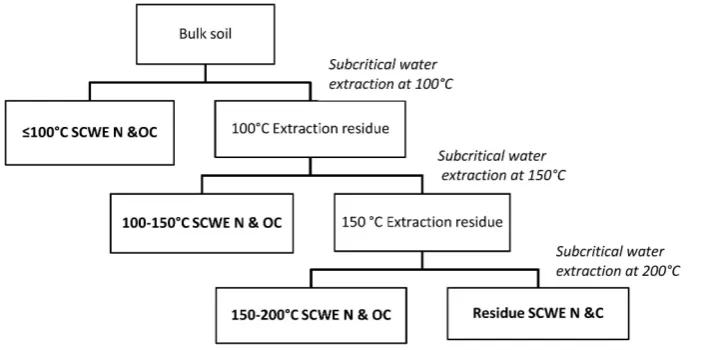
al. (1991) found rapid thermal degradation of SOM compo-nents around 250◦C. Soil samples of 7 g were mixed with acid washed sand at a 1 : 2 weight ratio in 22 mL capacity Dionex stainless steel extraction cells (equipped with PEEK seal ring and Viton O-rings) to achieve an adequate perme-ability for perfusion of the subcritical water. Quartz filters (27 mm) were fitted at the bottom and top of each cell. Each extraction cycle consisted of different steps: filling of the cell with water, heating, stationary extraction (static cycle time: 5 min, number of static cycles: 1), rinsing the cell with fresh deionized water (rinsing volume 60 %), and finally purging (80 s) with N2gas. The extracts were collected in 60 mL glass vials and their volumes were determined by weight differ-ence with the empty vials. At the end of the sequential ex-tractions, the solid residues were removed from the cells and were oven dried at 105◦C (Fig. 1). Subcritical water extrac-tions were carried out in twofold.
2.4 Carbon and nitrogen analysis
Table 1. Soil properties of sampled agricultural fields in Bangladesh (data from Kader et al., 2013).
Soil Soil Cropping Soil particles Soil Soil C : N pHKCl Fixed- NH4-oxalate
series type pattern∗ (%) OC N ratio (–) NH+4 extractable (g kg−1)
>50 2–50 <2 (g kg−1) (g kg−1) (–) (g kg−1) Feox Alox Mnox
µm µm µm
1 Sonatala-1 Aeric Haplaquepts R-F-R 4 76 20 21.4 2.1 10.4 5.6 0.22 5.1 0.9 0.4
2 Sonatala-2 Aeric Haplaquepts R-F-R 13 73 14 16.3 1.7 9.6 5.2 0.21 4.9 0.8 0.3
3 Faridgonj Aeric Haplaquepts R-F-R 14 79 7 11.4 1.2 9.5 5.3 – 2.2 0.6 0.2
4 Noakhali Arents V-V-R 9 79 12 10.0 1.1 9.4 5.7 – 2.9 0.7 0.1
8 Silmondi-1 Aeric Haplaquepts R-R/F-R 14 59 27 16.4 1.6 10.1 5.5 0.13 4.1 0.7 0.2
10 Ghatail Aeric Haplaquepts R-R/F-F 9 41 50 21.2 2.2 9.4 4.9 0.32 4.5 1.1 0.1
11 Balina Mollic Haplaquepts R-F-F 17 48 35 15.3 1.9 7.9 4.9 0.33 7.3 0.9 0.6
12 Melandoho Aeric Fluvaquents R-F-R 21 63 16 8.2 0.9 8.8 3.9 0.16 3.3 0.6 0.2
13 Tarakanda Typic Fluvaquents F-F-R 78 14 8 3.9 0.4 9.5 4.0 0.05 1.1 0.2 0.1
15 Gorargao Typic Haplaquepts R-F-F 18 39 43 30.5 3.2 9.6 4.6 0.26 3.7 1.2 0.2
16 Noadda-1 Ultic Ustochrepts F-F-R 10 46 44 9.2 1.0 9.1 3.7 0.15 6.1 0.9 0.2
19 Dhamrai Typic Haplaquepts R-F-F 15 60 25 17.0 1.9 9.2 3.7 0.28 3.6 0.8 0.1
24 Gopalpur Aquic Eutrochrepts R-F-R 5 88 7 7.6 0.9 8.6 5.7 – 3.4 1.2 0.6
25 Silmondi-2 Aeric Haplaquepts R/F-F-R 6 61 33 12.4 1.3 9.3 4.7 0.24 4.8 0.9 0.2
26 Sonatala-3 Aeric Haplaquepts R-F-R 18 60 22 12.1 1.3 9.5 4.1 0.15 3.7 0.6 0.2
27 Gangachhara Typic Haplaquepts F-F-R 27 60 13 10.0 1.0 10.4 4.1 0.12 2.0 1.3 0.1
28 Ranisankail Udic Ustochrepts P-F/J-R 71 19 10 6.5 0.7 9.4 4.2 0.07 0.4 0.6 0.1
29 Amnura Aeric Albaquepts P/M-F-R 19 65 16 12.4 1.5 8.2 4.4 0.05 1.4 0.4 0.1
31 Pritimpasa Typic Haplaquepts F-F-R 17 48 35 13.2 1.4 9.6 3.9 0.19 4.3 0.7 0.2
32 Sulla Typic Haplaquepts R-F-F 10 31 59 17.3 2.4 7.2 3.7 0.38 8.3 1.3 0.2
33 Silmondi-2 Aeric Haplaquepts R-F-R 28 52 20 10.7 1.2 8.6 4.3 0.12 3.9 0.6 0.2
35 Noadda-2 Ultic Ustochrepts R-F-R 24 50 26 10.5 1.1 9.3 4.1 – 6.1 1.0 0.2
36 Kalma Aeric Albaquepts R-F-R 10 60 30 14.4 1.5 9.7 4.8 – 7.2 0.8 0.2
37 Karail Cumulic Humaquepts R-F-F 20 48 32 35.2 2.7 12.8 3.4 – 4.7 1.0 0.2
38 Sonatala-4 Aeric Haplaquepts V-V-R 29 62 9 8.1 0.8 10.7 4.5 – 3.5 0.4 0.5
∗R – rice, F – fallow, P – potato, V – vegetable, M – mustard, J – jute.
Fig. 1. Schematic of an experimental procedure for the sequential separation of subcritical water extracts. Extractions at 100, 150 and 200◦C were made by means of an accelerated solvent extractor.
2.5 Statistical analysis
Pearson’s correlation coefficients were calculated to inves-tigate the relation between N or C in the isolated SCWE fractions and the aerobic or anaerobic N mineralization rate. ANOVA (analysis of variance) was used to test for differ-ences in N or C or the C : N ratio between groups of soils
[image:4.595.126.479.404.579.2]and the contents of OC and N of all the isolated fractions along with general soil properties as independents using SPSS’s “stepwise linear regression” function. The successive selection of independents in the final regression model herein takes the form of a sequence ofF tests in which the indepen-dent variables are successively entered (ifF < Pin=0.05) or removed (ifF > Pout=0.10). All statistical analyses were conducted with IBM SPSS statistics 21.0 (SPSS Inc., USA).
3 Results
3.1 Mineralogical composition
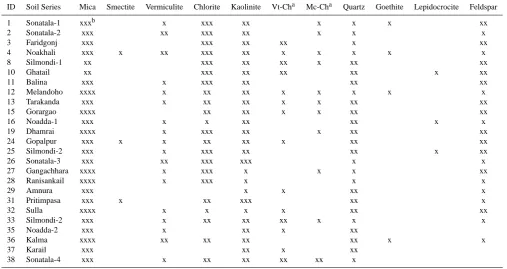
X-ray diffraction analysis revealed that all studied K and Mg-saturated clay fractions were composed of a variable ad-mixture of 2:1 phyllosilicates (peaks at 1.00, 0.500, and 0.333 nm), kaolinite (0.713 and 0.357 nm), quartz (0.425 and 0.333 nm), feldspar (0.320 nm), goethite (0.418 nm) and lepi-docrocite (0.627 nm). The broad bulge around 1.80 nm in the Mg-saturated and glycerol-solvated swelled specimens con-firmed the presence of smectite in soils 4, 24 and 31. Mica was identified in all 25 soils by the presence of the 1.00 nm reflection appearing in all the treatments. Vermiculite was identified in 18 soils (not in soils 3, 8, 10, 15, 29, 31 and 37) by a decrease in the peak intensity of the 1.42 nm re-flection and a corresponding increase in the peak intensity of the 1.00 nm reflection when shifting from Mg saturation to K saturation followed by air drying. Chlorite was detected in all soils except in soils 29, 35 and 37 by reflections at 1.42 nm in the K- and Mg-saturated air dried specimens and its ra-tional orders and by the remains of the 1.42 nm reflection in the 550◦C-heated K-saturated specimen. Presence of
kaoli-nite was confirmed in all studied soils from peaks or shoul-ders at 0.716 and 0.357 nm in the Mg-saturated specimens. In 14 soils, presence of a vermiculite-chlorite intergrade was ascertained by a decrease in peak intensity of the 1.42 nm re-flection after heating the K-saturated specimen. Mostly, very small peaks at 1.25 nm in all the treatments also suggested the presence of the interstratified mica-chlorite mineral in 11 soils. Quartz and feldspars were identified in all soils, ex-cept for feldspars in soils 35, 37 and 38. Goethite and lepi-docrocite were identified only in soils 1, 4, 12 and 36 and 10, 16 and 25, respectively. The X-ray diffraction clay mineral-ogy is summarized in Table 2.
3.2 N mineralization
The evolution of mineral N during 120 day incubations un-der aerobic and anaerobic conditions were described in de-tail by Kader et al. (2013). In summary, over the set of 25 soils the calculated aerobic N mineralization varied from 10 to 223 mg N kg−1120 days−1, that is 2.5 to 15 % of the soil N was mineralized in 120 days, respectively). The anaerobic N mineralization varied from 34 to 423 mg N kg−1120 days−1 (4.5 to 28.1 % of soil N, respectively). Over all 25 soils,
the mean anaerobic N mineralization rate was significantly higher (pairwiset test atP <0.05) than the mean aerobic N mineralization rate.
3.3 SCWE fractions
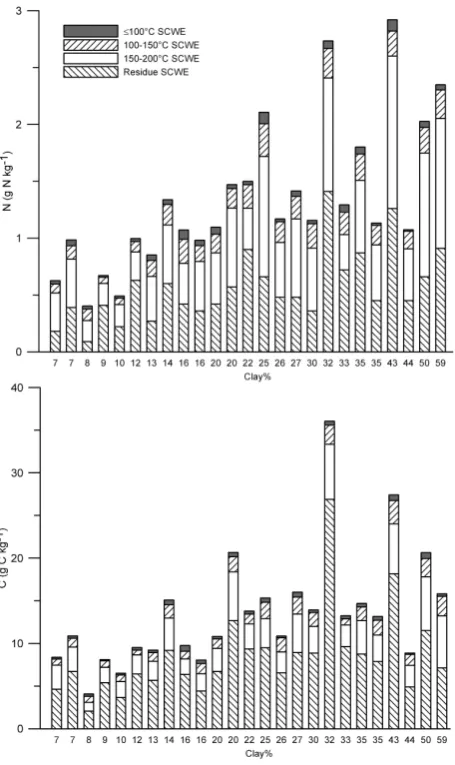
Four different SOM fractions were obtained from sequen-tial SCWE, namely≤100, 100–150 and 150–200◦C water extractable and>200◦C residual non-extractable N and C. The sizes of the N fractions were expressed on a bulk soil basis (g N kg−1) and are given in Fig. 2. The recovery of N and OC was 90.6±13.4 and 97.9±7.2 % of soil N and soil OC, respectively. The lower recovery of N compared to OC might have been due to N volatilization during extrac-tion at higher temperatures. At 100◦C SCWE removed 0.01– 0.10 g N kg−1, N representing 1.1–7.7 % of soil N (Fig. 2), in line with previously reported proportions of hot water ex-tractable N according to Kader et al. (2010) (2–5 % of soil N), Curtin et al. (2006) (2–7.5 % of soil N) and Leinweber et al. (1995) (3–5 % of soil N). The amount of additional N extracted at 150◦C (additional since 100◦C extractable OM was already removed by the preceding extraction at 100◦C) ranged between 0.06 and 0.29 g N kg−1, accounting for 7.5–25.2 % of soil N. Another larger share of 24–57 % of soil N was subsequently extracted at 200◦C (i.e. 0.18– 1.34 g N kg−1) (Fig. 2). The average C : N ratios of these three fractions decreased with increasing extraction temper-ature from 9.7 (≤100◦C SCWE fraction) over 8.4 (100– 150◦C SCWE fraction) to 6.4 (150–200◦C SCWE fraction) (Fig. 3). Over all fractions, the≤100◦C SCWE fraction’s C : N ratio showed the largest variation (5–22) and did not significantly differ from the bulk soil’s C : N ratio, in contrast to the 100–150 and 150–200◦C SCWE fractions. The SCWE
residue N ranged between 0.09 and 1.41 g N kg−1and rep-resented the largest isolated soil N (24.2–63.1 % of soil N) fraction (Fig. 2). The C : N ratio of the extraction residues were logically higher (on average 15.8±5.2) than the C : N ratios of the extracts and bulk soil (all atP <0.001).
The temperature dependency of release of SCWE N and OC was quantified by fitting an exponential function: SCWE N or OC = a ebT to the cumulative amounts of N and OC (g kg−1) at 100, 150 and 200◦C. T is the extraction tem-perature (◦C), a is SCWE N or OC at T =0◦C, and b is a constant expressing temperature dependency (◦C−1) of SCWE efficiency. This function fitted well to the SCWE-N and SCWE-OC data (averageR2=0.99 for N and OC), indi-cating an exponential increase of extractability of N and OC in response to subcritical water temperature increase from 100 to 200◦C (Fig. 4).
Fig. 2. Distribution of soil N and OC over subcritical water frac-tions. Fractions were subsequently extracted at 100 (≤100◦C SCWE N or OC), 150 (100–150◦C SCWE N or OC), 200◦C (150– 200◦C SCWE N or OC), leaving an extraction residue (Residue SCWE N or OC).
to Alox (P <0.01). Theb parameter for N was only posi-tively correlated to soil N.
3.4 SCWE N and C in relation to soil properties and clay mineralogy
[image:6.595.55.283.62.445.2]Pearson’s correlation coefficients were firstly calculated be-tween SCWE N and SCWE OC and general soil properties (Table 3). All the isolated SCWE N and SCWE OC fractions correlated significantly and positively with soil N (P <0.01) and soil OC (P <0.05). Correlation coefficients generally increased with increasing extraction temperature. The 100– 150 and 150–200◦C SCWE N and SCWE OC were strongly correlated with clay percentage, Feox and Alox, and fixed NH4-N content. On the contrary,≤100◦C SCWE N and OC was not correlated with these soil parameters. SCWE residue
Fig. 3. Average C : N ratios of the bulk soil, subcritical water ex-tracts and the extraction residue (n=25, error bars show standard deviations).
Fig. 4. Release of N and OC by subcritical water extraction in func-tion of the extracfunc-tion temperature. Symbols show means with stan-dard deviations in error bars of 25 paddy soils, line graphs show exponential models fitted to the data.
OC was comparatively weaker (P <0.05) correlated to these general soil properties.
[image:6.595.311.546.339.556.2]Table 2. Clay fraction mineralogical composition of sampled agricultural fields in Bangladesh (data from Kader et al., 2013).
ID Soil Series Mica Smectite Vermiculite Chlorite Kaolinite Vt-Cha Mc-Cha Quartz Goethite Lepidocrocite Feldspar
1 Sonatala-1 xxxb x xxx xx x x x xx
2 Sonatala-2 xxx xx xxx xx x x x
3 Faridgonj xxx xxx xx xx x xx
4 Noakhali xxx x xx xxx xx x x x x x
8 Silmondi-1 xx xxx xx xx x xx xx
10 Ghatail xx xxx xx xx xx x xx
11 Balina xxx x xxx xx xx xx
12 Melandoho xxxx x xx xx x x x x x
13 Tarakanda xxx x xx xx x x xx xx
15 Gorargao xxxx xx xx x x xx xx
16 Noadda-1 xxx x x xx xx x x
19 Dhamrai xxxx x xxx xx x xx xx
24 Gopalpur xxx x x xx xx x xx xx
25 Silmondi-2 xxx x xxx xx xx x xx
26 Sonatala-3 xxx xx xxx xxx x x
27 Gangachhara xxxx x xxx x x x xx
28 Ranisankail xxxx x xxx x x x
29 Amnura xxx x x xx x
31 Pritimpasa xxx x xx xxx xx x
32 Sulla xxxx x x x x xx xx
33 Silmondi-2 xxx x xx xx xx x x x
35 Noadda-2 xxx x xx x xx
36 Kalma xxxx xx xx xx xx x x
37 Karail xxx xx x xx
38 Sonatala-4 xxx x xx xx xx xx x
aVt-Ch: vermiculite-chlorite interstratified minerals; Mc-Ch: Mica-chlorite interstratified minerals.
bSemi-quantitative analysis of clay fraction mineralogy based on X-ray diffraction patterns: x – indications of presence; xx – present; xxx – substantial presence; xxxx – abundant.
analysis between the approximate proportions of clay min-erals and the relative proportions of SCWE N and OC (% of soil N or % of soil OC) showed that the proportion of
≤150◦C SCWE N was negatively correlated (P <0.05)
to the summed proportion of smectite and vermiculite and vermiculite-chlorite intergrade, while the summed propor-tion of 100–150 and 150–200◦C SCWE N was positively correlated with the proportion of quartz (P <0.05). In ad-dition, the observed decrease in the C : N ratio between the 100–150 and the 150–200◦C SCWE fractions was correlated to the proportion of kaolinite (P <0.01). Similarly, the dif-ference in the C : N ratio between the bulk soil and the 150– 200◦C SCWE fraction was positively correlated (P <0.05) with the proportion of quartz, but negatively (P <0.05) with the proportion of vermiculite. This decrease in the C : N ratio was also significantly higher (P <0.05) for soils containing no vermiculite or smectite (average decrease by 4.1) than for soils containing smectite (average decrease by 1.3).
3.5 SCWE N and OC and N mineralization
The N and OC in all the SCWE fractions and in the bulk soil was significantly correlated with the aerobic N mineral-ization rate but not with the anaerobic N mineralmineral-ization rate (Table 4). The strongest correlation was found between the aerobic N mineralization rate and the sum of the≤100 and 100–150◦C SCWE N fractions (r=0.70). A stepwise linear
regression was conducted between the aerobic or anaerobic N mineralization rates and the contents of SCWE N and OC fractions, general soil properties and the a and b parame-ters of the exponential model describing temperature depen-dency of cumulative C and N extraction by SCWE. Stepwise linear regression withheld only 100 + 150◦C SCWE N as a
predictor variable (R2=0.49; P <0.01,N=25) of aero-bic N mineralization. In case of the anaeroaero-bic N mineraliza-tion both soil pH and theb parameter for SCWE OC were withheld (R2=0.54;P <0.01,N=25), with positive coef-ficients (both at P≤0.01). The variance inflation factors of the excluded variables, 100–150◦C SCWE N and 150 + 200◦C SCWE N, were high (>3) and all were strongly correlated to the 6% NaOCl-ox N. This demonstrates multicollinear-ity and redundancy between these predictor variables and the withheld predictor variable 100 + 150◦C SCWE N.
4 Discussion
4.1 SCWE
Table 3. Pearson’s correlation coefficients (n=25) between subcritical water extracted N and C (g kg−1), contents of soil N, soil OC, ammonium oxalate extractable Fe and Al (Feox, Alox), and fixed NH4-N (g kg−1) and the soil clay percentage (clay %).
SCWE N SCWE OC
100– 150– 100– 150–
SOM fractions ≤100◦C 150◦C 200◦C Residue ≤100◦C 150◦C 200◦C Residue
Soil N 0.64∗∗a 0.77∗∗ 0.92∗∗ 0.85∗∗ 0.69∗∗ 0.88∗∗ 0.91∗∗ 0.83∗∗ Soil OC 0.56∗∗ 0.69∗∗ 0.83∗∗ 0.85∗∗ 0.64∗∗ 0.83∗∗ 0.88∗∗ 0.96∗∗ Clay % 0.24 0.70∗∗ 0.73∗∗ 0.59∗∗ 0.33 0.74∗∗ 0.68∗∗ 0.41∗ Feox −0.03 0.56∗∗ 0.46* 0.43∗ 0.00 0.54∗∗ 0.51∗∗ 0.26 Alox 0.22 0.42∗ 0.63∗∗ 0.43∗ 0.15 0.57∗∗ 0.64∗∗ 0.41∗ Fixed NH4-Nb 0.33 0.72∗∗ 0.77∗∗ 0.74∗∗ 0.28 0.72∗∗ 0.78∗∗ 0.57∗
a∗Correlation is significant atP <0.05(2-tailed);∗∗Correlation is significant atP <0.01(2-tailed).
b(n=18)
Table 4. Pearson’s correlation coefficients between amounts (g kg−1) of SCWE N and OC and the rate of soil N mineralization, measured under aerobic and anaerobic conditions.
N mineralization rate (mg N kg−1day−1)
Soil fraction Aerobic Anaerobic
Soil N 0.64∗∗ 0.24
Soil OC 0.60∗∗ 0.33
≤100◦C SCWE N 0.57∗∗ 0.10 100–150◦C SCWE N 0.68∗∗ 0.35 150–200◦C SCWE N 0.58∗∗ 0.30
SCWE Residue N 0.44∗ 0.33
100 + 150◦C SCWE N 0.70∗∗ 0.30 150 + 200◦C SCWE N 0.61∗∗ 0.32
≤100◦C SCWE OC 0.44∗ −0.23 100–150◦C SCWE OC 0.48∗ 0.32 150–200◦C SCWE OC 0.49∗ 0.21 SCWE Residue OC 0.50∗ −0.04 100 + 150◦C SCWE OC 0.51∗∗ 0.22 150 + 200◦C SCWE OC 0.50∗ 0.25
∗Correlation is significant atP <0.05(2-tailed) and∗∗correlation
is significant atP <0.01(2-tailed).
model (Fig. 4), consistent with Martinez et al. (2003), who found a nearly doubling of water extractable N and OC when the extraction temperature was raised from 10 to 50◦C and a nearly triple increase between 50 and 90◦C. The observed
relative increases of SCWE N and OC per ◦C extraction
temperature were also in line with findings of Chantigny et al. (2010), who reported a relative increase in water ex-tractable OC of 1.4–5.3 % per◦C increase within a gradient from 20 to 80◦C. Organic macromolecules may change from a rigid “glassy” state to a more flexible “rubbery” condition as temperature increases (Zhang et al., 2007) along with a de-creasing viscosity of humic substances (Boutaric and Then-evet, 1937) and it is possible that this increases the water
solubility of humic materials. However, changing physical properties of the solvent itself, in this case water, with tem-perature could have also determined extraction of soil N by SCWE. Water is a very polar solvent with a dielectric con-stant of 78.4 at 25◦C and 0.1 MPa and this limits the poten-tial to extract important non-polar organic N components like non-polar amino acids (e.g. valine, alanine, leucine, methio-nine, and proline) and many proteins. However, as water’s temperature and pressure increase, the thermal energy ex-cess disorients individual molecular dipoles and lessens the strong dipole–dipole electrostatic interactions within the liq-uid, which results in lower dielectric constants (Fernandez et al., 1997). For example, the dielectric constant of water de-creases to 31.5 at 225◦C and 20 MPa, which is very close to the dielectric constant of a less polar organic solvent like methanol (32.6 at 25◦C and 0.1 MPa) (Wohlfarth, 1991).
Un-der these circumstances most lipids and heterocycles should still be insoluble. The gradual lowering in C : N ratio from 9.7 for the≤100◦C over 8.4 at 100–150◦C to 6.4 at 150– 200◦C fractions indeed revealed an increasing selectivity to N over OC (in more hydrophobic substances) with increas-ing SCWE temperature. Gregorich et al. (2003) observed that the C : N ratio of water-extracted SOM was decreased with increasing extraction temperature from room temperature to 80◦C. They suggested that hot water facilitates the release of hydrophilic organic N. Schnitzer et al. (1991) also found a more efficient extraction of organic N than of other OM components at 200◦C. They attributed the greater affinity of subcritical water at 200◦C to the greater polarity of many
N containing compounds, compared with carbohydrates and lignin- and phenol-derived aromatics. In view of these obser-vations, it appears that by “tuning” of the dielectric constant through choice of SCWE temperature one can isolate OM fractions with differing solubility of N and OC in water.
[image:8.595.70.262.298.515.2]content and mineralogy to determine SCWE efficiency and its dependency on temperature. Firstly, the significant pos-itive correlations between the SCWE temperature depen-dency model parameterb for OC and clay percentage and Alox and Mnox confirm this for OC. In other words, higher extraction temperatures are required to extract equal amounts of OM from soils with higher content of clay or pedogenic oxides. Additionally, the data suggest that extraction of min-eral bound N and OC primarily occurred at extraction tem-peratures above 100◦C as only the 100–150 and 150–200◦C, but not ≤100◦C SCWE N and OC, correlated positively with the soil clay percentage and contents of Feox and Alox. Similarly, fixed NH4-N did not correlate to≤100◦C SCWE N, indicating that fixed NH4-N was extracted primarily by SCWE above 100◦C. Secondly, the proportions of smectite and vermiculite correlated negatively with SCWE N, while the proportion of quartz was positively correlated. There was furthermore a negative correlation betweenb for N and the summed proportion of 2 : 1 clay minerals (though only at P =0.075). From this we conclude a lower efficiency of SCWE in soils with increasingly reactive clay mineralogy. In addition, the increasing selectivity of SCWE towards N over C at higher temperatures, as indicated by the shift in C : N ra-tio in the SCWE fracra-tions, depended on clay mineralogy as well. SCWE was more selective towards N with decreasing proportion of high surface area clay minerals like smectite and vermiculite.
To interpret these data, an analogy could be made to data obtained by pyrolysis field ionization mass spectroscopy, in which the temperature dependent release of individual OM molecular markers is resolved. Schulten and Leinwe-ber (1999) found that volatilization of mineral bound OM requires higher temperatures than unbound OM to enable thermal bond cleavage. They identified three thermal classes: (i) unbound undecomposed plant fragments relatively rich in aliphatics; (ii) a thermally labile fraction containing N-containing compounds and carbohydrates associated with humified OM and (iii) thermally stable mineral bound OM. On the basis of the data in this study it seems plausible to hypothesize that SCWE at 100◦C primarily releases weak or intermediately bound N and OC, i.e. belonging to the second SOM pool identified by Schulten and Leinweber (1999). The first pool may well be of lesser importance because unbound undecomposed OM in fact comprises but a relatively small share of the soil N and is probably poorly extractable due to its particulate nature. Leinweber et al. (1995) found hot water extractable OM to be largely composed of carbohy-drates and N containing compounds and since many of these constituents volatilized at lower temperatures during pyrol-ysis, it was concluded that they were in soil solution or just weakly sorbed to mineral surfaces or humic macromolecules. It seems acceptable that such material formed a major part of the SCWE fractions. At 150 and 200◦C, SCWE probably extracted increasingly more OM, which is strongly bound to minerals, i.e. belonging to the third pool defined by
Schul-ten and Leinweber (1999). This was indirectly confirmed by correlation analysis with the clay percentage and contents of Feoxand Alox, as described above. Yet, direct supporting ev-idence should come from SCWE extraction of well known model OM–mineral mixtures. In addition, the average C : N ratio of the 150–200◦C SCWE fraction was 6.4, i.e. close to commonly observed clay fraction C : N ratios. This again suggests that OM bound to clay minerals or to pedogenic oxides was extracted by SCWE at 200◦C. As selectivity of SCWE towards N over C increased with decreasing propor-tions of smectite and vermiculite, it appears that extraction of N bound to such highly reactive minerals may have been limited.
4.2 SCWE N and C and N mineralization
The range in soil N (0.4–3.2 g kg−1), clay content (7.4– 58.7 %), crop rotation (single or double annual rice crops) and mineralogy (Table 1) allowed a robust and meaningful evaluation of the SCWE N fractions as indices for N miner-alization in paddy soils. This variation in the sampled soil set was also accompanied by a wide variation in the aerobic and anaerobic N mineralization rates.
The mean correlation coefficientrbetween soil N content and the aerobic N mineralization rate was 0.64 (Table 4), in-dicating that soil N content generally explained only 41 % of the observed variation in the N mineralization rate. Sev-eral researchers found the quality of soil N, as quantified by a distribution of N over physicochemical fractions or by the biochemical composition of SOM, to have a greater influ-ence on mineralization of N than soil N or soil OC content (Yonebayashi and Hattori 1986; Olk et al., 1996, Cassman et al., 1996). For the 25 studied soils, however, only slightly stronger correlations were found with the 100–150◦C SCWE N (r=0.68) and with the sum of the≤100 and 100–150◦C SCWE N (r=0.70) (Table 4). The resulting percentages of explained variance (46–49 %) are still too small to allow ac-curate fertilizer recommendations according to the guide-lines given by Malley et al. (2004), who suggested thatR2 values of calibrated soil tests should be more than 83 % (Ros, 2012). Surprisingly,≤100◦C SCWE N had a weaker corre-lation with the aerobic and anaerobic N mineralization rates than soil N, although hot water extractable N (mostly at 80– 100◦C) has been widely used as an index of plant available N (Broner and Bachler, 1980; Ghani et al., 2003; Curtin et al., 2006) and is considered to be composed of bio-available N-containing compounds (Landgraf et al., 2006). Unexpect-edly, the sequential SCWE residue N correlated positively to the aerobic N mineralization rate. This relationship may have been indirect, though, because SCWE residue N was also strongly correlated to soil N content (Table 3) and con-stituted the largest isolated soil N fraction.
explained variances remained low with a maximalR2of 0.54 for anaerobic N mineralization. We found no significant cor-relations at all between N or OC in any of the isolated soil fractions and the anaerobic N mineralization rate. Instead, soil pH and the SCWE OC temperature dependency model bparameter were the best predictors of anaerobic N miner-alization, with negative and positive linear regression coeffi-cients, respectively. The latter suggests, surprisingly, that N mineralization was higher in soils for which higher tempera-tures are required to extract soil OC, i.e. with a higher value ofb. It would appear, however, that this relation was in fact indirect as at the same timeb for OC correlated positively to Alox and Mnox and negatively to the sand percentage. In line, soil pH correlated positively to the silt percentage and negatively to the quartz percentage and Mnox. Both predic-tors (pH andb) therefore appear to depend on soil texture and content of pedogenic oxides. This designates that SOM quality, at least when expressed as a distribution of N and C over isolated SCWE fractions, does not control the anaero-bic N mineralization process at all and instead abiotic fac-tors are of importance. In a previous study by Kader (2012) it was found that the N mineralization of these soils col-lected from agricultural fields was also not explained by con-tent of N in different physicochemical fractions, including sand N, silt + clay N, 6 % NaOCl oxidizable N and 10 % HF-extractable N. Instead Kader et al. (2013) suggested that abi-otic factors like availability of reducible Fe, mineralogy and pH could play a decisive role, but this needs to be confirmed through further research. In line, Sahrawat and Narteh (2003) found reducible Fe to be a useful indicator to predict ammo-nium production in 15 west African rice soils. Most of the sampled Bangladeshi paddy soils are in a fairly early stage of soil development with relatively low content of pedogenic oxides and active clay mineralogy. Both aspects could be of importance to mineral N release under anoxic conditions in the studied soils. Firstly, as redox potential progressively lowers after onset of submergence electron acceptors alter-native to rapidly depleted O2and NO3, viz. Mn4+and Fe3+, are required for OM decomposition to proceed. The avail-ability of both would be limited in soils having a low pe-dogenic oxide content, and this may form a bottleneck for anaerobic N mineralization. Secondly, vermiculite contain-ing paddy soils accumulate fixed NH+4 (estimated to 100– 800 kg N ha−115 cm−1in the studied soils). It has, however, often been shown that a part of the fixed NH4-N is in fact dynamic (Nieder et al., 2011) and therefore release of fixed NH+4 may well have contributed to build-up of exchange-able NH+4 during the anaerobic lab incubations. It has also been shown that microbial reduction of Fe3+ followed by dissolution of Fe-oxides coated on the surfaces of clay min-erals is a prerequisite for fixed NH+4 exchange (Scherer and Zhang, 1999). Following these two points, again abiotic fac-tors like clay mineralogy and content of pedogenic oxides, rather than SOM quality, should be of importance to the
net-release of exchangeable NH+4 under anaerobic conditions in young paddy soils, in line with our regression analysis. In conclusion, quality and quantity of N fractions only partly explained the aerobic N mineralization and not anaerobic N mineralization of the studied set of 25 paddy soils and consequently alternative driving factors than the soil frac-tions isolated here should be looked for. The biochemistry of paddy soils is, however, controlled by complex interac-tions between redox potential, pH, solubility of OM (Kögel-Knabner et al., 2010) and availability of electron acceptors (Sahrawat, 2004).
Maybe we should not discard SCWE as a means for isola-tion of N pools with differing proneness to microbial decay, solely on the basis of this particular study on paddy soils. Bio-availability of N, approximated here by extractability of N at different temperatures, may well play a more im-portant role in well-drained upland agricultural soils. Per-haps SCWE holds potential to separate kinetically different SOM pools in these soils. Indeed, the aerobic N mineraliza-tion did relate to several >100◦C SCWE N fractions, al-though still with but a limited higher predictive power than soil N content. Under aerobic conditions, microbial activity is no longer dependant on availability of alternative electron acceptors and instead, as revealed by several authors (Ap-pelqvist et al., 1996; Schulten and Schnitzer, 1997; Lein-weber and Schulten, 2000; Kleber et al., 2007), association of organic N with soil mineral components is the dominant mechanism explaining the persistence of these inherently bi-ologically labile SOM constituents. Our study, in line with Schnitzer et al. (1991), demonstrated that N is preferentially extracted over C with increasing temperature by SCWE and that the extraction efficiency depended on soil mineralogy. This suggests that SCWE at different temperature intervals may be able to isolate specific OM- or mineral-associated N fractions, which are likely to be differently bio-available. In light of mineral association of N, an important difference between young floodplain paddy soils and more developed upland soils may be their contents of pedogenic oxides, as these have been identified as specific important binding sites for organic N in sand to loam textured croplands in Germany (Leinweber and Schulten, 2000). Since the content of pedo-genic oxides was low in the studied set of paddy soils we were not able to test the potential of SCWE to extract differ-ently bound N pools that would be relevant to upland soils. It would be most interesting to see if and how SCWE is able to separate OM-associated N, pedogenic oxide bound N, NH+4 in clay mineral interlayers and N bound to clay minerals.
5 Conclusions
primarily starts above 100◦C and increases with
tempera-ture as well. Clay mineralogy also seems to significantly affect the extractability of N and OC by SCWE. Eventu-ally, at 200◦C probably mostly clay fraction mineral bound OM is released by SCWE as seen from the negative rela-tion between the extracts’ C : N ratio and extracrela-tion temper-ature (to only 6.4 at 200◦C). We hypothesize that the step-wise SCWE at 100, 150 and 200◦C SCWE incrementally removed OM that is more strongly mineral bound and less OM that is weakly associated to mineral matter or SOM. If so, the three isolated SCWE fractions would each form mixtures of SOM pools with differing thermostability and perhaps also biodegradability. However, it seems that the se-quential SCWE procedure was in fact unable to completely isolate kinetically labile from stable (mineral bound and/or biochemically recalcitrant) organic N, as the amount of N in each of the SCWE fractions and in the SCWE residue cor-related with the aerobic N mineralization rate, indicating the presence of labile N in all of them. Alternatively, relations between N mineralization and SCWE extracted N may have been indirect since mutual positive correlations existed with soil N content. The present investigation of the SCWE proce-dure was conducted on a set of paddy soils, in which N min-eralization seemed to be decoupled from SOM quantity or quality. Perhaps SCWE does, however, hold potential to sep-arate kinetically different SOM pools in upland soils where the bio-availability of N is likely a key constraint in the N mineralization process.
Acknowledgements. MA Kader wishes to acknowledge the
Flem-ish Inter-University Council (VLIR) for providing him a Ph.D. grant to carry out this research. S. Sleutel is working as a post-doctoral researcher for the Research Foundation Flanders (FWO). This research was partly funded by FWO grant 1.5.088.10N. The FWO is also acknowledged for the funding of the ASE equipment (1.5.062.09N).
Edited by: S. Bouillon
References
Appelqvist, I. A. M, Graham, C. L., and Hayes, M. H. B.: Isolation, fractionation, and characterization of humic acids from a sapric histosol, in: Humic Substances and Organic Matter in Soil and Water Environments, edited by: Clapp, C. E., Hayes, M. H. B., Senesi, N., and Griffith, S. M., IHSS, University of Minnesota, St. Paul, 33–39, 1996.
Amashukeli, X., Grunthaner, F. J., Patrick, S. B., and Yung, P. T.: Subcritical water extractor for mars analog soil analysis, Astro-biology, 8, 597–604, 2008.
Augus, J. F., Ohnishi, M., Horie, T., and Williams, R. L.: A prelimi-nary study to predict net nitrogen mineralization in a flooded rice soil using anaerobic incubation, Aust. J. Exp. Agr., 34, 995–999, 1994.
Bangladesh Meteorological Department: available at: http://www. bmd.gov.bd/Document/climateofbangladesh.doc (last access: 14 February 2011), 2011.
Boutaric, A. and Thenevet, S.: Recherches physico-chimiques surles colloïdes humiques, Ann. Agron., 7, 18–32, 1937. Broner, H. and Bachler, W.: Evaluating the nitrogen requirement of
sugarbeet from hydrolyzable soil nitrogen, Soil Sci., 130, 303– 306, 1980.
Buresh, R. J., Reddy, K. R, and van Kessel, C.: Nitrogen transfor-mations in submerged soils, in: Nitrogen in agricultural systems. Agronomy Monograph 49, edited by: Schepers, J. S. and Raun, W. R., ASA, CSSA, and SSSA publishers inc., Madison WI, USA, 401–436, 2008.
Cassman, K. G., Dobermann, A., Sta Cruz, P. C., Gines, G. C., Sam-son, M. I., Descalsota, M., Alcantara, J. M., Dizon, M. A., and Olk, D. C.: Organic matter and the indigenous nitrogen supply of intensive irrigated systems in the tropics, Plant Soil, 182, 267– 278, 1996.
Chantigny, M. H., Curtin, D., Beare, M. H., and Greenfield, L. G.: Influence of Temperature on Water-Extractable Organic Matter and Ammonium Production in Mineral Soil, Soil Sci. Soc. Am. J., 74, 517–524, 2010.
Curtin, D. and McCallum, F. M.: Biological and chemical assays to estimate nitrogen supplying power of soils with contrasting management histories, Aust. J. Soil Res., 42, 737–746, 2004. Curtin, D., Wright, C. E., Beare, M. H., and McCallum, F. M.: Hot
water extractable nitrogen as an indicator of soil nitrogen avail-ability, Soil Sci. Soc. Am. J., 70, 1512–1521, 2006.
Fernandez, D. P, Goodwin, A. R. H., Lemmon, E. W., Sengers, J. M. H. L., and Williams, R. C.: A formulation for the static per-mittivity of water and steam at temperatures from 238 K to 873 K at pressures up to 1200 MPa, including derivatives and Debye-Hückel coefficients, J. Phys. Chem. Ref. Data, 26, 1125–1166, 1997.
Ghani, A., Dexter, M., and Perrott, K. W.: Hot water extractable carbon in soils: a sensitive measurement for determining impacts of fertilisation, grazing and cultivation, Soil Biol. Biochem., 35, 1231–1243, 2003.
Gregorich, E. G., Beare, M. H., Stoklas, U., and St-Georges, P.: Biodegradability of soluble organic matter in maize cropped soils, Geoderma, 113, 237–252, 2003.
Kader, M. A.: Nitrogen mineralization in subtropical paddy soils in relation to soil properties, organic matter fractions, and fertil-izer management, PhD Thesis, Faculty of Bioscience Engineer-ing, Ghent University, Ghent, 2012.
Kader, M. A., Sleutel, S., Begum, S. A., D’Haene, K., Jegajeevagan, K., and De Neve, S.: Soil organic matter fractionation as a tool for predicting nitrogen mineralization in silty arable soils, Soil Use Manage., 26, 494–507, 2010.
Kader, M. A., Sleutel, S., Begum, S. A., Moslehuddin, A. Z. M., and De Neve, S.: Nitrogen mineralization in sub-tropical paddy soils in relation to soil mineralogy, management, soil type and C, N and Fe contents, Eur. J. Soil Sci., 64, 47–57, 2013.
Kalbitz, K., Scheswig, D., Rethemeyer, J., and Matzner, E.: Stabi-lization of dissolved organic matter by sorption to the mineral soil, Soil Biol. Biochem., 37, 1319–1331, 2005.
molecular fragments into zonal structures on mineral surfaces, Biogeochemistry, 85, 9–24, 2007.
Knicker, H.: Biogenic nitrogen in soils as revealed by solid-state 13C and 15N NMR spectroscopy, J. Environ. Qual., 29, 715– 723, 2000.
Kögel-Knabner, I., Guggenberger, G., Kleber, M., Kandeler, E., Kalbitz, K., Scheu, S., Eusterhues, K., and Leinweber, P.: Organo-mineral associations in temperate soils: Integrating bi-ology, mineralogy, and organic matter chemistry, J. Plant Nutr. Soil Sci., 171, 5–13, 2008.
Kögel-Knabner, I., Amelung, W., Cao, Z., Fiedler, S., Frenzel, P., Jahn, R., Kalbitz, K., Kölbl, A., and Schloter, M.: Biogeochem-istry of paddy soils, Geoderma, 157, 1–14, 2010.
Koroleff, F.: Simultaneous oxidation of nitrogen and phosphorus compounds by persulphate, in: Methods of seawater analysis, edited by: Grasshoff, K., Eberhardt, M., and Kremling, K., Ver-lag Chemie, Weinheim, 168–169, 1983.
Lagadec, A. J. M., Miller, D. J., Lilke, A. V., and Hawthorne, S. B.: Pilot-scale subcritical water remediation of polycyclic aro-matic hydrocarbon- and pesticide-contaminated soil, Environ. Sci. Technol., 34, 1542–1548, 2000.
Landgraf, D., Leinweber, P., and Makeschin, F.: Cold and hot water extractable organic matter as indicators of litter decomposition in forest soils, J. Plant Nutr. Soil Sci., 169, 76–82, 2006.
Leinweber, P., Schulten, H. R., and Körschens, M.: Hot water ex-tracted organic matter: chemical composition and temporal varia-tions in a long-term field experiment, Biol. Fert. Soils, 20, 17–23, 1995.
Leinweber, P. and Schulten, H. R.: Nonhydrolyzable forms of soil organic nitrogen: Extractability and composition, J. Plant Nutr. Soil Sci., 163, 433–439, 2000.
Li, W., Xia, Y., Ti, C., and Yan, X.: Evaluation of biological and chemical nitrogen indices for predicting nitrogen-supplying ca-pacity of paddy soils in the Taihu Lake region, China. Biol. Fert. Soils, 47, 669–678, 2011.
Malley, D. F., Martin, P. D., and Ben-Dor, D.: 26 Analysis of soils, in: Near-Infrared Spectroscopy in Agriculture, edited by: Roberts C. A., Workman J., and Reeves, J. B., ASA, CSSA, and SSSA publishers inc., Madison, Wisconsin, 729–784, 2004.
Martinez, C. E., Jacobson, A. R., and McBride, M. B.: Aging and temperature effects on DOC and elemental release from a metal contaminated soil, Environ. Pollut., 122, 135–143, 2003. Mikha, M. M., Rice, C. W., and Benjamin, J. G.: Estimating soil
mineralizable nitrogen under different management practices, Soil Sci. Soc. Am. J., 70, 1522–1531, 2006.
Nayyar, A., Singh, B., and Singh, Y.: Nitrogen-Supplying Capacity of Soils for Rice and Wheat and Nitrogen Availability Indices in Soils of Northwest India, Comm. Soil Sci. Plant Anal., 37, 961– 976, 2006.
Nieder, R., Benbi, D. K., and Scherer, H. W.: Fixation and defixation of ammonium in soils: a review, Biol. Fert. Soils, 47, 1–14, 2011. Nguyen, V. B., Olk, D. C., and Cassman, K. G.: Nitrogen mineral-ization from humic acid fractions in rice soils depends on degree of humification, Soil Sci. Soc. Am. J., 68, 1278–1284, 2004. Nommik, H. and Vahtras, K.: Retention and fixation of ammonium
and ammonia in soils, in: Agronomy 22: Nitrogen in agricultural soils, edited by: Stevenson, F. J., ASA, CSSA, and SSSA pub-lishers inc., Madison WI, 123–171, 1982.
Olk, D. C, Cassman, K. G., Randall, E. W., Kinchesh, P., Sanger, L. J., and Anderson, J. M.: Changes in chemical properties of organic matter with intensified rice cropping in tropical rice soil, Eur. J. Soil Sci., 47, 293–303, 1996.
Ong, E. S., Cheong, J. S. H., and Goh, D.: Pressurized hot wa-ter extraction of bioactive or marker compounds in botanicals and medicinal plant materials, J. Chromatogr. A, 1112, 92–102, 2006.
Ros, G. H.: Predicting soil Nitrogen supply. Relevance of ex-tractable soil organic matter fractions, Ph.D. thesis Wageningen University, Wageningen, 2012.
Ros, G. H., Temminghoff, E. J. M., and Hoffland, E.: Nitrogen min-eralization: a review and meta-analysis of the predictive value of soil tests, Eur. J. Soil Sci., 62, 162–173, 2011.
Sahrawat, K. L.: Nitrogen availability indexes for submerged rice soils, Adv. Agron., 36, 415–451, 1983a.
Sahrawat, K. L.: Mineralization of organic nitrogen under water-logged conditions in relation to other soil properties of tropical rice soils, Aust. J. Soil Res., 21, 133–138, 1983b.
Sahrawat, K. L.: Organic matter accumulation in submerged soils, Adv. Agron., 81, 169–201, 2004.
Sahrawat, K. L.: Organic matter and mineralizable nitrogen rela-tionships in wetland rice soils, Comm. Soil Sci. Plant Anal., 37, 787–796, 2006.
Sahrawat, K. L.: Nitrogen mineralization in lowland rice soils: the role of organic matter quantity and quality, Arch. Agron. Soil Sci., 56, 337–353, 2010.
Sahrawat, K. L. and Narteh, L. T.: A chemical index for predicting ammonium production in submerged rice soils, Comm. Soil Sci. Plant Anal., 34, 1013–1021, 2003.
Scherer, H. W.and Zhang, Y. S.: Studies on the mechanism of fix-ation and release of ammonium in paddy soils after flooding. I. Effect of iron oxides on ammonium fixation. J. Plant Nutr. Soil Sci., 162, 593–597, 1999.
Schneiders, M. and Scherer, H. W.: Fixation and release of ammo-nium in flooded rice soils as affected by redox potential, Eur. J. Agron., 8, 181–189, 1998.
Schnitzer, M., Schulten, H. R., Schluppi, P., and Angers, D. A.: Or-ganic matter extraction from soils with water at high pressure and temperatures, Soil Sci. Soc. Am. J., 55, 102–108, 1991. Schulten, H. R. and Leinweber, P.: Thermal stability and
composi-tion of mineral-bound organic matter in density fraccomposi-tions of soil, Eur. J. Soil Sci., 50, 237–248, 1999.
Schulten, H. R. and Schnitzer, M.: Chemical model structures for soil organic matter and soils, Soil Sci., 162, 115–130, 1997. Schulten, H. R. and Schnitzer, M.: The chemistry of soil organic
nitrogen: a review, Biol. Fert. Soils, 26, 1–15, 1998.
Silva, J. A. and Bremner, J. M.: Determination and isotope-ratio analysis of different forms of nitrogen in soils: 5. Fixed ammo-nium, Soil Sci. Soc. Am. J., 30, 587–594, 1966.
Six, J., Elliott, E. T., and Paustian, K.: Soil macroaggregate turnover and microaggregate formation: a mechanism for C sequestration under no-tillage agriculture, Soil Biol. Biochem., 32, 2099–2103, 2000.
Sparling, G., Vojvodic-Vukovic, M., and Schipper, L. A.: Hot-water-soluble C as a simple measure of labile soil organic matter: The relationship with microbial biomass C, Soil Biol. Biochem., 30, 1469–1472, 1998.
Wilson, C. E., Norman, R. J., Wells, B. R., and Correll, M. D.: Chemical estimation of nitrogen mineralization in paddy rice soils: II. Comparison to greenhouse availability indices, Comm. Soil Sci. Plant Anal., 25, 591–604, 1994.
Wohlfarth, C.: Static dielectric constants of pure liquids and binary liquid mixtures. Landolt-Börnstein: Numerical Data and Func-tional Relationships in Science and Technology (New Series), Group 4, Macroscopic and Technical Properties of Matter. Vol. 6, Springer-Verlag, Berlin, 1991.
Yonebayashi, K. and Hattori, T.: Patterns and factors controlling nitrogen mineralization in paddy soils in tropical and temperate regions, J. Soil Sci. Plant Nutr., 32, 407–420, 1986.