Gresko Marina Dmitrуina, Bulik Tatyana Sergуivna, Rynzhuk Larisa Vasylivna, Rynzhuk Vasyl Yefremovych, Palamariuk Olexandra Ahdriivna, Vovk Olesia Yuriivna. Insulin-resistance and lipids metabolism in women at menopause. Journal of Education, Health and Sport. 2018;8(1):191-197. eISSN 2391-8306. DOI http://dx.doi.org/10.5281/zenodo.1182719
http://ojs.ukw.edu.pl/index.php/johs/article/view/5301
The journal has had 7 points in Ministry of Science and Higher Education parametric evaluation. Part B item 1223 (26.01.2017). 1223 Journal of Education, Health and Sport eISSN 2391-8306 7
© The Authors 2018;
This article is published with open access at Licensee Open Journal Systems of Kazimierz Wielki University in Bydgoszcz, Poland
Open Access. This article is distributed under the terms of the Creative Commons Attribution Noncommercial License which permits any noncommercial use, distribution, and reproduction in any medium, provided the original author(s) and source are credited. This is an open access article licensed under the terms of the Creative Commons Attribution Non Commercial License (http://creativecommons.org/licenses/by-nc/4.0/) which permits unrestricted, non commercial use, distribution and reproduction in any medium, provided the work is pro perly cited. This is an open access article licensed under the terms of the Creative Commons Attribution Non Commercial License (http://creativecommons.org/licenses/by-nc/4.0/) which permits unrestricted, non commercial
use, distribution and reproduction in any medium, provided the work is properly cited. The authors declare that there is no conflict of interests regarding the publication of this paper.
Received: 23.01.2018. Revised: 26.01.2018. Accepted: 31.01.2018.
INSULIN-RESISTANCE AND LIPIDS METABOLISM IN WOMEN AT
MENOPAUSE
Marina Dmitrуina Gresko, Tatyana Sergуivna Bulik, Larisa Vasylivna Rynzhuk,
Vasyl Yefremovych Rynzhuk, Olexandra Ahdriivna Palamariuk, Olesia Yuriivna Vovk
Higher State Educational Institution of Ukraine “Bukovinian State Medical University”
Department of Obstetrics and Gynecology with the Course of Infantile and Adolescent
Gynecology, BSMU, Ukraine
Summary
The article describes lipid metabolism in women during premenopausal and
considered their relationship with the level of insulin sensitivity and abdominal obesity.
Examined 20 women aged 46-48 years, with fixed transition to pre-menopause on the bases
of menstrual cycle dysfunction or amenorrhea during a year as well as a decrease of
visualized follicular reserve according to the results of ultrasonic examination of the organs of
the small pelvis, were involved into investigation. Body mass increase with abdominal obese
formation and disorders of the lipid metabolism against a background of insulin resistance is
observed in women during pre-menopause against a background of sexual hormones
deficiency.
Keywords: lipid metabolism, abdominal-visceral obesity, insulin resistance,
perimenopause.
Introduction
involution processes in the reproductive system, characterizing with the generative and
menstrual function stopping, prevail against a background of the age changes [5]. It lasts
about 10 years and embraces period from 40-45 years to menopause.
It is known that women’ssexual hormones control lipid exchange and carbohydrate metabolism in the organism, accelerating fats’ splitting and suppressing synthesis of lipid
fractions [2]. Since pre-menopause is characterized by progressing emaciation of the follicular
apparatus of the ovaries and concentration variability of the women’s sexual hormones in the
blood plasma [8], it is possible to presume the presence of changes in lipid exchange on this
stage of woman’s life. The analysis of the literary sources affirm that studying the lipid
exchange depending upon involution processes in the ovaries was carried out only in women
under climacteric period [2, 3, 6, 8, 12, 13], and only separate works [4, 5] are devoted to the
investigations of these changes during pre-menopause period.
Material and methods
Examined 20 women aged 46-48 years, with fixed transition to pre-menopause on the
bases of menstrual cycle dysfunction (periodic delays of menstruation from 1 to 6 months) or
amenorrhea during a year as well as a decrease of visualized follicular reserve according to
the results of ultrasonic examination of the organs of the small pelvis, were involved into
investigation.
According to the results of anthropometrical investigations body mass index and the
ratio of circumference of the waist and thighs was determined in women.
Investigations of the indices of the lipid exchange (triglycerides, general cholesterol
(Chl general), lipoprotein cholesterol of high density (Chl LPHD), lipoprotein cholesterol of
low density (Chl LPLD), and atherogenesity coefficient), levels of insulin and glucose were
accomplished by photometric method on biochemical analyzer “Slim”.
The results of investigation and discussion
It is known that estrogens in normal contribute to accumulation of adipose tissue in the
area of thighs and buttocks [11], however, during the period of menopause the level of these
hormones is significantly decreased that may contribute to the space localization change of
accumulated adipose tissue in the woman’s organism.
Anthropometric investigation of women in menopause period was conducted to verify
this assumption. According to the data obtained (table 1), the body mass index in women
during menopause fluctuated in the range of 32.21-37.88 kg/m², constituting on average
35.17±0.52 kg/m² in them, testifying to the presence of obesity II degree according to the
Table 1
Anthropometric indices of women in menopause
Аanthropometric index Women in pre-menopause Norma
Body mass indexkg/m² 35,17 ± 0,52 18,5–25
Waist circumference /
Femur circumference, c.u.
0,89 ± 0,01 < 0,8
The ratio of circumference of the waist and thighs in women during the period of
pre-menopause fluctuated in the range from 0.85 to 0.93 c.u, on average, permitting to ascertain
the pathological adipoxia in the abdominal region [7].
The results, obtained by us, coordinate with literary data, where it is indicated that an increase
of the visceral adipose tissue is a common and typical change in composite body structure in
women in menopause [14].
Thus, decrease of estrogens’ level is accompanied with the development of the
abdominal obesity, what coordinates with literary data [12]; however, the pathogenesis of this
phenomenon remains not ascertained. It is known that visceral adipocytes contain a
significant quantity of β-adrenoceptors, corticosteroids and androgenic receptors and relatively small quantity of α2-adrenoreceptors and receptors to insulin. These peculiarities
determine high sensitivity of the visceral adipose tissue to lipolityc action of catecholamine’s
and low to antilipolityc action of insulin (especially in postprandial period) and provide high
inclination to the hormonal changes accompanying abdominal obesity very often [1, 3].
Deficiency of the women’s sexual hormones contributes to an increase of
lipoprotein-lipase activity in the adipose tissue of the thigh-buttock, as well as a decrease of its activity in
the abdominal and visceral adipose tissue, promoting more intensive lipolis, increase
concentration of free adipose acids in the blood [8]. However, such changes are clearly
described in literature only for the women of climacteric period [6].
According to the results of our investigations (table2) an increase of the triglycerides
level from 0.7-1.7 mmol/l in normal to 2.74±0.1 mmol/l is observed in women with the
metabolic syndrome in pre-menopause period being the evidence of the hypertriglyceridemia
presence. This confirms an increase of the levels of the general cholesterol to 6.72±0.13
mmol/l and Chl LPLD to 3.93±0.1 mmol/l, as well as a decrease of the Chl LPHD level to
Table 2
Indices of lipid exchange in women during pre-menopause
Lipid exchange indices Women in pre-menopause Norma
triglycerides, mmol/l 2,74 ± 0,1 0,7–1,7
Chl general, mmol/l 6,72 ± 0,13 до 5,2
Chl LPLD, mmol/l 3,93 ± 0,1 до 3,3
Chl LPHD, mmol/l 0,6 ± 0,08 > 1,68
Atherogenesis coefficient,
c.u.
< 3
Atherogenesis coefficient in women during pre-menopause period constitutes
12.4±1.95 c.u., exceeding standard meanings in 3 times what is unfavorable factor of the
development of atherosclerosis and cardio-vascular diseases [9].
Visceral adipose tissue in contrast to adipose tissue of other localization has powerful
capillary network and is directly united with the portal system of the liver [14]. Direct getting
of free adipose acids, as well as other biologically active substances, which are discharged
from the adipose tissue to the liver, by the opinion of many researchers [1, 3, 10], is one of the
pathogenic mechanisms of insulin resistance.
Table 3
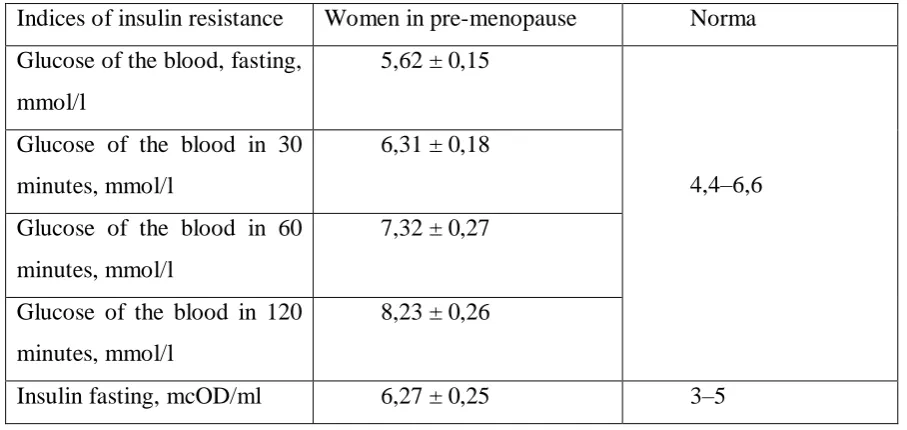
Indices of insulin resistance in women in pre-menopause
Indices of insulin resistance Women in pre-menopause Norma
Glucose of the blood, fasting,
mmol/l
5,62 ± 0,15
4,4–6,6 Glucose of the blood in 30
minutes, mmol/l
6,31 ± 0,18
Glucose of the blood in 60
minutes, mmol/l
7,32 ± 0,27
Glucose of the blood in 120
minutes, mmol/l
8,23 ± 0,26
Insulin fasting, mcOD/ml 6,27 ± 0,25 3–5
For the purpose of elucidation of the possible mechanisms of the lipid exchange
[image:4.595.68.522.487.702.2](table 3).
In standard insulin level fasting in the blood varies from 3-5 mc OD/ml [4], whereas
insulin level in plasma fasting constitute 6.27±0.25 mcOD in women during menopause
according to the results of our investigation and is estimated as basal hyperinsulinemia, what,
in its turn, is insulin resistance marker.
The authors conducted glucose- tolerant test to confirm this fact. Glucose level fasting
was in the ranges from 4.7 to 6.4 mmol/l, constituting on average 5.62±0.15 mmol/l in women
in pre-menopause period, corresponding to standard meanings [2].
When carried out glucose-tolerant test it has been revealed that glucose level in the
blood in 30 minutes from the moment of its introduction increased on average by 0.69 mmol/l
in comparison with the basal level, in 60 minutes – by 1.7 mmol/l, and in 2 hours exceeded
the basal level of glucose in 1.5 times. The indicated dynamics of the glucose level in the
blood at glucose-tolerant test and increased basal level of insulin in the blood allow coming to
a conclusion concerning insulin resistance presence in women during pre-menopause.
At visceral obesity under conditions of insulin resistance due to surplus getting of free
adipose acids into the liver and changes of lipoprotein-lipase and hepatic triglyceride-lipase
activity, breakup of lipoproteins, rich with triglycerides, slows down, hypertriglyceridemia
develops, what in its turn contributes to the level decrease of Chl LPHD, formation of small
parts of Chl LPLD. That is to say, locked circle, which contributes to the adipose tissue
storage in the abdominal area, is formed.
Conclusions. Body mass increase with abdominal obese formation and disorders of
the lipid metabolism against a background of insulin resistance is observed in women during
pre-menopause against a background of sexual hormones deficiency.
References
1. Бутрова С. А. Метаболический синдром: патогенез, клиника,
диагностика, подходы к лечению / Бутрова С. А. // Русский медицинский журнал. –
2001. – № 2. – С. 56–60. (Butrova S.A. (2001). Metabolicheskii sindrom: patogenes, klinika,
diagnostic, podhody k lecheniyu [Metabolic syndrome: pathogenesis, clinical picture,
diagnostics, approaches to the treatment / Butrova S.A. // Russian medical journal. – 2001. -
№ 2. - P. 56-60. in Russian].).
2. Григорян О. Р. Менопаузный синдром у женщин с нарушениями
углеводного обмена. Взгляд гинеколога-эндокринолога / Григорян О. Р., Андреева Е. Н. // Трудный пациент. – 2007. – № 9. – С. 29 – 34. (Grigorian O.R. (2007).
gineko-loga-endokrinologa [Menopause syndrome in women with carbohydrate metabolism disorder.
Point of view of gynecologist-endocrinologist / Grigorian O.R., Andreeva E. N. // Hard
patient. – 2007. -№ 9. – P. 29-34. in Russian].).
3. Григорян О. Р. Заместительная гормональная терапия у женщин, больных
сахарным диабетом, в период пери- и постменопаузы: руководство для врачей / Григорян О. Р., Анциферов М. Б. – М., 2001. – С. 15–16. (Grigorian O.R.
Menopauznyisindrom u zhenshchin s narusheniyamiuglevodnogoobmena. Vzgliad
gineko-loga-endokrinologa [Grigorian O.R. Grigorian O.R. (2001) Substituting hormonal therapy in
women suffering from diabetes mellitus in pre- and postmenopausal period: guidance for
doctors / Grigorian O.R., Antsyferov M.B. – M., 2001. – P. 15-16. . in Russian].).
4. Дубоссарская З. М., Дубоссарская Ю. А. Репродуктивная
эндокринология (перинатальные, акушерские и гинекологические аспекты): Учебно-метод. пособ.. – Д.: Лира ЛТД, 2008. – 416 с. (Dubossarskaya Z.M., Dubossarskaya Yu. A.
(2008). Reproductive endocrinology - (perinatal, obstetrics and gynecological aspects)
[Dubossarskaya Z.M., Dubossarskaya Yu. A. Reproductive endocrinology - (perinatal,
obstetrics and gynecological aspects): Educational-methodical textbook. – D.: Lira LTD,
2008. – 416 p. in Russian].).
5. Ефименко О. А. Пременопауза – предчувствие осени / Ефименко О. А. //
Здоров’я України. – 2009. – Тематичний номер. – С. 60–62. (Efimenko O.A. (2009).
Premenopauza – predchuvstvie oseni [Pre-menopause – presentiment of senility / Efimenko
O.A. // Health of Ukraine. – 2009. – Subject issue. – P. – 60-62.in Russian].).
6. Медицина климактерия / Под. ред. Сметник В. П. – Ярославль: ООО
«Издательство Литера», 2006. – 848 с. (Meditsyna I klimakteriya / Pod red. Smetnik V.P.
(2006). [Climacteric medicine / Edited by Smetnik V.P Yaroslavl’: OOO “Publishing house
Litera”, 2006. – 848 p. in Russian].).
7. Савельева Л. В. Современные подходы к лечению ожирения / Савельева
Л. В. // Врач. – 2000. – № 12. – С. 12–14. (Savel’eva L.V.(2000). Sovremennye podhody k
lecheniyu ozhyreniya [Savel’eva L.V. Sovremennyepodhody k lecheniyuozhyreniya /
Savel’eva L.V. // Vrach. – 2000. - № 12. – S. 12-14. in Russian].).
8. Сметник В. П. Системные изменения у женщин в климактерии
[Електронний ресурс] / Сметник В. П. // Русский медицинский журнал. – 2001. – № 9. – Режим доступу до журн.: http://www.rmj.ru/articles_1286.htm. (Smetnik V.P. (2001).
Sistemnyeizmeneniya u zhenshchin v klimakterii [Electronnyiresurs] [Smetnik V.P. System
journal. – 2001. - № 9. – Access to the journal://www.rmj.ru/articles_1286.htm. in Russian].).
9. Bray G. A. Etiology and pathogenesis of obesity / Bray G. A. // Clinical
Conerstone. – 1999. – Vol. 2. – P. 1–15.
10. Granberry M. C. The insulin resistance syndrome / Granberry M. C., Fonseca
V. A. // Southern Medical Journal. – 1999. – vol. 92. – № 1. – Р. 2–14.
11. Krotkiewski M. Impact of obesity on metabolism in men and women.
Importance of regional adipose tissue distribution / Krotkiewski M., Bjorntorp P., Sjostrom
L., Smith U. // J Chin Invest. – 1983. – vol. 72. – P. 1150–1162.
12. Poehlman E. T. Changes in energy balance and body composition at
menopause: a controlled longitudinal study / Poehlman E. T., Toth M. J., Gardner A. W. //
Ann Intern Med. – 1995. – vol. 123. – P. 673–675.
13. Poehman E. T. Traversing the menopause: changes in energy expenditure and
body composition / Poehman E. T., Tchernof A. // Coronary Artery Dis. – 1998. – vol. – P.
799–803.
14. Shimokata H. Studies in the distribution of body fat: effects of age, sex and
obesity / Shimokata H., Tobin J. D., Muller D. C. et al. // J Gerontol. – 1989. – vol. 44. – P.
66–73.
15. WHO. Obesity: preventing and managing the global epidemic // Report of a
WHO Consultation. WHO Technical Report Series 894. – Geneva: World Health