
©Springer-Verlag Berlin Heidelberg Published online: 10 April 2008
Metallocene Organoactinide Complexes
Manab Sharma · Moris S. Eisen (u)
Schulich Faculty of Chemistry, Institute of Catalysis Science and Technology, Technion – Israel Institute of Technology, Technion City, 32000 Haifa, Israel [email protected]
1 Introduction . . . 2
2 Synthesis and Reactivity of Actinide Complexes . . . 4
2.1 Trivalent Actinide Cp Complexes . . . 4
2.2 Sterically Induced Reduction . . . 10
2.3 Displacement of(C5Me5)1–Ligands . . . 14
2.4 Bridging Complexes . . . 20
2.5 Affinity Towards Lewis Bases . . . 25
2.6 Metal Ligand Back Donation . . . 28
2.7 Beyond the Tris-Cp Complexes . . . 32
3 Tetravalent Chemistry . . . 35
4 Conclusion and Perspectives . . . 76
References . . . 77
Abstract During the last decade, the chemistry of d0/fnactinides has flourished reaching
a high level of sophistication. Compared to the early or late transition-metal complexes and lanthanides, the actinides sometimes exhibit parallel but mostly complementary ac-tivities for similar organic processes, and sometimes even challenge the acac-tivities of the transition metals. A rapid increase in the numbers of reports in the Cambridge database also reflects their current importance. In view of the above, in this particular review we have provided an overview and updated information about the preparation and prop-erties of the major classes of actinide complexes containing different cyclopentadienyl ligands and having the oxidation states (+3 and +4).
Keywords Metallocene complexes·Organoactinides·Sterically induced reduction (SIR)
Abbreviations
Cp Cyclopentadienyl,η5-C 5H5 Cp η5-C(CH
3)3C5H4 Cp= η5-(CH
3)C5H4 Cpφ η5-{Si(CH
3)3}C5H4 Cp η5-1,3-{Si(CH3)3}2C5H3 Cp# η5-1,3-{C(CH3)3}2C5H3 Cp∗ η5-(CH3)5C5
THF Tetrahydrofuran DMSO Dimethylsulfoxide tmeda Me2NCH2CH2NMe2 pmdeta (Me2NCH2CH2)2NMe HMPA OP(NMe2)3
dddt 5,6-Dihydro-1,4-dithiin-2,3-dithiolate bipy 2,2-Bipyridine
terpy 2,2:6,2-Terpyridine
py Pyridine
1
Introduction
Organometallic chemistry has attracted much attention in recent years be-cause of the structural novelty, reactivity, and catalytic applications. This interesting area of chemistry is building a bridge between organic and in-organic chemistry that involves a direct metal-to-carbon bond formation. With the advances of analytical techniques, researchers are able to investi-gate the chemistry to a much deeper level and, therefore, this subject is in the limelight of coordination chemistry. Since the preparation of ferrocene, the first metallic complex containing aπ-bonding ligand,(η5-C5H5)2Fe [1],
organometallic chemistry has traveled a long way from the early transition metals to the chemistry of electrophilic d0/fnactinides complexes. In fact, the first well-characterized organoactinide complex, Cp3UCl, was synthesized by
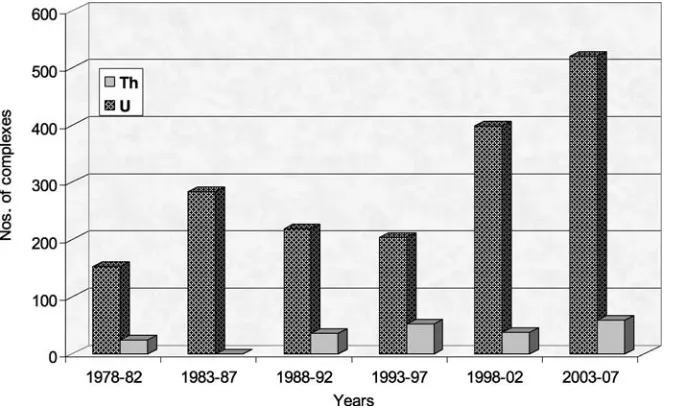
are almost 1.3 times more than those reported during the previous 5 years (Fig. 1), whereas all the molecular complexes of the 3d transition metals and f elements increased by a factor of around 1.5 times [4]:
Fig. 1 Number of thorium and uranium complexes crystallographically characterized from 1978 to 2007
The electronic states of the actinides are also interesting as the energies of the 5f , 6d, 7s and 7p orbitals are very close to each other over a range of atomic number (especially U to Am) [3, 5] and might be responsible for a broad spectrum of oxidation states. Uranium has further demonstrated the ability to access a wide range of oxidation states (III to VI) in organic solvents, providing for greater flexibility in affecting chemical transformations.
[image:3.439.54.392.101.305.2]model assumes pure ionic bonding, and is based on cone angles defining the term “steric coordination number”.
A more important and unique approach to the reactivity of organo5f -complexes regards the utilization of thermochemical studies. The knowledge of the metal–ligand bond enthalpies is of fundamental importance for the estimation of new reaction pathways [10–17]. In addition, neutral organoac-tinides have been shown to follow activation via a four-center transition state (Eq. 1) due to the high-energy orbital impediment to undergo oxidative add-ition and reductive elimination. Such a transadd-ition state allows the predictions of new actinide reactivities, when taking into account the negative entropies of activation [18]:
(1)
Several general review articles [19–41] dealing mostly with the synthesis of new actinide complexes confirm the broad and rapidly expanding scope of this field. Those reviews dealt with the structure, stability, and reactivates of complexes with cyclopentadienyl, dienyls (pentadienyl, cyclohexadienyl, indenyl, phospholyl), cyclooctatetraenyl, arene ligands, hydrocarbyls, and hydrides ligands.
In this particular review we will provide an overview of the preparation and properties of the major classes of actinide complexes containing differ-ent cyclopdiffer-entadienyl ligands. Discussions are classified on the basis of formal oxidation states and we are confining our discussions only to the oxidation states III and IV.
2
Synthesis and Reactivity of Actinide Complexes
The rapid growth of the organoactinide chemistry is intimately coupled with the use of theπ-coordinating cyclopentadienyl (Cp) or modified Cp ligands. Since the first report of the complex(Cp)3UCl by Wilkinson [2], followed by Fischer’s report of cyclopentadienyl compound of U and Th [42], a plethora of Cp actinide complexes have been synthesized. The most interesting part of this chemistry is that it is possible to coordinate one, two, three, or four Cp ligands in anη5-coordination mode [43–48] and that it has the ability to stabilize a wide variety of oxidation states and coordination environments [3].
2.1
Trivalent Actinide Cp Complexes
(An = actinide) has been reported. During the period of 1960s to 1970s a spurt of activity concerning the primary investigation of trivalent organoac-tinides was observed, after that there was a dormant period till 1987 when Cramer, Gilje, and coworkers uncovered a rich chemistry in the reactions of Cp3UCl with lithiated phosphoylides and related molecules [49, 50]. The reaction of UC13, with Cp-, or the reduction of Cp3UX in the presence of neutral Lewis bases (L), was shown to produce a variety of U(III) complexes Cp3UL [50, 51]. Later, it has been reported that these ligands support most members of the actinide series from thorium to californium to form com-plexes of the type (η5-C5H5)3An (An = actinide). These complexes exhibit a wide variety of novel structures and reactivities, including uranium–carbon multiple bonding.
A number of synthetic routes have been reported to generate these species and their tetrahydrofuran (THF) adducts, including direct metathesis with alkali metal salts [50, 52–55], or transmetallation with Be(η5-C5H5)2 or Mg(η5-C5H5)2 [56–62]. In addition, the trivalent compounds may be ob-tained from chemical [53] or photochemical [63, 64] reduction of suitable tetravalent actinide precursors [51, 65–67]. Examples of these preparations are given in Eqs. 2–5:
(2)
(3)
(4)
(5)
Le Marechal and coworkers [68] showed a new method for the preparation of Cp3U(THF)by the treatment of Cp3UCl with sodium amalgam, Na/Hg, in the presence of 18-crown-6-ether and NaH (Eq. 6):
Table 1 NMR data of actinide complexes
Compound Chemical shifts in C6D6(ppm) Refs.
(MeC5H4)3U·THF –11.62 (6H), –13.99 (4H), –14.39 (6H), [72] –15.61 (9H), –31.06 (4H)
(MeSiC5H4)3U –19.2 (2H), –18.7 (9H), 9.2 (2H) [72]
(Me3CC5H4)3U –21.0 (9H), –24.2 (2H), 9.04 (2H) [73]
[1,3-(Me3Si)2(C5H3)]3U 20.8 (s, 1H, CH–Cp), –4.8 (s, 2H, CH–Cp), [75] –9.3 (s, 18H, SiMe3–Cp)
[(C5Me4H)3U] 7.4, –35.5 (s, 6H each, CH3–Cp), [74] –5.0 (s, 1H, CH–Cp)
(Me5C5)3U –0.93 [85]
They also reported the successful synthesis of [Cp3UCl][Na(18-crown-6)], and[(Cp3U)2(µ-H)][Na(THF)2](Cp =η5-C5H5) by following the same pro-cedure.
The solubility of the parent tris(cyclopentadienyl)actinide, Cp3An, com-plexes is limited in non-polar media, presumably due to oligomerization through bridging cyclopentadienyl ligands. Therefore, the synthesis of the most soluble iodine starting material, AnI3L4 (An = U, Np, Pu; L = THF, pyridine, DMSO) [69], perhaps can be considered as the major useful de-velopment of the actinide coordination chemistry. These species, generated from actinide metals and halide sources in coordinating solvents, are readily soluble in organic solvents, and serve as convenient precursors to a variety of trivalent actinide species [70]. Later, the hurdle of solubility was attended by a number of researchers by synthesizing a variety of substituted-tris-Cp ligand complexes (Table 1). A wide spectrum of synthetic routes have been proposed for these precursors [71–75] (Eqs. 7–11):
(7)
(9)
(10)
(11)
Until 1999 the only reported single crystalline compound of thorium(III)-Cp was [ThCp3]{Cp=η5-C5H3(SiMe3)2-1,3}. In 1986, Blake and co-worker [76] reported the synthesis of dark blue crystalline complex [ThCp3]
(Fig. 2) by the reduction of [Cp2ThCl2] in toluene with sodium–potassium alloy along with metallic Th as the byproduct. Later a preferred route was re-ported [77] (Scheme 1) for the synthesis of this complex by using [Cp3ThCl] as the precursor, which could control the production of Th byproducts.
Scheme 1 Synthetic routes of[Th{C5H4(R/R)}3]; R = SiMe3; R= SiMe2Bu-t [76, 77] Most of the base-free tris(cyclopentadienyl)thorium complexes crystal-lize in a pseudotrigonal planar structure, with averaged (ligand centroid)– Th–(ligand centroid) angles near 120◦, and average Th–Cring distances of
2.80(2)˚A. One of the most investigated aspects of actinide–cyclopentadienyl
chemistry is the nature of the bonding between the metal and the ligands [78]. Experimental studies of tris(cyclopentadienyl)actinide complexes, including 237Np Mössbauer studies of (η5-C
5H5)3Np [51] and infrared and absorp-tion spectroscopic studies of plutonium, americium, and curium analogs [57, 79, 80] suggest that the bonding is somewhat more covalent than that of lanthanide analogs, but the interaction between the metal and the cyclopen-tadienyl ring is still principally ionic. Theoretical treatments have suggested that the 6d orbitals are chiefly involved in interactions with ligand-based or-bitals. While the 5f orbital energy drops across the series, creating an energy match with ligand-based orbitals, spatial overlap is poor, precluding strong metal–ligand bonding [44]. Thorium lies early in the actinide series and the relatively high energy of the 5f orbitals (before the increasing effective nu-clear charge across the series drops the energy of these orbitals) has lead to speculation that a Th(III) compound could in fact demonstrate a 6d1ground state. In support of this, Kot and coworkers [81] have reported the observa-tion of an EPR spectrum with g values close to2at room temperature.
of cyclopentadienyl-actinide chemistry. The complex(η5-C5Me5)3U was pre-pared by the reaction of a trivalent hydride complex with tetramethylfulvene (Scheme 2) and, in fact, a direct metathesis route has not yet proven success-ful. The discovery of two or three electron reductivity of this complex had stimulated researchers to develop better synthetic routes.
Scheme 2 Multiple synthetic routes of[(Me5C5)3U][85, 86]
Evans [86] and coworker have developed a modified pathway for the syn-thesis of Cp∗3U with improved yield up to 92% (Scheme 3). The molecular structure of the complex is shown in Fig. 3. The average U–Cring bond dis-tance in this compound (2.858(3)˚A) is much larger than in other crystallo-graphically characterized U(III) pentamethylcyclopentadienyl complexes (ca. 2.77˚A), suggesting a significant degree of steric crowding.
Fig. 3 Crystal structure of(η5-C5Me5)3U [85]. Reproduced with permission 2.2
Sterically Induced Reduction
The synthesis of Cp∗3U{Cp∗=η5-C5Me5} carved a new path for the re-searchers to go one step ahead in the electrochemical studies of organoac-tinide complexes. The reduction reaction involving more than two electrons are not common for metal complexes containing just one metal. However, the synthesis of complexes of the type Cp∗3M led to the development of “sterically induced reduction” (SIR) chemistry in which sterically crowded complexes of redox inactive metals act as reductants [87, 88]. Evans et al. showed that the sterically induced reduction couple, U(III)/U(IV), can act as a multielectron reductant [89]. As an example, Cp∗3U reacts as a three-electron reductant with 1,3,5,7-C8H8, (Eq. 12) in which one electron arises from U(III) (Eq. 13) and two result from two C5Me5–/C5Me5 half reactions (Eq. 14) presumably via SIR. This phenomenon was further corroborated by the stepwise reduc-tion of phenyl halide with Cp∗3U (Eq. 15):
(12)
(13)
[image:10.439.107.329.50.265.2]Fig. 4 Crystal structure of a (η5-C
5Me5)3U(CO) [95] and b (η5-C5Me5)3U(N2) [96]. Reprinted with permission from [95, 96];©(2003) American Chemical Society
(15)
Sterically hindered metal centers for the class of compounds of the type
(η5-C
5Me5)3M have unusually long metal ligand bonds. Although long metal ligand distances are known in f -element complexes containing agostic inter-actions [90], they generally involve only one or two interinter-actions and the rest of the bonds are normal and predictable based on ionic radii [91–93]. In con-trast, in the molecule(η5-C5Me5)3U all the metal–ligand bonds were longer than the conventional distance [94]. This phenomenon further induced re-searchers to investigate the reaction chemistry of the(η5-C5Me5)3U moiety. The reaction of(η5-C5Me5)3U with CO produced the sterically more crowded U(III) complex Cp∗3U(CO) [95]. With N2[96] it afforded the monometallic complex Cp∗3U(η1-N2)(Fig. 4), demonstrating that end-on nitrogen coordi-nation is possible for f -elements (Scheme 3)(vide supra). In fact, this is the first monometallic f -element complex of N2 of any kind because it is most commonly found as M2(µ-η2:η2-N2)moieties involving(N2)–2[97–103]. The binding of N2 in Cp∗3U(η1-N2) was found to be reversible, i.e., it releases N2 when the pressure was lowered to1atm in a solution of C6D6, quantita-tively regenerating the parent complex (Scheme 3). In contrast, a solution of Cp∗3U(CO)was found to be stable for hours under Ar or vacuum.
The discovery of the SIR phenomenon for this kind of complex opened the window for the multi-electron reduction system. The complex Cp∗3U shows a reductive coupling of acetylene [104] and reductive cleavage of azoben-zene [105] (Scheme 4), two- and four-electron processes, respectively.
These U(IV) and U(VI) complexes can also be obtained from [(η5-C5Me5)2U][(µ-Ph)2BPh2], where [BPh4]– acts as a one-electron reduc-tant (Scheme 4) [104]. On the other hand the reaction of (η5-C
Scheme 4 Sterically induced reduction chemistry of[(Me5C5)3U][89, 104–107]
With KC8in benzene it gave[{U(η5-C5Me5)2}2(µ-η6:η6-C6H6)][106], which itself proved to be also quite interesting in the area of multi-electron reduction chemistry, as shown by its reaction with azobenzene in which it functions as an eight-electron reductant [104]. Thus, it is clear that the complex (η5-C5Me5)U shows quite an interesting two- to four-electron reduction chemistry in a similar way to that of the
Fig. 5 Crystal structure of[(η5-C5Me5)2U]2(µ-O)[107]. Reprinted with permission from Elsevier
plexes[(η5-C5Me5)2U][(µ-Ph)2BPh2]and[{U(η5-C5Me5)2}2(µ-η6:η6-C6H6)] (Scheme 5).
Another most interesting and unusual result has been reported regard-ing the formation of an U(III) oxide complex, [(Cp∗)2U]2(µ-O)(Fig. 5) ob-tained by the (η5-C5Me5)3U reduction system (Scheme 4) [107]. This has been claimed to be the first molecular trivalent uranium oxide so far re-ported. The complex was isolated from a reaction of(η5-C5Me5)3U with KC8 in toluene. Probably this is the first example of an SIR process in which the C5Me5–1reduction precedes the U(III) electron transfer.
Further investigating the SIR, Evans et al. [106] reported that[(Cp∗)2U]2 (µ-η6:η6-C6H6)functions as a six-electron reductant in its reaction with three equivalents of cyclooctatetraene to form [(Cp∗)(C8H8)U]2(µ-η3:η3-C8H8), (C5Me5)2, and benzene (Eq. 16):
(16)
This multi-electron transformation can be formally attributed to three dif-ferent sources: two electrons from two U(III)/U(IV) reaction, two electrons from sterically induced reduction by two (C5Me5)1–/(C5Me5) ligands, and two electrons from a bridging(C6H6)2–/(C6H6)process.
Apart from these SIR processes, there are few other examples where the U(III) center undergoes one- or two-electron oxidation. It was found that alkyl halides can also be oxidized by U(III) to generate equimolar mixtures of U(IV)–R and U(IV)–X as shown in Eq. 17 [108]:
[image:13.439.138.303.51.161.2]There are few examples on the oxidation of the U(III) center to give cor-responding U(IV) complexes. Stults et al. [73] showed that unlike the cerium metallocene, the uranium metallocene(MeC5H4)3U(THF)behaves quite dif-ferently with alcohols and thiols. It forms the U(IV) complex of the type [(MeC5H4)3UER], where ER is OMe, OCHMe2, OPh, or SCHMe2. The dif-ferent type of reaction shown by cerium and uranium metallocenes towards alcohols and thiols most likely reflects the case of oxidizing uranium: the U(IV)/U(III) couple is – 0.63V in aqueous acid whereas the Ce(IV)/Ce(III) is
+ 1.74V [73]. Even the uranium complex with the more crowded substituent
on the cyclopentadiene, i.e,(Me3CC5H4)3U, also undergoes a similar type of reaction with thiophenol (Eq. 18) to give(Me3CC5H4)3USPh:
(18)
2.3
Displacement of (C5Me5)1-Ligands
Significant steric hindrance and the longer M–C bond in complexes of the type (C5Me5)3M induced another type of reaction, i.e., (C5Me5)1– substi-tution reaction from the metal center [106]. Removal of (C5Me5)1– is very reasonable due to the steric crowding in these long bonded organometallics. The loss of(C5Me5)1–anions from(C5Me5)3M complexes byη1-alkyl or SIR pathways is well known [94], but the removal of(C5Me5)1–rings from f elem-ent complexes by ionic metathesis is not a common reaction.
The synthesis of[(Cp∗)2U]2[(µ-η6:η6-C6H6)]provides an example of the (C5Me5)1– displacement from the (Cp∗)3U moiety. Initially the complex [(Cp∗)2U]2[(µ-η6:η6-C6H6)] was obtained as a byproduct in the synthesis of(Cp∗)3U from[(Cp∗)2U][(µ-Ph2)BPh2][86], but it could have been syn-thesized directly from(C5Me5)3U [106] (Scheme 4) (vide supra). In an an-other synthetic route, it was also synthesized from[(Cp∗)2U][(µ-Ph2)BPh2], the precursor to(C5Me5)3U, in combination with K/18-crown-6/benzene as shown in Eq. 19:
The complex [(C5Me5)2U]2[(µ-η6:η6-C6H6)] was structurally character-ized as a bimetallic species in which an arene ring is sandwiched between two [(C5Me5)2U] moieties. The U–U distance was found to be 4.396˚A, and the (C5Me5)1– rings arranged tetrahedrally around the U–C6H6–U core. In a similar manner, the amide analog, {[(Me3Si)2N](C5Me5)U}2 [(µ-η6:η6-C6H6)], was synthesized by displacement of two(C5Me5)1– moi-eties from[(C5Me5)2U]2[(µ-η6:η6-C6H6)]when it reacts with two equivalents of KN(SiMe3)2(Eq. 20). The comparison of the crystallographic data (Table 2) of these two complexes revealed that the average U–C(C5Me5) bond dis-tances in {[(Me3Si)2N](C5Me5)U}2[(µ-η6:η6-C6H6)] is shorter than that of [(C5Me5)2U]2[(µ-η6:η6-C6H6)]as well as the angle(C5Me5ring centroid)–U –(C6H6ring centroid)in the former is smaller than the latter (Table 2). Thus, incorporation of the(Me3Si)2N ligand into the coordination sphere reduced the steric constrain around the metal centers. In {[(Me3Si)2N](C5Me5)U}2 [(µ-η6:η6-C6H6)](Fig. 6), the two C5Me5ring centroid, the two N-donor sites took a square plane arrangement rather than the sterically more compact tetrahedral arrangement of the four rings as in[(C5Me5)2U]2[(µ-η6:η6-C6H6)] [106]:
(20)
[image:15.439.64.374.282.561.2]Table 2 C o mp ar is on of b o n d le n g th (
˚ A)
and b o nd ang le ( ◦)o f [( C5 Me 5 )2 U ]2 ( µ -η
6:η 6-C 6 H6 ) an d { [( Me 3 Si )2 N ]( C5 Me 5 ) U }2 ( µ -η
6:η 6-C 6 H6 ) [106] [( C5 Me 5 )2 U ]2 ( µ -η
6:η 6-C 6 H6 ) { [( Me 3 Si )2 N ]( C5 Me 5 ) U }2 ( µ -η
6:η 6-C 6 H6 ) P aramet ers Bo n d d is tan ce Bo n d an g le P aramet ers B o n d d is tan ce B o n d an g le (
While investigating the nature of bonding in these complexes, Evans et al. reported [106] an arene exchange reaction in which a bridged xylene com-plex was formed by the reaction of(C5Me5)3U, KC8 and p-xylene as shown in Eq. 21:
(21)
The synthesis of(C5Me5)2U[N(SiMe3)2] by the addition of KN(SiMe3)2 to a solution of (C5Me5)3U in C6D6 provides an excellent example of an ionic metathesis reaction [106] (Scheme 6). (Cp∗)2U[N(SiMe3)2] has been previously synthesized by addition of M[N(SiMe3)2] (M=Na,K) to [(Cp∗)2UCl]3 [109, 110] or(Cp∗)2UMe2K [86]. It can also be obtained from KN(SiMe3)2 and [(Cp∗)2U][(µ-Ph2)BPh2], a complex that is an excellent reagent for ionic metathesis reactions because it contains the [(Cp∗)2U]+ cation loosely ligated by bridgingη2-arenes of the(BPh4)1–anion [106].
Scheme 6 Synthetic routes for[(C5Me5)2U][N(SiMe3)2][86, 106, 109]
procedures as shown in the following reactions (Eqs. 22–25):
(22)
(23)
(24)
(25)
The structural analysis shows that the crystals composed of discrete trin-uclear{[η5-(CH3)5C5]U(µ2-Cl)}3molecules (Fig. 7) in which each U(III) ion adopts the familiar pseudotetrahedral “bent sandwich” configuration. The bridging Cl–ligands serve to generate the planar (to within0.02˚A) six-atom (–U–CI–)3ring.
Fig. 7 Perspective drawing of the{U[η5-(CH
3)5C5]2Cl}3molecule [109]. Reprinted with permission from [109];©(1979) American Chemical Society
The complex{[η5-(CH3)5C5]U(µ2-Cl)}3 is insoluble in hydrocarbon sol-vents, but readily dissolves in the presence of Lewis base donors to form the corresponding adducts (Scheme 7) [109]. Once the solubility problem was solved, the chemistry of this molecule was investigated in various reac-tions, like alkylation with the sterically bulky lithium reagent, preparation of organouranium(III) amide, and reductive coupling of alkyne as shown in Scheme 7.
Scheme 7 Reaction chemistry of{(η5-Me5C5)2U(µ2-Cl)}3[109]
2.4
Bridging Complexes
During the 1980s, Zalkin and coworkers synthesized a variety of complexes to profoundly study the coordination chemistry of tetra- and trivalent ura-nium complexes with a variety of mono-, or bidentate ligands. A phosphorus bridge uranium complex [U(C5H5)3]2{(CH3)2PCH2CH2P(CH3)2} was syn-thesized (Eq. 26) [115] in which the P–P ligand did not act as a bidentate chelating ligand but indeed formed a bridge in a monodetate fashion between two trivalent U units (Fig. 8):
(26)
Therefore, the geometry of the complex is quite unusual with respect to the type of the ligand. The reason for this structural change is pre-sumably the steric hindrance around the metal center. The coordina-tion geometry around each uranium atom is quite similar to that in (CH3C5H4)3U{P(CH3)3}(vide infra) [114]. The average U–P bond distance in
[U(C5H5)3]2{(CH3)2PCH2CH2P(CH3)2}is 3.022(2)˚A, which is almost same
as that found in(CH3C5H4)3U{P(CH3)3}(2.972(6)˚A).
Another U(III) bridging complex,[Li(tmeda)2]·[Li(tmeda)]2[µ-MeC5H4] [(MeC5H4)U]2[µ-Me], was obtained by the addition of one molar equiva-lent of methyllithium to(C5H4Me)3U(THF)in diethyl ether in the presence of one molar equivalent of Me2NCH2CH2NMe2 (tmeda) at – 30◦C [116]. The crystal structure of the complex reveals that it contains one molecule each of Li(tmeda)2 and [Li(tmeda)]2[µ-MeC5H4], and two molecules of [(MeC5H4)3U]2[µ-Me]. The geometry of the anion has an U–C–U angle of
176.9◦ and U–C distances of 2.71(3) and2.74(2)˚A. The U–C (bridging) dis-tance is long relative to Cp3U(n-Bu)[117] with2.43(2)˚Aand[Cp3U(n-Bu)]–
with2.56(1)˚A[118], as expected due to bridging. The bonding was explained
with the help of the D3h symmetry methyl anion, which was formed from s-and two p-orbitals giving a sp2-hybridized set that contains six electrons for the C–H bonds and an unhybridized p-orbital with its two electrons that can be used in bonding with theσ-orbitals on the Lewis acid(MeC5H4)3U.
A series of halide bridge U(III) complexes of the type [Cp2U(µ-X)]n (where Cp = 1,3-(SiMe3)2C5H3; X = F, Cl, Br or I) have been synthe-sized [119] by the reduction of corresponding U(IV) halides,[Cp2UX2](X = F, Cl, Br or I) with Na/Hg in toluene. The complexes were fully characterized analytically and single crystal analysis showed that Cl and Br form dimeric bridging compounds. In contrast, chlorine formed a trimeric bridge complex when it contained the ligand η5-(CH3)5C5 (vide supra) [109]. This implies that (SiMe3)2C5H3 is sterically more demanding than (CH3)5C5. However, when the two structures[Cp2U(µ-Cl)]2and[Cp∗2U(µ-Cl)]3were compared, it was found that the average U–C(Cp) distance is equivalent (2.78(2)˚A
and 2.77(1)˚A, respectively), whereas the U–Cl bond distance in the
for-mer (2.810(4)˚A) was found to be significantly shorter than in the latter
(2.900(2)˚A). This may be due to weak U–Cl interaction in the latter, caused
by the wider U–Cl–U angle of 154.9(1)◦ compared to that of the former 101.5(1)◦. Investigating in this series, chlorine was found to form another bridging complex,[(Cp#)4U2(µ-Cl)2](where Cp#= 1,3-(Me3C)2C5H3) [120], which was produce by the reaction of K[1,3-(Me3C)2C5H3]and UCl3in THF (Eq. 27):
(27)
The complex was also fully characterized by single crystal X-ray crys-tallography (Fig. 9) and found to have a similar structure to that of the [(Cp)4U2(µ-Cl)2]. The average U–C distance of2.79˚Aand U–Cp (centroid) distance of2.51˚A are not significantly different from those values in other trivalent uranium metallocenes.
The reaction of (η5-C5H5)3U(THF) with dioxygen produces the bridged bimetallic complex [(η5-C5H5)3U]2(µ-O) [121]. The analogous µ-sulfido complex was produced by the reaction of (η5-C5H5)3UCl with freshly pre-pared K2S.
Fig. 9 The complex structure of[1,3-(Me3C)2C5H3]4U2(µ-Cl)2[120]. Reprinted with per-mission from IUCr Journals, http://journals.iucr.org
that they exist as dimers also in solution [123, 124]. These were found to react with Lewis bases to yield monomeric mono- or bis-ligand adducts [125–127]. In continuation to the exploration of bridging uranium complexes, Blake et al. reported a newer type of bimetallic bridging complex [128] of uranium with alkali metals of the type [UCp2(µ-Cl)2M(THF)2] (where M = Li(1), Na(2)), [UCp2(µ-Cl)2M(tmeda)] (where M = Li(3), Na(4)), [UCp2(µ-Cl)2Li(pmdeta)] (5), [UCp2(µ-Cl)2Li(THF)2] (6) and [PPh4] [UCpClX](where X = Cl(7), Br(8); Cp =η5-(C5H3)–(SiMe3)2-1,3; THF =
[image:22.439.119.318.55.216.2]tetrahydrofuran; tmeda =(Me2NCH2)2; and pmdeta =(Me2NCH2CH2)2NMe). The complexes 1–5 were prepared by the reduction of [CpUCl2] with n-butyllithium or sodium amalgam in the presence of the appropriate neutral ligand, and 6–8 were prepared from[Cp2U(µ-Cl)]2[128] (Scheme 8). The single crystal X-ray structure of the complex [UCp2(µ-Cl)2Li(pmdeta)] was found to be very interesting and quite unique in nature because the Li center had a trigonal bipyramidal environment around it, with one Cl-ligand axial and the other equatorial. The crystal structure of the complex [UCp2(µ-Cl)2Li(THF)2]has also been reported [129].
On investigating the reactivity of chalcogen donor ligands towards (Cp=)3U(THF) (where Cp= = η5-MeC5H4), it was found that SCO, SPPh3, SePPh3, and TeP(n-Bu)3form bridging complexes of the type[(Cp= )3U]2(µ-E) (where E = S, Se, Te) (Scheme 9) [130]. The complex [(Cp=)3U]2(µ-S) was characterized structurally (Fig. 10) and it was found that the two (Cp=)3U units bridging by the S atom have a U–S–U bond angle of 164.9(4)◦. The average U–S distance of2.60(1)˚A supports the π-bonding explanation for the bridging-sulfido geometry [130]. The averaged U–C (ring) distance of 2.71±0.06˚A and the average ring centroid–U–ring centroid angle, 116(2)◦
Fig. 10 Molecular structure of complexes[(MeC5H4)3U]2(µ-S)[130]. Reprinted with per-mission from [130];©(1986) American Chemical Society
is well within the range of complexes of the type Cp3UIVX [111, 112, 114, 131, 132]. The linearity of the U–S–U bond angle was explained by assum-ing the bondassum-ing in this complex primarily as electrostatic, and the repulsive interaction between the(MeC5H4)3U groups.
An analogous bridging oxo complex was generated by the reaction of (Cpφ)3U (where Cpφ=η5-C5H4SiMe3) with CO2or N2O (Eq. 28) [133]:
(28)
The oxo bridged complexes{(Cpφ)3U}2(µ-O)and{(Cpφ)2U(µ-O)}3were also obtained simultaneously when[(Cpφ)3U(OH)]was heated in toluene in the presence of an equivalent amount of [(Cpφ)3UH]. Under the same re-action conditions, thermolysis of [(Cpφ)3U(OH)]was found to afford only {(Cpφ)2U(µ-O)}3with the elimination of C5H4SiMe3 (trimethylsilylcyclopen-tadiene) [134, 135].
In a comparative reactivity study of Ce(III) and U(III) complexes with pyrazine, Ephritikhine and coworkers reported [136] that [Ce(C5H4R)3] forms a Lewis base type of adduct [Ce(C5H4R)3(pyz)] while [U(C5H4R)3] oxidized to form dimeric complex [U(C5H4R)3]2(µ-pyz), (where R = t-Bu, SiMe3; pyz = pyrazine) (Eq. 29):
2.5
Affinity Towards Lewis Bases
As a part of the study on how steric and electronic factors influence the coor-dinative affinity of a given Lewis base towards trivalent uranium, a number of complexes were synthesized. The affinity of PMe3was determined by synthe-sizing the complex[(C5H4Me)3U(PMe3)]according to the following reaction (Eq. 30):
(30)
The complex [(Cp=)3U(PMe3)] is monomolecular in the crystalline state [114] and consists of an U atom coordinated to the three methyl-cyclopentadienyl groups in a pentahapto bonding mode and to the P atom of the trimethylphosphine molecule in a distorted tetrahedral ar-rangement. While comparing the structure of this complex with ana-log U(III) alkylphosphine structures, the U(III)–P distance of 2.972(6)˚A was found to be significantly shorter than the U–P distances of 3.211˚A
and 3.092˚A in {(CH3C)5}2UH{(CH3)2PCH2CH2P(CH3)2} [137], 3.057 and
3.139˚Ain U(BH4)3{(CH3)2PCH2CH2P(CH3)2}2[138], and 3.085 and3.174˚A
in U(CH3BH3)3{(CH3)2PCH2CH2P(CH3)2}2[139].
On the other hand, the thiophene ligand SC4H8reacted with(Cp=)3U(THF) in toluene to form a mononuclear complex (Cp=)3U(SC4H8) in solid state [112]. Like (Cp=)3UPMe3, here also the uranium atom is coordi-nated to Cp groups and to the sulfur atom of the tetrathiophene ligand in a distorted tetrahedral array. The structures of [(C5H4Me)3U(SC4H8)] and (C5H4Me)3U(THF) [111] are similar, but the U–S and U–O distances are found to be 2.986 and2.55˚Arespectively.
Another almost similar type of complex[(Cp=)3U{4-(Me2N)C5H4N}]was synthesized from the U(III)·THF adduct [113]. The complex was character-ized structurally, and like other U(III) molecules it also has the tetrahedral arrangement around the uranium atom with three cyclopentadienyl cen-troids and a pyridine. The average Cp–U–Cp angle in[(Cp=)3UL](where L = 4-(Me2N)C5H4N) is117◦which is almost the same as the values of118◦for L = SC4H8[112],118◦for OPPh3[130], and118◦in CpU(OC4H8)[111] but dif-ferent form angles 106, 109 and119◦found in[(MeC5H4)3UP(Me3)], which can be explained with the help of the more crowding PMe3molecule.
a similar type of reductive product could not be obtained for R = t-Bu, rather it gave U(IV) sulfide Na[Cp∗2U(SBu-t)(S)]. Compound Na[Cp∗2U(SPh)2]was thermodynamically stable but, in contrast, the complexes with R = Me and i-Pr were not so stable. In solution they slowly decompose to their analog sulfide derivatives Na[Cp∗2U(SR)(S)] (R = Me and i-Pr). These facts sug-gested that compounds Na[Cp∗2U(SR)2] (R = t-Bu, Me and i-Pr) undergo facile homolytic C–S bond cleavage of the SR ligand. From NMR stud-ies, the C–S bond rupture was found to follow the order t-Bu > i-Pr > Me Ph. The complex Na[Cp∗2U(SBu-t)(S)] was also alternatively syn-thesized by treating the U(III) chloride[Na(THF)1.5][Cp∗2UCl2][110] with NaSBu-t in THF. By using a bigger counter-cation like 18-crown-6-ether, the complex [Na(18-crown-6)][Cp∗2U(SBu-t)S] [141] could have been recrys-tallized (Fig. 11). As usual, the uranium coordination geometry was pseu-dotetrahedral, which is typical of the Cp∗2MX2 fragment. The U–S bond distances of 2.791(1) and2.777(1)˚A are0.1˚Alonger than in Cp∗2U(SMe)2,
2.640(5)˚A, [142] in agreement with the difference of ionic radii between the
U(III) and U(IV) centers.
In organometallic chemistry, the metal–ligand bond strength and the lig-and displacement studies are fundamental problems. Brennan et al. [143] studied the relative affinity of Lewis bases towards(Me3C5H4)3U on the ba-sis of the equilibrium constant and reported a ligand displacement series as PMe3 > P(OMe)3 > pyridine > tetrahydrothiophene ∼ tetrahydrofuran ∼ N(CH2CH2)3CH > CO and towards (Me3SiC5H4)3U the series is EtNC > EtCN [144]. The observation that phosphite and isocyanide molecules,
which are generally classified as π-acceptors, are good ligands toward the trivalent uranium metallocenes suggests that the uranium center can act as a π-donor. Again for the phosphine and amines, the ligand displace-ment towards (RC5H4)3U follows the order phosphine > amine [144]. To evaluate the U–Pπ-back bonding, complexes(MeC5H4)3U[N(CH2CH2)3CH] and(MeC5H4)3U[P(OCH2)3CEt]were synthesized (Eq. 31) and characterized structurally. Table 3 shows a comparison of the M–L distance for the com-plexes of the type(RC5H4)3U(L):
(31)
Ephritikhine and coworkers investigated the reactivity of U(III) metal-locene towards various pyridine-based azine molecules and reported the Lewis base adducts[(C5H4R)3UL](L = pyridine, picoline, 3,5-lutidine, 3-chloropyridine, pyridazine, pyrimidine, pyrazine, 3,5-dimethylpyrazine and s-triazine). Except in the cases of L = 3-chloropyridine, pyridazine, pyrazine and s-triazine, the U(III) center was found to be oxidized (Scheme 10) [145].
Scheme 10 Reactivity of tris(cyclopentadienyl)U molecule towards various azines [144]
Table 3 Some important bond length and angles of few of the cyclopentadienyl U(III) Lewis base complexes
Complexes Bond distance Bond angle Refs.
U–Cpav U–L L–U–Cp1 L–U–Cp2 L–U–Cp3 (˚A) (˚A) (◦) (◦) (◦)
(MeC5H4)3U[N(CH2CH2)3CH]2.82±0.03 2.764(4) 100.9 101.3 101.4 [144]
(MeC5H4)3U[P(OCH2)3CEt] 2.805 2.521 95.7 90.0 98.1 [144]
(MeC5H4)3U(PMe3) 2.789 2.972(6) 112.7 109.7 96.7 [114]
(MeC5H4)3U(O=PPh3) 2.82±0.04 2.389(6) 99.3 98.7 100.7 [130]
2.6
Metal Ligand Back Donation
In matrix isolation studies at cryogenic temperatures, it was observed that actinide carbonyl complexes, U(CO)6, can exist below ca.20K. This led to studies on the synthesis of actinide carbonyl complexes, and in 1986 the first molecular actinide complex of carbon monoxide,(Me3SiC5H4)3UCO, was re-ported [146]. The coordination of CO to the metal center was found to be reversible. When a deep green solution of(Me3SiC5H4)3U in either pentane or hexane was exposed to CO at 1atm and 20◦C it turned to a burgundy colored complex (Me3SiC5H4)3UCO, which under vacuum or purging with argon gave back the original green colored complex. Examination of the IR spectrum of the burgundy solution using 12CO showed νCO at 1976cm–1, with 13CO νCO at 1935cm–1, and with 18CO νCO at 1976cm–1 [146]. The (Me3SiC5H4)3U also reversibly absorbs12CO in the solid state. Exposure of (Me3SiC5H4)3U in a KBr wafer to 12CO at 1atm results in the appearance of an absorption at1969cm–1, which completely disappears when the sam-ple is evacuated for1.5h. Using 13CO (99%) causes the absorption to shift to1922cm–1. To study the effect of substituents on the Cp ring, another few uranium carbonyl complexes with different substituted cyclopentadienyl lig-ands were synthesized [74, 147]. Both structural and spectroscopic studies indicate that in these complexes a strong degree of metal-to-ligand back do-nation occurs. The only complex which has been structurally characterized is
(η5-C
Table 4 C o m p ara ti ve d at a fo r th e tr iv alen t uran iu m(III) co m p lex es co n tain in g az in e li gan d s C o mp le xe s B on d d is ta n ce B on d an g le R ef s. U – NU – CU – Cp ∗ Cp – U – Cp Cp – U – N (
Fig. 12 Molecular structure of (C5Me4H)3U(CO) [147]. Reprinted with permission from [147];©(1995) American Chemical Society
Table 5 υ(CO)frequencies of various U(III) complexes of the type[U(η5-C
5H5–nRn)3CO]
Complexes State νCO(cm–1) Refs.
(η5-C
5Me4H)3U(CO) Nujol 1880 [74]
(η5-Me
3CC5H4)3U(CO) Hexane 1960 [74]
(η5-Me3SiC5H4)3U(CO) Hexane 1976 [74]
KBr 1969
[η5-(Me3Si)2C5H3]3U(CO) Methylcyclohexane 1988 [74]
com-plex (η5-C5H5)3Pu(THF)could be isolated from solution, and the THF was removed by sublimation [53]; whereas in the analogous uranium compound, THF remains intact upon sublimation [55].
Different organic isocyanides adducts of uranium(III) metallocenes of the type [(RnC5H5–n)3U(CNR)] have been isolated [74], where R = H, Me, Me3Si, Me3C and R = Et; R=(1,3-(Me3Si))2and R = t-Bu; or R= Me4and R =4-(MeO)C6H4, CH3, i-Pr, t-Bu and 2,6-Me2C6H3. All of the isocyanide com-plexes were made by the addition of an excess of CNR to the[(RnC5H5–n)3U] complex in hexane, toluene or diethyl ether (Eq. 32):
(32)
All the isocyanides have 1 : 1 stoichiometry with the exception of MeC5H4 and R = 2,6-Me2C6H3 for which both the 1 : 1 and 1 : 2 adducts were ob-tained. Table 6 lists the isocyanide complexes and the νCNR frequencies in the infrared spectrum. The IR spectra showed thatνCNincreased slightly for the alkyl isocyanide complexes and decreased slightly for the aryl isocyanide complexes relative toνCNfor the free ligands. The substituents on the
cyclo-Table 6 IR data of different cyclopentadienyl U(III) isocyanide complexes [74]
Complex νCNa
(C5H5)3U(CNEt) 2170
(MeC5H4)3U(CNEt) 2155
(MeC5H4)3U(CNXyl) 2060
(MeC5H4)3U(CNXyl)2 2095
(Me3SiC5H4)3U(CNEt) 2178
(Me3CC5H4)3U(CNEt) 2180 {1,3-(Me3Si)2C5H3}3U(CNBu-t) 2140
(Me4C5H)3U(CNMe) 2165
(Me4C5H)3U(CNPr-i) 2143
(Me4C5H)3U(CNBu-t) 2127
(Me4C5H)3U(CNC6H4–p–OMe) 2072
[image:31.439.55.387.405.570.2]pentadienyl ligand also affectνCN, and for a given isocyanide theνCNvalues follow the order Me3C≈Me3Si≈(Me3Si)2> H > Me > Me4. To compare the νCNstretching frequencies between the 4f and 5f series it is worth mention-ing here that for a given adduct,νCN for the uranium complex is always less than that of its cerium analog. This comparison clearly shows that uranium in the trivalent complexes is a betterπ-donor than its cerium analog.
2.7
Beyond the Tris-Cp Complexes
There exist relatively few examples of trivalent actinide complexes with two cyclopentadienyl rings. Compounds of the parent cyclopentadienyl ion are somewhat rare. Examples include the reported compounds (η5-C5H5)2 ThCl [52] and (η5-C5H5)2BkCl [59] that exist as dimers. The compounds
(η5-C
5H4Me)2NpI(THF)3and(η5-C5H4Me)NpI2(THF)3were prepared by re-actions of NpI3(THF)4with Tl(C5H4Me)in tetrahydrofuran [148].
A cationic bis(pentamethylcyclopentadienyl)uranium(III) complex has been reported by Ephritikhine and coworkers [149]. The complex
[(η5-C
5Me5)2U(THF)2][BPh4]is generated by the protonation of the complex
(η5-C
5Me5)2U[N(SiMe3)2]with[NH4][BPh4].
[image:32.439.100.338.388.562.2]Cendrowski-Guillaume et al. reported the synthesis of a mixed cyclopen-tadienyl/cyclooctatetraenyl complex [U(COT)(Cp∗)(HMPA)](where COT = η-C8H8, HMPA = OP(NMe2)3) [150] by the treatment of[U(COT)(HMPA)3] [BPh4] with KCp∗. The complex [U(COT)(Cp∗)(HMPA)]was characterized crystallographically and was found to adopt trigonal configuration as shown
in Fig. 13. The U–O, U–COT(centroid) and U–Cp∗(centroid) bond distances were found to be 2.461(8), 2.01(1), and2.50(1)˚A, respectively.
Recently some mono- and bis(cyclopentadienyl) compounds
[(C5H4–t-Bu)UI2] and [(C5H4–t-Bu)UI] were synthesized by
compropor-tionation reactions of [U(C5H4–t-Bu)3] and [UI3(L)4] (where L = THF or py) in the molar ratio of 1 : 2 and 2 : 1, respectively. The treatment of [UI3(py)4] with one or two molar equivalents of LiC5H4–t-Bu in THF afforded the[(C5H4–t-Bu)UI2]and [(C5H4–t-Bu)2UI2]compounds, respec-tively (Scheme 11) [151].
Scheme 11 Synthesis of various mono- and di-cyclopentadienyl complexes by compropor-tionation reaction [150]
The complex[U(C5H4–t-Bu)I2(py)3] was characterized by X-ray crystal-lography and the average U–C, U–I and U–N bond distances were found to be 2.80(5), 3.17(2), and 2.66(5)˚A, respectively. On investigating the affinity of cyclopentadienyl ligand, (C5H4-t-Bu), towards Ln(III) (Ln = La, Ce, Nd) and U(III), it was reported that the U(III) center is relatively more prone to coordinate the cyclopentadienyl ligand [151].
Investigating the mix ligand complexes, Summerscales et al. discovered that the U(III) COTR/Cp mixed sandwich complex[U(η-C8H6{Si-i-Pr3-1,4}2) (Cp∗)(THF)] induces efficient cyclotrimerization of CO to give [U(η-C8H6 {Si-i-Pr3-1,4}2)(Cp∗)]2(µ-η1:η2-C3O3)[152].
Roger et al. reported [153] the synthesis of mixed cyclopentadienyl/dithiol-ene complexes and compared the structural parameters with the analog lanthanide complexes. The treatment of [(Cp∗)2UCl2] with Na2dddt in THF afforded the complex [(Cp∗)2UCl(dddt)Na(THF)2], which upon treat-ment in toluene afforded the salt-free compound [(Cp∗)2U(dddt)](dddt = 5,6-dihydro-1,4-dithiin-2,3-dithiolate). Reduction of [(Cp∗)2U(dddt)] with Na/Hg or addition of Na2dddt to [(Cp∗)2UCl2Na(THF)x] in the presence of 18-crown-6 gave [Na(18-crown-6)(THF)2][(Cp∗)2U(dddt)]. The crys-tal structures of [(Cp∗)2U(dddt)],[Na(18-crown-6)(THF)2][(Cp∗)2U(dddt)] ·THF were determined by X-ray diffraction analysis and a few selected pa-rameters around the U center are given in Table 7.
Table 7 Selected crystal data, bond lengths (˚A) and bond angles (◦) in[(Cp∗)2U(dddt)]
and[Na(18-crown-6)(THF)2][(Cp∗)2U(dddt)]·THF [153]
[(Cp∗)2U(dddt)] [Na(18-crown-6)(THF)2][(Cp∗)2U(dddt)]·THF Crystal system Orthorhombic Triclinic
Space group Pnma PI
U–S(1) 2.629(3) 2.7807(16) U–S(2) 2.650(3) 2.7661(17) U–Cp∗(av) 2.73(2) 2.79(2) Cp∗–U–Cp∗a 133.1 135.7 S(1)–U–S(2) 78.93(12) 76.24(5) aCentroid
(where M = Ce, U; bipy =2, 2-bipyridine) by the treatment of[(Cp∗)2CeI] or[(Cp∗)2UI(py)]with one equivalent of bipy in THF. These complexes were found to be further transformed into [(Cp∗)2M(bipy)] (where M = Ce, U) by Na(Hg) reduction. On the other hand, the reaction of [(Cp∗)2CeI] or [(Cp∗)2UI(py)]with one equivalent of terpy (terpy =2, 2:6, 2-terpyridine) in THF afforded the ionic complex [(Cp∗)2M(terpy)]I (where M = Ce, U), which on reduction by Na(Hg)afforded the neutral complexes [(Cp∗)2 M(terpy)](where M = Ce, U) [154].
The uranium(III) complexes [η5-1,3-R2C5H3]3U react stoichiometri-cally with one equivalent of water to produce complexes of the type {[η5-1,3-R2C5H3]2U(µ-OH)}2(where R = Me3Si or Me3C) [155], which upon heating undergo an unusual “oxidative elimination” of hydrogen to yield the correspondingµ-oxo complexes. The kinetics of this process has been exam-ined, and the reaction was found to be intramolecular, probably involving a stepwiseα-elimination of hydrogen.
In the presence of excess pyridine, this complex can be converted to the analogous pyridine adduct, (η5-C5Me5)UI2(py)3. The complex (η5-C5Me5) UI2(THF)3was found to be very reactive and generated the bis(ring) product (η5-C5Me5)2UI(THF)by reaction with K(C5Me5), or with two equivalents of K[N(SiMe3)2]produced(η5-C5Me5)U[N(SiMe3)2]2. The solid state structure of the bis(trimethylsilyl) amide derivative reveals close contacts between the uranium center and two of the methyl carbons (2.80(2),2.86(2)˚A).
Oxidation of (η5-C5Me5)UI2(THF)3 with CS2 or ethylene sulfide pro-duces a complex of the formula [(η5-C5Me5)UI2(THF)3]2(S). This species undergoes slow decomposition in solution to yield a polynuclear complex (10) [157]:
3
Tetravalent Chemistry
It is not surprising that the cyclopentadienyl ligands also dominate the tetravalent chemistry of the early actinide elements. Complexes of the type (η5-C5H5)4An (where An = Th [158], Pa [159], U [42], and Np [160]) were the earliest actinide complexes with the tetrakis(cyclopentadienyl) ligand. Among these, the uranium and thorium compounds have been structurally characterized [161, 162]. Moreover, IR spectral and X-ray powder data con-firm that all four complexes are isostructural. (η5-C5H5)4U is found to be psuedotetrahedral, with a mean U–Cring bond distance of 2.81(2)˚A. This is somewhat longer than average U–Cring distances for other U(IV) cyclo-pentadienyl complexes and reflects a degree of steric crowding. In 1986, Rebizant and coworker reported a related thorium complex containing the tetrakis(indenyl) ligand [163], in which the thorium atom is not bonded in η5 fashion to the carbons of the five-membered ring portion of the indenyl ligand.
ex-hibits more covalency in chemical bonding; unlike lanthanides they do not react with FeCl2 to form ferrocene, but are still believed to be more ionic than the majority of d-transition metal cyclopentadienyl complexes [78]. The isolation of these tetrakis(cyclopentadienyl) complexes carved the path for the researchers to peep inside the chemistry of the actinide(IV) complexes. Reynolds and Wilkinson [2] were the pioneers reporting the preparation of (η5-C5H5)3UCl, the first complex of the type Cp3AnX, by the reaction of ura-nium tetrachloride with sodium cyclopentadienide in tetrahydrofuran. Fol-lowing this, the chemistry was extended to prepare other actinide complexes of this class [164, 165]. Later, alternative routes were also reported for the syn-thesis of the complex(η5-C5H5)3UCl by the reaction of actinide halides with cyclopentadienyl thallium in DME (Eq. 33) [166]:
(33)
Following this, to study the bonding and geometry of these kind of organoactinide complexes, a plethora of complexes of the type [(RnC5H5–n)3AnX] were synthesized and characterized structurally. Most of the tris(cyclopentadienyl)uranium halides were prepared by the reaction of uranium tetrachloride and a stoichiometric amount of either sodium or potassium salt of an appropriately substituted cyclopentadiene, generated in situ [2, 167–169]. The drawbacks of this procedure were the lack of careful control of stoichiometry and polymer formation resulting from the use of ex-cess cyclopentadiene in the preparation of the alkali metal salt. To overcome these drawbacks, Anderson et al. [170] reported the synthesis of(C5H5)3UCl by the reaction of uranium tetrachloride and a stoichiometric amount of thallous cyclopentadienide in a suitable solvent. Later, a similar method was used to prepare (C5H4CH2C6H5)3UCl [171]. In an attempt to obtain hydrocarbon-soluble complexes of thorium and uranium, bulky substituted tris(cyclopentadienyl)thorium(IV) or uranium(IV) halides were prepared by the ready transmetallation between MCl4 (M = Th or U) and the appropri-ate lithium cyclopentadienyl [172]. On investigating the limiting factors of steric hindrance around the actinide metal center and sterically induced re-duction chemistry, Evans et al. [173] could have synthesized Cp∗3UCl, by the controlled reaction of Cp∗3U with one equivalent of PhCl (Eq. 34):
(34)
subse-quently forms Cp∗2UCl2over several days (Eq. 34). Once the existence of the Cp∗3UCl was established, several synthetic routes were developed [173, 174], as shown in Scheme 12. The fluorine analog of this complex was also isolated and readily synthesized by the reaction of Cp∗3U with HgF2. Although the bromide and iodide analog of this complex have been synthesized by the reac-tion of Cp∗3U with PhX (X = Br, I) and analyzed spectroscopically, they have not yet been characterized crystallographically [173].
Scheme 12 Various synthetic routes towards Cp∗3UCl [173, 174]
The existence and isolation of(C5Me5)3UCl (Fig. 14) clearly indicates that this class of complexes has not yet reached the limits of steric crowding. The structure of (C5Me5)3UCl was found to be rather similar to that of (C5Me5)3U, as shown by the overlay of the two structures in Fig. 15 [94]. From Fig. 15 it is evident that in (C5Me5)3U [85] and(C5Me5)3UCl the ring cen-troids are coplanar, and that they also crystallize in the same space group P63/m. A molecular mirror plane bisects the three symmetry-equivalent C5Me5 rings, and the chloride ligand is disordered on either side. The U–C(C5Me5)bond distances fall within the range 2.780(6)–2.899(9)˚A and average 2.833(9)˚A. They are equivalent within experimental error to those
of (C5Me5)3U (2.857(4)˚A) and (C5Me4H)3UCl (2.791(12)˚A) [175]. Thus,
the chloride ligand does not appear to perturb the U–C(C5Me5) parame-ters, but the U–Cl bond of 2.90(1)˚A is exceptionally longer than those in (C5Me4H)3UCl [175] (2.637˚A) and in (C4Me4P)3UCl (2.67(1)˚A) [85, 176] (Table 8).
Fig. 14 Crystal structure of(η5-C
5Me5)3UCl [173]. Reprinted with permission from [173]; ©(2000) American Chemical Society
complexes have been prepared by the metathesis reactions with K(C9H7)in THF [167, 177–179], but in this review we have decided to restrict our discus-sion only to the cyclopentadienyl complexes.
The molecular structure of several tri(cyclopentadienyl)AnX complexes have been structurally determined. The structure of these complexes was found to possess pseudotetrahedral geometry, with the halide ligand on an approximate threefold axis of symmetry. To study the structural correlativity, the average M–C and M–X bond distances are tabulated (Table 8) for most of the common complexes of this class. The An–C and An–X bond lengths are consistent in most of the complexes for a particular metal center and in
[image:38.439.56.387.427.561.2]Table 8 St ru ctural in fo rm at io n fo r Cp 3 An X co m p lex es C o mp le xe s B on d le n g th B on d an g le R ef s. M – CCp (a ve ra ge) M – XC p (2)– U – LC p (1)– U – LC p (3)– U – L (
˚ A)( ˚ A)( ◦)( ◦)( ◦) ( η 5-C 5 H5 )3 UC l 2. 74 2. 559( 16) 101. 28 101. 42 99. 30 [67] ( η 5-C 5 H5 )3 UBr 2. 72( 1) 2. 820( 2) 101( 1) 99. 7( 4) 101. 0( 8) [168] ( η 5-C 5 H5 )3 UI 2. 73( 3) 3. 059( 2) 101. 3( 6) 100. 9( 6) 100. 0( 6) [169] ( η 5-C 5 H4 CH 2 Ph )3 UC l 2. 733( 1) 2. 627( 2) 101. 2 99. 9 98. 8 [171] [ η
5-(
Me 3 Si )2 C5 H3 ]3 UC l 2. 77( 1) 2. 614( 2) 116. 6 118. 0 116. 4 [128] ( η 5-C 5 Me 4 H )3 UC l 2. 79( 1) 2. 637 98. 45 98. 45 98. 45 [175] ( η 5-C 5 Me 5 )3 UF 2. 829( 6) 2. 43( 2) 90. 00 90. 00 90. 00 [173] ( η 5-C 5 Me 5 )3 UC l 2. 833( 9) 2. 90( 1) 90. 00 90. 00 90. 00 [173] [ η
5-(
Me 3 Si )2 C5 H3 ]3 T h C l 2. 84( 1) 2. 651( 2) 116. 7 117. 6 116. 6 [172] [ η
5-(
Me 3 Si )2 C5 H3 ]2 ( C5 Me 5 ) T h C l 2. 84( 2) 2. 657( 5) 97. 8 97. 3 99. 8 [172] [ η
5-(
Si M e2 – t-B u )2 C5 H3 ]3 T h C l 2. 85( 1) 2. 648( 2) 99. 4 99. 7 100. 9 [172] { η
5-[(
parison to U, Th–C and Th–X bond lengths are slightly longer, as expected from their large ionic radii. Among these, the smallest M–X bond length was found for the complex Cp∗3UF, although it seems to be a sterically very crowded molecule. This difference may be due to the smaller size and higher electron affinity of the F atom.
Discovery of this interesting branch of uranium chemistry has given impe-tus to develop a similar type of chemistry for the Th(IV) system, as it may be also very interesting to the SIR (sterically induced reduction) processes. However, the synthesis of Cp∗3ThX-type complexes was not so easy as the precursor Th(III) is much less accessible. Ultimately, the complex Cp∗3ThH could have been synthesized (Eq. 35) and characterized crystallographically. The crystal structure reveals that it crystallized in the same space group (P63/m) as that of the complexes Cp∗3UX (X = Cl, F). The Th–ring centoids distance lies almost in the same range as that of Cp∗3UX and Cp∗3U. The Th–H bond distance was found to be2.00(13)˚A, which is the shortest among all the other M–X (where M = U, Th; X = halides) bonds of the similar types of tris-cyclopentadienyl uranium or thorium halide complexes. Later, Berthet et al. reported the synthesis of thermally stable U(IV) hydride complexes,
[{η5-(Me
3Si)C5H4}3UH]and[{η5-(Me3C)C5H4}3UH][180]:
(35)
The existence of the crowded molecule Cp∗3UX, catalyzed the researchers to find more facts of such type of complexes. A number of derivatives of the class Cp3AnY (where An = U, Np, Pu; Y = CN, CNBH3, NCS) have been gen-erated either by prototype reactions, include protonation of(η5-C5H5)4U or by metathesis reaction of(η5-C5H5)3AnCl (Eqs. 36–37) [121, 181–187]:
(36)
In the case of the cyanide complexes, the metal–ligand bond is found to be very stable as the reaction of (η5-C5H5)3UCl with KCN may be car-ried out in water [186]. The ionization of (η5-C5H5)3UCl in water yielded the five-coordinate adduct[(η5-C5H5)3U(H2O)2]+[188]. The isolation of this complex opened the door for the researchers to investigate more about five-coordinated species like [(η5-C5H5)3An(XY)]–. Bagnall et al. reported the successful synthesis of[(η5-C5H5)3An(NCS)2]–(where An = U, Np, Pu) with a sufficiently large cation like [K(Crypt)] (Crypt = cryptofix-222), NMe3, or AsPh4 [186]. On the basis of spectrophotometric and other evidences a trigonal-bipyramidal coordination for the metal atoms has been proposed. This proposed structure was further supported by structural characteriza-tion of neutral base adducts such as (η5-C5H5)3U(NCS)(NCMe) [189, 190] or (η5-C5H5)3U(NCBH3)(NCMe) [191]. The geometry of these complexes found to be trigonal-bipyramidal, in which the smaller ligands adopt the axial positions. While investigating this series of complexes, the cationic species [(η5-C5H5)3U(NCR)2]+(where R = CH3, C2H5, n-C3H7 or Ph) were able to isolate as a [BPh4]– salt by the reaction of (η5-C5H5)3UCl with Na[BPh4] in water/NCR mixtures [190]. Applying the protonolysis reac-tion to tris(cyclopentadienyl)diethylaminouranium, [(Cp)3U(NEt2)], with [NHEt3][BPh4] in THF yielded the cationic complex [(Cp)3U(THF)]BPh4 (Scheme 13) [192], which was easily transformed to its chloride deriva-tive [(Cp)3UCl] by the addition of NBu4Cl. Apart from these, a number of mono- and di-cationic species containing mono-, bis-cyclopentadienyl as well as mixed cyclopentadienyl and cyclotetraene complexes have been synthesized.
Scheme 13 Synthesis of various cationic uranium complexes [192]
The reaction of tris(cyclopendienyl)uranium chloride with potassium
thiocyanate and potassium phenoxide in THF produced
[(η5-C
and 2.119(7)˚A, respectively. Although the complex[(η5-C5H5)3U(C6H5O)] seems to be sterically more hindered, still the U–O bond distance is shorter. The placement of the phenyl ring in it divides the Cp rings into two classes. Two Cp rings are non-planar with the phenyl moiety, while the third one is almost planar (Fig. 16). Complexes [(η5-C5H5)3UNCBH3] and [(η5-C5H5)3UNCB(C6H5)3] were synthesized [184] by the reaction of
[(η5-C
5H5)3UCl]with the corresponding anionic borates (Scheme 14). The complexes were characterized spectroscopically and found that they bind to the metal center through the N-donor site.
Scheme 14 Various derivatives of Cp3UCl [184, 193, 194]
Fig. 16 Crystal structure of [(η5-C5H5)3U(C6H5O)] [194]. Reprinted with permission from IUCr Journals, http://journals.iucr.org
[(Cp)3U(OTf)] was transformed into [Cp3U(OTf)(CNBu-t)]. Interestingly, the triflate group was not displaced by the isocyanide molecule (Fig. 17).
[image:43.439.148.298.51.235.2]It has been found that Cp3AnX undergo metathesis and protonation reac-tion with various ligands like alkoxide (OR), amide (NR2), phosphide (PR2), and thiolate (SR) groups to generate the complexes of the type Cp3An(L)[142, 164, 198–201]. The alkyl thiolate complex [(Cp∗)3Th(SCH2CH2CH3)2] was synthesized by the reaction of Cp∗2ThMe2 with HS(n-Pr) in toluene. It crystallizes in the monoclinic space group C2/c with Th–C bond dis-tance 2.718(3)˚A [202]. The complexes of the type Cp3U(IV)(SR) were pre-pared by two principal methods namely: (1) substitution of the chloride
group of [(Cp)3UCl] by SR–, and (2) oxidation of the trivalent precursors [(Cp)3U(THF)]. The method (1) was unsuccessful for the complexes contain-ing the substituted cyclopentadienyl ligands (C5H4SiMe3) and (C5H4Bu-t), hence they were treated with the disulfide RSSR (where R = Me, Et, i-Pr, t-Bu or Ph). Similarly, [(Cp)3U(SeMe)] and [(C5H4SiMe3)3U(SeMe)] were afforded by the treatment of MeSeSeMe with the corresponding U(III) species [142]. Like most of the tris(cyclopentadienyl) complexes of the type Cp3UX, the crystal structure of[(Cp)3U(SMe)](Table 9) adopted pseudote-trahedral geometry. The U–S bond length (2.696(4)˚A) and the U–S–C(1) angle, (107.2(5)◦) were found to be almost similar to those in other ura-nium thiolate complexes [203–210]. While discussing the reactivity of [(Cp)3U(SPr-i)], it was found that the U–S bond was readily cleaved by var-ious ligands, as shown in Scheme 15.
Scheme 15 Reactivity of[(Cp)3U(SPr-i)][142]
Anderson et al. reported [73] the synthesis of the similar type of com-plexes [(MeC5H4)3U(SPr-i)] and [(Me3CC5H4)3U(SPh)] by the reaction of (MeC5H4)3U(THF)with isopropyl thiol and(Me3CC5H4)3U with HSPh, re-spectively.
By applying the Mössbauer spectroscopy technique the bonding nature of the Np(IV)–ligand bond was determined for a number of complexes of the type Cp3NpOR, Cp3NpR (R = alkyl), and Cp3NpAr (Ar = aryl) [164]. Strong σcharacter for the Np–(n-Bu)and Np–(C6H4C2H5)bonds were found, while in Np–OR it was less pronounced.
Table 9 Important bond distances in actinide complexes containing O- or N- or S-donor ligands
Complex Bond distance (˚A) Refs.
U–Cp(I) U–Cp(II) U–Cp(III) U–heteroatom centroid centroid centroid
[(Cp)3U(NCS)] 2.45(4) 2.51(4) 2.47(4) U–N 2.34(2) [193]
[(Cp)3U(C6H5O)] 2.45(2) 2.47(2) 2.48(2) U–O 2.119(7) [194]
[(Cp)3U(O3SCF3)(CNBu-t)] 2.479 2.484 2.482 U–O 2.36(1) [196] U–C 2.59(2)
[(Cp)2U(O3SCF3)2(OH2)] 2.439 2.469 – U–O 2.36(1) [196] U–O 2.40(1)
H–OH2O2.57(2) [(η5-C5H5)3U(SMe)] 2.468 2.477 2.477 U–S 2.696 [142]
[(Cp)2U(O3SCF3)2(py)2] 2.454(5) 2.466(5) – U–O 2.395(4) [197] U–O 2.385(4)
U–N 2.685(5) U–N 2.614(5)
Table 10 Some bond lengths of uranium(IV) complexes containing U–Cσ-bond
Complex Bond distance (˚A) Refs.
U–Cp U–Y average
[(Cp)2U{µ-CHP(Ph)2(CH2)}]2 2.53 U1–C22.67(4) [236] 2.46 U1–C32.44(4)
2.51 U1–C42.55(3) 2.52 U2–C12.66(4) U2–C32.48(4) U2–C42.41(4)
[(Cp)3UCHP(CH3)2(Ph)] 2.79(3) U–C 2.29(3) [238]
[(Cp)3U{(CH3)C(CH2)2}] 2.74(1) U–C 2.48(3) [219]
(Cp)3U(n-C4H9) 2.728(12) U–C 2.426(23) [117] 2.738(15)
2.747(14)
(Cp)3U[CH2(p-CH3C6H4)] 2.705(7) U–C 2.541(15) [117]
2.742(5)
(Cp)3U(CCH) 2.73(5) 2.339 [217]
(η5-C
5Me5)3UMe 2.418∗ 2.66(2) [174]
(Cp)4U 2.81 [218]
[image:45.439.51.386.334.572.2]Fig. 18 Crystal structure of(η5-C5H5)3U[CH2C(CH3)2][219]. Reprinted with permission from [219];©(1975) American Chemical Society
complexes was found to be almost saturated as the allyl ligands can only be accommodated in a simple σ-bonded fashion [219], as shown in Fig. 18.
In this class of compounds, particularly with uranium, the metal–carbon bond possesses considerable ionic character. This is evident from the forma-tion of Cp3UOCH3 by the reaction of methanol with Cp3UR, which further confirms the existence of a metal–carbon σ-bond. Marks et al. [214] used NMR spectroscopy to study the nature of bonding in the class of complexes Cp3UR (where R = CH3, allyl, neopentyl, C6F5, i-C3H7, n-C4H9, t-C4H9, cis-2-butenyl, trans-cis-2-butenyl, C6H5, vinyl). The allyl compound Cp3U(allyl)was found to adopt the monohapto geometry in ground state at low temperature, but at room temperature it shows fluxional behaviors, presumably intercon-verting sites by means ofπ-bonding intermediates. Most of these complexes Cp3UR (where R = CH3, allyl, neopentyl, C6F5, i-C3H7, n-C4H9, t-C4H9, cis-2-butenyl, trans-cis-2-butenyl, C6H5, vinyl) were found to have high thermal stability, which in turn depends on the nature of the R group. Based on kinetic studies in toluene solution, a general stability order was proposed as: primary > secondary > tertiary [214].
Another interestingσ-bonded organouranium complex containing acety-lene or another organometallic moiety has been reported by Tsutsui et al. [215]. Complexes (Cp)3U(C≡CH), (Cp)3U(C5H4)Fe(C5H5), (Cp)3U(C5H4)Fe(C5H4)U(Cp)3 and (Cp)3U(p–C6H4)U(Cp)3 were synthe-sized by following the simple metathesis reactions shown in Eqs. 38–41:
(39)
(40)
(41)
The complexes with ferrocene were found to be thermally stable in vacuo to at least180◦C. The decomposed products were only ferrocene, cyclopenta-diene, and uranium. This results further supports the mode of decomposition by the proton abstraction by R from a Cp group as suggested by Marks [214]. Complexes of the type (η5-C5H5)3U(EPh3) (where E = Si [220, 221], Ge [222]) were prepared by the reaction of (η5-C5H5)3UCl with Li(EPh3). The stannyl analog (η5-C5H5)3U(SnPh3) was made from the protonolysis of (η5-C5H5)3U(NEt2) with HSnPh3 or by the transmetallation reaction of HSnPh3 with(η5-C5H5)3U(EPh3) (where E = Si, Ge) [221]. The silyl com-pound was found to be very reactive and can easily be converted into
(η5-C
5H5)3U(OSiPh3). The η2-iminoacyl complexes [(η5-C5H5)3U {C(EPh3)=N(xylyl)}](E = Si, Ge) were generated by the insertion of xylyl-isocyanide into the U–E bonds.
Th-R bond disruption enthalpies. When this correlation was compared with the CO2insertion, to generate carbonate complexes, it showed that carboxy-lation is significantly slower than carbonycarboxy-lation, and exhibits different trends on the dependence of rate on the alkyl ligand [223].
Scheme 16 CO insertion on thorium hydrocarbyls complexes [223]
In a similar manner, uranium complexes of the type (η5-C5H4R)3UR (where R = CH3, C2H5, i-C3H7, n-C4H9, t-C4H9, N(C2H5)2 and even P(C6H5)2and NCBH3) [224, 225] also undergo CO insertion reactions. Mech-anistic studies [225] showed that the insertion reaction appears first-order under the conditions of excess CO. The rate of insertion depends on the steric factors of the cyclopentadienyl ring and with different substituent fol-lows the order H > Me > i-Pr > t-Bu. Interestingly the rate also depends on the identity of the alkyl ligand with an unusual order R = n-Bu > t-Bu > Me > i-Pr. The resulting η2-acyl product was not stable and rearranged to yield alkylbenzenes C6H4RR, suggested to arise from ring enlargement of the cyclopentadienyl ligand by incorporation of the CRfragment.
Likewise, CO2reacts with(Cpφ)3UH (where Cpφ =η5-C5H4SiMe3) [226] to afford the formate derivative (Cpφ)3UOCHO, which further reacted with the starting uranium hydride to give the dioxymethylene complex
Isoelectronic isocyanide ligands also undergo insertion into uranium– carbon or uranium–nitrogen bonds [227, 228] to yieldη2-iminoalkyl (11) and η2-iminocarbamoyl (12) adducts:
Cramer et al. synthesized an unusual class of complexes of the type (η5-C5H5)3UY, which contains M–carbon/nitrogen multiple bond charac-ter [229–234]. They were also the pioneers in synthesizing the first actinide complexes containing phosphorus ligands (Scheme 17).
Scheme 17 Synthesis of various uranium phosphorus complexes [236, 238]
Fig. 19 Crystal structure of[{µ-(CH)(CH2)P(C6H5)2}U(C5H5)2]2 [236]. Reprinted with permission from [236];©(1980) American Chemical Society
Some other interesting uranium(IV) phosphoylide complexes, Cp3 UCHP-Me2(Ph), Cp3UCHPMe(Ph)2, CpU[(CH2)2P(Ph)2]3, and CpU[(CH2)2 P(Me)(Ph)]3, were synthesized [238] by the metathesis reaction of Cp3UCl with LiR (where R = –CH2CH2P(Me)(Ph), –CH2CH2P(Ph)2) (Scheme 17). The molecular structure of the complex Cp3UCHPMe2(Ph)reveals that the uranium is bonded in tetrahedral fashion to three cyclopentadienyl ligands and fourth to the ligand “R” [229, 231]. The U–C bond was found to be the shortest in all these kinds of complexes (Table 10), which suggests multiple bond character. This was explained via the following two resonance forms (C and D) of the ligand:
Working on this series of compounds, Cramer et al. reported [234] a complex which contains an uranium–nitrogen multiple bond, i.e., an (imido)uranium complex(C5H5)3UNC(CH3)CHP(C6H5)2CH3(Eq. 42):
(42)
The U–N bond distance was found to be very short (2.06(1)˚A), which suggests the existence of a multiple bond character. On the other hand, the bond angles around the C-atoms attach to the N or P are consistent with sp2 hybridized state. Therefore, it was suggested that the molecule (C5H5)3UNC(CH3)CHP(C6H5)2CH3might have the resonating structures as shown:
Their combination implies a highly delocalizedπsystem and an uranium– nitrogen bond order between two and three.
Bimetallic complexes of the type Cpn(OC)mMC(OUCp3)=CHPMePhR1(M = Mn, n = 1, m = 2 (16); M = W, n = 0, m = 5 (17); M = Co, n = m = 1 (18): R=Me (18a), Ph (18b)) were synthesized by the insersion of terminal CO from the starting complexes like CpMn(CO)3, W(CO)6and CpCo(CO)2to Cp3U=CHP(Ph)(R)Me respectively [233, 239, 241]. On the basis of the crystal data, the structure of the complex Cp(CO)2MnC(OUCp3)=CHP(Ph)Me was best interpreted with the help of the following resonating structures:
The complexes(OC)5WC(OUCp3)=CHPMe(R)Ph undergo isomerization at90◦C to form Cp3UOCH=CHPPh(R)CH2W(CO)6(19), R = Me (19a), Ph (19b) [239]. Some important bond lengths around the U metal center are given in Table 11.
The reaction between Cp3U=CHP(CH3)(C6H5)2 and HN(C6H5)2 pro-duces Cp3UN(C6H5)2 in good yield [240]. The X-ray structure of Cp3UN (C6H5)2shows the U–N bond distance of 2.29 (1)˚A, which indicates that the U–N bond order is close to two.
The reaction of Cp3AnCl with LiNPPh3produces Cp3AnNPPh3(An = U or Th). The molecular structure of Cp3UNPPh3was determined by single crystal X-ray crystallography [242] and the geometry around the U and P atoms was found to have the usual tetrahedron orientation. The average U–C(Cp) bond distance,2.78(2)˚A, is in the range reported for other Cp3U–X type of com-plexes, but the U–N and U–P bond lengths are significantly shorter compared to the transition metal–phosphine imine complexes. Based on these struc-tural parameters, the bonding in these phosphine imide complexes could only be described with the help of the following resonating structures:
Table 11 Some selected bond lengths of bimetallic complexes of uranium(IV)
Complex Bond length (˚A) Refs.
U–Cp(I) U–Cp(II) U–Cp(III) U–Y(1)
Cp(OC)2MnC(OUCp3)=CHPMe2Ph 2.504 2.513 2.495 U–O 2.13(2) [233]
(OC)5WC(OUCp3)=CHPMePh2 2.472 2.516 2.482 U–O 2.15(2) [239] Cp3UOCH=CHPPh2CH2W(CO)6 2.465 2.477 2.470 U–O 2.207(9) [239] Cp(OC)CoC(OUCp3)=CHPMe2Ph 2.498 2.496 2.489 U–O 2.08(2) [241]
After the successful study of many An(IV) tris cyclopentedienyl complexes, chemists looked for some kind of organoactinide complexes that would have less steric hindrance. In view of this, synthesis of biscyclopentadienyl complexes of the type (η5-C5H5)2AnX2 was explored, although these were difficult to synthesized due to ligand distribution to yield mono- and tris-cyclopentadienyl species [243]. Alternative approaches to generate complexes of this formula have generally involved introduction of the cyclopentadi-enyl ligands in the presence of other ligands that inhibit redistribution, as in Eqs. 43–45 [244–247]:
(43)
(44)
(45)
The complex[Cp2U{N(C2H5)2}2]reacts with ligands that have protons of more acidic nature than that of diethylamine [244], like toluene-3,4-dithiol, o-mercaptophenol, catechol, and 1,2-ethanediol (Eq. 46):
(46)
![Fig. 3 Crystal structure of (η5-C5Me5)3U [85]. Reproduced with permission](https://thumb-us.123doks.com/thumbv2/123dok_us/8138414.244054/10.439.107.329.50.265/fig-crystal-structure-h-c-me-reproduced-permission.webp)
![Fig. 5 Crystal structure of [(η5-C5Me5)2U]2(µ-O) [107]. Reprinted with permission fromElsevier](https://thumb-us.123doks.com/thumbv2/123dok_us/8138414.244054/13.439.138.303.51.161/fig-crystal-structure-h-me-reprinted-permission-fromelsevier.webp)
![Fig. 6 Crystal structure ofmission from [106]; [(Me3Si)2NCp∗U]2(µ-η6:η6-C6H6) [106]. Reprinted with per- © (2004) American Chemical Society](https://thumb-us.123doks.com/thumbv2/123dok_us/8138414.244054/15.439.64.374.282.561/fig-crystal-structure-ofmission-reprinted-american-chemical-society.webp)
![Fig. 9 The complex structure of [1,3-(Me3C)2C5H3]4U2(µ-Cl)2 [120]. Reprinted with per-mission from IUCr Journals, http://journals.iucr.org](https://thumb-us.123doks.com/thumbv2/123dok_us/8138414.244054/22.439.119.318.55.216/fig-complex-structure-reprinted-mission-iucr-journals-journals.webp)
![Table 5 υ(CO) frequencies of various U(III) complexes of the type [U(η5-C5H5–nRn)3CO]](https://thumb-us.123doks.com/thumbv2/123dok_us/8138414.244054/30.439.52.387.49.385/table-frequencies-various-iii-complexes-type-nrn-co.webp)
![Table 6 IR data of different cyclopentadienyl U(III) isocyanide complexes [74]](https://thumb-us.123doks.com/thumbv2/123dok_us/8138414.244054/31.439.55.387.405.570/table-ir-data-different-cyclopentadienyl-iii-isocyanide-complexes.webp)
![Fig. 13Molecular structure of [U(η-C8H8)(Cp∗){OP(NMe2)3}] [150]. Reproduced withpermission](https://thumb-us.123doks.com/thumbv2/123dok_us/8138414.244054/32.439.100.338.388.562/fig-molecular-structure-cp-op-nme-reproduced-withpermission.webp)
![Table 7 Selected crystal data, bond lengths (A˚) and bond angles (◦) in [(Cp∗)2U(dddt)]and [Na(18-crown-6)(THF)2][(Cp∗)2U(dddt)]·THF [153]](https://thumb-us.123doks.com/thumbv2/123dok_us/8138414.244054/34.439.55.388.81.192/table-selected-crystal-data-lengths-angles-crown-dddt.webp)
![Fig. 15Overlay drawing ofpermission from [94]; (C5Me5)3U (- -) and (C5Me5)3UCl(-) [94]](https://thumb-us.123doks.com/thumbv2/123dok_us/8138414.244054/38.439.128.313.48.237/fig-overlay-drawing-ofpermission-c-me-me-ucl.webp)
