Acta Cryst. (1997). B53, 306-316
Effects of Crystal Packing on Photoinduced Proton-Transfer Processes of 2,4-
Dinitrobenzylpyridine Derivatives
SOLIMAN KHATIB, M A R K BOTOSHANSKY AND YOAV EICHEN*
Department of Chemistry, Technion-lsrael Institute of Technology, Technion City, Haifa 32000, Israel. E-mail: chryoav @ techunix, technion, ac. il
(Received 27 June 1996; accepted 6 December 1996)
Abstract
Photoinduced and thermally activated proton-transfer processes taking place in crystals of 2-(2,4- dinitrobenzyl)pyridine and some of its derivatives are highly sensitive to molecular packing. Small differences in the way the molecules are packed in the crystal are found to dominate molecular properties in controlling the photoactivity of the different phototautomers, leading, for example, to photoactive or photoinert systems. Three compounds, 2-(2,4-dinitrobenzyl)-4-methylpyridine, 1- (2,4-dinitrophenyl)-l-(2-pyridine)ethane and 4'-(2,4- dinitrobenzyl)-4-methyl-2,2'-bipyridine, having different photochemical properties, were prepared and their crystal structures characterized by means of X-ray analysis. In the photoinert crystals the 2,4-dinitrophenyl group is 7r-stacked with other aromatic rings of neighboring molecules. This arrangement may open some deactivation channels to the excited state which are faster than the proton-transfer process, leading to photoinert crystals. The absence of 7r-stacking between the chromophore and other aromatic rings leads to photoactive systems. An O atom of the o-nitro group is the only basic atom that is systematically found to interact with the abstracted proton. It seems that this atom is responsible for the photoinduced proton abstraction of the benzylic H atom, while the role of the N atom of the pyridine ring in the proton-abstraction process is mainly inductive.
I. Introduction
Photoinduced and thermally activated inter- and intra- molecular transformations provide the means to control the physical properties of molecular and supramolecular species such as catenanes (V6gtle, MOiler, Miiller, Bauer & Rissanen, 1993), host molecules (Willner, Marx & Eichen, 1992; Willner, Eichen, Doron & Marx, 1992; Wtirthner & Rebek, 1995), biological materials (Willner & Rubin, 1996; Osterhelt, Br~iuchle & Hampp, 1991), polymeric films and membranes (Willner, Sussan & Rubin, 1991; Mamada, Tanaka, Kungwatchakun & Irie, 1990; Irie & Iga, 1986; Drain, Cristensen & Mauzerall,
© 1997 International Union of Crystallography Printed in Great Britain - all rights reserved
1989), glasses and supercooled melts (Khatib, Poplawski & Eichen, 1997), and crystals (Eichen et al., 1995; Scherl et al., 1996). The development of such tunable materials is an important step towards the control of processes at the molecular level.
Induced proton-transfer (PT) and proton-mediated electron-transfer processes are of particular interest to this field since they present a number of unique properties (Bell, 1973; Jeffrey & Saenger, 1991; Kosower & Huppert, 1986; Philips, 1973; Porter, 1967; Weller, 1961): (a) Tautomerization processes in protonic systems do not necessarily require large structural reorganization and therefore can take place in the solid state, be it amorphous or crystalline, even at very low temperatures. (b) Proton-transfer processes are among the fastest reactions competing with most of the nonreversible parasitic processes and thus often lead to fatigue-resistant switch systems. (c) Proton- transfer reactions can be thermo-, photo-, electro- and even piezo-induced, ensuring a wide scope of potential applications for such systems. (d) Protonic systems may be designed to self-assemble into large and well defined supramolecular assemblies where the monomers are interconnected via hydrogen bonds and other noncovalent interactions.
One of the most interesting solid-state photoac- tive proton-transfer processes is the photoinduced proton transfer taking place in crystals of 2-(2,4- dinitrobenzyl)pyridine [o~-DNBP (1) (Chichibabin, Kuindzhi & Benewolenskaja, 1925)] and some of its derivatives. Previous reports referred to the question of the reaction path and concluded that the transfer is intramolecular on the basis of the crystal structure of (1) (Serf & Trueblood, 1968). Detailed optical spectroscopic characterization of 2-(2,4-dinitrobenzyl)pyridine and some of its derivatives in the crystalline state (Sixl & Warta, 1985; Eichen et al., 1995; Scherl et al., 1996) have led to the proton-transfer mechanism outlined in Scheme I. The nature of the excited states responsible for the photoactivity of nitroaromatic compounds, especially in the crystalline state, is characterized only in some cases (D6pp, 1975; Dtirr & Bouas-Laurant, 1990, and references therein; Sarma & Desiraju, 1985).
Acta Crystallographica Section B
SOLIMAN KHATIB, MARK BOTOSHANSKY AND YOAV EICHEN 307 o,
N*-O- H - O
- o"N*
"OH" v a ~ ~ hvl A; hv 2 h
O
- O l~*o_ -O "'. _
H
"CH . . . . NH"
However, not all the 2-(2,4-dinitrobenzyl)pyridine derivatives are photoactive. Some of the molecules prepared in recent years, such as 2-(2,4- dinitrobenzyl)phenanthroline, were reported to be photoinert (Scherl et al., 1996). Another DNBP derivative, 6-(2,4-dinitrobenzyl)-2,2'-bipyridine, forms two different polymorphs, one photochromic and the other photoinert (Eichen et al., 1995). This example emphasizes the strong influence of the differences in the supramolecular interactions found in the different crystals on their photochemical properties.
In similar cases, such as in the case of salicylidene- aniline and its derivatives, the differences in the photo- chemical properties observed for the various crystals was correlated with the differences in the free volume avail- able in the crystal lattice (Schmidt, 1976; Aldoshin & Chue, 1994, and references therein). Salicylideneanilines crystallize in two different packing patterns: (i) Crystals with aromatic rings tightly 7r-stacked together. In this type of packing the molecules are planar and densely packed. These crystals are photoinert and generally thermochromic. (ii) Less densely packed crystals where the aromatic rings are not 7r-stacked. In this type of packing the molecules are not planar and therefore less densely packed. These crystals are photoactive and the phototautomers are not always thermally accessible.
It was therefore suggested that the differences in photoactivity originate from the differences in the free volume of the crystals. This suggestion was based, in part, on the lack of any D/H isotope effect for the photocoloration reaction (Cohen, Schmidt & Flavian, 1964), indicating that the process is not merely a simple proton-transfer reaction, but rather an important skeletal reorganization associated with a proton-transfer process. In the case of 2-(2,4-dinitrobenzyl)pyridine and its derivatives, a high primary isotope effect was reported (Eichen et al., 1995; Scherl et al., 1996), indicating a process that requires only little structural reorganization. Furthermore, no evident correlation between the crystal density and photoactivity could be drawn on the basis of the known structures. The
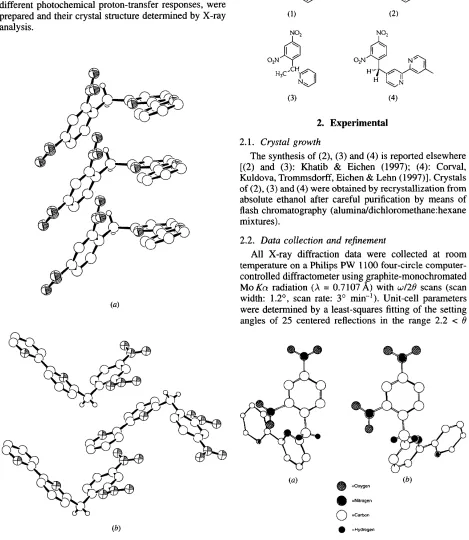
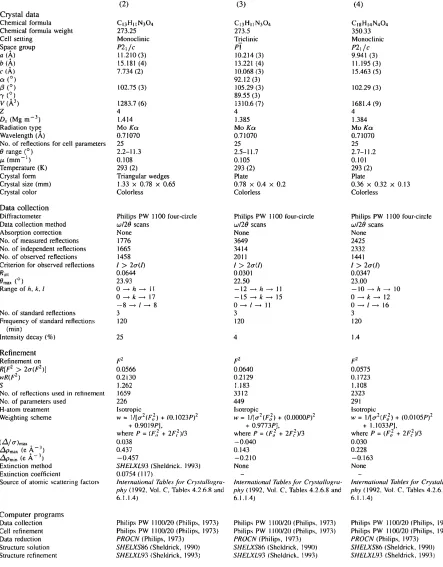
molecule contains o n e sp 3 carbon connecting the two aromatic rings and therefore may not be planarized. Based on previously reported crystal structures of 2,4- dinitrobenzylpyridine derivatives and on the observation that the photoinduced proton-transfer process is a true bulk effect and is not restricted to defect sites (Sched et al., 1996), two alternative approaches were proposed for the rationalization of the differences between photoactive and photoinert systems: (i) close- contact 7r-Tr interactions between the 2,4-diniti'obenzyl chromophore of one molecule and other neighboring aromatic rings exist only in photoinert crystals. On the other hand, in the photoactive crystals the 2,4- dinitrobenzyl chromophore is relatively isolated and with no close inter-ring contacts to any other aromatic ring. It was suggested that in structures where the 2,4-dinitrobenzyl chromophore is tightly stacked with aromatic systems of neighboring molecules, deactivation pathways that are faster than proton transfer may be envisaged due to stronger electronic coupling between the excited chromophore and other 7r-systems. These new deactivation routes may lead to photoinert crystals. This argument may be backed by many examples from the salicylideneaniline series (Schmidt, 1976; Aldoshin & Chue, 1994, and references therein; Kawato, Koyama, Kanatomi, Yonatani & Matsushita, 1994; Kawato, Koyama, Kanatomi, Tagawa & Iga, 1994; Hoshino, Inabe, Mitani & Maruyama, 1988), where tight molecular arrangement due to 7r-stacking results with a lack of photoactivity. Fig. 1 presents the molecular arrangement found in (a) the photoactive and (b) the photoinert phase of the 6-(2,4-dinitrobenzyl)- 2,2~-bipyridine system (Eichen et al., 1995) as an example for the different packing patterns found in 2,4- dinitrobenzylpyridine derivatives. (ii) The photoinduced proton-transfer process involves the abstraction of a carbon-bound proton. This implies a relatively high activation barrier for the process. Therefore, this reaction may require a significant activation of the benzylic proton by both the O atom of the o-nitro group and the N atom of the pyridine group. According to previously reported crystal structures, all the photoactive systems have both the O atom of the o-nitro group and the N atom of the pyridine ring interacting with the same benzylic proton and situated on the same side of the molecule. It was suggested that this arrangement allows the lowering of the barrier for the proton abstraction by forming some kind of a low energy path to deprotonation (Scherl et al.,
1996). In all known photoinert structures, at least one of these two requirements is not fulfilled. For example, Fig. 2 presents the different molecular conformations found in (i) the photoactive and (ii) the photoinert phases of the 6-(2,4-dinitrobenzyl)-2,2'-bipyridine system (Eichen
In order to better understand the structural factors con- trolling the photoactivity of this class of compound, three compounds: 4-methyl-2-(2,4-dinitrobenzyl)pyridine (2), 1-(2-pyridine)-l-(2,4-dinitrophenyl)ethane (3) and 4- methyl-4~-(2,4-dinitrobenzyl)-2,2~-bipyridine (4), having different photochemical proton-transfer responses, were prepared and their crystal structure determined by X-ray analysis.
(a)
[image:3.588.290.457.48.211.2](b)
Fig. 1. A schematic representation of the molecular arrangement of 6- (2A-dinitrobenzyl)-2,2Cbipyridine in (a) the photoactive and (b) the photoinert phases (Eichen et al., 1995).
NO 2
NO2
(1) (2)
NO 2
NO 2
O2~3c~C
H~, ~
O 2 N ~
N~I
(3) (4)
2. Experimental
2.1. Crystal growth
The synthesis of (2), (3) and (4) is reported elsewhere [(2) and (3): Khatib & Eichen (1997); (4): Corval, Kuldova, Trommsdorff, Eichen & Lehn (1997)]. Crystals of (2), (3) and (4) were obtained by recrystallization from absolute ethanol after careful purification by means of flash chromatography (alumina/dichloromethane:hexane mixtures).
2.2. Data collection and refinement
All X-ray diffraction data were collected at room temperature on a Philips PW 1100 four-circle computer- controlled diffractometer using graphite-monochromated MoKo~ radiation (A = 0.7107/1,) with ~v/20 scans (scan width: 1.2 °, scan rate: 3 ° min-l). Unit-cell parameters were determined by a least-squares fitting of the setting angles of 25 centered reflections in the range 2.2 < 0
(
(a) (b)
--Oxygen
=Nitrogen
C =Carbon
[image:3.588.26.495.103.643.2]0 =Hydrogen
SOLIMAN KHATIB, MARK B O T O S H A N S K Y A N D YOAV EICHEN 309
T a b l e 1.
Experimental details
(2) (3) (4)
C r y s t a l d a t a
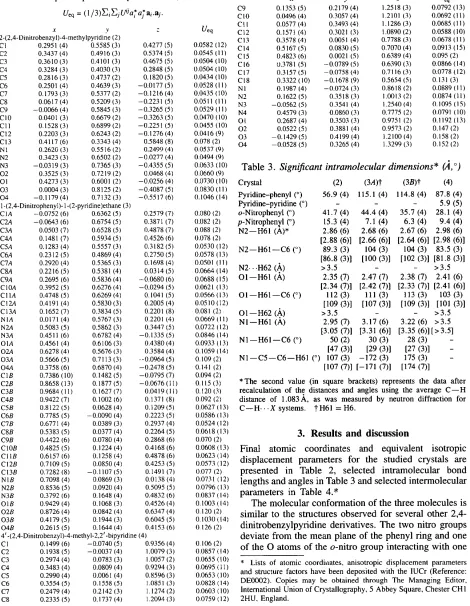
Chemical formula Ct3HltN304 Cl3Hll N304 CI8HI4N404
Chemical formula weight 273.25 273.5 350.33
Cell setting Monoclinic Triclinic Monoclinic
Space group P21/c P ! P21/c
a (A) 11.210 (3) 10.214 (3) 9.941 (3)
b (,~,) 15.181 (4) 13.221 (4) 11.195 (3)
c (,~) 7.734 (2) 10.068 (3) 15.463 (5)
a (o) 92.12 (3)
/3 (o) 102.75 (3) 105.29 (3) 102.29 (3)
"r (o) 89.55 (3)
V (,~3) 1283.7 (6) 1310.6 (7) 1681.4 (9)
Z 4 4 4
Dx (Mg m - 3 ) 1.414 1.385 1.384
Radiation type, Mo Kc~ Mo K a Mo Ko~
Wavelength (A) 0.71070 0.71070 0.71070
No. of reflections for cell parameters 25 25 25
0 range (o) 2.2-11.3 2.5-11.7 2.7-11.2
tz (mm - z ) 0.108 0.105 0.101
Temperature (K) 293 (2) 293 (2) 293 (2)
Crystal form Triangular wedges Plate Plate
Crystal size (mm) 1.33 × 0.78 × 0.65 0.78 x 0.4 x 0.2 0.36 x 0.32 × 0.13
Crystal color Colorless Colorless Colorless
D a t a c o l l e c t i o n
Diffractometer Philips PW 1100 four-circle Philips PW 1100 four-circle Philips PW 1100 four-cir.cle Data collection method w/20 scans w/20 scans w120 scans
Absorption correction None None None
No. of measured reflections 1776 3649 2425
No. of independent reflections 1665 3414 2332
No. of observed reflections 1458 2011 1441
Criterion for ohserved reflections 1 > 2~r(/) 1 > 2cr(/) 1 > 2~r(/)
Rint 0.0644 0.0301 0.0347
0max (o) 23.93 22.50 23.00
Rangeofh, k , l O----~h.---* 11 - 1 2 ---* h --~ 11 - 1 0 ----~ h ---o 10
0 ---* k ---* 17 --15 ---* k ---* 15 0 ---* k --* 12 --8 ---o l---o 8 0 ---* l---* 11 0 ---* l---~ 16
No. of standard reflections 3 3 3
Frequency of standard reflections 120 120 120
(min) Intensity decay (%)
R e f i n e m e n t Refinement on
R[F 2 > 2or(F2)]
wR(F 2) S
No. of reflections used in refinement No. of parameters used
H-atom treatment Weighting scheme
(A/o')max Apmax (e ~ - 3 ) Z~prnin (e , ~ - 3 ) Extinction method Extinction coefficient
Source of atomic scattering factors
C o m p u t e r p r o g r a m s Data collection Cell refinement Data reduction Structure solution Structure rcfinement
25 4 1.4
F ~ F 2 F 2
0.0566 0.0640 0.0575
0.2 i 30 0.2129 0.1723
1.262 I. 183 1.108
1659 3312 2323
226 449 291
lsotropic Isotropic Isotropic
w = l/[o'2(F?) + (0.1023P) 2 w = l/[rr2(Fo 2) + (0.0000P) 2 w = l/[cr2(F 2) + (0.0105P) 2
+ 0.9019P1, + 0.9773P], + 1.1033P],
where P = (F, 2, + 2F,2)/3 where P = (Fo z + 2Fc2)/3 where P = (Fo 2 + 2Fc2)/3
0.038 - 0.040 0.030
0.437 0.143 0.228
- 0 . 4 5 7 - 0 . 2 1 0 - 0 . 1 6 3
SHELXL93 (Sheldrick. 1993) None None
0.0754 (117) - -
International Tables for Crystallogra- International Tables for Crystallogra- International Tables for Crystallogra- phy ('1992, Vol. C, Table.s 4.2.6.8 and phy (1992, Vol. C, Table.,; 4.2.6.8 and phy (1992, Vol. C, Table.s 4.2.6.8 and
6.1. 1.4) 6,1.1.4) 6. I. 1.4)
Philips PW 1100/20 (Philips, 1973) Philips PW 1100/20 (Philips, 1973)
PROCN (Philips, 1973)
SHELXS86 (Sheldrick, 1990)
SHELXL93 (Sheldrick, 1993)
< 11.5 °. The intensities of three standard reflections were measured every 120 min during the data collection. Decays of 25, 4 and 1.4% were observed for (2), (3) and (4), respectively. A decay correction was applied only
Philips PW 1100120 (Philip.s, 1973) Philips PW I 1(X)/20 (Philip.s, 1973)
PROCN (Philips, 1973)
SHELXS86 (Sheldrick, 1990)
SHELXL93 (Sheldrick, 1993)
Philips PW 1100/20 (Philips, 1973) Philips PW 1100120 (Philips, 1973)
PROCN (Philips, 1973)
SHELXS86 (Sheldrick, 1990)
SHI£LXL93 (Sheldrick, 1993)
[image:4.588.82.525.68.635.2]Table 2.
Fractional atomic coordinates and equivalent
isotropic displacement parameters (,~2 )
Ueq =
(l/3)Ei~yUiYa~a;ai.aj.
X V
2-(2,4- Dinitrobenzyl)-4-methylpyridine (2) C1 0.2951 (4) 0.5585 (3) C2 0.3437 (4) 0.4916 (3) C3 0.3610 (3) 0.4101 (3) C4 0.3284 (3) 0.4030 (3) C5 0.2816 (3) 0.4737 (2) C6 0.2501 (4) 0.4639 (3) C7 0.1793 (3) 0.5377 (2) C8 0.0617 (4) 0.5209 (3) C9 -0.0066 (4) 0.5845 (3) C I 0 0.0401 (3) 0.6679 (2) C I I 0.1528 (3) 0.6899 (2) C12 0.2203 (3) 0.6243 (2) C13 0.4117 (6) 0.3343 (4) N 1 0.2620 (3) 0.5516 (2) N2 0.3423 (3) 0.6502 (2) N3 -0.0319 (3) 0.7365 (3) 0 2 0.3525 (3) 0.7219 (2) Ol 0.4273 (3) 0.6001 (2) 03 0.0004 (3) 0.8125 (2) 0 4 -0.1179 (4) 0.7132 (3)
1-(2,4-Dinitrophenyl)- 1-(2-pyridine)ethane C1A -0.0752 (6) 0.6362 (5) C2A -0.0643 (6) 0.6754 (5) C3A 0.0503 (7) 0.6528 (5) C4A 0.1481 (7) 0.5934 (5) C5A 0.1283 (4) 0.5557 (3) C6A 0.2312 (5) 0.4869 (4) C7A 0.2920 (4) 0.5365 (3) C8A 0.2216 (5) 0.5381 (4) C9A 0.2695 (6) 0.5836 (4) C10A 0.3952 (5) 0.6276 (4) CI IA 0.4748 (5) 0.6269 (4) CI2A 0.4191 (4) 0.5830 (3) CI3A 0.1652 (7) 0.3834 (5) NIA 0.0171 (4) 0.5767 (3) N2A 0.5083 (5) 0.5862 (3) N3A 0.4511 (6) 0.6782 (4) OIA 0.4561 (4) 0.6106 (3) O2A 0.6278 (4) 0.5676 (3) O3A 0.5666 (5) 0.7113 (3) O4A 0.3758 (6) 0.6870 (4) C1B 0.7386 (10) 0.1482 (5) C2B 0.8658 (13) 0.1877 (5) C3B 0.9684 (11) 0.1627 (7) C4B 0.9422 (7) 0.1002 (6) C5B 0.8122 (5) 0.0628 (4) C6B 0.7785 (5) -0.0090 (4) C7B 0.6771 (4) 0.0389 (3) C8B 0.5383 (5) 0.0377 (4) C9B 0.4422 (6) 0.0780 (4) C10B 0.4825 (5) 0.1224 (4) CI IB 0.6157 (6) 0.1258 (4) C12B 0.7109 (5) 0.0850 (4) CI3B 0.7282 (8) -0.1107 (5) NIB 0.7098 (4) 0.0869 (3) N2B 0.8536 (5) 0.0920 (4) N3B 0.3792 (6) 0.1648 (4) O1B 0.9429 (4) 0.1068 (3) O2B 0.8726 (4) 0.0842 (4) O3B 0.4179 (5) 0.1944 (3)
: Ueq
0.4277 (5) 0.5374 (5) 0.4675 (5) O.2848 (5) 0.1820 (5) -0.0177 (5) -0.1216 (4) -0.2231 (5) -0.3265 (5) --0.3263 (5) -0.2251 (5) -0.1276 (4) 0.5848 (8) 0.2499 (4) -0.0277 (4) -0.4355 (5) 0.O468 (4) - 0 . 0 2 5 6 (4) --0.4087 (5) -0.5517 (6) (3)
0.2579 (7) 0.3871 (7) 0.4878 (7) 0.4526 (6) 0.3182 (5) 0.2750 (5) 0.1698 (4) 0.0314 (5) -0.0680 (6) -0.0294 (5) 0.1041 (5) 0.2005 (4) 0.2201 (8) 0.2201 (4) 0.3447 (5) -0.1335 (5) 0.4380 (4) 0.3584 (4) --0.0964 (5) -0.2478 (5) --0.0795 (7) -0.0676 (I 1)
0.0419 (11) 0.1371 (8) 0.1209 (5) 0.2223 (5) 0.2937 (4) 0.2264 (5) O.2868 (6) 0.4168 (6) 0.4878 (6) 0.4253 (5) 0.1491 (7) 0.0138 (4) 0.5095 (5) 0.4832 (6) 0.4526 (4) 0.6347 (4) 0.6045 (5) O4B 0.2615 (5) 0.1644 (4) 0.4153 (6) 4'-(2,4-Dinitrobenzyl)-4-methyl-2,2'-bipyridine (4) C1 0.1499 (6) -0.0740 (5) 0.9356 (4) C2 0.1938 (5) -0.0037 (4) 1.0079 (3) C3 0.2974 (4) 0.0783 (3) 1.0057 (2) C4 0.3483 (4) 0.0809 (4) 0.9294 (3) C5 0.2990 (4) 0.0061 (4) 0.8596 (3) C6 0.3554 (5) 0.1558 (5) 1.0851 (3) C7 0.2479 (4) 0.2142 (3) I. 1274 (2) C8 0.2335 (5) 0.1737 (4) 1.2094 (3)
0.0582 (12) 0.0545 (I I ) 0.0504 (10) 0.0504 (10) 0.0434 (10) 0.0528 (I 1) 0.0435 (10) 0.0511 (11) 0.0529 (I I) 0.0470 (10) 0.0455 (10) 0.0416 (9) 0.078 (2) 0.0537 (9) 0.0494 (9) 0.0633 (10) 0.0660 (9) 0.0730 ( I 0) 0.0830 ( 11 ) 0.1046 (14)
O.O8O (2) 0.082 (2) 0.088 (2) 0.078 (2) 0.0530 (12) 0.0578 (13) 0.0501 (11) 0.0664 (14) 0.0688 (15) 0.0621 (13) 0.0566 (13) 0.0510 (12) 0.081 (2) 0.0669 ( 11 ) 0.0722 (12) 0.0846 (14) 0.0933 (13) 0.1059 (14) 0.109 (2) 0.141 (2) 0.094 (2) 0.115 (3) 0.120 (3) 0.092 (2) 0.0627 (13) 0.0586 (13) 0.0524 (12) 0.0618 (13) O.O7O (2) 0.0608 (13) 0.0623 (14) 0.0573 (12) 0.077 (2) 0.0731 (12) 0.0796 (13) 0.0837 (14) 0.1003 (14) 0.120 (2) 0.1030 (14)
0.126 (2)
0.106 (2) 0.0857 (14) 0.0655 (10) 0.0695 ( 11 ) 0.O653 (10) 0.0828 (14) 0.0603 ( I 0) 0.0759 (12)
Table 2
(cont.)
x y z Ueq
C9 0.1353 (5) 0.2179 (4) 1.2518 (3) 0.0792 (13) C I 0 0.0496 (4) 0.3057 (4) 1.2101 (3) 0.0692 (1 l) C l l 0.0577 (4) 0.3493 (4) 1.1286 (3) 0.0685 ( l l ) C12 0.1571 (4) 0.3021 (3) 1.0890 (2) 0.0588 (10) CI3 0.3578 (4) 0.0051 (4) 0.7788 (3) 0.0678 (1 l) CI4 0.5167 (5) 0.0830 (5) 0.7070 (4) 0.0913 (15) C15 0.4823 (6) 0.0021 (5) 0.6389 (4) 0.095 (2) Cl6 r0.3781 (5) -0.0789 (5) 0.6390 (3) 0.0866 (14) CI7 0.3157 (5) -0.0758 (4) 0.7116 (3) 0.0778 (12) C18 0.3322 (10) -0.1678 (9) 0.5654 (5) 0.131 (3) Nl 0.1987 (4) -0.0724 (3) 0.8618 (2) 0.0889 (l 1) N2 0.1622 (5) 0.3518 (3) 1.0013 (2) 0.0874 ( 11 ) N3 -0.0562 (5) 0.3541 (4) 1.2540 (4) 0.1095 (15) N4 0.4579 (3) 0.0860 (3) 0.7775 (2) 0.0791 (10) Ol 0.2687 (4) 0.3503 (3) 0.9751 (2) 0.1192 (13) 02 0.0522 (5) 0.3881 (4) 0.9573 (2) 0.147 (2) 03 -0.1429 (5) 0.4199 (4) 1.2100 (4) 0.158 (2) 0 4 -0.0528 (5) 0.3265 (4) 1.3299 (3) 0.152 (2)
Table 3.
Significant intramolecular dimensions* (,~,o)
Crystal (2) (3A)I" ( 3 B ) t (4)
[image:5.588.31.501.71.677.2]P y r i d i n e - p h e n y l (o) 5 6 . 9 (4) 115.1 (4) 114.8 (4) 87.8 (4) P y r i d i n e - p y r i d i n e (°) - - - 5.9 (5) o - N i t r o p h e n y l (o) 4 1 . 7 (4) 4 4 . 4 (4) 35.7 (4) 28.1 (4) p - N i t r o p h e n ~ l (°) 15.3 (4) 7.1 (4) 6.3 (4) 9.4 (4) N 2 - - H 6 1 (A)* 2 . 8 6 (6) 2.68 (6) 2 . 6 7 (6) 2.98 (6) [2.88 (6)] [2.66 (6)] [2.64 (6)] [2.98 (6)] N 2 - - H 6 1 - - C 6 (°) 89.3 (3) 104 (3) 104 (3) 83.5 (3)
[86.8 (3)] [100 (3)] [102 (3)] [81.8 (3)] N 2 . . -H62 (A) > 3.5 - - > 3.5 O 1 - - H 6 1 (A) 2.35 (7) 2 . 4 7 (7) 2.38 (7) 2.41 (6)
[2.34 (7)1 [2.42 (7)] [2.33 (7)] [2.41 (6)] O1 - - H 6 1 - - C 6 (o) 112 (3) 111 (3) 113 (3) 103 (3)
[109 (3)] [107 (3)] [109 (3)] [101 (3)]
O 1 - - H 6 2 (A) > 3 . 5 - - > 3 . 5 N I - - H 6 1 (A) 2.95 (7) 3.17 (6) 3.22 (6) > 3 . 5 [3.05 (7)] [3.31 (6)] [3.35 ( 6 ) ] [ > 3 . 5 ] N 1 - - H 6 1 - - C 6 (°) 50 (2) 30 (3) 28 (3) - [47 (3)] [29 (3)] [27 (3)] - N 1 - - C 5 - - C 6 - - H 6 1 (o) 107 (3) - 1 7 2 (3) 175 (3) -
[107 (7)] [ - 1 7 1 (7)] [174 (7)]
* The second value (in square brackets) represents the data after recalculation o f the distances and angles using the average C - - H
distance o f 1 . 0 8 3 A , as was measured by neutron diffraction for C - - H - . . X systems, t H 6 1 = H 6 .
3. Results and discussion
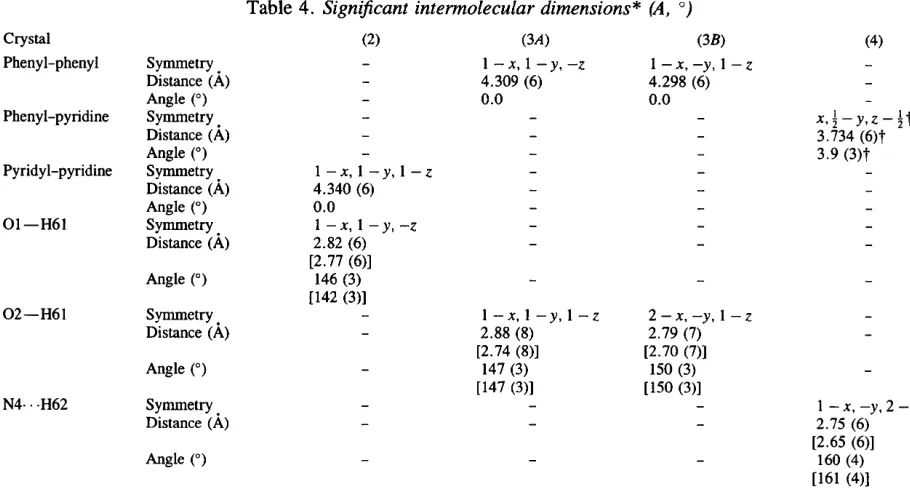
Final atomic coordinates and equivalent isotropic displacement parameters for the studied crystals are presented in Table 2, selected intramolecular bond lengths and angles in Table 3 and selected intermolecular parameters in Table 4.*
The molecular conformation of the three molecules is similar to the structures observed for several other 2,4- dinitrobenzylpyridine derivatives. The two nitro groups deviate from the mean plane of the phenyl ring and one of the O atoms of the o-nitro group interacting with one
* Lists o f atomic coordinates, anisotropic displacement parameters and structure factors have been deposited with the IUCr (Reference:
DE0002). C o p i e s m a y be obtained through T h e M a n a g i n g Editor,
SOLIMAN KHATIB, MARK BOTOSHANSKY AND YOAV EICHEN 311
Table 4.
Significant intermolecular dimensions* (fl, °)
C r y s t a l (2) (3A) ( 3 B ) (4)
P h e n y l - p h e n y l S y m m e t r y . - 1 - x, 1 - y, - z 1 - x, - y , 1 - z - D i s t a n c e ( A ) - 4 . 3 0 9 (6) 4 . 2 9 8 (6) -
A n g l e (o) - 0 . 0 0 . 0 -
P h e n y l - p y r i d i n e S y m m e t r y . - - - x, ½ - y, z - ½ t
D i s t a n c e ( A ) - - - 3 . 7 3 4 ( 6 ) t
A n g l e (o) _ _ - 3 . 9 ( 3 ) t
P y r i d y l - p y r i d i n e S y n u n e t r y . 1 - x, 1 - y, 1 - z - - -
D i s t a n c e ( A ) 4 . 3 4 0 (6) - - -
A n g l e (o) 0 . 0 - - -
O 1 - - H 6 1 S y m m e t r y . 1 - x, 1 - y, - z - - -
[image:6.588.81.536.52.296.2]D i s t a n c e ( A ) 2 . 8 2 (6) - - -
[2.77 (6)]
A n g l e (°) 146 (3) - - -
[ 1 4 2 (3)]
O 2 - - H 6 1 S y m m e t r y . - 1 - x, 1 - y, 1 - z 2 - x, - y , 1 - z - D i s t a n c e ( A ) - 2 . 8 8 (8) 2 . 7 9 (7) -
[ 2 . 7 4 (8)] [ 2 . 7 0 (7)]
A n g l e (o) - 147 (3) 150 (3) -
[ 1 4 7 (3)] [ 1 5 0 (3)]
N 4 - . . H 6 2 S y m m e t r y . - - - 1 - x, - y , 2 - z
D i s t a n c e ( A ) - - - 2 . 7 5 (6)
[ 2 . 6 5 (6)]
A n g l e (°) - - - 160 (4)
[161 (4)1
* T h e s e c o n d v a l u e ( i n s q u a r e b r a c k e t s ) p r e s e n t s t h e d a t a a f t e r r e c a l c u l a t i o n o f t h e d i s t a n c e s a n d a n g l e s u s i n g t h e a v e r a g e C - - H d i s t a n c e o f 1.083,~, as w a s m e a s u r e d b y n e u t r o n d i f f r a c t i o n f o r C - - H . . - X s y s t e m s , t R e f e r s to t h e d i s t a l p y r i d i n e r i n g .
of the benzylic H atoms. The dominant intermolecular interactions are the intermolecular 7r-Tr stacking between the various ring systems and hydrogen bonds (Bernstein, Etter & Leiserowitz, 1994, and references therein; Sharma & Desiraju, 1994; Sharma, Panneerselvam, Pilati & Desiraju, 1993; Desiraju, 1991) formed between the benzylic protons and neighboring basic moieties such as O and N atoms.
3.1.
2-(2,4-Dinitrobenzyl)-4-methylpyridine (2)
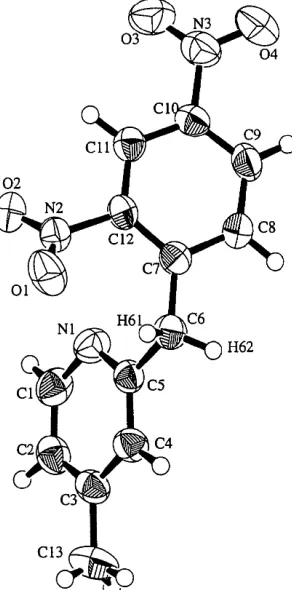
The molecular structure and atom labeling of 2-(2,4- dinitrobenzyl)-4-methylpyridine (2) and its arrangement in the unit cell are presented in Figs. 3 and 4, respectively. Crystals of (2) are monoclinic, space group
P21/c,
with four molecules in the asymmetric unit. The planes of the o-nitro and p-nitro groups are twisted by 41.7(4) and 15.3 (4) ° , respectively, from the phenyl ring plane. The mean plane of the pyridine ring is twisted ti'om the mean plane of the phenyl ring by 56.9 (4) ° , so that the o-nitro group and the N1 atom of the pyridine moiety are positioned on the same side of the molecule. The O1 atom of the o-nitro group and the N atom of the py.ridine ring interact with the same benzylic hydrogen, H61, d ( O . . . H ) = 2.35 (7)/~ [2.34 (7)/~*], with O 1 . . . H 6 1 - - C 6 = 112 (3) °* X - r a y a n d n e u t r o n d i f f r a c t i o n m e a s u r e m e n t s y i e l d d i f f e r e n t C - - H b o n d l e n g t h s . T h e r e f o r e , t h e d i s t a n c e s a n d a n g l e s o f t h e C - - H - . - X s y s t e m s a r e g i v e n as m e a s u r e d b y X - r a y d i f f r a c t i o n a n d c o m p a r e d w i t h t h e s a m e p a r a m e t e r s ( t h e v a l u e s in b r a c k e t s ) c a l c u l a t e d u s i n g s t a n d a r d n e u t r o n d i f f r a c t i o n C - - H d i s t a n c e s in C - - H . . . X s y s t e m s (X = N , O ;
1 . 0 8 3 / ~ ) .
[109(3)°], and d ( N . . . H ) = 2.95 (7)/~ [3.05 (7)/~], with N1...H61---C6 = 50(2) ° [47 (3)°]. The torsion angle between the carbon-nitrogen C 5 - - N I bond and the car- bon-hydrogen C6---H61 bond is N1---C5---426---H61 = 107(3) ° . The shortest inter-ring distance is found between the pyridine ring and another pyridine ring from a neighboring molecule related by the 1 - x, 1 - y, 1 - z symmetry operation, d(center-center)= 4.340 (6)/~. This inter-ring separation reflects the absence of any significant 7r-Tr interactions between the two moieties. Similarly, the dinitrophenyl moiety is relatively isolated with no close intermolecular contacts to any other aromatic ring. The closest ring to the dinitrophenyl group is the pyridine ring of the molecule related by the +x, +y, 1 + z symmetry operation, d(center-center)= 4.728 (6) /~, which is twisted by 56.9(4) ° from the mean plane of the phenyl ring. The O1 atom of the o-nitro group interacts with the benzylic H61 atom of the molecule related by the 1 - x, 1 - y, -z symmetry operation, d(O..-H) = 2.82 (6)/~ [2.77 (6)/~], O 1 . . . H 6 1 - - C 6 = 146(3) ° [142(3)°].
The molecular structure and supramolecular arrange- ment of the molecules in this crystal are in agreement with the two proposed models dealing with the origins of the photoactivity of DNBP systems. The crystals of 2-(2,4-dinitrobenzyl)-4-methylpyridine are indeed pho- tochromic and develop a deep blue color upon exposure to near-UV light.
X-ray beam and the crystal. Interestingly, this decay is reversible. The intensity of the standard reflections is almost completely recovered within 3 d. This effect is currently being studied in order to uncover its origin.
3.2.
1-(2,4-Dinitrophenyl)-l-(2-pyridine)ethane (3)
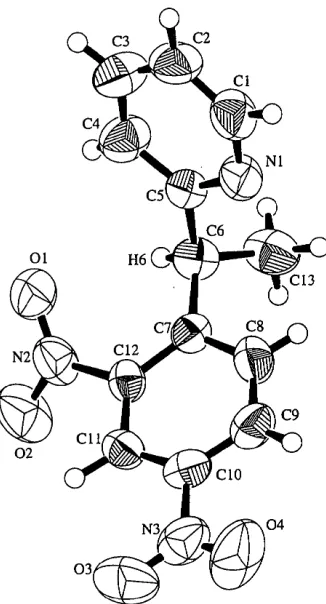
The molecular structure and atom labeling of 1- (2,4-dinitrophenyl)-l-(2-pyridine)ethane (3) and its arrangement in the unit cell are presented in Figs. 5 and 6, respectively. Crystals of (3) are triclinic, space group P i , with four molecules in the unit cell. There are
O4
02 N2
C8
Ol
C1
C2 N1
C5
C4 C6
H62
C13
Fig. 3. The molecular structure and atom-labeling scheme of 2-(2,4- dinitrobenzyl)-4-methylpyridine (2).
two (A and B) pairs of symmetrically nonequivalent molecules in the unit cell. The molecule is chiral and each one of the two enantiomers is represented by two slightly different conformers in the unit cell. The main structural and environmental differences between the A and B conformers are listed in Tables 3 and 4, respectively. The planes of the o- and p-nitro groups are twisted about the mean plane of the phenyl ring by 44.4 (4) and 7.1 (4) °, respectively, for the A molecule and 35.7 (4) and 6.3 (4) °, respectively, for molecule B. The angle between the mean planes of the pyridine and phenyl rings is 115.1 (4) and 114.8(4) ° for molecules A and B, respectively. Thus, the o-nitro group and the N atom of the pyridine moiety are situated at opposite sides of the molecule both in A and B conformers. Consequently, solely the O1 atom of the o- nitro group is within interaction distance and orientation to the benzylic H6 atom, d ( O . . . H ) - 2.47 (7) [2.42 (7)] and 2.38 (7)/~ [2.33 (7)/~], O1...H6---C6 = 111 (3) [107 (3)] and 113 (3) ° [109 (3) °] for molecules A and B, respectively. The lone pair of the N1 atom of the pyridine ring is pointing towards the methyl group and is close to being in an
anti
position to the benzylic H6 atom, N1--C5---C6---H6 = -172(3) [-171(7)] and N 1 - - C 5 - - C 6 - - H 6 = -175 (3) ° [-174 (7) °] for molecules A and B, respectively. The distance from the N1 atom of the pyridine ring to the same proton is d(N...H) = 3.17 (6) [3.31 (6)] and 3.22 (6)/~ [3.35 (6) /~], N 1 . . . H 6 - - C 6 = 30(3) [29(3)] and N 1 . . . H 6 - - C 6 = 28 (3) ° [27 (3) °] for molecules A and B, respectively. No close-contact 7r-Tr interactions are found in the crystal lattice. The shortest intermolecular inter-ring distances are found between the phenyl rings and other phenyl rings from neighboring molecules related by the 1 - x, 1 - y, -z (A) and 1 - x, -y, 1 - z (B) symmetry operations. The center-to-center distances between the rings [d(center-center)=4.309(6) and 4.298 (6)/~ for molecules A and B, respectively] indicate the absence of any close-contact 7r-Tr interactions between the two. Similarly, the pyridine moieties are situated far apart from one another and from the phenyl rings. The 0 2 atoms of the o-nitro groups interact with the benzylic H6 atoms of the molecules related by the [image:7.588.73.219.197.492.2] [image:7.588.33.342.546.674.2]SOLIMAN KHATIB, M A R K B O T O S H A N S K Y A N D YOAV EICHEN 313
1 - x , 1 - y, 1 - z (A) and 2 - x, -y, 1 - z (B) symmetr~ operations, d ( O . . . H ) - 2.88 (8) [2.74 (8)] and 2.79 ( 7 ) A [2.70(7)/k]i with 0 2 . . . H 6 - - - C 6 = 147 (3) [147 (3)] and 150 (3) ° [150 (3) °] for molecules A and B, respectively. According t o model (ii) presented above, this crys- tal was expected to be photoinert as only the o-nitro group is interacting with the 9hotolabile benzylic proton.
However, the crystals were found to be photoactive, developing a deep blue color upon exposure to near- UV light. It is therefore evident that the role of the N atom of the pyridine ring in the proton-abstraction process is mainly inductive and its interaction with the benzylic proton is not essential for the excited state proton abstraction to occur.
C2
C1
C4
C5
Nl
Ol H6
213
N2 ( ' ~ , ~ C1_.2
02
C10 C9
04
03
Fig. 5. The molecular structure and atom-labeling scheme of 1-(2,4- dinitrophenyl)- 1-(2-pyridine)ethane (3).
3.3.
4~-(2,4-Dinitrobenzyl)-4-methyl-2,2'-bipyridine (4)
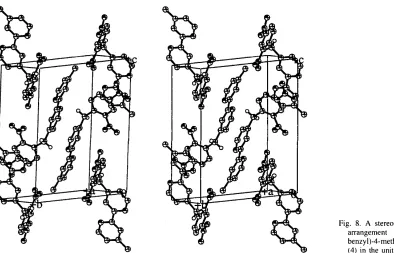
The molecular structure and atom labeling of 4'- (2,4-dinitrobenzyl)-4-methyl-2,T-bipyridine (4) and the unit-cell content of crystals of (4) are presented in Figs. 7 and 8, respectively. Crystals of (4) are monoclinic, space groupP21/c,
with four molecules in the asymmetric unit. The planes of the o- and p-nitro groups are twisted by 28.1 (4) and 9.4 (4) °, respectively, from the mean plane of the phenyl ring. The interplanar angle between the phenyl ring and the proximal pyridine ring is 87.8 (4) °. The interplanar angle between the two pyridine rings is 5.9 (5) °. In this case, close contact between the N1 atom of the proximal pyridine ring and the benzylic H61 atom is topologically impossible. The O1 atom of the o-nitro group interacts with the benzylic H61 atom, d ( O . . . H ) - 2.41 (6)/~ [2.41 (6)/~], with an angle of O 1 . . . H 6 1 - - - C 6 = 103 (3) ° [101 (3)°]. The distal pyridine ring is almost coplanar with the dinitrophenyl ring of a neighboring1
molecule related by the x, ½ - y, z - 7 symmetry operation. The angle between the mean planes of 3.9 (3) ° and the center-to-center distance of 3.734 (6)/~ reflects the existence of a 7r-Tr interaction between these two rings. No other pair of aromatic rings exhibit close 7r-Tr interactions in this crystal.
[image:8.588.111.274.144.446.2] [image:8.588.82.400.495.679.2]The N4 atom of the distal pyridine ring interacts with the benzylic H62 atom of the molecule related by the 1 - x, -y, 2 - z symmetry operation, d ( N . . . H ) = 2.75 (6)/~ [2.65 (6)/~], with an angle of N 4 . . . H 6 2 - - C 6 = 160 (4) o [161 (4)°].
o4
Fig. 7. The molecular structure and atom-labeling scheme of 4'-(2,4- dinitrobenzyl)-4-methyl-2,2~-bipyridine (4).
As stated above, it is topologically impossible to photoinduce a direct transfer of the benzylic proton to the nitrogen of the proximal pyridine ring of the same molecule. On the other hand, according to the arrangement of the basic groups around the abstracted proton, the 'CH' ~ 'OH' proton-transfer process (see Scheme I) is still theoretically feasible. However, the crystals were found to be photoinert and did not exhibit any photoactivity at the temperature spectrum range 325-77 K and 400-800 nm, respectively. This implies that the close-contact 7r-Tr interactions inhibit the proton- transfer process, probably by opening some new deacti- vation routes which are faster than the proton transfer.
4. Conclusions
Photoinduced and thermally activated proton-transfer processes are known to take place in single crystals of dinitrobenzyl pyridine derivatives. Recent reports have concluded that this effect is a true bulk effect and is not restricted to defect sites. Therefore, a correlation between the crystalline structure and the proton-transfer properties may be drawn. Previous attempts to correlate the photoactivity of a-DNBP and its derivatives with the properties of the molecular structure and crystal packing have led to the conclusion that the process is intramolecular (Serf & Trueblood, 1968) and that two different alternative models exist for the origins of the photoactivity (Eichen et al., 1995; Scherl et al., 1996). Model (i) suggests that close-contact 7r-Tr interactions
t~
-9
te
[image:9.588.38.432.420.673.2]SOLIMAN KHATIB, MARK BOTOSHANSKY AND YOAV EICHEN 315
between the 2,4-dinitrobenzyl group and other aromatic rings open some deactivation routes to the excited state that are faster than the proton-transfer process and model (ii) suggests that the abstraction of the benzylic proton requires its activation by both the o-nitro group and the N atom of the pyridine ring, in order to generate the substantial electrostatic potential needed for the proton- abstraction process.
The molecular structure and crystal packing in the crystal of 2-(2,4-dinitrobenzyl)-4-methylpyridine (2) is such that both the o-nitro group and the pyridine nitrogen are situated at the same side of the molecule. These two atoms interact with the same benzylic proton. On the other hand, the dinitrophenyl moiety is free from any close-contact 7r-Tr interactions. Therefore, this system is in agreement with the two models. However, in 1-(2,4- dinitrophenyl)-l-(2-pyridine)ethane (3) the torsion angle N 1 - - - C 5 - - C 6 - - H 6 A shows that the lone pair N atom of the pyridine ring is pointing towards the methyl group. Thus, this nitrogen is too far from the benzylic hydrogen and cannot contribute to the abstraction of the proton. This implies that, in contrast to model (ii), the role of the nitrogen of the pyridine ring in the proton-abstraction process is mainly inductive and its interaction with the benzylic proton is not essential for the excited-state proton abstraction to occur. In the case of 4'-(2,4- dinitrobenzyl)-4-methyl-2,2'-bipyridine (4) the pyridine nitrogen is situated in a para position relative to the benzylic carbon and therefore cannot interact with any of the benzylic protons. On the other hand, as the effect of this nitrogen is mainly inductive, 4'-(2,4-dinitrobenzyl)- 4-methyl-2,2'-bipyridine (4) should still be photoactive through the 'CH' ~ 'OH' path. However, this crystal is found to be photoinert. This observation, together with the observation that the dinitrophenyl group is 7r-stacked with the distal pyridine ring of a neighboring molecule, agrees with model (i).
The findings that photoinert systems are related to 7r-Tr interactions that control the packing of the molecules in the crystal are in agreement with many previously reported salicylideneaniline crystalline systems. However, it seems that at least for the 2,4- dinitrobenzylpyridine family, the free volume argument is inconsistent with the observed spectroscopic and kinetic data. In this type of system only the 7r-Tr interactions of the 2,4-dinitrophenyl ring with other aromatic rings lead to photoinert systems, while 7r-Tr interactions between pyridine rings can be found in photoactive and photoinert systems. It is therefore suggested that the difference between photoactive and photoinert systems originate from the difference in the deactivation pathways that are available to the electronic excited states. 7r-Tr interactions between the chromophore (2,4-dinitrophenyl ring) and other aromatic rings allow fast deactivation of the electronic excited state via energy or electron transfer. Alternatively, 7r-Tr interactions between the chromophore and other
aromatic rings can induce a change in the relative population of the different excited states, leading to inactive excited species. In the absence of these fast deactivation channels, proton transfer may take place. Several new 2,4-dinitrobenzylpyridine derivatives are currently being prepared and characterized by means of optical spectroscopy and X-ray analysis in order to further clarify this point.
The authors thank Professors F. H. Herbstein and M. Kaftory for many helpful discussions. This work was supported by The Israel Science Foundation, administrated by The Israel Academy of Sciences and Humanities (135-96-1), and by The Fund for the Promotion of Sponsored Research at the Technion (060-377).
References
Aldoshin, S. M. & Chue, I. I. (1994). Correlations, Trans- formations and Interactions in Organic Crystal Chemistry,
edited by D. W. Jones & A. Katrusiak, pp. 79-92. Oxford University Press.
Bell, R. P. (1973). The Proton in Chemistry, 2nd ed. New York: Cornell University Press.
Bernstein, J., Etter, M. C. & Leiserowitz, L. (1994). In Struc- ture Correlation, edited by H. B. Btirgi & J. D. Dunitz, Vol. 2, pp. 431-507. Weinheim: VCH.
Chichibabin, A. E., Kuindzhi, B. M. & Benewolenskaja, S. W. (1925). Ber. Dtsch. Chem. Ges. 58, 1580-1583.
Cohen, M. D., Schmidt, G. M. J. & Flavian, S. (1964). J.
Chem. Soc. pp. 2041-2051.
Corval, A., Kuldova, K., Trommsdorff, H. P., Eichen, Y. & Lehn, J. M. (1997). To be published.
Desiraju, G. R. (1991). Acc. Chem. Res. 24, 290. D6pp, D. (1975). Top. Curr. Chem. 55, 49.
Drain, C. M., Cristensen, B. & Mauzerall, D. (1989). Proc. Natl. Acad. Sci. USA, 86, 6959-6962.
D0rr, H. & Bouas-Laurant, H. (1990). Editors. Photochromism: Molecules and Systems, Studies in Organic Chemistry, Vol. 40, chs. 16 and 17. Amsterdam: Elsevier.
Eichen, Y., Lehn, J. M., Scherl, M., Haarer, D., Fischer, J., DeCian, A., Corval, A. & Trommsdorff, H. P. (1995).
Angew. Chem. Int. Ed. Engl. 34, 2530-2533.
Hoshino, N., Inabe, T., Mitani, T. & Maruyama, Y. (1988).
Bull. Chem. Soc. Jpn, 61, 4207-4214.
Irie, M. & Iga, R. (1986). Macromolecules, 19, 2480-2484. Jeffrey, G. A. & Saenger, W. (1991). Hydrogen Bonding in
Biological Structures. Berlin, Springer-Verlag.
Kawato, T., Koyama, H., Kanatomi, H., Tagawa, H. & Iga, K. (1994). J. Photochem. Photobiol. A, 78, 71-77.
Kawato, T., Koyama, H., Kanatomi, H., Yonatani, K. & Matsushita, H. (1994). Chem. Lett. pp. 665-668.
Khatib, S. & Eichen, Y. (1997). In preparation.
Khatib, S., Poplawsky, J. & Eichen, Y. (1997). Submitted. Kosower, E. M. & Huppert, D. (1986). Ann. Rev. Phys. Chem.
37, 127-156.
Mamada, A., Tanaka, T., Kungwatchakun, D. & Irie, M. (1990). Macromolecules, 23, 1517 1519.
Philips (1973). PW1100/20 Software.
Porter, G. (1967). Reactivity of Photo-Excited Organic Molecules. London: Wiley Interscience.
Sarma, J. A. R. & Desiraju, G. R. (1985). J. Chem. Soc. Perkin Trans. 2, p. 1905.
Scherl, M., Haarer, D., Fischer, J., DeCian, A., Eichen, Y. & Lehn, J. M. (1996). J. Phys. Chem. 100, 16175- 16186.
Schmidt, G. M. J. (1976). Solid State Photochemistry, edited by D. Ginsburg, pp. 61-89. Weinheim: Verlag Chimie. Serf, K. & Trueblood, K. N. (1968). Acta Cryst. B24,
1406-1415.
Sharma, C. V. K. & Desiraju, G. R. (1994). J. Chem. Soc. Perkin Trans. 2, p. 2345.
Sharma, C. V. K., Panneerselvam, K., Pilati, T. & Desiraju, G. R. (1993). J. Chem. Soc. Perkin Trans. 2, p. 2209. Sheldrick, G. M. (1990). Acta Cryst. A46, 467-473.
Sheldrick, G. M. (1993). SHELXL93. Program for the Refine- ment of Crystal Structures. University of G6ttingen, Ger- many.
Sixl, H. & Warta, R. (1985). Chem. Phys. 94, 147-155. V6gtle, F., Mtiller, W. M., MUller, U., Bauer, M. & Rissanen,
K. (1993). Angew. Chem. Int. Ed. Engl. 32, 1295-1297. Weller, A. (1961). Prog. React. Kinet. 1, 189-214.
Willner, I. & Rubin, S. (1996). Angew. Chem. Int. Ed. Engl.
35, 367-385.
Willner, I., Eichen, Y., Doron, A. & Marx, S. (1992). Isr. J. Chem. 32, 53-59.
Willner, I., Marx, S. & Eichen, Y. (1992). Angew. Chem. Int. Ed. Engl. 31, 1243-1244.
Willner, I., Sussan, S. & Rubin, S. (1992). J. Chem. Soc. Chem. Commun. pp. 100-101.