ISSN 2324-805X E-ISSN 2324-8068 Published by Redfame Publishing URL: http://jets.redfame.com
The Methods of Teaching Course Based on Constructivist Learning
Approach: An Action Research
Sertel Altun1, Banu Yücel-Toy1 1Faculty of Education, Yildiz Technical University, Istanbul, Turkey
Correspondence: Sertel Altun, Faculty of Education, Yildiz Technical University, 34210, Istanbul, Turkey
Received: August 21, 2015 Accepted: September 7, 2015 Online Published: September 21, 2015
doi:10.11114/jets.v3i6.1047 URL: http://dx.doi.org/10.11114/jets.v3i6.1047
Abstract
This purpose of this study is to investigate how the course designed based on constructivist principles has been implemented, what actions have been taken to solve problems and what thoughts have arisen in the minds of teacher candidates with regard to the constructivist learning approach. In this study, an action research was employed which emanated from qualitative research designs. The participants in this study consisted of 55 science teacher candidates from the fields of biology, physics and chemistry for secondary education enrolled on the Teacher Training Certificate Program at one of large state university in Turkey. So as to collect necessary data for the study, reflection notes written by the teacher candidates, their products and a questionnaire to elicit opinions were used. The data obtained were then analyzed by using descriptive and content analysis methods. The acquired results demonstrated that on account of teacher candidates’ increased exposure to the constructivist learning environment, their knowledge and professional skills increased over time. The teacher candidates outlined in their reflections on the process that becoming better acquainted with the approach did indeed make valuable contributions to their cognitive, academic and affective development. However, they indicated that factors such as inadequate provision of equipment in classrooms, oversized classes, individual differences in academic abilities of students and the centralized examination system prevented the successful implementation of this approach in the schools.
Keywords: Constructivist learning approach, teacher education, the methods of teaching course, action research
1. Introduction
In Turkey, the primary-school programs that have been introduced since 2005, have been revised and applied in accordance with the educational tenets of the constructivist approach. The constructivist learning approach has at its center an active learning processes permitting students to become responsible for their own learning and assisting them in become capable of constructing the knowledge that they require for their learning. In this regard, curricula that are based on this approach aim to create a learning environment in which students themself take responsibility for their own learning and learning concepts are created in accordance with students’ own prior knowledge of topics in keeping with their own learning preferences (Jaworski, 1994; Marlowe & Page, 1998; Von Glasersfeld, 1995; Woolfolk, 2004).
This is achieved by helping students to pass from an initial stage of drawing on their own experiences through active learning to another in which they create their own concepts of the subject knowledge.
In order to devise activities in accordance with the constructivist approach that help students achieve a successful outcome necessitates the design of relevant activities, the choice and use of the suitable equipment and materials, application of varied learning-teaching methods and the implementation of appropriate measurement and evaluation tools, in addition to the creation of suitable learning environments. Teachers should be required to undergo additional in-service training with view to enhancing their knowledge and application of that subject area so as to carry out their roles successfully, both prior to and following on from the delivery of particular subject material. For this reason, and with view to supporting the creation of constructivist educational environments and assisting students’ harmonious adaptation to the principles of this approach, the Turkish Ministry of Education has provided a great number of in-service training programs for teachers after the new educational programs have been put into practice (Eren, Ozen & Karabacak, 2009; Kildan & Temel, 2008; Onen, Mertoglu, Saka & Gurdal, 2009). Nevertheless, when one studies the application of the new approach within the classroom, it can be observed that the quality of the application of the approach has not yet reached an adequate level. Even teachers may understand constructivist learning on a theoretical level, it can be seen that they remain ill-equipped to apply it in a successful fashion in a real educational setting (Kasapoglu, 2010; Unsal, 2013). In certain studies carried out on this topic, it was highlighted that due to the fact that teachers themselves had throughout their own learning process been exposed mainly to traditional learning approaches, they themselves largely tended to prefer approaches that were teacher-centered in their nature (Kabapinar, 2012; Koc, 2006; Tsai, 2002).
As indicated in a study carried out by Karadag, Deniz, Korkmaz and Deniz (2008), not only focusing on in-service training of current teachers but raising teachers who display an affinity with the philosophy of constructivism at a pre-service teacher training is also important and necessary for successful implementation of the new education programs that have been developed in accordance with the principles of the constructivist learning approach. Nevertheless, studies examining the opinions of teachers regarding in-service trainings on the programs introduced in 2005 showed that majority of teachers described both in-service and preservice training as inadequate in this respect (Aytac, 2000; Bal, 2008; Boydak, 1999). To allow teachers to prepare learning environments based on constructivist principles in their classes, the principles of constructivist education need to be incorporated into the delivery of pedagogical courses and delivered as part of teacher training programs. In this respect, the need to create a clear model of the learning environments that teacher candidates are expected to create during their training gains importance. In other words, if teacher candidates are to be expected to create constructivist learning environments and guide their future students on their own learning journeys, designing teacher-training so as to become more synchronized with constructivist principles will be advantageous in helping future teachers to undergo a change in attitudes and behaviors so as to acquire the necessary skills and knowledge for successful future application of constructivism.
With this in mind, Abdal-Haqq (1998) specified two different educational models suitable for the constructivist approach. One of these models that are often observed in the present educational system is namely an introduction of how teachers facilitate learning in the constructivist approach and a description of methods, equipment and materials to be employed. The second model constitutes the experiential application of the approach whereby teacher candidates reconstruct their prior knowledge, they gain new skills by way of experiencing and give meaning to those experiences, and they have an opportunity for self-evaluation and a great amount of reflective activities. According to Kroll (2004), the views of teacher candidates need to be developed within the framework of a teacher-training program that should take the constructivist viewpoint as its very foundation stone. This state of affairs needs to be supported by offering practice-based training in accordance with this understanding and also by supporting them in terms of provision of materials and resources (Bagci-Kilic, 2001).
optics. In another group, the lesson material was presented through a traditional approach. The group that followed the experimental approach and the group that were exposed to the traditional approach showed large differences in their level of understanding of the subject material, in favor of the experimental group. Similarly, in an attempt to reduce misconceptions, Birinci-Konur (2010) created an experimental group in which conceptual change texts designed in accordance with the principles of the constructivist approach were employed in a Chemistry course. The results of the experimental group were compared with two other control groups, one of which had not seen the subject material and the other who had been taught according to traditional methods, and it was found that the constructivist application had ensured the more effective understanding of the topic of chemical and physical change and its accompanying terminology and phraseology. In another study by Ozden (2012), the effect of the Teaching Practice course involving the implementation of reflective thinking on teacher candidates’ preparation of a constructive learning environment was observed. Within the scope of the application, teacher candidates’ lesson plans, the observation results of their presentations and the journals that they had kept during the course were collected and feedback was given. In such a way, it was revealed that this course made meaningful and permanent contribution to knowledge and skills regarding constructivism. In short, in the studies conducted, it became evident the act of introducing activities appropriate to the constructivist approach into the framework of teacher training had exerted a positive impact on teacher candidates.
Leading on from the explanations and studies discussed above, in this study, the Methods of Teaching Course was designed in accordance with the principles of constructivist learning approach so as to have teacher candidates to internalize constructivist approach and to use the principles of the approach in an effective manner in the future. The purpose of this study is to observe changes in teacher candidates themselves during the course designed in accordance with the constructivist approach, to take steps to address issues relating to interest, needs and any possible problems arising from the delivery of this course and then, at the end of the course, to evaluate the views of the teacher candidate with regard to the constructivist approach. The research questions giving direction to the study are as follows:
1. How was the learning-teaching process of the course designed according to the principles of constructivist approach implemented and what type of action was taken with regard to problems arising during its implementation?
2. At the end of the course, what were the opinions of teacher candidates regarding constructivist learning approach?
2. Method
2.1 Design of the Study
In this study, in order to observe the teaching-learning process of the course designed according to constructivist learning approach and the changes among teacher candidates within this process, to identify problems and to devise measures to address them, action research was conducted. Action research is one type of research design in which an educational problem is identified, an application is devised with view to finding a systematic solution which is then observed for the duration of its implementation, the proposals for different variations of this solution take shape in light of the data collected during this process and thereby the improvement of educational applications is aimed (Burns, 2010; Creswell, 2012). Within the scope of this study, both researchers and participants took place in the process together and action research was conducted based on the model proposed by Berg and Lune (2012). The model under discussion consists of the following stages: the identification of questions to be researched, the collection of data, the analysis of data, the sharing of the results of the analysis with the participants and the creation of an action plan. Within the scope of the research, activities were carried out with the aim of identifying the teacher candidates’ prior knowledge of the topic under discussion and questions were specified with particular regard to the needs of the teacher candidates. In the second stage, data were collected so as to answer the questions under discussion by involving teacher candidates in a variety of activities and asking them to provide product (such as a lesson plan, small project or piece of writing). In the third stage, the products submitted by the teacher candidates were analyzed by the researchers and in the final stage feedback was provided to the teacher candidates and a plan of action was embarked upon. This process was repeated in a cyclical fashion for the duration of the course.
2.2 The Participants
The study group consisted of 55 science teacher candidates comprising the fields of Physics, Chemistry and Biology, currently enrolled on the Teacher Training Certification Program at a state university. Of them, 32 were female and 23 were male. 15 were from the field of Biology, 20 were from the field of Chemistry and 20 were from the field of Physics.
2.3 Role of the Researchers
content to be covered in the lesson. The aim of the researchers was to ensure effective delivery of the course, to increase awareness of teacher candidates regarding the constructivist approach and develop accompanying skills. Therefore objectiveness was maintained in situations whereby positive or negative situations were encountered within the research process. One of the researchers was taught the course and maintained lessons for a total of 15 weeks. At the end of each lesson, the two researchers came together; the instructor presented her observations regarding the lesson delivered, they examined the products created by the teacher candidates, analyzed the reflective notes and journals and then, based on the results they devised an action plan. Furthermore, both researchers cooperated on the evaluation of the teacher candidates’ products and on the development and assessment of mid-term and final exams. Finally, the analysis of the data, the interpretation of the findings, and the results and discussion sections were also undertaken and carried out by the two researchers.
2.4 Data Collection Tools
In the study, a data triangulation method was implemented involving the incorporation of more than one data collection method and technique at the same time. According to Maxwell (1996), in qualitative studies the collection of data based on numerous data sources reduces the risk of systematic errors. The data collection tools employed in this research were as follows.
2.4.1 The Instructors’ Reflective Notes
Notes submitted by researchers are one of the data collection methods often employed in action research (Yildirim & Simsek, 2013). The instructor who taught the course recorded her reflections weekly on the activities embarked upon that week, the positive or negative reactions of students and any problems encountered without including her own opinions.
2.4.2 Teacher Candidates’ Reflections
Reflections were gathered from teacher candidates at the end of each assignment/task verbally and these are recorded together with the instructor’s reflective notes. Additionally, the teacher candidates were asked to write their reflection for each of their product or piece of work that they submit in their portfolio at the end of the term. Within the scope of the study, the researchers utilized these reflections in both action plans and writing findings.
2.4.3 Documentation
Yildirim and Simsek (2013) underlined the fact that documents are sources of information that need to be used in an effective way in qualitative research studies and stressed the importance of documentation in providing required data for researchers without the necessity of conducting interviews and observations. Punch (2005) listed journals, letters, essays, personal notes, biographies, and autobiographies as documentation while Boke (2009) added visual and sound recordings, photographs, and drawings. In the study under discussion, the documentation included the products (lesson plans, posters and presentations etc) submitted by the teacher candidates.
2.4.4 Questionnaire for Teacher Candidates’ Opinions regarding Constructivist Learning Approach
The questionnaire was developed by the researchers, each containing six open-ended questions. The aim was to identify the opinions of the teacher candidates with regard to the constructivist approach at the end of the course that had been designed according to constructivist approach. On the form, teacher candidates were asked to answer questions and to submit additional personal comments regarding: definition of constructivist learning, the skills that constructivist learning had helped them to gain (or not helped them to gain), the suitability of applying constructivist learning approach in teaching science, factors that prevent effective implementation of the constructivist approach, issues that they should pay attention to in the planning of their own courses in the field of science, and the suitability of the implementation of the constructivist learning approach within the setting of Turkish educational system.
2.5 Procedure
The teaching-learning process of the course in which action research was conducted was as follows:
1. The aim of the research was explained to teacher candidates and participation is ensured on a voluntary basis. 2. So as to identify the prior knowledge of teacher candidates with regard to the topic, case study which is one of
the need analysis methods was conducted.
3. A draft syllabus was drawn up in accordance with the needs of the teacher candidates, it was introduced to them and it was finalized according to their opinions.
4. The implementation of the course was based on the constructivist learning approach during the whole term. Embarking from this approach, every instructional method and techniques were taught in an applied manner.
example if the subject under discussion was cooperative learning, the lesson was delivered in a cooperative manner with the aim that students learn by ‘experiencing’ the concepts and principles of the method).
b. Teacher candidates were then requested to prepare a lesson plan and/or perform activities in accordance with the method under discussion.
c. Opportunities were provided for all lesson plans and activities to be presented in class. d. After each presentation, self-, peer- and instructor evaluations were carried out.
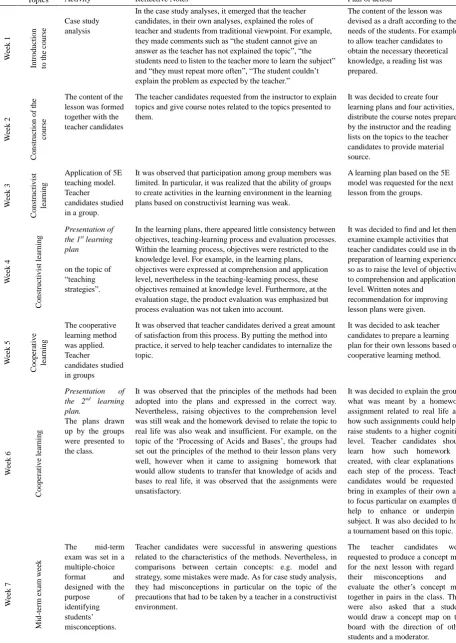
5. The Methods of Teaching Course is a four-hour lesson and is distributed into two sessions per week, with two hours in each session. After each two-hour lesson period, the researchers came together to share their observations on the lessons and to draw up a plan of action with regard to what they will undertake in the next lesson. The information regarding the weekly learning activities, observation and action plan are presented in Table 2 in detail.
6. At the end of the term, opinions were collected from the teacher candidates as to the characteristics and implementation of the constructivist approach.
2.6 Data Analysis
In the study, the instructor’s reflection notes were presented in a descriptive form and the data gathered from the questionnaire were analyzed by content analysis method. Content analysis is carried out to arrive at common themes and relationships that can be explained by the data obtained. This method includes conceptualizing and coding data collected, arranging these codes and extracting themes that can account for these data (Yildirim & Simsek, 2013). The data analysis process in this study was as follows:
1. The responses to the open ended questions in the questionnaire were first read and then read with greater care by one of the researchers who then encoded the responses. A code list consisting of all codes was then obtained.
2. After that, the codes and the data pertaining to those codes were then repeatedly analyzed and the code list then assumed its final form.
3. The codes in their final form were then examined with regard to their similarities and differences, the related codes were categorized and suitable themes were identified so as to be coherent to the meaning of these codes.
4. Following this, the other researcher encoded the data collected and similarly identified themes. Once this was completed, the two researchers came together and compared the codes and themes. Having reached consensus on those codes and themes where there existed discrepancies, they gave final form of the list of codes and themes (Appendix A). An example of encoding is given in Table 1.
5. In order for confidentiality, anonymity of students’ name was ensured in transcripts by giving an ID to each student, such as S1, S2, S3 and so on.
Table 1. An example of data coding
Responses Code Category Theme
Constructivist learning approach is an instructional approach in which [student is in the center], [teacher is a guidance], [student learn by doing and experiencing, find answer by searching him selves] [teacher aims to teach propose solutions rather than answer]
Student centered Teaching-learning process
Definition of constructivist learning approach
Guidance Teacher roles
Learning by doing and experiencing
Learning
Teaching how to
propose solutions Teacher roles 3. Results
3.1 The Teaching-Learning Process of The Methods of Teaching Course based on the Constructivist Learning Approach
Table 2.Learning activities, instructor’s reflective notes and plan of action
Topics Activity Reflective Notes Plan of action
W ee k 1 In tr o d u ct io n to t h e co u rse Case study analysis
In the case study analyses, it emerged that the teacher candidates, in their own analyses, explained the roles of teacher and students from traditional viewpoint. For example, they made comments such as “the student cannot give an answer as the teacher has not explained the topic”, “the students need to listen to the teacher more to learn the subject” and “they must repeat more often”, “The student couldn’t explain the problem as expected by the teacher.”
The content of the lesson was devised as a draft according to the needs of the students. For example, to allow teacher candidates to obtain the necessary theoretical knowledge, a reading list was prepared. W ee k 2 C o n st ru ct io n o f th e co u rse
The content of the lesson was formed together with the teacher candidates
The teacher candidates requested from the instructor to explain topics and give course notes related to the topics presented to them.
It was decided to create four learning plans and four activities, to distribute the course notes prepared by the instructor and the reading lists on the topics to the teacher candidates to provide material source. W ee k 3 C o n st ru ct iv is t le ar n in g
Application of 5E teaching model. Teacher candidates studied in a group.
It was observed that participation among group members was limited. In particular, it was realized that the ability of groups to create activities in the learning environment in the learning plans based on constructivist learning was weak.
A learning plan based on the 5E model was requested for the next lesson from the groups.
W ee k 4 C o n st ru ct iv is t le ar n in
g Presentation of the 1st learning
plan
on the topic of “teaching strategies”.
In the learning plans, there appeared little consistency between objectives, teaching-learning process and evaluation processes. Within the learning process, objectives were restricted to the knowledge level. For example, in the learning plans, objectives were expressed at comprehension and application level, nevertheless in the teaching-learning process, these objectives remained at knowledge level. Furthermore, at the evaluation stage, the product evaluation was emphasized but process evaluation was not taken into account.
It was decided to find and let them examine example activities that teacher candidates could use in the preparation of learning experiences so as to raise the level of objectives to comprehension and application level. Written notes and recommendation for improving lesson plans were given.
W ee k 5 C o o p er at iv e le ar n in g The cooperative learning method was applied. Teacher candidates studied in groups
It was observed that teacher candidates derived a great amount of satisfaction from this process. By putting the method into practice, it served to help teacher candidates to internalize the topic.
It was decided to ask teacher candidates to prepare a learning plan for their own lessons based on cooperative learning method.
W ee k 6 C o o p er at iv e le ar n in g
Presentation of the 2nd learning
plan.
The plans drawn up by the groups were presented to the class.
It was observed that the principles of the methods had been adopted into the plans and expressed in the correct way. Nevertheless, raising objectives to the comprehension level was still weak and the homework devised to relate the topic to real life was also weak and insufficient. For example, on the topic of the ‘Processing of Acids and Bases’, the groups had set out the principles of the method to their lesson plans very well, however when it came to assigning homework that would allow students to transfer that knowledge of acids and bases to real life, it was observed that the assignments were unsatisfactory.
It was decided to explain the groups what was meant by a homework assignment related to real life and how such assignments could help to raise students to a higher cognitive level. Teacher candidates should learn how such homework is created, with clear explanations of each step of the process. Teacher candidates would be requested to bring in examples of their own and to focus particular on examples that help to enhance or underpin a subject. It was also decided to hold a tournament based on this topic.
W ee k 7 M id -t er m e x am w ee k
The mid-term exam was set in a multiple-choice format and designed with the purpose of identifying students’ misconceptions.
Teacher candidates were successful in answering questions related to the characteristics of the methods. Nevertheless, in comparisons between certain concepts: e.g. model and strategy, some mistakes were made. As for case study analysis, they had misconceptions in particular on the topic of the precautions that had to be taken by a teacher in a constructivist environment.
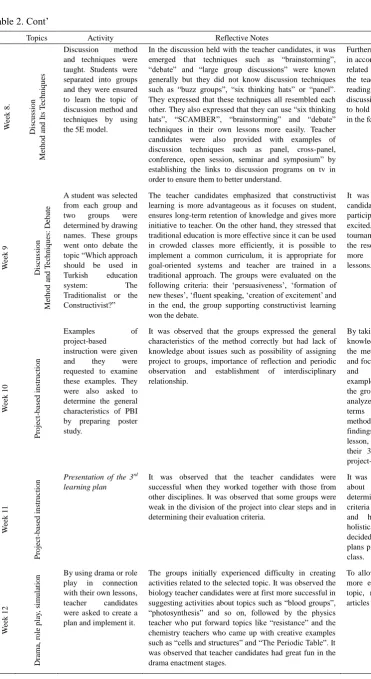
Table 2. Cont’
Topics Activity Reflective Notes Plan of action
W ee k 8 . D iscu ssi o n M et h o d a n d I ts T ec h n iq u es
Discussion method and techniques were taught. Students were separated into groups and they were ensured to learn the topic of discussion method and techniques by using the 5E model.
In the discussion held with the teacher candidates, it was emerged that techniques such as “brainstorming”, “debate” and “large group discussions” were known generally but they did not know discussion techniques such as “buzz groups”, “six thinking hats” or “panel”. They expressed that these techniques all resembled each other. They also expressed that they can use “six thinking hats”, “SCAMBER”, “brainstorming” and “debate” techniques in their own lessons more easily. Teacher candidates were also provided with examples of discussion techniques such as panel, cross-panel, conference, open session, seminar and symposium” by establishing the links to discussion programs on tv in order to ensure them to better understand.
Furthermore, lesson plans prepare in accordance with the topic and the related articles were suggested to the teacher candidates for further reading. As an application of discussion method, it was decided to hold a debate on a specific topic in the following week’s lesson.
W ee k 9 D iscu ssi o n M et h o d a n d T ec h n iq u es: D eb at e
A student was selected from each group and two groups were determined by drawing names. These groups went onto debate the topic “Which approach should be used in Turkish education
system: The
Traditionalist or the Constructivist?”
The teacher candidates emphasized that constructivist learning is more advantageous as it focuses on student, ensures long-term retention of knowledge and gives more initiative to teacher. On the other hand, they stressed that traditional education is more effective since it can be used in crowded classes more efficiently, it is possible to implement a common curriculum, it is appropriate for goal-oriented systems and teacher are trained in a traditional approach. The groups were evaluated on the following criteria: their ‘persuasiveness’, ‘formation of new theses’, ‘fluent speaking, ‘creation of excitement’ and in the end, the group supporting constructivist learning won the debate.
It was observed that the teacher candidates showed increased participation in-class activities, excited, enjoyed and preferred more tournament activities. Therefore, the researchers decided to include more such activities in future lessons. W ee k 1 0 P ro je ct -b ase d i n st ru ct io n
Examples of project-based instruction were given and they were requested to examine these examples. They were also asked to determine the general characteristics of PBI by preparing poster study.
It was observed that the groups expressed the general characteristics of the method correctly but had lack of knowledge about issues such as possibility of assigning project to groups, importance of reflection and periodic observation and establishment of interdisciplinary relationship.
By taking into account their lack of knowledge, the instructor illustrated the method on an example design and focused the associated concepts and principles. Furthermore, example designs were distributed to the groups and they were asked to analyze and evaluate the designs in terms of the principles of the method and then to present their findings to the class. For the next lesson, they were asked to prepare their 3rd learning plan based on
project-based instruction. W ee k 1 1 P ro je ct -b ase d i n st ru ct io
n Presentation of the 3
rd
learning plan
It was observed that the teacher candidates were successful when they worked together with those from other disciplines. It was observed that some groups were weak in the division of the project into clear steps and in determining their evaluation criteria.
It was decided to give explanation about the importance of determining the list of evaluation criteria in the evaluation of projects and how projects should be holistically evaluated. It was also decided to show good example plans prepared by the groups in the class. W ee k 1 2 D ra ma, r o le p la y, s imu la ti o
n By using drama or role
play in connection with their own lessons, teacher candidates were asked to create a plan and implement it.
The groups initially experienced difficulty in creating activities related to the selected topic. It was observed the biology teacher candidates were at first more successful in suggesting activities about topics such as “blood groups”, “photosynthesis” and so on, followed by the physics teacher who put forward topics like “resistance” and the chemistry teachers who came up with creative examples such as “cells and structures” and “The Periodic Table”. It was observed that teacher candidates had great fun in the drama enactment stages.
Tablo 2. Cont’
Topics Activity Reflective Notes Plan of action
W ee k 1 3 D if fe re n ti at ed In st ru ct io n
The basic principles and techniques were applied through the use of the ‘station technique.’
The teacher candidates all expressed that this instruction was appropriate for their own fields, individual differences were particularly an important factor in their courses and they acquired advices about what they should do in this respect. It was identified that the teacher candidates were weak in regard to which assessment tools they should use so as to identify individual differences.
It was decided to give information about measurement and evaluation methods and techniques that can be employed for identifying students’ learning styles, readiness level, and individual areas of interest and ask teacher candidates, for the next lesson, to prepare their last learning plans in accordance with the differentiated instruction principles.
W ee k 1 4 D if fe re n ti at ed In st ru ct io n
Presentation of the 4th learning plan
In general, compared to their initial plans, their last plans were more creative, enriched with more materials and included a number of activities ensuring students to reach higher cognitive level. In the plans, attention was paid to the cognitive differences among students, while little importance was attached to the affective differences between students.
Examples were requested from students with regard to the topic.
W ee k 1 5 Si x ‘T hi nk in g ha ts’ te ch ni qu e an d ad mi ni st ra tio n of q u est io n n ai re
‘The constructivist learning approach’ was evaluated by using the ‘six thinking hats’ technique.
At this stage, it was observed that teacher candidates produced more ideas with regard to the black hats than the blue hats. In other words, it can be said that while they could produce more ideas with regard to the limitations of the approach, they were not be able to produce ideas so as to provide its successful implementation.
The following explanations arose with regard to the topic:
Yellow: We will rise to the highest level.
White: Putting students at the center of learning is an unavoidable fact.
Red: A more active and exciting class environment.
Green: Lessons shouldn’t just be done in class; knowledge should be learnt in its real setting and source where it is originated from. For example, to learn about blood groups by visiting a doctor and learning from the doctor or lab assistants.
Black: The method is very difficult to apply in crowded classes. Our system is not suitable for this approach. It is an additional load. If you leave the learning process to children, none will learn anything.
3.2 Opinions of Teacher Candidates with regard to the Constructivist Learning Approach
Five basic themes were identified as a result of the content analysis of the responses. These were the definition of the constructivist learning approach, the contributions of the approach to students, limitations of this approach and the implementation of the approach in teaching science and in the Turkish educational context.
3.2.1 The Definition of the Constructivist Learning Approach
In the comments made by teacher candidates with regard to definition of the constructivist learning process, it was observed that definitions were largely made concerning the constructivist as a theory of learning. In their definitions, great emphasis was also attached to the student, teacher, and teaching-learning process. Moreover, the constructivist learning approach was seen and expressed by using terms such as an approach, a method, a form of teaching, a model and a learning mechanism.
In the definitions that were connected most closely with constructivist learning theory, the approach was described as the formation of knowledge based on the student’s creation of ideas, arrival at knowledge as a result of his own study and his construction of this knowledge, the construction of knowledge through experiencing, searching, questioning, and discovering and the formation of knowledge based on prior learning.
“(constructivism) is an approach in which through learning knowledge by applying and doing, the student leaves a rote-learning system behind, and acquires the ability to think, reason and ask questions...”S28
information directly.” S46
When defining the constructivist learning approach, its features related to teachers’ and students’ roles and structure of the teaching-learning process were also mentioned. Students’ roles emphasized by the teacher candidates were being active and being responsible for their own learning. As concerns the roles of teacher, teacher as a guide was highlighted first and foremost by the majority.
“Constructivist learning is not a teacher-centered, but a student-centered instruction. Teacher is a guide and student arrives at information through his own endeavors. Teacher demonstrates to student how to arrive at that knowledge. In other words, the student is constantly active.” S10
In addition to the guidance role of teacher, when describing constructivist learning, the approach was termed as one in which the teacher does not provide knowledge in a ready-to-consume way, does not constitute the sole source of knowledge, teaches the student to produce several solutions to problems rather than giving answers, makes students’ active, ensures their participation, leads them to search, prepares and designs an environment appropriate for the construction of knowledge, provides feedback, has more responsibilities and are required to be qualified in terms of pedagogical knowledge and intellectual skills.
“...In order to provide education using this approach, more work is required of teachers. Teachers must both know this method so well and his knowledge of the theoretical dimensions of his area of specialization and intellectual knowledge must be so fine-tuned and developed that he can attract the interest of students in the correct manner towards the topic under discussion.” S9
“(The Teacher’s role) is to provide student to discover the required knowledge by himself through the activities teacher devises. In that respect, teacher only plays the role of a guide. The knowledge to be attained may be conveyed to the class through a number of media: stories, videos, jokes, stories or simulations. At the end of the presentation stage, he explains to the students what they have to do to ‘discover’ the knowledge contained within. Through the teacher’s explanations, this knowledge is deepened and intensified. In the final stage of the process, an evaluation is conducted, and the topic is brought to a conclusion” S40
On the other hand, this learning approach was also defined with its teaching-learning process features. The teacher candidates characterized the approach by describing learning environment as a free, comfortable and dynamic setting for constructive learning. According to teacher candidates, in the teaching-learning process, individual differences, students’ interest and needs are taken into account and a milieu is formed appropriate for cooperative and student-centered learning. The approach was also defined as teaching-learning process in which problem solving and discussion methods are used, technology is frequently utilized, school is the life itself or preparatory for life and both the process and products of learning process are evaluated.
“…for students schools must be the life itself…..” S30
“… It is a system that takes form with the construction of the teaching model by taking students’ needs, interests and desires into account.” S52
3.2.2 The Contributions of the Constructivist Learning Approach to Students
From the responses given by the teacher candidates related to the constructivist learning approach and the skills attained through exposure to it, the approach can be seen to make contributions in three key areas: cognitive, academic and
personal development. As concerns cognitive development, it has been identified that the constructivist learning approach has positive contributions in developing the following aspects of the students: having thinking skills, research skills, problem solving skills, interpretation skills, discussion and debate skills, approaching events and occurrences from different perspectives, respecting for different or opposing points of view, solving problems individually, evaluating life and problems, raising curiosity, being able to understand complex information and to answer ‘higher-level’ questions.
“...Thinking, questioning, producing, problem solving, posing questions, research skills” S44
“...Thinking differently, demonstrating respect for opposing ideas, presenting one’s ideas openly and clearly, problem solving, the ability to look at problems from a different perspective, acquisition of research skills, asking questions, the ability to think objectively.” S54
being more interested in the subjects studied.
“It is a teaching approach in which students obtain knowledge through their own efforts and in which they construct knowledge themselves” S2
“It raises the self-confidence of even introverted children so that they are satisfied in what they learn and become happy. Compared to traditional methods, they do not forget subject matter that they learned.” S34
Finally, the view was also put forward that the constructive learning approach contributed to personal development in many ways. Among the examples cited were the development of self-efficacy, self-confidence, cooperation, presentation skills, ability to express oneself, an increase in democratic values, respect for oneself and self-actualization. “...Ensures the emergence of self confidence in passive students and compels them to develop the thought that ‘I too can do it’...” S21
“...(the student) learns to take responsibility in group activities and learns to work in a spirit of cooperation. If appropriate targets are assigned to reserved students, they can overcome their difficulties” S25
Furthermore, one teacher candidate highlighted positive aspects of the approach by drawing on his experiences in the Method of Teaching Course and compare the constructive approach with the existing education in most of today’s schools.
“... We were all educated according to traditional approaches. The knowledge we learned was merely memorized. The teacher explained and we listened. When we were to have an exam, we simply memorized information and passed the exam. The constructivist educational approach does not rest on the memorization of information or knowledge. At the school where I am currently doing my training, this approach is put into practice. I can observe at first hand the difference with the students (that I am acquainted with). Through performance-based homework, students can produce excellent products. Within the learning process, the students participate actively in the lessons. With posters that they have produced in class, they do presentation and the other students can participate into the lesson very well. They conduct experiments in the class. When I contrast all these with the experiences of my own education, it becomes self-evident that constructivism is necessary. Another example, activities we did in this course (the Methods of Teaching Course) reveal that knowledge that were learned by doing and experiencing is not forgotten. I am sure if I had just read the information about methods and techniques such as tournament technique, debate technique we did in the class from books, I could not learn so much” S40
3.2.3 Limitations of the Constructivist Learning Approach
Although a great number of advantages were mentioned with regard to the constructivist learning approach, various limitations were also cited by respondents. The teacher candidates indicated that they felt that constructivist learning may on occasions exert a negative influence on the development of students’ skills and this situation was mainly caused by the individual differences of students’readiness level and the overcrowded classes. It was indicated that when this approach is exposed to students whose cognitive and readiness levels are different, their participation would be difficult and they would not show achievement. Concerning crowded classrooms, they stated that as participation of all students would not be possible, there would be students who did not understand.
“...It will not be possible for students with different cognitive levels to participate in classes at the same time and slow learners will not be able to perform as successfully (as their peers with higher cognitive levels...” S7 “...On account of the fact that classes are so crowded, it will prove difficult to reach each student. While certain students are active, this may actually prevent the active participation of students who are quieter by nature.” S49
Another negative factor cited was the group work that forms an essential pillar of the constructivist philosophy as this may constitute a disadvantage in particular for those students who are not inclined to working in groups and may cause students to lose their competitive incentive because of supporting cooperation in groups.
“...If a student supports to work alone rather than with a group, he would show little interest towards group-based activities. This affects learning level negatively” S43
Furthermore, teacher candidates also focused on another related issue that the implementation of the constructive learning approach may lead to a regression in the students’ listening skills and learning by listening. These views can be evaluated as a reflection of the traditional understanding of education.
At this point, problems relating to teachers were shared. Issues were identified such as the danger that students may wrongly think that after having acquired knowledge, they no longer needed teachers; the worry that by excessively increasing self-confidence, the student may lose respect towards teachers; and problems that caused by teachers who do not adopt the constructivist learning approach and who do not apply it systematically and properly.
“..The child may think, on being able to arrive at knowledge easily or being able to access knowledge at any moment, that he has no need of the teacher” S46
“...The student may at times lose respect (for others) on account of excessive self-confidence.” S52 3.2.4 The Implementation of the Approach in Teaching Science
The teacher candidates also expressed many views with respect to the applicability of the constructive approach in teaching science. On evaluation of these opinions, they can be divided into the following three main areas of focus: (a) the necessity of applying the constructivist learning approach in science teaching, (b) factors that prevent its successful implementation, and (c) factors to be taken into consideration when putting the approach into practice. All of the participants indicated that generally speaking they felt that this approach was appropriate for application in the field of science education. In particular, on account of the fact that science lessons include subjects that are derived from real life and involve activities such as experiments, making observations and analyzing, conducting research, and learning through doing and experiencing the constructivist approach is a most suitable approach to be implemented.
“...As science education is based on observations and experiments, the student during the learning must obtain knowledge by searching, discussing and making use of various methods and techniques. Science education can only reach its goal through (the application of) constructivist learning.” S24
“...Science courses include many things from real life. A large part of our life contains (direct relationships with the topics of physics, chemistry and biology. For this reason, if the lesson is conducted in keeping with the principles of the constructivist approach, the student will obtain knowledge not from books, but rather from ‘himself’. He will learn by conducting experiments, observing nature and by doing such things will not merely memorize information, but instead learn knowledge in a way that is lasting and meaningful”. S40
“Science courses are ones that are surrounded by many prejudices. The subject is in need of the attractive, unusual methods that are contained within constructivism to destroy these prejudices and to demonstrate just how enjoyable and beneficial the discipline of science is”. S18
In the section above, the teacher candidates, by associating real-life needs with the structure of the lesson, demonstrated that they felt that the constructivist approach was suitable for application in teaching science and would also make a positive and lasting contribution to the quality of teaching and to scientific thinking. As regards the quality of teaching, a number of positive contributions that the approach could make to improve the present situation was cited: lasting and effective learning, the concretization of formerly abstract concepts, learning through ‘doing and experiencing’, the raising of students’ levels of participation and activity in class, the creation of a productive and beneficial learning environment, the motivation of students and a moving away from traditional rote-learning approaches.
“In the field of physics a great number of subjects cannot be learned properly, on account of relying on the memorization of subject matter. However, constructivist teaching is appropriate for Physics and other science courses in the sense that it reduces memorization to a minimum.”S32
“....The constructivist approach is an approach that ensures support to students in conceptualizing abstract knowledge in science lessons and most particularly in the field of chemistry and constructing correct schemes by understanding.” S33
It was also mentioned in the above context that the constructivist learning approach is advantageous in developing scientific thinking and analytical thought, reasoning, establishing relationships between cause and effect, designing and producing projects.
“....For a lesson that requires students to think analytically, it is logical to apply an approach that forces the student to think in an analytical fashion. Constructivist teaching is an approach extremely appropriate for science teaching in the way that it encourages the student to obtain knowledge by himself, renders laboratory work more effective and forces teacher to convey extremely abstract topics in chemistry and physics courses in an understandable way” S29
content base that incorporates a great amount of learning and calculation of formula or experiments that they would do firstly.
“...For certain topics in chemistry lessons such as heat conduction or in biology lessons such as description of different species (e.g. extinct species) the method may prove problematic in not allowing students to obtain key factual information” S 14
“I do not think that the approach is suitable for biology lessons. The teacher must for some topics, for example, the respiration process in plants, first explain the process and parts of the plant himself and only after listening to the teacher can students carry out experiments” S54
Other important limiting factor was the limited amount of time allocated to covering all elements of the curriculum and the large class sizes present in Turkish schools.
“The curriculum may at times be limited. There may be a yearly plan and the teacher is required to deliver lessons according to the order contained in the plan. However, implementation of this method requires a great deal of time. In this case, teachers do not prefer.” S37
The view was also expressed that the successful implementation of the method requires well-informed and well-trained teachers. However, in Turkey teachers either lacked the suitable background or training and adopted traditional approaches to teaching; even if they did possess the background or qualities to be a constructivist teacher, they were forced to apply teacher-centered instruction on account of inadequate conditions in the school environment.
“...Due to insufficient infrastructure and teachers who have been trained in accordance with traditional teaching models, there exist a number of inadequacies in attempting to create a (constructivist) educational environment.” S39
“... Certain teachers and students encounter difficulties in trying to understand the (constructivist) system. If a student is used to his teachers, explaining a topic in a direct manner, the student will come to expect this from his teachers. If the topic that they are supposed to search does not attract their interest, they may lose attention to that course. This is due to the fact that a teacher who does not correctly understand the system may end up placing the total burden of learning onto the student himself.” S52
Six basic principles were cited by teacher candidates that teachers need to take into account when planning a course in the field of science according to constructivist principles: characteristics of students, features of learning environment, course objectives and content, teaching-learning process, measurement and evaluation dimension and personal characteristics and attributes of teachers themselves. The characteristics of students that the teacher candidates would take into account were classified as their prior knowledge, needs, competencies, levels, socio-cultural characteristics, individual differences, and attitudes to the course.
“When planning such a lesson, by applying techniques such as questioning in order to ascertain students’ levels, it can be identified exactly what subject matter students can absorb and at what level students can be expected to reach.” S21
As regards the learning environment, the choice of equipment and materials, adequacy of materials, class sizes, conditions and structures were determined by the teacher candidates as issues that needs to be taken into consideration:
“The physical and economic opportunities at hand” S28
“I pay attention to what will be effective over a long time and (materials) that I can use in a beneficial way” S32 “...If I am to direct or guide a lesson, I am forced to pay attention to the class size. While one student is learning, I should not ignore another student in classes with large student numbers. For this reason, it is necessary to create suitable conditions for learning.”S37
Furthermore, in addition to setting out the skills and knowledge to be attained and the suitability of the topic, it was identified that the following factors must be taken into account for successful delivery of a constructivist based lesson: determining appropriate teaching methods, techniques and materials, relating subject matter to life, providing student participation, selecting attractive topics that spark curiosity, creating scenarios or situations and thus encouraging students to research, guiding students to solve problems through discovery, encouraging them to learn through research, allowing opportunities for observation, providing variety in lessons, establishing relationships between old and new knowledge and linking that with experience in real life, reflecting and revising previous material and providing clues to assist in the students’ learning process.
them research.” S37
“....During the engage stage in which there is the creation of an overall framework to their learning process (linking personal and theoretical knowledge), I am careful to provide common every day, yet attention-grabbing examples from real life - In the explore stage I provide apparatus and equipment for students that ensure that student is easily able to arrive at the knowledge he needs.- In the extend stage, once again through the provision of striking example and through mind games and puzzles as well as discussions and debates, I ensure that students are able to reconcile the knowledge with what they have learned previously.”S50
Although, there were a few teacher candidate pointing out evaluation dimension, those candidates mentioned that they would pay attention to what extent student understand and how their comparison and reasoning skills and evaluate the teaching-learning process.
“....at the evaluation stage, without only asking questions, preparing conditions that students would use knowledge that they learned in learning environment or was constructed in a qualified way and evaluating this process.” S39 “....Activities that student did would be real evaluation for me.” S45
Finally, it was mentioned that with regard to personal attributes or qualities of the teacher, importance should be attached to the following factors: behaving in an even-handed and democratic manner, being expert in the field, being creative, behaving and speaking carefully in class and sharing his views with other teachers.
“As I will play the role of a guide in this teaching approach, I must be totally competent and expert in the subject I am teaching. I must collect information concerning the projects that are to be conducted in class.” S10
“...In particular it is necessary to search the related studies about biology. I must follow current developments in my field so as to introduce them into the classroom environment and so create an environment for discussion with my students. I must also be creative in this regard” S26
Nevertheless, it was noteworthy that the traditional approach was reflected in the comments made by two teacher candidates about how they will implement the constructivist approach. One of them indicated that he would use reinforcement schedules in his classroom. The other assigned the students a project topic, but instead of stimulating them to carry out research, asked students to present the topic to the class. This situation indicates that they confused the constructivist approach with a ‘project assignment’.
“As it is important for every student to realize the importance of information he presented and for motivating them, I will use reinforcements” S52
“When planning the lesson according to this approach, every week the students make presentations in groups; I assign research topics and ask them students to present these research assignments in class. I gave grades to their presentations. I encourage students to ask their friends questions and I help to guide students in differentiating between the correct and wrong.” S42
3.2.5 The Implementation of the Approach in the Turkish Educational Context
In their evaluations of the constructivist learning approach within the context of Turkey, the teacher candidates cited the
problems that prevented application of the approach and stemmed from the qualities and characteristics of teachers, the school and class environment, the structure of the lesson, the curriculum and even the education system itself.
Common problems that were indicated included the impossibility of putting the approach into practice on account of teachers’ lacking sufficient training with regard to the approach as well as lacking adequate information technology skills. In addition, there was mentioned the predominance of teachers, who had reached retirement age and were too ‘old’ for the profession, were traditionalist in outlook closing their minds to innovation, prejudiced in their mindset and lacked motivation. Furthermore, it was indicated that some teachers avoid commitment by not exerting themselves excessively and wish to bother themselves with lesson planning. These teachers lacked the ability to make the learning environment attractive for students and did not possess the capabilities to ensure student participation. These and other matters were cited by teacher candidates.
“..Unless those teachers who have reached the age of 60 are not sent into retirement and class sizes are at least halved, this (constructivist) approach cannot be applied. The fact that the teacher is not open to innovation, is prejudiced in his outlook and does not know how to apply the necessary methods are all factors that prevent the application of the approach” S2
then passes to the next topic” S34
“...It is a teaching system that requires a great deal of time and which renders lesson planning difficult” S43 When considering how students may act to prevent successful implementation of the approach, the fact that classes are not homogenous in terms of their students’ readiness level for lessons, the individual differences between students, the inadequacy of prior knowledge on the part of certain students and the presence of students who have become accustomed to learning only by listening may prove problematic in attempting to deliver constructivist-based lessons:
“...It should be implemented but in my opinion it is difficult and requires long time. Because the dismantling of the shell of the model that has prevailed until recently in which the student learns only by listening will not prove easy.” S15
“In the school in which I did my teaching practice, I observed that the classes were extremely heterogeneous. This situation arose from the fact that the students did not possess the same cognitive levels of understanding. In such situations, the construction of knowledge by students in the same way, prevents the students from reaching the same conclusion and so limits the success of this approach.” S50
In the school and class environment, the following reasons were mentioned that prevented the successful implementation of the approach: overcrowded classes, the positioning of furniture and equipment in the classroom, the types of equipment, apparatus and materials used and inadequacies in the physical condition and infrastructure of the school.
The constructivist approach cannot be applied because classes in schools in our country are very crowded. In most schools in Turkey, there is a problem with class sizes. On account of the class sizes being so large, the constructivist approach is not appropriate. Every student does not get the same right to talk and participate.” S1 “...As the duration of a lesson is 40 minutes and because of the value of this time, and large numbers of students in the class, active learning is ensured for certain groups in the class, but not for the remaining students.” S36
With regard to the structure of the course and curriculum, the difficulty of applying the approach into every topics, the obligation to complete the curriculum and in this context the limitation on time were cited most often as the most pressing problems facing the constructivist teacher.
“...The fact that we have such an intensive curriculum, the subjects contained in it are very wide and comprehensive and there is a real problem concerning time....The sheer number of subjects and the intensity by which they are taught serve as obstacles to transitioning completely to the constructive approach”. S11
“..The fact that a lesson lasts only 40 minutes and time is therefore very valuable. As a physics teacher, there is a curriculum that I am supposed to cover and complete. The nature and length of this program prevents the application of the constructivist approach.” S36
Finally, there are also problems that originate in the education system in Turkey itself. These problems were listed as the lack of necessary learning resources, the inadequate allocation of financial resources to education, the rootedness and consolidation of an education system based on rote-learning, the lack of effective and adequate in-service training on the constructivist approach, coordination problems in terms of administration, and the negative effects of the exam system. With regard to the examination system, the negative effects of such a system both on teacher training and on the applications and activities conducted at schools were mentioned. For example, due to the fact that KPSS (Turkish Public Service Selection Exam) is focused largely on theoretical matters, teacher candidates and education faculties attach more importance to theoretical aspects than to practicing teaching skills needed for the profession. In terms of schools, it was indicated that since the centralized exams includes questions at knowledge level and schools give emphasize on these exams, these exams affect negatively the use of teaching methods encouraging higher order thinking skills.
“I think that teachers who have been raised within the traditional system and came from an educational background that largely favored rote learning must first adopt the principles of the new system before they can put them into practice. As far as I am concerned, the education I received up to university was the traditional, and even at university we studied through memorization. However, I would like to say that this teacher training certification program I receive was very effective (for my development).” S25
“...The fact that new teachers and we did not see constructive teaching at first hand during our primary or middle school education.” S29
appropriate.” S35
“Furthermore, the positive guidance provided by the Ministry of Education to the schools in certain regions under its remit but the lack of guidance in other regions. The government attaches importance to some regions while it ignores the importance of new approaches in others. This situation does not let to implement this approach.” S36 “This situation is most evident when one looks at the composition of staff members at all levels of the Ministry of Education. Within the education system, everyone from the teacher to the administrator find themselves in a ‘vicious circle’. In such a situation, in-service training remains nothing more than a formality and the traditionalist mentality cannot be broken out of. The summary of the situation is that the introduction of new applications within this system is not more than a ‘patchwork job’. Change must be applied in a serious way from top to bottom. When one pays attention to the awkwardness and clumsiness of the structure of the Ministry of Education, without breaking the classical teaching model that has taken root in the minds of those within the ranks of its personnel at all levels over the years, no progress can be made. With this in mind, experienced experts from their own fields of study must force those involved in education from the lowest to the highest levels to undergo a serious program of retraining and take measures to ensure reform is carried through.” S55
There were also numerous teacher candidates who indicated that they felt it was possible for the approach to be implemented in the Turkish educational system providing that certain conditions were satisfied. In the event of a reduction in class sizes, provision of sufficient learning materials, the guarantee of pre-service training to teacher candidates and in-service training to existing teachers, accompanied by the sufficiently equipping teachers with the required skills and knowledge, teachers would be able to successfully apply the approach in a spirit of idealism, self-sacrifice and patience. A small, yet significant number of the teacher candidates also expressed the view that they felt that Turkey was more advanced in comparison with many other countries, and that there were schools that would be able and indeed are presently able to apply this approach and there also exist numerous teachers who already possess the necessary knowledge and skills to be able to put this approach into practice.
“... I think that Turkey is more developed compared to a large number of countries. I work in a private school. It is a school that attaches importance to the implementation of constructivist education. In many state schools where my friends work, the approach is also applied. When I studied the yearly plans issued by the Ministry of Education, I saw that they had prepared a plan that encouraged the students to learn through questioning.” S5
“..In particular, class sizes need to be reduced. Materials need to be provided that allow students to learn visually. However, together with such changes, teachers need to be trained in accordance with a constructivist manner. A teacher who has not been raised according to such principles and does not know how to proceed will not succeed even if he has small class sizes.” S26
4. Discussion and Conclusion
In this study, findings regarding the teaching-learning process of the Methods of Teaching Course were drawn from the observations made by instructor, from the products created by students and their reflections and findings regarding the outcome of this course were obtained from the teacher candidates’ opinions. The findings with regard to the process can be considered in terms of two aspects: the delivery of the course as a whole and the changes that occurred within the teacher candidates themselves.