JIEM, 2010 – 3(3): 576-602 – Online ISSN: 2013-0953 Print ISSN: 2013-8423
An accounting system to support process improvements:
Transition to lean accounting
Patxi Ruiz de Arbulo-López
1, Jordi Fortuny-Santos
21
Universidad del País Vasco (SPAIN);
2Universitat Politecnica de Catalunya (SPAIN)
Received February 2010
Accepted November 2010
Abstract: From the last two decades of the 20th Century on, many companies have
adopted production strategies that could be termed “lean manufacturing”. Lean team
leaders state that traditional costing systems fail to properly assess their operational
improvements and therefore ask for new cost accounting methods. The search for a new
accounting paradigm has led to important applied research and several accounting
methods. In this paper we are going to show the state of the art in costing techniques used
in companies that adopt lean manufacturing practices and we will be presenting an
additional costing method, based on Activity-Based Costing, intended to cast light on the
operational improvements achieved in companies that are just starting a maturity path
towards lean manufacturing. This article examines how the approach is applied in the
context of a manufacturing company.
Keywords: lean manufacturing, lean accounting, Activity-Based Costing
1 New cost accounting paradigms
JIEM, 2010 – 3(3): 576-602 – Online ISSN: 2013-0953 Print ISSN: 2013-8423
companies may find that lean practices lead to operational improvements but they do not “hit the bottom-line” because there are neither short-term financial benefits nor product cost reductions. This fact can act as a disincentive to change the production system (Ahlström & Karlsson, 1996). In The Goal (Goldratt & Cox, 1986) there is an example of the fact that a simple manufacturing improvement based on the reduction of the transfer batch size between workstations leads to an apparent increase in per unit product cost (Equation 1) even though the plant operating cost (operating expense according to Goldratt) has not gone up. This is only true while there is unused capacity, but the costing system ignores whether there is or not and assumes that extra work always needs extra labor).
𝐶𝑜𝑠𝑡𝑝𝑒𝑟 𝑢𝑛𝑖𝑡=�𝑆𝑒𝑡𝑢𝑝𝐵𝑎𝑡𝑐ℎ𝑡𝑖𝑚𝑒𝑠𝑖𝑧𝑒+𝑝𝑟𝑜𝑐𝑒𝑠𝑠𝑡𝑖𝑚𝑒�·𝐿𝑎𝑏𝑜𝑟𝑟𝑎𝑡𝑒· (1 +𝑜𝑣𝑒𝑟ℎ𝑒𝑎𝑑𝑎𝑝𝑝𝑜𝑟𝑡𝑖𝑜𝑛𝑚𝑒𝑛𝑡)
Equation 1. “The influence of batch size on the cost of pieces according to traditional cost accounting”. Based on Goldratt and Cox (1986)
In consequence, Goldratt and Cox (1986) state that cost accounting is the number one enemy of productivity and they put forward their own accounting approach termed throughput accounting.
JIEM, 2010 – 3(3): 576-602 – Online ISSN: 2013-0953 Print ISSN: 2013-8423
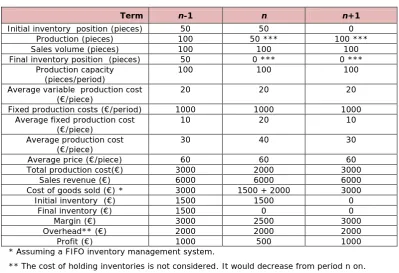
In period n + 1, keeping production adjusted to demand, transitory costs caused by misused capacity cease and the company returns to financial benefits, but in the meantime, people responsible for the transition to lean manufacturing have to justify the results to their managers (Olivella, 2008).
Term n-1 n n+1
Initial inventory position (pieces) 50 50 0 Production (pieces) 100 50 *** 100 ***
Sales volume (pieces) 100 100 100
Final inventory position (pieces) 50 0 *** 0 *** Production capacity
(pieces/period) 100 100 100
Average variable production cost
(€/piece) 20 20 20
Fixed production costs (€/period) 1000 1000 1000 Average fixed production cost
(€/piece) 10 20 10
Average production cost
(€/piece) 30 40 30
Average price (€/piece) 60 60 60
Total production cost(€) 3000 2000 3000
Sales revenue (€) 6000 6000 6000
Cost of goods sold (€) * 3000 1500 + 2000 3000
Initial inventory (€) 1500 1500 0
Final inventory (€) 1500 0 0
Margin (€) 3000 2500 3000
Overhead** (€) 2000 2000 2000
Profit (€) 1000 500 1000
* Assuming a FIFO inventory management system.
** The cost of holding inventories is not considered. It would decrease from period n on. *** Production is adjusted to demand in order to not keep inventories.
Table 1. “Calculation of the production cost after and before production adjusted to demand”. Based on Olivella (2008)
Likewise, companies that have implemented lean manufacturing to a large extent find that traditional managerial accounting systems do not provide the information that managers need to make decisions (Harman & Peterson, 1990).
JIEM, 2010 – 3(3): 576-602 – Online ISSN: 2013-0953 Print ISSN: 2013-8423
The aim of standard costing does not depend on the production system, but the way information on costs is generated does (Tatikonda, 1988). This statement is not new: without a standardized production system as described by authors like Taylor or Ford, in the early days of the Twentieth Century, standard costing would be meaningless because each product would be different (Cooper, 2000).
Overproduction and work in process inventories have so far been considered a valuable asset, but lean philosophy considers them a waste (unnecessary consumption of resources). Traditional cost accounting and parameters like machine utilization or productivity per employee lead to decisions against lean philosophy, because, in order to achieve a minimum cost, they endorse that every section in the factory has to produce as much as possible, in large production runs and therefore keeping all sorts of inventories. Lean manufacturing focuses on manufacturing only what the customers really buy, and tries to reduce inventories, reduce cycle time and eradicate all the operations that do not add value to the products (Ward & Graves, 2004).
Besides, accounting was created to provide financial information, not to support ongoing improvement (Harman, 1992). Harman and Peterson (1990) and Hyer and Wemmerlöv (2002) list some of the problems of traditional accounting techniques:
• Overhead cost allocation policies are not always reasonable. For example, overhead costs are allocated on the basis of direct labor costs, even though currently labor cost is a small percentage of the production (Blanco, 1988). According to Berliner and Brimson (1988) this does not seem logical. Errors in calculating labor costs are amplified.
• The recording of depreciation does not match actual asset deterioration
because it is an uneven process. Assets are not appraised every year to determine their value.
• Efficiency metrics refer to internal issues that try to keep people and
machines busy. They do not measure customer-related aspects (on-time delivery, quality…).
JIEM, 2010 – 3(3): 576-602 – Online ISSN: 2013-0953 Print ISSN: 2013-8423
• Inventories are an asset. The cost of holding items in stocks is not
calculated. Traditional inventory control is not concerned with minimizing the cost of inventory. It strives to avoid inventory stock-out.
• The aim of cost accounting is to know the exact cost of a product, but
changes in demand make changes in production cost because of average fixed costs (fixed cost over the number of units that are produced).
• Managers claim that they use costing to make decisions on issues like price, on order profitability or on outsourcing. On one hand, companies cannot price a product on the basis of the cost. The price is fixed by the client or there is a market price that the company must obey. Usually, an approximate cost is enough. The decision on whether to outsource or manufacture something is tricky. When a company decides to outsource part of its process, many fixed costs do not disappear - surely those fixed costs are included in the standard cost of the product and are the cause for deciding to outsource it.
A lean company cannot neglect the legally mandatory set of financial statements but may look for an accounting system that is capable of measuring operational improvements and allows the company to keep operational and financial control of the business.
Harman (1992) sums up possible accounting practices for companies which can be described as completely lean (Cuatrecasas, 2006):
• Since in lean companies raw material and work-in-process inventories are
lower than in traditional companies and their fluctuations over time are also lower because of the way lean schedules production, it is not important to keep a detailed track of the inventories. They can be estimated.
• Overhead costs must not be employed to assess the goodness of the
production process. However, people responsible for such costs must manage them.
• Purchases and pay slips can be used to calculate costs. Purchases are
JIEM, 2010 – 3(3): 576-602 – Online ISSN: 2013-0953 Print ISSN: 2013-8423
track of their changes. If production is adjusted to demand, pay slips equal labor costs for the produced and sold goods.
• Reports on the performance of single employees or departments are not
needed anymore. Production is adjusted to demand so no one tries to do more or less work. Less non-value- added paperwork is necessary.
• Overhead costs can be allocated on labor and material cost together, not
just labor. Material cost is probably more accurate. Depreciation can be allocated on the basis of the number of hours that the machines have been in use. However, the aim is to cut overhead cost, not to discuss allocation methods.
The need to review cost accounting arose in the 1980s and originated different research papers (Kaplan, 1983, 1984, 1985, 1986, 1987, 1988, 1989; Johnson & Kaplan, 1987; Cooper & Kaplan, 1988). The problem of the lack of adaptation of costing systems to lean manufacturing lasts till the present day (Ward, Crute, Tomkins, & Graves, 2004; DeLuzio, 2006).
In the early days of the 21st Century, some accounting methods termed as Lean Accounting were presented, mainly removed from academic research journals -Except Huntzinger and Kennedy (2005) and Maskell and Kennedy (2007)-. Those methods can be used by companies in their maturity path towards lean manufacturing (Maskell & Baggaley, 2004). Those methods, according to the principles of lean manufacturing, focus on metrics in search of simplicity (Martínez & Pérez, 2001). Indicators can be controlled visually and they supply useful and frequent information in order to improve processes.
Lean accounting techniques emerged in the United States. In Japan, where lean manufacturing first emerged (Tatikonda, 1988), companies use other methods such as kaizen costing or target costing (Williamson, 1997; Huntzinger, 2007).
The first answer to the problem of the lack of valid costing methods for new production paradigms was Activity-Based Costing. It was developed in 1986, on the basis of the early work done at General Electric (Johnson, 1992).
JIEM, 2010 – 3(3): 576-602 – Online ISSN: 2013-0953 Print ISSN: 2013-8423
costing systems. It has allowed a major advance in cost accounting since costs can be allocated to the activities that cause them (Tirado, 2003), and then to object costs (products, clients, etc). In literature there is much evidence of companies that use ABC as a tool to rank their opportunities to reduce costs (Jenson, Brackner, & Skousen, 1996; Crute, Ward, Brown, & Graves, 2003; Ward, Crute, Tomkins, & Graves, 2003) and well-known companies continue to implement ABC costing as a tool to support continuous improvement (Balada, 1994) and to gain competitiveness (Tamarit & Ripoll, 2006).
ABC is related to full-costing methods and therefore it is very different from lean accounting, but ABC allows tracking of waste of resources which is one of the pillars of lean manufacturing, and in consequence, ABC costing can be used in a company independently of whether it follows the principles of lean management or not.
ABC costing has been defended by international authors (Cooper, 1994, 1996) and by specialists in lean manufacturing (Cuatrecasas, 2000). Kaplan and Cooper (1998) suggest that ABC can show which improvement efforts should be given the highest priority, and help justify improvement actions from the point of view of costs while keeping track of the operational benefits. Cooper (1996) points out that ABC can be compatible with lean manufacturing because it shows the causes of the costs and therefore it makes it possible to redesign the processes.
JIEM, 2010 – 3(3): 576-602 – Online ISSN: 2013-0953 Print ISSN: 2013-8423
There is controversy about the advantages and drawbacks of ABC, like between direct costing and full costing, but since direct costing has not replaced full costing and both methods coexist (a recent discussion can be found in Argilés (2007)), we believe, like Banker, Barhand and Chen (2008), that companies that are starting advanced manufacturing practices such as the transition towards lean manufacturing can take advantage of some features of ABC, and therefore we developed a costing method for such environments.
2 A method to start the transition towards lean manufacturing
Maskell and Baggaley (2004) suggest that the transition towards lean accounting must be carried out in a gradual way, embodying new tools as the company introduces lean production techniques throughout its facilities. Harman (1992) suggests that the company must not wait until the lean transformation is complete to implement an accounting system that can make controlling the improvements easier. In the same way, Harman (1992) admits that in the transition it is still necessary to allocate costs to products.
For these reasons we present a practical framework to be used when starting lean manufacturing practices:
• It is based on traditional accounting practices and therefore it is easy for accountants to understand, while avoiding an outright rejection.
• It is based on Activity-Based Costing so it can help the company monitor
operational improvements and discover the sources of waste. It is not necessary that the whole company adopts an ABC system, which could be costly and take long. It is only a way to control the areas in transition towards lean manufacturing.
• It can be used in companies that still do not have either a global lean layout or stable lean practices and therefore cannot use advanced lean accounting techniques such as value stream costing.
JIEM, 2010 – 3(3): 576-602 – Online ISSN: 2013-0953 Print ISSN: 2013-8423
termed as lean accounting, only seem to be useful when the company has reached a certain degree of maturity in lean manufacturing (Ruiz de Arbulo, 2005).
Taking into account the advantages and disadvantages of Activity-Based Costing that have been discussed before, our method includes technical ratios for the expense entries of the activities (Baguer & Zarraga, 2002) and aligns with current methodologies for the implementation of efficient production processes from the client’s point of view, such as lean manufacturing (Ruiz de Arbulo, 2007).
It is not necessary to substitute, throughout the company, traditional accounting practices with our method or ABC. The company may want to use our ABC-based costing approach only for tracking the improvements in the transition towards lean manufacturing and, as the company advances, it will be able to implement other lean accounting techniques.
Our costing method can include:
• Changes in plant layout
• Changes in handling between operations
• Reductions in production run size in order to adjust to production, avoiding inventories of finished products
• Reductions in transfer lot size
• Other changes that make production more efficient and adjusted to demand
Expected cost entries are:
• Cost of raw materials and purchased components (Crm)
• Cost of activities that add value to the product (Cva)
• Cost of internal transportation (Ctran)
• Setup cost (Cset)
• Cost of work in process inventory (Cwip)
JIEM, 2010 – 3(3): 576-602 – Online ISSN: 2013-0953 Print ISSN: 2013-8423
Even companies that use Activity-Based Costing calculate the final cost of the product as the summation of the costs of every single production step but, in practice, some costs such as the wait times are not considered. Since wait times and inventories are two types of “muda” that conceal deficiencies in processes (Ohno, 1988), their existence and their cost should not be ignored. Our method calculates the costs of wait time and the costs of work in process inventory. In consequence, when a new production method cuts inventories or wait times, it affects the production cost.
2.1 Steps of the process
Our costing method can be divided into steps:
Step 1. Analysis of the process and its activities
In Activity-Based Costing, activities are main or auxiliary tasks that when performed incur in a cost. It is necessary to know the production process in some detail in order to discover its activities. Activities can then be listed and classified:
• Activities that add value to the product (in a manufacturing company, they are operations that transform the product) or value-added activities.
• Activities that do not add value to the product from the point of view of the customer (non-value-added activities) but are currently necessary. For instance, to set a machine up, to control the production process, etc.
• Waste. Activities that do not add value to the product and are not
necessary. They can be eliminated.
Step 2. Determination of cost drivers
For every activity it is necessary to have at least one cost driver. It is a measure to allocate costs, and therefore drivers must be chosen on the basis of a cause and effect relation. The greater the number of drivers there are, the more complex the system.
JIEM, 2010 – 3(3): 576-602 – Online ISSN: 2013-0953 Print ISSN: 2013-8423
Step 3. Cost per driver
When cost drivers have been selected and the different sources of cost have been considered, the cost per driver is calculated.
Step 4. Cost of raw materials and purchased components (Crm)
Here we consider the amount of raw materials and components that are present in a unit of finished product. The total quantity includes the design values plus a percentage to include defects and losses in order to match current consumption of resources. Their cost is the acquisition price.
Step 5. Cost of activities that add value to the product (Cva), cost of internal transportation (Ctran), and setup cost (Cset)
According to the first step and once different types of activities have been defined, it is then the moment to calculate the cost of the value-added activities, non-value-added-but necessary-activities and other non-value-added activities by means of equation 2, where Cj is the cost of product j; Ndij is the number of drivers in activity i (value-added, transportation or setup) that product j consumes in that operation, and Cdi is the cost per driver in activity i.
𝐶𝑗=𝐶𝑣𝑎𝑗+𝐶𝑡𝑟𝑎𝑛𝑗+𝐶𝑠𝑒𝑡𝑗=��𝑁𝑑𝑖𝑗·𝐶𝑑𝑖�
𝑛
𝑖=1
Equation 2. “Cost of activities on the basis of driver consumption”.
Step 6. Cost of work-in-process inventories (Cwip)
JIEM, 2010 – 3(3): 576-602 – Online ISSN: 2013-0953 Print ISSN: 2013-8423
Step 7. Cost of wait time between processes (Cwait)
Finally, the cost of waiting between processes is calculated. Different operations in the production process have different production rhythms. That unbalance makes parts wait between operations. Also some machines remain idle because when they finish processing a part, a new one has not arrived yet from the previous operation. This time spent waiting is considered “muda”, but traditional accounting does not take it into account. To calculate this cost, it is necessary to know the wait time in each operation. In equation 3, twait ij represents the total wait time time in activity i –for all units of product j-. CdFi is the cost of one driver of activity i when it is idle. Nj is the number of units of production j that are produced.
𝐶𝑤𝑎𝑖𝑡 (𝑓𝑜𝑟𝑒𝑎𝑐ℎ𝑢𝑛𝑖𝑡𝑜𝑓𝑝𝑟𝑜𝑑𝑢𝑐𝑡𝑗)=� �𝑡𝑤𝑎𝑖𝑡𝑖𝑗𝑁·𝐶𝑑𝐹𝑖
𝑗 �
𝑛
𝑖=1
Equation 3. “Cost of wait time”.
3 A case study
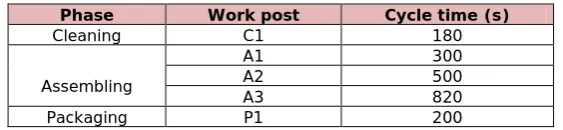
In order to step by step illustrate the use of the costing method and the output produced, we will next present a case study taken from a company that assembles computer peripherals. From a traditional batch-and-queue production process, this company has started to adopt lean practices in order to improve its efficiency. Namely, this case study presents an improvement in the assembly line balancing (initial values show a hard unbalance) in order to make one-piece-flow possible, which is a typical feature of lean manufacturing. Table 2 shows, for the initial situation, the different steps in the production process, the number of workstations (one for initial cleaning, three in the assembly process and one for the final packaging) and the cycle time for each workstation.
Phase Work post Cycle time (s)
Cleaning C1 180
Assembling
A1 300
A2 500
A3 820
Packaging P1 200
JIEM, 2010 – 3(3): 576-602 – Online ISSN: 2013-0953 Print ISSN: 2013-8423
3.1 Evaluation of the initial situation
The initial situation can be evaluated through some key parameters that have to be calculated. Changes in the values of these parameters will be used as indicators of the results of the improvements implemented on the production line.
Monitoring parameters can be obtained from direct observation on the shop floor – plus some calculations- or by means of simulation as stated by Cuatrecasas (2003, 2006) who uses an Operation-Time chart.
The main key parameters are:
• Process cycle time: this is the time elapsed between the production of two consecutive transfer lots.
• Manufacturing Lead time: this is the time necessary to manufacture the
units in a production run.
• Lead time for the first unit: this is the time necessary to manufacture the first unit in a production run.
• Lead time for the last unit: this measures the time the last transfer lot is in process.
• In-process inventory (WIP): the greatest number of partially completed
goods, parts or sub-assemblies that are in the different stages of the production process.
Table 3 shows the values of the different key parameters for the initial layout of the system and a production of 170 units per week.
Cycle time
(s) Total Lead time (s) 1st part (s) Lead time last part (s) Lead time Max WIP (pieces) (parts/h) Capacity
820 140,580 (39.05
hours) 2,000
110,160 (30.60
hours) 136 4.39
JIEM, 2010 – 3(3): 576-602 – Online ISSN: 2013-0953 Print ISSN: 2013-8423
3.2 Improvements in the production process
In the initial implementation of the production process, parts move forward with an uneven flow due to the unbalance among workstations which causes bottlenecks and work-in-process inventories. Although it is out of the scope of this work, let us remark that in order to improve the line balancing, it would be necessary to reassign tasks among employees by breaking down tasks into work elements that can then be grouped in blocks with a similar cycle time (Cuatrecasas, 1996, 2003). The way some tasks are performed may have to be redefined too. Let us assume that figure 1 shows the new assignment of tasks to workstations after the line balancing.
Figure 1. “Cycle time for every work post before the line balancing”.
After the line is balanced, key parameters are calculated for the new layout (Table 4) by means of simulation because the new process has not been implemented yet. Manufacturing lean time decreases by 32.5 per cent (this means a better service for customers), in-process inventory moves down from 136 to 118 pieces (it is a reduction in “muda” and in money invested); cycle time decreases around 33 per cent (reduction in “muda” and gain in speed) and total wait time also decreases to 43.3 per cent, which represents an increase in capacity.
Cycle time
(s) Total Lead time (s) 1st part (s) Lead time last part (s) Lead time Max WIP (pieces) (parts/h) Capacity
550 94,950 (26.38
hours) 2,000
64,530 (17.93
hours) 118 6.54
Table 4. “Key metrics after balancing the production line”.
3.3 Costing the improvement
By knowing the key parameters of the process before and after the line balancing, it is possible to calculate the cost of products in each situation by means of the methodology discussed in this paper. The necessary steps to calculate the cost are:
Post: C1
T1 =180 s
Post: A1
T2 =520 s
Post: A2
T3 =550 s
Post: A3
T4 =550 s
Post: P1
JIEM, 2010 – 3(3): 576-602 – Online ISSN: 2013-0953 Print ISSN: 2013-8423
1. Choosing drivers for activities
All activities in the production process and their drivers have been defined in table 5. In an attempt at simplicity, drivers have been named Employee-Hour (EH) and Machine-Hour (MH). Here, “Employee-Hour” means that in a specific activity, a person is performing that task for an hour and consuming all the necessary resources.
Process Activity code Description Driver
Cleaning
CT1 Components necessary to manufacture 10 units of finished product are taken to the cleaning area
(from warehouse) EH
C1 Some parts, such as screens, need some cleaning EH CT2 Parts are taken from the cleaning area to the assembly line EH
Assembling
A1 Assembly line workstation 1 EH A2 Assembly line workstation 2 MH A3 Assembly line workstation 3 EH AT Product is taken from the assembly line to the packaging area EH
Packaging P1 PT Final packaging 10 units of finished product are taken to the EH
warehouse EH
Table 5. “Activities and cost drivers”. EH: Employee-hour. MM: Machine-hour.
2. Cost of drivers
Cost of one unit of cost driver
in every type of task in every activity in the process (All figures are in Euros per employee-hour or machine-hour)
Production
Other tasks
Idle Process
(Activities) Transport Waiting Others Cleaning
(C1, CT1 and CT2) 30 20 20 0 20
Assembly line workstation 1 (A1) 35 20 20 0 20 Assembly line workstation 2 (A2) 35 20 20 0 20
Assembly line workstation 3
(A3 and AT) 35 20 20 0 20
Packaging
(P1, PT) 20 15 15 0 15
Table 6. “Cost per unit of cost driver, according to the type of task in activity”.
JIEM, 2010 – 3(3): 576-602 – Online ISSN: 2013-0953 Print ISSN: 2013-8423
3. Cost of raw materials and components
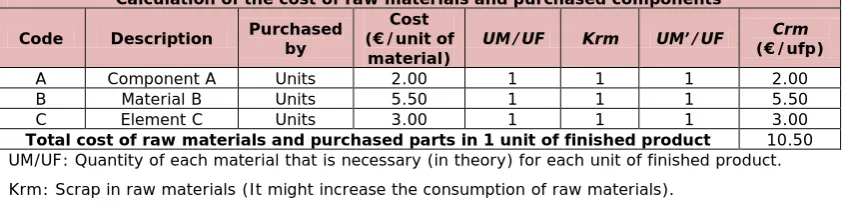
The cost of raw materials and purchased components has been quantified as 10.50 € per unit of finished product (Table 7). In the attempt at simplicity seen in the example, it is admitted that the value of the coefficient Krm that marks up the consumption of raw materials due to the existence of scrap in raw materials is one. Otherwise, the real consumption of raw materials would be greater than what was theoretically necessary.
Calculation of the cost of raw materials and purchased components
Code Description Purchased by (€/unit of Cost
material) UM/UF Krm UM’/UF
Crm (€/ufp)
A Component A Units 2.00 1 1 1 2.00
B Material B Units 5.50 1 1 1 5.50
C Element C Units 3.00 1 1 1 3.00
Total cost of raw materials and purchased parts in 1 unit of finished product 10.50
UM/UF: Quantity of each material that is necessary (in theory) for each unit of finished product. Krm: Scrap in raw materials (It might increase the consumption of raw materials).
UM´/UF: Quantity of each material that is necessary (in practice) for each unit of finished product. It is UM/UF times Krm.
Crm: Cost of raw materials and purchased parts per unit of finished product (ufp).
Table 7. “Cost of materials and parts”.
4. Cost of work-in-process inventories
JIEM, 2010 – 3(3): 576-602 – Online ISSN: 2013-0953 Print ISSN: 2013-8423
𝐶𝑊𝐼𝑃𝜃=
𝑊𝐼𝑃𝑚𝑎𝑥
2 ·𝐶𝑃·𝑟·𝜃 𝑁
Equation 4. “Cost of holding inventories of in-process materials”.
Case max WIP (pieces)
Average WIP (pieces)
Production cost (€/unit)
Rate
r (%) (years) Time
Production run (units)
Cost Cwip (€/ufp)* Before
balancing 136 68 31.40 50% 1/50 170 0.13 After
balancing 118 59 30.30 50% 1/50 170 0.10 * In Euros per unit of finished product (ufp)
Table 8. “Calculation of the in-process inventory and its cost”.
5. Calculating the cost of production
From the description of the initial process (see table 2 and figure 1) and its key metrics (Table 3 and table 4), following the steps of the costing method (Tables 5, 6 and 7) and solving equations 2 and 3, it is possible to quantify the cost of production according to table 9. The cost of holding inventories (Equation 4 and table 8) is then added. Again in this example, the coefficient that measures the occurrence of defective parts (Kd) is set to 1. A greater value of this coefficient would increase the quantity of resources necessary to get a valid unit of finished product, therefore increasing the production cost.
3.4 Improvements according to the pre-ABC costing
From an operational point of view, thanks to a better line balancing, the average capacity of the line has improved from 4.39 parts per hour to 6.55 parts per hour and work conditions have improved because the quantity of work at each post is similar, workers have to wait less, the products flow though the stations, and work-in-process inventory has decreased. But if the company used a full costing system, although the cost of each operation would be different due to the new use of labor at each post, there would be no change in the final cost, as shown in table 10.
JIEM, 2010 – 3(3): 576-602 – Online ISSN: 2013-0953 Print ISSN: 2013-8423
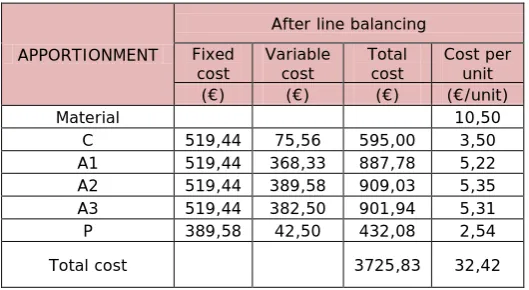
considered the cost of unused capacity. In that case (Table 11) the cost of the products would be lower but the company would still bear the rest of the burden.
Operation Cost driver Cost (€/unit of driver)
Before balancing the process After balancing the process
Time for this element
(s)
Consumption of drivers
I’/UFP = Kd · I/UFP
** Cost (€/unit of finished product) Time for this element (s) Consumption of drivers I’/UFP = Kd · I/UFP
**
Cost (€/unit of
finished product) CT EH 20 10 0.0028 0.0556 10 0.0028 0.0556 C1 EH 30 160 0.0444 1.3333 160 0.0444 1.3333 CT EH 20 10 0.0028 0.0556 10 0.0028 0.0556 Wait
A1 20 180 Average on 170 units 0.0059 180 Average on 170 units 0.0059 A1 EH 35 300 0.0833 2.9167 520 0.1444 5.0556 Wait
A2 20 480 Average on 170 units 0.0157 700 Average on 170 units 0.0229 A2 MH 35 500 0.1389 4.8611 550 0.1528 5.3472 Wait
A3 20 980 Average on 170 units 0.0320 1,250 Average on 170 units 0.0408 A3 EH 35 810 0.2250 7.8750 540 0.1500 5.2500 AT EH 20 10 0.0028 0.0556 10 0.0028 0.0556 Wait
P1 15 106,580 Average on 170 units 2.6123 60,950 Average on 170 units 1.4939 P1 EH 20 180 0.0500 1.0000 180 0.0500 1.0000 PT EH 15 20 0.0056 0.0833 20 0.0056 0.0833
Cost of activities *
In production processes 20.90 19.80
Cost of raw materials Crm
(Table 7) * 10.50 10.50
Total cost of production CP
* 31.40 30.30
Cost of in-process inventories Cwip
(Table 8) * 0.13 0.10
Total cost of the product * 31.53 30.40
* In Euros per unit of finished product
** Quantity of cost driver consumed by the activity per unit of finished product. The empirical quantity I’ equals the theoretical quantity I because the coefficient Kd that takes into account the production of defectives is set to 1 (no defectives).
Table 9. “Calculation of the production cost, according to the costing method based on ABC”.
FULL COSTING
Before line balancing After line balancing Fixed
cost Variable cost Total cost Cost per unit Fixed cost Variable cost Total cost Cost per unit (€) (€) (€) (€/unit) (€) (€) (€) (€/unit)
Material 10,50 10,50
C 780,00 75,56 855,56 5,03 780,00 75,56 855,56 5,03 A1 780,00 212,50 992,50 5,84 780,00 368,33 1148,33 6,75 A2 780,00 354,17 1134,17 6,67 780,00 389,58 1169,58 6,88 A3 780,00 573,75 1353,75 7,96 780,00 382,50 1162,50 6,84 P 585,00 42,50 627,50 3,69 585,00 42,50 627,50 3,69
Total cost 4963,47 39,70 4963,47 39,70
JIEM, 2010 – 3(3): 576-602 – Online ISSN: 2013-0953 Print ISSN: 2013-8423
While in table 2 there is a reduction in production, in tables 9 and 10 the number of parts assembled is the same as usual, so in practice the company would probably fail to appreciate the change in capacity and therefore would never consider table 11. In future periods, the company may be able to adjust the amount of labor or may produce more (if demand increases), but in the present, accounting is not able to anticipate future profits (Olivella, 2008).
APPORTIONMENT
After line balancing Fixed
cost Variable cost Total cost Cost per unit (€) (€) (€) (€/unit)
Material 10,50
C 519,44 75,56 595,00 3,50 A1 519,44 368,33 887,78 5,22 A2 519,44 389,58 909,03 5,35 A3 519,44 382,50 901,94 5,31 P 389,58 42,50 432,08 2,54
Total cost 3725,83 32,42
Table 11. “Calculation of the production cost when apportionment is used”.
4 Conclusions
There is evidence in literature that the adoption of the lean manufacturing paradigm brings about improvements in productivity, quality and delivery figures. In consequence, many companies implement lean manufacturing techniques.
These companies hope that lean techniques will bring better operational performance that can be measured as a decrease in cost. However, while operational improvements are evident sometimes they do not seem to lead to reduced costs. Since this seemed strange, it was discovered that traditional costing methods were not suitable for lean production.
JIEM, 2010 – 3(3): 576-602 – Online ISSN: 2013-0953 Print ISSN: 2013-8423
The example in table 1 showed that the adoption of certain manufacturing practices, despite their operational advantages, may convey, at least in the short run, costs (instead of cutting them) and losses that may discourage managers. If rational apportionment of fixed cost is used, it is possible to better understand the causes of the cost and not to allocate it to products; however, the final result is the same.
Changes towards lean manufacturing such as cellular manufacturing make cost management easier because each product (or family) has a distinct flow and there are not many variations from time to time in the production process. There are also not many units in inventory. This allows some simplifications that have been termed lean accounting.
However, there is no agreement on how accounting practices should be adopted and developed to support lean manufacturing. There is no relevant academic literature on this topic.
Lean accounting is suitable for companies that have implemented lean manufacturing to a certain extent. The company may then implement further lean accounting techniques along with new lean manufacturing practices, but there is no “non traditional” accounting method for companies that have just started the transformation to lean manufacturing. For this reason, this paper presents an accounting method based on Activity-Based Costing that can calculate the cost of products, the cost of waste (such as waiting) and the savings of operational improvements.
ABC has been chosen because that method came about in order to support companies that did not fit the mass production paradigm. Although ABC consumes many resources for data collection (and this is contrary to the principles of lean management), it includes the concept of production flow and helps reveal sources of waste (activities that can be considered a waste of resources) and its effect (cost) on products. Its ideas are of flow, waste reduction, ongoing improvement and target cost which are central to the paradigm of lean manufacturing.
JIEM, 2010 – 3(3): 576-602 – Online ISSN: 2013-0953 Print ISSN: 2013-8423
aspects of lean manufacturing. Once the implementation of lean manufacturing progresses, other lean accounting techniques may be implemented.
The application of our costing method has been presented by means of a simple example. Without being foreign to traditional costing (similar to time-driven ABC because drivers are based on time), it has shown the cost of the activities, its effect on the product and the savings conveyed by the operational improvement. With the help of the costing method presented in this paper, the operational improvement is related to an improved cost.
Table 9 shows a comparison between the cost of the product in the initial situation and once the process is more efficient. After balancing the production process, the cost of value added and transportation activities has not changed because the time of the operations is the same, as well as the cost of the drivers. However, the cost of wait time and the cost of holding inventories have diminished because these are the main improvements introduced by a line balancing.
In many companies, traditional accounting does not consider such costs and therefore the improvement would be irrelevant from the point of view of cost (as seen in Table 10). The capacity has increased, and in the future it can be very positive for the company, but accounting does not measure future profits. If the company uses apportionment of costs, then part of the cost can be described as the cost of unused capacity and not be allocated to products; but since capacity is measured in volume and the production of parts in our example is the same as usual, the company would probably never notice a change in capacity or cost.
References
Ahlström, P., & Karlsson, C. (1996). Change processes towards lean production: the role of the management accounting system. International journal of
operations & production management, 16(11), 42-56.
JIEM, 2010 – 3(3): 576-602 – Online ISSN: 2013-0953 Print ISSN: 2013-8423
Argilés Bosch, J. M. (2007). Análisis del comportamiento de los resultados en “full” y “direct costing”. Cuadernos de CC.EE y EE., 53, 107-133.
Baguer, A., & Zárraga, M. (2002). Dirige. Manual de conceptos prácticos y
necesarios para la gestión empresarial. Madrid: Ed. Diaz de Santos.
Balada Ortega, T. (1994). El rediseño de procesos en el contexto de la contabilidad de gestión: prácticas y experiencias en Ford España S.A., In J. Lizcano (coordinator), Elementos de Contabilidad de Gestión. Madrid: Ediciones Asociación Española de Contabilidad y Administración de Empresas.
Banker, R. D., Bardhan, I.R., & Chen, T.Y. (2008). The role of manufacturing practices in mediating the impact the impact of activity-based costing on plant performance. Accounting, organizations and society, 3, 1-19.
Berliner, C., & Brimson, J.A. (1988). Cost management for today’s advanced
manufacturing: The CAM-I conceptual design. Boston: Harvard Business School
Press.
Blanco Ibarra, F. (1988). Curso de contabilidad analítica. Bilbao: Ediciones Deusto.
Cooper, R. (1994). The role of Activity-based system in supporting the transition to the lean enterprise". Advances in Management Accounting; Research annual, 3, 1-24.
Cooper, R. (1996). Activity-based costing and the lean enterprise. Journal of Cost Management (Winter), 6-14.
Cooper, R. (2000). Cost management: from Frederick Taylor to the present. Journal
of Cost Management, (September/October), 4-9.
Cooper, R., & Kaplan, R.S. (1988). Measure costs right: make the right decisions.
Harvard Business Review, (September-October), 96-103.
Crute, V., Ward, Y., Brown, S., & Graves, A. (2003). Implementing Lean in Aerospace – challenging the assumptions and understanding the challenges.
Technovation, (23) 917-928.
JIEM, 2010 – 3(3): 576-602 – Online ISSN: 2013-0953 Print ISSN: 2013-8423
Cuatrecasas Arbós, L. (1996). Diseño de procesos de producción flexible. Madrid: TGP-Productivity Press.
Cuatrecasas Arbós, L. (2000). Organización de la producción y dirección de
operaciones. Sistemas actuales de gestión eficiente y competitiva. Madrid: Ed.
Centro de estudios Ramón Areces.
Cuatrecasas Arbós, L. (2003). Gestión competitiva de stocks y procesos de
producción. Barcelona: Ed. Gestión 2000.
Cuatrecasas Arbós, L. (2006). Claves de Lean Management. Barcelona: Ed. Gestión 2000.
DeLuzio, M.C. (2006). Accounting for lean - Conventional accounting must adapt to accommodate the lean movement. Manufacturing engineering, 137(6), 83.
Dhavale, D.G. (1996). Performance Measures for Cell Manufacturing and /Focused Factory Systems. Journal of Cost Management, 10(1), 59-69.
Goldratt, E. M., & Cox, J. (1986). The Goal: A process of ongoing improvement. New York: North River Press.
Grasso, L.P. (2005). Are ABC and RCA accounting systems compatible with lean management. Management accounting quarterly, 7(1), 12-27.
Harman, R. L. (1992). Reinventing the factory II. Managing the world class factory. New York: The Free Press, New York.
Harman R. L., & Peterson, L.D. (1990). Reinventing the Factory: Productivity
Breakthroughs in Manufacturing Today. New York: The Free Press.
Hyer, N. L., & Wemmerlöv, U. (2002). Reorganizing the factory: competing through
cellular manufacturing. Portland: Productivity Press.
Huntzinger, J. R. (2007). Lean cost management: accounting for lean by
establishing flow. San Francisco: J. Ross Publishing.
JIEM, 2010 – 3(3): 576-602 – Online ISSN: 2013-0953 Print ISSN: 2013-8423
Jenson, R., Brackner, J., & Skousen, C. (1996). Management accounting in support
of manufacturing excellence. Montvale: Institute of Management Accountants.
Johnson, H.T., & Kaplan, R.S. (1987). Relevance Lost- The rise and fall of
management accounting. Boston: Harvard Business School Press.
Johnson, H.T. (1992). Relevance Regained: from ttop-down control to bottom-up
empowerment. New York: The Free Press Business.
Kaplan, R. S. (1983). Measuring manufacturing performance: a new challenge for managerial accounting research. The accounting review, 58(4), 686-705.
Kaplan, R. S. (1984). Yesterday’s accounting undermines production. Harvard
Business Review, 62(July-August), 95-101.
Kaplan, R.S. (1985). Una contabilidad anticuada puede socavar la producción.
Harvard Deusto Business Review, (23), 125–134.
Kaplan, R.S. (1986). Accounting lag: The obsolescence of cost accounting systems.
California Management Review, 18(2), 174-199.
Kaplan, R.S. (1987). Regaining Relevance. In R. Capettine, R. & D.K. Clancy (Ed.),
Cost Accounting, Robotics, and the New Manufacturing Environment. Sarasota:
American Accounting Association.
Kaplan, R.S. (1988). One cost system isn't enough. Harvard Business Review 66(January-February), 61- 66.
Kaplan, R.S. (1989). Limitations of Cost Accounting in Advanced Manufacturing
Environments. Colloquium. Cambridge (MA.): Harvard Business School,
Cambridge.
Kaplan, R.S, & Anderson, S.R. (2004). Time driven activity-based costing. Harvard
Business Review, 82(11), 131-138.
Kaplan R.S., & Cooper, R. (1998). Cost and Effect. Boston: Harvard Business School Press.
JIEM, 2010 – 3(3): 576-602 – Online ISSN: 2013-0953 Print ISSN: 2013-8423
1433-1451.
Maskell, B.H., & Baggaley, B. (2004). Practical lean accounting. A proven system
for measuring and managing the lean enterprise. New York: Productivity Press.
Maskell, B.H., & Kennedy, F.A. (2007). Why Do We Need Lean Accounting and How Does It Work? The Journal of Corporate Accounting & Finance, (March/April), 59-73.
Ohno, T. (1988). Toyota Production System: Beyond Large-Scale Production. Cambridge (MA.): Productivity Press.
Olivella Nadal, J. (2008): Los beneficios de las empresas durante la implantación
del lean. Retrieved August 29th, 2009, from
Plenert, G. (1999). The new manufacturing-accounting interface. Industrial
management and data systems, 99(1), 25-32.
Ruiz de Arbulo López, P. (2005). Un nuevo modelo de gestión de costes para
avanzar hacia la producción lean (Doctoral dissertation). Universidad del País
Vasco.
Ruiz de Arbulo López, P. (2007). La gestión de costes en lean manufacturing. La Coruña: NetBiblo.
Sriparavastu, L., & Gupta, T. (1997). An empirical study of just-in-time and total quality management principles implementation in manufacturing firms in the USA.
International Journal of Operations & Production Management, 17(12),
1215-1232.
Sugimori, Y., Kusunoki, K., Cho, F., & Uchikawa, S (1977). Toyota production system and Kanban system. Materialization of just-in-time and respect-for-human system. International Journal of Production Research, 15(6), 553-564.
JIEM, 2010 – 3(3): 576-602 – Online ISSN: 2013-0953 Print ISSN: 2013-8423
Tamarit Aznar, M.C., & Ripoll Feliu, V.M. (2006). Implantación del ABC/ABM en RENFE. Revista de contabilidad y dirección, (3), 197-208.
Tatikonda, M. V. (1988). Just-in-time and modern manufacturing environments: implications for cost accounting. Production and inventory management journal, (First quarter), 1-5.
Tirado Valencia, P. (2003). Gestión de costes y mejora continua. Los sistemas de
costes y de gestión basados en las actividades (ABC-ABM). Bilbao: Ed. Desclée de
Brouwer.
Ward, Y., & Graves, A. (2004). A new cost manufacturing and accounting approach
for lean enterprises. (Working paper series, 5). University of Bath School of
management.
Ward, Y., Crute, V., Tomkins, C., & Graves, A. (2003). Cost management and
accounting methods to support lean aerospace enterprises. A UK Lean Aerospace initiative Report, University of Bath.
Ward, Y., Crute, V., Tomkins, C., & Graves, A. (2004). Costing for Competitiveness:
Cost Management and Accounting for Lean Enterprises. Society of British
Aerospace Companies Publication.
Williamson, A. (1997). Target and kaizen costing. Manufacturing engineer, 76(1), 22–24.
Womack, J. P., & Jones, D. T. (1996). Lean thinking: banish waste and create
wealth in your corporation. New York: The Free Press.
JIEM, 2010 – 3(3): 576-602 – Online ISSN: 2013-0953 Print ISSN: 2013-8423
Journal of Industrial Engineering and Management, 2010
Article's contents are provided on a Attribution-Non Commercial 3.0 Creative commons license. Readers are allowed to copy, distribute and communicate article's contents, provided the author's and Journal of Industrial Engineering and Management's names are included. It must not be used for commercial purposes. To see the complete