Blogs: a tool for the physical sciences
Kaye Placing
UniServe Science The University of Sydney
Mary-Helen Ward
Flexible Online Learning Team The University of Sydney
Mary Peat and
Pedro Telleria Teixeira
School of Biological Sciences The University of Sydney Australia
[email protected] [email protected]
Introduction
Teaching and learning are never static processes, and in the sciences we are increasingly mindful of the constructivist learning paradigm. We accept that science education needs to change from teacher-centred teaching to student-centred learning, from passive learning to active learning and towards a blended learning situation that relies heavily on research-led teaching. Lately we have been asking how the newest developments on the Web can be used to achieve these goals.
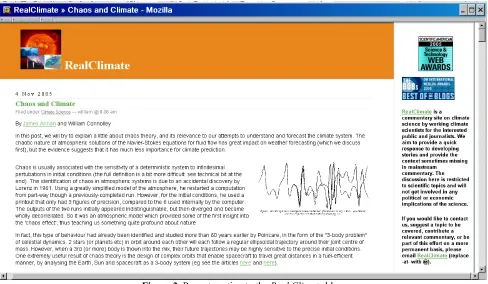
Direct publishing to the web and content aggregation tools such as blogs, wikis and RSS (Really Simple Syndication) are having a powerful effect on publishing. These are excellent tools for promoting ongoing dialogue. Because of their ability to provide thoughtful dialogue within a short time frame, they provide a platform within science education for discussion on current theories and recent discoveries and development. One excellent example of a blog being used in this way is Real Climate (http://www.realclimate.org/) with its ongoing discussion of global dimming and other issues of climate change.
This paper aims to explore the various forms of direct publishing and content aggregation tools currently available to educators and the range of educational activities to which they are being applied. However, our search for examples of how blogs are being used in science research, science education and research into science education has not been very rewarding.
Blogs
Weblogs, colloquially shortened to blogs, are frequently updated web sites which are displayed as a series of short entries, in reverse chronological order. They are essentially a web-based journal – usually the product of a single author – being made up of personal experiences and subsequent reflections, and often incorporate hyperlinks to web-based sources (which are often other blogs) and images. However, multiple authorship is not uncommon, and a blog can provide a useful space for course planning or the sharing of resources and communication throughout a research project. Parts of the blogging page are available for hyperlinked or non-hyperlinked lists of various kinds (books or articles, other blogs that bloggers consider worth reading, completed tasks or tasks to be undertaken, worthwhile conferences or meetings that are being planned or have proceedings published and so on). Blogs also have the possibility of allowing comments from readers on an entry, and reader-based discussions can and do develop in the comment sections of blogs as well as between bloggers themselves.
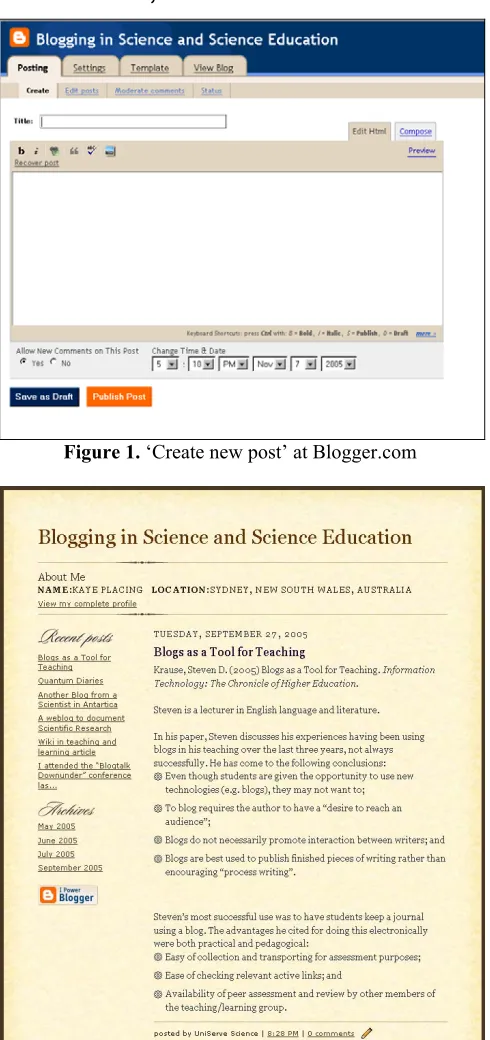
The maintenance of a blog requires minimal web-page development skills; web sites exist which allow anyone to create a personal blog by adding text entries and images to a selected template, the developing blog being hosted and archived by the web site and its provider. Web sites which offer this service at no cost or very low cost include Blogger (http://www.blogger.com/) and TypePad
Figure 1. ‘Create new post’ at Blogger.com
Figure 2. Blog created using one of the available templates
Blogging, the act of creating and maintaining a blog, has developed its own associated vocabulary e.g., a blogger is someone who maintains a blog, while the blogosphere refers to the interconnected, interlinked and constantly self-referential community of blogs and bloggers. The number of blogs presently being maintained in the world is impossible to establish, but has been variously estimated at between eight and sixty million (sites that periodically discuss the number of blogs in existence include http://www.dijest.com/bc/, http://www.sifry.com/, http://www.blogherald.com/).
One tool that works to make blogs interactive is Really Simple Syndication or RSS. RSS is a series of XML files that provide an easy way for frequent visitors to stay up-to-date with changes to a specific website by tracking changes and providing a summary of headlines, content and hyperlinks. The use of RSS is not restricted to blogs; it can
be used on any web site and is particularly beneficial on web sites that are regularly updated with new information.
Another tool that is closely related to blogging is the ‘wiki’. The origin of the term ‘wiki’ is debatable. One suggestion is that the term wiki is an acronym for ‘What I Know Is’, while an alternative suggestion claims that it derives from the Hawaiian term wiki wiki, which means quick or
informal. Whatever its origin, a wiki provides an open-access web site that can be edited or added to by visitors. Unlike a blog, no-one ‘owns’ a wiki’s contents.
The most popular example of a wiki is Wikipedia, an open-content encyclopaedia which at the time of writing this paper has over 600 000 entries. What makes it unique is that the content has been compiled from anonymous contributions. By design, the content of Wikipedia can be altered by anyone with access to the Internet, and indeed the Wikipedia web site makes the submission of material extremely easy even for those who have no web development skills. The open nature of the process and the lack of any peer review make the reliability and validity of entries open to question, but it can be a useful tool for pooling and sharing information. Augur, Raitman and Zhou (2004) give a good summary of what wikis are, things to consider when selecting a wiki for educational purposes and a justification for making the selection they did. They also discuss some of the conditions they established to ensure a positive experience for students.
Several offsprings of Wikipedia are of specific interest to the scientific community. These are the series of directories which access content from Wikipedia, and include Biology Daily (http://www.biologydaily.com/), and similar pages for Chemistry, Physics and Mathematics.
The social nature of blogging has been explored by Nardi, Schiano and Gumbrecht (2004) who claim that ‘blogs create the audience, but the audience also creates the blog’. Their study of 23 social blogs maintained by university students, graduates and graduate students also found that the social dimension of blogging made blogs much more than online diaries; they classified the motivations that bloggers had to continue their blogging activities to:
1) update others on activities and whereabouts; 2) express opinions to influence others; 3) seek others’ opinions and feedback; 4) ‘think by writing’; and
5) release emotional tension.
Although her blog is personal, not educational, Rebecca Blood (2000), author of Rebecca’s Pocket
(http://www.rebeccablood.net/) and one of the most widely respected commentators on the blogosphere, has used her blogging to develop her thinking and writing. She writes:
Shortly after I began producing Rebecca’s Pocket I noticed two side effects I had not expected. First, I discovered my own interests. I thought I knew what I was interested in, but after linking stories for a few months I could see that I was much more interested in science, archaeology, and issues of injustice than I had realised. More importantly, I began to value more highly my own point of view. In composing my link text every day I carefully considered my own opinions and ideas, and I began to feel that my perspective was unique and important.
Similarly, Mortensen and Walker (2002) argue that blogs provide an excellent development tool for students and junior researchers, because bloggers need to sustain ‘a confident and clear voice of one’s own and the ability to formulate and stand by opinions’. Additionally, they point out, ‘Writing in a weblog one is forced to confront one’s own writing and opinions and to see them reflected in the words of others’.
There are already a number of tried-and-true web-based ways of structuring e-communication in education, such as mailing lists, listservs, and bulletin boards. It would be reasonable to ask why the use of blogs might be an advance on these.
The main difference between mail-based communication and blogs is that while the former is mostly a one-way means of communication, normally ‘from the technically powerful to the technically powerless’ (Wright 2004), blogs allow individuals to publish to the Web, with no need to buy web-space on a server, and, as Nardi et al. (2004) report, the possibility for feedback and participation by the community of commentators is an important dimension in the creation of the blog. While email-based communication is passive and reception-only, blogs, being a combination of browser and email, allow for a more interactive experience based on visual stimuli and multi-directional paths.
In education the development of team blogs, such as the now famous Harvard Law, seems to be the preferred model. Team blogs can be password-protected for subscriber view only, and accessed from any Internet connection point (Harvard Law, for example, allows access only to individuals with a Harvard Law email address). The advantage of password-protected team blogs is that restricting the number of participants to those with a genuine interest in the field cuts out the possibility of undesired participation, and also provides a refereed environment which promotes collaborative activity, knowledge-sharing, and debate on issues related to the discipline. Education blogs, or edublogs, allow for an enhanced flexible content delivery, when compared to traditional email-based communication, bulletin boards and forums. Edublogs promote student autonomy and provide students with the opportunity to interact with their peers as well as with experts.
Existing blogs in science
Informing the scientific community: science blogs
In early 2005, the ABC on their program Four Corners
broadcast the BBC documentary on ‘global dimming’. In the week following the broadcast, UniServe Science developed a web-based activity for secondary science students that investigated the phenomenon known as ‘global dimming’, how it was discovered, its cause and effect and what are the consequences if we do, or do not, act to slow or stop ‘global dimming’.
The broadcast of this program caused great concern amongst many viewers and it very quickly became a hot topic in personal blogs. Currently, a search on Google using the combination of words ‘global dimming’ and ‘blog’ will result in over 14 000 hits.
One blog which stands out within this extensive list is Real Climate (http://www.realclimate.org/) – see Figure 3. Unlike many less informed blogs this one is the work of a number of scientists working in the area of climate and climate change, and is their attempt to ensure the general public and the media are kept informed on key issues.
Real Climate is a commentary site on climate science by working climate scientists for the interested public and journalists. We aim to provide a quick response to developing stories and provide the context sometimes missing in mainstream commentary. The discussion here is restricted to scientific topics and will not get involved in any political or economic implications of the science.
2005 being the International Year of Physics, one project of particular interest is the Quantum Diaries (http://interactions.org/quantumdiaries/). Over thirty physicists world-wide have set up an individual blog in which they have documented their experiences in this the Year of Physics. Entries have been varied and while it is interesting to experience the ordinary (and not so ordinary) life of a physicist, the references to actual physics is sparse and somewhat difficult to find.
Numb3rs is a television series in which an FBI agent and his brother, a mathematical-genius, help to solve a wide range of challenging crimes by using mathematical probability and equations. A professor from Northeastern University’s Mathematics department in the United States maintains a blog at http://www.atsweb.neu.edu/math/cp/ blog/ where the mathematical content of each episode is explained and discussed.
Informing students: blogs in scientific research
In December, 2004, Ashley Below (2004) from the University of New England undertook her second journey to Antarctica as part of a research team. The team was investigating the effects of high levels of UV radiation on the development of fatty acids, amino acids, and carbohydrate in phytoplankton and the impact in the food chain.
information is collected and what instruments were used to collect it? what will need to be done at the end of the expedition? and what is life like on board a research vessel? It provides a valuable resource for school students in NSW, who are expected to study a variety of science-based careers. It gives students an insight into modern scientific research and life as a scientist. Below’s weblog can be found at http://www.une.edu/admissions/research/ below3.html.
Blogs in tertiary education
There is not yet a large body of work on the use of blogs in tertiary education. Williams and Jacobs (2004) discuss some of the published material, including the Harvard Law model and the ‘MBA blog’ established at the Brisbane Graduate School of Business at Queensland University of Technology. They conclude that blogging has the potential to be a transformational technology for teaching and learning. Maag (2005) argues for the use of blogs in Nursing Education as they ‘can enhance health professional’s writing, communication, collaboration, reading, and information-gathering skills’.
Dickey (2004) undertook an investigation of the impact of blogs on students’ perception of isolation and alienation in a distance education involving the web. The findings
revealed the expected – that students used the blogs to comment on assignments and course content; less expected (but confirming the findings of Nardi et al on social blogging) were the postings covering personal feelings and interests, anxieties, and importantly, personal and professional support for other bloggers – the interactions often missing when studying by distance education. The students reported that their experience with blogging was a positive one and had reduced their feelings of isolation. They felt it was advantageous to share their feelings and anxieties with fellow students. They also felt that blogging was less stressful than alternative communication tools such as discussion forums, perhaps because they feel an ownership in their blogs that they didn’t feel with forum-type communication.
E-portfolios are being encouraged as a tool for promoting student reflection, career planning and resumé building. Within large universities the prospect of providing computer resources for all students to prepare and maintain an e-portfolio is daunting, and Tosh and Werdmuller (2004) discuss a role for the use of blogs in the development of e-portfolios. Living the Scientific Life (http://girlscientist. blogspot.com/) is the personal blog of a young science researcher in New York. While the blog covers not only the author’s research interests in avian ecology (Birds in the News) it also covers the struggle to find suitable employment. While this is not an e-portfolio, it could form the basis of one and is definitely a compelling read.
Wikis in tertiary education
Deakin University in Victoria, Australia, has a long and well established role as a provider of distance and online education. Within their degree course in IT, one subject must be undertaken entirely online. In previous years, students had expressed some dissatisfaction with both the course and online learning. In an attempt to counteract this dissatisfaction, Augur, Raitman and Zhou (2004) carried out an ‘icebreaker’ activity by using a wiki. Their paper (available online at http://www.ascilite.org.au/conferences/ perth04/procs/augar.html) discusses how this worked, although at the time of writing the effect on student satisfaction had not been established.
Other challenges for educators relate to the instantaneous nature of mobile communication – it is always already available. Wireless access points, with a range of coverage from a single room to entire urban sectors, abound. This offers new opportunities for mobile blogging, or moblogging, as it is called. Michele Forman, Teacher of the Year 2001 in the US, claims that the intimacy and privacy offered by mobile devices has led to an increase in her high school student’s production of personal writing and composition (Alexander 2004).
As mobile learning, or m-learning, enhances Internet access and collaborative learning, it will lead to an increase in blended learning. The possibility of connecting anywhere means that new learning technologies such as the University of Western Australia’s i-lecture, developed in collaboration with Apple Computers, allow students to retrieve lecture information and participate in any activities wherever they are, on- or off-campus, within six minutes from the time the materials, including audio and video, are published to the Web. Students could download a lecture, watch it, reflect on it in their blogs, then read what others have said in their blogs and comment on that – all within hours after the lecture has finished and without leaving their home. Educators may feel pressured by this immediacy.
Although in terms of tertiary education the use of blogs is a relatively new way to communicate and involve students, blogs have obvious advantages in a constructivist environment, and they provide a more democratic approach to student participation. Bloggers own their own blogs, and can be encouraged to reflect on their own writing by being confronted with the comments of their peers. Over time, bloggers tend to refine and focus their thinking and writing more clearly, and it is possible that students blogging their learning experiences within a discipline, for example, could help to focus them on an area of science in which they might specialise and research at a postgraduate level. The depth and breadth of the knowledge students could build from their blogging experience is as yet unknown, but early indications are that it may possibly be an improvement of present forms of e-communication.
In May 2005, UniServe Science set up a blog called
Blogging in Science and Science Education
(http://scienced.blogspot.com/) to accumulate information on the use of blogs and other content aggregation tools in the area of science, scientific research, science education
and research into science education. This type of blog is sometimes known as a knowledge log or klog.
As our blog on science and science education develops postings will fall into two categories. The first category will be for reviews of papers found in academic journals or on the web that relate to issues pertaining to blogs, wikis and their use in education – in particular, science education. The second category will constitute an annotated list of weblogs. We hope to discover, report on and discuss more uses that blogs can be and are being put to in science education, and to stimulate more discussion between science educators about their use and about challenges in this use of blogs. One such challenge is how to sustain blogging by students. The life of blogs, even that of team blogs is always dependent on participation. Many blogs come to a dead end, due to either waning interest by the blogger or because they have moved on to other blogs or other forms of communication and participation. The challenge for the educator is to maintain interest and relevance within the blog.
It is hoped that the blog will also provide a platform for the interchange of information and ideas on how these tools can play a role in science and science education and to provide a forum for discussion of these issues.
To find out more about blogging in education, visit
Blogging Across the Curriculum: A course resource for an Interactive Digital Design program at Quinnipiac University at http://mywebspace.quinnipiac.edu/PHastings/ what.html.
References
Alexander, B. (2004) Going Nomadic: Mobile Learning in Higher Education. EDUCASE September/October, 28-35.
Augar, N., Raitman, R. and Zhou, W. (2004) Teaching and learning online with wikis. In R. Atkinson, C. McBeath, D. Jonas-Dwyer and R. Phillips (Eds), Beyond the comfort zone: proceedings of the 21st ASCILITE Conference. Perth, WA: 95-104.
Below, A. (2004) Ashley Below: Antarctic Blog Entries
[Online] Available: http://www.une.edu/admissions/ research/below3.html.
Blood, R. (2000) Weblogs: a History and perspective. Rebecca’s Pocket.
[Online] Available: http://www.rebeccablood.net/essays/ weblog_history.html.
Dickey, M. (2004) The impact of web-logs (blogs) on student perceptions of isolation and alienation in a web-based distance-learning environment. Open Learning,
19(3), 279-291.
Maag, M. (2005) The Potential Use of ‘Blogs’ in Nursing Education. Computers, Informatics, Nursing, 23(1), 16-24.
Mortensen, T. and Walker, J. (2002) Blogging thoughts: personal publications as an online research tool. In A. Morrison (Ed.) Researching ICTs in Context. InterMedia Report. Norway. 249- 278.
Computer-supported Cooperative Work, Chicago Illinois. NY, ACM Press.
Tosh, D. and Werdmuller, B. (2004) ePortfolios and weblogs: one vision for ePortfolio development.
ePortfolio research and development community. [Online] Available: http://www.eradc.org/papers/ ePortfolio_Weblog.pdf.
Turnbull, G. (2004) The seven-year-old bloggers. BBC News [Online] Available: http://news.bbc.co.uk/1/hi/ magazine/3804773.stm.
Williams, J.B. and Jacobs, J. (2004) Exploring the use of blogs as learning spaces in the higher education sector.
Australasian Journal of Educational Technology, 20, 232-247.