Copyright © 2019 (Traci Gillig and Leila Bighash). Licensed under the Creative Commons Attribution Non-commercial No Derivatives (by-nc-nd). Available at http://ijoc.org.
Gendered Spaces, Gendered Friendship Networks?
Exploring the Organizing Patterns of LGBTQ Youth
TRACI K. GILLIG
Washington State University, USA
LEILA BIGHASH
University of Arizona, USA
Research has found a tendency for youth to develop friendships with same-gender peers. Whether this is due to a preference for same-gender friends or is an outcome of communication constraints from gender-segregated physical spaces and social practices is unclear. The current study is among the first to examine the role of emerging gender-inclusive spaces in adolescent friendship network patterns. A network of 111 LGBTQ adolescents interacting in a summer camp featuring gender-inclusive housing is examined using social network analysis techniques. Exponential random graph models found that campers’ assigned cabin was significantly related to friendship ties. Notably, the probability of a friendship tie was approximately 6 times greater when campers were assigned to the same cabin. Gender identity and birth sex had no significant influence on friendship patterns, in contrast to prior studies. Our findings highlight the potential for gender-inclusive spaces to integrate youth’s friendships across gender identities.
Keywords: adolescents, LGBTQ, gender, transgender, social network analysis, friendship
Bathrooms; locker rooms; housing at boarding schools, universities, and summer camps; sports teams; scouting groups—the list of traditionally gender-segregated physical spaces and social practices encountered by young people in the United States is long. But it is changing. In the five years since TIME magazine declared that the U.S. had reached a “transgender tipping point” (Steinmetz, 2014) in which the media visibility of transgender people (i.e., those whose gender identity does not align with their sex assigned at birth) was at an all-time high, influencing audiences’ gender-related attitudes (Gillig, Rosenthal, Murphy, & Folb, 2018), entities as disparate as the International Olympic Committee; Target, Inc.; and a Kansas City, Missouri, school district implemented gender-inclusive regulations and facilities (Associated Press, 2016, 2018; Safdar, 2016). New terms emerged in the popular lexicon, such as gender nonconforming (i.e., having a gender expression that does not follow stereotypical conventions of masculinity or femininity) and nonbinary (i.e., those who do not identify as exclusively male or female)—labels largely unknown one generation ago (Henig, 2017). Today, more than one third of teens (35%) know someone who uses gender-neutral pronouns like
Traci Gillig: [email protected]
“they/them” (Parker, Graf, & Igielnik, 2019). The emergence of gender-inclusive spaces and language aligns with scientific research demonstrating the complexity of biological sex and gender identity. For instance, biological sex is determined not only by anatomy, but also by complex chemical and genetic processes that unfold over time (Moñtanez, 2017), and more gender similarities than differences exist on psychological variables (e.g., mathematics ability, facial expression processing; see Hyde, 2005, for a meta-analysis).
While gender-inclusive physical spaces and social practices are becoming more common, their social impact is unclear, particularly for adolescents, who may regularly encounter such spaces during a time in which they are developing gender-related attitudes. Might such spaces and practices foster cross-gender friendships? The current study examines a youth context in which gender segregation is still the norm—summer camp— though calls for change have been made (Browne, Gillard, & Garst, 2019; Gillard, Buzuvis, & Bialeschki, 2014). Specifically, the research site is a leadership summer camp for LGBTQ youth, in which campers share cabins with peers from their age group, regardless of gender, and where bathroom facilities are gender inclusive. As such, the site represents a context for youth where gender and physical space are not confounded. This provides an opportunity to understand whether the tendency for friendships to form between those of the same gender (i.e., gender homophily) found in youth friendship networks in previous studies may be the result of gender-segregated youth spaces and practices (and the constraints these place on youth’s opportunities to communicate with peers of different genders) rather than an inherent preference for same-gender friendships (McPherson & Smith-Lovin, 1987). In other words, the completely gender-inclusive setting examined here ensures that any gender homophily among youth in the network is the result of friendship preferences rather than proximity generated by gender-segregated physical spaces and social practices. Analyzing this preference-versus-proximity question among youth can extend scientific understanding of gender homophily patterns developed in adolescence that may have long-lasting social effects.
In the following, we provide an overview of the concept of homophily and literature examining gender as a driver of friendships. Then, we discuss research exploring the influence of physical proximity on friendship development. Next, we detail the setting of the current study and describe our social network analysis methodology. Finally, we present our findings and discuss their practical and theoretical implications.
Theoretical Background
Gender has been argued to be one of the most important traits across cultures, shaping social interaction throughout the life span (Maccoby, 2003; Mehta & Strough, 2009). It influences the friendship patterns of adults (Ibarra, 1992; Ruef et al., 2003) and youth (Burke & Fuqua, 1987; Hall, 1904; Jones, Bloys, & Wood, 1990; Maccoby & Jacklin, 1987; McPherson et al., 2001). Meta-analyses have found the magnitude of gender homophily among youth to be quite large (Hyde, 2005), increasing across young ages (i.e., from ages 4-1/2 to 6-1/2; Maccoby & Jacklin, 1987), becoming strongest among adolescents (i.e., up to grade 3), and then modestly decreasing (i.e., from grade 3‒12; Shrum, Cheek, & Hunter, 1988). When looking at strong ties (i.e., peers with whom youth interacted most often), Stehlé, Charbonnier, Picard, Cattuto, and Barrat (2013) uncovered increases in gender homophily among children (ages 6–12) as they aged. Similarly, Diamond and Dubé (2002) found predominantly same-gender peer networks and best friends among young people (ages 15‒24).
Among LGBTQ people (i.e., those identifying as lesbian, gay, bisexual, transgender, queer, questioning, and other related terms), gender may also influence friendship development. Galupo (2007) found that lesbian, gay, and bisexual (LGB) adults primarily formed close relationships with same-gender peers. Similarly, Logan (2013) found that 86% of lesbian adults reported that most of their friends were female. Diamond and Dubé (2002) found that young lesbians (ages 15‒24) had a heightened participation in same-gender close friendships as compared with their peers in the general population, while gay males had more cross-gender than same-gender friends.
Just why, when, and how gender influences youth friendship selection is not fully understood. Do youth experience a spontaneous drive or preference to befriend same-gender peers? Or do they befriend peers who are close to them in physical proximity and frequently share space with them? McPherson and Smith-Lovin (1987) suggest two processes by which homophily can emerge in friendships: (1) personal preference (i.e., a desire to befriend others who share some characteristic; choice homophily) and (2) composition of the group (i.e., a tendency to develop friendships with others who share some characteristic because those they encounter regularly, or exclusively, are homogenous regarding that characteristic; induced homophily).
current study examines whether a network of LGBTQ adolescents choose same-gender friends in an environment where they are not forced into physical proximity with same-gender peers.
A Gender-Inclusive Summer Camp
The nonprofit organization Brave Trails was founded in 2014 as the first summer camp for LGBTQ youth in the Western United States (Gillig, Miller, & Cox, 2019). Data for the current study were collected in summer 2017, when 115 youth attended the camp. Of importance to the current work are the camp’s physical spaces, social practices, and programming.
For the duration of camp in summer 2017, the organization transformed gender-segregated facilities on their rented campground into gender-inclusive spaces. Staff members covered any single-sex bathroom labels with signage designating them “gender-free,” or other similar terms, and assigned campers to cabins based on age rather than gender or sex assigned at birth. At camp check-in, campers created name tags displaying their pronouns (e.g., he, she, or they), which staff also prompted them to articulate during group introductions. Note that although campers’ gender identities were often apparent through communication at camp, their sexual orientations may not have been; this information would be communicated by choice, through conversations or visual indicators (e.g., wearing a pansexual pride flag pin).
Camp activities alternated between campers being grouped by cabin and being able to interact freely with campers from other cabins, a common practice at youth camps. Specifically, campers were in their cabins from 9:30 p.m. (Lights Out) until 8:15 a.m. (Round Up). At 8:30 a.m., campers were seated for breakfast by miscellaneous groupings (e.g., campers’ shirt color that day). From 9:15 a.m. to 1:20 p.m., campers attended programming and ate lunch not grouped by cabins. Then, campers returned to their cabins for an hour of In-Cabin Chill Time (e.g., cleaning up, socializing, reading). Next, from 2:25 to 5:45 p.m., campers attended programs with peers outside their cabin (e.g., Free Choice Programs), returning to their cabin groups for dinner. Last, evening programming (6:30 to 9:30 p.m.) allowed campers to socialize across cabins. Of note, aspects of camp programming prompted campers to reflect on their personal experiences and share their stories with fellow campers. These practices, coupled with the living environment, may encourage the development of close friendships in a short period. See Gillig et al. (2019) for further program details.
Hypotheses and Research Question
Based on the homophily literature outlining two routes to friendship development (preference/choice homophily and proximity/induced homophily), prior research showing youth’s tendency toward same-gender friendships, and the gender-inclusive research site, the following research question and hypotheses are posed:
H1: LGBTQ adolescents tend to develop friendships with peers of the same gender identity at summer camp.
RQ1: Does gender identity or assigned housing have a stronger influence on friendship formation among LGBTQ youth in the context of a gender-inclusive summer camp environment?
Method
Procedure
The data are drawn from a longitudinal study of LGBTQ youth participating in the previously described program during summer 2017. The research procedure was implemented in conjunction with camp staff certified by the Collaborative Institutional Training Initiative (CITI) for human subjects research. The process was approved by the relevant university institutional review board.
Six weeks before the start of camp, Brave Trails contacted youth and parents through the secure online portal Camp Site, informing them of the research opportunity and providing consent information and a link to the first questionnaire. Youth were assured that their choice regarding participation in the study would not affect their role in camp. Research participants were able to enter a drawing for a $250 Visa gift card. Both youth consent and parental permission were obtained online.
For consenting youth, questionnaires were administered online before and after the program, which lasted one week or two weeks, depending on the session in which youth were enrolled. The pretest opened when youth and parents were informed of the research six weeks before camp. It closed on the first day of camp. The first author administered the posttest on-site, and participating youth used rented iPads to complete the survey in a location where other youth and staff would not see their responses. Two camp sessions occurred, and the procedure for data collection was identical for both sessions.
To match participants across waves, all were asked to provide their name. Participants wishing to enter the gift card drawing were asked at the end of the survey to provide their email address. At Time 1, 115 youth (of 118 eligible) consented and completed the survey. At Time 2, 108 youth completed the survey and had matching data from Time 1. Attrition was low: 6.1%, n = 7 (5% or less is typically considered to be of little concern; Dumville, Torgerson, & Hewitt, 2006). A chi-square test was used to identify the nature of missing gender identity data, and results were nonsignificant (χ2 = 83.27, p = .89), indicating that data
were missing at random. The final sample size was 111; three participants who completed Time 1 surveys (but not Time 2) were listed as friends by participants at Time 2.
Measures
Data for the current study were drawn from two complementary waves of data collection. Demographic information was collected at pretest (not a second time at posttest because of survey length constraints), and friendship networks were assessed at posttest.
No participants identified as intersex. For participants selecting “other,” their written response was coded to the closest category provided (e.g., nonbinary and genderqueer were coded as gender nonconforming).
In the posttest, youth were asked to list their close friends, up to 10 friends (name generator approach). The prompt read: “Please write the names of your closest friends. List your closest friend as Friend 1, your second closest friend as Friend 2, etc. You may name up to ten friends. Include first and last names! For example, Jo Smith.” At the end of this question, participants were asked, “Have you finished listing the names of your closest friends?” Selection of the answer “Yes” displayed a follow-up question: “Have any of these friends attended [program redacted] in the past or this summer? Click on the names of any friends who have attended [program redacted] in the past or this summer.” A multiple-choice list reading from “Friend 1” to “Friend 10,” with the final option of “None of my friends have attended [program redacted] in the past or this summer,” was shown. Participants could select as many as needed. Friends identified as campers were included in a matrix generated by the researchers using unique identification numbers assigned to each participant. Of the 111 youth in the network, 67 nominated campers as their close friends. Of the 44 remaining campers who did not name campers as close friends, 34 were named by other campers. Because this network represents the closest friends who came to mind for campers, conclusions are based on a conservative friendship network within the camp.
Race/ethnicity, age, cabin, birth sex, and sexual orientation were included as covariates. Participants were asked to select the race/ethnicity best describing them (i.e., White (non-Hispanic), Latino/a/x, Black, Asian, Pacific Islander, Middle Eastern, Native American, Other, please specify). These categories were recoded to white, Latinx, black, multiracial, and other, based on participants’ responses. Age was written in as a digit. Response options for religion were Protestant, Catholic, Jewish, Muslim, Buddhist, Hindu, agnostic, atheist, unsure, and other, please specify. Responses were recoded to Christian, Jewish, agnostic, atheist, unsure/questioning, and other. Participants provided their cabin name, which was then assigned a number. Birth sex was determined based on gender identity selected (e.g., transgender male gender identity was coded as female birth sex; see gender identity variable described earlier). Sexual orientation categories provided were: gay, lesbian, bisexual, pansexual, queer, questioning/unsure, straight/heterosexual, and other, please specify. Responses were recoded to gay/lesbian, bisexual/pansexual, queer, unsure/questioning, and straight/heterosexual. Education categories provided were: student in a public high school, student in a non-religious public high school, student in a religious high school, home schooled, college student, non-student, and other, please specify. Responses were recoded to middle school student, high school student, college student, not a student, and other.
Participant and Network Characteristics
for campers in the network was 4.18 (SD = 3.30), with the average number of incoming connections (mean in-degree) equal to 2.09 (SD = 1.73) and the average number of outgoing connections (mean out-degree) also equal to 2.09 (SD = 2.44). The total number of connections in the network is 232.
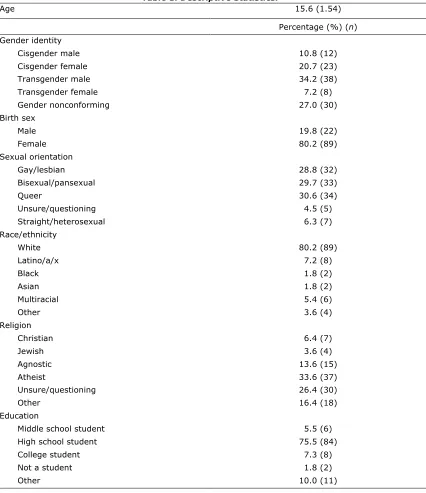
Table 1. Descriptive Statistics.
Age 15.6 (1.54)
Percentage (%) (n) Gender identity
Cisgender male 10.8 (12)
Cisgender female 20.7 (23)
Transgender male 34.2 (38)
Transgender female 7.2 (8)
Gender nonconforming 27.0 (30)
Birth sex
Male 19.8 (22)
Female 80.2 (89)
Sexual orientation
Gay/lesbian 28.8 (32)
Bisexual/pansexual 29.7 (33)
Queer 30.6 (34)
Unsure/questioning 4.5 (5)
Straight/heterosexual 6.3 (7)
Race/ethnicity
White 80.2 (89)
Latino/a/x 7.2 (8)
Black 1.8 (2)
Asian 1.8 (2)
Multiracial 5.4 (6)
Other 3.6 (4)
Religion
Christian 6.4 (7)
Jewish 3.6 (4)
Agnostic 13.6 (15)
Atheist 33.6 (37)
Unsure/questioning 26.4 (30)
Other 16.4 (18)
Education
Middle school student 5.5 (6)
High school student 75.5 (84)
College student 7.3 (8)
Not a student 1.8 (2)
Analyses
Exponential random graph models (ERGMs) were employed to analyze the hypotheses. Additional analyses included a correlational analysis using Newman’s assortativity coefficient and a visual analysis of the visualized network. ERGMs determined which factors influenced friendship formation in this network. These inferential statistical models account for dependencies in network data, allowing modeling of the probability of the existence of a tie between individuals in the network as a function of different characteristics that are both endogenous (i.e., relational features within the network that explain the structure) and exogenous (i.e., features other than relational, such as individual characteristics) to the network (Monge & Contractor, 2003). The models analyze which features significantly determine how a network was formed. Parameters are estimated using Markov chain Monte Carlo (MCMC) maximum likelihood estimation, which involves simulating a “distribution of random networks to be compared with the observed network,” and “parameter estimates are revised through the simulation process until they stabilize (i.e., converge)” (Shumate & Palazzolo, 2010 p. 353). Unlike traditional statistics, in social network analysis, samples are not obtained; instead, whole populations or groups are examined (Hanneman & Riddle, 2005). In this case, almost all campers attending the relevant program in 2017 are included in the network. MCMC estimates can be interpreted even in the case of small network sizes (Shumate & Palazzolo, 2010). The output of the models can be interpreted similarly to a logistic regression, where the features’ estimates indicate how those features influence the probability of a tie between a dyad (i.e., a connection between any two people in the network).
For this study of friendships in an LGBTQ-youth-directed network established over a short period, we included mutual ties as a structural network factor to account for a common mechanism in friendship networks, reciprocity (i.e., someone is more likely to choose another person as a close friend if also chosen by that other person). The mutual term in the ergm function (from the statnet suite of packages used in the R statistical program) was used to model reciprocity, which determines the change in a probability of a tie from person i to person j, given that there exists a tie from person j to person i. We also included a second structural network term to account for transitivity in friendship networks, where two individuals are more likely to be friends if they have at least one friend in common. The transitiveties term in the ergm function was used to model transitivity. This statistic is “the most conservative special case of the GWESP [geometrically weighted edgewise shared partners] (Hunter & Handcock, 2006) statistic” and
counts the number of ties (i, j) such that there exists at least one path of length 2 (two-path) between them—a third actor k such that yi,k = yk,j = 1. (Unlike the triangle count,
each tie may contribute at most +1 to the statistic, no matter how many such ks exist.) (Krivitsky, 2012, p. 1114)
odds of the factors predicting the existence of a tie in the network (Goodreau, Handcock, Hunter, Butts, & Morris, 2008; Hunter, Handcock, Butts, Goodreau, & Morris, 2008). To evaluate relative performance of the models examining the same outcome, we examined the Akaike information criterion (AIC; Akaike, 1998). A lower AIC relative to another AIC indicates a better model.
Additionally, to examine if youth tended to make friends with others who matched them on gender identity or cabin, we also examined Newman’s assortativity coefficient (Newman, 2003). The coefficient can range from −1 to 1, with 1 indicating perfectly assortative mixing in the network (individuals only connect with other people like themselves and do not have connections with people different from themselves on the given characteristic or measure), and −1 indicating perfectly dissortative mixing in the network (individuals only connect with other people different from themselves and do not connect with anyone like themselves on the given characteristic or measure). A coefficient of 0 indicates random mixing, where the characteristic or measure of interest does not play a role in whether people connect with one another. We also performed a two-tailed t test to determine if the estimated coefficients were significantly different from the null hypotheses (H0: the friendship network does not show homophily in terms of gender identity and/or
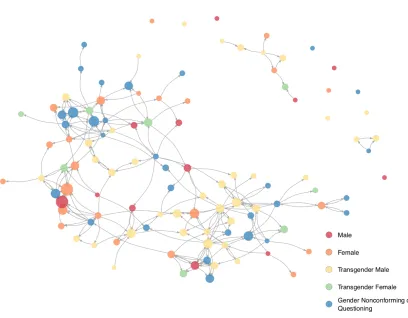
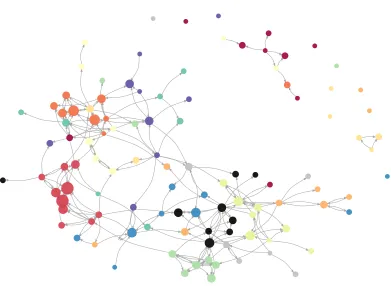
cabin assignment; r = 0). Finally, we examined the network visually by creating network visualizations highlighting gender identity and assigned cabin, respectively. The next section details the findings from these analyses.
Results
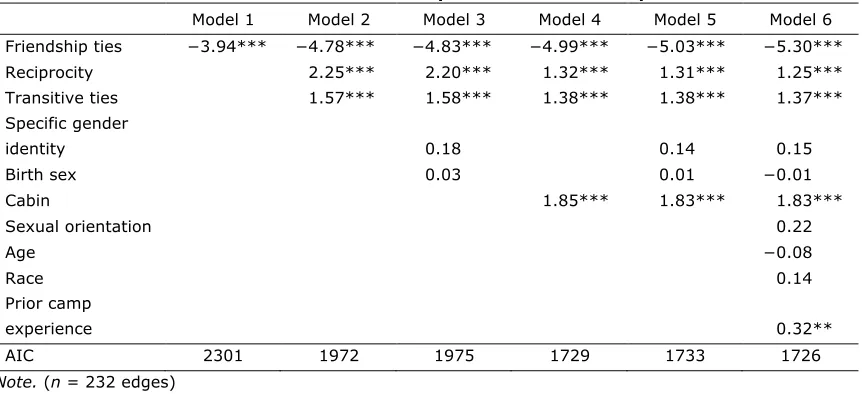
We conducted an inferential analysis of the hypotheses using ERGMs to understand which factors significantly influence the probability of a tie forming in the network. Table 2 summarizes the ERGM results, all of which were evaluated for goodness of fit (Hunter, Goodreau, & Handcock, 2008a) and to ensure that the MCMC routine behaved properly to produce the maximum likelihood estimates. See supplementary materials1 for the results of the goodness-of-fit tests of all evaluated models. Model 1 is a baseline model
that provides the baseline probability of a tie in this network, which is .019 (or 1.9% probability of a tie; equal to the overall network density), as can be calculated by taking the inverse logit of the coefficient on edges (coefficient = −3.94, p < .001) in the initial baseline model. Adding the structural terms of reciprocity and transitivity in Model 2, the baseline probability of a tie is .83% after taking the inverse logit of the parameter on friendship ties (coefficient = −4.78, p < .001). For Model 2, when a path of length two (transitivity) and a mutual tie (reciprocity) are present, the probability of a tie increases to 27.79% (transitivity coefficient = 1.57, p < .0001; reciprocity coefficient = 2.25, p < .001). Model 3 provides a model including the two theoretical factors of interest from H1, gender identity and birth sex, along with the edges, reciprocity, and transitivity terms. Neither of the two factors of interest is significant in this model (gender identity coefficient = .18, p = .10; birth sex coefficient = −.03, p = .97). Model 4 includes being housed in the same cabin as the theoretical factor of interest from H2, along with the edges, reciprocity, and transitivity terms. Matching on cabin is significant in this model (coefficient = 1.85, p < .001). The baseline probability of a tie in Model 4 is .68% (edges coefficient = −4.99, p < .001). When campers match on cabin (coefficient = 1.85, p < .001), the probability of a tie increases to 4.15%. When a path of length two (coefficient = 1.38, p < .001) and a mutual tie (coefficient = 1.32, p < .001) are present and the
campers match on cabin (all terms in the model), the probability of a tie increases to 39.30%. Model 5 includes all theoretical factors of interest in this study: matching on gender identity, birth sex, and cabin. Again, neither matching on gender identity (coefficient = .14, p = .24) nor birth sex (coefficient = .01, p = .94) is significant in this model, but matching on cabin is significant (coefficient = 1.83, p < .001). However, Model 6, which includes both theoretical and control variables, has a lower AIC than Model 5.
[image:10.612.93.524.448.645.2]Model 6 is the complete model, including all variables (both theoretically relevant and control variables) that may impact friendship tie formation and that are available from the data collected. Of the six models presented, this model has the lowest AIC term (AIC = 1726). In this model, the baseline probability of a tie is .50% (edges coefficient = −5.30, p < .001). Other than the edges, reciprocity, and transitivity coefficients, only two factors were significant: Matching on assigned cabin was significant at the p < .001 level with coefficient = 1.83, and matching on prior camp experience was significant at the p < .01 level with coefficient = .32 (p = .006). Including the cabin term, the probability of a tie increases by 6.04 times, to 3.02%. Under conditions that campers only match on prior camp experience, the probability of a friendship tie increases only to .68%, a small but significant difference. Including all significant terms (edges, reciprocity, transitivity, assigned cabin, and prior camp experience), the probability of a tie increases to 37.05%. Age was not significant when assigned cabin was included in the model because campers are assigned to the same cabin based on their age. Additionally, as with the previous models, neither gender identity nor birth sex was significant. With this full model including all relevant theoretical and control variables, we can reject the null hypothesis for H1 that assigned cabin (proximity) does not explain friendship development. As such, there is evidence that assigned cabin influences friendship formation among campers in this summer camp. However, we cannot reject the null hypothesis for H2, that gender does not explain friendship development. In other words, we do not find evidence that gender influences friendship formation in this network.
Table 2. Parameter Estimates for Exponential Random Graph Models.
Model 1 Model 2 Model 3 Model 4 Model 5 Model 6 Friendship ties −3.94*** −4.78*** −4.83*** −4.99*** −5.03*** −5.30***
Reciprocity 2.25*** 2.20*** 1.32*** 1.31*** 1.25***
Transitive ties 1.57*** 1.58*** 1.38*** 1.38*** 1.37***
Specific gender
identity 0.18 0.14 0.15
Birth sex 0.03 0.01 −0.01
Cabin 1.85*** 1.83*** 1.83***
Sexual orientation 0.22
Age −0.08
Race 0.14
Prior camp
experience 0.32**
AIC 2301 1972 1975 1729 1733 1726
Note. (n = 232 edges)
To provide further evidence of the findings, Table 3 shows Newman’s assortativity coefficients for each of the variables for the hypotheses, as well as other variables of interest, to determine if factors other than the hypothesized variables may impact friendship connections. Examining assortativity for gender identity, the coefficient, r = .06, is in the dissortative range (Fujimoto & Williams, 2015), but is not significant (p = .13). The assortativity coefficient for birth sex, r = .01, is also in the dissortative range and not significant (p = .86). Assigned cabin, however, has a significant assortativity coefficient in the assortative range (r = .50, p < .001), providing further evidence that assigned cabin played a role in the formation of this friendship network. The assortativity coefficients for race/ethnicity (r = .007, p = .83) and sexual orientation (r = .07, p = .09) are in the dissortative range and not significant. The assortativity coefficients for both prior camp experience (r = 0.41, p < .001) and age (r = .50, p < .001) are in the assortative range and significant, providing evidence that friendships in this network were more likely to occur between those of the same age and those who both had prior camp experience; this is likely because youth are organized into cabins by their age, and those who may have interacted during past summers are more likely to become friends at the current camp.
Table 3. Homophily in Friendship Nominations.
Assortativity r Error 𝜎 p value
Gender identity 0.0550 0.0366 0.1338
Birth sex 0.0117 0.0677 0.8636
Sexual orientation 0.0714 0.0421 0.0913
Race/ethnicity 0.0071 0.0341 0.8348
Age 0.5026 0.0582 0.0000***^
Prior camp experience 0.4098 0.0482 0.0000***^
Assigned cabin 0.5001 0.0352 0.0000***^
Note. ***p < 0.001. (two-tailed). ^ rounded.
Figure 1. Network visualization (nodes = 111; edges = 232) with gender identified by color and in-degree centrality identified by size.
Figure 2. Network visualization (nodes = 111; edges = 232) with cabin identified by color and in-degree centrality identified by size.
Discussion
case. Accordingly, the covariates of sexual orientation, race/ethnicity, and age were not significantly associated with friendship development, while prior camp participation had a significant effect.
The findings that gender identity and birth sex did not drive friendship development stand in contrast with previous research finding that youth and LGBTQ individuals tend to develop same-gender friendships. Additionally, the results counter the perception of segregation among LGBTQ subgroups (Roberts, Horne, & Hoyt, 2015; Talusan, 2014). While we cannot fully understand the mechanism(s) behind friendship formation for all youth in our study, findings suggest that physical proximity (i.e., being housed in the same cabin) was a driving factor. Though the group in the current study is unique, gender is an aspect of group members’ identity that is consistently communicated at camp; thus, it may be particularly salient and relevant if there were inherent preferences for developing friendships with same-gender youth. Despite this, the results show that gender preference was not a primary mechanism driving friendship formation for this group.
A number of potential explanations for the gender-related findings exist. The gender-integrated friendships may be the result of youth in this network not placing importance on gender-based similarity within friendships (Galupo & Gonzalez, 2013). It is also possible that the youth experienced exclusion or discrimination in their home environments from same-gender peers, causing them to develop more cross-gender friendships at home and thus become accustomed to such relationships (Galupo & St. John, 2001). Another explanation is that the physical environment drove friendship formation: the most likely explanation, given that the findings show that youth tended to develop friendships with their cabin mates. Prior literature has shown that individuals tend to congregate with others based on physical proximity (see Ajrouch et al., 2005; McPherson et al., 2001; Smith et al., 2014). Our findings indicate that the gender homophily found in prior research may be, at least in part, a result of social and organizational “top-down” sorting (i.e., physical division by gender and gender-differentiating practices), as opposed to a spontaneous drive or preference to befriend same-gender peers. As such, our findings provide initial evidence that gender-inclusive environments (e.g., camp and university housing and other facilities) can in fact promote friendships across a range of gender identities.
Limitations
should continue to disentangle the roles of personal preference and physical proximity, which is often confounded with gender, in the pattern of gender homophily among youth.
Additionally, the conclusions of this study pertain to close friendships that came first to mind for youth. They involve a conservative within-camp network because campers could name friends both inside and outside of camp. Future work should examine whether these findings hold if youth are only allowed to name friends within camp (or a similar context), which would generate a broader within-camp network, including peers who are not the closest camp friends. For this study, however, close friendships are important to examine because previous work has shown that strong ties are sometimes even more prone to gender homophily (Stehlé et al., 2013). Of note, though our sample is relatively small, it is consistent with the sample sizes of other studies of involving LGBTQ youth (e.g., Grossman and D’augelli, 2007, surveyed 55 transgender youth). Some campers did not respond to the friendship item in the survey, possibly resulting in minor model specification issues as indicated in the supplemental goodness-of-fit tests.2
Future work should seek to further modify model specifications to achieve the best fit possible for this unique group. Additionally, friendship networks were assessed at one time point right after camp. Thus, the durability of these friendships is not apparent from the available data. Given the short-term nature of camp (1‒2 weeks) during which youth developed friendships, it is possible that different patterns may have emerged over time for youth in the camp environment, as has been suggested by other work (Oloritun, Madan, Pentland, & Khayal, 2012). Yet, the programming examined in the current study has real-world implications. Participants reported friendships that they can (and likely do) maintain beyond the camp context. Given that many campers return for subsequent summer programming (see Table 1), the gender-integrated friendships developed at camp are likely to remain over time and in noncamp contexts. While friendship patterns may evolve in a longer camp context, the duration of the current program is representative of summer camps in general; this suggests that youth attending programs with gender-segregated housing (the majority of camps) are likely to tend to develop same-gender friendships, which may be maintained after camp and contribute to gender homophily beyond the camp context.
As previously noted, our findings suggest promising directions for future research. Work examining the psychological, social, and structural factors influencing gender homophily among youth (e.g., identity threat, cognitive need for closure, bathroom policies, housing, single-gender versus coeducational schools) could inform gender-related policies. We reiterate the call of Martin-Storey, Cheadle, Skalamera, and Crosnoe (2015) for more work that helps to isolate “what matters and why” regarding structural features influencing the social experiences of youth. As the authors note, “Unpacking how homophily works and why is a potentially fruitful area for future developmental research” (p. 972). Finally, this study suggests the usefulness of experimental studies randomly assigning youth to gender-segregated and gender-inclusive conditions to test the effects of gendered spaces, practices, and related cues on peer selection and other attitudes and behaviors.
Practice Implications
The results of this study have practical and theoretical implications. The findings that youth’s friendship patterns were not driven by gender identity or birth sex, but were influenced by the cabin in
which campers lived, suggest the power of gender-inclusive spaces to encourage communication across gender identities and the subsequent integration of friendship networks. Youth in the study were assigned to cabins in which campers represented many gender identities. Their subsequent friendship networks emerging from this setting reflected a tendency to be friends with cabin mates, not people of their same gender identity. This suggests that, had campers been assigned to a cabin based on their gender (i.e., to single-gender cabins), they would have developed more friendships with same-gender peers. Our findings indicate that physically segregating young people along a male–female gender binary has implications for socialization and subsequent friendship formation. Policy makers, administrators, and other decision makers should consider how gendered spaces, such as housing, bathrooms, extracurricular activities, and the like, affect the opportunities young people have to develop friendships with their peers. More broadly, our findings illustrate how opportunities to socialize with individuals representing diverse identities, even in the short term, matter. Creating spaces that promote intergroup contact, without forcing people into relationships, can help people avoid the usual fallbacks of seeking out “similar others.” This may be particularly important for youth, because their early relationships can influence the course of their lives.
Friendships influence critical aspects of youth’s lives. They confer social status (Crosnoe & Benner, 2015) and can determine access to resources and information (McPherson et al., 2001). Through communication and peer influence, friendships can affect youth’s identity development, health, and academic achievement (Brechwald & Prinstein, 2011). Friendships and patterns established early in life often carry on into adulthood, influencing personal and professional outcomes. A vast literature on gender bias, including the impact of certain identities (e.g., male) accruing power and privilege, exists (e.g., Buday, 2012; Eagly & Chin, 2010). Spain (1993) found that the more pronounced the degree of spatial gender segregation in a location, the lower women’s status compared with men’s. Recently, Bogle (2017) used social network analysis to demonstrate the tendency for male researchers to collaborate with other males in a network of Australian scholars, effectively reducing the professional opportunities for female researchers. Given that new technologies have made network data more readily available in many cases, social network analysis represents a promising method for interrogating systematic inequality.
References
Ajrouch, K. J., Blandon, A. Y., & Antonucci, T. C. (2005). Social networks among men and women: The effects of age and socioeconomic status. The Journals of Gerontology Series B: Psychological Sciences and Social Sciences, 60(6), S311–S317. https://doi.org.10.1093/geronb/60.6.S311
Akaike, H. (1998). Information theory and an extension of the maximum likelihood principle. In Selected papers of Hirotugu Akaike (pp. 199‒213). New York, NY: Springer. https://doi.org/10.1007/978-1-4612-1694-0_15
Associated Press. (2016, January 25). Transgender athletes can now compete in the Olympics without surgery. The New York Times. Retrieved from https://www.nytimes.com/2016/01/26/sports/ olympics/transgender-athletes-olympics-ioc.html
Associated Press. (2018, August 19). A Kansas City school district is embracing gender-neutral
bathrooms. TIME/Yahoo!. https://www.yahoo.com/news/kansas-city-school-district-embracing-024744634.html
Bianchi, B. D., & Bakeman, R. (1978). Sex-typed affiliation preferences observed in preschoolers: Traditional and open school differences. Child Development, 910–912.
Bogle, A. (2017, November 24). Australian research “has a Daversity problem”: Analysis shows too many men work mostly with other men. ABC. Retrieved from http://www.abc.net.au/news/science/ 2017-11-24/australian-research-has-a-daversity-problem/9178786
Borgatti, S. P., Brass, D. J., & Halgin, D. S. (2014). Social network research: Confusions, criticisms, and controversies. In D. J. Brass, G. Labianca, A. Mehra, D. S. Halgin, & S. P. Borgatti (Eds.), Contemporary perspectives on organizational social networks (pp. 1–29). Bingley, UK: Emerald Group.
Borgatti, S. P., & Cross, R. (2003). A relational view of information seeking and learning in social networks. Management Science, 49(4), 432–445. doi:10.1287/mnsc.49.4.432.14428
Brechwald, W. A., & Prinstein, M. J. (2011). Beyond homophily: A decade of advances in understanding peer influence processes. Journal of Research on Adolescence, 21(1), 166–179.
https://doi.org/10.1111/j.1532-7795.2010.00721.x
Browne, L. P., Gillard, A., & Garst, B. A. (2019). Camp as an institution of socialization: Past, present, and future. Journal of Experiential Education, 42(1), 51–64.
https://doi.org/10.1177/1053825918820369
Burke, R. A., & Fuqua, D. R. (1987). Sex differences in same-and cross-sex supportive relationships. Sex Roles, 17(5), 339–352.
Crosnoe, R., & Benner, A. D. (2015). Children at school. In R.M. Lerner (Ed.), Handbook of child psychology and developmental science: Vol. 4. Ecological settings and processes (7th ed., pp. 268–304). Hoboken, NJ: Wiley.
Diamond, L. M., & Dubé, E. M. (2002). Friendship and attachment among heterosexual and sexual-minority youths: Does the gender of your friend matter? Journal of Youth and Adolescence, 31(2), 155–166. doi:10.1023/A:1014026111486
Dumville, J. C., Torgerson, D. J., & Hewitt, C. E. (2006). Reporting attrition in randomised controlled trials. British Medical Journal, 332(7547), 969–971. doi:10.1136/bmj.332.7547.969
Eagly, A. H., & Chin, J. L. (2010). Diversity and leadership in a changing world. American Psychologist, 65, 216–234. doi:10.1037/a0018957
Fine, C., & Elgar, M. A. (2017). Promiscuous men, chaste women, and other gender myths. Scientific American. Retrieved from https://www.scientificamerican.com/magazine/sa/2017/09-01/?WT.ac=SA_SA_CurrentIssue
Fujimoto, K., & Williams, M. L. (2015). Racial/ethnic differences in sexual network mixing: A log-linear analysis of HIV status by partnership and sexual behavior among most at-risk MSM. AIDS and Behavior, 19(6), 996–1004. doi:10.1007/s10461-014-0842-8
Galupo, M. P. (2007). Friendship patterns of sexual minority individuals in adulthood. Journal of Social and Personal Relationships, 24(1), 139–151. doi:10.1177/0265407506070480
Galupo, M. P., & Gonzalez, K. A. (2013). Friendship values and cross-category friendships: Understanding adult friendship patterns across gender, sexual orientation and race. Sex Roles, 68(11–12), 779–790. doi:10.1007/s11199-012-0211-x
Galupo, M. P., & St. John, S. (2001). Benefits of cross-sexual orientation friendships among adolescent females. Journal of Adolescence, 24, 83–93. doi:10.1006/jado.2000.0364
Gillard, A., Buzuvis, E. E., & Bialeschki, M. D. (2014). Supporting transgender and gender nonconforming youth at summer camp. Journal of Park & Recreation Administration, 32(3), 92–105.
Gillig, T. K., Rosenthal, E. L., Murphy, S. T., & Folb, K. (2018). More than a media moment: The influence of televised storylines on viewers’ attitudes toward transgender people and policies. Sex Roles, 78(7–8), 515–527. doi:10.1007/s11199-017-0816-1
Godley, J. (2008). Preference or propinquity? The relative contribution of selection and opportunity to friendship homophily in college. Connections, 1(1), 65–80.
Goodreau, S. M., Handcock, M. S., Hunter, D. R., Butts, C. T., & Morris, M. (2008). A statnet tutorial. Journal of Statistical Software, 24(9), 1–27.
Grossman, A. H., & D'augelli, A. R. (2007). Transgender youth and life-threatening behaviors. Suicide and Life-Threatening Behavior, 37(5), 527–537. doi:10.1521/suli.2007.37.5.527
Hall, G. S. (1904). Adolescence (Vols. 1 & 2). New York, NY: D. Appleton & Company.
Hanneman, R. A., & Riddle, M. (2005). Introduction to social network methods. University of California, Riverside. Retrieved from http://faculty.ucr.edu/~hanneman/
Henig, R. M. (2017, January). How science is helping us understand gender. National Geographic
Magazine. Retrieved from https://www.nationalgeographic.com/magazine/2017/01/how-science-helps-us-understand-gender-identity/
Huang, Y., Shen, C., & Contractor, N. S. (2013). Distance matters: Exploring proximity and homophily in virtual world networks. Decision Support Systems, 55(4), 969–977.
http://dx.doi.org/10.1016/j.dss.2013.01.006
Hunter, D. R., Goodreau, S. M., & Handcock, M. S. (2008). Goodness of fit of social network models. Journal of the American Statistical Association, 103(481), 248–258.
doi:10.1198/016214507000000446
Hunter, D. R., & Handcock, M. S. (2006). Inference in curved exponential family models for networks. Journal of Computational and Graphical Statistics, 15(3), 565–583. doi:10.1198/106186006X133069
Hunter, D. R., Handcock, M. S., Butts, C. T., Goodreau, S. M., & Morris, M. (2008). ergm: A package to fit, simulate and diagnose exponential-family models for networks. Journal of Statistical Software, 24(3), 1–29.
Hyde, J. S. (2005). The gender similarities hypothesis. American Psychologist, 60(6), 581–592. doi:10.1037/0003-066X.60.6.581
Jones, D. C., Bloys, N., & Wood, M. (1990). Sex roles and friendship patterns. Sex Roles, 23(3–4), 133–145.
Kandel, D. B. (1978). Homophily, selection, and socialization in adolescent friendships. American Journal of Sociology, 84(2), 427–436.
Krivitsky, P. N. (2012). Exponential-family random graph models for valued networks. Electronic Journal of Statistics, 6, 1100–1128. doi:10.1214/12-EJS696
Laursen, B., & Williams, V. A. (1997). Perceptions of interdependence and closeness in family and peer relationships among adolescents with and without romantic partners. New Directions for Child and Adolescent Development, 78, 3–20.
Logan, L. S. (2013). Status homophily, sexual identity, and lesbian social ties. Journal of Homosexuality, 60(10), 1494–1519. doi:10.1080/00918369.2013.819244
Maccoby, E. E. (2003). The two sexes: Growing up apart, coming together (Vol. 5). Cambridge, MA: Harvard University Press.
Maccoby, E., & Jacklin, C. N. (1987). Gender segregation in childhood. Advances in Child Development and Behavior, 20, 239–287. https://doi.org/10.1016/S0065-2407(08)60404-8
Martin-Storey, A., Cheadle, J. E., Skalamera, J., & Crosnoe, R. (2015). Exploring the social integration of sexual minority youth across high school contexts. Child Development, 86(3), 965–975. doi:10.1111/cdev.12352
McPherson, J. M., & Smith-Lovin, L. (1987). Homophily in voluntary organizations: Status distance and the composition of face-to-face groups. American Sociological Review, 52(3) 370–379.
McPherson, M., Smith-Lovin, L., & Cook, J. M. (2001). Birds of a feather: Homophily in social networks. Annual Review of Sociology, 27(1), 415–444. doi:10.1146/annurev.soc.27.1.415
Mehta, C. M., & Strough, J. (2009). Sex segregation in friendships and normative contexts across the life span. Developmental Review, 29(3), 201–220. doi:10.1016/j.dr.2009.06.001
Monge, P. R., & Contractor, N. S. (2003). Theories of communication networks. Oxford, UK: Oxford University Press.
Moñtanez, A. (2017). Beyond XX and XY. Scientific American. Retrieved from
Newman, M. E. (2003). Mixing patterns in networks. Physical Review, 67(2), 026126. http://dx.doi.org/10.1103/PhysRevE.67.026126
Ognyanova, K. (2019) Network visualization with R. Retrieved from http://www.kateto.net/network-visualization
Oloritun, R. O., Madan, A., Pentland, A., & Khayal, I. (2012, December). Evolution of social encounters in ad-hoc mobile face-to-face interaction networks. In Proceedings of 2012 International Conference on Social Informatics (pp. 192–198). Piscataway, NJ: IEEE.
doi:10.1109/SocialInformatics.2012.101
Parker, K., Graf, N., & Igielnik, R. (2019, January 17). Generation Z looks a lot like millennials on key social and political issues. Pew Research Center. Retrieved from http://www.pewsocialtrends.org/ 2019/01/17/generation-z-looks-a-lot-like-millennials-on-key-social-and-political-issues/
Roberts, T. S., Horne, S. G., & Hoyt, W. T. (2015). Between a gay and a straight place: Bisexual individuals’ experiences with monosexism. Journal of Bisexuality, 15(4), 554–569. http://dx.doi.org/10.1080/15299716.2015.1111183
Rothenberg, R. B. (1995). Commentary: Sampling in social networks. Connections, 18(1), 104–110.
Ruef, M., Aldrich, H. E., & Carter, N. M. (2003). The structure of founding teams: Homophily, strong ties, and isolation among U.S. entrepreneurs. American Sociological Review. Advance online
publication. doi:10.1177/000312240406900208
Safdar, K. (2016). Target adds private bathrooms to quell transgender debate. Wall Street Journal. Retrieved from https://www.wsj.com/articles/target-to-spend-20-million-to-roll-out-private-bathrooms-to-all-stores-1471453630
Shrum, W., Cheek, N. H., & Hunter, S. M. (1988). Friendship in school: Gender and racial homophily. Sociology of Education, 61(4), 227–239. http://dx.doi.org/10.2307/2112441
Shumate, M., & Palazzolo, E. T. (2010). Exponential random graph (p*) models as a method for social network analysis in communication research. Communication Methods and Measures, 4(4), 341–371. doi:10.1080/19312458.2010.527869
Smith, J. A., McPherson, M., & Smith-Lovin, L. (2014). Social distance in the United States: Sex, race, religion, age, and education homophily among confidants, 1985 to 2004. American Sociological Review, 79(3), 432–456. doi:10.1177/0003122414531776
Stehlé, J., Charbonnier, F., Picard, T., Cattuto, C., & Barrat, A. (2013). Gender homophily from spatial behavior in a primary school: A sociometric study. Social Networks, 35(4), 604–613.
https://doi.org/10.1016/j.socnet.2013.08.003
Steinmetz, K. (2014, May 29). The transgender tipping point. TIME. Retrieved from http://time.com/magazine/us/135460/june-9th-2014-vol-183-no-22-u-s/
Talusan, M. (2014, June 24). 45 years after Stonewall, the LGBT movement has a transphobia problem. The American Prospect. Retrieved from http://prospect.org/article/45-years-after-stonewall-lgbt-movement-has-transphobia-problem