Modern Journal of Language Teaching Methods (MJLTM)
ISSN: 2251-6204
Modern Journal of Language Teaching Methods (MJLTM)
ISSN: 2251-6204
Modern Journal of Language Teaching Methods (MJLTM)
ISSN: 2251 - 6204
www.mjltm.com
Editor – in – Chief
Hamed Ghaemi, Assistant Professor in TEFL, Islamic Azad University (IAU)
Editorial Board:
1.
Abednia Arman, PhD in TEFL, Allameh Tabataba’i University, Tehran, Iran
2.
Afraz Shahram, PhD in TEFL, Islamic Azad University, Qeshm Branch, Iran
3.
Amiri Mehrdad, PhD in TEFL, Islamic Azad University, Science and research
Branch, Iran
4.
Azizi Masoud, PhD in Applied Linguistics, University of Tehran, Iran
5.
Basiroo Reza, PhD in TEFL, Islamic Azad University, Bushehr Branch, Iran
6.
Dlayedwa Ntombizodwa, Lecturer, University of the Western Cape, South Africa
7.
Doro Katalin, PhD in Applied Linguistics, Department of English Language Teacher
Education and Applied Linguistics, University of Szeged, Hungary
8.
Dutta Hemanga, Assistant Professor of Linguistics, The English and Foreign
Languages University (EFLU), India
9.
Elahi Shirvan Majid, PhD in TEFL, Ferdowsi University of Mashhad, Iran
10.
Fernández Miguel, PhD, Chicago State University, USA
11. Ghaemi Hamide, PhD in Speech and Language Pathology, Mashhad University of
Medical Sciences, Iran
12.
Ghafournia Narjes, PhD in TEFL, Islamic Azad University, Neyshabur Branch, Iran
13. Grim Frédérique M. A., Associate Professor of French, Colorado State University,
USA
14. Izadi Dariush, PhD in Applied Linguistics, Macquarie University, Sydney, Australia
15. Kargozari Hamid Reza, PhD in TEFL, Payame Noor University of Tehran, Iran
16.
Kaviani Amir, Assistant Professor at Zayed University, UAE
17. Kirkpatrick Robert, Assistant Professor of Applied Linguistics, Shinawatra
International University, Thailand
18.
Mehrani Mehdi, PhD in TEFL, University of Neyshabur, Neyshabur, Iran
19. Morady Moghaddam Mostafa, PhD in TEFL, University of Tabriz, Iran
20. Mouton Nelda, PhD in Education Management, North-West University
(NWU), South Africa
21. Najafi Sarem Saeid, PhD Candidate in TEFL, Islamic Azad University, Science and
Research Branch, Tehran, Iran
Modern Journal of Language Teaching Methods (MJLTM)
ISSN: 2251-6204
22. Naicker Suren, Department of Linguistics and Translation, University of South
Africa
23. Ndhlovu Finex, PhD, Linguistics Programme, University of New England, Australia
24.
Raddaoui Ali Hechemi, PhD, Associate Professor of Applied Linguistics, University
of Wyoming in Laramie, USA
25. Rezaei Saeed, PhD in TEFL, Sharif University of Technology, Tehran, Iran
26.
Rolstad Kellie, PhD, Associate Professor of Education, University of Maryland, USA
27. Roohbakhshfar Hamid, PhD in TESOL, Islamic Azad University, Neyshabur Branch,
Iran
28.
Sanatifar Mohammad Saleh, PhD in Translation Studies, Tabaran Institute of Higher
Education, Mashhad, Iran.
29.
Shafiee Sajad, Department of English, Shahrekord Branch, Islamic Azad University,
Shahrekord, Iran
30. Stobart Simon, PhD, Dean of Computing, Teesside University, UK
31.
Suszczynska Malgorzata, Senior Assistant Professor, University of Szeged, Hungary
32. Tabeifard Sayed Javad, PhD in ELT, University of Tehran, Kish International
Campus, Iran
33. Weir George R. S., PhD in Philosophy of Psychology, University of Strathclyde,
Glasgow, UK
34.
Zabihi Reza, PhD in TEFL, University of Neyshabur, Neyshabur, Iran
35. Zegarac Vladimir, PhD, University of Bedfordshire, UK
Modern Journal of Language Teaching Methods (MJLTM)
ISSN: 2251-6204
Abstracting/Indexing
Index
Copernicus 2011
Linguistics Abstract
EBSCO Publication
Modern Journal of Language Teaching Methods (MJLTM)
ISSN: 2251-6204
Lulu Publication
Directory of Open Access Journals
ProQuest
Modern Language Association
Cabell's Directories
Modern Journal of Language Teaching Methods (MJLTM)
ISSN: 2251-6204
COPE
Directory of Research Journal Indexing (DRJI)
Indian Citation Index
International Society of Universal Research in Sciences
Modern Journal of Language Teaching Methods (MJLTM)
ISSN: 2251-6204
J-Gate
Ulrich's
Modern Journal of Language Teaching Methods (MJLTM)
ISSN: 2251-6204
TABLE OF CONTENTS
INNOVATIVE METHODS OF FOREIGN LANGUAGES TEACHING
Akzhan Abdyhalykova
THE EFFECT OF COLLABORATIVE PRACTICE THROUGH WORDLES ON EFL
LEARNERS’ WRITING ACCURACY IN COMPOSING DISCURSIVE TEXTS
Ali Gholami Mehrdad
Seyed Mohammad Alavi
Mohammad Khatib
REPRESENTATION VOCABULARY IN IRANIAN JUNIOR HIGH SCHOOL ENGLISH
TEXTBOOK: A SURVEY STUDY AMONG IRANIAN HIGH SCHOOL TEACHERS
Fatemeh Aliniya
Marjan Heidarpour
EFFECTS OF TEACHING STRATEGIES AND TOPIC FAMILIARITY ON PERSIAN
SPEAKING IELTS CANDIDATES’ SPEAKING SCORES
Ahmad Ameri-Golestan
THE EFFECT OF ONLINE DYNAMIC ASSESSMENT OF UNIVERSITY STUDENTS’
WRITING ELECTRONIC PORTFOLIOS ON MICRO-COMPONENTIAL WRITING
ABILITY
Seyed Mohammad Reza Amirian
Mortaza Bonjakhi
Asghar Moulavi Nafchi
THE EFFECTS OF FLOOR-LEVEL SCORES AND CEILING-LEVEL SCORES ON
RESEARCH FINDINGS IN SECOND LANGUAGE STUDIES
Loghman Ansarian
Hadis Beheshti
Mohammad Ramezani
THE EFFECT OF LISTENING TO COMIC STRIP STORIES ON INCIDENTAL
VOCABULARY LEARNING AMONG IRANIAN EFL LEARNERS
Omid Arast
Bahman Gorjian
A STUDY OF TECHNOLOGICAL PEDAGOGICAL KNOWLEDGE (TPK) AMONG
UNIVERSITY ENGLISH LANGUAGE INSTRUCTORS: A CASE STUDY OF GUILAN
UNIVERSITIES INSTRUCTORS
Masoumeh Ghavidel Atashgahi
Ghasem Aghajanzadeh Kiasi
Majid Pourmohammadi
AUTHORIAL IDENTITY PRESENCE: THE CASE OF HEALTH SCIENCES AND LIFE
SCIENCES
Simin Attarzadeh
Ali A. Khansir
ELT EVALUATION: THE ISSUE OF IN-COMPANY ENGLISH TRAINING IN
TUNISIA
Zeineb Ayachi
Modern Journal of Language Teaching Methods (MJLTM)
ISSN: 2251-6204
THE IMPACT OF TEXT ANALYSIS TASKS ON IRANIAN EFL LEARNERS’
PARAGRAPH WRITING ABILITY
Zaynab Bagheri ziyabari
Davood Taghipour Bazargani
Majid Pourmohammadi
FIRST LANGUAGE TRANSFER AND UG-BASED MODELS OF SLA
Masoumeh Benshams
Firooz Sadighi
EXPLICIT VS IMPLICIT INSTRUCTION OF LEXICAL LEARNING STRATEGIES FOR
IMPROVING L2 LEXICAL DEVELOPMENT OF ADULTS AND YOUNG ADULTS
IRANIAN EFL LEARNERS
Reza Biria
Naser khodaeian
THE COMPARATIVE STUDY OF WOMAN CHARACTERS IN HNEINRICH BOLL
AND JALAL AL-E AHMAD
Parmis Borhanjoo
Masoud Salami*
THE ATTITUDES OF ALTERNATIVE LEARNING SYSTEM LEARNERS TOWARD
ENGLISH LANGUAGE LEARNING
Jane Charity A. Estrada
EFFECT OF COLLABORATIVE TRANSLATION TASKS ON LOW INTERMEDIATE
IRANIAN EFL LEARNER’S LISTENING COMPREHENSION
Elham Dashtian
Fatemeh Behjat
Ali Asghar Kargar
THE EFFECT OF LEXICAL INFERENCING ON THE VOCABULARY LEARNING AND
READING COMPREHENSION OF IRANIAN INTERMEDIATE EFL LEARNERS
Mohammad Davoudi
Rokhsareh Ghorbani Moghadam
Asghar Moulavi Nafchi
IN SEARCH OF A UNIFIED CONCEPTUALIZATION OF LANGUAGE TEACHERS’
KNOWLEDGE – BASE: FANTASY OR REALITY?
Hadi Eal
THE IMPLEMENTATION OF COMMUNICATIVE LANGUAGE TEACHING (CLT) IN
AN EFL CONTEXT: A CASE STUDY OF LEARNERS' ATTITUDES AND
PERCEPTIONS
Ekrem Eroz
Azamat A. Akbarov
THE DELAYED EFFECTS OF FOCUSED AND UNFOCUSED WRITTEN CORRECTIVE FEEDB
ACK ON USE OF FUTURE PERFECT TENSE BY IRANIAN EFL LEARNERS
Fatemeh Ali fallah
Ali GholamiMehrdad
Seyed Darush Ahmadi
Modern Journal of Language Teaching Methods (MJLTM)
ISSN: 2251-6204
THE ROLE OF TEACHERS’ AWARENESS OF LEARNERS’ LEARNING STYLES IN
IRANIAN EFL LEARNERS’ VOCABULARY GAINS
Ali Soltani
and Yalda Rajabioon
THE STUDY OF IRANIAN EFL LEARNERS’ READING COMPREHENSION ABILITY
DURING EMERGING ADULTHOOD PERIOD FROM THE PERSPECTIVE OF
GENDER DIFFERENCES IN INTERPERSONAL IDENTITY STATUSES
Rana Shahriari and Ali Soltani
Modern Journal of Language Teaching Methods (MJLTM)
ISSN: 2251-6204
INNOVATIVE METHODS OF FOREIGN LANGUAGES
TEACHING
Akzhan Abdyhalykova
Kazakh University of Economy, Finance and International Trade 010005, Republic of Kazakhstan, Almaty, Ahmet Zhubanov Street 7
Email: [email protected]
ABSTRACT
In this article reviewed innovative methods of foreign languages teaching and different techniques used in the teaching process. Actual materials reflect the history of pedagogy since ancient times to its modern state. Extracts from the works of Russian and foreign specialists let us know the main trends of development, the formation of new directions in the methodology of foreign languages teaching. The main goal is to introduce innovative methodological techniques.
Keywords: educational process, foreign language learning, modernization, communication activities, innovative methods
Introduction
In modern society foreign languages is becoming an essential component of professional training. Experts in different fields interested in a high level of language proficiency, because it affects the successful solution of issues and professional growth. In many areas there is a need to establish contacts with foreign partners. School would provide a basic set of knowledge that will help to study foreign language in higher educational institutions, training courses or independently. Today, there is a large set of training materials for people with different levels of language knowledge.
The success and the achievement of this goal depend on the applied methods and teacher qualifications. The ability to use information technology and modern teaching methods contributes to the rapid understanding of new material. By combining different techniques, teacher will be able to solve specific educational programs. With this in mind, teachers and students should be familiar with modern methods of foreign languages teaching. They further can choose the most effective techniques to achieve their goal.
Methods and approaches of foreign languages teaching
According to scientific calculations of national and foreign scientists, the term "method" has two basic meanings:
A certain path to the goal, means to achieve the result.
Complete methodological system and the fundamental direction of the learning process, which
prevail in the various periods of the science development.
Modern stage is characterized by careful selection of methods of foreign languages teaching. Particular emphasis today is made on modern information technology and actual trends. There is a sort of selection of the most effective methods, techniques and tools during the preparation of specialists in various fields. The most important goal, according to scientists - is the formation of a secondary language personality. Students must take a new language to a fundamentally new level. To do this, it is important to separate it from the mother tongue, in order to avoid errors in perception.
During selection of innovative methods following criteria taken into account:
Creating a comfortable and supportive atmosphere for student, promotion of natural interest and
desire to learn a new foreign language.
Modern Journal of Language Teaching Methods (MJLTM)
ISSN: 2251-6204
Involvement of emotions, feelings, experiences in the educational process to stimulate verbal, written
and creative abilities.
Use of the cognitive approach in the educational process.
Call to work with the language on their own at the level of emotional and physical capabilities.
Various forms of work will help to achieve these goals. Practical experience allows concluding that the personality and interests of the student directly affects the quality of foreign language understanding. To do this, it is important to use a variety of techniques and learning tools.
By the end of the 20th century in pedagogy has accumulated a lot of interesting and effective methods and approaches. Scientists have enriched the methodology of foreign languages teaching, so it has become complex and multifaceted science.
Humanistic approach
In 1960-1970 formed a humanistic approach to learning. According to it, the learning process is guided directly to the individuality of the student. Bringing his interests and needs contribute to a more rapid studying of foreign languages. Creating game situations, taking into account the individual characteristics of a person stronger involve him in the process. In humanistic approach personality of the teacher becomes less important, although still important enough.
The humanistic approach has led to the formation of a number of alternative methods of learning. Their aim was to study a foreign language, the formation of speaking and writing skills. These unconventional methods include:
Reliance on physical actions.
The method of "community".
"Quiet learning".
Neuro-linguistic programming.
Some techniques have proved their worth and have survived. The pedagogy adopted combined various methods to increase the efficiency of the learning process.
Communicative approach
With the development of high-tech usual methods of teaching through books, similar grammar exercises, reading and translation of texts go on the back burner. The humanistic approach eventually led to the formation of the communicative approach, on which is based the whole procedure.
Traditional grammar-translation methods do not form language skills. The student is capable to read and translate various textsat high-level, but he is not able to apply the knowledge of a foreign language in real life situations. The communicative approach allows the use of grammatical knowledge in a form of speaking and writing skills.
One of the key tasks is the enriching of vocabulary. However, new words must be stored not only in a passive, but also in active form. In other words, the student must not only know the translation of a word, but should be able to use it in speech or in writing of own texts.
As a simple exercise to develop skills can be noted spontaneous group dialogues. Students are divided into pairs and try to communicate on various topics. Usually the teacher oversees the conversation or helping with leading questions.
During learning of new words used exercises with cards. On them written new words, and then they are turned and mixed. One student draws a card and tries to explain the meaning of a foreign word so the others can guess it. This exercise allows you to "feel" new words and remember situations in which they are used correctly.
At a certain stage of development can be implemented into the learning process different movies in a foreign language. Students are asked questions, the answers to which should be identified directly from watched videos.
Within the communicative approach there is almost no simple reading and translation of texts. Most often, teachers organize some group discussion. One of the options - a creative answers to questions about the material covered.
Teachers are moving away from the traditional grammar and translation exercises. They use a variety of techniques and combine them with each other to achieve the desired result. Students use grammar knowledge to form conversational skills. Exercises involve listening, reading, writing, and so on.
Modern Journal of Language Teaching Methods (MJLTM)
ISSN: 2251-6204
Culturological approach
When you create a methodical system of teaching a foreign language is often taken into account culturological approach. Its main objective is the formation of intercultural competence. On this based particular model of learning and key principles. The teacher may choose a set of exercises, taking into account the task.
The described method is based on the principles of private teaching, describing culturological direction of foreign language learning.
Experts identify the following principles:
Verbal orientation of training.
Taking into account characteristics of speech activity in a foreign language.
Modeling a situation of intercultural communication in the learning process.
Taking into account consciousness and modularity.
Rational use of native and foreign language.
Taking into account personal needs of students.
The desire for systematicity in the preparation of exercise set.
Exercises of verbal and conditionally verbal nature are always have bigger priorities. This is evidenced by the principle of the speech focus of the learning process in the culturological approach. Through this we can form intercultural communication skills.
In the modern methods of foreign language teaching accepted division into vocabulary, spelling, phonetics, grammar, speech, language, receptive and productive skills. However, the practical goal of learning still amounts directly to the ability to maintain intercultural communication.
An important role played the principle of exercise adequacy. They are designed to simulate situations for intercultural training. To do this, you must consider the culture, values, communication intentions and expectations, as well as background knowledge. The teacher should select tasks, taking into account various aspects, so students will be able to participate in intercultural communication at various levels.
The possible exercise could be dialogue between students, discussing various texts and films, comparing features of native culture and the target language culture. Simulation of different situations allows you to expand your language skills and train your speaking skills.
Problem approach
In the area of improving the efficiency and effectiveness of the training studies conducted continuously. One of the key areas - a problem-based learning, affecting the development of various aspects of a foreign language. Experts are looking for means to solve the problem tasks - development of cognitive activity, including in the work of all mental powers, stimulating creativity and independence.
Pedagogy has concluded that the student should not be simply a passive object, perceiving the information, but a full participant in the process. Problem learning today refers to innovative methods of foreign languages teaching. It acts as a mean for skills self-development and students' thinking.
The specific of the problem approach to learning is the involvement of students in the process by which they make their own specific findings, get new knowledge, it is the next stage of learning. They make assumptions and arguments in favor of certain conclusions, not just learn information provided. Thus, problem-based learning stimulates self-reliance and contributes to the formation of skills of teaching and research activities. Teachers who use the problem approach in training should pay attention to the systematic development of independent work of students in the group. The main goal is to help them to get knowledge by themselves. Development of creative imagination, speculations and attention to detail help in further training.
The main aspects of this method:
The development of logical, creative and dialectical thinking.
The conversion of conventional training material in a more demonstrative.
Regular working of problematic situations.
Creation of a training system.
The main varieties of problematic situations are pedagogical and psychological. They are appearing at all stages of education, affecting both the activities of students and the learning process itself. The teacher creates a problematic situation for the development, consolidation and control of acquired knowledge.
Objectives for creation of problematic situations:
Motivation to the theoretical explanation of the various facts.
An analysis of life situations with a detailed analysis.
Independent search of practical application of knowledge.
Modern Journal of Language Teaching Methods (MJLTM)
ISSN: 2251-6204
Motivation to generalize, and comparison of new facts.
In practice it is used in various ways. The teacher creates a problematic situation that students subsequently study. They are looking for contradictions, new information and facts. After this, they have independent work on the systematization and analysis.
It can be concluded that in the problem approach students face different tasks that leads to self-discoveries.
Examples of innovative methods of foreign languages teaching Problem method.
For several decades in education system dominated mainly training with an authoritarian approach. As a result, students played the role of passive objects, which rarely take the initiative. Currently at the forefront there is personality-oriented education designed to change the situation and to involve students in the process.
Problematic method allows to develop in a person the necessary qualities for being an independent person. Through this the process of learning a foreign language goes more effectively.
Leading didacticians identify several basic ways of organizing the learning process using the problem method. They are based on certain activities emerging in the forefront:
monologic;
dialogic;
research;
reasoning;
heuristic;
programmed.
Most often, students are given a new text in which there is a new vocabulary and unknown information. As a monologic activity they write a story or essay, where express their opinions and produce new facts.
Dialogic activity involves the construction of a dialogue between teacher and students, who have to answer questions. For this used information from the new text.
The next stage of study is thinking activity. Students write the presentation, which make certain conclusions. This allows to check logic and reasoning, as well as the correct understanding of the text as a whole.
Heuristic tasks is a special form of activity in which students themselves must do some sort of discovery of a new rule or law. For example, they can identify the particular use of the verb or time in text.
Research tasks is a higher level of performance. Students are required to independently uncover new phenomena and essence. As a specific form of organization of classes, you can choose the experiment, reports, simulations, surveys, data collection, analysis of the facts, and so on.
Subsequently, to secure the teacher can use a programmable tasks. Teacher makes exercise so that this knowledge can be used and new rules can be trained.
Modeling a lesson with the problem method
Subject: Environment.
Targets and objectives: the development of language competence and critical thinking, the formation of a responsible approach to team targets.
1. Organizational stage.
Welcome words and opening remarks of the teacher. A brief introduction to the key environmental issues. The call for reading a new text and discussion of new information in the classroom.
2. Preparing students for independent and informed understanding of the material (updating of knowledge). Suggesting students to name the causes of negative impact on the environment, to find the relationship between the industry and the economy.
3. Formation of skills and abilities.
Text reading, identifying of new vocabulary, re-reading with comprehension, making certain conclusions about environmental issues. Grammatical analysis of sentences. Translation. \
4. Summarizing.
In this lesson, the usual reading and working with new words mixed with dialogues and arguments, thereby realized problematic approach. As an exercise you can give making a report or an essay about environmental issues.
Modern Journal of Language Teaching Methods (MJLTM)
ISSN: 2251-6204
Communicative approach
The act of communication is the main unit of communication activities that play an important role in the development of foreign languages. The student must be able to communicate in a new language. In the training needs to be given enough attention to the formation of speech skills and development of communicative competence.
Communication is always accompanied by a number of conditions to ensure the adequacy of:
the individual characteristics of each person;
speech focus;
functionality;
contextuality;
novelty.
Subject to these conditions, we can talk about communication. Otherwise, the feasibility of communication will be open to questioning. In learning these issues need to be addressed.
Development of lexical speaking skills performed using specific exercises. E.I. Passov and other scientists spoke about the appropriateness of conditional speech exercises. They can be divided into several subspecies:
imitative (expression of thought on the model);
substitution (selection of appropriate statements within the meaning);
transformation (change replicas to transfer other information);
self-reproductive (student independently makes suggestions for statements).
Students gradually pass the different stages of developing of their own skills. In the future, they need to engage dialogue on their own, using the acquired skills.
The system of exercises helps to achieve a high level of speaking. They must be applied at various stages of training. This allows you to develop speaking to a proper level.
To begin the lesson you should ask a warm-up questions like:
How are you?
What were you doing at home?
What topics have you done before that?
A similar situation occurs during the development of new material. The teacher should regularly ask questions about studied topic, offering each member of the audience to give their answer. Thanks to this two basic problems are solved:
assimilated new vocabulary;
language skills developed.
Adequate communication contributes to this. By providing novelty, functionality and contextuality, they let you form speech and thinking.
According to many experts, the development of dialogue and monologue speech should be spontaneous. To do this, offered to answer questions or talk on various topics without preparation.
Interactive methods
At present, widely used interactive learning tasks and exercises. They demonstrate high efficiency, depending on the age group. To such actions are usually related:
speech warm-up;
group work in teams (round tables, discussions, mini-conferences and so on);
various games;
the use of audio and video materials.
Warm-up implies some dialogue between teacher and students, allowing you to enter a class in a subject. It also serves to master language skills and vocabulary repetition. As the games improvisation, theatrical performances, contested dialogues and so on are good. Each student can have a role that he should play. With these games solved several problems:
provided novelty of communicative situation;
appearance of opportunities to use new and old vocabulary;
development of creative abilities;
freedom from fear before speaking in a foreign language.
For the development of speech and other skills today used audio and video materials. They allow to gain new information, listen to texts and practice pronunciation. On lessons used tape recorders, interactive
Modern Journal of Language Teaching Methods (MJLTM)
ISSN: 2251-6204
whiteboards, projectors and a variety of multimedia equipment. This ensures diversity in the process of learning a foreign language.
The modernization of the process of foreign language learning
Mobile and qualified people are needed to the social, economic and spiritual development of the governement. To solve the problem modernization of the learning process is made in accordance with the relevant requirements. In particular it relates to foreign languages teaching.
Modernization involves changing of goals, the volume of mandatory content, as well as methods and tools for the development of new knowledge. Today there is a tendency to individualize the learning process and the use of new information technologies in the education system.
Modern processes are focused on the saving of fundamental education. In this case, in learning of foreign languages can be traced the problem to strengthen practical and activity orientation. As a result, the traditional system of formation of knowledge and skills is undergoing some changes.
Competent-active approach implies changes in the content of education in order to create competence of the student. The development of new knowledge has activity manner, so students are trying in various ways to apply their knowledge in practice.
Characteristic features of competencies are:
The versatility and the ability to use in daily life.
Interdisciplinary and versatility.
Forming the basis for the further development of thought, reflection and self-assessment.
It can be concluded that formed competences are a valuable asset in the learning process. In the future, the student has the opportunity to develop skills and to analyze new information.
To solve the problem, and for the development of competences of students used a variety of methods. Teachers should organize the learning process taking into account different requirements. They actively implement approaches and use a variety of tools to solve key tasks.
The key moment in the modernization of the educational process is the introduction of modern information and communication technologies. In our time, they not only help in training, but also become a means of communication for millions of people around the world. Anyone faced with innovative technologies in the educational, professional and personal relationships, so in the process of training particular attention should be paid to this.
The computer makes it easy to simulate a situation, access a variety of educational materials, exercises and multimedia data. Because of this there is a formation of systemic thinking.
In studies of foreign language students are able to use educational programs and to perform various exercises. Teachers, in turn, have better control of learning.
At various stages of study the students will take advantage of the Internet and various multimedia tools. This makes it easier to use humane methods and cultural studies. Teachers will be able to model problem situations much faster and easier, and students become more involved in the learning process. With the help of modern technologies it is much easier to gather information, analyze and organize it.
Many institutions goes to a new level the use of multimedia capabilities for sending and receiving information. The use of computers and other devices determines the success of the whole educational process. Multimedia textbooks and teaching materials are available in digital format. The Internet opens up opportunities to communicate with native speakers virtually anywhere in the world. This was almost impossible even 10-15 years ago. Most teachers today are actively developing these technologies, because it concerns the issue of professionalism and career development.
Conclusion
It has been proven that traditional studies directed only to the transfer and maintenance of knowledge, skills and abilities, and do not demonstrate adequate performance. Modern language education aimed at the formation of a multicultural identity, with the skills of self-analysis and systematization of new knowledge. For this purpose, used competence and culturological approaches. Information and computer technology can improve efficiency and create the conditions for self-study.
An innovative method is an integral part of the modernization of the whole system. Teachers should familiarize themselves with the most progressive approaches and later combine them and use in work.
Modern Journal of Language Teaching Methods (MJLTM)
ISSN: 2251-6204
REFERENCES
1. Bocharova, O.V. Ispol'zovanie elektronnykh uchebnikov v prepodavanii predmetov professional'noy podgotovki [Tekst]: metodicheskie rekomendatsii dlya pedagogov UNPO [The use of electronic textbooks in the teaching of subjects [Text]: guidelines for teachers of UNPO]/ O.V. Bocharova, S.M. Kasharnaya. - Kurgan: IPKiPRO Kurganskoy oblasti, 2008. – p.48
2. Bocharova, O.V. Primenenie IKT na urokakh i posle urokov [Tekst]: metodicheskie rekomendatsii dlya uchitelya sel'skoy shkoly [Application of ICT in the classroom and after school [Text]: guidelines for rural school teachers] / O.V. Bocharova, O.N. Aref'eva. - Kurgan: IPKiPRO Kurganskoy oblasti, 2008. – p.24
3. Kashina E.S. Traditsii i innovatsii v metodike prepodavaniya inostrannykh yazykov [Tekst]: uchebnoe posobie dlya studentov filologicheskikh fakul'tetov universitetov [Tradition and innovation in the methods of teaching foreign languages [text]: textbook for students of Philology faculties of universities]/ E. S. Kashina – OOO "Univers-Grupp", Samara, 2006. – p.4
4. Gal'skova, N.D. Sovremennaya metodika obucheniya inostrannym yazykam [Tekst]: posobie dlya uchiteley[Modern methods of foreign languages teaching [text]: a manual for teachers] / N.D. Gal'skova. - 2-e izd., pererab. i dop. - M.: ARKTI, 2003. – p.192
5. Druzhinin, V.I. Organizatsiya innovatsionnoy deyatel'nosti v obrazovatel'nom uchrezhdenii [Tekst]: uchebnoe posobie [Organization of innovative activity in educational institution [Text]: a tutorial] / V.I. Druzhinin, N.A. Krivolapova. - Kurgan: IPKiPRO Kurganskoy oblasti, 2008. – p.85
6. Metodika obucheniya inostrannym yazyka v nachal'noy i osnovnoy obshcheobrazovatel'noy shkole [Tekst]: uchebnoe posobie dlya studentov pedagogicheskikh kolledzhey [Methods of teaching foreign languages in primary and basic secondary school [Text]: a textbook for students of pedagogical colleges]/ V.M. Filatov; edited by V.M. Filatova. - Rostov-on-Don: Feniks, 2004. – p. 416
7. Passov, E.I. Kommunikativnyy metod obucheniya inostrannomu govoreniyu [Tekst]: posobie dlya uchiteley inostrannogo yazyka [Communicative method of teaching a foreign speaking [Text]: manual for teachers of foreign language] / E.I. Passov. - M.: Prosveshchenie, 1985. – p.208
8. Traditsii i innovatsii v metodike obucheniya inostrannym yazykam [Tekst]: uchebnoe posobie dlya studentov i uchiteley [Tradition and innovation in the methods of teaching foreign languages [text]: textbook for students and teachers]/ M.K. Kolkova; edited by M.K. Kolkovoy. – St. Petersburg.: KARO, 2007. – p.288 9. Golovko, E.A. Infokommunikatsionye tekhnologii kak sredstvo modelirovaniya sotsiokul'turnogo prostranstva izucheniya inostrannogo yazyka [Tekst] [Information and communication technologies as a means of modeling socio-cultural space of foreign language learning]/ E.A. Golovko // Inostrannye yazyki v shkole: nauchno-metodicheskiy zhurnal. 2007. - №8. - p.60 - 66.
10. Efremenko, V.A. Primenenie informatsionnykh tekhnologiy na urokakh inostrannogo yazyka [Tekst] [The application of information technologies in foreign language lessons]/ V.A. Efremenko // Inostrannye yazyki v shkole: nauchno-metodicheskiy zhurnal. 2007. - №8. - p.18 - 22.
11. Sysoev, P. V, Evstigneev, M.N. Tekhnologii Veb 2.0: Sotsial'nyy servis blogov v obuchenii inostrannomu yazyku [Tekst] [Web 2.0: Social blogging service in foreign languages teaching] / P.V. Sysoev, M.N. Evstigneev // Inostrannye yazyki v shkole: nauchno-metodicheskiy zhurnal. 2009. - №4. - p.12-18.
Modern Journal of Language Teaching Methods (MJLTM)
ISSN: 2251-6204
THE EFFECT OF COLLABORATIVE PRACTICE THROUGH
WORDLES ON EFL LEARNERS’ WRITING ACCURACY IN
COMPOSING DISCURSIVE TEXTS
Ali Gholami Mehrdad
PhD student, Department of English, Science and Research Branch, Islamic Azad University, Tehran, Iran [email protected]
Seyed Mohammad Alavi1
Department of English, Tehran University, Tehran, Iran [email protected]
Mohammad Khatib
Department of English, Allameh Tabatabaei University, Tehran, Iran [email protected]
ABSTRACT
Technology has influenced the writing process and practices in many ways, offering a plethora of novel techniques for boosting meaningful practice among learners in general and foreign language learners in particular, helping them to tackle with the difficulty and boredom of learning to write in new ways. Among these, Wordles or word clouds, as data representation devices, have been receiving attention from scholars in the field of applied linguistics who have asserted their multiple application and uses in the EFL classes. Therefore, attempts were made in this study to investigate the effect of collaborative practice through these devices on learners’ writing fluency among Iranian intermediate EFL learners. To that end, a pretest, posttest quasi-experimental design was used in which 75 EFL students at Islamic Azad University, Hamedan Branch, Iran were conveniently sampled and then were assigned into three groups: a Wordle group, a no-Wordle group and a control group, 25 people each. To begin with, all the participants were taught the structure of a discursive essay and were then given a sample of Test of Writing English (TWE) as a pretest. This was followed by an 8-week treatment where the participants in the two experimental groups were first divided in 5 five-member groups who were instructed to write collaboratively on the topics assigned, with the difference that those in the first experimental (Wordle) group were required to do this inspired by the Wordles of similar texts generated by the instructor, while the participants in the second experimental group produced their texts using the italicized, boldfaced keywords from passages with similar content. However, in the control group the participants wrote individually based on the sample of texts or wordles they were given. After this treatment period, the posttest was administered. To compare the performance of the groups, Analysis of Covariance (ANCOVA) was run. The results indicated that collaborative practice in general and collaborative practice through Wordles in particular would have a significant positive effect on EFL learners’ writing performance in terms of writing accuracy.
Keywords: Collaborative practice, Wordles, writing accuracy, EFL learner
1 Corresponding Author
Modern Journal of Language Teaching Methods (MJLTM)
ISSN: 2251-6204
Introduction
Over the last few decades the field of language studies has witnessed a great revolution due to so many insights we have been obtaining about the nature of language and mind. And parallel to this, the field of second language acquisition studies with all its disciplines is full-fledgedly expanding its wings to better explain processes and variables involved in successful mastery of a second language.
However, beyond this prospect, the situation seems to be getting more and more complicated because of the so many speculations, which are indeed sometimes conflicting, about the factors that mediate and may account for learning of a second language. One of such conflicting issues, hotly discussed in second-language-acquisition studies over the last 20 years, is the role and significance of input and input practice as opposed to output and output practice in second or foreign language learning.
From one hand, there are those who adhere to the idea that ample exposure to the input which is comprehensible for the learners is the key to the success (see Krashen’s comprehensible input hypothesis, 1985) although questions as to what is comprehensible input and how it is made comprehensible are hotly discussed even among advocates of this school (see Longs’ Interactionist hypothesis, 1996); on the other hand, there are those who believe that a language cannot be acquired through exposure to input unless the learners find chances of using and producing samples of language based on the inputs they have received (see Swain’s comprehensible output hypothesis, 1985, 2005).
The controversy is an ongoing one. For example, while Ellis (1992, 1993) and VanPatten (2004), VanPatten and Cadierno (1993); VanPatten and Oikkenon (1996) take the view that it is input practice that leads to acquisition, and that output practice merely serves to improve fluency, there are studies such as those by DeKeyser (2003), DeKeyser and Sokalski (1996), and Izumi (2002) which clearly show a lack of transfer between receptive and productive skills at the level of both proceduralized and automatized knowledge. However, it seems that in the recent years those on the output side have gained momentum backed up by such ideas as the role of noticing and awareness (Schmidt, 1990, 2001), the significance of negotiation for meaning (Long, 1996), implicit vs. explicit and incidental vs. intentional learning of concepts and rules (Ellis, 1997).
In spite of all this, what both sides agree on is that some form of practice either with the input (Van Patten, 2004) or with the output (Dekeyser, 2007) plays a significant role in the move toward mastery of a second and/or a foreign language. Nevertheless, as Dekeyser (2007) puts it, despite its focal role “practice has received a raw deal in SLA studies” (P. 1), and in spite of the change of attitudes and practices, from the route exercises with mechanical drills of 1960s to more authentic, meaning focused, task-oriented activities of the decades following the Audiolingualism, which were motivated by our changing of perceptions about nature of human learning and the learning process in general, and learning a second or foreign language in specific, questions pertaining to its nature and its effects on subsequent learning still remain among issues to be investigated as empirical research on its role and nature has been quite limited in recent decades, the main findings in their support coming from relatively few studies mostly conducted in second rather than foreign language contexts, frequently with students representing diverse L1 backgrounds and interacting in laboratory conditions (Dekeyser, 2007).
In the recent years, however, motivated largely by Vygotsky's sociocultural accounts of cognitive development, a new trend has started in education in general and language education in particular which can put the concepts of input, output and practice together. This new trend widely known as collaborative learning is a kind of instructional method in which students at various levels of performance work together interactively, sharing ideas and helping each other, in small groups towards a common goal. The students are responsible for one another's learning as well as their own. This active exchange of ideas, according to Johnson and Johnson (1986), not only increases interest among participants but also promotes their critical thinking.
Therefore, the years that followed, witnessed a proliferation of studies investigating the possible roles of collaborative learning and collaborative activities in acquiring and learning of knowledge of different types. Simultaneous to this novel emphasis on the benefits of collaborative learning, in the later parts of 1980s, one sort of practice known as collaborative practice found widespread use among scholars especially in the field of language studies in which researchers attempted to investigate how such practice may result in language gains. This interest was also reflected in a very important aspect of language knowledge and performance, that is writing, since the ability to write effectively is becoming more and more significant in today's
Modern Journal of Language Teaching Methods (MJLTM)
ISSN: 2251-6204
communication and academic settings (Matsuda & Hammill, 2014).This growing significance has resulted in the idea of collaborative writing in which students, in pairs or in small groups, write collaboratively.
Indeed, research has indicated a positive effect of collaborative writing on L1, L2 and FL learners’ writing performance. For example, Storch (2005) studied the effectiveness of collaborative writing on L2 argumentative essays. In her study, Storch both analyzed the participants’ final products in terms of fluency, accuracy and complexity, and the nature of interactions within pairs during the task. The results showed that collaboration would lead to many opportunities for idea exchanging and peer feedback among team members. Moreover, the results also indicated that the students who produced the text in pair wrote shorter but grammatically more accurate and more complex texts in comparison to those who produced the texts individually. However, her study did not show a statistically significant difference between the individual and group work.
Storch (2007), on the other hand, examined the possible effects of pair work by comparing texts produced by pairs versus those produced by individuals. The study was conducted in four ESL classes designated as A, B, C, and D. Students in class A completed their task in pairs; whereas, those in class B did the task individually. Both class C and Class D had to choose from either of these two conditions (e.g. working individually or collaboratively). All the data collected were audio-taped and transcribed for further investigation. The analysis of edited texts did not indicate a significant difference between tasks performed collaboratively and those written individually in terms of accuracy. Besides, the careful analysis of transcribed pair interactions revealed that most pairs engaged actively in the word choice. Thus the author concluded that although group work may not lead to greater levels of accuracy in doing written tasks, it can give L2 learners ample opportunity to use L2 language meaningfully to come to a compromise about which words and/or structures to use.
In the same line, Wiggleworth and Storch (2009) conducted a study to investigate the advantages of paired written in second language contexts. They compared and contrasted the writing scripts produced by 48 pairs of students as well as 48 individual learners in terms of accuracy, fluency and complexity of the texts produced. Results showed that collaboration could have a positive effect on accuracy, but not on fluency or complexity.
More recently, Biria and Jafari (2013) carried out a study to examine the impact of practicing in pairs on the writing fluency of Iranian EFL learners. To this end, they selected 90 homogenous female learners at an intermediate level and randomly divided them into two groups including a control group of 30 students, each producing a written text individually, and an experimental group of 60 learners working in pairs. Since each pair produced a single text, the numbers of texts rather than the number of participants was considered. In
order to compare the data collected from two groups, a t- test was used. The results obtained from the essays
written in the first session of the writing phase revealed that pairs produced less fluent texts than the individual writers. More specifically, the average number of words, T-units, and clauses in their essays was less than those of individuals. The essays written in the last session revealed that there was a considerable improvement in the use of T-units and clauses produced by pairs; however, the fluency of the written texts was not noticeably significant in comparison with the fluency of essays produced by the individuals. The findings also revealed that practicing in pairs did improve the overall quality of the learners' writing productions even though the fluency of written texts did not change significantly.
Lastly, Khatib and Meihami (2015) conducted a study to explore the effect of using collaborative techniques and activities on EFL students’ writing performance. Their study included 35 low-intermediate EFL students ranging in age from 15 to 18. The participants were assigned into two groups: an experimental group (N=17) in which the students worked on their writing skill collaboratively and a control group (N=18) in which writing skill was exercised individually. Their study used a pretest and a post-test as well as a paragraph rating scale to measure students’ overall writing performance and their performance on different components of writing such as content, organization, grammar, vocabulary, and mechanics. The findings of the study indicated that using collaborative techniques and activities had a positive effect on overall writing performance of EFL students, and on writing components such as content, organization, grammar, vocabulary, and mechanics.
Meanwhile, in the last two decades, with a tremendous growth of information communication technologies (ICT), a new line of studies has emerged which focuses on how new technologies may help improve students' learning. This coupled with the idea of collaborative learning has opened up a new educational paradigm within collaborative learning known as computer-supported collaborative learning (CSCL) which uses technology in a learning environment to help mediate and support group interactions in a
Modern Journal of Language Teaching Methods (MJLTM)
ISSN: 2251-6204
collaborative learning context. CSCL systems employ technology, especially a group of them known as Web 2.0 tools, to control and monitor interactions, to regulate tasks, rules and roles, and to mediate the acquisition of new knowledge.
Now, as Kessler (2009) maintains collaborative practices are being increasingly advocated in second language classrooms largely in response to the collaborative potential of Web 2.0 tools, and the literature reveals a noticeable increase in interest in collaborative writing (e.g., Arnold, Ducate, & Kost, 2009; Kessler, 2009; Kessler & Bikowski, 2010; Storch, 2005). And although Ferris and Hedgcock (2005) warn that “empirical research investigating the effects of technology on ESL writers’ processes, texts, and attitudes is scarce indeed” (p. 346), according to Bax (2003), learning technologies are becoming more "normalized" (p. 23) in language classrooms, and teachers, although reluctant at times, are beginning to ‘stop seeing them as technologies and start seeing them as tools which suit some purpose and not others’ (Pegrum, 2009). The reason is that using technology to enhance language learning, as Jewell (2006) mentions "allows for increased learner autonomy and control, providing a more student-centered pedagogy’ with learners at the centre of the learning process and ‘more actively engaged in their learning than in traditional direct instruction methods" (p.178).
In the last few years, with the emergence of Web 2.0 tools, educators have constantly sought new solutions to engage learners in dynamic, authentic learning activities. By engaging students with these motivating digital tools, researchers and teachers have often been able to observe huge gains in overall learning (Motteram & Stanley, 2011). Data visualization devices such as Wordles or Word Clouds are one example of such Web 2.0 tools. Word clouds, assist in accentuating the main points of text-based information. In a matter of a few seconds, a Word Cloud highlights the main ideas by presenting words used in a text in the shape of a cloud, with the biggest words being those that were most frequently employed in the text.
While numerous ideas exist for the potential of word clouds (Anderson, 2007), there is relatively little research on whether and how they can facilitate the teaching and learning of different aspects of language. This lack is much gravely felt when it comes to application of such devices in promoting writing performance especially as far as collaborative practice through technology among EFL learners is concerned. Indeed the only study carried out so far to investigate the role Wordles might play in motivating foreign language writing comes from an action research by Baralt, Pennestri and Selvandin (2011) who used word clouds to facilitate the teaching of foreign language (FL) writing. Over the course of one semester, students in a third-semester university FL Spanish course submitted drafts of their compositions electronically to create Wordles (word clouds). The Wordles were then used as visual tools to discuss students' writing development, writing strategies, and lexical acquisition. Word frequency counts along with Wordles also contributed to student-centered discussions about writing. The study reported a positive effect of Wordles in facilitating the teaching of L2 writing, as well as promoting vocabulary development and communicative task-based teaching and learning.
Thus, a review of the literature reveals that collaborative writing in the L2 writing classroom is advocated though it is still in need of attention, and that there is a history of how technology has impacted the L2 collaborative writing process, and that technology provides many benefits to the L2 collaborative writing process. Yet, more research is needed on the nature and process of collaborative writing and learners’ perceptions of the collaborative writing process (Storch, 2005). Even less are works published on collaborative writing in Web-based word processing, and on the nature of Web-based collaborative writing within these environments.
Therefore the present study was designed to fill the needs addressed above and understand the collaborative writing process involving more than two non-native English speaking writers working within a shared Web-based document. In effect, the study aims at finding answers to the following questions:
Q1. Is there a significant difference between the effects of collaborative practice through Wordles and without Wordles on EFL learners’ writing accuracy in writing expository texts?
Q2. Is there a significant difference between the effects of collaborative practice through Wordles and without Wordles on EFL learners’ writing fluency in writing expository texts?
Q3. Is there a significant difference between the effects of collaborative practice through Wordles and without Wordles on EFL learners’ writing complexity in writing expository texts?
Modern Journal of Language Teaching Methods (MJLTM)
ISSN: 2251-6204
Methodology
Design of the Study and the Participants
Quasi-Experimental design was used to carry out the study. In the present study, 75 students, both male (20) and female (55), within the age range of 18 to 27 were conveniently sampled from 4 intact classes at Islamic Azad University of Hamedan to take part in the study. All the participants had already passed their grammar and advanced writing courses as part of their general education, both of which are pre-requisites to the Essay-Writing Course they were taking in the second semester of the educational year 2013-2014. The homogeneity of the subjects was checked based on their performance on Oxford Quick Placement Test administered before the actual phase of the study through which 75 students whose scores fell between one standard deviation minus and plus the mean were chosen as the participants to the study.
The participants were first pre-tested for their writing performance in terms of accuracy, fluency and complexity. Next they were assigned to one of the 3 groups: a Wordle group, a no-Wordle group, and a control group, with the first two working collaboratively to go through the assigned tasks with the use of Wordles or without them. After the treatment which lasted for 12 sessions all the participants were posttested to find out how they had been affected by the interventions.
Instruments
To collect the data for the present study, two samples of Test of Written English (TWE) were used: one as pre-test and the other as post-pre-test. The TWE pre-test requires candidates to produce an essay in response to a brief question or topic. The TWE is in the category of timed impromptu tests in that the test-takers are under a 30-minute time pressure to accomplish the task. This seemed of importance since one variable of concern in the study was participants’ writing fluency, which is a function of the number of words produced in a certain amount of time.
The first sample of TWE used as the pre-test asked the participants to write a 300-word essay on whether physical exercise should be a required part of every school day or not and the second one used as the post-test required them to write one to suggest solutions to the problem of unemployment in the society they are living in. These two topics were selected out of a list of 50 writing topics available on the TOEFL official website based on a survey of three faculty members at English department in Islamic Azad university of Hamedan who had taught these very students the Advanced Writing course the previous semester.
Materials
Two sets of materials were used in the present study. The first was adopted from “Successful Writing Proficiency” (Evans, 2000) because it provides ample examples of different types of discursive writing in an easy-to-grasp, accessible way. These were used to teach participants of the study the structure of discursive essays in the first three sessions of the treatment.
The second type of the materials used came from reading passages taken from such books as Passages 2 (Richards & Sandy, 2008), Reading and Writing (Mann & Taylor-Knowles, 2004), Ready for IELTS (McCarter, 2010) and Cambrige IELTS 7 (Cambridge University Press, 2009) and Longman Preparation Course for the TOEFL (Phillips, 2012).
These passages were used to provide an appropriate content and the necessary linguistic and contextual background to be used by the students in the groups to produce their own texts. These passages for the first
experimental group (the Wordle group) were input to Tag-Crowd software, freely available at
http://wordsift.com/ to create word clouds or Wordles of the texts. This generator allows the user to create a cloud from copy and pasted text, a URL (web address) or from an uploaded file (.txt only). The reason for choosing this generator was that it is free to try online, and it accepts all file types. The final cloud can be shared and it can also be embeded in a webpage, can be printed or can be saved as a PDF.
For the second experimental group (the no-Wordle group) the same passages were used with the difference that here the key words were italicized and/or bold-faced by the researcher to make them more prominent.
Procedure
After the participants were selected and their homogeneity was checked, they were assigned to two experimental groups and one control group, 25 people each. The actual phase of the study began by the researcher teacher teaching all the participants the structure of a discursive essay to make sure that all of them were familiar with the organization of the type of writing task they were supposed to produce during the
Modern Journal of Language Teaching Methods (MJLTM)
ISSN: 2251-6204
semester. The content used for this introductory phase of the study, was adopted from “Successful Writing Proficiency” (Evans, 2000), which was described in 3.4 above. Students in the 3 groups all joined 3 one-and-a-half-hour class sessions during which the instructor introduced the elements of a discursive essay by giving them samples of such essays and asking them to write the introductory paragraph, the body paragraphs and the concluding paragraph.
Next, to capture the initial differences among the groups, all the participants were sit for a pre-test in which they had been asked to write a three-hundred-word essay on whether physical exercise should be a required part of every school day or not in 30 minutes time.
Afterwards, the treatment phase started by subdividing the subjects in each of the experimental groups into five five-member subgroups. This was done since a major aim of the study was to check the effect of collaborative practice on students’ writing performance.
This was followed with a session for briefing participants in the experimental groups on the principles and techniques of collaborative practice since the review of the literature showed that on reason for failure of some studies on collaborative writing tasks was participants’ lack of familiarity with the concept and practice of collaborative writing (Chisholm, 1990). This briefing was done based on the suggestion put forward by Chisholm (1990) in his article entitled “Coping with the Problems of Collaborative Writing”.
After all this, each of the subgroups in the first experimental group was given a Wordle the teacher had created of a similar content the group was supposed to write on. The Wordles revealed the frequencies of the words that appeared in the text, with more frequent words having larger font sizes and more colorful prominent forms. The subjects then tried to use all or some of those words or expressions to create their own writings, working collaboratively, negotiating about the best possible expressions, combinations and sequences. This provided for more enriched input and more practice on the output. This writing phase lasted about 75 minutes during which the instructor supervised their activities and gave them necessary support by scaffolding their performance. This included suggesting words and expressions from the Wordles that were important to their writings but had been overlooked by the group members. The participants were even allowed to run the text of their paper through the cloud generator and see if the main points displayed in the cloud matched the main points they hoped to cover or convey in their writing. This brought up even more interaction and collaboration among the participants in this group creating a sense of competition among the groups. Later, the instructor collected up the first draft of their products, commented on its content, structure and style, and gave it back to them to work on throughout the week and hand in the final draft in the following class meeting.
In the second experimental group, however, the subjects were not given the Wordles; rather, they had to cooperate, and negotiate on producing the final product, relying on the sample reading passages or essays they had been provided with by the instructor. Here, the students were given the same reading passage out of which a Wordle had been generated for the first experimental group. For example, if they were to write on different sides of living in a big city, they were given a reading passage on the same topic and they were asked to go through it rapidly and scan the text for the key words which were italicized and/or bold-faced to make them more prominent. They were then asked to write their own assignments collaboratively using the same key words or other useful expressions they might have come across in the reading passage. Here again, the writing phase lasted about 75 minutes during which the instructor would supervise their activities and would give them necessary support by scaffolding their performance. Later, the instructor collected up the first draft of their products, commented on the content, structure and style, and gave it back to them to work on throughout the week and to hand in the final draft in the next class session.
In the control group, on the other hand, the subjects were assigned similar writing assignments drawing on the principles of a process approach to writing (considering the goals of the writing, having a model of the reader, gathering ideas, organizing ideas, turning ideas into written text, drafting and reviewing what has been written, and editing); however, this was done individually inspired by the same sample readings and/or essays given to the participants in the experimental groups. Here, there were no subgroups although the instructor did provide support to an individual whenever he was asked to do so. After the subjects had written their drafts, the instructor would collect them up, would comment on their content, form and style and would return them to the students to edit and to hand them in the following class session.
At the end of this treatment stage which lasted about 10 weeks and 10 class sessions, again, all the participants were given a topic to write on. This served as the post-test and asked the students to write a three-hundred-word discursive essay in 30 minutes to suggest solutions to the problem of unemployment in the society they were living in.
Modern Journal of Language Teaching Methods (MJLTM)
ISSN: 2251-6204
Scoring Procedure
As mentioned above, to test subjects’ performance before and after the treatment, two samples of Test of Written English (TWE) were used. As TWE is a standardized test of writing ability, the scoring procedures follow a pre-established routine for a holistic evaluation of an essay in which each point on the scoring system is defined by a set of statements that address topic, organization and development, supporting ideas, facility (fluency, naturalness, appropriateness) in writing, and grammatical and lexical correctness and choice.
However for the sake of the present study, this scoring rubric was not followed since a holistic score of the type normally provided in TWE reports was not of concern. Rather, what concerned the present study was measures of grammatical accuracy which was measured in its own specific ways which is described below. Measuring accuracy. Although in measuring accuracy, different methods are used such as the proportion of error-free clauses (e.g. Skehan & Foster, 1997) or the number of error-free T-units (e.g. Larsen-Freeman & Long, 1991), in this study, following Chandler (2003), Ellis and Barkhuzen (2005), and Michel, Kuiken and Vedder (2007), the total number of errors per 100 words minus 100 was used as a general measure of accuracy since it did not pose the problem of coding clauses or T-units.
The types of errors identified in the participants’ writings can be found in table 1 below. As shown in the table, these included 20 types of errors, 14 of which were suggested in Guide for Correcting Compositions by Azar (1985), four of which had been suggested in a study by Chandler (2003) in addition to those suggested by Azar, and two were introduced for the case of the present study to cover almost all types of the errors found in participants’ writings. These included errors on parallelism and prepositions which were found in almost all of the writings participants had produced in the pretest and the post-test. It is worth mentioning that the errors were not weighted against each other, and every occurrence was given a point.
Another point of concern here is that following Roberts (1999) who argues for the difficulty of achieving high indexes of inter-rater reliability on accuracy measures, the papers were just marked by the instructor to avoid inconsistencies in scoring of errors and to make comparisons between the pretest and the post-test results more authentic and logical.
Table 1
Examples of Error Types
Error Type Example Error Type Example
1 Sentence Structure I will explain you the
reason
Voice The problems are solving
little by little
2 Meaning Unclear But they do not plip with
energy Deletion I want talk about
3 Fragment Since it is very important. Insertion They will can use their
money
4 Run-On Sentence This important point that
needs explanation. Collocation They become friends with everyone
5 Word Order Routine daily Parallelism Making new factories and
to give loans to them
6 Redundant A famous example which
is very well known Preposition It depends to officials
7 Wrong Form For to achieve Capitalization exercise is very important
8 Subject-Verb
Agreement
Everyone know this is not possible
Spelling A very crutial point
9
Pronoun-Antecedent Agreement
A lot of them live by them Article Many young people like
the exercise
1 Verb tense If you want to solve it, no
one would help you Word Choice To receive to what they needing
Data analysis
As already described, the data for the present study came from two sources: a pre-test and a post-test, in both of which the participants papers in the three groups were scored for writing accuracy. However, as the study involved a pretest which could have affected participants’ performance on the posttest as a covariate, it was
Modern Journal of Language Teaching Methods (MJLTM)
ISSN: 2251-6204
decided to run Analysis of Covariance (ANCOVA) to compare the results. The data were input to SPSS and Significance levels (set at p<.05) were calculated and included in the statistical reporting.
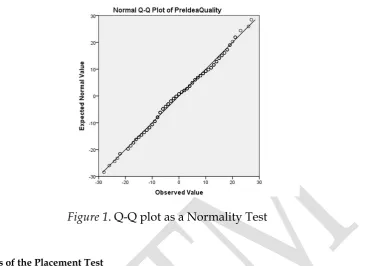
Testing the Normality ASssumptions for running ANCOVA
Testing the Normality of Test Scores. To check this assumption Kolmogrov- Smirnov and Shapiro-Wilk’s normality tests were run. Table 2 below reflects the results of this test.
Table 2
Kolmogrov- Smirnov and Shapiro-Wilk’s normality tests
Tests of Normality
Groups
Kolmogorov-Smirnova Shapiro-Wilk
Statistic df Sig. Statistic df Sig.
Pretest Wordle .209 25 .006 .948 25 .231
No-wordle .165 25 .078 .953 25 .295
Control .114 25 .200* .955 25 .330
Posttest Wordle .119 25 .200* .973 25 .710
No-wordle .081 25 .200* .979 25 .864
Control .108 25 .200* .960