33607 Pessac Cedex, France
2 Centre National de la Recherche Scientifique, Laboratoire de Chimie des Polymères Organiques UMR 5629, 33607 Pessac Cedex, France 3 ITERG, 11 rue Gaspard Monge, 33600 Pessac Cedex, France
Received 18 May 2016 – Accepted 7 June 2016
Abstract – This manuscript is dedicated to the literature on vegetable oil-based polyurethanes via the
iso-cyanate/alcohol route. A lot of efforts have been made to replace petroleum-based resources. Among renewable re-sources, vegetable oils present various advantages going from their availability to the large range of possible chemical modifications they permit. Firstly, the vegetable oil chemical composition and the main commercially available veg-etable oil precursors are exposed. Concerning vegveg-etable oils-based polyurethanes, research groups first focused on cross-linked systems directly from triglycerides then on thermoplastic ones from fatty acids or fatty acid methyl esters. This manuscript focuses on thermoplastic PUs and underlines the literature about the introduction of hydroxyl groups and isocyanate functions onto triglycerides and fatty acid derivatives. Besides, in a view to the isocyanate/alcohol ap-proach, vegetable oil-based thermoplastic PUs and corresponding diols and diisocyanates are described in details.
Keywords: Polyurethanes/bio-based/vegetable oils/fatty acid/diol/di-isocyanate
Résumé – Huiles végétales : une source de polyols pour les matériaux en polyuréthane. Cet article fait un état de
l’art de la synthèse de polyuréthanes issus des huiles végétales par la voie alcool/isocyanate. De nombreux efforts ont été réalisés pour remplacer les ressources pétrolières. Parmi les ressources renouvelables, les huiles végétales représentent de nombreux avantages liés à leur disponibilité et aux nombreuses possibilités de modification chimique qu’elles offrent. Dans cet article, les principales huiles, leur composition, et les principaux précurseurs commercialisés issus des huiles végétales sont d’abord présentés. Concernant les PUs issus des huiles végétales, les travaux portent d’une part sur des réseaux tridimensionnels directement à partir des triglycérides et, d’autre part, sur des PUs thermoplastiques à partir des acides gras et de leurs dérivés. Les méthodes d’introduction de fonctions alcool et isocyanate sur les triglycérides et acides gras sont présentées puis la synthèse de PUs thermoplastiques par la voie alcool/isocyanate est discutée de façon détaillée.
Mots clés : Polyuréthanes/bio-sourcé/huiles végétales/acide gras/diol/di-isocyanate.
1 Introduction
Various renewable resources (cellulose, hemicellulose, starch, lignin, natural oils, chitosan, etc.) have gathered a lot of attention as potential substitute for fossil resources in the poly-mer field. Three ways have been studied to obtain renewable polymers. The first and second are respectively the fermenta-tion of the biomass and the chemical degradafermenta-tion and transfor-mation of natural polymers. The third route, which is followed in this manuscript, consists in using the biomass obtained from Nature with or without chemical transformation.
Correspondence:[email protected]
Why choosing vegetable oils as renewable resources? Veg-etable oils are among the most promising renewable resources thanks to various advantages. Indeed, vegetable oils present different chemical structures and various reactive sites that can be straightforward chemically modified into a large range of tailor-made monomers with variable functionalities. More-over, the latter are available and annually renewable, regener-ated by photosynthesis year after year. The inherent biodegrad-ability of vegetable oils is also an attractive characteristic in the growing environmental concerns context.
One question, which returns continuously, is the compe-tition with the feed and food industry. The scientist’s opin-ions are split on this question. On one hand, some support that
D
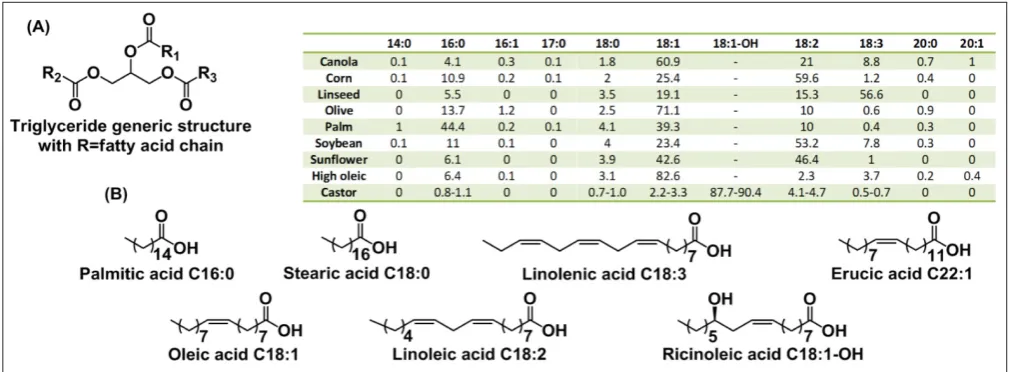
Fig. 1.(A) General triglyceride structure and the proportion of the different fatty acid chains in vegetable oils. (B) Common fatty acids found in vegetable oils (in Cx:y, thex=chain carbon atoms andy=number of C-C double bonds (De Espinosa and Meier,2011; Mutlu and Meier,
2010)).
conventional crops is only a part of the solution and underline the serious competition between the production of food and feed, with the bio-based products (chemicals and polymers) and the transportation biofuels (bioethanol and biodiesel). They recommend the use of agricultural wastes and the de-velopment of both new crops grown on marginal land, and fast-growing vegetative biomass such as grass, wood, etc. (Gallezot,2007a). On the other hand, it has been shown that biomass can be produced in a sufficient volume for industrial utilization without compromising the food supply for the in-creasing global population. (Biermannet al.,2011). Besides, the needs of raw materials for bio-based products will al-ways be very modest compared to the food and feed require-ments (Gandini,2008). Indeed, the bio-based and biodegrad-able plastics rely on only 0.006% of the global agricultural area of 5 billion ha in 2011, and is predicted to be 0.022% in 20161. To replace fossil resources in polymer science, dif-ferent strategies need to be studied at the same time such as the use of wastes (agricultural and others), the use of inedible resources, the improvement of biomass growing and the use of various renewable resources (vegetable oils but also others) to satisfy the requirement of sustainability and to get the expected performances.
Another key issue up to date is the high cost involved in processing renewable resources into chemicals compared with their synthesis from fossil resources. The difference is that pro-cesses from fossil resources have been continuously improved during more than one century resulting in a very high degree of technical and cost optimization, whereas methods to obtain chemicals from biomass are comparatively in their infancy. Therefore, wide research and development efforts in biotech-nology, chemistry and engineering are required to reduce pro-cessing cost by valorizing co-products and by-products and optimizing the inputs (feedstock supply, water management) and outputs (energy and product recovery, treatment of waste)
1 Bioplastics Bioplastics facts and figures. Available from:http://
en.european-bioplastics.org/.
(Gallezot,2007a). The life cycle analysis of the synthesized product is also a crucial tool to take into account in order to validate whether the use of biomass in such or such applica-tion is relevant or not.
In the last decades, numerous studies and reviews have emerged using fats and oils for the polymer field (Biermann
et al.,2000, De Espinosa and Meier,2011; Maisonneuveet al., 2013a; Meier et al., 2007; Metzger, 2009; Stempfle et al., 2016; Xia and Larock,2010).
2 Vegetable oils: general data
The main constituents of vegetable oils are triglycerides, which are the esterification product of glycerol with three fatty acids. The fatty acids account for 95% of the total weight of triglycerides. Each vegetable oil contains different triglyc-erides with various fatty acid chains. Fatty acids and fatty acid methyl esters can be recovered and purified from vegetable oil respectively by saponification and transesterification with methanol (Schuchardtet al.,1998). The common fatty acids that can be obtained vary from 14 to 20 carbons in length, with 0 to 3 double bonds per fatty acid. Soybean and sunflower oils, for instance, consist of largely linoleic acid (C18:2) and oleic acid (C18:1). The fatty acid structure and the compositions of few common oils are given in Figure1.
The fatty acid composition in vegetable oils varies depend-ing on the plant, the crop, the season, the growdepend-ing conditions, the year and the location of crops (Lligadaset al.,2013). The annual world supply and distribution of the major vegetable oils in 2015/16 amounted to 179 Million tons (Mt). On the Figure2, the variation of the world supply and distribution of the major vegetable oils, as well as the compared proportion of each vegetable oil are represented.
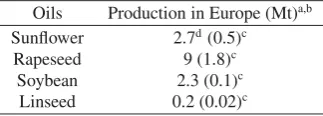
Table 1.Fatty acid production in Mt per year of the four most pro-duced vegetable oil.
Oils Production in Europe (Mt)a,b
Sunflower 2.7d(0.5)c
Rapeseed 9 (1.8)c
Soybean 2.3 (0.1)c
Linseed 0.2 (0.02)c
aAverage over the 2010–2014 period,b FEDIOL source,c
produc-tion in France within the same period,d including very high oleic
sunflower oil.
3 Reactive sites and common derivatives
from vegetable oils
Two main approaches are followed to synthesize polymers from vegetable oils. The first way is the direct use of triglyc-erides taking advantages of the naturally occurring functional groups or after chemical modifications, to end up with cross-linked materials. The second route is the use of purified fatty acids or fatty acid methyl esters to design well-defined ther-moplastic polymers and to better control the relationship be-tween the chemical structures of the monomers and the fi-nal polymer properties. The reactive sites in triglycerides and fatty acids available for chemical modifications are the carbon-carbon double bonds, the allylic carbon-carbons, the ester groups, the alpha carbons to the ester group and, in some cases, the hy-droxyl and epoxide moieties.
Castor oil is a unique vegetable oil because it is non-edible, owing to the presence of ricine in it, which is a toxic protein. Moreover, it contains up to 90% of ricinoleic acid, a mono-unsaturated fatty acid with 18 carbons bearing, na-tively, a hydroxyl function. Other advantages that can be no-ticed is that the plant itself requires relatively less fertilizers, pesticides, water and maintenance than most other cultivated crops2. Those properties make castor oil a veritable interest-ing renewable precursor for chemical and polymer syntheses. Castor oil is extracted from the seeds of the castor bean plant
2 CastorOil Preview of Comprehensive Castor Oil Report.
Avail-able from:http://www.castoroil.in, India, 2013.
Fig. 3.Castor oil as a platform precursor (Mutlu and Meier,2010).
Ricinus communis (Euphorbiaceae), which grows in tropical and subtropical areas (Van der Steen and Stevens,2009). Sev-eral platform molecules, widely used in polymer industry (giv-ing access to PA-11 for example), can be derived from castor oil: the methyl 10-undecenoate (Daset al.,1989; Ogunniyi, 2006; Van der Steen and Stevens,2009) and the sebacic acid (Azcan and Demirel,2008; Mutlu and Meier,2010), as can be illustrated in Figure3.
In addition to fatty acids, glycerol is also a valuable biomolecule; the main utilization of glycerol is the production of glycerol esters, used as emulsifiers, surfactants and lubri-cants. Besides, among the various chemicals that can be ob-tained from glycerol, some of them, which are interesting for PUs preparation, can be listed: the 1,3-propanediol and the glycerol carbonate (Gallezot,2007b; Melero et al.,2009). In terms of added value provided, glycerol and glycerol carbon-ate take part of the top 30 chemicals for the chemical industry (Werpy and Peterson,2004).
4 Derivatization of fatty acid derivatives
to thermoplastic PUs
via the alcohol/
isocyanate route
Industrially a broad range of polyols is available whereas only few diisocyanates are commonly prepared from
D
Fig. 4.Commonly used strategies to introduce OH groups into triglycerides and thus prepare polyols (Pfisteret al.,2011; Nohraet al.,2013).
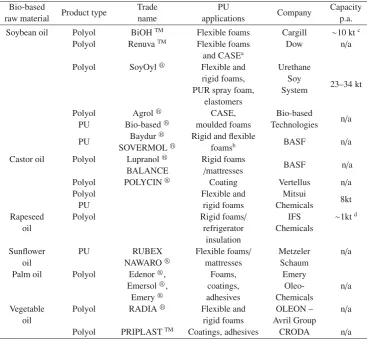
petrochemical resources. This wide range of polyols brings PUs a plethora of different properties, making them suitable in many fields of applications (Engels et al., 2013). A lot of efforts have been done to develop alternatives from veg-etable oils. The synthesis of polyols and corresponding PU net-works from vegetable oils has been already well reviewed in the literature (De Espinosa and Meier,2011; Desrocheset al., 2012a; Maisonneuveet al.,2013a; Pfisteret al.,2011). Castor oil is an exception in vegetable oils with its naturally occur-ring hydroxyl groups and thus was studied in priority in PU synthesis (Mutlu and Meier, 2010; Ogunniyi,2006). Diff er-ent methods (Fig. 4) have been followed such as (1) epox-idation/ring opening of the epoxide; (2) transesterification or amidation; (3) hydroformylation/reduction; (4) ozonoly-sis/reduction and (5) thiol-ene addition. Nowadays, the com-mercialization of vegetable oils-based polyols and correspond-ing PUs is growcorrespond-ing.
Vegetable oil-based polyisocyanates have been studied to a much lesser extent compared to vegetable oil-based polyols. Two strategies have been followed to bring isocyanate groups onto the double bond of the triglycerides; they both use the very expensive silver isocyanate salt AgNCO, prepared from NaOCN, and AgNO3. The silver counter ion in AgNCO
en-sures that the isocyanate reacts on the nitrogen end, and not on the oxygen end of the group (Çayli and Küsefoglu,2008, 2010).
A remarkable large series of papers and reviews investi-gated the functionalization of triglycerides to get interesting multifunctional PU precursors. The main problem encountered in such cases is the heterogeneity of the monomers due to the distribution of double bonds per triglyceride. This has a negative effect on the mechanical properties and the correla-tion between the final polymer properties and the monomer structures is more complicated. In light of this, the follow-ing part covers the advances made in the synthesis of veg-etable oil-based well-defined difunctional PU precursors, col-lecting the literature data of the different synthetic routes used.
5 Fatty acid-based diols
5.1 Diols containing ether and ester functions
BASF n/a BALANCE /mattresses
Polyol POLYCIN Coating Vertellus n/a
Polyol Flexible and Mitsui
8kt
PU rigid foams Chemicals
Rapeseed Polyol Rigid foams/ IFS ∼1ktd
oil refrigerator Chemicals
insulation
Sunflower PU RUBEX Flexible foams/ Metzeler n/a
oil NAWARO mattresses Schaum
Palm oil Polyol Edenor, Foams, Emery
Emersol, coatings, Oleo- n/a
Emery adhesives Chemicals
Vegetable Polyol RADIA Flexible and OLEON – n/a
oil rigid foams Avril Group
Polyol PRIPLASTTM Coatings, adhesives CRODA n/a
aCASE: Coatings, Adhesives, Sealants and Elastomers;bfor Bayer’s flexible PU foams, SoyOyl polyols from Urethane Soy System are used; c,destimation;eprojected data for the next 2–4 years by the company.
derivatives. Hard domains are usually crystalline with high melting points. For polyether diol obtained from vegetable oil, only one example of TPUs was reported from vegetable oil derivatives (Lligadaset al.,2006). This polyether diol contain-ing ester pendant groups was obtained by the acid-catalyzed ROP of epoxidized methyl oleate and partial reduction with lithium aluminum hydride (LiAlH4). Polyols with various
hy-droxyl functionality degrees were obtained depending on the conversion of the reduction step and PUs were synthesized with methylene di-isocyanate (MDI). The TPU obtained with the polyether diol (f =2) presents a low glass transition tem-perature of –15◦C and an interesting degradation temperature at 5 wt% loss of 307◦C.
Synthesis of polyester diols, diols containing ester and/or amide linkages, dimer diols, linear saturated or unsaturated di-ols and didi-ols containing thio-ether linkages are widely reported using fatty acids or fatty acid methyl esters as starting materi-als. The synthesis of diols containing ester group have been much more widely explored due to the initial presence of es-ter or acid function in vegetable oil derivatives. Few research groups have prepared low Tg polyester diols from vegetable
oil derivatives to use them in TPE-Us. The fatty acid-based polyester diols were synthesized either by transesterification
of methyl ricinoleate with diethylene glycol as an initiator or by transesterification of diesters with diols in excess.
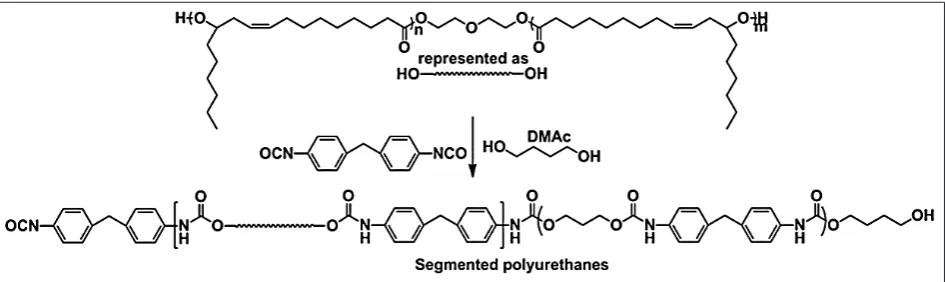
Petrovic and coll. have used a poly(ricinoleic acid) diol of 2580 g mol−1 as soft segment to prepare a series of
TPE-Us by reacting MDI and 1,4-butanediol with various soft seg-ment weight concentrations ranging from 40% to 70% (Xu
et al., 2008) (Fig. 5). The TPE-Us obtained display a mi-crophase separation and two glass transition temperatures at around –50◦C and 100◦C. Melting points in the range 170◦C to 220 ◦C were observed depending on the soft segment content. The mechanical and thermal features of these bio-based PUs suggest that they could be used in conventional TPE-Us applications. A co-continuous morphology with do-mains around 15 nm was obtained in the case of the TPE-Us with 50% of soft segment weight concentrations. However, in the sample of TPE-Us with 70% of soft segment weight con-centrations, dispersed hard domains were observed in the soft matrix. The biodegradation of these TPUs has been investi-gated by respirometry (Petrovi´cet al.,2010). These TPE-Us with poly(ricinoleic acid) as soft segments have been found to exhibit faster degradation rates than the corresponding petro-chemical poly(ester urethane)s, even if this rate is relatively slow. The authors observed that TPE-Us with a co-continuous
D
Fig. 5.Thermoplastic elastomer polyurethane prepared from poly (ricinoleic acid) (Xuet al.,2008).
morphology demonstrated a slightly slower biodegradation than those with dispersed hard domains in the soft phase.
Using the same methodology, a hydroxytelechelic α,
ω-OH polyester was prepared by transesterification of methyl 12-hydroxy stearate with 1,6-hexanediol catalyzed by titanium isopropoxide (Omprakash and Petrovic,2010). This precursor of 1552 g mol−1was used in segmented PU with MDI and
1,4-butanediol with 50% and 70% of soft segment content. Glass transition temperatures of –40◦C and 100◦C were obtained for the soft segments and hard segments respectively. Besides, Tmof –18◦C to 14◦C and 175◦C to 180◦C were observed for
the soft segments and hard segments respectively.
Polyester diols (pre-polymer) have been synthesized by transesterification of diesters with diols in excess. Using this strategy, Koning and coll. have prepared partially fatty acid-based aliphatic polyester diols from dimethyl sebacate using TBD as a catalyst (Tang et al., 2011). Moreover, Corcuera and coll. have used similar polyester diols from dimethyl se-bacate with molar mass from 1320 g mol−1 to 3500 g mol−1 to prepare TPE-Us with HMDI and 1,3-propanediol as chain extender. The TPE-Us obtained by a two-step bulk polymer-ization without catalyst exhibited a molar mass in the range of 52.1 kg mol−1 to 138.9 kg mol−1. The authors have stud-ied the effect of the soft segment molar mass on the morphol-ogy and the final properties (Saralegiet al.,2012). A decrease in the polyester diol molar mass leads to a better phase mix-ing between hard and soft domains, givmix-ing higher Tg for the
soft segments than the one for the prepolymer. The same ap-proach has also been used to synthesize polyester diols from azelaic acid and 1,9-nonanediol using titanium (IV) butoxide, with molar masses ranging from 500 to 1500 g mol−1. The
ef-fect of the polyester diol have then been studied in aliphatic thermoplastic poly(ester urethane)s with fatty acid based HP-MDI (1,7-heptamethylene diisocyanate) (Hojabriet al.,2012). The use of polyester diols with various lengths into the TPUs enabled to control the crystalline morphology, the chain dy-namics and eventually the strength of the polymer. The crys-tal structure and the physical properties are directly linked to the polyester chain length and can be explained by the inter-play between polyester dipole-dipole intermolecular forces, as well as by the Van der Waals and hydrogen bonding attractive interactions.
Another effective strategy to polyester diols was devel-oped by Càdiz (Lluchet al.,2010). These telechelic
macro-diols with a molar mass of 3.1 kg mol−1 have been
synthe-sized through two one-pot thiol-ene reactions; first a step-growth polymerization using 3,6-dioxa-1,8-octanedithiol and then an end-group post-polymerization modification with 2-mercaptoethanol. Then TPE-Us have been prepared with MDI and 1,4-butanediol. A low Tgand Tmat –45◦C and –9◦C
re-spectively were observed, which correlate well with the ther-mal properties of the polyester diol precursor. The phase sep-arated morphology has been confirmed by the hard segment transitions: a second Tg at 55 ◦C and a broad melting
en-dotherm at 190◦C.
An alternative to synthesize TPE-Us with a fatty acid-based diol as soft segment, is to use the CRODA polyester diol synthesized by transesterification between dimerized fatty acids (obtained by Diels-Alder reaction) and an excess of lin-ear diol. Averous and coll. have synthesized bio-based TPE-Us from this diol of 3 kg mol−1having dangling alkyl chains, MDI and 1,4-butanediol, with several hard segment contents from 10% to 40% (Bueno-Ferreret al.,2012a,2012b). Mo-lar masses of 14.7 kg mol−1 to 38.0 kg mol1 with dispersity
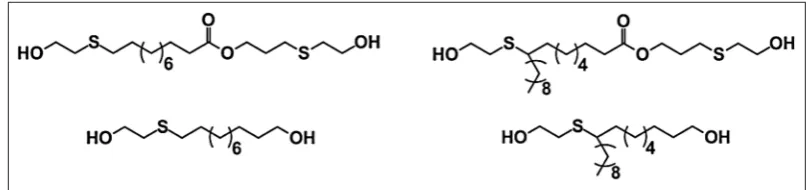
from 2.17 to 5.52 have been reached. Only one glass transi-tion temperature at –47.0◦C was noticed for the PU with 10% of hard segments. Otherwise two glass transition temperatures were obtained; one for the soft segments (51.3◦C to –47.8◦C) and one for the hard segments (118.1◦C to 122.8◦C). Melting points around 200◦C are observed for PUs with hard segment content of 30% and 40%. By selecting the appropriate hard segment concentration, different thermo-mechanical proper-ties were achieved and could fulfill some industrial require-ments in diverse fields (Bueno-Ferreret al.,2012a,2012b). To obtain well-defined monomers, several research groups have synthesized bis-unsaturated compounds with one or two ester functions from methyl oleate and methyl undecenoate or from the corresponding acid derivatives. Afterwards, the hydroxyl moieties were introduced on the double bonds by thiol-ene reaction or ring-opening of the epoxide. By using the thiol-ene addition method, asymmetric ester diols have been pre-pared from oleic and undecenoic acids by esterification with allyl alcohol and thiol-ene reaction with 2-mercaptoethanol (González-Paz et al., 2011) (Fig. 6). Polymerizations with MDI and using tin(II) 2-ethylhexanoate as catalyst, have led to TPUs with molar masses from 50 to 70 kg mol−1and
disper-sity in the range 1.6–1.9. Amorphous (Tg =8◦C to 20◦C) to
purposes.
Boutevin and coll. have used a similar strategy to pre-pare symmetrical diester diols by transesterification of methyl oleate with ethylene glycol followed by a grafting of 2-mercaptoethanol onto the double bonds using thiol-ene click chemistry (Desrocheset al.,2012b). The diester diols appeared not pure enough to synthesize TPUs. Finally, PU networks with interesting thermal properties were obtained by step-growth polyaddition with MDI.
To further explore the potential of such diester diols, Cramail and coll. have synthesized a plethora of diester diols by transesterification of methyl oleate or methyl undecenoate with various central diol blocks followed by either thiol-ene re-action with 2-mercaptoethanol, or ring opening of epoxidized double bonds (Palaskaret al.,2012a). Diols containing ether linkages were also synthesized in this work. These diester di-ols have been polymerized with IPDI in the presence of dibutyl tin dilaurate (DBTDL) as a catalyst. The behavior of the PUs was correlated to the purity and to the chemical structure of the starting ester-containing diols. As expected, the reactivity of primary diols obtained by thiol-ene reaction was found to be higher than the one of secondary diols synthesized by ring-opening of the epoxide, yielding higher molar mass TPU up to 35 kg mol−1. The rheological properties were also impacted
by the monomer structure and the purity. Glass transitions be-low room temperature were observed due to the pendant alkyl chains along the PU backbone.
Cramail and coll. also prepared sugar-based fatty ester polyols by selective transesterification of epoxidized methyl or ethyl oleate with unprotected methylαDglucopyranoside and sucrose respectively, followed by hydrolysis of the epox-ide moiety (Boyeret al.,2012). The polyols were then used in PU synthesis with IPDI. The authors noticed that the reactivity of the hydroxyl functions attached to the sugar and to the fatty ester chain moieties respectively could be discriminated with respect to the solvent used, enabling the synthesis of either lin-ear or cross-linked PUs.
Finally, polyesterdiols, obtained after transesterification of methyl ricinoleate in presence of an excess of butanediol or propanediol, have been reported for the synthesis of PU latexes
viaa miniemulsion process (Rix et al.,2015). Stable latexes were obtained with IPDI with solid content up to 40%wt, with particles size around 100 nm.
tion, Narine and coll. have synthesized 1,18-octadec-9-endiol, a long chain diol from oleic acid, by self-metathesis followed by reduction to the diol (Y = 58%) (Hojabriet al.,2010a). Alternatively, a saturated shorter terminal diol, 1,9nonanediol, has been synthesized from oleic acid with a purity of 99% (Y =
72%). These diols were reacted with different di-isocyanates namely HMDI and the fatty acid-based HPMDI to give TPUs. The properties of such aliphatic TPUs will be described in the fatty acid-based diisocyanate section.
Cationic dimerization of oleic and linoleic acids could also be done to synthesize saturated diols with pendant chains. This complex reaction is realized at high temperature with homo-geneous catalysts such as ionic salts of alkali metals, or het-erogeneous catalysts such as clays (montmorillonite or ben-tonite) or aluminosilicates. The synthesized diacids are re-duced to yield fatty acid-based diols. This methodology was initially introduced, in the 1950s, by General Mills Chemi-cals and Emery (became Cognis Corp. acquired by BASF) (US Pat., US 2793219, 1957, US 2955121, 1960). These fatty acid dimer diols are commercially available and used in TPUs pro-viding biocompatibility, high hydrophobicity, mechanical elas-ticity and chemical stability properties (Hill,2000).
5.3 Diols containing thio-ether linkages
Using efficient functionalization techniques such as thiol-ene and thiol-yne reactions, fatty acid-based diols contain-ing thioether linkages have been synthesized. Diols by thiol-ene reaction of methyl oleate and methyl undecenoate with 2-mercaptoethanol followed by reduction of the ester group using LiAlH4have been reported (González-Pazet al.,2011).
Afterwards TPUs having molar masses from 40 to 80 kg mol−1
and dispersities in the range 2.1–2.2 were done with MDI. Only semi-crystalline PUs were obtained with glass transition temperature from 28 ◦C to 56 ◦C and melting temperatures around 110◦C. No cytotoxic response was observed for these TPUs suitable in the medical field. In a significant contribu-tion, the same group demonstrated the use of thiol-yne reac-tion for the synthesis of polyols and in particular diols for PUs (González-Pazet al.,2012). These diols were synthesized in two steps, the first being an alkyne derivatization of fatty acids by bromation and dehydrobromation of the double bond and the second being a thiol-yne addition with 2-mercaptoethanol
D
Fig. 7.Use of the thiol-yne reaction to prepare diol and triol (González-Pazet al.,2012).
Fig. 8.Fatty acid-based diisocyanates using hydrazine hydrate (Moreet al.,2013).
(Fig.7). Such TPUs obtained with MDI as comonomer were amorphous (Tg=15 to 20◦C). Based on the analyses of
bio-compatibility, in terms of cell attachment of an osteoblastic cell line, the authors have suggested using such PUs as poly-meric scaffolds for tissue engineering. Although the literature above proved the contribution of research groups to the syn-thesis of fatty acids-based diols to TPUs, a lack of papers on fatty acid-based diisocyanates can be noticed.
6 Fatty acid-based di-isocyanates
Vegetable oil-based diisocyanates have been studied in a much lesser extent perhaps as a consequence of the inherent aliphatic structure of the isocyanate that could be prepared and their lower reactivity compared to aromatic ones, as well as due to the intrinsic toxicity of isocyanates. Indeed the most commonly di-isocyanates used industrially are aromatic namely MDI and TDI due to their high reactivity required to produce foams. Thus, the uses of aliphatic diisocyanates are limited to coatings in which the absence of unsaturation is profitable. In industry, isocyanates are synthesized from pri-mary amines by phosgenation. As pripri-mary amines are not eas-ily introduced into vegetable oils, other strategies have been developed on vegetable oils and their derivatives.
Isocyanates can be synthesized by taking the advantage of the Curtius, Hoffman and Lossen rearrangements, which in-volve nitrene intermediates. In an effort to access fatty acid-based di-isocyanates, Narine and coll. used the Curtius re-arrangement to prepare oleic acid-based linear diisocyanates, both saturated and unsaturated (Hojabriet al.,2009,2010b). Two linear diacids were first synthesized by methods reported earlier in this chapter, then converted to acyl azides by the re-action with sodium azide and, upon heating, had decomposed to isocyanates. The fatty acid-based HPMDI was used to pre-pare TPUs and compre-pared with HMDI (Hojabriet al.,2010a). The odd number of methylene groups in HPMDI-based TPUs
affected the thermo-mechanical properties, because the crys-tal structure was less ordered and the strength of the hydro-gen bonding was weaker. Indeed lower Tg and Tm were
ob-tained for HPMDI-based TPUs than for HMDI-based TPUs. Still the authors claim that HPMDI-based TPUs exhibit com-parable properties that HMDI-based TPUs within acceptable tolerances considering the impacts on physical properties.
Our group reported the synthesis of fatty acid-based di-isocyanates using the Curtius rearrangement through acyl hy-drazide fatty acid-based derivatives without the use of harmful sodium azide (Fig.8) (Moreet al.,2013). Diesters were first synthesized and then reacted with hydrazine hydrate to form diacyl hydrazides in quantitative yields. Afterwards, these di-acyl hydrazides were converted into didi-acyl azides then into diisocyanatesviathe Curtius rearrangement. A series of par-tially and fully vegetable oil-based TPUs were synthesized and a large range of thermo-mechanical properties were achieved. Relatively good thermal behaviors were observed with decom-position temperatures at 5 wt% loss from 230◦C to 280◦C. For some PUs, a close resemblance to HDPE was obtained in terms of solubility and thermal transitions with melting points close to 145◦C.
In Figure9, the different routes to isocyanates or equiva-lents are summarized.
7 Conclusion
Fig. 9.Summary of the different routes to fatty acid based-isocyanates or equivalents via the Curtius rearrangement.
References
Azcan N, Demirel E. 2008. Obtaining 2-Octanol, 2-Octanone, and Sebacic Acid from Castor Oil by Microwave-Induced Alkali Fusion.Indus. Eng. Chem. Res.47: 1774–1778.
Biermann U, Bornscheuer U, Meier MAR, Metzger JO, Schäfer HJ. 2011. Oils and Fats as Renewable Raw Materials in Chemistry. Angew. Chem. Int. Ed.50: 3854–3871.
Biermann U, Friedt W, Lang S,et al. 2000. New Syntheses with Oils and Fats as Renewable Raw Materials for the Chemical Industry. Angew. Chem. Int. Ed.39: 2206–2224.
Boyer A, Lingome CE, Condassamy O, et al. 2012. Hydroxyl telechelic building blocks from fatty acid methyl esters for the synthesis of poly(ester/amide urethane)s with versatile proper-ties.Polym. Chem.4: 296–306.
Bueno-Ferrer C, Hablot E, Perrin-Sarazin F, Garrigós MC, Jiménez A, Averous L. 2012a. Structure and Morphology of New Bio-Based Thermoplastic Polyurethanes Obtained From Dimeric Fatty Acids.Macromol. Mater. Eng.297: 777–784.
Bueno-Ferrer C, Hablot E, Garrigós MDC, Bocchini S, Averous L, Jiménez A. 2012b. Relationship between morphology, properties and degradation parameters of novative biobased thermoplastic polyurethanes obtained from dimer fatty acids.Polym. Degrad. Stability97: 1964–1969.
Çayli G, Küsefoglu, S. 2008. Biobased polyisocyanates from plant oil triglycerides: Synthesis, polymerization, and characterization.J. Appl. Polymer Sci. 109: 2948–2955.
Çayli G, Küsefoglu, S. 2010. A Simple One-Step Synthesis and Polymerization of Plant Oil Triglyceride Iodo Isocyanates. J. Appl. Polymer Sci.116: 2433–2440.
Das G, Trivedi RK, Vasishtha AK. 1989. Heptaldehyde and unde-cylenic acid from castor oil.J. Am. Oil Chem. Soc.66: 938–941. De Espinosa LM, Meier MAR. 2011. Plant oils: the perfect renewable
resource for polymer science?!Eur. Polym. J.47: 837–852. Desroches M, Escouvois M, Auvergne R, Caillol S, Boutevin B.
2012a. From Vegetable Oils to Polyurethanes: Synthetic Routes to Polyols and Main Industrial Products.Polym. Rev.52: 38–79. Desroches M, Caillol S, Auvergne R, Boutevin B. 2012b. Synthesis of
pseudo-telechelic diols by transesterification and thiol-ene cou-pling.Eur. J. Lipid Sci. Technol.114: 84–91.
Engels HW, Pirkl HG, Albers R, et al. 2013. Polyurethanes: Versatile Materials and Sustainable Problem Solvers for Today’s Challenges.Angew. Chem. Int. Ed.52: 9422–9441.
FAS ForeignAgriculturalService. 2013. (ed.) USDA, Circular Series FOP 04–13.
Gallezot P. 2007a. Process options for converting renewable feed-stocks to bioproducts.Green Chem.9: 295–302.
Gallezot P. Process Options for the Catalytic Conversion of Renewables into Bioproducts. In: Centi G, van Santen RA (eds.), Catalysis for Renewables: From Feedstock to Energy Production. Wiley-VCH Verlag GmbH & Co. KGaA, 2007b.
Gandini A. 2008. Polymers from Renewable Resources: A Challenge for the Future of Macromolecular Materials.Macromolecules41: 9491–9504.
González-Paz RJ, Lluch C, Lligadas G, Ronda JC, Galià M, Cádiz V. 2011. A green approach toward oleic- and undecylenic acid-derived polyurethanes.J. Polym. Sci. Part A49: 2407–2416. González-Paz RJ, Lligadas G, Ronda JC, Galia M, Cadiz V. 2012.
Thiol–yne reaction of alkyne-derivatized fatty acids: biobased polyols and cytocompatibility of derived polyurethanes.Polym. Chem.3: 2471–2478.
Hill K. 2000. Fats and oils as oleochemical raw materials.Pure Appl. Chem.72: 1255–1264.
Hojabri L, Kong X, Narine SS. 2009. Fatty Acid-Derived Diisocyanate and Biobased Polyurethane Produced from Vegetable Oil: Synthesis, Polymerization, and Characterization. Biomacromolecules10: 884–891.
Hojabri L, Kong X, Narine SS. 2010a. Functional Thermoplastics from Linear Diols and Diisocyanates Produced Entirely from Renewable Lipid Sources.Biomacromolecules11: 911–918. Hojabri L, Kong X, Narine SS. 2010b. Novel long chain unsaturated
diisocyanate from fatty acid: Synthesis, characterization, and ap-plication in bio-based polyurethane. J. Polym. Sci. Part A 48: 3302–3310.
Hojabri L, Jose J, Leao AL, Bouzidi L, Narine SS. 2012. Thermoplastic polyurethanes from renewable resources: effect of soft segment chemical structure and molecular weight on mor-phology and final properties.Polymer53: 3762–3771.
D
Lligadas G, Ronda JC, Galià M, Biermann U, Metzger JO. 2006. Synthesis and characterization of polyurethanes from epoxidized methyl oleate based polyether polyols as renewable resources.J. Polym. Sci. Part A44: 634–645.
Lligadas G, Ronda JC, Galià M, Cádiz V. 2013. Monomers and poly-mers from plant oils via click chemistry reactions.J. Polym. Sci. Part A51: 2111–2124.
Lluch C, Ronda JC, Galià M, Lligadas G, Cádiz V. 2010. Rapid Approach to Biobased Telechelics through Two One-Pot Thiol−Ene Click Reactions.Biomacromolecules11: 1646–1653. Maisonneuve L, Lebarbé T, Grau E, Cramail H. 2013a. Structure– properties relationship of fatty acid-based thermoplastics as syn-thetic polymer mimics.Polym. Chem.4: 5472–5517.
Meier MAR, Metzger JO, Schubert US. 2007. Plant oil renewable resources as green alternatives in polymer science.Chem. Soc. Rev.36: 1788-1802.
Melero JA, Iglesias J, Morales G. 2009. Heterogeneous acid catalysts for biodiesel production: current status and future challenges. Green Chem.11: 1285–1308.
Metzger J O. 2009. Fats and oils as renewable feedstock for chem-istry.Eur. J. Lipid Sci. Technol.111: 865–876.
More AS, Lebarbé T, Maisonneuve L, Gadenne B, Alfos C, Cramail H. 2013b. Novel fatty acid based di-isocyanates towards the syn-thesis of thermoplastic polyurethanes. Eur. Polym. J.49: 823– 833.
Mutlu H, Meier MAR. 2010. Castor oil as a renewable resource for the chemical industry.Eur. J. Lipid Sci. Technol.112: 10–30. Nohra B, Candy L, Blanco JF, Guerin C, Raoul Y, Mouloungui
Z. 2013. From Petrochemical Polyurethanes to Biobased Polyhydroxyurethanes.Macromolecules46, 3771–3792. Ogunniyi DS. 2006. Castor oil: a vital industrial raw material.
Bioresour. Technol.97: 1086–1091.
Omprakash SY, Petrovic ZS. 2010. Novel Thermoplastic Polyurethane Elastomers Based on Methyl-12-Hydroxy Stearate. ACS Sympos. Ser.1061: 29–39.
Palaskar DV, Boyer A, Cloutet E,et al.2012. Original diols from sunflower and ricin oils: Synthesis, characterization, and use as polyurethane building blocks.J. Polym. Sci. Part A 50: 1766– 1782.
Petrovi´c Z, Xu Y, Mili´c J, Glenn G, Klamczynski A. 2010. Biodegradation of Thermoplastic Polyurethanes from Vegetable Oils.J. Polymers Environ.18: 94–97.
Pfister DP, Xia Y, Larock RC. 2011. Recent Advances in Vegetable Oil-Based Polyurethanes.ChemSusChem4: 703–717.
Rix E, Ceglia G, Bajt J,et al.2015. Hydrophobe-free miniemulsion polymerization: towards high solid content of fatty acid-based poly (urethane-urea) latexes.Polym. Chem.6: 213–217. Saralegi A, Rueda L, Fernández-d’Arlas B, Mondragon I, Eceiza
A, Corcuera MA. 2012. Thermoplastic polyurethanes from re-newable resources: effect of soft segment chemical structure and molecular weight on morphology and final properties.Polym. Int. 62: 106–115.
Shen J, Patel MK. 2009. Product overview and market projec-tion of emerging bio-based plastics, Utrecht University commis-sioned by European Polysaccharide Network of Excellence and European Bioplastics.
Schuchardt U, Sercheli R, Vargas RM. 1998. Transesterification of Vegetable Oils: a Review.J. Brazilian Chem. Soc.9: 199–210. Stempfle F, Ortmann P, Mecking S. 2016. Long-Chain Aliphatic
Polymers To Bridge the Gap between Semicrystalline Polyolefins and Traditional Polycondensates.Chem. Rev.116: 4597–4641. Tang D, Noordover BAJ, Sablong RJ, Koning CE. 2011.
Metal-free synthesis of novel biobased dihydroxyl-terminated aliphatic polyesters as building blocks for thermoplastic polyurethanes.J. Polym. Sci. Part A49: 2959–2968.
Van der Steen M, Stevens CV. 2009. Undecylenic Acid: A Valuable and Physiologically Active Renewable Building Block from Castor Oil.ChemSusChem2: 692–713.
Werpy T, Peterson G, Top Value Added Chemicals from Biomass. Washington DC, 2004.
Xia Y, Larock RC. 2010. Vegetable oil-based polymeric materials: synthesis, properties, and applications.Green Chem.12: 1893– 1909.
Xu Y, Petrovic Z, Das S, Wilkes GL. 2008. Morphology and Properties of Thermoplastic Polyurethanes with Dangling Chains in Ricinoleate-Based Soft segments.Polymer49: 4248–4258.