ISSN (Print) : 2320 – 3765 ISSN (Online): 2278 – 8875
I
nternational
J
ournal of
A
dvanced
R
esearch in
E
lectrical,
E
lectronics and
I
nstrumentation
E
ngineering
(An ISO 3297: 2007 Certified Organization)
Vol. 5, Issue 9, September 2016
Reading Linear Barcode Using Template
Matching Techniques
Snehal S. Jadhav1, Prof. S. K. Bhatia2
PG student (Signal Processing), Dept. of E&TC, ICOER, Wagholi, Pune, Maharashtra, India1 Assistant Professor, Dept. of E&TC, ICOER, Wagholi, Pune, Maharashtra, India2
ABSTRACT: The system proposes linear barcode scanning based on a dynamic template matching scheme. This system works entirely in the spatial domain and is able to read linear barcode from low-resolution images containing blur and noise. The blurred barcode scanline waveform and its corresponding symbol values are characterized by directed graphical model. A dynamic programming-based inference algorithm is used to retrieve the optimal sequence of barcode which enables real time barcode decoding on mobile devices of low resolution cameras.
KEYWORDS: Barcode, Barcode Extraction, Spatial domain model, Templates matching.
I.INTRODUCTION
In today’s digital world barcode technology is commonly used in various industries. Barcodes represent data with the width and the parallel lines, and may be referred to as 1D barcodes. 2D barcodes represented as depicted Binary data in statistical patterns such as dots or squares inside images. Barcodes are used for keeping the records of product, to tract the product or to compare the price of product. When captured, the original barcode is corrupted by blur caused by a improper focalization or a camera movement, in addition to noise, the whole resulting in a blurred deafening barcode. Barcode scanning systems like LASER scanning systems and more lately charged coupled devices are used. These systems are costly and the basic condition of these systems is barcode images should be highly focused. Recently cell phones come with optical imaging system. These hand held devices with facility to reading barcodes is best choice to the existing barcode scanning system. Cell phones are easily available to people. This will increase daily shopping experience.
II.RELATED WORK
There were many methods invented to read barcodes. Like edge detection, data symbol, blind deconvolution etc.
A. Edge detection
J.F. Canny proposed Edge detection [2] technique where edges of bars of blurry barcode image are extracted along with blur. It may results in false detection. Edge detection requires well focused image for correct detection. So this method is not suitable for low resolution image.
B. Blind Deconvolution
S. Esedoglu proposed Blind deconvolution [3] of barcode signals which based on minimizing the total variation [2] of original barcode and detected barcode. Blur of captured barcode is modeled with a Gaussian kernel, and the iterative algorithm adjusts the blur kernel parameters. In this method each image requires six minutes in MATLAB with 2.4 GHz clock rate. As this method is time consuming is not usable for mobile application.
The leftover of the paper is arranged as follows. In section III proposed method is described. In section IV results of proposed method are discussed. Conclusion is mentioned in section V.
III. PROPOSED WORK
Fig.1: Block Diagram of dynamic Template Matching Scheme
In this system, a set of scanline template banks is created offline. Each bank of scanline templates contains templates corresponding to all possible barcode values. The scanning process can be skilled by comparing the deformed scanline extracted from the blurred image with the scanline templates.
Fig.2 Linear Barcode Symbologies
As each linear barcode symbol is composed of a series of concatenated symbol font, and each character is separate valued, we can always split a linear barcode symbol into a series of state variables. For example EAN-13 Barcode has 12 symbols and 1 left guard symbol.
Fig. 3 Detailed Description of EAN-13 Barcode
ISSN (Print) : 2320 – 3765 ISSN (Online): 2278 – 8875
I
nternational
J
ournal of
A
dvanced
R
esearch in
E
lectrical,
E
lectronics and
I
nstrumentation
E
ngineering
(An ISO 3297: 2007 Certified Organization)
Vol. 5, Issue 9, September 2016
Fig. 4 Symbologies of EAN-13 Barcode
Based on state variable sequence modeling of linear barcode determination of a scanline segmentation format to have each created waveform segment jointly resolute by only two neighboring state variables, and make it be independent from any other state variables in the state variable sequence.
The barcode detection performs a look for selected rows of the input image, called scan lines. Proceeding to recognition, each pixel of the scan line is processed by transforming it into a next value. The feature value of a pixel is set to a 1, if the pixel is considered black, 0 if it is considered white. Once all pixels are changed, the scan line sequences are analyzed.
Once the observation variable sequence is created, the observation variables need to be compared with standard reference waveform segments of the detected blur level for any qualified state variable values
A linear barcode scanning system based on dynamic template matching (DTM) in which can efficiently find the optimal state variable sequence and, therefore, the barcode value.
IV.EXPERIMENTAL RESULTS
Results for barcode detection and reading are obtained using MATLAB as follows:
A. Barcode Extraction:
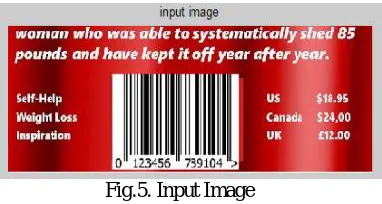
Image captured by low resolution camera is given as input:
Fig.5. Input Image
Image is blurred with motion blur and given as input to DTM. To extract barcode from captured image edge detection technique along with morphological operations are applied
Fig.8 Extracted barcode
Canny edge detection technique is applied to detect the edges present in an image. After edge detection image is subjected to dilation and boundary detection for extracting barcode from an image.
B. Scanline of detected barcode:
This scanline compare with predefined barcode formats and finally result of barcode value is obtained.
Fig. 11 Output of barcode.
Output of whole system is shown in GUI. After processing the image, barcode symbols are extracted and shown as result of the system.
ISSN (Print) : 2320 – 3765 ISSN (Online): 2278 – 8875
I
nternational
J
ournal of
A
dvanced
R
esearch in
E
lectrical,
E
lectronics and
I
nstrumentation
E
ngineering
(An ISO 3297: 2007 Certified Organization)
Vol. 5, Issue 9, September 2016
C. Comparison of DTM with Data Symbol:
Recognition Rate can be calculated as:
= .
. 100
TABLE I
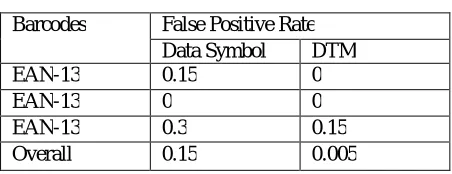
The recognition rate ranges from 0 to 1. Ideally value of recognition rate should be 1 i.e. 100% accuracy. False Positive Rate can be calculated as:
= .
.
TABLE II
.
T he false positive rate ranges from 0 to 1. Ideally value of False Positive rate should be 0.
V. CONCLUSION
Proposed method of reading linear barcode using dynamic template matching is achieved. The proposed method is effective than previous methods.
Experimental results are tested in the form of Recognition Rate and False Positive Rate. The RR and FPR values are improved as compared to literature methods. Thus, proposed method attains excellent result.
REFERENCES
[1] Ling Chen, Hong and Huading Jia ”On Scanning Linear Barcodes From Out-of-Focus Blurred Images: A Spatial Domain Dynamic Template Matching Approach” IEEE TRANSACTIONS ON IMAGE PROCESSING, VOL. 23, NO. 6, JUNE 2014
[2] J. F. Canny. A computational approach to edge detection. IEEE Trans. Pattern Analysis and Machine Intelligence, 8(6):679–698, 1986. ISSN 0162-8828.
[3] S. Esedoglu. Blind deconvolution of bar code signals. Inverse Problems, 20:121–135, Feb.2004. doi: 10.1088/0266-5611/20/1/007 [4] P. Hough. Method and means for recognizing complex patterns. U.S. Patent 3,069,654, Dec.1962.
[5] R.O.Duda and P. E. Hart. Use of the Hough transformation to detect lines and curves in pictures. Commun. ACM, 15(1):11–15, 1972. ISSN 0001-0782. doi: http://doi.acm.org/10.1145/361237.361242
[6] X.-W. Xu, Z.-Y. Wang, Y.-Q. Zhang, and Y.-H. Liang. A skew distortion correction method for 2d bar code images based on vanishing points. Machine Learning and Cybernetics, 2007 International Conference on, 3:1652–1656, Aug. 2007. doi: 10.1109/ICMLC.2007.4370412
Barcodes Recognition Rate Data Symbol DTM EAN-13 85% 100% EAN-13 100% 100% EAN-13 69% 85% Overall 84% 95%
[7] J. Kim and H. Lee. Joint nonuniform illumination estimation and deblurring for bar code signals. Optics Express, 15:14817–+, 2007. doi: 10.1364/OE.15.014817.
[8] E. Joseph and T. Pavlidis. Peak classifier for bar code waveforms. In 11th IAPR International Conf. Pattern Recognition Methodology and Systems, volume 2,pages 238–241,Sept. 1992.ISBN 0-8186-2915-0.doi: 10.1109/ICPR.1992.201763.
[9] S. Shellhammer, D. Goren, and T. Pavlidis. Novel signal-processing techniques in barcode scanning. IEEE Robotics & Automation Magazine, 6(1):57–65, Mar. 1999. ISSN 1070- 9932. doi: 10.1109/100.755815
[10] E. Ohbuchi, H. Hanaizumi, and L. A. Hock. Barcode readers using the camera device in mobile phones. In CW ’04: Proceedings of the 2004 International Conference on Cyberworlds, pages 260–265, Washington, DC, USA, 2004. IEEE Computer Soc.
[11] R. Chan, C. Hu and M. Nikolova, “An iterative procedure for removing random-valued impulse noise,” IEEE Signal Process. Letters, pp. 921–924, 2004.
[12] M. Nikolova, “A variational approach to remove outliers and impulse noise,” Journal of Mathematical Imaging and Vision, pp.99–120, 2004.
BIOGRAPHY
Snehal Jadhav Completed BE from Savitribai Phule university Pune. Currently pursuing ME in signal processing from ICOER Pune.