Vol.5 (2015) No. 4
ISSN: 2088-5334
Effect of Microwave Heating on Potato and Tapioca Starches in
Water Suspension
N. I. Nadiah
#, U. Uthumporn
#1, Z. A. Syahariza
##
School of Industrial Technology, Universiti Sains Malaysia, Minden, Penang, 11800, Malaysia E-mail: [email protected]
Abstract— The effects of microwave heating on properties of starch were studied on potato and tapioca starches in water suspension
at different temperature (50°C and 60°C). Potato and tapioca starches were adjusted to 30% (w/v) and heat-moisture treated in a microwave oven and conventional heating. Conventional heating was carried out by direct heating the moisture heated sample at 50ºC and 60ºC while the microwave heating was carried out by microwave oven and the temperature was controlled approximately to 50ºC and 60ºC. The heated starch samples were analysed for amylose content, pasting properties, swelling and solubility, thermal properties, light microscopy, scanning electron microscopy (SEM) and X-ray diffraction. There were present several changes on physicochemical and functional properties of heated starch for both heating methods. However, microwave method gave higher affect on heating treatment rather than conventional heating. Microwave heating was evidenced in affecting pasting properties of potato and tapioca starches by increase the pasting temperature and the paste stability. Microwave heating also significantly increased the amylose content and swelling power but reduced the solubility and enthalpy of gelatinization (∆H) of those starches. There were changes in granule structure of starch observed by loss of birefringence and ruptures granule in SEM micrographs in both heating treatment. A change in the X-ray diffraction pattern from B-type to A-type was occurred in potato starch but tapioca starch shows no changes in X-ray pattern.
Keywords— Potato and tapioca, starch, microwave heating treatment, gelatinization temperature, X-ray diffraction, Scanning
Electron Microscopy (SEM).
I. INTRODUCTION
Tuber crops can be divided into two major groups: tubers, which is potato and roots including tapioca and sweet potato. Each type of tuber crops has their own characteristics and usage. Granules structure of tuber and root starches can exist as oval, round, spherical, polygonal and irregular shaped [1]. Tuber and root crops provide a substantial part of the world’s food chain and normally growth in hot and humid region. The tropical root and tuber crops are comprised of crops covering several genera. The commodities that make up root and tuber crops are tapioca (Manihot esculenta), potato (Solanum tuberosum), sweet potato (Ipomoea batatas) yam (Dioscorea spp) and edible aroids (Colocasia
esculanta). These tuber and root crop production is
consumed as food, within remainder used as animal feed or for industrial processing for products such as starch and a range of minor products. Granule of tuber and root starches are exist in oval, although round, spherical, polygonal and irregular shapes. Generally, the granule size of potato starch
is fall within 15 – 110 µm and larger among all the tuber and
roots starches [2]. Besides, the granule of tapioca starch in
range of 5 - 35 µm.
The properties of native starch may not be desirable for all applications. They are some limitations such as low shear and thermal resistance. Applications of starch in food products usually related to gelatinization for functional and nutritional properties. One of common modification for starch is heat-moisture treatment. The heat treatment of starch can give modification to physical of starch granules without gelatinization, damage to granular integrity and loss of birefringence. Recently, microwave heating of foods is increasing trend towards the use of thermal treatment and offers many advantages such as less start-up time, faster heating, energy efficiency, space saving, precise control and
final products with improved nutritive quality [3].Usage of
selective absorption. Optimal utilization of microwave energy requires basic knowledge of the dielectric properties of chemical constituents of food. The dielectric properties have two parameters which are the dielectric constant and the dielectric loss factor. When dielectric loss occurs, power is absorbed by the dielectric material.
Microwave heating consists of the interaction between an electromagnetic filed and molecules of food. The dipolar nature of water and the principle of component in food are the main cause interaction with the microwave [6]. The food inside the microwave oven receives the effect of the wave on their surface and in their interior to a depth part of food. The depth of penetration of heat depends on dielectric properties, volume and surface of food. On the other hand, microwave energy effects on various food components could differ significantly from those of cooking conventional [4]. Basically, microwave has unique heating ability such as baking, cooking, thawing and pasteurization. This might due to microwave non iodizing energy capable of penetrating heat deep inside the penetrated medium by the ‘molecular friction’ in altering electromagnetic field. The absorption of microwave energy will lead to bulk heating throughout the whole sample causing a faster heating rate than conventional heating. Thus, increases in heating rate of temperature in microwave heated sample cause by increased efficiency of energy conversion in starch granule.
Many researches had done to compare the properties of starch in using microwave heating such as Zylema et al [7], who found no differences in the swelling of granules when heated using microwave or conduction at the same heating
rate. Lewandowicz et al. [8]had done study about effect of
microwave radiation on the physicochemical properties and structure of potato and tapioca starch and they reported that microwave radiation was found to affect the properties, structure and behavior of both starches. Several studies have reporting the effect of microwave heating on the physicochemical properties of starch [8]. However, the study of comparison of heat moisture treatment below
gelatinization temperature using microwave and
conventional heating using moisture level of 30% (w/v) at 50ºC and 60ºC is still very limited. Therefore, this research is carried out to evaluate the physiochemical and functional properties of microwave heating with conventional heating and the characteristic changes of 30% (w/v) moisture level of potato and tapioca starches at heating temperature of 50ºC and 60ºC.
II. EXPERIMENTAL
A. Materials
Potato and tapioca starches were obtained from SIM Company Sdn. Bhd. (Penang, Malaysia). Pure amylose and amylopectin from potato were purchased from Sigma Aldrich (Selangor, Malaysia).
B. Sample Preparation
Starch suspensions were prepared by adding distilled water to starch and adjusted to concentration of 30% (w/v). Approximately 100 ml of distilled water was added in 30 g of starch. The suspension must be stirred at ambient temperature until completely dissolve. Then the starches
undergo heat treatment by using microwave heating and convention heating method at 50°C and 60°C. Before the experiment, the heating time for microwave heating was determined by trial and error. At 10 seconds of heating the starch, the temperature just rise to 40ºC. While at 15 seconds, the temperature of starch slurry reaches to 50ºC and at 20 seconds the temperature rise to 60ºC. The temperature at the center of each sample was measured by using thermometer periodically.
C. Microwave Heating Treatment
Heat-moisture treatment in microwave was conducted[9]
with 30% (w/v) starch slurry was heated in microwave oven (Microwave/ Grill Oven Panasonic (27 L), Model NN-GD570S) at 50°C and 60°C in sealed glass jar respectively and mix thoroughly using magnetic stirrer. The frequency of microwave oven is 2450 MHz and power heating is 1000 W. Care is taken to place the sample at the same place in the microwave for each treatment. The temperature at the center of each sample was measured by using thermometer. After that, the cool heated samples were filter through filter paper by using vacuum pump and need to be dried in drying oven at 40°C for 2 day. Then the samples were kept in hermetically container. Each set of starch sample was analyzed in triplicate.
D. Conventional Heating Treatment
The 30% (w/v) starch slurry was heated directly on hot plate in sealed glass jar until achieve the final temperature of 50°C and 60°C respectively. The slurry was mix thoroughly using magnetic stirrer. Temperature was determined by putting thermometer in the center of starch slurry. After that, the cool heated samples were filter through filter paper by using vacuum pump and need to be dried in drying oven at 40°C for 2 day. Then the samples were kept in hermetically container. Each set of starch sample was analyzed in triplicate.
E. Determination of Amylose Content
Amylose content of each samples and raw starch was determined in triplicate according to the procedure described by McGrance et al. [10] with minor modification. Pure starch used as standards. The results were expressed on a dry basis. Starch (0.1 g, dry basis) is accurately weigh and dissolve by heating in 2 ml of dimethyl sulphoxide (DMSO) for 15 min on a hot plate at 85°C while stirring continuously with a magnetic stirrer bar. After the solution is dissolve, it is dilute to 25 ml in a volumetric flask with deionized water. An aliquot (1 ml) of this solution was diluted with 50 ml of deionized water. Five ml iodine (0.0025 mol/L) in potassium iodide (0.0065 mol/L) was added with mixing and the absorbance of this solution is measure by using UV/Visible spectrophotometer (UV-160A, SHIMADZU, Kyoto, Japan) in a 1 cm path length glass cell read at 600nm. Samples were left for 15 minutes after addition of iodine before taking the readings on the spectrophotometer.
F. Light Microscopy
the sample for microscopic examination. The light microscope with a magnification 40x objective was used to observe birefringence of the starch granules.
G. Scanning Electron Microscopy (SEM)
Microstructure of starch granule is view with a filed emission scanning electron microscope. The starch sample was mounted on aluminium specimen stubs with double-sided adhesive tape and sputter-coated with 20-30 nm layer gold under vacuum condition. Then the prepared starch granule morphology was viewed with a field emission electron microscope (Model Evo-MA 10).
H. X-Ray Diffraction
Crystallinity patterns of starch granule are examined by X-ray diffraction method. The dried starches are condition overnight at 100% relative humidity (RH) at room
temperature. The starches are scanned by X-ray
diffractometer (Diffractometer D5000, SIEMENS, Karlsruhe, Germany). Diffractograms were recorded in the reflection
mode in the angular range 4-40° (2θ). The Cu Kα-radiation
(λ 1.5406 Ǻ), generated at 40kV and 30 mA, was made
monochromatic using a 15 m of Ni-foil. Scatter radiation
was detected using a proportional detector.
I. Particle Size Distribution Analysis
The particle size and distribution study was analyzed by using the Long Bench Mastersizer S (Malvern Instrument) fitted with QSpec Dry Powder Feeder. Starch powder (2.0 g, dry basis) was prepared in triplicate for this analysis.
J. Pasting Properties
Pasting properties of heat-treated starch and control are measure using Rapid Visco Analyser (RVA) (Model RVA-4; Newport Scientific, Warriewood, Australia). The starch-water suspensions (8%, w/w, dry starch basis) was monitored. 2g of starch samples and 25 ml distilled water is added in aluminum RVA sample canister. Temperature was held at 50°C in 3.75 minutes and then raised to 95°C in 3.75 minutes, held for 2.5 minutes, cooled at 50°C in 3.75 min and held for 5 minutes. The paddle speed was set at 960 rpm for the first 10 seconds to evenly disperse the starch slurry and reduced to 160 rpm throughout the entire experiment. The units of viscosity were expressed as RVU.
K. Thermal Properties
The thermal properties of starches were determined by using differential scanning calorimetry, DSC-Q100 (TA Instruments, Lukens Drive, New Castle, USA), equipped with a refrigerated cooling system (RCS). Approximately 2 mg of starch was weighed in an aluminium pan, mixed with deionized water [1:3 (w/v), starches to water ratio] to achieve starch-water suspension containing 75% water and sealed. Sample was allowed to equilibrate for 2 hours and scanned over temperature 30°C to 130°C at a rate of 10°C min-1. The onset (To), peak (Tp) and conclusion (Tc) temperatures of gelatinization were taken from the curve.
The enthalpy of gelatinization (∆H) was calculated from the
area under the gelatinization peak. All thermal properties were carried out in duplicate for each microwave and conventional starches treatment.
L. Swelling and Solubility
Swelling and solubility of starch were determined by adopting the method of Schoch [11]. Approximately 0.5 g of starch samples were mixed with 25 ml distilled water in a centrifuge tube and heated at 85°C in a shaking water bath for 30 min. The starch solution was cooled to room temperature and then centrifuged (5100 KUBOTA, Tokyo, Japan) for 15 min at 3500 rpm. After centrifugation, swelling was determined as sediment weight (g/g), while the supernatant was used for measuring solubility of starch. The supernatant was carefully decanted by transferred to weighted moisture dish and dried overnight at 105ºC in an oven. Solubility was calculated. The swollen starch sediment in the tube was weighed. Swelling and solubility of the starches were calculated using the following formula;
Swelling power (g/g) =
Solubility (%) =
M.Statistical Analysis
Data were analyzed using one-way analysis of variance (ANOVA) to obtained mean values and standard deviations. Duncan’s Multiple Range test (P< 0.005) was used to determine the significant differences among the samples by using Statistical Package Social Science (SPSS) 17.0 for Window Evaluation Version.
III.RESULT AND DISCUSSION
A. Amylose content
Amylose content of the starch samples was present in Table 1. The percentage of amylose content of control potato starch is 20.17 ± 0.29%, while for control tapioca starches is 19.33 ± 0.29%. According to Gunaratne and Hoover {12] the amylose content of some tubers and root starches were 19.8% and 26.1% respectively for tapioca starch and tuber starch. In general, amylose content of potato starch is higher than tapioca starch.
differences between the extents of amylose leaching and attribute to the setback phenomenon. They also claimed that the rapid heating rate during microwave heating likely results in lesser amount of leached amylose into the extra granular matrix.
A significant reduction of amylose content for tapioca starch after convention and microwave heated was observed. The decrease in amylose on heat-moisture treatment suggests that additional interaction may have occurred between amylose-amylose and amylopection chain during heat-moisture treatment [12]. These types of mechanism were responsible for the observed decrease in swelling factor on heat-moisture treatment. In conventional heated potato starch, the amylose content increase significantly. This was due to the intrinsic amylose leached out from granule and cause irreversible swelling. This was due to the extent of interaction between starch chain, phosphate content and amount of lipid complexes amylose chains [12] which restrict the swelling of starch granule. These will altered granule amorphous regions and affect the gelatinization and physical properties of starch.
TABLEI
AMYLOSE CONTENT OF CONTROL, CONVENTIONAL HEATED AND MICROWAVE HEATED OF POTATO AND TAPIOCA STARCHES WITH DIFFERENT
TEMPERATURE.
Starch Sample Amylose (%) Potato Control 20.17 ± 0.29a
CH at 50ºC 26.27 ± 0.58c
CH at 60ºC 26.60 ± 0.46c
MH at 50ºC 21.87 ± 0.35b
MH at 60ºC 23.00 ± 0.50b
Tapioca Control 19.33 ± 0.29b
CH at 50ºC 19.00 ± 0.50b
CH at 60ºC 18.17 ± 0.28a
MH at 50ºC 18.83 ± 0.29b
Result are expressed as mean ± standard deviation (n=3). Means within a row with different superscripts are significantly different (p<0.05).
B. Light Microscopy
Light microscopy is often used to identify the type of starch. This technique can observed the general size and shape of starch granules from different sources. Other than light microscopy, the granule can be observed under a polarized light microscope. By using polarized light microscope, the radial orientation of crystallites in native starch granule cause the characteristic birefringence
(Maltaese cross-pattern) can be observed [13].According to
Ratnayake et al. [14] stated that as starch undergo a phase transition from the ordered state to a disordered state during gelatinization, its will loss of birefringence indicate loss of crystallinity.
Figure 1 shows the general size and shape of control potato and tapioca starches. Potato starch was large granules and oval in shape compared to small round granules of tapioca starch. Besides, there is present of maltase cross for both potato and tapioca starches. Figure 2 shown the gradually loss of hilum as result of loss birefringence observed under light microscopy in accordance with the data obtained by DSC. The light micrographs of conventional
heating at 50ºC and 60ºC shown that the size of granule become slightly swollen and exhibited a maltase cross. However, the microwave heated at 60ºC starches was fully soluble and the granules appear ruptured. The shape of starch granule become distorted and loss of granule compound. Besides, in microwave heated starches, the swelling of starch granules during heating sufficient to distort crystalline region of starch as indicated by the loss of birefringence. The observation confirm when heated at 60ºC, the starch undergo initial gelatinization and amylose escape from starch granule. The loss of birefringence also indicates of loss in crystallinity of starch granule and suggested partial gelatinization had occurred. The conventional heated starches at 60ºC showed more swollen of starch granule compare to conventional heated at 50º C starches. This indicates higher the temperature of heating, the granule become larger and more swollen. This is in accordance with
the observation of Ratnayaka et al.14 increase in temperature
within 65°C show significant amount of leachate in the suspension and the granules appear ruptured with granule remnants appear.
C. Scanning Electron Microscopy
Scanning electron microscopy (SEM) allows the shape and surface features of starch granule to be viewed in three dimensions. From SEM micrographs (Figure 3), there were smooth surface of truncated control tapioca starch and oval potato starch granules shown in this figure. After heat treatment (conventional and microwave heating), the starch shown disruptions on the surface of the starch granule. Starch granule of conventional heated tapioca starch show porous and some eroded on the surface of granule. While, in the microwave heated tapioca starch, there were presents of irruption and puckered appearance of starch granule. This indicates that during heating with present of water, the starch granule undergo changes in size and shape. The granule size become larger due to initially swell and the shape become flatted dick as result of swelling in the plane of major axes.
translucency and pasting properties. In the other words, the heat-moisture treatment caused the starch to swell, altered the structure of granule and cause degrade at the surface of starch granule that leads to rough surface and eroded granule.
D. X-Ray Diffraction
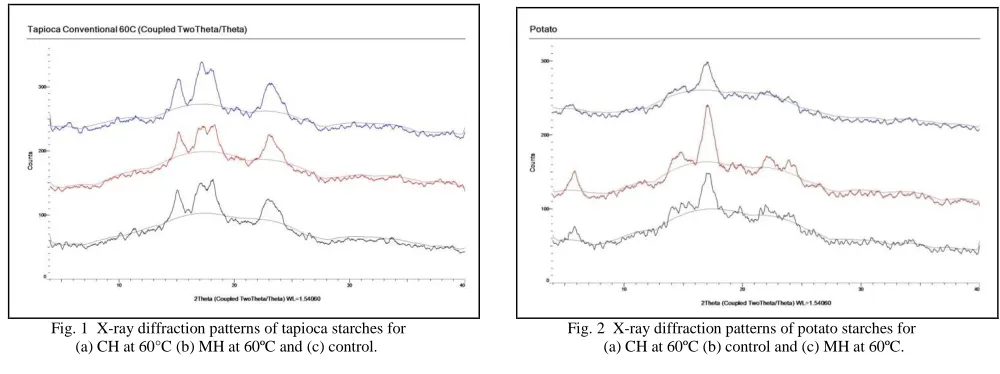
X-ray diffraction patterns can be used to study starch’s crystalline nature. Generally, X-ray patterns have can identified in native starch and if any changes occurs in crystalline upon physical and chemical treatment of granular starch the X-rays split to form the difference pattern distinctive to the crystal structure. X-ray diffraction pattern of conventional heated and microwave heated tapioca and potato starches were presented in Figure 4 and Figure 5. Native tapioca starch gave an A-type of X-ray diffraction pattern (Figure 4) while native potato starch gave a B-type X-ray diffraction pattern as typical pattern of tuber starches (Figure 5). According to results obtained, both conventional heated and microwave heated tapioca exhibit as A-type
pattern with strong peak at 2θ about 15º, 17º, 18º and 23º.
For tapioca starch, there was none obvious difference between diffraction patterns as correlated with Abraham’s [16] observation found that no differences in his experiments with tapioca starch. The tapioca starch underwent similar X-ray pattern with less marked changes.
However, there was marked differences between the diffraction patterns of heat treated of potato starch compared to native potato starch. The B-type X-ray pattern of native
potato starch with strong intensity peak at 2θ about 17º and
18º was shift to A-type with strong peak at 2θ about 15º, 17º,
18º and 23º . The divergence of result was due to the change in crystalline structure of potato starch after heat-moisture treatment. Furthermore, the shift of X-ray pattern was due to the movement of double helices in the central chain of granule and more packing arrangement of starch granule after heating. The crystal structure changed from B-type X-ray pattern to A-type X-X-ray pattern of potato starch after microwave treatment was confirms by Lewandowicz et al. [8] in their study on effect of microwave radiation on physicochemical properties and structure of potato and tapioca starches. According to Imberty and Perez [17] double helices of A and B type starches are packed in a pseudo-hexagonal array. They stated that the change in
X-ray pattern (B A+B) on heat-moisture treatment can be
attributed to dehydration or vaporization of the water molecules in the central channel of B-unit cell and movement of a pair of double helices into the central channel. Thus, the movement of double helices during heat-moisture treatment could disrupt starch crystallites and change crystalline orientation.
E. Particle Size and Distribution Analysis
Table 2 shows the mean particle size and distribution analysis of potato and tapioca starch before and after heat-treated. It is obvious that the mean diameter of control potato starch is larger than tapioca starch. Significant increase of mean diameter can be observed in sequence of control starch, conventional heated at 50ºC starch, microwave heated at 50ºC, conventional heated at 60ºC and microwave heated at 60ºC. The largest mean diameter was observed at
microwave-heated starch for both potato and tapioca starch
was 306.69 µm and 309.62 µm respectively.
The increment of mean diameter in microwave heating at 60ºC indicated the highest granule size achieved after heat-treated between both different heating. Microwave heating caused the irreversible swelling of the starch granule to a certain degree resulting in larger diameter of the granule in both tapioca and potato starch. Microwave heating shown larger granule size of heated starch compare to conventional heating and it is indicates of higher swelling power occurred in microwave heating. There was drastic increasing of mean diameter of control potato starch from conventional heated and microwave heated potato starch. This probable due to a higher content of phosphate groups on amylopectin molecules where the repulsion between these bulky phosphate groups on adjacent chains weakening the extent of bonding within the crystalline domain and therefore increase the hydration power of starch granule [18].
F. Pasting Properties
Pasting properties of control, conventional heating and microwave heating starches measured using a Rapid Visco Analyser (RVA) are summarized in Table 3.
In general, the pasting temperature of tapioca starch was higher than potato starch. The pasting temperature of conventional heated for both potato and tapioca starches increased significantly from control starch. Increment in pasting temperature after conventional heated were consistent with most of the other starches as reported for lentil, potato and yam starches by Hoover and Vasanthan [19]. It was suggested that these changes were due to the structural rearrangement of starch granule. This is because more energy needed to achieve the pasting temperature due to better packing structure and molecular bonds strength.
During heating, the degree of crystalline order and extent of starch-chain associations within the amorphous regions are altered. The heating effect enhances the pasting temperature of starch by forming better packing structure. The starch was strengthening in molecular bonds, therefore its required higher temperature to gelatinize the starch. However, the pasting temperature of the microwave-heated of both starches was significantly lower than convention-heated starches. This could due to the disruption of amorphous regions during microwave heating therefore reduce the pasting temperature. According to Jane et al.[20] the destroyed of granular integrity and changes within both the crystalline and amorphous regions caused the reduction in pasting temperature.
Fig. 1 X-ray diffraction patterns of tapioca starches for Fig. 2 X-ray diffraction patterns of potato starches for (a) CH at 60°C (b) MH at 60ºC and (c) control. (a) CH at 60ºC (b) control and (c) MH at 60ºC.
TABLEII
PARTICLE SIZE AND DISTRIBUTION OF CONTROL, CONVENTIONAL HEATED AND MICROWAVE HEATED OF POTATO AND TAPIOCA STARCHES AT DIFFERENT TEMPERATURE.
Range Distribution Diameter (µm)
Sample
(µm) to (µm) Median Mean D [n, 0.5] D [4, 3]
Potato Control 20.25a 84.90a 41.43 ± 0.39a 71.39 ± 0.21a
CH at 50°C 23.08a 277.14b 48.21 ±0.23b 97.01 ± 1.69b
CH at 60°C 43.39c 576.61d 206.91 ± 0.99d 262.18 ± 0.93d
MH at 50°C 28.92b 555.12c 76.95 ± 0.54c 192.11 ± 0.93c
MH at 60°C 60.59d 603.38e 284.21 ± 0.71e 306.69 ± 2.67e
Tapioca Control 8.76a 317.01a 17.06 ± 0.37a 104.85 ± 1.24a
CH at 50°C 8.76a 370.90b 18.76 ± 0.28a 110.28 ± 1.43b
CH at 60°C 17.59b 592.49d 225.92 ± 1.25c 267.14 ± 1.61d
MH at 50°C 10.88a 525.25c 96.07 ± 0.79b 192.41 ± 0.59c
MH at 60°C 48.41c 603.36e 285.05 ± 2.47d 309.62 ± 0.56e
*D [4, 3] is the volume of mean diameter; D (n, 0.5) is the volume median diameter and divides the distribution exactly in half; Result are expressed as mean ± standard deviation (n=3). Means within a row with different superscripts are significantly different (p<0.05).
TABLEIII
PASTING PROFILE OF CONTROL, CONVENTIONAL HEATED AND MICROWAVE HEATED OF POTATO AND TAPIOCA STARCHES AT DIFFERENT TEMPERATURE.
Sample Pasting Viscosity (RVU)
temperature (°C) Peak Viscosity Breakdown Final Viscosity Setback
Potato Control 65.40 ± 0.09b 641.03 ± 1.78c 452.61 ± 1.64d 215.31 ± 1.63a 26.89 ± 2.90b
CH at 50°C 65.67 ± 0.09b 644.52 ± 5.06c 447.72 ± 3.35d 224.70 ± 0.86b 22.47 ± 0.75a
CH at 60°C 66.23 ± 0.10c 489.31 ± 3.64a 174.00 ± 1.62b 254.03 ± 2.44d 25.31 ± 0.70ab
MH at 50°C 64.58 ± 0.03a 628.92 ± 0.88b 363.89 ± 4.87c 221.88 ± 3.36b 32.33 ± 1.61c
MH at 60°C 65.67 ± 0.51b 488.28 ± 3.25a 165.41 ± 5.65a 237.08 ± 1.72c 33.47 ± 0.79c
Tapioca Control 70.23 ± 0.03b 170.05 ± 0.88d 67.75 ± 0.22c 149.78 ± 0.39c 49.42 ± 0.09b
CH at 50°C 71.03 ± 0.06c 167.06 ± 1.01d 67.69 ± 0.77c 150.86 ± 0.35c 52.39 ± 0.56d
CH at 60°C 70.45 ± 0.43b 156.22 ± 1.54b 54.01 ± 1.18b 145.17 ± 1.46b 44.04 ± 0.69a
MH at 50°C 70.17 ± 0.03b 161.89 ± 3.60c 65.75 ± 2.47c 145.56 ± 0.55b 50.67 ± 0.59c
MH at 60°C 69.28 ± 0.08a 148.45 ± 0.21a 50.03 ± 0.41a 140.09 ± 0.52a 44.56 ± 0.17a
Besides, higher phosphorus in potato starch associated with higher peak viscosity. The peak viscosity of both heating treatment for both starches were reduce significantly (P<0.05) from control starch. The reduction of peak viscosity was due to destroyed of granular integrity, lower down the water binding capacity and reduced of the ability of starch to swell. This phenomenon related to study shown by Jane et al.[20] that peak viscosities are influenced by amylose content, extent of amylose leaching, granular swelling, friction between swollen granules, phosphate monoester content and the proportion of long amylopectin branch chains.
The breakdown viscosity is a measure of stability of starch. The breakdown viscosity of conventional heated and microwave heated for both potato and tapioca starches also decrease significantly from native starch. This result agreed by Stute [22] who found that the general effect of heat-moisture treatment on pasting properties of starch is lower peak viscosities and lesser breakdown. Thus, during heating treatment, lower breakdown viscosity due to better packing structure of heated starch and can be associated with partial gelatinization. Therefore, the microwave heated for both starches show lower breakdown viscosity compare to conventional heated starches. The reduction of breakdown viscosity suggests better packing structure of heated starch and associated with partial gelatinization occurred.
Setback viscosity is a measure of the degree of retrogradation of starch or the tendency of starch to retrograde, mainly amylose [23]. Thus, setback is commonly used to describe the increase in viscosity that occurs on cooling a pasted starch [24]. The higher setback viscosity reflects more extensive amylose leaching. There was also different trend for the setback viscosity between potato starch and tapioca starch. For potato starch, the setback
viscosity of microwave heated starches increased
significantly from control and conventional heated starches. This suggests that increased setback viscosity on microwave heated of potato starch reflects an increase in the proportion of swollen intact granules which provides increased resistance to shearing during the cooling cycle in the RVA.
Besides that, according Jayakody et al.[25] shown that
both amylose gelation and presence of rigid swollen granules embedded within the leached amylose network and influence the extent of setback. Compared to tapioca starch, the setback viscosity was decrease significantly between different temperatures of heating treatment. Besides, lower setback viscosity indicates granule extensively degraded lead to breaking down of starch granules into fragments.
G. Thermal Properties
Thermal properties of starch can be measured using differential scanning calorimeter (DCS). The DSC is common used for measured melting and thermal transitions energy. The thermal transition occurs in DSC will cause the material undergoes changes in physical state and energy absorbed by the sample is replenished by increased energy input to the sample. Thus, the energy absorbed during the transition is precisely equivalent to the energy input used to maintain the temperature balance. The thermal properties of control, convention-heated and microwave-heated potato and tapioca starches were summarized in Table 4. The
gelatinization properties include onset temperature, To; peak
temperature, Tp; conclusion temperature, Tc;and enthalpies
of gelatinization (∆H) had been measured. The differences in
gelatinization temperatures among the starches can be attributed to the interplay of three factors. According to Gunaratne and Hoover [12] the factors are molecular structure of amylopectin unit chain length, extent of branching), starch composition (amylose to amylopectin ratio, amount of lipid complex, amylose chains, phosphorus content) and granular architecture (crystalline to amorphous ratio).
The gelatinization temperature of tapioca starches were higher compared to potato starches. According to Geddes et al. [26] the small granules gelatinize at higher temperatures than larger granules. The result obtained was due to the different size between potato and tapioca starches. The
difference in Tc –To suggests that the degree of crystallites
that controlled the amorphous regions and leads to reassociation. However, there was no significant different found in tapioca starch between either convention-heated or
microwave-heated. Enthalphy of gelatinization (∆H) for both
potato and tapioca starches decreased gradually among the
starches compared to control starch. The decreases in ∆H on
conventional heated and microwave heated suggest some of the double helices present in crystalline and in non-crystalline regions of the granule may have been disrupted under the heating conditions.
There was significantly different between conventional heated and microwave heated for both potato and tapioca starch in term of reduction enthalpy of gelatinization. This suggests that the microwave heated starch were partial gelatinized based on the reduction of entalphy of gelatinization. Decreased pattern of gelatinization entalphy also indicates a partial loss of crystallinity of the starch granules during heating, degradation of some amylose content and disruption of the granule structure. This result is in accordance with the X-ray result shown changes of X-ray pattern. In regarding to granule crystalline regions, heated starch exhibit upward shift in gelatinization temperature and
decrease the entalphy27. The melting temperatures (To, Tp,
and Tc) of the starch crystallites are controlled indirectly by
the surrounding amorphous region12 The higher temperature
would determined higher energy required to melt crystallites
of heated starch. Thus, increase in To, Tp and Tc indicates
there were reduce the destabilization effect of the amorphous region on crystallite melting.
H. Swelling and Solubility
Solubility represents the amount of solubilized starch molecules at a certain temperature. Solubility is reduced by heat-moisture treatment. There was significantly reduction of solubility shown in both potato and tapioca starches. This suggested during heat treatment, the added water acted as plasticizer and promoted the interaction between amylose and amylopectin branches resulted in a denser granule structure and cause a drop in solubility in potato starch. Besides that, the decrease in solubility upon heat-moisture treatment has found to be consistent with studies on true yam, tapioca and Taro starches [12]. The decreases of solubility was due to starch disruption that cause the starch cannot take or bind with water thus low the solubility of the heated
starches.
IV.CONCLUSIONS
There is present of characteristic changes on
physicochemical and functional properties of heated starch for both heating methods. However, microwave heating method gave higher affect on heating treatment rather than conventional heating. The microwave heating was effective to facilitate rapid processing of heat-moisture treatment of starch because required shorter time to achieve similar changes on starch properties. Microwave heating was evidenced in affecting pasting properties of starch by increase the pasting temperature and the paste stability. Moreover, there was significantly increased the amylose content and swelling power but reduced the solubility and
enthalpy of gelatinization (∆H). There were changes in
granule structure of starch observed by loss of birefringence and ruptures granule in SEM micrographs and in light microscopy. A change in the X-ray diffraction pattern from B-type to A-type was occurred in potato starch but tapioca starch shows no changes in X-ray pattern. All these changes of physicochemical and functional properties of heated starch were markedly observed at 60°C of heating temperature during microwave heating. Tapioca starch underwent similar effect as potato starch but less marked changes. Microwave heating reduced the gelatinization temperature of tapioca starch and showed different trend of pasting property as compared to potato starch. This proven that microwave heating methods has different effect on different tuber and root starches. Thus, information from this study can be used for greater purpose in future utilize for modified starch. Microwave heating can be used as one type of heat-induced gelatinization in food industrial processing.
ACKNOWLEDGMENT
This work was supported by Universiti Sains Malaysia (USM), Penang, Malaysia and funded by Short term Grant 304/PTEKIND/6311131.
REFERENCES
[1] N. Lideboom, R. Chang, and R. Tyler, Analytical, biochemical and physicochemical aspects of starch granule size, with emphasis of small granule starches: A review. Starch/Stärke, 56, 89-99, 2004 [2] R. Hoover, Composition, molecular structure,a nd physicochemical
properties of tuber and root starches: a review. Carbohydrate Polymer, 45, 253-267, 2001
[3] G. Sumnu, A review on microwave baking of foods. International Journal of Food Science and Technology, 36, 117-127, 2001 [4] O. Daglioglu, M. Tasan, and B. Tunnel, Effects of microwave and
conventional baking on the oxidative stability and fatty acid
composition of puff pastry. Journal of the American Oil Chemists Society, 77, 543-545, 200
[5] R. Rajkó, G. Szabó, C. Vidal-Valverde, and E. Kovács, Designed experiments for reducing antinutritive agents in soybean by microwave energy. Journal of Agricultural and Food Chemistry, 45, 3565-3569, 1997
[6] A. K. Andersen, and H. Guraya, Effect of microwave heat-moisture treatment on properties of waxy and non waxy rice starches. Food Chemistry, 97, 318, 2006
[7] B. J. Zylema, J. A. Grider, J. Gordon, and E. A. Davis, Model wheat starch systems heated by microwave irradiation and conduction with equalized heating times. Cerel chemistry, 62, 447-453,1985 [8] G. Lewandowicz, J. Fornal, and A. Walkowski, Effect of microwave
radiation on physic-chemical properties and structure of potato and tapioca starches. Carbohydrate Polymers, 34, 213-220, 1997 [9] T. Palav, and K. Seetharam, Impact of microwave heating on the
physic-chemical properties of a starch-water model system. Carbohydrate Polymers, 67, 596-604, 2006
[10] S. J. McGrance, H. J. Cornell, and C. J. Rix, A Simple and Rapid Colourimetric Method for the Determination of Amylose in Starch products. Starch/Stärke, 50, 158-1631998
[11] T. J. Schoch, Swelling Power and Solubility of Granular Starches. In: Methods in Carbohydrate Chemistry, Whistler, R.L., R.J. Smith and J.N. BeMiller (Eds.). Vol. 4. Academic Press, New York, USA., pp: 106-108, 1964
[12] A. Gunaratne, and R. Hoover, Effect of heat-moisture treatment on the structure and physicochemical properties of tuber and root starches. Carbohydrate Polymers, 49, 425-437, 2002
[13] V. P. Yuryev, L. A. Wasserman, N. R. Andreev, and V. B. Tolstoquzov, Structural and thermodynamic feartures of low- and high amylose starches. A review. In V. P. Yuryev, A. Cesaro, & W. J. Bergthaller (Eds.), Starch and starch containing origins: Structure, properties and new technologies, 23-55. New York: Nova Science Publishers, Inc. 2002
[14] W. S. Ratnayake, R. Hoover, & T. Warkentin, Pea starch: Composition, structure & properties, Starch-Starke, 54(6), 217-234, 2002
[15] A. Kawaba, N. Takase, E. Miyoshi, S. Sawayama, T. Kimura, and K. Kudo, Microscopic observation and X-ray diffraction of heat-moisture treated starch granules. Starch/Starke, 46, 463-469, 1994 [16] T. E. Abraham, Stabilization of paste viscosity of cassava starch by
heat moisture. Starch/Starke, 45. 131-135, 1993
[17] A. Imberty, and S. Perez, A revisit to the three-dimensional structure of B-type starch. Biopolymers, 27, 1205-1221, 1989
[18] T. Galliard, and P. Bowler, Morphology and composition of starch, in T. Galliard (Ed.), Starch properties and potential, Chichester: Wiley, pp. 57-78, 1987
[19] R. Hoover, and T. Vasanthan, Effect of heat-moisture treatment on the structure and physicochemical properties of cereal, legume, and tuber starches. Carbohydrate Research International, 37, 497-503, 1994
[20] J. Jane, Y.-Y Chen, L. F. Lee, A. E. McPherson, K. S. Wong, M. Radosavljevic, and T. Kasemsuwan, Effects of amylopectin branch chain-length amylose content on the gelatinization and pasting properties of starch. Cereal Chemistry, 52, 555-559, 1999
[21] Y. S. Kim, D. P. Wiesenborn, J. H. Lorenzen, and P. Berglund, Suitability of edible bean and potato starch noodles. Cereal Chemistry, 73, 302-308, 1996
[22] R. Stue, Hydrothermal modification of starches: The different between annealing and heat-moisture treatment. Starch/Starke, 44, 205-214, 1992
[23] A. A. Karim, M. H. Norziah, and C. Seow, Methods for study of starch retrogradation. Food Chemistry, 71, 9-36, 2000
[24] D. K. Fisher, and D. B. Thompson, Retrogradation of maize starch after thermal treatment within and above the gelatinization temperature range. Cereal Chemistry, 74, 344-351, 1997
[25] L. Jayakody, R. Hoover, Q. Liu, and E. Donner, Studies on tuber starches. II. Molecular structure, composition and physicochemical properties of yam (Dioscorea sp) starches grown in Sri Lanka. Carbohydrate Polymers, 69, 148-163, 2007
[26] R. Geddes, C. T. Greenwood, and S. Mackenzie, Studies on the biosynthesis of starch granules. Carbohydrate Research, 1, 71-82, 1965