Vol. 48, No. 2, Fall 2016, pp. 71-79
Please cite this article using:
Abdolmaleki, B., Baghery, K., and Emadi, M. J., 2016. “HMAC-Based Authentication Protocol: Attacks and Improvements”. Amirkabir International Journal of Electrical and Electronics Engineering, 48(2), pp. 71–79.
DOI: 10.22060/eej.2016.817
URL: http://eej.aut.ac.ir/article_817.html
*Corresponding Author, Email: [email protected]
HMAC-Based Authentication Protocol: Attacks and
Improvements
B. Abdolmaleki1, K. Baghery1, M. J. Emadi2,*
1- M.Sc. Student, Information Systems and Security Laboratory (ISSL), Sharif University of Technology 2- Assistant Professor, Department of Electrical Engineering, Amirkabir University of Technology
(Received 11 October 2015, Accepted 3 February 2016)
As a response to a growing interest in RFID systems, such as the Internet of Things technology along with satisfying the security of these networks, proposing secure authentication protocols is an indispensable part of the system design. Hence, authentication protocols to increase security and privacy in RFID applications have gained much attention in the literature. In this study, security and privacy of the recent well-known HMAC-based RFID mutual authentication protocol is analyzed. We prove that this protocol is not secure against various attacks and also does not provide untraceability. Also, in order to improve the performance of the mentioned protocol and enhance the security of RFID users, a more effective and secure authentication HMAC-based protocol is presented. Furthermore, security of our protocol is
explored against different attacks, such as the replay attack, the tag’s ID exposure, the spoofing attack,
DoS attack and traceability attack. It is shown that our proposed protocol is safe against the attacks. Finally, the security of the presented protocol is compared with some well-known related protocols.
KEYWORDS:
RFID Systems, Authentication Protocols, HMAC, Security Analysis
1- Introduction
Nowadays, as the demand for highly secure
Radio Frequency Identification (RFID) systems is
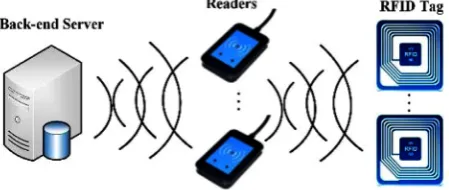
increasing, enhancing security and privacy in RFID applications become more important [1-5]. Fig. 1 depicts a typical RFID system which includes a tag, reader and back-end server. Note that each RFID tag
has the unique Identification (ID) code and there is not
any limitation on the number of tags in an implemented RFID system. Basically, an RFID tag has a memory which contains specialized secret keys and various cryptography functions and operators such as one-way Hash, Cyclic Redundancy Check (CRC), and pseudo Random Number Generator (PRNG) which PRNG is unique for each tag. For instance, PRNGij shows the
j-th invocation of the PRNG of the tag i. Note that, for the two given values PRNGij and PRNG
ik, deciding
whether i=j is computationally difficult for any input
of PRNG [6]. During the authentication process, the
reader first sends data to the tag and requests to access the tag’s information. After successful identification
processes, the tag responses to the reader. Next, the reader forwards the received data to the back-end server to identify the tag. Then, the back-end server authenticates both the tag and the reader. Finally, after some authentication process between the tag, the reader, and the back-end server, the reader could retrieve corresponding data from a database of the back-end server [7].
Since the RFID systems are generally low cost, they may suffer from privacy and security threats. In order to overcome these problems, there are two
main schemes. The first is a physical method and
the other one is encryption method. Cryptology methods havegained much attention due to their low cost. These days, most of the RFID systems are using cryptology methods that include dynamic ID and static ID mechanisms. In static ID mechanism,
the tag maintains itself as an identifier in all sessions
of the authentication process, but in the dynamic ID
mechanism, the tag identifier will change. Some of the
protocols using static ID mechanism are considered by Jung et al.’s [5], Cho et al.’s [8], Cho et al.’s [9] and Wang et al. [1]. In this study, we also use the static ID mechanism.
In this paper, we first analyze the security and
the privacy of keyed-Hash Message Authentication Code (HMAC)-based RFID mutual authentication protocol which is introduced by Jung et al. in [5]. This protocol is based on HMAC, and it is assumed that the communications channel between the reader and the back-end server is secure, but the communications channel between the reader and the tag is not a secure one. In Jung et al.’s protocol, the authors claimed that their protocol is secure against most of the famous attacks. In this paper, it is argued that the protocol has some weaknesses and is not safe against most of the attacks at all. Furthermore, in order to improve the performance of this protocol and increase the security of the user, we propose a more effective and secure authentication protocol. The presented scheme is also based on HMAC. Similarly, in the proposed protocol, we assume a secure communications channel between the reader and the back-end server, but the communications channel between the reader and the tag is not secure. In the presented protocol, a Hash function of the tag ID is eXclusive-OR (XOR)-ed by a random number that is concatenat(XOR)-ed with another random number, thus the security of the recommended protocol is very high and the attacker could not compute the secret values. In addition, it is proved that the new protocol is secure against various attacks and also provides user privacy. Ultimately, the security of our protocol is compared with some known protocols.
The remainder of the paper is organized as follows: section II reviews several threats for RFID systems. The HMAC-based authentication protocol which is studied by Jung et al. is introduced in section III. The weaknesses of Jung et al.’s protocol are analyzed in section IV. Section V presents our proposals. In section VI, the security and privacy of the improved protocol are investigated, and also the performance of the protocol is compared with other related protocols. Finally, we conclude the paper in section VII.
2- Overview of RFID attacks and threats
In RFID systems and their applications, the security problem is one of the most important challenges. In this section, some of the well-known
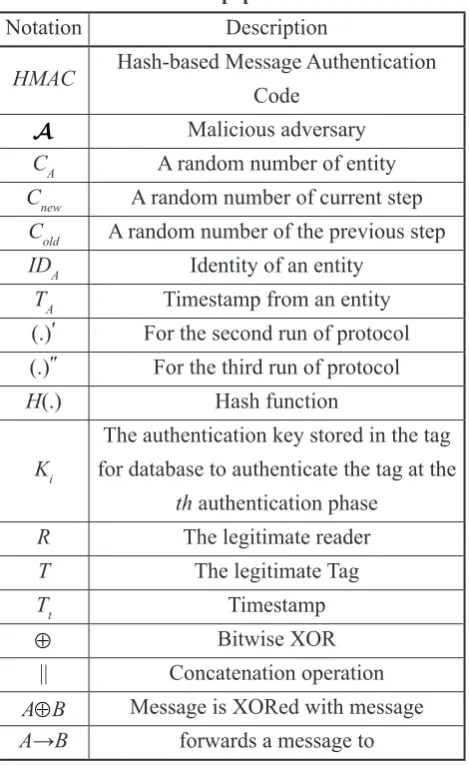
Table 1. Summarizes the notations used throughout the paper
Notation Description
HMAC Hash-based Message Authentication Code
Malicious adversary
CA A random number of entity Cnew A random number of current step Cold A random number of the previous step IDA Identity of an entity
TA Timestamp from an entity (.)׳ For the second run of protocol (.)״ For the third run of protocol
H(.) Hash function
Ki
The authentication key stored in the tag for database to authenticate the tag at the
th authentication phase R The legitimate reader
T The legitimate Tag
Tt Timestamp
⊕ Bitwise XOR
|| Concatenation operation A⊕B Message is XORed with message
A→B forwards a message to
attacks and threats that RFID systems are vulnerable
to them are introduced briefly.
2- 1- Information leakage
In RFID systems, when the tag and the reader want to send messages to each other, if the communications channel between the tag and the reader is not safe, this signaling could be eavesdropped by an adversary. Therefore, it is necessary to guarantee that the user authentication protocol must be secure against eavesdropper. That is, the sent data between the tag and the reader should not leak any secret information to illegitimate parties [10].
2- 2- Tag tracing and tracking
Tag tracing and tracking are two major issues in RFID systems. In the tag tracking, in order to recognize the tag’s behavior, an attacker can track the
tag by the use of tag identifier. Also, in the tag tracing,
an attacker can trace the location of the user using
the tag identifier. Therefore, in the authentication
protocol design, untraceability is too important. In other words, it is important when the tag and the reader send signals to each other, the adversary could not eavesdrop the transmitted message [11] and [12].
2- 3- Denial-of-Service attack
Message blocking attack or Denial-of-Service (DoS) attack is another attack on RFID systems. In this case, the attacker tries to block the sent messages between the tag and the reader. DoS attack causes de-synchronization between the tag, the reader, and the end server. De-synchronization causes the back-end server and the tag could not recognize each other in the next steps [13] and [14].
2- 4- Replay attack
The replay attack occurs when an attacker tries to obtain transmitted messages between the tag and the reader using eavesdropping. Consequently, after obtaining the message by the attacker, the attacker replays it to the tag or the reader. It means that the attacker uses the obtained message to impersonate a legitimate reader or a legitimate tag [15].
2- 5- Tag impersonation attack
Tag impersonation attack occurs when an attacker is between a reader and the tag, and the attacker tries to impersonate a reader to receive a response from the tag. The attacker plays this role by sending an impersonated query to the tag. Then, an attacker sends the obtained response to the reader to impersonate the tag [13].
3- Review of Jung et al.’s protocol
Recently, Jung et al. proposed an HMAC-based RFID authentication protocol with minimal retrieval at the server [5]. Jung et al.’s protocol is based on the HMAC technique; see Fig. 2 for the whole procedure
of the protocol involves five steps as follows.
Step 0: Enrollment phase
a) The following values are shared by the tag and
the back-end server;
• C0: A random number
• HMAC function • k: a secret key
• IDt: tag identifiers
Fig. 2. The Junget al.’s protocol [5]
Step 1: Hello
The reader transmits a hello message for the tag with his/her ID (IDr).
Step 2: Response of the tag
a) The tag T generates random number C1 independent of the other one.
b) Then, the tag computes the following
parameters and transmits them to the reader;
• IDt⊕C0 • k⊕C0⊕C1
• a=HMCAIDt(Tt,IDr)
• IDr and Tt.
Step 3: The tag authentication
a) First, the reader sends IDt⊕C0, k⊕C0⊕C1, IDr and Tt to the back-end server.
b) Secondly, the back-end server matches IDt
⊕C0 with the first part of the received message and obtains <IDt,IDt⊕C0> with IDt⊕C0 and use them to extract IDt.
c) After that, the back-end server calculates a׳=HMCAIDt(Tt,IDr) and C1=k⊕C0⊕C1k⊕C0.
d) Then, the back-end server checks whether a׳=a or not.
e) Next, β=HMACIDt(Tt+1,IDr,C1) is calculated by the back-end server and is sent back to the reader.
f) Finally, β it is transmitted to the tag by the reader.
Step 4: The back-end server authentication
a) Firstly, β׳=HMACIDt(Tt+1,IDr,C1) is calculated by the tag using his/her Tt, C1 and the received IDr.
b) The tag checks whether β׳=β or not. If β׳=β,
then the authentication of the back-end server is
confirmed by the tag.
Step 5: Update C1
After the successful authentication process at the tag and the back-end server, the tag and the back-end
server substitute <IDt,k,IDt⊕C0> with <IDt,k,IDt⊕
C1> and in the next session IDt⊕C1 will be used.
4- Vulnerabilities of Jung’s protocol
In this section, we analyze the Jung et al.’s protocol and present some weaknesses of the protocol. In [5], the authors claimed that their protocol is secure against replay, eavesdropping, DoS and impersonation attacks. In the following, we prove that not only their protocol suffers from several threats such as replay, eavesdropping, DoS and impersonation attacks but also it does not provide privacy, and the adversary could track the tag. These attacks are analyzed as follows:
4- 1- Eavesdropping and impersonation attack In this subsection, an impersonate attack against the Jung et al.’s protocol is studied. This attack consists of two phases; a learning phase and the attack phase.
• Attack phase
In this phase, an attacker plays the reader role and performs the following steps;
- The attacker transmits IDr to the tag
- The tag responses as;
a) The tag selects a random number C2 b) The tag computes IDt⊕C1, k⊕C1⊕C2, IDr, T׳t and a=HMCAIDt(T׳t,IDr) and transmits them to the spoofed reader or the attacker.
- Using IDt⊕C0,k⊕C0⊕C1 which are obtained
from the first step, and IDt⊕C1 received from the tag, the attacker computes the secret key as: k=IDt⊕C1⊕
IDt⊕C0⊕k⊕C0⊕C1.
- Using IDt⊕C1, k⊕C1⊕C2 that are received in the second step, and computed in the previous phase, the attacker computes IDt⊕C2=IDt⊕C1⊕k⊕C1⊕C2⊕k.
- In this phase, the attacker changes the
received messages from the tag, IDt⊕C1, k⊕C1⊕
C2, IDr, T׳t, HMCAIDt(T׳t,IDr) to IDt⊕C1, k, IDr, T׳t, HMCAIDt(T׳t,IDr). Now the attacker plays the role of the tag and transmits these messages to the reader and the reader forwards them to the back-end server.
- The tag authentication
a) The back-end server matches IDt⊕C1 with the
first part of the received message and obtains <IDt,IDt
⊕C1> and IDt⊕C1 and utilize them to extracts IDt.
b) The back-end server calculates a׳=HMACIDt(T׳t,IDr) and C2=k⊕k⊕C1.
c) Then, the back-end server checks whether a׳=a or a׳≠a.
d) Next, β=HMACIDt(T׳t+1,IDr,C2) is calculated by the back-end server and is sent back to the reader.
At the end, the back-end server updates <IDt,k,IDt⊕
C1> with <IDt,k,IDt⊕C2> for the next session. Note that from now, the value of C2 is equal to C1 in the back-end server.
- When the reader wants to send the received
message from the back-end server to the tag, the attacker blocks the transmitted message from the reader and stops the rest of protocol run. Then, the attacker impersonates the tag and transmits IDt⊕C1, k, IDr, T׳t, HMCAIDt(T׳t,IDr) to the back-end server, and the back-end server authenticates the attacker and
updates <IDt,k,IDt⊕C1> with <IDt,k,IDt⊕C1> for the next session.
Note that, after this session the attacker can impersonate the tag by transmitting IDt⊕C1, k, IDr, T׳t, HMCAIDt)(T׳t,IDr) to the back-end server.
4- 2- DoS attack
In this subsection, a DoS attack against the Jung’s protocol is presented. In this attack, after running three steps of the protocol, when the reader wants to transmit a message to the tag, the attacker intercepts the transmitted message to the tag. Therefore, the
back-end server is updated <IDt,k,IDt⊕C0> with
<IDt,k,IDt⊕C1> but the tag does not update its information. Hence, in the next session of protocol, the back-end server cannot authenticate the tag.
4- 3- Replay attack and privacy problem
In [5], the authors claimed that their protocol is secure against the replay attack and the privacy of this protocol is provided. In this subsection, we prove that their protocol is not secure against the replay attack and the tag could be tracked by the attacker. In the following, two traceability attacks are provided.
4- 3- 1- First traceability attack
In this attack, the attacker performs two following phases:
• Learning phase: After two successful runs, the attacker achieves IDt⊕C0, k⊕C0⊕C1, IDt⊕C1, k
⊕C1⊕C2 by eavesdropping. Afterwards, using these messages, the attacker computes k=IDt⊕C1⊕IDt⊕C0
⊕k⊕C0⊕C1. With the use of k, the attacker obtains
γ=IDt⊕C1⊕k⊕C1⊕C2⊕k.
• Attack phase: The attacker plays the role of the reader and performs the following operations;
- The tag responses IDt⊕C2, k⊕C2⊕C3, IDr, Tt״ and HMACIDt(Tt״,IDr) to the attacker.
- After two successful runs of protocol, the tag updates with <IDt,k,IDt⊕C2> and the attacker observes γ=IDt⊕C2. Therefore, the attacker tracks the tag.
4- 3- 2- Second traceability attack
This attack consists of the two following phases.
• Learning phase: After running three steps of the protocol, the attacker obtains γ1=IDt⊕C0, k⊕C0⊕
C1, IDr, Tt and a=HMCAIDt(Tt,IDr). When the reader transmits the message to the tag, the attacker blocks the transmitted message to the tag. Therefore, the tag does not update its data.
following operations:
- The attacker sends a hello message, IDr to the tag
- The tag responses γ2=IDt⊕C0, k⊕C0⊕C1, IDr, Tt and HMACIDt(Tt,IDr) to the attacker. Note that because of the interception done by the attacker in the learning phase, the tag does not update its database, thus the values of γ1 and γ2 are the same. Therefore the attacker could track the tag easily.
In summary, we proved that the protocol suggested in [5] is not secure at all. In the following section, we improve the protocol to overcome all the mentioned vulnerabilities.
5- Proposed protocol
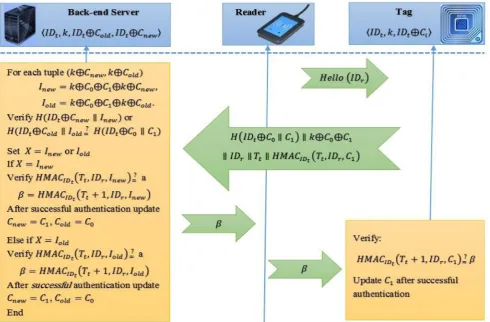
In this section, an improved version of the Jung’s protocol is presented which eliminates all the above weaknesses. The summary of the proposed protocol is presented in Fig. 3. We show that our protocol is secure against all of the attacks and provide forward secrecy and untraceability attacks. The suggested
protocol consists of five steps as follows:
Step 0: Initialization phase
a) The following values are shared by the tag and
Fig. 3. The proposed protocol
the back-end server;
• Cold: A random number
• HMAC function • k: a secret key
• IDt: tag identifiers.
b) Then, a triple of <IDt,k,IDt⊕Cold,IDt⊕Cnew> is saved in the database of the back-end server, and,
c) A triple of <IDt,k,IDt⊕Cold> is saved in the database of the tag.
Note that in this phase Cnew and Cold are the same. Step 1: Hello
This phase is the same as Jung’s protocol. Step 2: Response of tag
a) A random number C1 is selected by the tag
b) The tag computes H(IDt⊕C0||C1), k⊕C0⊕C1, IDr, Tt and a=HMACIDt(Tt,IDr,C1), then sends them to the reader.
Step 3: The tag authentication
a) The reader sends H(IDt⊕C0||C1), k⊕C0⊕C1, a, IDr, and Tt to the back-end server.
b) With the use of k⊕Cnew and k⊕Cold, the back-end server computes
c) Then, the back-end server computes H(IDt⊕
Cnew||Inew) and H(IDt⊕Cold||Iold) using Inew and Iold.
d) The back-end server checks whether H(IDt⊕
Cnew||Inew) or H(IDt⊕Cold||Iold) matches with H(IDt⊕
C0||C1) received in the first phase of this step. In order to find a match, this process is done for both H(IDt⊕
Cnew||Inew) and H(IDt⊕Cold||Iold). The matched one will set value as Inew or Iold. Note that the value of (Inew or Iold) X is saved as a random number in the tag.
1) If X=Inew, the back-end server computes HMACIDt(Tt,IDr,Inew) and compares it with the received a and authenticate the tag. Then, computes
β=HMACIDt(Tt+1,IDr,Inew) and sends it β to the reader. Finally, the reader sends it to the tag.
2) If X=Iold, the back-end server computes HMACIDt(Tt,IDr,Iold) and compares it with the received a and authenticate the tag. Then, computes
β=HMACIDt(Tt+1,IDr,Iold) and sends it to the reader. Finally, the reader sends it β to the tag.
Step 4: The back-end server authentication This phase is the same as Jung et al.’s protocol. Step 5: Update Ci
a) After the successful authentication at the tag
and the back-end server, if X=Inew is used, the
back-end server and the tag update, and replace <IDt,k,IDt
⊕C0> with <IDt,k,IDt⊕C1>.
b) Otherwise, the back-end server and the tag use
the previous values.
6- Security analysis
In this section, the security of the proposed protocol against various attacks described in section IV is analyzed. Similar to [5], we assume that communications channel between the reader and the back-end server is secure but the communications channel between the reader and the tag is not secure.
6- 1- Eavesdropping
Although, the attacker can eavesdrop H(IDt⊕
C0||C1), k⊕C0⊕C1, IDr, Tt and HMACIDt(Tt,IDr,C1),but, because of using the Hash function and the XOR operator, the security of the proposed protocol is very high and the attacker could not compute the secret values. Therefore, the proposed protocol is secure against the eavesdropping.
6- 2- DoS attack
In this case, the attacker tries to block the sent message between the tag and the back-end server.
But due to the use of IDt⊕Cold and IDt⊕Cnew at the back-end server, if an attacker blocks the protocol, he/she could not perform DoS attack. As a result, the proposed protocol is secure against DoS attack and the attacker is not able to cause de-synchronization between the tag and the back-end server.
6- 3- Replay attack
In the replay attack, the attacker tries to impersonate the tag and the reader to access the transmitted messages, modify, and even delete them [16]. In the proposed protocol, because of generating a new random number in each session and utilizing a Hash of it, our suggested protocol provides a strong resistant against the replay attack.
6- 4- Tag impersonation
In order to impersonate a legitimate tag, the attacker tries to use the secret keys IDt and k/or two consecutive tag’s response. In the proposed protocols, the secret key IDt is protected by a hash function and the attacker does not have access to it directly. In addition, due to the use of a random number Ci in each run of the protocol, the dependency between different parts of two consecutive tag’s responses is omitted. By applying these changes, the attacker cannot use the responses of the two consecutive run of the protocol to impersonate the legitimate tag.
6- 5- Privacy
In the proposed protocol, the tag ID is XOR-ed with an old random number and the result is concatenated with another new random number. Then, the Hash function is applied which results in H(IDt⊕Cold||Cnew). Therefore, the privacy of our proposed protocol is high and the attacker could not trace the tag. Note that the values of Cold and Cnew are updated after each successful session and only the back-end server and the tag know the values of IDt, Cold and Cnew.
Table 2. Security analysis comparison
Protocols
Threats [17] [18] [19] [8] [5]
Proposed Protocol Eavesdropping × × § × × §
Spoofing Attack § § § × × §
DoS Attack § × × × × § Replay Attack × × § × × § Untraceability § § × § × § §: Secure ×: Insecure
7- Conclusion
In the paper, the security and the privacy of HMAC-based RFID mutual authentication protocol studied by Jung et al. is analyzed. Although the authors claimed that this protocol is secure against various attacks, we proved that their protocol is not secure against most of the well-known attacks and also does not provide untraceability. To improve the performance of the mentioned protocol and increase the security of the users, we proposed a more effective and secure authentication protocol. In additions, the security, and privacy of our protocol are investigated against various attacks. The analyses showed that the protocol is safe against the well-known attacks and provide users’ privacy. Finally, the security and the privacy comparisons with other protocols claims that our protocol outperforms the other recent protocols.
8- References
[1] Wang, S. P.; Ma, Q. M.; Zhang, Y. L. and Li, Y. S.; “A HMAC-Based RFID Authentication Protocol,” in 2nd International Symposium on Information
Engineering and Electronic Commerce (IEEC), pp. 1–4, 2010.
[2] Baghery, K.; Abdolmaleki, B. and Emadi, M. J.; “Game-Based Cryptanalysis of a Ligthwigth CRC-Based Authentication Protocol for EPC Tags,” Amirkabir International Journal of Electrical and Electronics Engineering (AIJ-EEE), Vol. 46, No. 1, pp. 27–36, 2014.
[3] Ren, X.; Xu, X. and Li, Y.; “An One-Way Hash Function Based Lightweight Mutual Authentication RFID Protocol,” Journal of Computers, Vol. 8, No. 9, pp. 2405–2412, 2013.
[4] Asadpour, M. and Dashti, M. T.; “A
Privacy-Friendly RFID Protocol Using Reusable Anonymous Tickets,” in 10th International Conference on
Trust, Security and Privacy in Computing and Communications, Changsha, pp. 206–213, 2011. [5] Jung, S. W. and Jung, S.; “HMAC-Based RFID Authentication Protocol with Minimal Retrieval at Server,” in The 5th International Conference on
Evolving Internet, pp. 52–55, 2013.
[6] Tsudik, G.; YA-TRAP: Yet Another Trivial RFID Authentication Protocol,” in 4th Annual IEEE
International Conference on Pervasive Computing and Communications Workshops, 2006.
[7] Zhang, X.; Cheng, L. and Zhu, Q.; “Improvement of Filtering Algorithm for RFID Middleware Using KDB-tree Query Index,” Journal of Software, Vol. 6, No. 12, pp. 2521–2527, 2011.
[8] Cho, J. S.; Yeo, S. S. and Kim, S. K.; “Securing Against Brute-Force Attack: A Hash-Based RFID Mutual Authentication Protocol Using a Secret Value,” Computer Communication, Vol. 34, No. 3, pp. 391–397, 2011.
[9] Cho, J.; Kim, S. C. and Kim, S. K.; “Hash-Based RFID Tag Mutual Authentication Scheme
with Retrieval Efficiency,” in 9th IEEE Internation
Symposium on Parallel and Distributed Processing with Applications, pp. 324–328, 2011.
[10] Van-Deursen, T. and Radomirovic, S.; “Attacks on RFID Protocol,” Cryptology ePrint Archive, 2008. [11] Phan, R.; “Cryptanalysis of a New Ultralightweight RFID Authentication Protocol-SASI,” IEEE Transactionson Dependable and Secure Computing, Vol. 6, No. 4, pp. 316–320, 2009.
[12] Lim, C. H. and Kwon, T.; “Strong and Robust RFID Authentication Enabling Perfect Ownership Transfer,” in Proceedings of ICICS’06, LNCS 4307, pp. 1–20, 2006.
[13] Piramuthu, S.; “Lightweight Cryptographic Authentication in Passive RFID-Tagged Systems,” IEEE Transactions on Systems, Man and Cybernetics, Vol. 38, No. 3, pp. 360–376, 2008.
[14] Peris-Lopez, P.; Hernandez-Castro, J. C.; Estevez-Tapiador, J. M. and Ribagorda, A.; “Vulnerability Analysis of RFID Protocols for Tag Ownership Transfer,” Computer Networks, Vol. 54, pp. 1502–1508, 2010.
“Lightweight Mutual Authentication and Ownership Transfer for RFID Systems,” IEEE INFOCOM, pp. 251–255, 2010.
[16] Liu, H. and Ning, H.; “Zero-Knowledge Authentication Protocol Based on Alternative Mode in RFID Systems,” IEEE Sensors Journal, Vol. 11, No. 12, pp. 3235–3245, 2011.
[17] Lim, J.; Oh, H. and Kim, S.; “A New Hash-Based RFID Mutual Authentication Protocol Providing Enhanced User Privacy Protection,” in Information Security Practice and Experience, Springer Berlin
Heidelberg, pp. 278–289, 2008.
[18] Lee, Y. C.; Hsieh, Y. C.; You, P. S. and Chen, T. C.; “An Improvement on RFID Authentication Protocol with Privacy Protection,” in 3rd International
Conference on Convergence and Hybrid Information Technology, South Korea, Busan, 2008.
[19] Wang, S.; Ma, Q. M.; Zhang, Y. L. and Li, Y. S.; “A HMAC-Based RFID Authentication Protocol,” in 2nd International Symposium on Infromation
![Fig. 2. The Junget al.’s protocol [5]](https://thumb-us.123doks.com/thumbv2/123dok_us/17004.2001717/4.595.44.540.73.314/fig-the-junget-al-s-protocol.webp)