A
pplied
R
esearch on
E
nglish Language
V. 5 N. 1 2016 pp: 99- 120
http://uijs.ui.ac.ir/are
___________________________________________ *Corresponding Author.
Long-term Utilization of Interaction by Young EFL Learners:
The Effects of Strategy Training
Mohammad Mahdi Hajmalek
1*, Ehsan Majidifard
2, Omid Rikhtegar
31 Khatam University, Department of English Language, Tehran, Iran 2 Allameh Tabataba'i University, Tehran, Iran
3 Iran Language Institute, Urmia Branch, Urmia, Iran
Abstract: The bulk of research within the interactionist framework seems to be consensually pointing to the beneficial effects of interaction in SLA. However, few studies have investigated the role of training in providing and perceiving interactional feedback, especially among young learners. This study probed the effects of training prior to engagement in interaction in case of young learners acquiring polar questions in an EFL context. Sixty learners aged 9-14 in three intact groups were exposed to instruction followed by peer interaction in case of the experimental groups while the control group simply received traditional teacher-fronted practice. Also, while one treatment group received prior training in interactional feedback strategies, the other group did not. The pre-test, immediate post-test, and delayed post-test were administered. The results of mixed between-within subjects ANOVA (SPANOVA) showed that engaging in interaction, regardless of any prior training, could significantly improve learners’ immediate mastery over the target form. However, in the long run, only the group trained in feedback strategies could maintain its superiority over the control group. The findings suggest that although engaging in peer interaction can be beneficial for young learners, sustained interlanguage development can result only if learners are trained in feedback strategies.
100 Applied Research on English Language
Introduction
Interaction has attracted a great deal of attention in studies of Second Language Acquisition
(SLA) ever since the traditional enthusiasm with the exaggerated role of input began to be
challenged. This trend was launched with a series of pioneering studies by Long (1981, 1983)
who analyzed the talk directed to L2 learners by native speakers (NSs) and the interaction in
which they engaged. While acknowledging the necessity condition for input, new findings
started to contradict the sufficiency condition for input as implied by, among others,
Krashen’s input hypothesis (1982). Schmidt (1990, 1993), for instance, proposed that the mere exposure to input may not be beneficial unless “noticing” occurs and input is transformed into “intake” or is “consciously registered” (p.130). Therefore noticing, defined as “the mechanism by which learners, after sensitization to a particular structure, spot such structure (or its absence) in subsequent natural input” (Fotos, 1993, p. 383) is speculated as a
pre-requisite for the process of language learning and a proposition to challenge the
sufficiency condition for input. Another trend which questioned the dominance of input in the
field of SLA in 1990s was Swain’s (1995) Output Hypothesis which was intended to shift the
focus from the adequacy of input to the benefits of output, encompassing a learner’s
production. Swain (1995, 2000) highlighted the role of output as a supplement to input.
Finally, building on the arguments put forth by Schmidt (1990, 1993), Swain (1995),
and earlier interactionist research, Long (1996) presented an updated version of his
Interaction Hypothesis (Long, 1983), forming another building block in arguments
endeavouring to improve or redefine the notion of input in SLA. Among different accounts of
SLA processes that have been put forward in recent decades, the Interaction Hypothesis
(Long, 1996) emphasizes the strong connection between learners’ engagement in
conversational interaction and second language acquisition based on negotiation of meaning.
According to Richards and Schmidt (2002), this hypothesis claims that “the language
acquisition requires or at least greatly benefits from interaction, communication and
especially negotiation of meaning, which takes place when interlocutors attempt to overcome
problems in conveying their meaning, resulting in both additional input and useful feedback
on the learner’s own production” (p. 264). As Garcia Mayo and Alcon Soler (2013) remind us, the process of acquisition is held to be facilitated by a learner’s participation in
meaningful conversational interaction with other learners or native speakers, featuring several
instances of conversational and linguistic adjustments where “these adjustments were not
V. 5 N. 1. 2016 101
environments” (p. 221). Long (1996) had already suggested that those adjustments might
play a role in interlocutors’ provision of comprehensible input. In fact, enhancing
comprehensible input, encouraging modified output, and exposure to corrective feedback are
very often summarized as the main reasons why interaction and negotiation of meaning can
lead to learning (García Mayo & Lazaro Ibarrola, 2015). This is compatible with the claims
that both positive and negative evidence are necessary for interlanguage development,
particularly when the negative evidence is in form of corrective feedback provided within an
interactionist framework and serving meaning and meaningful communication (Leeman,
2007). The next section elaborates on these aspects, reports on the body of empirical works,
and discusses the dearth of research on child interaction in SLA to demonstrate how needy
this area of research is, especially in an EFL context.
Background
The field of SLA has been through a vivid history since the proposal of input hypothesis by
Krashen in 1987. The input hypothesis along with Long’s emphasis on the role of
engagement in conversation with native speakers in the acquisition of a new language (Long,
1983) opened a new pathway in second language research: the study of interaction. Varonis
and Gass (1985) suggest that “the modified interactions found in conversations between
native speakers and non-native speakers are the sine qua non of second language acquisition”
(p. 71). Long (1981) asserts that participation in conversation with native speakers made
possible through modification of interaction, is the necessary and sufficient condition for
SLA.
Since its introduction to the field of SLA, the study of interaction has developed a great
number of new dimensions and has evolved vastly in its nature. Mackey (2007) reminds us
that the questions addressed in interaction research today are now “qualitatively different” since it has “carved out an initial area of inquiry” and “it has now come to the point where researchers are contemplating the scope of the area” (Mackey, 2007, p. 1). As Mackey (2006)
suggests the study of interaction is no longer limited in scope to its beneficial effects since its
usefulness has been already established in the literature. In fact, the nature of the question has
shifted from “does interaction work” to “how it works”. Mackey goes one step further by
arguing that Interaction Hypothesis is now closer in characteristics to a theory rather than a
102 Applied Research on English Language
In this regard, a number of studies have been conducted to delve into the role of
interaction and pinpoint the ways in which it benefits the learners (see Mackey, 2007, pp. 3-6
for a partial list). As a result of such research, interaction is now claimed to enhance learners’
interlanguage development based on a number of arguments. First, engaging in interaction
facilitates the process of input enhancement by giving and receiving feedback. Long (1996)
believes that children do not learn the grammar first and subsequently start to talk. Rather,
children benefit from the interactive nature of communication and the feedback they receive
from more competent speakers (in this case adults) when speech has already begun. This is
argued to be similarly the case when learners engage in face to face interaction, especially
with native speakers, in which learners may benefit from the feedback they receive. In
NS-NNS (non-native speaker) interactions learners may implicitly attend to the correct form of
the structure which they use erroneously. This type of feedback is known as “recast” (Lyster
& Ranta, 1997). By receiving this feedback, learners benefit from enhanced input which
leads to noticing the intended target form and facilitates the process of acquisition. Second, it
enhances the saliency and frequency of targeted forms. According to Mackey (1999), when
learners engage in interaction, they implicitly and naturally face numerous instances of the
target form. This is where “Input Enhancement” occurs as an attempt to make a certain
linguistic form salient to L2 learners by manipulating characteristics of input (Sharwood
Smith, 1991, 1993) which in turn leads to the noticing of those features. By providing recasts
and consequently increasing the saliency of certain input features, learners ‘notice’ the target
form and SLA processes are facilitated.
Swain’s (1985, 1995) Output Hypothesis provides yet another argument to support the
role of interaction in the acquisition of a second language. This hypothesis views output as
the manifestation of learning process whose benefits to learners are three-fold: noticing/
consciousness raising, discovery and hypothesis testing, and finally reflection as a
metalinguistic function. The language provoked as a result of the aforementioned functions is
referred to as pushed output and helps learners revise their interlanguage (Swain, 1995).
Output can also “serve a consciousness-raising function by helping learners to notice gaps in
their interlanguage” (Ellis, 2003, p. 49). Here, the role of interaction is to facilitate the
production of more and more output which can in turn lead to:
noticing the gap in one’s interlanguage (the difference between a learner’s present
competency and the target form),
V. 5 N. 1. 2016 103
negotiation of meaning for more clarification as in LREs (language related episodes)
The role of interaction in SLA seems to have been well established in the literature by
turn of the century. A series of seminal studies including Lyster and Ranta (1997), Gass,
Mackey, and Pica (1998), Mackey (1999, 2006, 2007, 2012), Ellis, Basturkmen, and Loewen
(2001, 2002), Leeman, (2003), Ellis, Loewen, and Erlam (2006) and many others have
already founded a strong argument in favor of interaction in language learning classes. As far
as grammatical development (as one focus of the present study) is concerned, Mackey
(1999), for instance, asserted how important active participation in interaction is in the
process of form internalization. Yet, these findings had to be tested in a variety of
environments and with younger learners as Polio and Gass (1998), Mackey and Oliver
(2002), Mackey and Silver (2005), and many others called for. Perhaps the most relevant to
the discussion of the present paper is the findings from a series of unique studies conducted
by Oliver (1998, 2002, 2009). Though restricted to ESL contexts, Oliver’s pioneering studies
are the quintessence of interactionist framework of research in child language learning.
Oliver (1998) studied 96 pairs of young children ranging from 8-13 in age by engaging
them in conversational tasks. Interestingly enough, it was found that ESL children were
capable of deploying interactional strategies of meaning negotiation including clarification
requests, repetitions, and confirmation checks, however in a different proportion from that of
their adult counterparts. Oliver (1998) concluded that engaging in interaction can lead to as
beneficent outcomes in case of younger learners and this can be promoted by introducing
tasks into such courses. In a later study, Oliver (2002) investigated whether nativeness and
proficiency level of interlocutors played a role in the utilization of interaction by young pairs.
To this end, Oliver created three types of dyads by matching native speakers (NS) and
non-native speakers (NNS) of English and engaged them in conversational tasks. The results
revealed that NNS-NNS pairs created the highest quantity of meaning negotiation in their
interactions while the NS-NS pairs engaged in the least amount of interaction. Following a
similar pattern, level of proficiency significantly affected the amount of negotiation with
higher proficiency students producing smaller amounts of interaction. On the whole, Oliver
(2002) concluded that the more native like the interlocutors, the less amount of negotiation of
meaning is produced and found an advantage for lower proficiency NNS-NNS pairs. Finally,
Oliver (2009) probed whether younger children aged 5-7 are also capable of meaning
negotiations in communicative tasks. The results indicated that not only did these children
104 Applied Research on English Language
did and provided feedback to their interlocutors. This arsenal of findings on the interactional
behavior of ESL learners posits that adolescents and even younger children are both capable
of and benefit from engaging in interaction and strategic negotiation of meaning.
Sharing a similar focus with the present study, Mackey and Silver (2005) investigated
the development in young learners’ question formation ability as a result of engaging in
interaction with adult native speakers. For this purpose, 26 young EFL learners aged 6-9 in
Singapore were assigned to two groups where the experimental group received feedback on
their question formation mistakes while interacting with adult native speakers and the control
group engaged in mere interaction without such feedback. The results indicated that the
group receiving feedback during their interactions significantly outperformed the control
group and feedback was a determining element in benefitting from interactional exchanges.
Philip, Walter, and Basturkmen (2010) examined whether young French learners
noticed the form while engaging in peer interaction during role-play and discussion tasks.
Philip et al. (2010) concluded that a number of task and social considerations affected the
peers’ attention to forms and their willingness to interact. In another study, Guillén (2012)
investigated the role of interaction in developing the four language skills in case of young
learners. The teaching techniques and the learning strategies observed in young learners’
classrooms as well as the evidence-based practices reported in Guillén’s study can be very
revealing. Findings from this study proved that engaging in conversational interactions with
teachers actually had a significant effect on children’s internalization of the forms and
mastering the four skills.
Other studies have taken a methodological perspective and focused on the mode of
instruction following an interactionist framework. For instance, Huang (2011) investigated
the effect of content-based language instruction (CBLI) on young EFL learners’ attention,
engagement, and eager volunteering, as well as classroom verbal interaction, generally
termed as motivated behaviors. The results revealed that learners showed better tendency
toward interactive and subject learning classes compared to traditional language-input
classes. Sharing a similar instructional focus, Gunning and Oxford (2014) employed a mixed
method design to check whether strategy instruction and use had any significant effect on
interactional success of young learners of French performing oral tasks. The findings
revealed that instruction was effective in enhancing strategy awareness and use in case of
V. 5 N. 1. 2016 105
Lazaro and Azpilicueta-Martinez (2015) set out to identify the interactional strategies
used by a group of sixteen 7-8 year old Spanish EFL learners who engaged in a guessing
game task. Utilizing an interactionist framework, the study concluded that these young
children do negotiate for meaning, however, much less than ESL adult and child learners.
The findings also confirmed those of Oliver (1998, 2002) in that the type and frequency of
conversational strategies employed by young EFL learners were different from ESL adult or
child learners. The main point was that children were able to interact in English in order to
accomplish the task and benefit from it in spite of having a very limited proficiency in the
target language.
In another study, Garcia Mayo and Lazarro Ibarrola (2015) investigated the role of
negotiation for meaning in task-based interactions among children in EFL and CLIL (Content
and Language Integrated Learning) settings. To fulfill the purpose, eighty 8-11 year old
children participated in the study and were paired to form 40 age- and-proficiency-matched
groups (20 EFL, 20 CLIL). In order to identify the different strategies they used to complete
the task, their oral production was analyzed. Findings proved that CLIL learners negotiated
more and resorted to L1 less frequently than EFL learners. On the other hand, older children
in both contexts showed a tendency to use their mother tongues in the class and to negotiate
less. In general, the beneficial effects of interaction reported earlier in ESL contexts were
confirmed for an EFL context. The results also corroborated the general trend identified by
Oliver (2002) in that the amount of interaction reduced with an increase in learners’ proficiency.
The present study aimed at continuing this line of research by establishing the
connection between strategy training and interactional feedback for young EFL learners, the
population most often ignored in interaction research. In fact, although as already asserted,
the applicability of interaction and its beneficial effects have been largely supported in the
literature of SLA (for some recent evidence see García Mayo & Alcon Soler, 2013; Mackey,
2012; Mackey, Abbuhl, & Gass, 2011; Pica, 2013) it seems that there have been few studies
to investigate the utility of interaction in case of young learners (for some rare exceptions see
García Mayo & Lazaro Ibarrola, 2015; Oliver, 1998, 2002, 2009). As Mackey and Silver
(2005) and Garcia Mayo and Lazaro Ibarrola (2015) remind us, little empirical studies have
been conducted to investigate the role of interaction among children while “SLA research
should not be generalized from adult learners to children without adequate empirical
evidence” (Mackey & Silver, 2005, p. 243). More importantly, seminal studies such as Oliver
106 Applied Research on English Language
EFL children interactional behavior. Since young learners are believed to possess more
limited cognitive abilities, working memory capacity, and attention span (Cochran et al.,
1999; Mackey & Silver, 2005; Philip, Oliver & Mackey, 2008), it is probable that children
are not as capable as adult learners in providing and receiving interactional feedback with
their peers. Thus, this study sets out to investigate the effects of interaction on young EFL
learners and examine whether it is possible to train them in exchanging such feedback. The
study aims to point out if engaging young EFL learners in interaction with their peer NN
learners of English has any significant effect on the grammatical development of their
interlanguage and also it tries to find out if there is any significant difference between
instructed and uninstructed interaction in terms of grammatical development in the
interlanguage of young learners. That is, the study will investigate whether training young
learners in social strategies of giving and receiving corrective feedback can significantly
benefit them in making the most of interaction with peers.
Research Question
Does engaging in peer interaction with or without prior training in strategies of interactive
feedback influence young EFL learners’ ability to form accurate polar questions over time?
The Study
Participants
In order to answer the research question earlier put forth by the present study, 60 young adult
English learners in a national language school in Iran were designated as the participants. The
age of the cohort ranged between 9 and 14 years - late elementary school and early
adolescence ages according to the classification by Philp et al. (2008) - with an average of
12.13. The participants were all male as a result of a single-sex educational system. Since a
participant randomization was inconceivable due to administrative constraints, three intact
classes comprising 20 students each were randomly assigned to one of the following
conditions: the Interaction with Training group (IT), the Interaction with No Training group
(IN), and the No Interaction or the Control group (CG). However, to make up for this
shortcoming, all the classes were selected from the same level (the sixth one out of a
thirteen-level system) representing roughly similar language proficiency thirteen-levels. To ensure the
homogeneity of the groups prior to the treatment, one way ANOVA was used to compare
pre-V. 5 N. 1. 2016 107
test of the present study, which will be discussed in more detail later. The three groups
displayed no significant differences in terms of their general language proficiency as
measured by the final exam of the previous term (F(2,57)=.38 , p=n.s.) and their yes/no
question formation ability as indicated by the results of the pre-test (F(2,57)=.19 , p=n.s.).
This built an argument to support the homogeneity of the three groups to begin with despite
the non-random distribution of the participants.
Testing Instruments
The present study focused on the simple present yes/no question formation as an indicator of
interlanguage development. Due to the unavailability of a formerly validated test of this
particular grammatical ability for young English learners, the researchers were driven to write
their own test with 30 items encompassing two types of question formation tasks. The test
included 15 sentences to be transformed into yes/no questions and 15 answers for the
students to write an appropriate polar question for. The test was initially piloted with a class
of 18 students at a level similar to the main participants and a group of 5 instructors at the
same school to locate any possible instances of ambiguity, ambivalence, or infelicity. Based
on the feedback from these two groups, minor modifications were applied and some items
were replaced or improved. Particularly, based on item facility and difficulty indices, the
items which proved to be invariably easy or very hard were either eliminated or modified.
Consequently, as a second piloting, the modified test was administered to a group of 39
students from two different proficiency levels (beginners and higher level students).
Comparisons of the results of the test across proficiency levels using a t-test revealed that the
test was adequately functioning in discriminating the beginners from a high proficiency
group.
Once the first version of the test was ready, the items were slightly changed to create
two more versions of the same test. For this purpose, the focus of each question was retained
while the insignificant details such as the subject or the object of the sentence, adverbs of
time and place, and alike were substituted. The outcome was three versions of the same test
with 30 items each to be used as the pre-test, immediate post-test, and delayed post-test. To
ensure that all three versions of the test were parallel, they were administered to 58 students
at the same level in three different classes. Approximately one third of the students took one
form of the test while the other fractions got the other two versions. Finally the results of a
108 Applied Research on English Language
performances of students from a similar proficiency level on all three forms of the test and
they were statistically parallel (F(2,55)=.66 , p=n.s.). Furthermore, the reliability of the tests
based on Cronbach alpha estimate of internal consistency was computed to be α1=85, α2=87,
and α3=82 for the pre-test, immediate post test, and delayed post test versions respectively.
Therefore, all three measures demonstrated high reliability for the purpose of the present
study. These three forms were randomly assigned to the pre-test, immediate post-test, and
delayed post-test situations.
Procedure
The treatment was devised to take as long as a single term comprising approximately 10
weeks during three months. Although the classes originally met two sessions every week, the
treatment was planned to be delivered for about twenty minutes once a week. This reflected
the prescribed syllabus of the institute which demanded explicit focus on form activities
every other session. Being taught by the same instructor (one of the authors) all three classes
followed exactly identical lesson plans. To begin with, one of the three test versions was
randomly administered as the pre-test to all three classes. Following the pre-test, the three
classes were randomly assigned to the IT (interaction with training), IN (interaction with no
training), and CG (control group). All three groups were similarly presented with present
tense structures focusing on the auxiliaries be and can, and a number of main verbs. Along
with the teaching methodology prevailing at this school, a combination of inductive and
deductive grammar presentation techniques was employed followed by ample drilling with
the newly taught grammar in the context of the previously practiced structures. However, the
IT and IN groups were given an opportunity to engage in peer interaction for twenty minutes
after each grammar lesson under the close supervision of the instructor while the control
group engaged in other individual activities.
To further distinguish the two treatment conditions, the IT group had received a one
hour training session on giving and receiving interactional feedback on the first day of classes
following a categorization of these strategies provided by Long (1983) and Lyster (2004).
The learners in this group were particularly introduced to recasts, elicitations, metalinguistic
clues, prompts, repetitions, and clarification requests. According to Lyster (2004)
metalinguistic clues refer to comments, information, or questions related to the
wellformedness of the student’s utterance, delivered during interactional activities.
V. 5 N. 1. 2016 109
mean repeating the student’s wrong utterance with rising intonation and putting stress on the
erroneous section. Clarification requests involve using some utterances to demonstrate that
the student’s sentence has either been misunderstood or ill-formed. The teacher made sure
ample instances of each type of strategy was provided by interacting with individual students
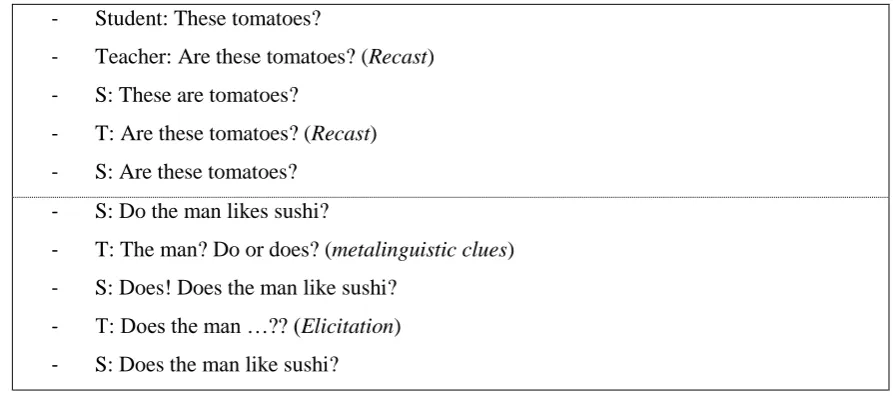
and strictly monitoring student interactions during this one hour workshop. Figure 1
illustrates some examples of the interactions exchanged between the teacher and students
during this training session. These interactions were prompted by using several cue cards and
encouraging the students to ask polar questions about the pictures. On the other hand, the IN
group did not receive such training prior to the study and merely engaged in interactions with
peer NNSs every week.
Upon the completion of the term, another version of the test was administered to all
three groups on the day of their end of the term exam as the immediate post-test. Following
that, the classes did not meet for approximately one month due to between-term and Iranian
New Year holidays. Accordingly, the delayed post test was administered after about a month
to all 60 participants which were by this time assigned to new classes. Each participant,
including the ones who were repeating the previous term after failing it, was located in their
new classes and was asked to answer the last test. The results from all these three test
administrations were submitted to IBM SPSS for statistical analysis.
Analysis
Having administered the three parallel tests prior to, immediately after, and one month after
the treatment, the scores obtained by all three groups were analyzed using a mixed between-- Student: These tomatoes?
- Teacher: Are these tomatoes? (Recast)
- S: These are tomatoes?
- T: Are these tomatoes? (Recast)
- S: Are these tomatoes?
- S: Do the man likes sushi?
- T: The man? Do or does? (metalinguistic clues)
- S: Does! Does the man like sushi?
- T: Does the man …?? (Elicitation)
- S: Does the man like sushi?
110 Applied Research on English Language
within subjects ANOVA or a SPANOVA (split plot ANOVA), as it is alternatively called,
with a 3*3 design. The mixed ANOVA or the repeated measure factorial ANOVA allows for
the simultaneous analysis of variability both between and within subjects by mixing regular
ANOVAs with repeated measure ANOVAs (Tabachnik & Fidell, 2013). Furthermore, the
advantage of this design is the ability to locate any possible interaction effects between the
independent variables (IVs), here being the type of interaction and time. Since each of these
two independent variables or factors had three levels, an analysis with a 3*3 design was
produced. The levels of the between subjects IV (type of interaction) included interaction
with training, interaction with no training, and no interaction. On the other hand, the levels
of the within subjects IV included the three time intervals (pre-test, post-test, and delayed
post test). Finally, the dependant variable (DV) was the scores of the participants on the polar
question formation tests. A summary of the descriptive analysis of the group performances on
each of the testing occasions is provided in table 1 below.
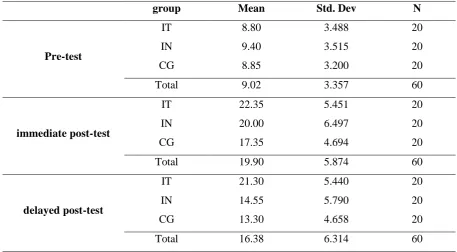
As table 1 indicates, all three groups started the term with very similar means on their
question formation tests (𝑋̅= 8.80, 9.40, and 8.85) and showed some improvement during the
treatment time before the first post test. However, by the time of the immediate post test or
the end of the term, the three groups had maintained a distance while the mean performances
of the IT and IN groups were ahead of the control group (𝑋2̅̅̅̅𝐼𝑇=22.35, 𝑋2̅̅̅̅𝐼𝑁=20.00, 𝑋2
̅̅̅̅𝐶𝐺=17.35). The performance of all three groups proved to be poorer on the delayed post
Table 1. Descriptive statistics of the group performances
group Mean Std. Dev N
Pre-test
IT 8.80 3.488 20 IN 9.40 3.515 20 CG 8.85 3.200 20 Total 9.02 3.357 60
immediate post-test
IT 22.35 5.451 20 IN 20.00 6.497 20 CG 17.35 4.694 20 Total 19.90 5.874 60
delayed post-test
V. 5 N. 1. 2016 111
test while the IT group demonstrated the mildest drop in mean (𝑋3̅̅̅̅𝐼𝑇=21.30, 𝑋3̅̅̅̅𝐼𝑁=14.55, 𝑋3
̅̅̅̅𝐶𝐺=13.30). In order to establish the significance of the differences, these changes had to be
statistically analyzed.
The first step was to check for the assumptions of the ANOVA in general and those
pertaining to mixed model ANOVAs in particular. The normality of the scores on all testing
occasions was checked using the explore option of SPSS and examining the skewness and
kurtosis values. Next, Levene’s Test of Equality of Error Variances and Box’s Test of
Equality of Covariance Matrices were checked as two important assumptions of SPANOVA.
Since both tests were non-significant, neither of the two assumptions had been violated and
we were safe to proceed. However, as a common occurrence in factorial ANOVA
procedures, the assumption of sphericity was violated based on Mauchly’s Test of Sphericity.
Therefore, instead of referring to the univariate statistics results, the multivariate statistics
table was consulted as it does not require the assumption of sphericity (Pallant, 2013). Both
main effect (the individual effects of the IVs) and interaction effect (the effect of the IVs
combined) were checked in the Multivariate statistics table, a summary of which is
reproduced here as table 2.
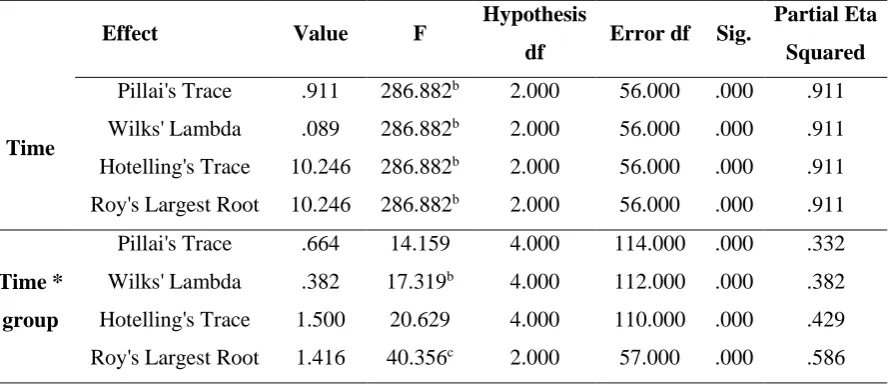
First, the interaction effect in the time*group row was checked. Although all
multivariate tests produced by SPSS syntax tend to yield very similar results, Wilks’
Table 2. Multivariate testsa of main and interaction effects of IVs.
Effect Value F Hypothesis
df Error df Sig.
Partial Eta
Squared
Time
Pillai's Trace .911 286.882b 2.000 56.000 .000 .911
Wilks' Lambda .089 286.882b 2.000 56.000 .000 .911
Hotelling's Trace 10.246 286.882b 2.000 56.000 .000 .911
Roy's Largest Root 10.246 286.882b 2.000 56.000 .000 .911
Time *
group
Pillai's Trace .664 14.159 4.000 114.000 .000 .332 Wilks' Lambda .382 17.319b 4.000 112.000 .000 .382
Hotelling's Trace 1.500 20.629 4.000 110.000 .000 .429 Roy's Largest Root 1.416 40.356c 2.000 57.000 .000 .586
a. Design: Intercept + group Within Subjects Design: Time b. Exact statistic
112 Applied Research on English Language
Lambada is reported here as it is common practice. According to table 2, there was a
significant effect for the interaction between the two independent variables on the dependent
variable with a large effect size; F(4,112)=17.31, p<.001, 𝜂2=.382. This indicates that our
grouping criteria or the treatment conditions did have an effect on participants’ polar question
formation ability, however, through the levels of the other IV which was time. That is, the
question formation ability of the learners was differentially affected by the type of interaction
they engaged in according to different time periods and the change for the three different
groups was not similar over time. When the interaction effect is significant in factorial
ANOVA, the interpretation of the main effects proves to be rather tricky and should be
treated with caution as it will be less than revealing (Pallant, 2013). However, as table 2
indicates, the main effect of the IV time was also significant with a very large effect size;
F(2,56)=286.88, p<.001, 𝜂2=.911.
As suggested by Pallant (2013), since the interaction effect had been significant, the
profile plot of the analysis was consulted to make an interpretation of the results possible.
This plot is reproduced below as Figure 2.
Figure 2. Profile plot of the main and interaction effects
As figure 2 and the descriptive statistics presented earlier in Table 1 suggest, while the
mean question formation ability of the three groups did not show any significant difference to
begin with (𝑋1̅̅̅̅𝐼𝑇= 8.80, 𝑋1̅̅̅̅𝐼𝑁=9.40, and 𝑋1̅̅̅̅𝐶𝐺=8.85), all three groups demonstrated considerable changes from the time of the pre-test to the first post test (𝑋2̅̅̅̅𝐼𝑇=22.35, 𝑋2
̅̅̅̅𝐼𝑁=20, and 𝑋2̅̅̅̅𝐶𝐺=17.35). In fact, all three groups dramatically improved in their ability to
V. 5 N. 1. 2016 113
performances on the delayed post test deteriorated. This decrease was obviously more
substantial for the IN (interaction with no training) and CG (no interaction) groups and the IT
(interaction with training) experienced a milder decrease (𝑋3̅̅̅̅𝐼𝑇=21.30, 𝑋3̅̅̅̅𝐼𝑁=14.55, and 𝑋3
̅̅̅̅𝐶𝐺=13.30). Although these patterns are observable from the profile plot in Figure 2 above,
post hoc tests are required to establish the statistical significance of the differences
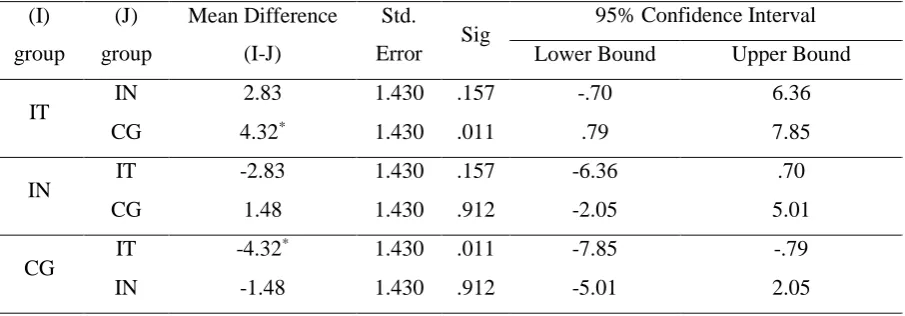
demonstrated by the means of the three groups. For this purpose, a Bonferroni post hoc
analysis was requested for the grouping variable in the SPSS. The results are presented in
Table 3 below.
As Table 3 suggests, Bonferroni pos hoc analysis indicated that the only significant
grouping effect occurred between the two groups IT and CG (p<.05). Therefore, it can be
concluded that the only group which performed significantly different from the control group
over time was the Interaction with Training group. The implications of these results are
discussed more fully in the next section.
Discussion, Conclusion, and Implications
All three groups of the study showed development in their ability to form yes/no questions
immediately after the treatment period and differentially deteriorated in this regard after a one
month gap. This observation sounds rather plausible as long as the immediate post test was
given on the day of their final exam, when the students are expected to show the greatest
amount of preparation. Furthermore, the first post test was administered immediately after
Table 3. Multiple comparisons based on Bonferroni post hoc analysis for the grouping
variables
(I) group
(J) group
Mean Difference (I-J)
Std.
Error Sig
95% Confidence Interval Lower Bound Upper Bound
IT IN 2.83 1.430 .157 -.70 6.36 CG 4.32* 1.430 .011 .79 7.85
IN IT -2.83 1.430 .157 -6.36 .70 CG 1.48 1.430 .912 -2.05 5.01
CG IT -4.32
* 1.430 .011 -7.85 -.79
IN -1.48 1.430 .912 -5.01 2.05
Based on observed means.
The error term is Mean Square(Error) = 20.462.
114 Applied Research on English Language
three months of class practice while the delayed post test was given after a one month
interval during which the students did not attend their classes and were not formally required
to practice English. However, in order to make claims about these findings, statistical
analyses were run as explained earlier in this text.
The results of the mixed between-within subjects analysis of variance (SPANOVA),
presented in the previous section revealed that the type of peer interaction that young EFL
learners engaged in as further practice after a grammar lesson had an effect on their polar
question formation ability over time. More precisely, as suggested by the analysis of the
profile plot and post hoc tests, although all groups similarly improved in their question
formation ability during the treatment period and slightly regressed by the time of the delayed
post test, the only group which significantly sustained its development as compared to the
other groups was the interaction with training group. In fact, while engaging in interaction
with peers for both treatment groups did have an effect in attaining better scores on post tests,
only the students who were trained in providing and receiving interactional feedback could
significantly outperform the control group on the immediate post test and maintain their
interlanguage development over time until the delayed post test.
These findings suggest that young learners may benefit from interaction with their peer
learners only if it is accompanied by appropriate training in dealing with interactional
feedback and close mentoring of the teacher. This is particularly true when it comes to the
long term effects of peer interaction while the differences may not be of significant value in
the short run. These findings tend to corroborate the results from a number of studies
including Philp et al. (2010), Mackey, (1999), and Huang (2011) in that a tendency toward
interacting in the class among learners and engaging in interactive tasks will benefit the
students and will also facilitate the learning process. Particularly, since teachers are expected
to be familiar with their learners’ cognitive capabilities, if this participation is accompanied by the instructor’s close monitoring and feedback, the vividness of its effect will be more
dominant. The results are also in concordance with Mackey and Silver’s (2005) findings as
feedback was found to be a determinant of successful grammatical development based on
interactional exchanges. Also, Gunning and Oxford’s (2014) claims about the effects of
strategy training on the quality of young learners’ peer interactions were corroborated and it
was shown how important such training can be. The outcomes of the present study also
confirmed Oliver’s (1998, 2002, 2009) findings about ESL learners in case of EFL children
V. 5 N. 1. 2016 115
challenged these earlier results by indicating that long-term improvements in child
interlanguage can occur only when the interlocutors are trained and well-rehearsed in
strategies for negotiation of meaning and receiving and providing feedback. Therefore, at
least in case of younger learners, sustained grammatical development results as long as
interaction is informed, meaningful, and orchestrated.
There are a number of pronounced implications for these results directly applicable to
young adult classes in EFL contexts. The implications target both language teachers and
curriculum developers, especially in case of young learners’ language education. This study
showed that despite the doubts cast on the efficiency of NNS-NNS interactions in EFL
classes, specifically in case of younger learners, (Gunning & Oxford, 2014; Butler & Zeng,
2014; Lazaro & Azpilicuteta-Martinez, 2015; Garcia Mayo & Lazarro Ibarrola, 2015)
integration of such interactive activities into routine classroom procedures is worthwhile as
long as the interaction is guided by the teacher. In order to maintain the interlanguage
development of young learners over time, it is recommendable to encourage meaningful peer
interaction among them once they are introduced to the feedback strategies required to
facilitate conversational exchanges and interlanguage development through such processes as
noticing. This is especially important to all EFL contexts including Iran where teachers are
very often accused of running one-directional, teacher-fronted classes with little attention to
the benefits of interaction as a result of an allegedly lower appreciation for individual
learning and interpersonal interaction in such non-western cultures (Mackey & Silver, 2005),
a stereotype which needs to be challenged and changed. As local studies including
Keivanpanah, Alavi and Sepehrinia (2012) showed, while Iranian EFL teachers insisted to
perform most of the correction in the class, their learners preferred to maintain self and peer
correction and engage in interactional activities rather than being corrected by their
instructors. Therefore, based on the evidence from this study as situated within the body of
literature, EFL teachers of young classes are suggested to trust the interactive capabilities of
their students and give a chance to these potentialities to burgeon and grow. With little
strategy training and monitoring, peer interaction can significantly enhance learners’
internalization and long-term retention of language forms even in case of younger learners.
As to the limitations and delimitations of the present study, it must be reminded that the
development of learners’ interlanguage was limited to grammatical competence and narrowly
operationalized as polar question formation which can hardly represent all intricate aspects of
116 Applied Research on English Language
came from intact classes of 20. Therefore, it is recommendable that in possible replications in
future, larger populations of both male and female learners, randomly assigned to various
treatment conditions, be targeted. It is also suggested that interactionist researchers interested
in the promising area of young learners research continue this trend by focusing on a wider
range of grammatical and linguistic features including phonological, lexical, and pragmatic
exchanges. For this purpose, standardized tests now available for younger learners, including
TOEFL Junior® and Cambridge English Placement Test for Young Learners, can be
employed to more fully grasp the development of their interlanguage.
References
Butler, Y. G., & Zeng, W. (2014). Young foreign language learners’ interactions during task
based paired assessment. Language Assessment Quarterly, 11(1), 45-75.
Cochran, B.P., McDonald, J.L., & Parault, S. J., (1999). Too smart for their own good: The
disadvantage of a superior processing capacity for adult language learners. Journal of
Memory and Language, 41(1), 30–58
Ellis, R. (2003). Task-based language learning and teaching. Oxford: Oxford University Press.
Ellis, R., Basturkmen, H., & Loewen, S. (2001). Learner uptake in communicative ESL
lessons. Language Learning, 51(2), 281–318.
Ellis, R., Basturkmen, H., & Loewen, S. (2002). Doing focus on form. System, 30(2), 419-430.
Ellis, R., Loewen, S., & Erlam, R. (2006). Implicit and explicit corrective feedback and the
acquisition of L2 grammar. SSLA, 28(2), 339-368.
Fotos, S. (1993). Consciousness raising and noticing through focus on form: Grammar
performance versus formal instruction task. Applied Linguistics, 14(4), 385-407.
García Mayo, M. P., & AlcónSoler, E. (2013). Negotiated input and output/Interaction. In J.
Herschensohn and M. Young-Scholten (Eds.). The Cambridge handbook of second
language acquisition (pp. 209-229). Cambridge: Cambridge University Press.
Garcia Mayo, M.P. & LazarroIbarrola, A. (2015). Do children negotiate for meaning in task
based interaction? Evidence from CLIL and EFL settings. System. (in press).
http://dx.doi.org/10.1016/j.system.1014.12.001.
Gass, S. M., Mackey, A., & Pica, T., (1998). The role of input and interaction in second
language acquisition: an introduction. Modern Language Journal, 82(3), 299-307.
Guillén, M., T., F. (2012). The role of interaction in the young learners’ classroom.
V. 5 N. 1. 2016 117
Gunning, P. & Oxford, R., L. (2014). Children’s learning strategy use and the effects of
strategy instruction on success in learning ESL in Canada. System, 43(1) 82-100.
Huang, K., M. (2011). Motivating lessons: A classroom-oriented investigation on the effects
of content based instruction on EFL young learners’ motivated behavior and classroom
verbal interaction. System: An International Journal of Educational Technology and
Applied Linguistics, 39(2), 186-201.
Keivanpanah, S., Alavi, M., & Sepehrinia, S. (2012). Preferences for interactional feedback:
differences between learners and teachers. The Language Learning Journal, 40(1), 1-20.
Krashen, S. (1982). Principles and practices in second language acquisition. Oxford:
Pergamon.
Krashen, S. (1985). The input hypothesis. London: Longman.
Krashen, S. (1987). Principles and practices in second language acquisition. Prentice-Hall
International.
Lazaro, A., & Azpilicueta-Martinez, R. (2015). Investigating negotiation of meaning in EFL
children with very low levels of proficiency. International Journal of English Studies,
(in press).
Leeman, J. (2003). Recasts and second language development: Beyond negative evidence.
Studies in Second Language Acquisition, 25(1), 37–63.
Leeman, J. (2007). Feedback in L2 learning: responding to errors during practice. In R.
DeKeyser (Ed.), Practice in second language learning. Perspectives from linguistics
and psychology (pp. 111-138). Amsterdam: John Benjamin.
Long, M. H. (1981). Input, interaction, and second language acquisition. In H. Winitz (Ed.),
Native language and foreign language acquisition. New York: Annals of the New York
Academy of Sciences.
Long, M. H. (1983). Native speaker/non-native speaker conversation and the negotiation of
comprehensible input. Applied Linguistics, 4(2), 126-141.
Long, M. H. (1996). The role of the linguistic environment in second language acquisition. In
W. Ritchie & T. Bhatia (Eds.), Handbook of second language acquisition. (pp. 413–
468). San Diego, CA: Academic Press.
Lyster, R., (2004). Differential effects of prompts and recasts in form-focused instruction.
Studies in Second Language Acquisition, 26(3), 399–432.
Lyster, R., &Ranta, L. (1997). Corrective feedback and learner uptake: Negotiation of form
118 Applied Research on English Language
Mackey, A. (1999). Input, interaction and second language development: An empirical study
of question formation in ESL. Studies in Second Language Acquisition, 21(4), 557–587.
Mackey, A. (2006). Epilogue to the special issue of SSLA. Studies in Second Language
Acquisition, 28(2), 369-379.
Mackey, A. (2007). The role of conversational interaction in second language acquisition. In
A. Mackey (ed.), Conversational interaction in second language acquisition: A
collection of empirical studies. (pp. 1-26). Oxford: Oxford University Press.
Mackey, A. (2012). Input, interaction and corrective feedback in L2 classrooms. Oxford:
Oxford University Press.
Mackey, A., Abbuhl, R., & Gass, S. (2011). Interactionist approaches. In S. Gass, & A.
Mackey (Eds.), Handbook of second language acquisition (pp. 7-23). New York:
Routledge.
Mackey, A., & Gass, S. M. (2006). Introduction to the special issue of SSLA. Studies in
Second Language Acquisition, 28(2), 169-178.
Mackey, A., Kanganas, A., P., & Oliver, R., (2007). Task familiarity and interactional
feedback in child ESL classrooms. TESOL QUARTERLY, 41(2), 285-312
Mackey, A., & Oliver, R. (2002). Interactional feedback and children’s L2 development.
System, 30(4), 459-477.
Mackey, A., Oliver, R., & Leeman, J. (2003). Interactional input and the incorporation of
feedback: An exploration of NS-NNS and NNS-NNS adult and child dyads. Language
Learning, 53(1), 35–66.
Mackey, A., Silver, R., E. (2005). Interactional tasks and English L2 learning by immigrant
children in Singapore. System, 33(2), 239-260.
Oliver, R. (1998). Negotiation of meaning in child interactions. The relationship between
conversational interaction and second language acquisition. The Modern Language
Journal, 83(3), 372-386.
Oliver, R. (2000). Age differences in negotiation and feedback in classroom and pair work.
Language Learning, 50(1), 119–151.
Oliver, R. (2002). The patterns of negotiation for meaning in child interactions. Modern
Language Journal, 86(1), 97–111.
Oliver, R. (2009). How young is too young? Investigating negotiation of meaning and
feedback in children aged five to seven years. In A. Mackey, &Ch. Polio (Eds.),
V. 5 N. 1. 2016 119
O'Malley, J.M. & Chamot, A.U. (1990). Learning strategies in second language acquisition.
Cambridge: Cambridge University Press.
Pallant, J. (2013). SPSS survival manual (5th ed.). Berkshire: Open University Press.
Philp, J., Oliver, R., & Mackey, A. (Eds.). (2008). Child's play? Second language acquisition
and the younger learner. Amsterdam: John Benjamins.
Philp, J., Walter, S., & Basturkmen, H. (2010). Peer interaction in the foreign language
classroom: What factors foster a focus on form? Language Awareness, 19(4), 261-279.
Pica, T. (2013). From input, output and comprehension to negotiation, evidence and
attention: an overview of theory and research on learner interaction in SLA. In M. P.
García Mayo, J. Gutierrez, & M. MartínezAdri an (Eds.), Contemporary approaches to
second language acquisition (pp. 49-70). Amsterdam: John Benjamins.
Polio, C. & Gass, S.M., (1998). The role of interaction in native speaker comprehension of
nonnative speaker speech. Modern Language Journal, 82(3), 308–319.
Richards, J. C. & Schmidt, R. (Eds.). (2002). Longman dictionary of language teaching and
applied linguistics (3rd ed.). London: Longman.
Schmidt, R. W. (1990). The role of consciousness in second language learning. Applied
Linguistics, 11(2), 129-158.
Schmidt, R. W. (1993). Awareness and second language acquisition. Annual Review of
Applied Linguistics, 11(2), 129-158.
Sharwood Smith, M (1991). Speaking to many minds: On the relevance of different types of
language information for the L2 learner. Second Language Research, 7 (2), 118-132.
Sharwood Smith, M. (1993). Input enhancement in instructed SLA: Theoretical bases.
Studies in Second Language Acquisition, 15(2), 165-179.
Swain, M. (1985). Communicative competence: some roles of comprehensible input and
comprehensible output in its development. In S. Gass & C. Madden (Eds.), Input in
second language acquisition. Rowley, Mass.: Newbury House.
Swain, M. (1995). Three functions of output in second language learning. In G. Cook & B.
Seidhofer (Eds.), Principles and practice in the study of language: Studies in honor of
H. G. Widdowson. Oxford: Oxford University Press.
Swain, M. (2000). The output hypothesis and beyond: Mediating acquisition through
collaborative dialogue. In J. P. Lantolf (Ed.), Sociocultural theory and second language
120 Applied Research on English Language
Tabachnick, B. G., & Fiddel, L. S. (2013). Using multivariate statistics. (6th ed). Boston:
Pearson Education.
Varonis, E. M., & Gass, S. (1985). Nonnative/nonnative conversations: A model for