Modern Journal of Language
Teaching Methods
Modern Journal of Language Teaching Methods
ISSN: 2251- 6204
Modern Journal of Language Teaching Methods
(MJLTM)
www.mjltm.com
This e-book is in copyright.
No reproduction may take place without the express written permission
of the Modern Journal of Language Teaching Methods (MJLTM)
No Unauthorized Copying
All rights reserved. No part of this book may be reproduced, stored in a
retrieval system or transmitted in any form or by any means Electronic,
mechanical, photocopying or otherwise, without the prior written
permission of the Modern Journal of Language Teaching Method.
Director:
Mohammad Shahbazi Rad
Editor
–
in
–
Chief:
Hamed Ghaemi
ISSN: 2251-6204
Editor-in-Chief
Modern Journal of Language Teaching Methods
ISSN: 2251- 6204
Editor
–
in
–
Chief:
Hamed Ghaemi, Islamic Azad University, Iran
Director
Mohammad Shahbazi Rad, Dean of Jahan Elm Institute of Higher Education,
Mashhad, Iran
Managing Editor
Aqil Izady Sadr
Editorial Board:
Abednia Arman, PhD in
TEFL, Allameh Tabataba’i University,
Tehran, Iran
Azizi Masoud, PhD
Candidate in
Applied
Linguisitcs,
University of
Tehran, Iran
Basiroo Reza, PhD Candidate in TEFL,
University of Tehran, International
Campus, Iran
Elahi Shirvan Majid, PhD Candidate in
TEFL,
Ferdowsi
University
of
Mashhad, Iran
Fernández Miguel, PhD, Chicago State
University, USA
Ghaemi Hamide, M.A. in Speech and
Language
Pathology,
Mashhad
University of Medical Sciences, Iran
Grim Frédérique M. A., Associate
Professor of French, Colorado State
University, USA
Kargozari Hamid Reza, PhD Candidate
in TEFL, Payame Noor University of
Tehran, Iran
Kaviani Amir, Assistant Professor at
Zayed University, UAE
Kirkpatrick Robert, Assistant Professor
of
Applied Linguistics, Shinawatra
International University, Thailand
Rezaei Saeed, PhD Candidate in TEFL,
Sharif
University
of
Technology,
Tehran, Iran
Shahbazirad
Mohammad,
PhD
candidate in English language and
Literature, Yerevan State University,
Armenia
Weir George R. S., PhD in Philosophy
of Psychology, University
of Strathclyde, Glasgow, UK
Zegarac Vladimir, PhD, University of
Bedfordshire, UK
Modern Journal of Language Teaching Methods
ISSN: 2251- 6204
TABLE OF CONTENTS:
Abstracting/Indexing ... 5
Exploring the Effects of First Language Influence on Second Language in Iranian EFL
Context
... 6
Fakhri Mesri
Applying Strategy Inventory for Language Learning and the Motivated Strategies for
Learning Questionnaire in Assessing Learning Strategies and Motivation of Iranian
EFL Learners ... 14
Hamid R. Kargozari, Ali Zahabi and Hamed Ghaemi
The Use of Textual and Interpersonal Metadiscourse Across Disciplinary
Communities ... 23
Biook Behnam and Elnaz Roohi
Ideology and Academic Discourse: The Case of Iranian EFL Students ... 34
Farzaneh Dehghan and Rahman Sahragard
Metalinguistic Intuition in Fla: A Seminal Enterprise Deserving Deeper Scrutiny ... 42
Nassim Golaghaei and Mortaza Yamini
EFL-Based Materials Development: Does It Work? ... 55
Nasser Rashidi and Zahra Javidanmehr
Remedial English Classes at University of Sindh, Jamshoro... 66
Rafique Ahmed Memon
Animal Communication and the Origin of Human Language ... 91
Parviz Birjandi and Houman Bijani
Dealing With Misbehaviors of Young EFL Learners ... 102
Parinaz Mohammadi
Modified Output in EFL Context ... 108
Seyyede Paria Sajedi and Javad Gholami
Effect of Disappearing Dialogue on Vocabulary Learning and Retention of EFL
Learners ... 121
Yaser Kheyrkhah and Hamed Ghaemi
Submission Guidelines ... 133
Modern Journal of Language Teaching Methods
ISSN: 2251- 6204
Abstracting/Indexing
Index Copernicus 2011
Linguistics Abstract
EBSCO Publication
Modern Journal of Language Teaching Methods
ISSN: 2251- 6204
EXPLORING THE EFFECTS OF FIRST LANGUAGE
INFLUENCE ON SECOND LANGUAGE IN IRANIAN EFL
CONTEXT
Fakhri Mesri
Islamic Azad University,Salmas Branch, Salmas, Iran
Abstract
Second language use in the foreign language classroom needs to be maximized wherever possible, by encouraging its use and by using it for classroom management. Research shows that the first language has a small but important role to play in communicating meaning and content. This role is important across all four strands of a course. Thus, this study aims to explore the role of first language in Iranian context second language learning, particularly in terms of their learning opinion and learning strategies about using first language to learn second language. Research has shown that the first language of learners can play a useful role in some of these strands and the aim of this article is to look at some of this research and to clearly identify those parts of a language course where there is value in using the L1 A total of 30 learners from Andisheyeh Sabz institution in Salmas were selected to participate in this study for the survey. They were at intermediate level. The data from survey questionnaires will address the following research questions: (1) what are learners' opinions about using their first language to learn second language? (2) What are Iranian EFL learners' first language strategies to learn second language L1? Percentage values were used in order to analyze the collected data. The final result of this study shows that L2 and the L1 are in competition with each other and the use of English increases at the expense of the L1. Teachers need to show respect for the learners' L1 and need to avoid doing things that make the L1 seem inferior to English. At the same time, it is the English teacher's job to help learners develop their proficiency in
English. Thus, a balanced approach is needed which sees a role for the L1 but also recognizes the importance of maximizing L2 use in the classroom.
Keywords:
Learners' first language, second language, Percentage Value
Introduction
There is, today, a great deal of emphasis on the study of foreign languages. The ability to speak a foreign language is no longer merely an advantage – it is becoming a necessity. As a result, linguists and methodologists are looking for more effective approaches to language teaching. One of the suggested methods is translation. Until recently, translation was out of favor with the language teaching community. It was labeled “boring”,
“uncommunicative”, “difficult”, “pointless”
and the like, and suffered from too close an association with grammar (Duff, 1994). Today, thanks to the new communicative approach to language teaching, translation is gradually becoming recognized as a valid activity for language practice. Translation was a significant part of ELT for a long time, and then a significant missing part for a long time also. With the arrival and then total dominance of communicative methodologies, translation was quickly consigned to the past, along with other
‘traditional' tools such as dictation, reading
aloud and drills. However, it and these other abandoned activities are now a feature of many communicative classrooms and successful aids to learning, although the approach to using them has changed. As Duff (1990) says, teachers and students
Modern Journal of Language Teaching Methods
ISSN: 2251- 6204
now use translation to learn, rather than learning translation. Modern translation activities usually move from L1 to L2, (although the opposite direction can also be seen in lessons with more specific aims), have clear communicative aims and real cognitive depth, show high motivation levels and can produce impressive communicative results.
Thus, this study aims to explore the role of translation in Iranian context English learning, particularly in terms of their learning opinion and learning strategies about using translation to learn English. This article looks at the role of translation as an activity for learners in the ELT classroom. It does not consider the role of the L1 as a teaching tool, for example for classroom management, setting up activities, or for explaining new vocabulary.
Significance and Justification of the Study
Recent years have seen a growing interest in translation. The present research aims to explore the Iranian EFL learners’ opinions and strategies about use of translation in English learning. It is believed that this study would be beneficial for more effective teaching and learning foreign language.
Research Questions
The present research addresses the following question:
(1) What are learners' opinions about using translation to learn English?
(2)What are Iranian learners' translation strategies to learn English?
Background
There are numerous ways of conveying the meaning of an unknown word. These include a definition in the second language, a demonstration, a picture or a diagram, a real object, L2 context clues, or an L1 translation. In terms of the accuracy of conveying meaning, none of these ways is intrinsically better than any of the others. It all depends on the particular word concerned. However, studies comparing the effectiveness of various methods for learning always come up with the result that an L1 translation is the most effective (Lado, Baldwin and Lobo 1967; Mishima
1967; Laufer and Shmueli 1997). This is probably because L1 translations are usually clear, short and familiar, qualities which are very important in effective definitions (McKeown 1993). When the use of an L1 translation is combined with the use of word cards for the initial learning of vocabulary, then learners have a very effective strategy for speeding up vocabulary growth (Nation 2001: 296-316). Although there are frequent criticisms raised of learning L1-L2 word pairs, these criticisms are not supported by research. The research shows the opposite, the direct learning of L2 vocabulary using word cards with their L1 translations is a very effective method of learning.
This finding also receives some support from studies of dictionary use. Learners' dictionaries can be classified into two major types - those that only use the L2 (monolingual dictionaries like the Oxford Advanced Learners Dictionary, the COBUILD Dictionary, the Longman Dictionary of Contemporary English and the Cambridge Learners Dictionary), and those that make use of the L1 (bilingual or bilingualised dictionaries). A bilingualised dictionary is a monolingual dictionary with L1 translations included. Monolingual dictionaries usually contain a wealth of useful information and in an attempt to make them accessible for lower proficiency learners, the definitions are often within a controlled vocabulary. The definition vocabulary usually consists of around 2000 words. Thus to use a monolingual dictionary effectively learners need to have a effective receptive vocabulary of 2000 words. Most learners of English as a foreign language do not achieve this until they have been studying English for five to six years. It is not surprising then that surveys of dictionary preference (Laufer and Kimmel 1997; Atkins and Varantola 1997) and learner use (Baxter 1980) show that learners strongly favour bilingual or bilingualised dictionaries. To effectively use a monolingual dictionary, learners need to have a large enough vocabulary (at least 2000 words) and need to be able to interpret definitions, which are much more difficult than L1 synonyms.
Modern Journal of Language Teaching Methods
ISSN: 2251- 6204
Increasingly, languages borrow a lot of words from English. Daulton (1998) for example estimates that about half of the most common 3000 words of English have some borrowed form in Japanese. Sometimes the borrowing has resulted in so many formal and semantic changes that the relationship to English is hard to see (wan- piisu - a one piece dress), but most often the relationship is clear (waasuto - worst). Encouraging learners to notice this borrowing and to use the loan words to help the learning of English is a very effective vocabulary expansion strategy. This involves deliberately exploring L1 and L2 relationships. Even greater help is available where the L1 has a family relationship with English as is the case with languages like Spanish and Swedish (Ringbom 1987). The L1 clearly has a very important role to play in the deliberate learning of vocabulary.Translation was the basis of language teaching for a very long time, and then rejected as new methodologies started to appear. It was a key element of the Grammar Translation Method, which was derived from the classical method of teaching Greek and Latin. This was not a positive learning experience for many: as well as learners memorizing huge lists of rules and vocabulary, this method involved them translating whole literary or historic texts word for word. Unsurprisingly, new methodologies tried to improve on this. The Direct or Natural Method established in Germany and France around 1900 was a response to the obvious problems associated with the Grammar Translation Method. In the Direct Method the teacher and learners avoid using the learners' native language and just use the target language. Like the Direct Method, the later Audio-Lingual Method tried to teach the language directly, without using the L1 to explain new items. Subsequent ‘humanistic'
methodologies such as the Silent Way and Total Physical Response and communicative approaches moved even further away from the L1, and from these arise many of the objections to translation. Translation teaches learners about language, but not how to use it. Translation does not help learners develop their
communication skills. Translation is a difficult activity to set up and can go badly wrong, producing some of the objections described above. There are many aspects to designing and running tasks. Firstly, it is necessary to plan carefully and fully, and to identify the right kinds of aims. Ensure that your source material really does focus on these, and has not been introduced just because you like it. Try to integrate translation with other skills/systems practice where possible. Make sure you have dictionaries and usage sources available. It is important to recognise the problems associated with traditional approaches to translation (a solitary, difficult and time-consuming activity using literary texts) and find solutions to these, such as ensuring these tasks are short (not easy), always working in groups, and maintaining the element of a communication gap where possible.As the objections above showed, learner perception of this activity is key. It is useful to explain your aims and discuss any concerns that your learners have; many activities use materials that can be generated by learners, which can have positive impact on motivation and dynamics. Avoid activities which require your learners to use their L1 a lot if you don't have a consensus in your class. Think about the possibilities and pitfalls of this kind of work in a multi-lingual group - discussion and comparison of L1 idioms may be very rewarding, for example, but working on a text not. Think about the different benefits of translation and more specifically L1 - L2 or L2 - L1 work in the context of aims and also of the class profile. Krings (1986:18) defines translation strategy as "translator's potentially conscious plans for solving concrete translation problems in the framework of a concrete translation task," and Duff (1994) believes that there are at least three global strategies employed by the translators: (i) translating without interruption for as long as possible; (ii) correcting surface errors immediately; (iii) leaving the monitoring for qualitative or stylistic errors in the text to the revision stage. Moreover, Loescher (1991:8) defines translation strategy as "a potentially conscious procedure for solving a problem
Modern Journal of Language Teaching Methods
ISSN: 2251- 6204
faced in translating a text, or any segment of it." As it is stated in this definition, the notion of consciousness is significant in distinguishing strategies which are used by the learners or translators. In this regard, Cohen (1998:4) asserts that "the element of consciousness is what distinguishes strategies from these processes that are not strategic."
Furthermore, Bell (1998:188) differentiates between global (those dealing with whole texts) and local (those dealing with text segments) strategies and confirms that this distinction results from various kinds of translation problems.
Venuti (1998:240) indicates that translation strategies "involve the basic tasks of choosing the foreign text to be translated and developing a method to translate it." He employs the concepts of domesticating and foreignizing to refer to translation strategies. Jaaskelainen (1999:71) considers strategy as, "a series of competencies, a set of steps or processes that favor the acquisition, storage, and/or utilization of information." He maintains that strategies are "heuristic and flexible in nature, and their adoption implies a decision influenced by amendments in the translator's objectives." Taking into account the process and product of translation, Jaaskelainen (2005) divides strategies into two major categories: some strategies relate to what happens to texts, while other strategies relate to what happens in the process. Product-related strategies, as Jaaskelainen (2005:15) writes, involves the basic tasks of choosing the SL text and developing a method to translate it. However, she maintains that process-related strategies "are a set of (loosely formulated) rules or principles which a translator uses to reach the goals determined by the translating situation" (p.16). Moreover, Jaaskelainen (2005:16) divides this into two types, namely global strategies and local strategies: "global strategies refer to general principles and modes of action and local strategies refer to specific activities in relation to the translator's problem-solving and decision-making."
In most of the roles of the L1 that we have looked at, there is the common theme that the L1 provides a familiar and effective way of quickly getting to grips with the meaning and content of what needs to be used in the L2. It is foolish to arbitrarily exclude this proven and efficient means of communicating meaning. To do so would be directly parallel to saying that pictures or real objects should not be used in the L2 class (Nation 1978). All the arguments against L1 use similarly apply to the use of pictures, real objects, and demonstration. The L1 needs to be seen as a useful tool that like other tools should be used where needed but should not be over-used.
Method
This study primarily involved a survey, comprised of one set of questionnaires concerning beliefs, strategy use, moreover, in order to probe more deeply the relationships and among learners’ beliefs about L1.
Participants
A total of 30 learners from Andisheyeh Sabz institution in Salmas were selected to participate in this study for the survey. Their ages ranged from (15-18). They were at intermediate level. The data from survey questionnaires will address the following research questions: (1) what are learners' opinions about using their first language to learn second language? (2) What are Iranian EFL learners' first language strategies to learn second language L1?
Instrumentation
The instruments used in this study included two questionnaires which were taken from (Posen Liao) article. For beliefs measurement, the role of translation in Iranian Context English learning, particularly in terms of their learning opinion and learning strategies about using translation to learn ..The researcher went to class to administer the survey at a pre- arranged time. She first briefly explained to the participants the nature and the purpose of this study and provided instructions about how to answer the questionnaires.
Modern Journal of Language Teaching Methods
ISSN: 2251- 6204
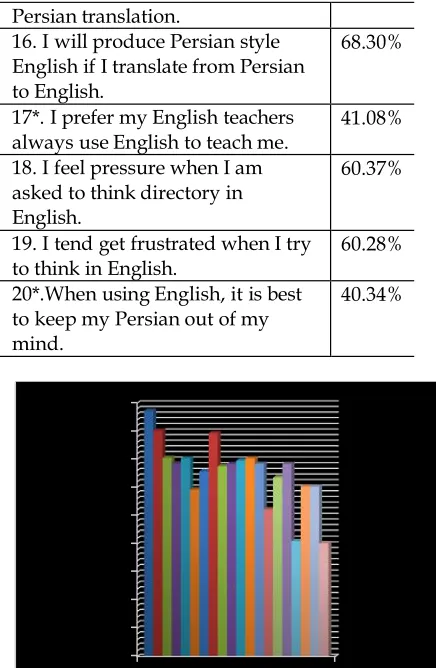
Persian translation.
16. I will produce Persian style English if I translate from Persian to English.
68.30%
17*. I prefer my English teachers
always use English to teach me. 41.08% 18. I feel pressure when I am
asked to think directory in English.
60.37%
19. I tend get frustrated when I try to think in English.
60.28%
20*.When using English, it is best to keep my Persian out of my mind.
40.34%
1. Translation helps me
understand textbox readings. 87.32% 2. Translation helps me
understand spoken English. 80.23% 3. Translation helps me speak
English.
70.54%
4. Translation helps me understand English grammar rules.
68.52%
5. Translation helps me learn
English idioms and phrases. 70.32% 6*. Translation does not help me
make progress in learning English. 59.24% 7. Translation helps me
understand my teacher's English instructions.
65.74%
8. Translation helps me interact with my classmates in English class to complete assignments.
79.32%
9. The more difficult the English assignments are, the more I depend on English translation.
67.50%
10. Using Persian translation helps
me finish my English. 68.32% 11. using Persian translation while
studying helps me butter recall the content of a lesson later.
69.54%
12. I like use Persian translation to
learn English. 70.32% 13*.The use of Persian translation
may interfere with my ability to learn English well.
68.42%
14*. Persian translation diminishes the amount of English input I receive.
52.24%
15. At this stage of learning, I
cannot learn English without 63.54%
Procedure
Students completed the questionnaire during class time .The questionnaire did not ask for any information that could be used to identify individual students. The students were informed that the survey would have no effect on their grade.
Data Analysis
Percentage values were used in order to analyze the collected data.
Results
Table 1: Iranian learners' opinion about using translation to learn English
Mean
Fig 1: Learners opinion about using translation to learn English
Figure 1 shows that, on the whole, the participants overwhelmingly believe that translating helps them acquire English language skills such as reading, writing, speaking, specially grammar and idiom. Translation can help them to communicate with each other and reduce learning anxiety. In sum, translation plays an important role in learners' English learning progress.
Table 2: The Iranian learners' translation strategies to learn English
Mean 1. When reading an English text, I
first translate it into Persian in my mind to help me understand its meaning.
68.32%
2. After I read English articles, I use an available Persian translation to check if my comprehension is correct.
63.25%
Modern Journal of Language Teaching Methods
ISSN: 2251- 6204
3. To write in English, I first brainstorm about the topic in Persian.
60.38%
4. When I write in English, I first think in Persian and then translate my ideas into English.
61.23%
5. When I listen to English, I first translate the English utterances into Persian to help me
understand the meanings.
65.32%
6. When I watch English TV or movies, I use Persian subtitles to check my comprehension.
65.23%
7. When speaking English, I first think of what I want to say in Persian and then translate it into English.
62.75%
8. I memorize the meaning of new English vocabulary words by remembering their Persian translation.
72.54%
9. I learn English grammar through Persian explanations of the English grammatical rules.
59.32%
10. I use Persian translation of grammatical terms such as parts of speech, tenses, and agreements to help me clarify the roles of the grammatical parts of English sentences.
60.72%
11. I learn English idioms and phrases by reading their Persian translation.
64.35%
12. I use English- Persian dictionaries to help myself learn English.
65.52%
13. I use Persian-English dictionaries to help myself learn English.
50.25%
14. I use an electronic translation machine to help myself learn English.
59.24%
15. I ask questions about how a Persian expression can be translated into English.
50.23%
Fig. 2: the Iranian learners ' translation strategies to learn English
Conclusions
The final results of this study shows that, L1could be valuable tool that can contribute to the development of varies language skills and the strategies of L1 would be helpful in developing language skills. As for our final considerations, we can say that the roles of L1in the L2 classrooms are many: First, it helps students to see the link between language usage and use. Second, it encourages students to see the similarities and differences between L1 and L2. Third, through a comparison of the target language and the students’ native language, most language learning difficulties are revealed. Finally, by allowing or even inviting students to give different translations to a word, teachers can check comprehension and introduce new vocabulary, not to mention the development of learning strategies which give learners autonomy and language and learning awareness.L1 as a method of language teaching is still a subject under research and continues to be one of the most frequently discussed topics among teachers of English. In our opinion, this activity should be considered in a wider range of situations than is currently the case. It can be used for language practice and improvement in a similar manner to role play, project work and conversation. We have attempted to show that translation can be introduced purposefully and imaginatively into the language learning programme.
Modern Journal of Language Teaching Methods
ISSN: 2251- 6204
Implications
Without careful and thoughtful application of the students' L1 in the class, excessive dependence on translation will permeate the language classroom, with no language goal being attained. However, the language teacher should make available whatever resources exist if what language is used to negotiate meaning is important for what students learn. If translation aids the student in relating the L2 with the L1, then it is good. If it helps students realize where their mistakes are developing or how others may interpret what they are saying in the L2, then it is something to consider
(Edge: 1984).
As far as research is concerned, we aimed to find out about the place of translation in the current curriculum of English language as a school subject. The results suggest that translation, particularly of texts, is used neither sufficiently nor effectively enough. If translation as a classroom technique is to help student achieve competence in the foreign language, it must be used sensibly, systematically and on a regular basis. We consider this purposeful approach very important. There is no point in merely handing out texts to the learners with the instruction “Translate”. Students should not be required to translate without having been given practice in the skill. Furthermore, it is essential that the teacher always explains what the purpose of each activity is the students need to know why the activity is being done. Another important issue is the selection of material. The material must be interesting and varied, covering the full range of styles and registers. Genuine translation involves analysis of the meaning of the source text. The students should be led to consider the expressive possibilities of the target language and to discover that it is not always possible to attain exact equivalence. In this way they will learn to evaluate possible versions to see which most fully captures all the implications of the original, and will find out that they need to look beyond single words, chunks of sentences, or even complete sentences to whole stretches of text as they make their
decisions. Ultimately, they will learn to translate ideas, not words. This is one of the main reasons why we consider translation of texts the most important of activities.
The teacher, when selecting the material, must also consider its potential for encouraging discussion. According to
Šavelová (2006), all translation should lead
to discussion – without this, the use of translation in the classroom is purposeless. Pair work and group work are effective as they give students opportunity to compare and discuss their suggestions with others. All students should be equally involved in the task. The material should preferably be short, with oral translation prevailing over written.
Limitations of the study
In addition, there are some variables not considered in this study which can be considered in further studies. These factors are as follows:
Gender and age of the learners were not considered, controlled or compared in this study. The sample of this study was limited. Studies can be done with large number of learners and see the result. The instrumentation in this study was limited (questionnaire) studies can be done with other instruments and see the results.
Suggestions for future studies
Every research has its own limitations and almost always there is a way to remove those limitations. According to the theoretical concepts and practice procedures in this study, some other related researches projects can be recommended: The first one would be increasing the number of the participants of the research. The second suggestion could be
the inclusion of sex as a variable into the study and see the differences.
Finally, we did not consider different levels of proficiency of language learners' in this study. Only intermediate learners participated in this research. Studies can be done with different levels of proficiency of language learners' and see the results.
Modern Journal of Language Teaching Methods
ISSN: 2251- 6204
References
Atkins, B.T.S. and Varantola, K. 1997. Monitoring dictionary use. International Journal of Lexicography 10, 1: 1-45.
Bell, R. T. (1998). Psychological/cognitive approaches. In M. Baker (Ed), Routledge
encyclopedia of translation studies. London & New York: Routledge.
Bell, R. T. (1995). Translation and Translating. London : Longman, 1995. pp. 298.
Cohen, A.D. (1998). Strategies in Learning and Using a Second Language (New York: Addison Wesley Longman).
Daulton, F.E. 1998. Japanese loanword cognates and the acquisition of English vocabulary. The Language Teacher 22, 1: 17-25.
Duff A. (1994). Translation: Resource Books for Teachers. Edited by A. Maley. Oxford: Oxford University Press.139
Duff, A (1990). Bringing translation back into the language class (Practical English Teaching 10/3)
Edge, J., 1986."Acquisition disappears in adultery : interaction in the translation classroom". ELTJ 49/2.
Šavelová, J. 2006. Teaching Translation of
Specialized Texts after the Accession to the EU. In: Ďuricova, A. Od textu k prekladu. Prague : JTP, 2006, pp. 95 – 98.
Jaaskelainen, R., (2005). Translation studies: what are they? Retrieved November 11, 2006 from
http://www.hum.expertise.workshop/. Jaaskelainen, R., (1999). Tapping the process: an explorative study of cognitive and effective factors involved in translating. Joensuu: University of Joensuu Publications in Humanities.
Krings, H.P. (1986). Translation problems and translation strategies of advanced German learners of French. In J. House, & S.
Blum-Kulka (Eds.), Interlingual and intercultural communication (pp. 263-75). Tubingen: Gunter Narr.
Lado, R., Baldwin, B. and Lobo, F. 1967. Massive vocabulary expansion in a foreign language beyond the basic course: the effects of stimuli, timing and order of presentation. U.S. Department of Health, Education, and Welfare, Washington, D.C.: 5-1095.
Laufer, B. and Shmueli, K. 1997. Memorizing new words: Does teaching have anything to do with it? RELC Journal 28, 1: 89-108.
Liao , P , (2006). EFL learners beliefs about and strategies of translation in English learning.
Loescher, W. (1991). Translation performance, translation process and translation strategies.
Tuebingen: Guten Narr.
McKeown, M.G. 1993. Creating effective definitions for young word learners. Reading Research Quarterly 28, 1: 17-31.
Mishima, T. 1967. An experiment comparing five modalities of conveying meaning for the teaching of foreign language vocabulary. Dissertation Abstracts 27: 3030-3031A.
Nation, I.S.P. (1978). Translation and the teaching of meaning: some techniques. ELT Journal 32, 3: 171-175.
Nation, I.S.P. 2001. Learning Vocabulary in Another Language. Cambridge: Cambridge University Press.
Ringbom, H. 1987. The Role of the First Language in Foreign Language Learning. Clevedon: Multilingual Matters.
Venuti, L. (1998). Strategies of translation. In M. Baker (Ed.), Encyclopedia of translation studies (pp. 240-244). London and New York: Routledge.
Modern Journal of Language Teaching Methods
ISSN: 2251- 6204
APPLYING STRATEGY INVENTORY FOR LANGUAGE
LEARNING AND THE MOTIVATED STRATEGIES FOR
LEARNING QUESTIONNAIRE IN ASSESSING LEARNING
STRATEGIES AND MOTIVATION OF IRANIAN EFL
LEARNERS
Hamid R. Kargozari,
Islamic Azad University, Mashhad Branch, English Department, Mashhad, Iran.
Ali Zahabi,
School of Languages, literacy, and Translation, Universiti sains malaysia
Penang, Malaysia [email protected]
Hamed Ghaemi,
Islamic Azad University, Gonabad Branch, Gonabad, Iran.
Abstract
This study investigated the possibility of using the Motivated Strategies for Learning Questionnaire (MSLQ) and the Strategy Inventory for Language Learning (SILL) as instruments of measuring Iranian EFL learners' motivation and their use of language learning strategies. The MSLQ was of exceptional interest because it contains both a fundamental motivation subscale and a motivation/language learning strategies subscale. Participants of this study were 210 EFL learners who were studying English as a Foreign Language at various EFL institutions and/or schools in Iran. Participants provided general demographic information and completed both scales in a counterbalanced manner. Findings depicted that while the two scales have some parallel content; the scales do not overlap completely and measured two discrete indices to some extent. Also, a temperate correlation between MSLQ learning strategies and SILL learning strategies was proved as well as between the SILL total score and the MSLQ total score.
Keywords: MSLQ, SILL, EFL learners, Learning Strategies, Motivation
1.Introduction
There is an important argument on the role of motivation in second language (L2) learning; but most researchers believe that motivation is a major determinant of L2 learning (Dörnyei, Csizer, 2006, and Nemeth, Gardner, Tremblay, and Masgoret, 1997). Past studies have reported a vivid association between motivation and language learning. However, it should be mentioned that because of the influence of mediating factors like self-efficacy, attribution, and achievement goals, this relationship is not straightly causal. Although all of these factors are related to the discussion, this fact that the previous studies couldn’t account for cognitive processes related to language
learning and
learner motivation is very significant. It
seems very interesting that while
plentiful theoretical frameworks an
motivation instruments are accessible in
general education (Schunk, Pintrich,
and J. Meese, 2007), most of them have
Modern Journal of Language Teaching Methods
ISSN: 2251- 6204
been used by SLA researchers (Huang, 2008). For instance, during the past 40 years, plentiful scales have been developed to assess motivation (e.g., Gardner’s
Attitude/Motivation Test Battery (AMTB), Pintrich et al.’s Motivated Strategies for Learning Questionnaire (MSLQ), and
Kuhl’s Action Control Scale (ACS-90)). All
of these instruments have their own rewards and drawbacks. Model suggested by Gardner is the only standardized instrument in the field of second language learning. Dornyei (2005) believes that because the AMTB assesses both motivation and motivated behavior, it is incapable to assess the precise nature of underlying learner attribute, and it is a factor of criticism. Because of the lack of agreement about standardized instruments that are used to assess L2 motivation (Dornyei 2005), it is impossible to compare the results of different studies (Huang, 2008).
Likewise, while the positive effect of learning strategies in L2 learning has been recognized (E. Macaro, 2006, Oxford, Burry- Stock, 1995, and Oxford and M. Nyikos, 1989), researchers over the past three decades have seldom agreed on the term
“language learning strategies” (Dörnyei
and P. Skehan, 2003); there is no consensus on a taxonomy of language learning strategies has been reached (Griffiths, 2004); and the psychometric properties of the assessment instruments have therefore been criticized (e.g., Dörnyei, 2005, Dörnyei, 2001, Macaro, 2006, Oxford and J. A. Burry-Stock, 1995, Oxford and M. Nyikos, 1989, Vann and R. G. Abraham, 1990,Dörnyei and P. Skehan, 2003). Once the situation become more complex, cultural background plays a significant role in the use of students’ language learning strategy (Oxford, 1996). Research findings have shown that Asian students use different language learning strategies than students from other cultural backgrounds (Politzer and M. McGroarty, 1985, MacIntyre, K. MacMaster, and S. Baker, 2001). For instance, Chinese students, wherever they study, repeatedly use compensation strategies but rarely do they use memory strategies, neither do Korean
students. Both Chinese and Japanese students disfavor also social strategies. It is clear that cultural factors influence the selection of language learning strategies. Skillful Students in monitoring their own metacognitive processes can control their learning by applying cognitive strategies. In the structure of metacognition, cognitive learning strategies play a significant role, providing methods for students to achieve higher academic achievement. Research on cognitive strategies has illustrated a significant correlation between cognitive learning strategies and academic performance, including language learning (MacIntyre, K. MacMaster, and S. Baker, 2001, Sachs, Y. K. Law, C. K. K. Chan, and N. Rao, 2001). Clearly educators, as well as students, must learn how the use of personalized cognitive strategies is contributed to language learning. The current study examined the possibility of using the Motivated Strategies for Learning Questionnaire (MSLQ) and the Strategy Inventory for Language Learning (SILL) as instruments in assessing the motivation and language learning strategies of Iranian EFL learners.
2. Strategy Inventory for Language Learning (SILL) and Motivated Strategies for Learning Questionnaire (MSLQ)
The MSLQ has been used by researchers and instructors all around the world in assessing students’ motivation and their use of learning strategies (Duncan and W. J. McKeachie, 2005). The scale has not been extensively applied in language learning. But, it has been confirmed that the instrument can be simply applied to language learning (MacIntyre, K. MacMaster, and S. Baker, 2001). The most commonly used instrument developed in evaluating students’ language learning strategies is the Strategy Inventory for Language Learning (SILL). The most up to date revision of the SILL provides a version for students who speak English as a Second Language (ESL)/English as a Foreign Language (EFL). The earliest revision of the SILL offers a version for students speaking English as a Second/foreign Language (ESL/EFL). Ellis (1994) considers ESL/EFL
Modern Journal of Language Teaching Methods
ISSN: 2251- 6204
SILL as the most comprehensive and modern categorization for learning strategies.
2.1. Motivated Strategies for Learning Questionnaire (MSLQ)
The Motivated Strategies for Learning Questionnaire (MSLQ), developed by Pintrich and his colleagues, is mostly used to assess students' motivational orientations and learning strategies (Pintrich, D. Smith, T. Garcia, and W. J. McKeachie, 1991). This instrument is a Likert scale that consists of 81 items, and have six motivational scales (31 items measuring value, expectancy, and affective component) and nine learning strategies (50 items measuring cognitive and metacognitive strategies, and resource management strategies). The MSLQ has been broadly used to evaluate intrinsic and extrinsic motivation, critical thinking in learning, motivation for conceptual change, self-efficacy, beliefs about knowledge, integrated metacognitive instruction, and adolescent help-seeking in math classes, and goal orientation. It has been proved that the many of the components of the MSLQ are correlated with multiple aspects of motivation and learning strategies (Duncan and McKeachie, 2005, Ellis, 1994, Pintrich, Smith, Garcia, and McKeachie, 1991, Bassili, 2008). This instrument has undergone broad psychometric development, and it has been proved to experience adequate overall internal consistency reliability (Pintrich, Smith, Garcia, and McKeachie, 1991). Other studies have proved equivalent internal consistency reliability estimates for the MSLQ with independent samples (Huang, 2008, and Kosnin, 2007).
2.2. Strategy Inventory for Language Learning (SILL)
The Strategy Inventory for Language Learning (SILL) is planned to study students' frequency of use of six systems of language learning strategies. The six systems, proposed by Oxford (Oxford, 1990), include three direct language learning strategies (cognitive, memory, and compensatory strategies) and three indirect language learning strategies (metacognitive, affective, and social
strategies). The scale has also been shown to prove sufficient indices of reliability and validity (Oxford and Burry-Stock 1995); cronbach alphas have been shown to be0.94 for the entire scale (Hsiao and Oxford, 2002). Moreover, a great amount of research has proved the criterion-related validity of this instrument (e.g., Anderson and Gerbing, 1988). Oxford (1996) reports Cronbach alpha reliability coefficients above 0.90 for The ESL/EFL version of the SILL among Chinese, Japanese, Korean, and Puerto Rican Spanish translations. Moreover, this version has shown high content and criterion-related validity in many studies (Oxford and Burry-Stock, 1995). The present SILL provides a version those students who speak English as a Second Language (ESL)/English as a Foreign Language (EFL) which includes 50 items, supposed to assess six domains: nine items in memory strategies, 14 items measuring cognitive strategies, six items measuring compensation strategies, nine items measuring metacognitive strategies, six items measuring affective strategies, and six items measuring social strategies. Furthermore, a similar version for native speakers of English who are learning a foreign language (80 item questionnaire) has also been produced. This instrument has been translated into different languages and has been used in educational systems and governmental institutions all over the world (Oxford and Nyikos, 1989). The SILL has been used in SLA to assess language strategy use (Gardner, P. F. Tremblay, and A. M. Masgoret, 1997).
3.Research Hypotheses
To examine the potential of using the Motivated Strategies for Learning Questionnaire (MSLQ) and the Strategy Inventory for Language Learning (SILL) in combination as instruments examining Iranian EFL learners’ motivation and their use of language learning strategies, the following research hypotheses were formulated:
1 – There will be a positive, significant relationship between language learning strategy and motivation with a population consisting of Iranian EFL learners.
Modern Journal of Language Teaching Methods
ISSN: 2251- 6204
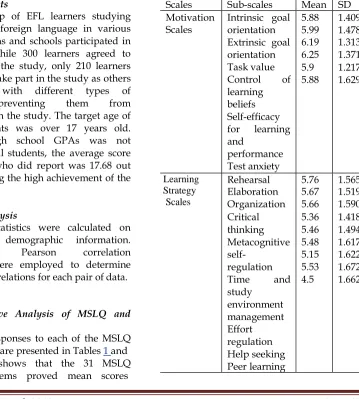
Scales Sub-scales Mean SD Motivation
Scales Intrinsic goal orientation Extrinsic goal orientation Task value Control of learning beliefs Self-efficacy for learning and
performance Test anxiety
5.88 5.99 6.19 6.25 5.9 5.88
1.409 1.478 1.313 1.371 1.217 1.629
Learning Rehearsal 5.76 1.565
Strategy Elaboration 5.67 1.519
Scales Organization 5.66 1.590
Critical 5.36 1.418 thinking 5.46 1.494 Metacognitive 5.48 1.617 self- 5.15 1.622 regulation 5.53 1.672 Time and 4.5 1.662 study
environment management Effort regulation Help seeking Peer learning 2 – There will be a positive, significant
relationship between the MSLQ learning strategies and the SILL learning strategies with a population consisting of Iranian EFL learners.
3 – There will be a positive, significant relationship between the MSLQ total scores and the SILL total scores with a population of Iranian EFL learners.
4.Research Methodology 4.1.Instruments
As indicated before, the two main research instruments were the MSLQ and the SILL scales. In addition, a demographic questionnaire was developed by the researchers to obtain participants’
background information relevant to their involvement in this study (i.e., age, EFL levels, and high school GPA). Students completed both scales, during a single administration, in counterbalanced order.
4.2.Participants
A large group of EFL learners studying English as a foreign language in various EFL institutions and schools participated in the study. While 300 learners agreed to participate in the study, only 210 learners could finally take part in the study as others encountered with different types of problems preventing them from participating in the study. The target age of the participants was over 17 years old. Although high school GPAs was not reported by all students, the average score for students who did report was 17.68 out of 20, reflecting the high achievement of the participants.
4.3.Data Analysis
Descriptive statistics were calculated on
participant’s demographic information.
Additionally, Pearson correlation coefficients were employed to determine significant correlations for each pair of data.
5.Results
5.1. Descriptive Analysis of MSLQ and SILL
Participant responses to each of the MSLQ and SILL item are presented in Tables 1 and 2. Table 1 shows that the 31 MSLQ motivation items proved mean scores
between 5.88 and 6.25, with standard deviations between 1.21 and 1.62. Additionally, when examining the 50 MSLQ learning strategy items, mean scores ranged between 4.5 and 5.76, with standard deviations between 1.41 and 1.67. When considering the six categories of MSLQ Motivation, Control of learning beliefs and Task value were employed the most by the Iranian EFL learners (mean of 6.25 and 6.19 resp.) while Intrinsic goal orientation and Test anxiety were utilized the least (mean of 5.88 for both). Finally, among the nine categories of MSLQ Learning strategies, Rehearsal, Elaboration, and Organization were utilized the most by the Iranian EFL learners (means of 5.76, 5.67, and 5.66, resp.) while Peer learning was used the lest (mean of 4.5).
Table 1: Descriptive statistics of motivated strategies for learning questionnaire
(MSLQ) for Iranian EFL Learners.
Modern Journal of Language Teaching Methods
ISSN: 2251- 6204
Systems Mean SD Memory strategies 4.02 1.208 Cognitive strategies 4.45 1.148 Compensatory 4.51 1.093 strategies 4.28 1.142 Meta cognitive 3.78 1.172 strategies 4.19 1.176 Affective strategies
Social strategies
M MS SIL SIL SI SL LQ LD LIn LL Q Tot ire dire To LS al2 ct3 ct4 tal Note: Minimum and maximum scores are based on 7-point Likert scale (1: Not at all and 7: Very true of me)
An examination of Table 2 illustrates that for the 50 SILL items, mean scores ranged from 4.02 to 4.51, with standard deviations between 1.09 and 1.20. The relatively small standard deviations indicate that responses were clustered closely around the mean. Among the six components of the SILL posited by Oxford, Table 2 also shows that Compensatory and Cognitive strategies were utilized the most frequently by the Iranian EFL learners, while Affective and Memory strategies were witnessed the least often.
Table 2: Descriptive Statistics of Strategy Inventory for Language Learning (SILL)
Note: Five-point Likert scale was used (1: Never or almost never true of me; 2: Usually not true of me; 3: Somewhat true of me; 4: Usually true of me; and 5. Always or almost always true of me).
5.2. Pearson Correlation Coefficients for MSLQ and SILL
The first comparison of the two measures examined the correlations between all indices of the MSLQ and SILL. Cronbach alphas for the MSLQ and SILL scales from the current sample were 0.920 and 0.946, respectively, showing strong internal consistencies. Correlations among these scores of the MSLQ and SILL are shown in Table 3.
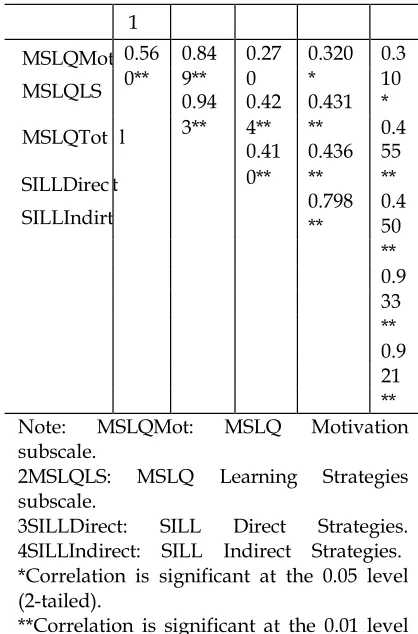
Table 3: Pearson correlation coefficients for MSLQ and SILL.
1
MSLQMot 0.56 0.84 0.27 0.320 0.3 MSLQLS 0** 9** 0.94 0 0.42 * 0.431 10 *
MSLQTot l 3** 4**
0.41 ** 0.436 0.4 55 SILLDirec
SILLIndirt
t 0** ** 0.798 **
** 0.4 50 ** 0.9 33 ** 0.9 21 ** Note: MSLQMot: MSLQ Motivation subscale.
2MSLQLS: MSLQ Learning Strategies subscale.
3SILLDirect: SILL Direct Strategies. 4SILLIndirect: SILL Indirect Strategies. *Correlation is significant at the 0.05 level (2-tailed).
**Correlation is significant at the 0.01 level (2-tailed).
Regarding the first research hypothesis, it was expected that there would be a significant, positive relationship between language learning strategies and motivation. Results produced a moderately, statistically significant correlation between the MSLQ Motivation and the MSLQ Learning Strategies (r = 0.560). In addition, there was a somewhat lower correlation between the MSLQ Motivation subscale and the SILL Indirect Learning Strategies (r = 0.32); and the MSLQ Motivation subscale failed to significantly correlate with the SILL Direct Learning Strategies (r = 0.27). Results indicated that while the two scales have some similar content, the scales do not overlap entirely and do appear to measure two discrete indices.
The second research hypothesis prognosticated that there would be a positive, significant relationship between the MSLQ learning strategies and the SILL learning strategies. As expected, results showed that there was a reasonably, statistically significant correlation between the MSLQ Learning Strategies and the two
Modern Journal of Language Teaching Methods
ISSN: 2251- 6204
types of scores (Direct/Indirect Strategies) produced by the SILL ( r = 0.41 and 0.43, resp.).
Concerning the final research hypothesis, it was expected that there would be a positive, significant relationship between the MSLQ total scores and the SILL total scores. Again, the findings confirmed a moderate correlation between the SILL total scores and the MSLQ total scores (r = 0.45), supporting the research hypothesis.
6.Discussion and Conclusion
The Main goal of this study was to scrutinize the relationship between motivation and language learning strategies in a population of Iranian EFL learners. Specifically, two of the most commonly administered scales used with EFL learners were examined to make better understanding of the potential relationship between the constructs of motivation and language learning strategies. Two chief conclusions were achieved which present significant theoretical and practical implications as well. First, results confirmed that the motivational subscale of the MSLQ was correlated with both subscales of the SILL to some extent. The MSLQ was chosen deliberately because it contains two subscales including a “pure”
motivation subscale as well as a motivation/language learning strategies subscale. No correlation was found between motivation and direct language learning strategies; though a significant relationship was proved between motivation and indirect language learning strategies. This connection between motivation and language learning strategies has been previously recognized; however, our results emphasize the complexity of this connection. The strong relationship between motivation and indirect language learning strategies is critical when located within a metacognitive framework. All EFL learners are expected to recognize and utilize the individualized processes which seem helpful for them. Findings of this study prove that the present sample of Iranian EFL learners seems to be capable to keep this balance. These results support
previous findings that most EFL learners are sent to school without enough English as a Foreign Language (EFL) education (Harklau, Losey, and Siegal, Eds, 1999).
We achieved several interesting findings by analyzing the Motivation and Learning strategies utilized by the students. The high Control of learning belief score shows the expectation by the learners that an attempt to learn will lead to positive outcomes. These results are also more dependent upon intrinsic factors such as one’s own effort, than external factors such as a teacher. Likewise, Task value was also scored high by the EFL learners reflecting the very practical, applied nature of their motivation. This finding is also reflected by the high Metacognitive self-regulation and Time and study environment management scores formed on the Learning strategies section of the MSLQ.
Several distinctive strategies emerged with regards to the present sample including: Compensatory and Cognitive techniques (e.g., Questions 15, I watch English language TV shows spoken in English or go to movies spoken in English; 17, I write notes, messages, letters, or reports in English; 24, To understand unfamiliar English words, I make guesses, and 29, If I can't think of an English word, I use a word or phrase that means the same thing). It is worth mentioning that these strategies were done in isolation not in an interactive or conversational setting.
The present study is also related to the existing educational research literature by advocating previous research on L2 learning. Ultimately, the current study has identified an essential indicator of educational practice for L2 learning through the combination of the MSLQ and the SILL. Indirect and direct language learning skills showed the strongest relationship among the examined variables. Language learning skills relate to motivation; however, they should most likely be thought of as a comparatively distinctive construct. When considering language learning strategies, the use of individualized strategies has been shown to
Modern Journal of Language Teaching Methods
ISSN: 2251- 6204
develop language proficiency (MacIntyre, K. MacMaster, and S. Baker, 2001, and Goh, 1998). Particularly, the distinction between successful and less successful learners is typically the learners’ ability of applying strategies in their own learning situations (Vann and Abraham, 1990). Students with different levels of language proficiency make different use of basic skills (Ross and Rost, 1991). Moreover, existing findings give important implications for EFL teachers who work with EFL learners in the context of Iran and suggestions for future research as well. First, instructors should re-reflect on the application of language learning strategies and motivation of students in their classes. The findings suggest a distinction between language learning strategies that to motivation and indirect language skills. Recognizing this distinction, teachers will be able to produce more individualized strategies for their EFL learners. Eventually, this study offers a new direction for L2 research, because the intended use of combining both MSLQ and SILL for this study was to depict the complexity of the L2 learning process. Teachers who work with EFL learners must continue to more carefully define the specific strategies that are used by these students, considering the fact that academic success is strongly influenced by individual differences in motivation (Komarraju, S. J. Karau, and Schmeck, 2009). . For instance, EFL instructors should recognize the strategies used by their students for language learning and should encourage elementary and low-intermediate learners to use more appropriate learning strategies. Furthermore, instructors should incorporate more strategies in their classes to facilitate the learners' learning style.
Another implication of this study is that researchers should try to involve the complexity of L2 student academic experiences and learning backgrounds in EFL teaching context. The current study did not scrutinize whether diverse socioeconomic levels of families are probable covariates or not, but these considerations are advised for future researchers. It seems also imperative to note this fact that all data in this study were
collected from self-reports; no attempt was made to collect data by measuring motivation and learning strategies directly in real situation. More studies may consider observing these behaviors within the classroom setting or obtaining reports from the classroom instructors regarding the frequency of their occurrence.
References
Anderson J. C. and Gerbing D. W., (1988),
“Structural equation modeling in practice: a
review and recommended two-step
approach,” Psychological Bulletin, vol. 103,
no. 3, pp.411–423.
Andreou E. and Metallidou P., (2004), “The relationship of academic and social cognition to behavior in bullying situations among Greek primary school children,”
Educational Psychology, vol. 24, no. 1, pp. 27–41.
Bassili J. N. (2008), “Motivation and cognitive strategies in the choice to attend lectures or watch them online,” Journal of Distance Education, vol. 22, no. 3, pp. 129–
148.
Bong M. (2001), “Between- and within- domain relations of academic motivation among middle and high school students: self-efficacy, task-value, and achievement
goals,” Journal of Educational Psychology,
vol. 93, no. 1, pp. 23–34.
Bong M. and Hocevar D. (2002),
“Measuring self-efficacy: multitrait-
multimethod comparison of scaling
procedures,” Applied Measurement in
Education, vol. 15, no. 2, pp. 143–171.
Dörnyei, Z., Csizer, Y.and Nemeth N. (2006), Motivation, Language Attitudes, and Globalization: A Hungarian Perspective, Multilingual Matters, Clevedon, UK.
Dörnyei Z. (2005), The Psychology of the Language Learner: Individual Differences in Second Language Acquisition, Lawrence Erlbaum, Mahwah, NJ, USA.
Modern Journal of Language Teaching Methods
ISSN: 2251- 6204
Dörnyei Z. and Skehan P.,
(2003),“Individual difference in second
language learning,” in Handbook of Second Language Acquisition, C. Doughty and M. Long, Eds., pp. 589– 630, Blackwell, Oxford, UK.
Dörnyei Z.,(2001), Teaching and Researching Motivation, Pearson Education, Harlow, UK.
Duncan T. G. and McKeachie W. J.,(2005),
“The making of the motivated strategies for learning questionnaire,” Educational Psychologist, vol. 40, no. 2, pp. 117–128. Ellis R.,(1994), The Study of Second Language, Oxford University, New York, NY, USA.
Eshel Y. and Kohavi R.,(2003), “Perceived
classroom control, self-regulated learning strategies, and academic achievement,”
Educational Psychology, vol. 23, no. 3, pp. 249–260.
Gardner R. C., Tremblay P. F.,(1997), and A. M. Masgoret, “Towards a full model of second language learning: an empirical
investigation,” The Modern Language
Journal, vol. 81, pp. 344–362.
Goh C. C. M., (1998), “How ESL learners with different listening abilities use comprehension strategies and tactics,”
Language Teaching Research, vol. 2, no. 2, pp. 124–147.
Griffiths C.,(2004), “Language learning strategies: theory and research,” Research paper series, http://www.crie.org.nz/research_paper/c _griffiths_op1.pdf.
Griffiths C.,(2003), “Patterns of language learning strategy use,” System, vol. 31, no. 3, pp. 367–383.
Harklau L., Losey K., and Siegal M., Eds.,(1999), Generation 1.5 Meets College Composition: Issues in the Teaching of Writing to U.S.-Educated Learners of ESL, Lawrence Erlbaum Associates, Mahwah, NJ, USA.
Hsiao T. Y. and Oxford R. L.,(2002),
“Comparing theories of language learning
strategies: a confirmatory factor analysis,”
The Modern Language Journal, vol. 2, pp. 368–383.
Huang S.C.,(2008), “Assessing motivation and learning strategies using the motivated strategies for learning questionnaire in a foreign language learning context,” Social Behavior and Personality, vol. 36, no. 4, pp. 529–534.
Komarraju M., Karau S. J., and Schmeck R. R., (2009), “Role of the Big Five personality traits in predicting college students' academic motivation and achievement,”
Learning and Individual Differences, vol. 19, pp. 47–52.
Kosnin A. M., (2007), “Self-regulated learning and academic achievement in Malaysian undergraduates,” International Education Journal, vol. 8, no. 1, pp. 221–
228.
Macaro E., (2006), “Strategies for language learning and for language use: revising the theoretical framework,” Modern Language Journal, vol. 90, no. 3, pp. 320–337.
MacIntyre P. D., MacMaster K. and Baker S., (2001), “The convergence of multiple models of motivation for second language learning: Gardner, Pintrich, Kuhl and
McCroskey,” in Montivation and Second
Language Acquisition, Z. Dörnyei and R. Schmidt, Eds., pp. 461–492, Second Language Teaching and Curriculum Center, The University of Hawaii, Honolulu, Hawaii, USA.
Neber H. and Heller K. A., (2002),
“Evaluation of a summer-school program
for highly gifted secondary-school students: the German Pupils Academy,” European Journal of Psychological Assessment, vol. 18, no. 3, pp. 214–228.
Ng J. C., Lee S. S. and Pak Y. K., (2007),
“Contesting the model minority and
perpetual foreigner stereotypes: a critical review of literature on Asian Americans in
Modern Journal of Language Teaching Methods
ISSN: 2251- 6204
education,” Review of Research in
Education, vol. 31, pp. 95–130.
Ommundsen Y. (2003), “Implicit theories of ability and self-regulation strategies in physical education classes,” Educational Psychology, vol. 23, no. 2, pp. 141–157.
Oxford R. and Nyikos M., (1989),
“Variables affecting choice of language
learning strategies by university students,”
Modern Language Journal, vol. 73, pp. 291–
399.
Oxford R. L. (1996), “Employing a questionnaire to assess the use of language learning strategies,” Applied Language Learning, vol. 7, no. 1-2, pp. 25–35.
Oxford R., Ed., (1996), Language Learning Strategies around the World: Cross- Cultural Perspectives, Second Language Teaching and Curriculum Centre, University of Hawaii Press, Honolulu, Hawaii, USA.
Oxford R. L. and Burry-Stock J. A. (1995),
“Assessing the use of language learning
strategies worldwide with the ESL/EFL version of the strategy inventory for language learning (SILL),” System, vol. 23, no. 1, pp. 1–23.
Oxford R. L., (1990), Language Learning Strategies: What Every Teacher Should Know, Newbury House, New York, NY, USA.
Pintrich P. R., Smith D., Garcia T., and McKeachie W. J., (1991), A Manual for the Use of the Motivated Strategies for Learning Questionnaire, National Center for Research to Improve Postsecondary Teaching and Learning, University of Michigan, Ann Arbor, Mich, USA.
Politzer R. L. and McGroarty M., (1985),
“An exploratory study of learning behaviors and their relationship to gains in linguistic and communicative competence,”
TESOL Quarterly, vol. 19, pp. 103–124.
Rao N., Moely B. E. and Sachs J., (2000),
“Motivational beliefs, study strategies, and
mathematics attainment in high- and low- achieving Chinese secondary school
students,” Contemporary Educational
Psychology, vol. 25, no. 3, pp. 287–316.
Rao N. and Sachs J., (1999), “Confirmatory
factor analysis of the Chinese version of the motivated strategies for learning
questionnaire,” Educational and
Psychological Measurement, vol. 59, no. 6, pp. 1016–1029.
Ross S. and Rost M., (1991), “Learner use of strategies in interaction: typology and
teachability,” Language Learning, vol. 41,
no. 2, pp. 235–273.
Sachs J., Law Y. K. and Chan C. K. K., (2002), “An analysis of the relationship between the motivated strategies for learning questionnaire and the learning process questionnaire,” Psychologia, vol. 45, no. 3, pp. 193–203.
Sachs J., Law Y. K., Chan C. K. K., and Rao N., (2001), “A nonparametric item analysis of the motivated strategies for learning questionnaire—Chinese version,”
Psychologia, vol. 44, no. 3, pp. 197–208.
Schunk D. H., Pintrich P. R. and Meese J., (2007), Motivation in Education: Theory, Research, and Applications, Prentice Hall, Englewood Cliffs, NJ, USA, 3rd edition.
Vann R. J. and Abraham R. G., (1990),
“Strategies of unsuccessful learners,”
TESOL Quarterly, vol. 24, pp. 177–198.
Modern Journal of Language Teaching Methods
ISSN: 2251- 6204
THE USE OF TEXTUAL AND INTERPERSONAL
METADISCOURSE ACROSS DISCIPLINARY
COMMUNITIES
Biook Behnam
Islamic Azad University, Tabriz Branch [email protected]
Elnaz Roohi
Islamic Azad University, Tabriz Branch [email protected]
Abstract
Metadiscourse offers a powerful analytical tool for describing discourse and mapping the ways that language is related to the social content in which it is used. With the recent developments in the area of academic discourse analysis it is accepted that the negotiation of academic knowledge is related to the social practices of the academic communities.