110 DOI: 10.
Nanoscale Studies on Aggregation Phenomena in Nanofluids
Naiyer Razmara1,* , Hossein Namarvari1, Naiyer Alizadeh2
1
Department of Mechanical Engineering, Azarbaijan Shahid Madani University, Tabriz, Iran
2Department of Mechanical Engineering, Technical University of Urmia, Urmia, Iran
Received 14 May 2017; revised 4 June 2018; accepted 12 June 2018; available online 3 July 2018
ABSTRACT: Understanding the microscopic dispersion and aggregation of nanoparticles in nanoscale media has become an important challenge during the last decades. Molecular dynamics is one of the important techniques to tackle many of the complex problems faced by rheologists and engineers. Making progress in the investigations at nanoscale whether experimentally or computationally has helped understand the physical phenomena at the molecular scale. In addition, important developments have been made in predicting behavior of confined fluids and lubricants at nanoscale. In this review we will discuss on some progress made on the illustration of aggregation mechanisms in nanofluids. Our main focus will be on the application of molecular modeling in the effect of aggregation on the nano-rheology of nanofluids.
KEYWORDS: Aggregation; Molecular dynamics; Nanoscale; Rheology
INTRODUCTION
Nanofluids are classified as a new branch of heat transfer fluids engineered by stably suspending nanoparticles, fibers, sheets, or tubes of 100 nm maximum average sizes into conventional heat transfer fluids to enhance thermal transport (1-2). The suspended nanoparticles are in random motion under the influence of acting forces such as the Brownian and the Van der Waals forces. During the random motion of the suspended nanoparticles, aggregation and dispersion may appear among nanoparticle clusters and individual nanoparticles.
The suspended nanoparticles may undergo interparticle collision and tend to aggregate under the influence of the external and internal forces. The stochastic motion of the suspended nanoparticles reinforces the energy transport inside the liquid.
Experiments revealed that the nanofluids show enhancement in heat transfer characteristics (3-7).
The unique properties of nanofluids require investigations to a great extent on the determination of the
key mechanisms behind the enhanced energy transport.
At present, a number of promising mechanisms
investigated by the researchers are declared such as the Brownian motion of nanoparticles (8-11), molecular-level layering at the solid–liquid interface (8,12-15), microconvection induced by Brownian motion of nanoparticles (9,16-18), and the effect of nanoparticle aggregation (8,9,19-21).
Aggregation or clustering is the direct mutual attraction of nanoparticles suspended in base fluid under the influence of Van der Waals, Brownian forces or chemical bonding.
*Corresponding Author Email: [email protected]
Tel.: +98 41 34327566; Note. This manuscript was submitted on May 14, 2017; approved on June 4, 2017; published online July 3, 2018.
In an ideal world, nanofluids contain well-dispersed nano nanoparticles in base fluids, but it is experimentally shown that nanofluids can make aggregated structures (22-25). Preparing a homogeneous suspension is still a technical challenge due to strong van der Waals interactions between nanoparticles which are likely to the formation of aggregates.
However, nanoparticle aggregation is always unknown in the majority of nanofluids experiments.
Furthermore, the experimental investigations can provide quantitative results rather than qualitative one from the microscopic viewpoint. Understanding the statistical mechanics is an effective way to recognize the relationship between molecular motion at nanoscale and macroscopic phenomena.
In this regard, Molecular Dynamics simulation is a hopeful methodology to investigate the nanoscale phenomena which is employed by a lot of researchers to complement experimental studies at the atomistic level (26-28).
This review paper is discussing about experimental and theoretical researches related to modeling and simulation of nanoparticle aggregation at macroscale.
Due to the lack of atomic details using molecular modeling techniques on the nanoparticle aggregation, the authors aimed to report existing studies and challenges in this subject for further investigations.
111 Nomenclature
d Diameter Greek Symbols
D Fractal index Φ Interaction potential
F Force between particles ϕ Pair potential
m Mass φ Particle volume fraction
r Distance ∇ Nabla operator
t Time Subscripts
v Velocity eff Effective
i Type of particle
j Type of particle
BASICS OF MOLECULAR DYNAMICS
TECHNIQUE
Molecular dynamics is a deterministic method so that the trajectories of the particles are completely determined by means of known initial conditions. Accordingly it can be used for estimating thermodynamic properties and the microscopic behavior of nanoscale phenomena. Nowadays it is a valuable tool to study e.g. liquids, defects, fractures, surfaces, friction, clusters, aggregation, biomolecules and electronic properties and dynamics. As the first simulation using the molecular dynamics method, in 1957, Adler and Wainwright (29) investigated a solid-fluid transition in a system composed of hard spheres interacting by instantaneous collisions. They focused on the dynamics of particles moving at constant velocity between perfectly elastic collisions. Rahman (30) in 1964 used Lennard-Jones potential to describe both attractive and repulsive interaction in a system of 864 argon atoms. The methods of the simulation and analysis of the molecular dynamics results described in this paper are still used in many present molecular simulation studies. Pair correlation function, velocity autocorrelation function, and mean square
displacement calculated for liquid argon. Molecular
dynamics method is a computer simulation technique where the time evolution of a set of interacting atoms is followed by integrating their equations of motions. In this method, the classical equations of motion (Newton's equations) are solved for atoms and molecules as:
2
2
,
i
i i
d r
m
F
dt
=
(1)
where mi is the particle mass, ri its position vector, and
Fi the force acting on the particles due to the interaction
potential of other particles and/or external forces. The
interaction potential, Φ, is a physical model describing the
interaction between particles which is a function of the positions of the particles. If the forces acting on each particle are independent of the velocities, the forces between particles can be derived as the gradient of the interaction potential with respect to the particle positions:
,
i i
F
= −∇ Φ
(2)For simplicity, the potential of a system can often be reasonably assumed to be the sum of the effective pair potential as:
(ij), i j i
r
φ
>
Φ =
∑∑
(3)where rij is the distance between molecules i and j.
Once the potential of a system is obtained, it is straightforward to numerically solve Equation1. Fundamentally, all of gas, liquid, solid states, and interphase phenomena can be solved without the knowledge of thermophysical properties such as thermal conductivity, viscosity, latent heat, saturation temperature and surface tension.
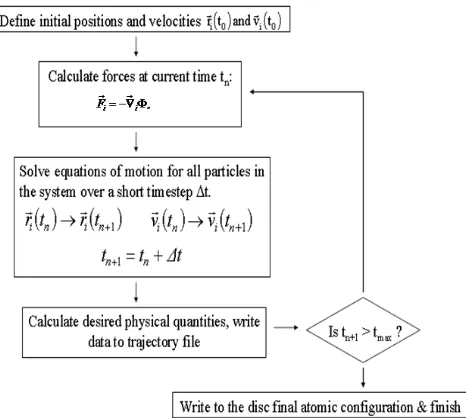
These equations are solved by time integration schemes based on finite difference methods such as the Gear algorithm or Verlet method (31-32). By the knowledge of the position and their time derivatives at time t, the scheme gives the same quantities at a later time. By iterating this procedure, the time evolutionof the system can be followed for long times. The overall schematic diagram of molecular dynamics procedure is shown in Figure 1.
112
MACROSCALE STUDIES
Influence of aggregation on thermal conductivity
Since thermal conductivity is the most important parameter responsible for enhanced heat transfer, many experimental and computational works have been reported on this field. Regarding experimental researches, it is apparently explained that the nanoparticle aggregation is the only mechanism capable of explaining the enhanced thermal conductivity of nanofluids (11-15, 20, 21, 33). The clustered nanoparticles make linear chains or local percolation-like conduction paths for rapid heat transfer (8, 19, 21, 34). The effects of particle agglomeration on thermal conduction in nanofluids have been studied extensively both theoretically and experimentally (35-37). Aggregation, which is responsible for high thermal conductivities in nanofluids at the upper bound, has become an important issue. An agreement has not yet been reached as to whether aggregation play a role in enhanced thermal transport. A number of investigations show that clustering and aggregation is one of the main features in thermal conductivity enhancement of nanofluids (20-22,38), although this may be highly specific to the high aspect ratio nanoparticles, including single wall nanotubes, but the opposite trend has also been observed (36,37).Keblinski et al. (8) revealed clustering of nanoparticle as a mechanism of enhanced thermal conductivity of nanofluids. They assumed that clustered nanoparticles supply local percolation-like paths for rapid heat transport and increase the effective nanoparticle volume fraction. Prasher et al. (19-20) investigated the effects of aggregation on the thermal conductivity of nanofluids and explained that the aggregation time constant decreases quickly with decreasing nanoparticle size. Also it is demonstrated that the aggregation of nanoparticles can significantly enhance the thermal conductivity of nanofluids. Based on the results of the numerical simulation, they concluded that conduction-phenomenon-based thermal conductivity of nanofluids can be significantly enhanced as a result of aggregation of the nanoparticles. This aggregation is a function of the chemical dimension of the aggregates and the radius of gyration of the aggregates. However, they excluded the effect of thermal interfacial resistance in their analysis. It is believed that the heat transport can be much faster along the backbone of the clusters. Evans et al. (21) and Philip et al. (39) investigated the effect of the aggregation and interfacial thermal resistance on the effective thermal conductivity of nanofluids and nanocomposites. It is explained that the high aspect ratio structure of the fractal-like aggregates is a key factor allowing rapid heat flow over large distances. They also stated that well dispersed composites show low thermal conductivity enhancement but composites with fractal aggregates show significant enhancements, even with considerable interfacial resistance. Eapen et al. (25) declared that even for dilute nanoparticle suspensions thermal conductivity augmentation is a function of the
aggregation state and hence connectivity of the particles; in particular, almost all available experimental data about thermal conductivity fall between lower and upper limits predicted by classical theories. Timofeev et al. (38) confirmed that the geometry, agglomeration state, and surface resistance of nanoparticles are the main variables controlling thermal conductivity enhancement in nanofluids. Gharagozloo and Goodson (40) also measured fractal dimensions for the 1%, 3% and 5% volume
concentrations of Al2O3 in H2O and concluded that
aggregation is a more likely cause for the measured enhancements of nanofluid. Ozerinc et al. (41) declared that ultrasonicated Fe nanofluids got enhancement in thermal conductivity due to their broken clusters although this enhancement reduced as a function of elapsed time after production. Recently, Shalkevich et al. (42) measured the thermal conductivity of silica/ and alumina/water nanofluids in fluid, glass, and gel states, and they revealed that heat diffusion in nanofluids was significantly affected by the particle arrangements. This work clarifies the relationship between the aggregation state of a nanofluid and its effective thermal conductivity. The thermal conductivity of glassy samples, in which particles were separated and kinetically frozen by strong repulsive interparticle forces, was lower than that of the base fluid, and the thermal conductivity decreased rapidly with decreasing particle volume fraction.
Hong and Kim (43) measured thermal conductivities for different particle and electrolyte concentrations to show the effect of aggregation on the thermal conductivity of alumina/water nanofluids. It is indicated that the thermal conductivity increased with the degree of aggregation and the gelled nanofluids showed substantially larger thermal conductivities than the fluidic samples. However, the comparison between results showed that the thermal conductivity enhancement was much larger in this work compared to the Maxwell. This indicated that the degree of aggregation was not only the factor that determined the thermal conductivity, and other important factors, such as the particle configuration in the aggregates, are expected to contribute as well.
Wang and Peng (44) have studied experimentally the effective thermal conductivity of liquids with 25 nm SiO2 particle inclusions, and observed the percolation pattern of particle clustering by scanning tunnel microscopic (STM) photos. It was believed that clustering could affect the enhancement prominently.
113
thermal conductivity of fluids by providing a long path for
heat transport. However, thermal conductivity would not be improved effectively if the cluster size is increased for a given loading of particles because heat transport paths due to clusters are localized. The effect of the heat transport path due to nanoclusters would be more important in improving thermal conductivity at lower particle concentration, which illustrates the nonlinearity of thermal conductivity with the volume fraction of particles. Gaganpreet and Srivastava (46) have examined the unusual increase in the thermal conductivity and relative viscosity of nanofluids by taking clustering as a function of particle volume concentrations, particle size and concentration of aggregated nanoparticles. The aggregation of nanoparticle formation inside the fluid was emphasized and a new aspect parameter as the weight factor has been inserted into the model. Therefore, it is concluded that the arrangement of various types of clusters plays vital role in the conductivity mechanism of heat in nanofluids.
Contrarily, some other studies show that agglomeration and clustering reduce stability and thermal conductivity improvement.
Xuan et al. [24] simulated Brownian motion and aggregation of nanoparticles and demonstrated that nanoparticle aggregation decreases the thermal conductivity of nanofluids for the reason that the random motion of aggregates is slower than that of a single nanoparticle. Hong et al. [36] investigated the effect of the clustering of Fe nanoparticles on the thermal conductivity of nanofluids. They found that the thermal conductivity of nanofluids is directly related to the agglomeration of Fe nanoparticles, which caused the nonlinear relation between the Fe volume fraction and thermal conductivity of nanofluids due to rapid clustering of nanoparticles.
It is found that the reduction of the thermal conductivity of nanofluids is directly related to the agglomeration of nanoparticles. In general, it is accepted that heat transfer is a surface phenomenon and the thermal energy interaction takes places at the surface of nanoparticles. When the particles get agglomerated, the effective surface area to volume ratio decreases, thus reducing the effective area of thermal interaction of particles causing a decrease in the thermal conductivity of the fluid. Karthikeyan et al. [37] studied the parameters influencing the thermal conductivity increase in water and ethylene glycol based nanofluids including CuO nanoparticles with average diameter 8 nm. They observed that the enhancement of the thermal conductivity of nanofluid with the volume fraction of nanoparticles is nonlinear and the thermal conductivity decreases with elapsed time due to clustering of nanoparticles. Finally they concluded that the nanoparticles size, polydispersity, cluster size and the volume fraction of particles have a significant influence on thermal conductivity of suspensions. The size of cluster not only depends on average particle diameter but also the particle concentration in the fluid.
The higher the particle concentration in the fluid, the
smaller the inter-particle distance between the particles, as a result the probability of agglomeration is more due to vander Waals attraction.
Utomo et al. [47] investigated thermal conductivity, viscosity and heat transfer coefficient of water-based alumina and titania nanofluids. The thermal conductivity of alumina nanofluids follow the prediction of Maxwell model, whilst that of titania nanofluids is slightly lower than model prediction because of high concentration of stabilizers. None of investigated nanofluids show anomalously high thermal conductivity enhancement frequently reported in literature. H.Kang et al. [48] studied on the clustering and aggregation of Ar-Cu effects on the thermal conductivity and shear viscosity. Different configurations of nanoparticle clustering were considered and revealed that this factor would cause different thermal conductivity and shear viscosity enhancements in nanofluid. Moreover, it’s showed that if nanoparticle aggregation happens, thermal conductivity and shear viscosity will be induced to increase. Also, the effects of configuration and aggregation on the thermal conductivity are more significant than their effects on the shear viscosity. The results of their study are summarized at Table 1.
Adil Loya [49] used MD for studying on the dispersion of CuO in the water and alkanes whose nanoparticles were modified throughout butyric acid as a modifying agent. He applied LAMMPS software to simulate system and calculate the thermal conductivity and viscosity. For a better understanding of the aggregation phenomenon, radial distribution function (RDF) was introduced because it informs about pair distribution function of molecules. The calculated RDF in his work was used to estimate the aggregation of the CuO-water system in different temperature, with and without nanoclusters. The water simulation RDF showed much less aggregation since the peaks are smooth rather than being intense. Whereas, the RDF results for CuO nanoclusters water system showed that, to have strong peaks representing aggregation of CuO nanoclusters in water. The water system RDF results interpretations demonstrate better dispersing capability when temperature is increased, whereas the CuO nanoclusters water system proves better dispersion at low temperatures.
This discrepancy between the water and water with nanoparticle system can be explained by kinetic molecular theory for water and the heat conduction of nanoparticles for water with nanoparticles.
114
causing the aggregation to increase. This increasing aggregation shows high peak intensities at high
temperatures.
Table 1
Effects of aggregated and non-aggregated nanoparticles on thermal conductivity and viscosity (48). Thermal
conductivity (W/m K)
Thermal conductivity enhancement (%)
Shear viscosity (Pa s)
Increase of shear viscosity (%)
Pure fluid 0.134 - 0.279 × 10⁻³ -
Two nanoparticles Without aggregation 0.169 27.1 0.341 × 10⁻³ 22.2
With aggregation 0.195 46.6 0.357 × 10⁻³ 30.0
Four nanoparticles Without aggregation 0.168 26.3 0.331 × 10⁻³ 18.6
Two nanoparticle-pairs 0.201 51.1 0.349 × 10⁻³ 25.1
Four nanoparticles clustered as a line 0.215 61.7 0.350 × 10⁻³ 25.4 Three-nanoparticles line and a single
nanoparticle
0.215 61.7 0.366 × 10⁻³ 31.2
Four-nanoparticles square 0.277 70.7 0.351 × 10⁻³ 25.8
Eight nanoparticles Without aggregation 0.173 30.1 0.336 × 10⁻³ 20.4
With aggregation 0.200 50.4 0.374 × 10⁻³ 34.1
If aggregated particles in the fluid lead to formation of particle clusters, the predicted thermal conductivity would be significantly higher as was observed by many researchers (50, 51) and might be of a strong function of the aggregates dimension and the radius of gyration of the aggregates. This result is based on the three-level homogenization theory, validated by MC (Monte Carlo) simulation of heat conduction on model fractal aggregates (21, 40, 52).
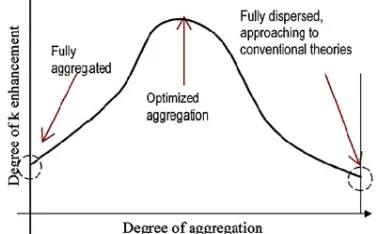
As it can be seen in Figure 2, they related the enhancement of thermal conductivity to nanoparticle aggregation (50). It is seen that there should be an
optimized aggregation structure for achieving maximum thermal conductivity, which is far beyond the prediction from homogeneous dispersions.
Such an argument eliminates thermal conductivity as an intrinsic physical characteristic. Possible influence of particle aggregation on conduction highlights the colloid chemistry’s significant role in optimizing this property of nanofluids. Meanwhile, there exists another theory of lowering thermal conductivity of aggregation forming as found by Hong et al. (36, 41) from experiments by light scattering of Fe nanoparticles aggregate.
Fig. 2. The effect of aggregation on the effective thermal conductivity (50)
Lee et al.(53) simulated argon liquid and copper nanoparticles for calculating thermal conductivity, while they have considered aggregated and non-aggregated states and compared the role of nanoparticles aggregation on the enhancement of thermal conductivity in both aggregated
115 Fig. 3. Thermal conductivity of non-aggregated and aggregated
nanofluids as a function of nanoparticle volume fraction (53)
The higher increases in aggregated nanofluids are attributed to both higher collision among nanoparticles and increases in the potential energy of nanoparticles. Thermal conductivity of both states is well covered by Hashin– Shtrikman (HS) mean field bounds (see Figure 4).
Fig. 4. Comparison of thermal conductivity enhancement of nanofluids in aggregated and non-aggregated states with Hashin-Shtikman (HS) mean
field theory (53)
By decomposition of heat current into two different terms, collision and convective (see Figure 5), and further decomposition of the convective term into kinetic and potential energy it’s explored that potential energy is responsible for increasing in thermal conductivity with respect to nanoparticle volume fraction. For non-aggregated nanofluids, thermal conductivity mainly increased by increasing in the potential energy of argon, while for aggregated nanofluids it’s not only contributed to increase in the potential energy of argon and copper, but also by more collisions between particles.
At low volume fractions, thermal conductivity enhancement of the aggregated state only contributes to higher collision among particles and at high volume fraction thermal conductivity enhancement attributes to more collision among particles as well as increasing the potential energy of copper nanoparticles.
Fig. 5. Thermal conductivity of nanofluids as a function of nanoparticle volume fraction. (a) Total thermal conductivity contributed by collision and convective terms; (b) thermal conductivity contributed by collision term; (c)
thermal conductivity contributed by convective term (53)
Mina Sedighi and Ali Mohebbi (54) showed that improvement of thermal properties of nanofluids via nanoparticle aggregation is not perpetual. When the nanoparticles become aggregated, their concentration in the nanofluid increases until the aggregates become so large and forced them to separate from each other over the time and settling takes place; as a result of this reason it can be concluded that aggregation cannot have remarkable influence on thermal properties of nanofluid. They used a combined EMD and NEMD simulation to calculate the specific heat, thermal conductivity and thermal diffusivity for silicon dioxide in water nanofluid system and to validate the MD model; the results were compared with experimental data.
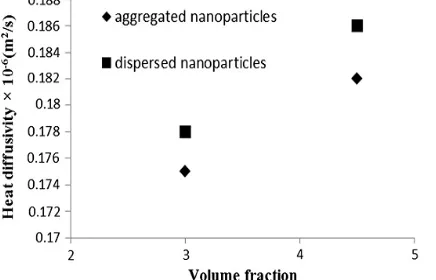
For investigating the influence of nanoparticle aggregation they considered two cases of constant and variable volume fractions at temperature of 308K. They explored that by increasing nanoparticles concentrations, specific heat reduced (see Figure 6), in return thermal conductivity and thermal diffusivity increased (see Figure 7 and Figure 8).
116
Y.H Chen applied Molecular Dynamics as a tool to explain the possible mechanism of the abnormal thermal conductivity enhancement which might be affected by aggregation in nanofluids systems.
Fig. 6. Comparison of specific heat of SiO2-water nanofluid for two cases of dispersed and aggregated nanoparticles (54)
Fig. 7. Comparison of the thermal conductivity of aggregated and dispersed nanoparticles in the nanofluid with HC model and the base fluid
(54)
Fig. 8. Comparison of thermal diffusivity of SiO2-water nanofluid for two cases of dispersed and aggregated nanoparticles (54)
His results revealed that clustering phenomena has a positive impact on thermal conductivity, in other words,
aggregation is considered as a dominating factor to the significant enhancement beyond Maxwell’s prediction. (55) Motevasel et al.(56) have done experimental and theoretical evaluations to clarify the effect of different
nanoparticles (Al2O3, MgO, CuO and SiC) aggregation on
the thermal conductivity of nanofluids at very low concentrations. They compared the available models considering and neglecting the effect of aggregation of particles. The relative absolute average deviation (RAAD) ratio of thermal conductivity models without considering the aggregation effect in relation with the models considering the aggregate, is observed to be between 2 and 6 times. Therefore, it seems that inclusion of the aggregation of particles in calculation of the thermal conductivity is important even at very low concentrations. In conclusion, some investigators believe that nanoparticle aggregation plays an important role in thermal transport due to their chain shape (21, 23) but some others believe that the time-dependent thermal conductivity in the nanofluids proves the reduction of thermal conductivity by passing time due to clustering of nanoparticles with time (37).
Therefore, for classification of the stability theory more experimental and computational works especially those based on molecular techniques are needed to clarify the role of aggregation in conductivity enhancement.
Influence of aggregation on viscosity
It has been confirmed that the nanoparticles in the fluids are mostly in the form of aggregates (20, 57, 58). The liquid inside and adjacent to these aggregates are less mobile. Consequently, the nanofluid becomes more viscous. As shear rate increases these aggregates break into smaller or primary structures.
Prasher et al. (20) developed Einstein equation (59) for calculation of viscosity by considering the aggregation of nanoparticles. Chen et al. (60) extended the Krieger and Dougherty equation (61) considering the effects of variable packing fraction within the aggregate structure. They expressed the viscosity enhancement of a nanofluid only to the aggregation state of the nanoparticles. Particle aggregation has no direct impression on the viscosity of nanofluids.
Though, the effective volume fraction is completely higher than the actual volume fraction due to micro-aggregation of nanoparticles and this leads to the increase in viscosity of nanofluids. To give explanation for this, Chen et al. (62) introduced fractal geometry to predict the volume fraction increase. According to the fractal theory, the effective particle volume is given by:
𝜑𝑒𝑓𝑓
𝜑
=
�
𝑑𝑒𝑓𝑓
𝑑
�
(3−𝐷)
(4)
where d and deff are diameters of the primary
117
fractal index having typical values ranging from 1.6–2.5 for aggregates of spherical nanoparticles.
Then it is possible to describe the measurements corresponding to water-based and glycerol-based nanofluids on modifying Krieger–Dougherty and Mooney
model by replacing φ with φeff.
Chen et al. (63) examined the rheological behavior of
TiO2 nanotube based EG nanofluids. The effects of particle
shape and aggregation of nanoparticles on the rheological behavior of the EG-TNT nanofluids were discussed and a theoretical model for the four regimes was developed. They showed that the rheological behavior can be described by Brenner and Condiff equations with different intrinsic viscosity depending on the particle shape and/or aggregate structure.
Duan et al. (64) measured viscosity of 2-week-old
Al2O3-water nanofluids with volume fraction of 1-5% by
applying ultrasonication. They concluded that the high viscosity observed is most likely as a result of agglomeration. Once agglomeration is formed, a larger stress is necessary to break the structure among particles when shearing takes place; therefore, a high relative viscosity would be observed in the fluids.
Their measurement fits the modified Krieger–Dougherty model. They indicated that the huge deviation between the experimental results and theoretical models might be due to the nanoparticle agglomeration. They suggested conducting more detailed studies of particle agglomeration in the nanofluids and the effects on the thermal properties to stabilize nanofluid for applications in the near future. Viscosity was also measured in the work of Hong and Kim (43).
As a result, the viscosity in the shear rate range above
125 s−1 showed a similar trend to that of other gelled
samples.Consequently, the viscosity of a nanofluid was found to be a good indicator of the aggregation state and the rheological behavior. Utomo et al. (47) showed that the viscosity of alumina and titania nanofluids was higher than the prediction of Einstein–Batchelor model due to aggregation.
Moreover, Gaganpreet and Srivastava (46) demostrated that the relative viscosity of nanofluids, which has been predicted with the modified K-D equation, increases with the increase in particle aggregate ratio and is found to match well at low concentration.
Zhou et al. (65) also highlighted that the shear thinning behavior at high shear rate is likely due to aggregates being destroyed under shear.
This can also explain that the non-Newtonian characteristics of nanofluids are more apparent at a higher volume fraction and a longer holding time because the possibility of aggregation is higher. Pastoriza-Gallego et al. (66) investigated the viscosity variation of Al2O3-water nanofluids kept 2 weeks between before and after re-ultrasonication treatment.
They indicated that the variation in size or aggregation of the nanoparticles have a determining impact on the viscosity of nanofluids. Rubio-Hernandez et al. (67) showed that as the size of the aggregates increases, the relative viscosity will increase. Also, as the shape of the aggregate is no longer spherical due to aggregation, the intrinsic viscosity should be greater than 2.5 for other shapes.
In spite of this, a small number of studies have concentrated on the effect of the nanoparticle aggregation on the viscosity in the nanofluids.
MOLECULAR STUDIES
There are very limited molecular studies on the domino effect of aggregation in naofluids characteristics. However, the existing studies focused on the molecular investigation of the effect of aggregation only on thermal conductivity, viscosity and diffusion. Lee et al. (53) used molecular dynamics simulation with the Green Kubo method to model nanofluid including argon liquid and copper nanoparticles in aggregated and non-aggregated states. They concluded that thermal conductivity of both state enhance with increasing nanoparticle volume fraction.
Also, they showed that in aggregated state thermal conductivity growth of nanofluids is about 35% higher than in a nonaggregated state. The heat current is decomposed in to convective and collision terms in which the convective term is the summation of kinetic and potential energy. As the result of study, at low volume fraction of 2.59% and 3.89%, collision correlation dominated thermal conductivity variation in both aggregated and nonaggregated states. At higher volume fraction of over 3.89%, thermal conductivity variation was contributed to by both collision and convective terms. Also they concluded that enhancement of thermal conductivity is mainly due to potential rather than kinetic energy. They stated that for nonaggregated nanofluids increase in thermal conductivity is dominated by the increasing potential energy of argon but it increases by increasing potential energy of both argon and copper in aggregated nanofluids.
Kang et al. (48) studied the effect of nanoparticle aggregation on thermal conductivity and viscosity of nanofluids by molecular dynamics simulation. They placed two, four and eight copper nanoparticles in the simulation box with the same particle diameter and the same volume fraction. Within the time domain of 32 ns, no aggregation had been observed.
So, they concluded that with the same nanoparticle diameter, volume fraction is only parameter that affects the thermal conductivity of nanofluids, if the nanoparticles do not aggregate.
118
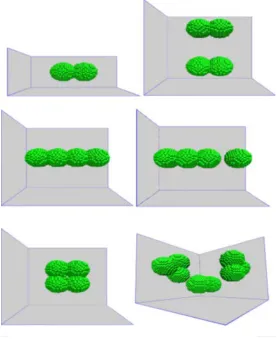
on the thermal conductivity, at first, they spread the nanoparticles stuck together in the liquid argon (configurations are shown in Figure 9. Results of simulation show that with aggregation of nanoparticles, thermal conductivity of nanofluid increase significantly.
The shear viscosity of nanofluid increases too, but its growth is more moderate than the thermal conductivity increment.
Also they concluded that various configuration of the nanoparticles cluster resulted in different enhancement of thermal conductivity and shear viscosity.
Fig. 9. Different configurations of nanoparticle clustering (48)
Vladkov and Barrat (68) simulated the thermal properties of nanofluids by using molecular dynamics simulations. They concluded that the Brownian motion of the particle does not affect the cooling process and that the Maxwell-Garnett model can predict the effective thermal conductivity of nanofluids.
They also concluded that the essential parameter that influences the effective thermal conductivity is the ratio of the Kapitza length to the particle radius. The large heat transfer enhancement of nanofluids is due to the aggregation effects, such as particle clustering and percolation or cooperative heat transfer modes.
Sedighi and Mohebbi (54) applied a simulation method which was a combination of EMD and NEMD for examining the thermal properties of water-silicon dioxide nanofluid, as shown in Figure 10.
They discovered that when aggregation occurs with increasing nanoparticle concentrations, thermal conductivity and diffusivity increase and its specific heat declines during the process.
Moreover, it was revealed that if the amount of nanoparticle concentration in base fluid remains stable, the specific heat of nanofluid won’t change with respect to the aggregated nanoparticles, but its diffusivity and thermal conductivity will increase by approximately 2%. They used only one aggregate in their study and generally concluded that aggregation cannot affect thermal properties of nanofluid noticeably.
119
therefore, improvement of thermal properties of nanofluids through nanoparticle aggregation is temporary.
Fig. 10. 1.5% (a), 3% (b) and 4.5% (c) aggregated SiO2 nanoparticles in water base fluid (54)
CONCLUSIONS
Nanoparticle aggregation is believed to be one of the most likely mechanisms for rheological properties of nanofluids. In the present paper, we reviewed the effect of aggregation on the rheological behavior of nanofluids published in recent research papers and patents. The significance of molecular dynamics can be an applicable purpose for investigators to simulate nanofluids rather than experimentally testing the properties of nanofluids. However, experiments cannot be totally ignored, but simulations sometime involve initial proper validation of parameters with realistic experimentation.
Due to the flexibility of molecular dynamics and it’s cost effective nature, it is being applied in biological sciences, engineering sciences, and nanotechnology. Molecular dynamics has helped researchers further understanding of different phenomena‘s at atomic level. However, the contribution and importance of aggregation on the characteristics of nanofluids are not very clear at the moment and more nanoscale work is needed to understand it. On the other hand, more study of the relation of rheological properties of nanofluids to the micro motion and microstructure of nanoparticles is needed to provide a comprehensive theory into the mechanism of thermal transport in nanofluid.
Based on the reported data, it has been found that they are inconsistency in the improved thermal conductivities of nanofluids due to aggregation.
This can be due to differences in sample quality, theoretical models, potential functions for nanoparticles, and differences in measurement uncertainties. Few researchers reported the inconsistencies between model and experimental results of characteristics of nanofluids. It is obvious that the published articles just reported the improved thermal, rheological, and heat transfer performances without correlating these performances with
the specific applications. This review can be helpful for researchers interested in simulation of nanoparticle’s dispersion in various engineering or biological fluids.
FUTURE RESEARCH DIRECTIONS
By the review in the literature it is clear that sedimentation of the aggregates may affect the rheological properties of nanofluids. Particle aggregation can increase aggregate size, and aggregates larger than a critical size are likely to settle under the force of gravity which has an effect on the characteristics of nanofluids. The recommendations to the reader are to consider effect of aggregation on different applicable phenomena of nanofluids via molecular techniques. For instance, the aggregation of nanofluids should be an important factor affecting the boiling performance, which needs to be clarified qualitatively further. Also, research on the effect of aggregation on viscosity, surface tension, heat transfer coefficient, diffusion coefficient of nanofluids in more detailed studies are the other recommended fields.
REFERENCES
[1] Choi SUS, Eastman JA. Enhancing thermal conductivity of fluids with nanoparticles. Argonne National Lab., IL (United States); 1995.
[2] Choi SUS. Nanofluids: from vision to reality
through research. J Heat Transfer. 2009;131(3):33106.
[3] Eastman JA, Choi SUS, Li S, Yu W, Thompson
LJ. Anomalously increased effective thermal conductivities of ethylene glycol-based nanofluids containing copper nanoparticles. Appl Phys Lett. 2001;78(6):718–20.
[4] Choi SUS, Zhang ZG, Yu Wl, Lockwood FE,
Grulke EA. Anomalous thermal conductivity enhancement in nanotube suspensions. Appl Phys Lett. 2001;79(14):2252–4.
[5] Xuan Y, Li Q. Heat transfer enhancement of
nanofluids. Int J heat fluid flow. 2000;21(1):58– 64.
[6] Das SK, Putra N, Thiesen P, Roetzel W.
Temperature dependence of thermal conductivity enhancement for nanofluids. J Heat Transfer. 2003;125(4):567-74.
[7] Murshed SM, Leong KC, Yang C. Enhanced
thermal conductivity of TiO2—water based nanofluids. Int J Therm Sci. 2005;44(4):367-73.
[8] Keblinski P, Phillpot SR, Choi SU, Eastman JA.
Mechanisms of heat flow in suspensions of nano-sized particles (nanofluids). Int J Heat and mass transfer. 2002;45(4):855-63.
[9] Jang SP, Choi SU. Role of Brownian motion in the
120
[10] Kumar DH, Patel HE, Kumar VR, Sundararajan T,
Pradeep T, Das SK. Model for heat conduction in nanofluids. Phys Rev Let. 2004;93(14):144301.
[11] Evans W, Fish J, Keblinski P. Role of Brownian
motion hydrodynamics on nanofluid thermal conductivity. Appl Phys Let. 2006;88(9):093116.
[12] Xue Q, Xu WM. A model of thermal conductivity
of nanofluids with interfacial shells. Mater Chem Phys. 2005;90(2-3):298-301.
[13] Xie H, Fujii M, Zhang X. Effect of interfacial
nanolayer on the effective thermal conductivity of nanoparticle-fluid mixture. Int J Heat Mass Trans. 2005;48(14):2926-32.
[14] Xue L, Keblinski P, Phillpot SR, Choi SS,
Eastman JA. Two regimes of thermal resistance at a liquid–solid interface. J Chem Phys. 2003;118(1):337-9.
[15] Xue L, Keblinski P, Phillpot SR, Choi SS,
Eastman JA. Effect of liquid layering at the liquid– solid interface on thermal transport. Int J Heat Mass Trans. 2004;47(19-20):4277-84.
[16] Shima PD, Philip J, Raj B. Role of
microconvection induced by Brownian motion of nanoparticles in the enhanced thermal conductivity of stable nanofluids. Appl Phys Let. 2009;94(22):223101.
[17] Prasher R, Bhattacharya P, Phelan PE.
Brownian-motion-based convective-conductive model for the effective thermal conductivity of nanofluids. J Heat Trans. 2006;128(6):588-95.
[18] Prasher R, Bhattacharya P, Phelan PE. Thermal
conductivity of nanoscale colloidal solutions (nanofluids). Phys Rev Let. 2005;94(2):025901.
[19] Prasher R, Phelan PE, Bhattacharya P. Effect of
aggregation kinetics on the thermal conductivity of nanoscale colloidal solutions (nanofluid). J Nano Let. 2006;6(7):1529-34.
[20] Prasher R, Evans W, Meakin P, Fish J, Phelan P,
Keblinski P. Effect of aggregation on thermal conduction in colloidal nanofluids. Appl Phys Let. 2006;89(14):143119.
[21] Evans, W., Prasher, R., Fish, J., Meakin, P.,
Phelan, P. and Keblinski, P. Effect of aggregation and interfacial thermal resistance on thermal conductivity of nanocomposites and colloidal
nanofluids. Int J Heat Mass Trans. 2008; 51(5-6):
1431-1438.
[22] Wang BX, Zhou LP, Peng XF. A fractal model for
predicting the effective thermal conductivity of liquid with suspension of nanoparticles. Int J Heat Mass Trans. 2003;46(14):2665-72.
[23] Zhu H, Zhang C, Liu S, Tang Y, Yin Y. Effects of
nanoparticle clustering and alignment on thermal
conductivities of Fe3O4 aqueous nanofluids. Appl
Phys Let. 2006;89(2):023123.
[24] Xuan Y, Li Q, Hu W. Aggregation structure and
thermal conductivity of nanofluids. AIChE J. 2003;49(4):1038-43.
[25] Eapen J, Rusconi R, Piazza R, Yip S. The classical
nature of thermal conduction in nanofluids. J Heat Trans. 2010;132(10):102402.
[26] Chen, L., He, Y.L. and Tao, W.Q. The temperature
effect on the diffusion processes of water and proton in the proton exchange membrane using
molecular dynamics simulation. Num Heat Trans,
Part A: Appl. 2014;65(3) .216-228.
[27] Darbandi M, Sabouri M, Jafari S. Thermal wall
model effect on the lid-driven nanocavity flow simulation using the molecular dynamics method. Num Heat Trans, Part B: Fundamentals. 2013;63(3):248-61.
[28] Zhou WJ, Luan HB, Sun J, He YL, Tao WQ. A
molecular dynamics and lattice boltzmann multiscale simulation for dense fluid flows. Numerical Heat Transfer, Part B: Fundamentals. 2012;61(5):369-86.
[29] Alder BJ, Wainwright T. Phase transition for a
hard sphere system. J Chem phys.
1957;27(5):1208-9.
[30] Rahman A. Correlations in the motion of atoms in
liquid argon. Phys Rev. 1964;136(2A):A405.
[31] Pfalzner S, Gibbon P. Many-body tree methods in
physics. Cambridge University Press; 2005.
[32] Allen MP, Tildesley DJ. Computer simulation of
liquids. Oxford university press; 2017.
[33] Keblinski P, Fundamentals of Energy Transport in
Nanofluids. United States: Rensselaer Polytechnic Institute (RPI); 2007.
[34] Eapen J, Li J, Yip S. Beyond the Maxwell limit:
thermal conduction in nanofluids with percolating fluid structures. Phys Rev E. 2007;76(6):062501.
[35] Philip J, Shima PD, Raj B. Nanofluid with tunable
thermal properties. Appl Phys Let.
2008;92(4):043108.
[36] Hong KS, Hong TK, Yang HS. Thermal
conductivity of Fe nanofluids depending on the cluster size of nanoparticles. Appl Phys Let. 2006;88(3):031901.
[37] Karthikeyan NR, Philip J, Raj B. Effect of
clustering on the thermal conductivity of nanofluids. Mater Chem Phys. 2008;109(1):50-5.
[38] Timofeeva EV, Gavrilov AN, McCloskey JM,
Tolmachev YV, Sprunt S, Lopatina LM, Selinger JV. Thermal conductivity and particle agglomeration in alumina nanofluids: experiment and theory. Phys Rev E. 2007;76(6):061203.
[39] Philip J, Shima PD, Raj B. Enhancement of
121
[40] Gharagozloo PE, Goodson KE. Aggregate fractal
dimensions and thermal conductiics. 2010;108(7):074309.
[41] Özerinç S, Kakaç S, Yazıcıoğlu AG. Enhanced
thermal conductivity of nanofluids: a state-of-the-art review. J Microflu Nanoflu. 2010;8(2):145-70.
[42] Shalkevich N, Shalkevich A, Bürgi T. Thermal
conductivity of concentrated colloids in different states. J Phys Chem C. 2010;114(21):9568-72.
[43] Hong J, Kim D. Effects of aggregation on the
thermal conductivity of alumina/water nanofluids. Thermochimica Acta. 2012;542:28-32.
[44] Wang BX, Li H, Peng XF. Research on the
heat-conduction enhancement for liquid with nano-particle suspensions. J Therm Sci. 2002;11(3):214.
[45] Hong TK, Yang HS, Choi CJ. Study of the
enhanced thermal conductivity of Fe nanofluids. J Appl Phys. 2005;97(6):064311.
[46] Srivastava S. Effect of aggregation on thermal
conductivity and viscosity of nanofluids. Appl Nanosci. 2012;2(3):325-31.
[47] Utomo AT, Poth H, Robbins PT, Pacek AW.
Experimental and theoretical studies of thermal conductivity, viscosity and heat transfer coefficient of titania and alumina nanofluids. International J Heat Mass Trans. 2012;55(25-26):7772-81.
[48] Kang H, Zhang Y, Yang M, Li L. Molecular
dynamics simulation on effect of nanoparticle aggregation on transport properties of a nanofluid. J Nanotech Engine Medi. 2012;3(2):021001.
[49] Loya A. Large Scale Dynamic Molecular
Modelling of Metal Oxide Nanoparticles in Engineering and Biological Fluids.
[50] Wen D, Lin G, Vafaei S, Zhang K. Review of
nanofluids for heat transfer applications. Particuology. 2009;7(2):141–50.
[51] Sommers AD, Yerkes KL. Experimental
investigation into the convective heat transfer and
system-level effects of Al2O3-propanol nanofluid.
J Nanoparticle Res. 2010;12(3):1003–14.
[52] Gharagozloo PEJGK, Diffusion, aggregation, and
the thermal conductivity of nanofluids, Appl Phys
Let. 2008; 93(10):103110–103113.
[53] Lee SL, Saidur R, Sabri MFM, Min TK.
Molecular Dynamic Simulation on the Thermal Conductivity of Nanofluids in Aggregated and Non-Aggregated States. Int J Comput Method. 2015;37–41
[54] Sedighi M, Mohebbi A. Investigation of
nanoparticle aggregation effect on thermal properties of nano fl uid by a combined equilibrium and non-equilibrium molecular dynamics simulation. J Mol Liq [Internet].
2014;197:14–22. Available from: http:// dx.doi. org/10.1016/j.molliq.2014.04.019
[55] Y. Chen, “Investigating The Aggregation Effect
in Nanofluids by Molecular Dynamics,”; 2013.
[56] Motevasel M, Reza A, Nazar S, Jamialahmadi M.
The effect of nanoparticles aggregation on the thermal conductivity of nanofluids at very low concentrations : Experimental and theoretical evaluations. 2017;
[57] Kwak K, Kim C. Viscosity and thermal
conductivity of copper oxide nanofluid dispersed in ethylene glycol. Korea-Australia Rheol J. 2005;17(2):35–40.
[58] He Y, Jin Y, Chen H, Ding Y, Cang D, Lu H.
Heat transfer and flow behaviour of aqueous suspensions of TiO2 nanoparticles (nanofluids) flowing upward through a vertical pipe. Int J Heat Mass Transf. 2007;50(11–12):2272–81.
[59] A. Einstein, "Eine neue Bestimmung der
Molekul-dimension," Annalen der Physik; 1906.
[60] Chen H, Ding Y, He Y, Tan C. Rheological
behaviour of ethylene glycol based titania nanofluids. Chem Phys Lett. 2007;444(4–6):333– 7.
[61] Krieger IM, Dougherty TJ. A mechanism for non‐
Newtonian flow in suspensions of rigid spheres. Trans Soc Rheol. 1959;3(1):137–52.
[62] Chen H, Witharana S, Jin Y, Kim C, Ding Y.
Predicting thermal conductivity of liquid suspensions of nanoparticles (nanofluids) based on rheology. Particuology. 2009;7(2):151–7.
[63] Chen H, Ding Y. Heat transfer and rheological
behaviour of nanofluids–a review. In: Advances in transport phenomena. Springer; 2009. p. 135– 77.
[64] Duan F, Kwek D, Crivoi A. Viscosity affected by
nanoparticle aggregation in Al 2 O 3-water nanofluids. Nanoscale Res Lett. 2011;6(1):248.
[65] Zhou S-Q, Ni R, Funfschilling D. Effects of shear
rate and temperature on viscosity of alumina polyalphaolefins nanofluids. J Appl Phys. 2010;107(5):54317.
[66] Pastoriza-Gallego MJ, Casanova C, Páramo R,
Barbés B, Legido JL, Piñeiro MM. A study on stability and thermophysical properties (density and viscosity) of Al 2 O 3 in water nanofluid. J Appl Phys. 2009;106(6):64301.
[67] Rubio-Hernández FJ, Ayucar-Rubio MF,
Velazquez-Navarro JF, Galindo-Rosales FJ. Intrinsic viscosity of SiO2, Al2O3 and TiO2 aqueous suspensions. J Colloid Interface Sci. 2006;298(2):967–72.
[68] Vladkov M, Barrat J-L. Modeling transient