R E S E A R C H
Open Access
Dynamical analysis of a competition and
cooperation system with multiple delays
Xin Zhang
1, Zizhen Zhang
2*and Matthew J. Wade
3,4*Correspondence:
2School of Management Science
and Engineering, Anhui University of Finance and Economics, Bengbu, China
Full list of author information is available at the end of the article
Abstract
This paper is concerned with a competition and cooperation system with multiple constant delays relating to economic enterprise. The stability of the unique positive equilibrium is investigated and the existence of Hopf bifurcations is demonstrated by analysing the associated characteristic equation. Furthermore, the explicit formulae determining the stability and the direction of periodic solutions bifurcating from Hopf bifurcations are obtained by applying centre manifold theory and the normal form method. Finally, special attention is paid to some numerical simulations in order to support the theoretical predictions.
MSC: 34K10; 34K20; 37L10
Keywords: Competition and cooperation system; Time delays; Stability; Local Hopf bifurcation
1 Introduction
Delay differential equations (DDEs) which involve delays and change in time [1,2] ex-hibit considerably more complex dynamical behaviour than ordinary differential equa-tions (ODEs), since the delays could cause a stable equilibrium to become unstable and fluctuate. Many complicated and large-scale systems in nature and society can be mod-elled as DDEs due to their flexibility and generality for representing virtually any natu-ral and man-made structure. Research of the dynamical behaviour of DDEs has received much attention in interdisciplinary subjects, including natural sciences [3–6], engineering [7,8], life sciences [9] and others [10–16]. In recent decades, scientists have focused on the stability and bifurcation phenomena of the continuous-time autonomous predator–prey system with multiple delays (see, for example, [17–22]). In fact, there is a strong relation-ship between how species co-evolve in nature and how different enterprises co-exist in societal economics, leading to significant research into the delayed competition and co-operation model for business enterprises [23–25], which are governed by the following system of ODEs:
⎧ ⎨ ⎩
˙
x1(t) =r1x1(t)(1 –x1K(1t)–α(x2(t)–c2) 2 K2 ), ˙
x2(t) =r2x2(t)(1 –x2K(2t)+β(x1(t)–c1) 2 K1 ),
(1.1)
wherex1(t),x2(t) denote the output of enterprisex1and enterprisex2at timet,
respec-tively, (x1(t),x2(t))∈R1×R1;ri(i= 1, 2) represents the intrinsic growth rate for the output
of the two enterprises;Ki(i= 1, 2) is a measure of the load capacity of the two enterprises
in an unrestricted natural market;α,βare the coefficients of competition of enterprisex1
andx2, respectively;ci(i= 1, 2) denotes the initial production of them. All the parameters
assume strictly positive values.
Let a1 = Kr11, a2 = Kr22, b1 = αKr21, b2 = βKr12, di =ri –aici, ∀i= 1, 2, u(t) =x1(t) –c1,
v(t) =x2(t) –c2. System (1.1) becomes ⎧
⎪ ⎪ ⎨ ⎪ ⎪ ⎩
du(t)
dt = (u(t) +c1)(d1–a1u(t) –b1v 2(t)), dv(t)
dt = (v(t) +c2)(d2–a2v(t) +b2u2(t)),
u(0) > 0, v(0) > 0,
(1.2)
where (u(t),v(t))∈R1×R1.
Taking into account the influence of the prior history of the enterprises, authors have introduced a time delay,τ, to the feedback in model (1.2) [26], which is a more realistic approach for understanding competition and cooperation dynamics. Delays can induce oscillations and periodic solutions through bifurcations as the delay is increased. There-fore, it is interesting to investigate the following delayed model:
⎧ ⎨ ⎩
˙
y1(t) = (y1(t) +c1)(d1–a1y1(t–τ1) –b1y22(t–τ2)),
˙
y2(t) = (y2(t) +c2)(d2–a2y2(t–τ1) +b2y21(t–τ3)),
(1.3)
whereyi(t) (i= 1, 2) denotes the output of two enterprises at timet,ai, bi (i= 1, 2)
de-note the intraspecific competition rate and interspecific effect rate between them, where
ai,bi,ci,di (i= 1, 2) are positive constants.τ1denotes the interior delays of themselves, τi (i= 2, 3) denotes the exterior delays between each other, and τi (i= 1, 2, 3) is
non-negative constant delays.
We defineR+≡ {x∈R:x≥0},intR+≡ {x∈R:x> 0},τˆ=max{τ1,τ2,τ3}. Denote by
C([–τˆ, 0],R+) the infinite dimensional Banach space of continuous functions from the
in-terval [–τˆ, 0] intoR+, equipped with the uniform norm. We assume that the initial data
for model (1.3) is taken from
X=C[–τˆ, 0],R+
×C[–τˆ, 0],R+
. (1.4)
The variablesy1(t) andy2(t) in model (1.3) belong toXfort∈[–τˆ, 0].
By [1] (Theorem 2.1 and 2.3, Chap. 2, p. 41), solutions of system (1.3) with the initial value inCexist and are unique for allt> 0.
Liao [23] assumedτi(i= 1, 2, 3) =τ and Li [24] consideredτ1= 0, regardingτandτ2+τ3
as the bifurcation parameters, respectively. They investigated the existence of the unique positive equilibrium and proved that the Hopf bifurcation can occur as the bifurcation parameter crosses some critical value, and studied the direction of Hopf bifurcation and stability of the periodic solutions. In [27], Liao consideredτ2=τ3=τ1, analysed the
In the more realistic competition and cooperation model, the interior delays exist (i.e.
τ1= 0) and the exterior delays are not necessarily equal (i.e.τ2=τ3). Based on these
obser-vations, we studied the system of (1.3) that could better describe the real system behaviour. Compared with the models from the literature [23,27], the dynamical behaviour of system (1.3) is more complicated than the above models.
In this paper, we have taken the delayτ1:=τ2+τ3as the bifurcation parameter and show
that whenτ1passes through the critical values, the positive equilibrium loses its stability
and a Hopf bifurcation occurs. Furthermore, we give details of the bifurcation values that describe the direction of the Hopf bifurcation and the stability of the bifurcated periodic solution using centre manifold theory and the normal form method introduced by Hassard et al. [28]. Finally, some numerical simulations and conclusions are given to illustrate the theoretical predictions.
2 The existence and the property of the local Hopf bifurcation
In this section, we give the following results about the existence and stability of the positive equilibrium of system (1.3).
Proposition 1 For system(1.3),assume that a2,b1,d1,d2are positive constants such that
(H1) a22d1>b1d22
holds,then the system has a unique positive equilibrium E∗= (y∗1,y∗2).Furthermore,when system(1.3)has no delay,i.e.τi(i= 1, 2, 3) = 0,then E∗is globally asymptotically stable.
Proof For system (1.3), assumption (H1) is the parameter condition which ensures the
existence of the positive equilibriumE∗. The proof for the existence ofE∗is similar to that in [23], we omit it here.
We now prove the global asymptotic stability. Whenτi(i= 1, 2, 3) = 0, system (1.3) is
reduced to the ODE system (1.1). Defining Dulac function asB(x1,x2) = x11x2, and
D=∂{
1
x1x2[r1x1(t)(1 – x1(t)
K1 –
α(x2(t)–c2)2 K2 )]} ∂x1
+∂{
1
x1x2[r2x2(t)(1 – x2(t)
K2 +
β(x1(t)–c1)2 K1 )]} ∂x2
= – r1
K1x2
– r2
x1K2
,
we easily getD< 0 in theintR2
+={(x1,x2) :x1> 0,x2> 0}space. By [29] (Theorem 4.1.2,
Chap. 4, p. 72), it follows from Dulac’s principle that the system has no closed path curve. SoE∗ is globally asymptotically stable when system (1.3) has no delay and also when the
non-negative delays are sufficiently small.
If a pair of complex roots with negative real parts and non-zero imaginary parts cross the imaginary axis asτincreases, this potentially results in Hopf bifurcation and the positive equilibriumE∗ loses stability. Now we discuss the existence of a local Hopf bifurcation occurring atE∗. Letu1(t) =y1(t) –y∗1,u2(t) =y2(t) –y∗2, then system (1.3) becomes
⎧ ⎨ ⎩
˙
u1(t) = (u1(t) +y1∗+c1)[–a1u1(t–τ1) –b1u22(t–τ2) – 2b1y∗2u2(t–τ2)],
˙
u2(t) = (u2(t) +y2∗+c1)[–a2u2(t–τ1) +b2u12(t–τ3) + 2b2y∗2u1(t–τ3)],
the linearization of system (2.1) atE∗is
⎧ ⎨ ⎩
˙
u1(t) = –a1(y∗1+c1)u1(t–τ1) – 2b1y∗2(y∗1+c1)u2(t–τ2),
˙
u2(t) = 2b2y∗2(y∗2+c1)u1(t–τ3) –a2(y∗2+c1)u2(t–τ1),
(2.2)
and the associated characteristic equation of (2.2) is
λ+a1
y∗1+c1
e–λτ1 2b 1y∗2
y∗1+c1
e–λτ2
–2b2y∗2
y∗2+c1
e–λτ3 λ+a 2
y∗2+c1
e–λτ1
= 0.
For the above characteristic equation, it is hard to do the complete analysis for the dis-tribution of the roots, so we assume that
(H2) τ2+τ3=τ1
holds, andτ1τ.
Hence, the characteristic equation is equivalent to
λ2+e–λτ(pλ+q) +re–2λτ= 0, (2.3)
wherep=a1(y1∗+c1) +a2(y∗2+c1),q= 4b1b2(y∗2)2(y∗1+c1)(y∗2+c1),r=a1a2(y∗1+c1)(y∗2+c1).
Since the characteristic equation (2.3) has the same form as equation (2.4) in [30], so by Theorem 2.5 in [30], we can get the following result, which presents the conditions for a Hopf bifurcation to occur in system (1.3).
Proposition 2 Suppose that(H1)and(H2)hold.Then τkj= 1/ωk arccosq/
ω2k–r+ 2jπ, k= 1, 2, 3, 4,j= 0, 1, 2, . . .
are Hopf bifurcation values at E∗,where iωk(k= 1, 2, 3, 4)are the roots of(2.3).And E∗is
locally asymptotically stable forτ∈[0,τ10]and unstable whereτ>τ10.
Remark 1 The characteristic equation (2.3) has some pairs of purely imaginary roots denoted byλ=±iωk with τ =τ
j
k under the condition of (H1), (H2). Defineτ0=τk00 =
min1≤k≤4{τk0},ω0=ωk0, wherek0∈ {1, 2, 3, 4}. Thenτ0is the first value ofτsuch that (2.3)
has purely imaginary roots. For convenience, we denoteτkj byτj(j= 0, 1, 2, . . .) for fixed
k∈ {1, 2, 3, 4}.
Remark2 Letλ(τ) =α(τ)±iω(τ) be the roots of (2.3) nearτ =τj satisfyingα(τj) = 0,
ω(τj) =ω0 (j= 0, 1, 2, . . .). By the theory of DDEs, for∀τkj,∃ε> 0 s.t.λ(τ) in|τ –τ j k|<ε
aboutτ is continuous and differentiable. The transversality condition dRedτλ(τ)|τ=τj > 0 is satisfied (more details are provided in [30]).
In the previous part, it was shown that system (2.1) undergoes a Hopf bifurcation un-der certain conditions. Here we will un-derive explicit formulae determining the direction of the Hopf bifurcation and the stability of the periodic solutions bifurcating fromE∗at
The discussion will be divided into five steps as follows. Step 1. Transform system (2.1) into the abstract ODE.
System (2.1) can locally be represented as the following DDE inC=C([–τ, 0],R2):
˙
u(t) =Lμ(ut) +F(μ,ut), (2.4)
whereu(t) = (u1(t),u2(t))T,ut(θ) =u(t+θ),Lμ:C→Ris a bounded linear operator and
F:R×C→Ris continuous and differentiable with
Lμφ= (τ+μ)
–a1(y∗1+c1)φ1(–τ1) + 2b1y∗2(y∗1+c1)φ2(–τ2)
2b2y∗2(y2∗+c1)φ1(–τ3) –a2(y∗2+c1)φ2(–τ1)
,
and
F(μ,φ) = (τ+μ)
×
–a1φ1(0)φ1(–τ1) –b1φ1(0)φ22(–τ2) – 2b1y∗2φ1(0)φ2(–τ2) –b1(y∗1+c1)φ22(–τ2)
–a2φ2(0)φ2(–τ1) +b2φ2(0)φ21(–τ3) + 2b2y∗2φ2(0)φ1(–τ3) +b2(y∗2+c1)φ12(–τ3)
,
whereφ= (φ1(θ),φ2(θ))∈C.
By the Riesz representation theorem, there exists a 2×2 matrix whose elements are a bounded variation functionη(θ,μ) inθ∈[–τ, 0] such that
Lμφ=
0
–τ
dη(θ,μ)φ(θ), φ∈C,
whereη(θ,μ) can be chosen as
η(θ,μ) =
⎧ ⎪ ⎪ ⎪ ⎪ ⎪ ⎨ ⎪ ⎪ ⎪ ⎪ ⎪ ⎩
(τ+μ)(M+N+P), θ∈[–τ2, 0),
(τ+μ)(M+N), θ∈(–τ3, –τ2),
(τ+μ)M, θ∈(–τ, –τ3],
0, θ= –τ,
with
M=
–a1(y∗1+c1) 0
0 –a2(y∗2+c1)
, N=
0 –2b1y∗2(y∗1+c1)
0 0
,
P=
0 0
2b2y∗2(y∗2+c1) 0
.
Forφ∈C, let
A(μ)φ(θ) =
⎧ ⎨ ⎩
dφ(θ)/dθ, θ∈[–τ, 0),
0
–τdη(μ,θ)φ(θ), θ= 0,
R(μ)φ(θ) =
⎧ ⎨ ⎩
0, θ∈[–τ, 0),
then system (2.4) is equivalent to the following abstract operator equation:
˙
u(t) =A(μ)ut+R(μ)ut. (2.5)
Step 2. Calculate the eigenfunctions of A=A(0)and the adjoint operator A∗ correspond-ing to iω0τ and–iω0τ.
Forψ∈C([0,τ], (C2)∗), where (C2)∗is the two-dimensional complex space of row
vec-tors, we define the adjoint operatorA∗ofA
A∗ψ(s) =
⎧ ⎨ ⎩
–dψ(s)/ds, s∈(0,τ],
0 –τdη
T(μ,t)ψ(–t), s= 0,
and the bilinear form is given by
ψ(s),φ(θ)=ψ(0)φ(0) –
0
–τ
θ
ξ=0
ψT(ξ–θ)dη(θ)φ(ξ)dξ,
whereη(θ) =η(θ, 0). ThenA=A(0) andA∗(0) are adjoint operators.
By [27],±iω0τ are eigenvalues ofA(0), so they are also eigenvalues ofA∗(0). Suppose
thatq(θ) = (1,α)Teiω0θ is the eigenfunction ofA(0) corresponding to the eigenvalueiω 0τ
andq∗(s) =G(β, 1)eiω0sis the eigenfunction ofA∗corresponding to the eigenvalue –iω 0τ,
where
α= – –iω0+a2
y∗2+c1
iω0e–iω0τ
/2b1y∗2
y∗1+c1
e–iω0τ, β= –iω0+a1
y∗1+c1
iω0e–iω0τ
/2b1y∗2
y∗1+c1
e–iω0τ,
G=β+α– 2αβb1y∗2
y∗1+c1
τ2eiω0τ2+ 2αβb2y∗2
y∗2+c1
τ3eiω0τ3
+ –βa1
y∗1+c1
–α2
y∗2+c1
τeiω0τ–1,
which assures thatq∗(s),q(θ)= 1,q∗(s),q(θ)= 0.
Step 3. Obtain the reduced system on the centre manifold.
In this part, we will use the same notations as in [28] and compute the coordinates to describe the centre manifold C0atμ= 0 (a local centre manifold is in general not unique,
and the dimension of local centre manifold is 2). Letut∈Cbe the solution of system (2.5)
whenμ= 0, and define
z(t) =q∗,ut
, W(t,θ) =ut(θ) –z(t)q(θ) –z(t)q(θ), (2.6)
wherezandzare local coordinates for the centre manifold C0in the direction ofq∗andq∗.
On the centre manifold C0, we haveW(t,θ) =W(z(t),z(t),θ), where
W(z,z,θ) =W20(θ)z2/2 +W11(θ)zz+W02(θ)z2/2 +· · ·. (2.7)
The existence of a centre manifold enables us to reduce (2.5) to an ODE on C0. Note that
atμ= 0,
˙
z(t) =q∗,u˙t
=q∗,A(ut) +R(ut)
=A∗q∗,ut
+q∗,R(ut)
=iω0τz(t) +q∗(0)·f
0,W(z,z,θ) + 2Rez(t)q(θ)
=iω0τz(t) +q∗(0)·f(0,ut), (2.8)
with
q∗(0)·f(0,ut)g(z,z).
Rewriting (2.8), we obtain that the reduced system on C0is described by
˙
z(t) =iω0τz(t) +g(z,z), (2.9)
where
g(z,z) =g20(θ)z2/2 +g11(θ)zz+g02(θ)z2/2 +g21(θ)z2z/2 +· · ·. (2.10)
We will mainly discuss equation (2.9) in the following part.
Step 4. Obtain the values of g20, g11, g02, g21in (2.10).
In this part, we calculate the coefficientsW20(θ),W11(θ),W02(θ), . . . and substitute them
in (2.8) to get the reduced system (2.9) on C0.
It follows from (2.6) that
ut(θ) =u(t+θ) =W(t,θ) + 2Re
z(t),q(θ)
=W20(θ)z2/2 +W11(θ)zz+W02(θ)z2/2 + (1,α)Teiω0τ θz
+ (1,α)Te–iω0τ θz+· · ·.
And we have
u1(t) =z+z+W(1)(t, 0), u2(t) =zα+zα+W(2)(t, 0),
u1(t–τ) =ze–iω0τ+zeiω0τ +W(1)(–τ),
u2(t–τ) =zαe–iω0τ+zαeiω0τ +W(2)(–τ),
u2(t–τ2) =zαe–iω0τ2+zαeiω0τ2+W(2)(–τ2),
u1(t–τ3) =ze–iω0τ3+zeiω0τ3+W(1)(–τ3),
u2(t–τ3) =zαe–iω0τ3+zαeiω0τ3+W(2)(–τ3).
(2.11)
It follows that together withF(μ,φ) we get
f(0,ut) =τ
–a1u1(t)u1(t–τ) –b1u1(t)u22(t–τ2) – 2b1y2∗u1(t)u2(t–τ2) –b1(y∗1+c1)u22(t–τ2)
–a2u2(t)u2(t–τ) +b2u2(t)u12(t–τ3) + 2b2y2∗u2(t)u1(t–τ3) +b2(y∗2+c1)u21(t–τ3)
.
Substituting (2.11) into (2.12), then this substitution into (2.8), and comparing the coeffi-cients with (2.10), we obtain
g20= 2τG
β –a1e–iω0τ– 2b1y∗2αe–i ω0τ2–b
1
y∗1+c1
α2e–2iω0τ2
–a2α2e–iω0τ+ 2b2y∗2αe–i ω0τ3+b
2
y∗2+c1
e–2iω0τ,
g11=τG
β –a1
eiω0τ +e–iω0τ– 2b 1y∗2
αeiω0τ +αe–iω0τ– 2b 1
y∗1+c1
αα
–a2αα
eiω0τ+e–iω0τ+ 2b 2y∗2
αeiω0τ3+αe–iω0τ3+ 2b 2
y∗2+c1
,
g02= 2τG
β –a1eiω0τ– 2b1y∗2αei ω0τ–b
1
y∗1+c1
α2e2iω0τ–a 2α2eiω0τ
+ 2b2y∗2αei ω0τ+b
2
y∗2+c1
,
g21=τG
β –a1
W11(1)(–τ) +W20(1)(–τ)/2 +e–iω0τW(1) 11(0) +ei
ω0τW(1) 20(0)/2
–b1
2αα+α2e2iω0τ2– 2b 1y∗2
W11(2)(–τ) +W20(2)(–τ)/2 +αe–iω0τW(1) 11(0)
+αeiω0τW(1) 20(0)/2
–b1
y∗1+c1
αe–iω0τW(2)
11(–τ) +αeiω0τW (2) 20(–τ)/2
–a2
αW11(2)(–τ) +αW20(2)(–τ)/2 +αe–iω0τW11(2)(0) +αeiω0τW20(2)(0)/2 +b2
2α+e–2iω0τ+ 2b 2y∗2 αW
(1)
11(–τ) +W (1)
20(–τ)/2 +e–i ω0τW(1)
11(0)
+eiω0τW(1) 20(0)
+b2
y∗2+c1 2e–iω0τW11(1)(–τ3) +eiω0τW20(1)(–τ3)
.
(2.13)
Since there areW20(θ) andW11(θ) ing21, we still need to compute them.
From (2.5) and (2.6), we have
˙
W=u˙t–zq˙ –zq˙ = ⎧ ⎨ ⎩
AW– 2Re{gq(θ)}, θ∈[–1, 0),
AW– 2Re{gq(0)}+f0, θ= 0,
(2.14)
where
f0=fz2z2/2 +fzzzz+fz2z2/2 +fz2zz2z/2· · ·.
On the other hand, near the origin, on the centre manifold C0, according to (2.7), we obtain
˙
W=Wzz˙+Wz˙z= W20(θ)z+W11(θ)z
˙
z+ W11(θ)z+W02(θ)z ˙
z
= W20(θ)z+W11(θ)z
iω0z+g(z,z)
+ W11(θ)z+W02(θ)z
g(z,z) –iω0z
+· · ·. (2.15)
Substituting (2.7) into the right-hand side of (2.14), equating terms ofz22 andzzof (2.14) with (2.15), we obtain
(2iω0I–A)W20(θ) = ⎧ ⎨ ⎩
–g20q(θ) –g02q(θ), θ∈[–τ, 0),
–g20q(0) –g02q(0) +fz2, θ= 0,
(2.16)
–AW11(θ) = ⎧ ⎨ ⎩
–g11q(θ) –g11q(θ), θ∈[–τ, 0),
–g11q(0) –g11q(0) +fzz, θ= 0.
According to the definition ofAand from (2.16), (2.17) forθ∈[–τ, 0), we get ˙
W20(θ) = 2iω0W20(θ) +g20q(θ) +g02q(θ),
˙
W11(θ) =g11q(θ) +g11q(θ).
Solving forW20(θ) andW11(θ), we obtain
W20(θ) =ig20/ω0·q(0)eiω0θ+ig02/3ω0·q(0)e–iω0θ+E1e2iω0θ, (2.18)
W20(θ) = –ig11/ω0·q(0)eiω0θ+ig11/ω0·q(0)e–iω0θ+E2, (2.19)
whereE1= (E1(1),E (2)
1 )T∈R2andE2= (E(1)2 ,E (2)
2 )T∈R2are constant vectors.
In what follows we shall seek appropriateE1andE2 in (2.18) and (2.19), respectively.
According to the definition ofAand (2.16), (2.17) forθ= 0, we have
0
–τ
dη(θ)W20(θ) = 2iω0W20(0) +g20q(0) +g02q(0) –fz2, (2.20)
0
–τ
dη(θ)W11(θ) =g11q(0) +g11q(0) –fzz, (2.21)
whereη(θ) =η(0,θ) and
fz2=
–a1e–iω0τ– 2b1y∗2αe–iω0τ2–b1(y∗1+c1)α2e–2iω0τ2
–a2α2e–iω0τ+ 2b2y∗2αe–iω0τ3+b2(y∗2+c1)e–2iω0τ
,
fzz=
–a1(eiω0τ+e–iω0τ) – 2b1y∗2(αeiω0τ+αe–iω0τ) – 2b1(y∗1+c1)αα
–a2αα(eiω0τ+e–iω0τ) + 2b2y∗2(αeiω0τ3+αe–iω0τ3) + 2b2(y∗2+c1)
.
Substituting (2.18) into (2.20), we obtain
2iω0I– 0
–τ
e2iω0θdη(θ)
E1=fz2,
that is
2iω0+a1(y∗1+c1)e–iω0τ 2b1y∗2(y∗1+c1)e–iω0τ2
–2b2y∗2(y∗2+c1)e–iω0τ3 2iω0+a2(y∗2+c1)e–iω0τ
E1=fz2. (2.22)
Similarly, substituting (2.19) into (2.21), we get
0
–τ
dη(θ)E2=fzz,
that is
a1(y∗1+c1)e–iω0τ 2b1y∗2(y∗1+c1)e–iω0τ2
–2b2y∗2(y∗2+c1)e–iω0τ3 a2(y∗2+c1)e–iω0τ
E2=fzz. (2.23)
We have obtained the values ofE1andE2as (2.22) and (2.23) and, ultimately, the reduced
Step 5. Obtain the key valuesμ2,β2, T2to determine the property of the Hopf bifurcation.
As with the calculation of the ODE Hopf bifurcation parameter and as in [28], accord-ing to the analysis above and the expressions ofg20,g11,g02andg21, we can compute the
following values:
c1(0) =i/2ω0τ
g11g20– 2|g11|2–|g02|2/3
+g21/2, μ2= –Re
c1(0)
/α(τ),
β2= 2Re
c1(0)
,
T2= –Im
c1(0)
+μ2ω(τ)
/ω0,
(2.24)
whereλ(τ) =α(τ)±iω(τ) is the characteristic root of (2.3), which is a continuous differ-entiable family.α(τ) andω(τ) can be obtained by taking the derivative of the two sides of (2.3) and taking values atτ.
These formulae give a description of the Hopf bifurcation periodic solution of system (1.3) atτ =τj(j= 0, 1, 2, . . .) on the centre manifold. Thus, we can obtain the following results according to the discussion about properties of Hopf bifurcating periodic solutions of dynamical system in [30].
Proposition 3 Assume that(H1)and(H2)hold.Then
(i) μ2determines the direction of the Hopf bifurcation.Ifμ2> 0(μ2< 0),then the Hopf bifurcation is supercritical(subcritical);
(ii) β2determines the stability of the bifurcating periodic solutions.Ifβ2< 0(β2> 0), then bifurcating periodic solution is stable(unstable);
(iii) T2determines the period of the bifurcating periodic solutions.IfT2> 0(T2< 0),then periods of the periodic solutions increase(decrease).
3 Numerical simulations and conclusions
In this section, we shall give some numerical simulations to support the theoretical anal-ysis discussed in the previous section. We also present our conclusions and limitations of the analysis.
Firstly, we study the following specific model:
⎧ ⎨ ⎩
˙
y1(t) = (y1(t) + 1)(0.6 – 0.2y1(t–τ) – 0.4y22(t–τ/3)),
˙
y2(t) = (y2(t) + 1)(0.4 – 0.6y2(t–τ) + 0.2y21(t– 2τ/3)),
(3.1)
with initial values (y1(t),y2(t)) = (0.2, 0.2), which satisfies (H1), (H2). By computing,E∗=
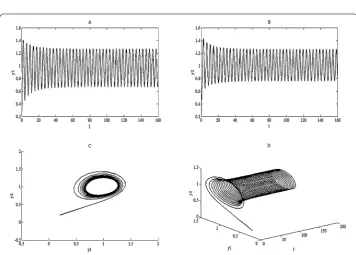
(1, 1) and by [30],h(z) =z4– 2.56z3+ 0.3584z2– 2.1627z– 0.3244 = 0, which has only one positive root z= 2.7341, getω= 1.6535,τ0= 0.5847. By Proposition2, we find thatE∗
is asymptotically stable when 0≤τ <τ0= 0.5847, as Figs.1(a)–(d) illustrate, andE∗ is unstable whenτ >τ0= 0.5847, as shown in Figs.2(a)–(d) which are generated by dde23
[31], a Matlab tool that integrates DDEs.
Figure 1The trajectory graph of system (3.1) withτ1= 0.56,τ2= 0.56/3,τ3= 1.12/3 in (a) thet–y1plane and
in (b) thet–y2plane. The phase graph of system (3.1) withτ1= 0.56,τ2= 0.56/3,τ3= 1.12/3 in (c) they1–y2
plane and in (d) thet–y1–y2plane
Figure 2The trajectory graph of system (3.1) withτ1= 0.6,τ2= 0.6/3,τ3= 1.2/3 in (a) thet–y1plane and in
(b) thet–y2plane. The phase graph of system (3.1) withτ1= 0.6,τ2= 0.6/3,τ3= 1.2/3 in (c) they1–y2plane
and in (d) thet–y1–y2plane
under-standing of market forces and economic laws in order to maintain a viable and successful enterprise.
However, here we have only considered the problem of a local Hopf bifurcation and do not give the conditions ensuring the existence of a global Hopf bifurcation for large values of the delay. Furthermore, we do not consider systems with a spatial variable, which is the diffusive model subject to a suitable boundary condition. We intend to make the comparison between the two models, and find what is the influence on the dynamical behaviour with different delays and diffusive terms [32–38], and then illustrate with the theoretical predictions. Lastly, our problem is only restricted to the theoretical analysis of such economical phenomena. It may be timely and necessary to make field investigations and experimental studies for real-world scenarios, and this is left for further study.
Acknowledgements
This research receives the grant from China Scholarship Council (CSC) and was supported by the Natural Science Foundation of Anhui Province (No. 1608085QF151, No. 1608085QF145). The authors would like to express their deep thanks to the referee for valuable suggestions for the revision and improvement of the manuscript.
Funding
This research is supported by the Natural Science Foundation of Anhui Province (No. 1608085QF151, No. 1608085QF145).
Abbreviations No.
Availability of data and materials Not applicable.
Ethics approval and consent to participate Not applicable.
Competing interests
All authors have declared that no conflict of interest exists in the submission of this manuscript, and the manuscript is approved by the authors for publication. We would like to declare on behalf of the authors that the work described was original research that has not been published previously, and not under consideration for publication elsewhere, in whole or in part. The authors listed have approved the manuscript that is enclosed.
Consent for publication Not applicable.
Authors’ contributions
The main idea of this paper was proposed by XZ and she prepared the manuscript initially and performed all the steps of the proofs in this research. All authors read and approved the final manuscript.
Authors’ information
Xin Zhang’s research interests are delay differential equations, dynamical systems, bifurcation theory and mathematical biology. The research interests of Zizhen Zhang mainly are bifurcation theory and population dynamics.
Matthew J. Wade’s research topics are numerical analysis and mathematical modelling.
Author details
1School of Mathematics, Jilin University, Changchun, China.2School of Management Science and Engineering, Anhui
University of Finance and Economics, Bengbu, China. 3School of Engineering, Newcastle University,
Newcastle-upon-Tyne, United Kingdom. 4School of Mathematics and Statistics, McMaster University, Hamilton, Canada.
Publisher’s Note
Springer Nature remains neutral with regard to jurisdictional claims in published maps and institutional affiliations.
Received: 14 March 2018 Accepted: 4 July 2018
References
1. Hale, J.: Theory of Functional Differential Equations, 2nd edn. Applied Mathematical Sciences, vol. 3 Springer, Berlin (1977)
2. Kuang, Y.: Delay Differential Equations with Applications in Population Dynamics. Mathematics in Science and Engineering, vol. 191. Academic Press, Boston (1993)
4. Cooke, K., Van den Driessche, P., Zou, X.: Interaction of maturation delay and nonlinear birth in population and epidemic models. J. Math. Biol.39(4), 332–352 (1999)
5. Hill, D.C., Shafer, D.S.: Asymptotics and stability of the delayed Duffing equation. J. Differ. Equ.265(1), 33–68 (2018) 6. Liu, X., Zhang, T.: Bogdanov–Takens and triple zero bifurcations of coupled Van der Pol–Duffing oscillators with
multiple delays. Int. J. Bifurc. Chaos27(9), Article ID 1750133 (2017)
7. Alvarez-Vázquez, L.J., Fernández, F.J., Muñoz-Sola, R.: Analysis of a multistate control problem related to food technology. J. Differ. Equ.245(1), 130–153 (2008)
8. Antman, S., Marsden, J., Sirovich, L.: Surveys and Tutorials in the Applied Mathematical Sciences. Springer, Berlin (2007)
9. Smith, H.: An Introduction to Delay Differential Equations with Applications to the Life Sciences. Texts in Applied Mathematics, vol. 57. Springer, New York (2011)
10. Zhang, W., Li, J., Chen, M.: Global exponential stability and existence of periodic solutions for delayed
reaction–diffusion BAM neural networks with Dirichlet boundary conditions. Bound. Value Probl.2013(1), Article ID 105 (2013)
11. Song, Y., Zhang, T., Tadé, M.O.: Stability switches, Hopf bifurcations, and spatio-temporal patterns in a delayed neural model with bidirectional coupling. J. Nonlinear Sci.19(6), Article ID 597 (2009)
12. Song, Y., Tade, M.O., Zhang, T.: Bifurcation analysis and spatio-temporal patterns of nonlinear oscillations in a delayed neural network with unidirectional coupling. Nonlinearity22(5), 975 (2009)
13. Bianca, C., Guerrini, L., Riposo, J.: A delayed mathematical model for the acute in ammatory response to infection. Appl. Math. Inf. Sci.9(6), 2775–2782 (2015)
14. Bianca, C., Guerrini, L.: Existence of limit cycles in the Solow model with delayed-logistic population growth. Sci. World J.2014, Article ID 207806 (2014)
15. Cai, Y., Zhang, C.: Hopf–Pitchfork bifurcation of coupled Van der Pol oscillator with delay. Nonlinear Anal., Model. Control22(5), 598–613 (2017)
16. Ozturk, O., Akin, E.: On nonoscillatory solutions of two dimensional nonlinear delay dynamical systems. Opusc. Math.
36(5), 651–669 (2016)
17. Bianca, C., Pennisi, M., Motta, S., Ragusa, M.A.: Immune system network and cancer vaccine. In: Numerical Analysis and Applied Mathematics. ICNAAM 2011: International Conference on Numerical Analysis and Applied Mathematics. AIP Conference Proceedings, vol. 1389, pp. 945–948. AIP, New York (2011)
18. Bianca, C., Pappalardo, F., Pennisi, M., Ragusa, M.: Persistence analysis in a Kolmogorov-type model for cancer-immune system competition. In: 11th International Conference of Numerical Analysis and Applied Mathematics 2013: ICNAAM 2013. AIP Conference Proceedings, vol. 1558, pp. 1797–1800. AIP, New York (2013)
19. Liu, W., Jiang, Y.: Bifurcation of a delayed Gause predator–prey model with Michaelis–Menten type harvesting. J. Theor. Biol.438, 116–132 (2018)
20. Huo, H.-F., Li, W.-T.: Periodic solution of a delayed predator–prey system with Michaelis–Menten type functional response. J. Comput. Appl. Math.166(2), 453–463 (2004).https://doi.org/10.1016/j.cam.2003.08.042
21. Bairagi, N., Jana, D.: On the stability and Hopf bifurcation of a delay-induced predator–prey system with habitat complexity. Appl. Math. Model.35(7), 3255–3267 (2011).https://doi.org/10.1016/j.apm.2011.01.025
22. Song, Y., Wei, J.: Local Hopf bifurcation and global periodic solutions in a delayed predator–prey system. J. Math. Anal. Appl.301(1), 1–21 (2005).https://doi.org/10.1016/j.jmaa.2004.06.056
23. Liao, M., Xu, C., Tang, X.: Stability and Hopf bifurcation for a competition and cooperation model of two enterprises with delay. Commun. Nonlinear Sci. Numer. Simul.19(10), 3845–3856 (2014).
https://doi.org/10.1016/j.cnsns.2014.02.031
24. Li, L., Zhang, C.-H., Yan, X.-P.: Stability and Hopf bifurcation analysis for a two-enterprise interaction model with delays. Commun. Nonlinear Sci. Numer. Simul.30(1–3), 70–83 (2016)
25. Du, Z., Xu, D.: Traveling wave solution for a reaction–diffusion competitive–cooperative system with delays. Bound. Value Probl.2016(1), Article ID 46 (2016)
26. Xu, C.: Periodic behavior of competition and corporation dynamical model of two enterprises on time scales. J. Quant. Econ.29(2), 1–4 (2012)
27. Liao, M., Xu, C., Tang, X.: Dynamical behaviors for a competition and cooperation model of enterprises with two delays. Nonlinear Dyn.75(1–2), 257–266 (2014).https://doi.org/10.1007/s11071-013-1063-9
28. Hassard, B.D., Kazarinoff, N.D., Wan, Y.H.: Theory and Applications of Hopf Bifurcation. London Mathematical Society Lecture Note Series, vol. 41. Cambridge University Press, Cambridge (1981)
29. Wiggins, S.: Introduction to Applied Nonlinear Dynamical Systems and Chaos, vol. 2. Springer, New York (2003) 30. Hu, G.-P., Li, W.-T., Yan, X.-P.: Hopf bifurcations in a predator–prey system with multiple delays. Chaos Solitons Fractals
42(2), 1273–1285 (2009).https://doi.org/10.1016/j.chaos.2009.03.075
31. Shampine, L.F., Thompson, S., Kierzenka, J.: Solving delay differential equations with dde23 (2000). http://www.runet.edu/~thompson/webddes/tutorial.pdf
32. Song, Y., Zhang, T., Peng, Y.: Turing–Hopf bifurcation in the reaction–diffusion equations and its applications. Commun. Nonlinear Sci. Numer. Simul.33, 229–258 (2016)
33. Cao, X., Song, Y., Zhang, T.: Hopf bifurcation and delay-induced Turing instability in a diffusive lac operon model. Int. J. Bifurc. Chaos26(10), Article ID 1650167 (2016)
34. Colli, P., Gilardi, G., Sprekels, J.: A boundary control problem for the pure Cahn–Hilliard equation with dynamic boundary conditions. Adv. Nonlinear Anal.4(4), 311–325 (2015)
35. Ghergu, M., Radulescu, V.: Singular Elliptic Problems: Bifurcation and Asymptotic Analysis. Oxford Lecture Series in Mathematics and Its Applications, vol. 37. Clarendon, Oxford (2008)
36. Wang, G.-Q., Cheng, S.S.: Bifurcation in a nonlinear steady state system. Opusc. Math.30, 349–360 (2010) 37. Ghergu, M., Radulescu, V.: Nonlinear PDEs: Mathematical Models in Biology, Chemistry and Population Genetics.
Springer, Berlin (2011)