Net Zero Energy Building and Its Analysis Using Primavera
Software
Mohammad Yaseen
1, Sowmya S.M
2*(Department of Civil Engineering, Shree Devi Institute of Technology Mangaluru/ Visvesvaraya Technological University Belagavi, India)
** (Asst. Professor, Department of Civil Engineering, Visvesvaraya Technological University, India
I. Introduction
A zero energy buildings, also called as zero net energy buildings, net zero energy buildings (NZEB) or net zero buildings is a building with zero net energy consumption, which means gross sum of utilized energy by the expanding on a yearly premise is roughly equal to the measure of renewable energy generated on that place itself or nearby place. Energy is typically created on that place itself by energy creating advancements such as wind turbines and sunlight based solar, while lessening the general utilization of energy with profoundly effective lighting and HVAC innovations. The goals of ZEB are becoming more practical now a days as the one main reason for this is the cost of alternate energy is increasing.
In present days for the successful administration and management of construction projects a systematic method is needed to be adopted, with the guide of procedure to control the activities inside the time span at a specific cost.
This system is ordinarily known as the critical path method. Utilizing the critical path method manually is troublesome because of increment of complexities in project. To defeat this trouble a CPM based scheduling software is utilized.
II. History
It is very difficult to say any particular building as the first net zero energy building the one of the main reason could be that this is not a new concept but just has given an another name. From the times before for house warming and lightening people used wood straw, candles and domestic animals for their houses. In the end of seventies and beginning of eighties some articles has established in which the phrases has been used as “zero energy home”, “neutral energy autonomous house” or “energy independent house”. That was the time when the shortage and soon getting over of the petroleum product were detected and the energy utilization begun to be talked about.
III.Scope and Objectives
Planning and scheduling the diverse exercises required in the Project.
Estimating the aggregate cost required for the project as for schedule, length and number of total critical activities in the project.
Developing the fluctuation and records identified with the cost and schedule of the project keeping in mind the end goal to track the project.
Developing the change and lists identified with the cost and calendar of the project so as to gauge the project.
Abstract: This thesis is based on analysis of Net zero energy building taking case study of a residential building (G+1). In this thesis an effort is made to explain in detail and to analyze the Net zero energy building. Major elements used are solar panels and wind turbines for the production of electricity for the building. The planning is done as per requirements and the various activities involved in the construction of this structure are considered. The study is carried out using Primavera P6 software which is a project management program.
V. Methodology
Enterprise Project Structure (EPS): EPS is used to perform top down budgeting, manage multiple projects, implement coding standards, and maintain security throughout the enterprise.
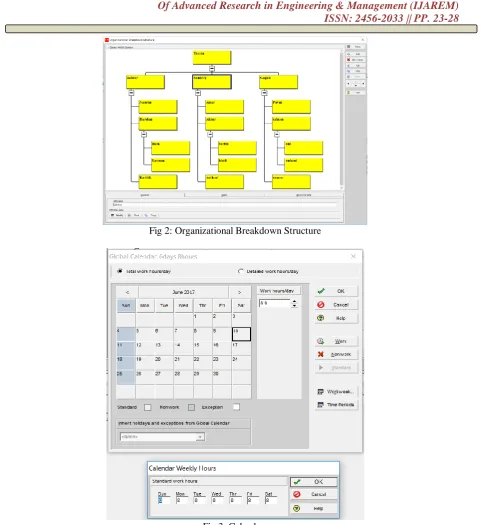
Organizational breakdown structure (OBS) overview: The OBS is a global hierarchy that represents the
managers responsible for the projects in your enterprise.
Calendars: Calendars can create and assign to each resource, each project, and each activity. For each calendars, you can define the following:
Available work hours in each calendar day
Default hours per time period settings that are used as conversion factors when Entering or displaying
units in time increments other than hours
National holidays
Your organization's holidays
Project-specific work/ non workdays
Resource vacation days.
Work Breakdown Structure (WBS): The total project has broken down into number of elements which
contains the activities to contribute the total work completion.
Activities: Activities window is used to add, view, edit, and delete activities for the open projects. You can divide the activities window into top and bottom layout views, and you can customize these layouts and how activities are displayed.
Resources: Resources window is used to maintain both your organization's resource hierarchy and individual resource information. You can assign resources to activities and roles in any project. If resources security is enabled, you can only view resources you have access to. See Introduction to resource Security.
Roles: Use the roles dialog box to add, edit, and delete roles. You can also use the roles dialog box to assign roles to resources, define up to five price/unit rates for each roles, and specify roles availability over time.
VI. Results and Discussions
Fig 2: Organizational Breakdown Structure
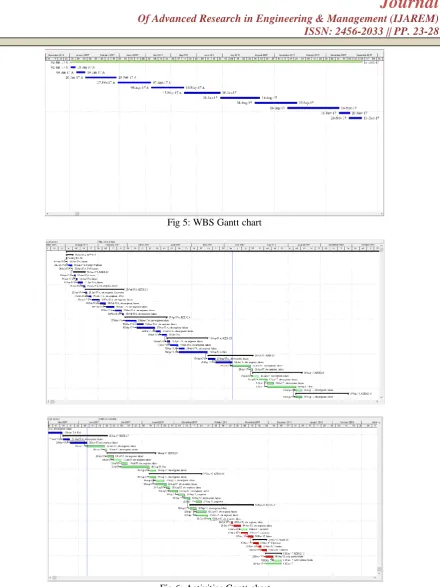
Fig 5: WBS Gantt chart
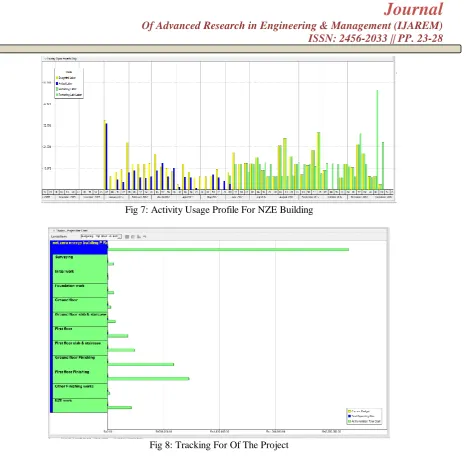
Fig 7: Activity Usage Profile For NZE Building
Fig 8: Tracking For Of The Project
VII. Conclusions
The main purpose of the study is to include the detail examination of the elements of net zero energy building. The study concluded as follows:
Net zero energy buildings are the future with the advancement in renewable technology. Many nations have framed zero energy building laws. Some governments are also providing subsidies to individuals and organizations for creating zero energy buildings. But the goal of zero energy building would not be fulfilled till the time all the people do not understand their responsibility and contribute towards reducing energy consumption.
ZEBs are most practical
Implemented in the field economically Substantial reduction in environmental issues Eco- friendly buildings can be achieved
Solar and wind energy will be the major contributor of renewable energy for ZEB’s owing to their wide spread availability.
No major maintenance is required so almost maintenance free It is the point where energy needs of a building has no impact
“Construction Project Scheduling with Time, Cost, and Material Restrictions Using Fuzzy Mathematical Models and Critical Path Method” , 1096 / JOURNAL OF CONSTRUCTION ENGINEERING AND MANAGEMENT © ASCE / OCTOBER 2009.
[5]. Andrew Fernans Tom, Sachin Paul “Project Monitoring and Control using Primavera” International Journal of Innovative Research in Science, Engineering and Technology Vol. 2, Issue 3, March 2013.
[6]. Jorn K. Grubera, Milan Prodanovica, Raul Alonsob “Estimation and analysis of building energy demand
and supply costs” published by IMDEA Energy Institute, 28935 M´ostoles, Spain, 2015.
[7]. Reshmi Banerjee, “Importance of Net Zero Energy Building” published by International Journal of Innovative Research in Advanced Engineering (IJIRAE) ISSN: 2349-2163 Issue 5, Volume 2 (May 2015).
[8]. Fahd Diab, Hai Lan, Lijun Zhang and Salwa Ali “An Environmentally-Friendly Tourist Village in Egypt
Based on a Hybrid Renewable Energy System A Net Zero Energy Tourist Village” energies ISSN 1996-1073, 2015.
[9]. 1T.Subramani , M.Sekar2, “Preplanning And Scheduling Of Road Construction By Using PPM”,
International Journal of Application or Innovation in Engineering & Management (IJAIEM), Volume 4, Issue 5, May 2015.
[10]. Mohammed ZakiHaider1, Rajendra.S2, Vijay.K3, “Planning scheduling, tracking and application