AND HIGHER ORDER OF CONVERGENCE FOR
SECOND-ORDER BOUNDARY VALUE PROBLEMS
TANYA G. MELTON AND A. S. VATSALAReceived 24 March 2005; Revised 13 September 2005; Accepted 19 September 2005
The method of generalized quasilinearization for second-order boundary value prob-lems has been extended when the forcing function is the sum of 2-hyperconvex and 2-hyperconcave functions. We develop two sequences under suitable conditions which converge to the unique solution of the boundary value problem. Furthermore, the con-vergence is of order 3. Finally, we provide numerical examples to show the application of the generalized quasilinearization method developed here for second-order boundary value problems.
Copyright © 2006 T. G. Melton and A. S. Vatsala. This is an open access article distrib-uted under the Creative Commons Attribution License, which permits unrestricted use, distribution, and reproduction in any medium, provided the original work is properly cited.
1. Introduction
The method of quasilinearization [1,2] combined with the technique of upper and lower solutions is an effective and fruitful technique for solving a wide variety of nonlinear problems. It has been referred to as a generalized quasilinearization method. See [9] for details. The method is extremely useful in scientific computations due to its accelerated rate of convergence as in [10,11].
In [4,13], the authors have obtained a higher order of convergence (an order more than 2) for initial value problems. They have considered situations when the forcing func-tion is either hyperconvex or hyperconcave. In [12], we have obtained the results of higher order of convergence for first order initial value problems when the forcing function is the sum of hyperconvex and hyperconcave functions with natural and coupled lower and upper solutions. In this paper we extend the result to the second-order boundary value problems when the forcing function is a sum of 2-hyperconvex and 2-hyperconcave func-tions. We have proved the existence of the unique solution of the nonlinear problem using natural upper and lower solutions. We demonstrate the iterates converge cubically to the unique solution of the nonlinear problem. We merely state the result related to coupled
Hindawi Publishing Corporation Boundary Value Problems
lower and upper solutions without proof due to monotony. Finally, we present two nu-merical applications of our theoretical results developed in our main result. We note that the monotone iterates may not converge linearly or quadratically in general. See [4,8] for examples. However in our result we have provided sufficient conditions for cubic conver-gence. For real world applications see [5].
For this purpose, consider the following second-order boundary value problem (BVP for short):
−u=f(t,u) +g(t,u), Bu(μ)=bμ, μ=0, 1,t∈J≡[0, 1], (1.1)
whereBu(μ)=τμu(μ) + (−1)μ+1νμu(μ)=bμ,τ0,τ1≥0,τ0+τ1>0,ν0,ν1>0,bμ∈Rand
f,g∈C[J×R,R].
Here we provide the definition of natural lower and upper solutions of (1.1). One can define coupled lower and upper solutions of the other types in the same manner. See for [14,15] details.
Definition 1.1. The functionsα0,β0∈C2[J,R] are said to be natural lower and upper
solutions if
−α0 ≤f
t,α0
+gt,α0
, Bα0(μ)≤bμ onJ,
−β0 ≥f
t,β0
+gt,β0
, Bβ0(μ)≥bμ onJ.
(1.2)
In order to facilitate later explanations, we will need the following definition.
Definition 1.2. A functionh:A→B, A,B⊂Ris called m-hyperconvex,m≥0, ifh∈ Cm+1[A,B] anddm+1h/dum+1≥0 foru∈A;his calledm-hyperconcave if the inequality
is reversed.
In this paper, we use the maximum norm ofuoverJ, that is,
u =max
t∈J |u|. (1.3)
Also throughout this paper we use the notation
∂kf(t,u)
∂uk = f
(k)(t,u) (1.4)
for any function f(t,u) and fork=0, 1, 2.
2. Preliminaries
In this section, we recall some well known theorems and corollaries which we need in our main results relative to the BVP
−u= f(t,u,u), Bu(μ)=bμ, μ=0, 1,t∈J≡[0, 1], (2.1)
whereBu(μ)=τμu(μ) + (−1)μ+1νμu(μ)=bμ,τ0,τ1≥0,τ0+τ1>0,ν0,ν1>0,bμ∈Rand
f ∈C[J×R×R,R]. For details see [3,6,7]. Theorem2.1. Assume that
(i)α0,β0∈C2[J,R]are lower and upper solutions of (2.1).
(ii) fu,fuexist, continuous,fu<0andfu≡0onΩ=[(t,u,u) :t∈[0, 1],β0≤u≤α0]
andu=α0(t)=β0(t).
Then we haveα0(t)≤β0(t)onJ.
Next we present a special case of the above theorem which is known as the maximum principle, whenuterm is missing.
Corollary2.2. Letq,r∈C[I,R]withr(t)≥0onJ. Suppose further thatp∈C2[I,R]and
−p≤ −r p, B p(μ)≤0. (2.2)
Thenp(t)≤0onJ. If the inequalities are reversed, thenp(t)≥0onJ. The next corollary is a special case of [9, Theorem 3.1.3].
Corollary2.3. Assume thatα0,β0are lower and upper solutions of (1.1) respectively such
thatα0(t)≤β0(t)onJ. Then there exists a solutionufor the BVP (1.1) such thatα0(t)≤ u(t)≤β0(t)onJ.
3. Main results
In this section, we consider the BVP
−u=f(t,u) +g(t,u), Bu(μ)=bμ, μ=0, 1,t∈J≡[0, 1], (3.1)
where Bu(μ)=τμu(μ) + (−1)μ+1νμu(μ)=bμ, τ0,τ1≥0, τ0+τ1>0, ν0,ν1>0, bμ∈R,
f,g∈C[Ω,R],Ω=[(t,u) :α0(t)≤u(t)≤β0(t),t∈J], andα0,β0∈C2[J,R] withα0(t)≤ β0(t) onJ.
Here, we state the inequalities satisfied by f(t,u) andg(t,u) when f(t,u) is 2-hyper-convex inuandg(t,u) is 2-hyperconcave inu. We need these inequalities for our first main result.
Suppose that f(t,u) is 2-hyperconvex inu, then we have the following inequalities,
f(t,η)≥ 2
i=0
f(i)(t,ξ)(η−ξ)i
i! , η≥ξ, (3.2)
f(t,η)≤
2
i=0
f(i)(t,ξ)(η−ξ)i
Similarly, wheng(t,u) is 2-hyperconcave inu, we have the following inequalities:
g(t,η)≥
1
i=0
g(i)(t,ξ)(η−ξ)i
i! +
g(2)(t,η)(η−ξ)2
(2)! , η≥ξ, (3.4)
g(t,η)≤ 1
i=0
g(i)(t,ξ)(η−ξ)i
i! +
g(2)(t,η)(η−ξ)2
(2)! , η≤ξ. (3.5)
Based on these inequalities, relative to the natural upper and lower solutions, we de-velop two monotone sequences which converge uniformly and monotonically to the unique solution of (3.1) and the order of convergence is 3.
Theorem3.1. Assume that
(i)α0,β0∈C2[J,R]are lower and upper solutions withα0(t)≤β0(t)onJ.
(ii) f,g∈C3[Ω,R]such that f(t,u)is2-hyperconvex inuonJ[i.e., f(3)(t,u)≥0for
(t,u)∈Ω], g(t,u)is2-hyperconcave in uon J [i.e.,g(3)(t,u)≤0for (t,u)∈Ω], f(t,u)is nondecreasing,g(t,u)is nonincreasing and fu+gu<0onΩ.
Then there exist monotone sequences{αn(t)}and{βn(t)},n≥0which converge uniformly and monotonically to the unique solution of (3.1) and the convergence is of order 3.
Proof. The assumptionsf(3)(t,u)≥0,g(3)(t,u)≤0 yield the inequalities (3.2), (3.3), (3.4),
and (3.5) wheneverα0≤η,ξ≤β0. Let us first consider the following BVPs:
−w=F(t,α,β;w)
= 2
i=0
f(i)(t,α)(w−α)i
i! +
1
i=0
g(i)(t,α)(w−α)i
i! +
g(2)(t,β)(w−α)2
2! ,
Bw(μ)=bμ onJ;
(3.6)
−v=G(t,α,β;v)
= 2
i=0
f(i)(t,β)(v−β)i
i! +
1
i=0
g(i)(t,β)(v−β)i
i! +
g(2)(t,α)(v−β)2
2! ,
Bv(μ)=bμ onJ.
(3.7)
We develop the sequences{αn(t)}and{βn(t)}using the above BVPs (3.6) and (3.7) respectively. Initially, we prove (α0,β0) are lower and upper solutions of (3.6) and (3.7)
respectively. To begin, we will consider natural lower and upper solutions of the equation (3.1):
−α0 ≤ f
t,α0
+gt,α0
, Bα0(μ)≤bμ,
−β0 ≥ f
t,β0
+gt,β0
, Bβ0(μ)≥bμ,
whereα0(t)≤β0(t). The inequalities (3.2) and (3.4), and (3.8) imply
−α0 ≤ f
t,α0
+gt,α0
=Ft,α0,β0;α0
, Bα0(μ)≤bμ,
−β0≥ f
t,β0
+gt,β0
≥ 2
i=0 f(i)t,α
0
β0−α0
i
i! +
1
i=0 g(i)t,α
0
β0−α0
i
i! +
g(2)t,β 0
β0−α0
2
2!
=Ft,α0,β0;β0
, Bβ0(μ)≥bμ.
(3.9)
We can applyCorollary 2.3together with (3.9) conclude that there exists a solutionα1(t)
of (3.6) withα=α0andβ=β0such thatα0≤α1≤β0onJ.
Using the inequalities (3.3), (3.5), and (3.8) on the same lines, we can get
−β0 ≥ f
t,β0
+gt,β0
=Gt,α0,β0;β0
, Bβ0(μ)≥bμ, (3.10)
−α0 ≤ f
t,α0
+gt,α0
≤ 2
i=0 f(i)t,β
0
α0−β0
i
i!
+
1
i=0 g(i)t,β
0α0−β0i
i! +
g(2)t,α
0α0−β02
2!
=Gt,α0,β0;α0
, Bα0(μ)≤bμ.
(3.11)
Henceα0,β0are lower and upper solutions of (3.7) withα0≤β0. ApplyingCorollary 2.3,
we obtain that there exists a solutionβ1(t) of (3.7) withα=α0 and β=β0 such that α0≤β1≤β0onJ.
Now we will prove that α1 is a unique solution of (3.6). For this purpose we need
to prove that ∂F(t,α0,β0;α1)/∂α1<0. Since f(t,u) is 2-hyperconvex inu andg(t,u) is
2-hyperconcave inuonJwith fu+gu<0 onΩ, we get
∂Ft,α0,β0;α1
∂α1 =
f(1)t,α 1
+g(1)t,α 1
− f(3)
t,ξ1α1−α02
(2)! +g(3)t,η
1
α1−α0
β0−ξ2
≤f(1)t,α 1
+g(1)t,α 1
<0,
(3.12)
whereα0≤ξ1,ξ2≤α1 andξ2≤η1≤β0. Hence by the special case ofTheorem 2.1with u-term missing, we can conclude thatα1is the unique solution of (3.6). Similarly we can
Using the nonincreasing property ofg(2)(t,u), (3.2), (3.3), (3.4), (3.5) withα
0≤α1≤ β0,α0≤β1≤β0we have
−α1 =F
t,α0,β0;α1
= 2
i=0 f(i)t,α
0α1−α0i i!
+
1
i=0 g(i)t,α
0
α1−α0
i
i! +
g(2)t,β 0
α1−α0
2
2!
≤ ft,α1
+gt,α1
, Bα1(μ)≤bμ;
(3.13)
−β1=G
t,α0,β0;β1
= 2
i=0 f(i)t,β
0
β1−β0
i
i!
+
1
i=0 g(i)t,β
0
β1−β0
i
i! +
g(2)t,α 0
β1−β0
2
2!
≥ ft,β1
+gt,β1
, Bβ1(μ)≥bμ.
(3.14)
Since α1, β1 are lower and upper solutions of (3.1), we can apply the special case of
Theorem 2.1to obtainα1≤β1onJ. Thus we haveα0≤α1≤β1≤β0onJ.
Assume now thatαnandβnare solutions of BVPs (3.6) and (3.7), respectively, with
α=αn−1andβ=βn−1such thatαn−1≤αn≤βn≤βn−1onJand
−αn ≤f
t,αn
+gt,αn
, Bαn(μ)≤bμ,
−βn ≥ft,βn
+gt,βn
, Bβn(μ)≥bμ,
(3.15)
Certainly this is true forn=1.
We need to show thatαn≤αn+1≤βn+1≤βnonJ, whereαn+1andβn+1are solutions of
BVPs (3.6) and (3.7), respectively, withα=αnandβ=βn. The inequalities (3.2) and (3.4), and (3.15) imply
−αn ≤ft,αn+gt,αn
=Ft,αn,βn;αn, Bαn(μ)≤bμ,
−βn ≥f
t,βn
+gt,βn
≥ 2
i=0 f(i)t,α
nβn−αni
i!
+
1
i=0 g(i)t,α
n
βn−αn i
i! +
g(2)t,β
n
βn−αn 2
2!
=Ft,αn,βn;βn
, Bβn(μ)≥bμ.
This proves thatαn,βnare lower and upper solutions of (3.6) withα=αnandβ=βn. Hence using (3.16) andCorollary 2.3we can conclude that there exists a solutionαn+1(t)
of (3.6) withα=αnandβ=βnsuch thatαn≤αn+1≤βnonJ. The inequalities (3.3) and (3.5), and (3.15) imply
−βn≥ ft,βn
+gt,βn
=Gt,αn,βn;βn
, Bβn(μ)≥bμ, (3.17)
−αn ≤f
t,αn
+gt,αn
≤ 2
i=0 f(i)t,β
nαn−βni
i!
+
1
i=0 g(i)t,β
n
αn−βn i
i! +
g(2)t,α
n
αn−βn 2
2!
=Gt,αn,βn;αn, Bαn(μ)≤bμ.
(3.18)
Henceαn,βnare lower and upper solutions of (3.7) withα=αnandβ=βn. Applying Corollary 2.3we can show that there exists a solution βn+1(t) of (3.7) withα=αnand
β=βnsuch thatαn≤βn+1≤βnonJ. In view of assumptions on f andg,αn+1,βn+1are
unique by the special case ofTheorem 2.1.
Furthermore, by (3.2), (3.3), (3.4), (3.5) with αn≤αn+1≤βn,αn≤βn+1≤βn, and
g(2)(t,u) nonincreasingu, we get
−αn+1=F
t,αn,βn;αn+1
= 2
i=0 f(i)t,α
nαn+1−αni
i!
+
1
i=0 g(i)t,α
n
αn+1−αn i
i! +
g(2)t,β
n
αn+1−αn 2
2!
≤ft,αn+1
+gt,αn+1
, Bαn+1(μ)≤bμ;
−βn+1=G
t,αn,βn;βn+1
= 2
i=0 f(i)t,β
n
βn+1−βn i
i!
+
1
i=0 g(i)t,β
n
βn+1−βn i
i! +
g(2)t,α
n
βn+1−βn 2
2!
≥ft,βn+1
+gt,βn+1
, Bβn+1(μ)≥bμ.
(3.19)
Sinceαn+1,βn+1are lower and upper solutions of (3.1) we can apply the special case of
Theorem 2.1and getαn+1≤βn+1onJ. This provesαn≤αn+1≤βn+1≤βnonJ. Hence by induction, we have
By the fact thatαn,βnare lower and upper solutions of (3.1) withαn≤βnandCorollary 2.3 we can conclude that there exists a solutionu(t) of (3.1) such thatαn≤u≤βnonJ. From this we can obtain that
α0≤α1≤ ··· ≤αn≤u≤βn≤ ··· ≤β1≤β0. (3.21)
Using Green’s function, we can writeαn(t) andβn(t) as follows:
αn(t)= 1
0K(t,s)
Fs,αn−1(s),βn−1(s);αn(s)
ds,
βn(t)= 1
0K(t,s)
Gs,αn−1(s),βn−1(s);βn(s)
ds.
(3.22)
HereK(t,s) is the Green’s function given by
K(t,s)= ⎧ ⎪ ⎪ ⎪ ⎨ ⎪ ⎪ ⎪ ⎩ 1
cx(s)y(t), 0≤s≤t≤1, 1
cx(t)y(s), 0≤t≤s≤1,
(3.23)
wherex(t)=(τ0/ν0)t+ 1,y(t)=(τ1/ν1)(1−t) + 1 are two linearly independent solutions
of−u=0 andc=x(t)y(t)−x(t)y(t). We can prove that the sequences{αn(t)}and
{βn(t)}are equicontinuous and uniformly bounded. Now applying Ascoli-Arzela’s theo-rem, we can show that there exist subsequences{αn,j(t)},{βn,j(t)}such thatαn,j(t)→ρ(t) and βn,j(t)→r(t) with ρ(t)≤u≤r(t) onJ. Since the sequences {αn(t)}, {βn(t)}are monotone, we haveαn(t)→ρ(t) andβn(t)→r(t). Taking the limit asn→ ∞, we get
lim
n→∞αn(t)=ρ(t)≤u≤r(t)=nlim→∞βn(t). (3.24)
Next we show thatρ(t)≥r(t). From BVPs (3.6) and (3.7) we get
−ρ(t)=f(t,ρ) +g(t,ρ), Bρ(μ)=b(μ),
−r(t)=f(t,r) +g(t,r), Br(μ)=b(μ). (3.25)
Setp(t)=r−ρand note thatB p(μ)=0. We have
−p= −r(t)−−ρ(t)=f(t,r) +g(t,r)−f(t,ρ)−g(t,ρ)
= fu(t,ξ)(r−ρ) +gu(t,η)(r−ρ)=fu(t,ξ) +gu(t,η)p,
(3.26)
Let us consider the order of convergence of{αn(t)}and{βn(t)}to the unique solution
u(t) of (3.1). To do this, set
pn(t)=u(t)−αn(t)≥0,
qn(t)=βn(t)−u(t)≥0,
(3.27)
fort∈JwithB pn(μ)=Bqn(μ)=0. Therefore we can write
pn+1=
1
0K(t,s)
f(s,u) +g(s,u)−Fs,αn,βn;αn+1
ds, (3.28)
whereK(t,s) is the Green’s function given by (3.23).
Now using the Taylor series expansion with Lagrange remainder, and the mean value theorem together with (ii) of the hypothesis, we obtain
0≤pn+1
=
1
0K(t,s)
f(s,u) +g(s,u)
−
2
i=0 f(i)s,α
n
αn+1−αn i
i!
+
1
i=0 g(i)s,α
n
αn+1−αn i
i! +
g(2)s,β
n
αn+1−αn 2 2! ds = 1
0K(t,s)
f(s,u) +g(s,u)
−
fs,αn+1
− f(3)
s,ξ1αn+1−αn3
(3)! +g
s,αn+1
−g(2)
s,ξ2αn+1−αn2
2! +
g(2)s,β
nαn+1−αn2 2!
ds
≤
1
0K(t,s)
fu
s,η1
u−αn+1
+gu
s,η2
u−αn+1
+ f
(3)s,ξ 1
u−αn3
(3)! −
g(3)s,η 3
βn−ξ2
u−αn2 2
ds
=
1
0K(t,s)
fu
s,η1
+gu
s,η2
pn+1
+ f
(3)s,ξ 1
p3
n
(3)! −
g(3)s,η 2
p2
n
qn+pn
2
ds,
where αn≤ξ1,ξ2≤αn+1≤η1,η2≤u, andξ2≤η3≤βn. Let |K(t,s)| ≤A1,|fu(t,u) +
gu(t,ν)| ≤A2,|f(3)(t,u)/3!| ≤A3, and|g(3)(t,u)/2| ≤A4. Then we have
pn+1≤k1pn3
+k2pn2qn+pn, (3.30)
wherek1=A1A3/(1−A1A2) andk2=A1A4/(1−A1A2).
Similarly, we can write
qn+1=
1
0K(t,s) G
s,αn,βn;βn+1
−f(s,u)−g(s,u)ds, (3.31)
whereK(t,s) is the Green’s function given by (3.23).
Using the Taylor series expansion with Lagrange remainder, and the mean value theo-rem together with (ii), we can show
qn+1≤k1qn3
+k2qn2qn+pn, (3.32)
wherek1=A1A3/(1−A1A2) andk2=A1A4/(1−A1A2).
Hence combining (3.30) and (3.32) we obtain
max t∈J
u(t)−αn+1(t)+ max t∈J
βn+1(t)−u(t)
≤C
max
t∈J
u(t)−αn(t)+ max t∈J
βn(t)−u(t)3
,
(3.33)
whereCis an appropriate positive constant.
This completes the proof.
We note that the unique solution we have obtained is the unique solution of (3.1) in the sector determined by the lower and upper solutions.
Next we merely state a result without proof using coupled lower and upper solutions of (3.1). However, in order to show the existence of the unique solution of the iterates, we use the existence result [7, Theorem 2.4.1]. for systems and a special case of the comparison theorem of [7].
Theorem3.2. Assume that
(i)α0,β0∈C2[J,R]are coupled lower and upper solutions of (3.1) withα0(t)≤β0(t)
onJsuch that
−α0 ≤f
t,β0
+gt,α0
, Bα0(μ)≤bμ on J,
−β0 ≥f
t,α0
+gt,β0
, Bβ0(μ)≥bμ on J;
(ii) f,g∈C3[Ω,R]such that f(t,u)is2-hyperconvex inuonJ[i.e., f(3)(t,u)≥0for
(t,u)∈Ω], g(t,u)is2-hyperconcave in uon J [i.e.,g(3)(t,u)≤0for (t,u)∈Ω], f(t,u),g(t,u)are nonincreasing with fu−gu>0and
fu(t,u)≤ −max Ω
f(3)(t,u)β
0−α02≤0 onΩ. (3.35)
Then there exist monotone sequences{αn(t)}and{βn(t)},n≥0such that
−αn=
1
i=0 f(i)t,β
n−1
βn−βn−1
i
i! +
f(2)t,α
n−1
βn−βn−1
2
(2)!
+
1
i=0 g(i)t,α
n−1
αn−αn−1
i
i! +
g(2)t,β
n−1
αn−αn−1
2
(2)! ,
Bαn(μ)=bμ on J;
−βn=
1
i=0 f(i)t,α
n−1
αn−αn−1
i
i! +
f(2)t,β
n−1
αn−αn−1
2
(2)!
+
1
i=0 g(i)t,β
n−1
βn−βn−1
i
i! +
g(2)t,α
n−1
βn−βn−1
2
(2)! ,
Bβn(μ)=bμ on J,
(3.36)
which converge uniformly and monotonically to the unique solution of (3.1) and the conver-gence is of order 3.
Remark 3.3. Similar results can be obtained for the other two coupled upper and lower solutions of (3.1) and the numerical applications of these results can be demonstrated.
4. Numerical results
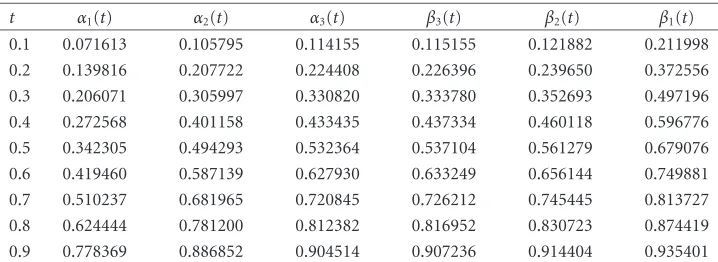
Next we will provide an example which satisfies all the hypotheses ofTheorem 3.1which demonstrates the application ofTheorem 3.1.
Example 4.1. Let us consider the following BVP:
−u=u3−2u4−0.1u+ 0.4,
u(0)=0, u(1)=1. (4.1)
It is easy to check that α0(t)≡0 andβ0(t)≡1 are natural lower and upper solutions
for (4.1), respectively. Let H(t,u) denote the right-hand side of (4.1) and split it into nonincreasing and nondecreasing functions asH(t,u)= f(t,u) +g(t,u) where
f(t,u)=u3,
Table 4.1. Table of threeα,β-iterates of (4.1).
t α1(t) α2(t) α3(t) β3(t) β2(t) β1(t)
0.1 0.071613 0.105795 0.114155 0.115155 0.121882 0.211998 0.2 0.139816 0.207722 0.224408 0.226396 0.239650 0.372556 0.3 0.206071 0.305997 0.330820 0.333780 0.352693 0.497196 0.4 0.272568 0.401158 0.433435 0.437334 0.460118 0.596776 0.5 0.342305 0.494293 0.532364 0.537104 0.561279 0.679076 0.6 0.419460 0.587139 0.627930 0.633249 0.656144 0.749881 0.7 0.510237 0.681965 0.720845 0.726212 0.745445 0.813727 0.8 0.624444 0.781200 0.812382 0.816952 0.830723 0.874419 0.9 0.778369 0.886852 0.904514 0.907236 0.914404 0.935401
1
0.8
0.6
0.4
0.2 u
0.2 0.4 0.6 0.8 1 t
Figure 4.1
It is easy to show that
fuuu=6>0,
guuu= −48u≤0 (4.3)
for 0≤u≤1. Hence f is a 2-hyperconvex function andg is a 2-hyperconcave function. Now we need to check the following conditions in order to useTheorem 3.1:
fu(t,u)=3u2≥0,
gu(t,u)= −8u3−0.1≤0,
fu(t,u) +gu(t,u)=3u2−8u3−0.1<0,
(4.4)
whenever 0≤u≤1. Hence we can apply the iterates ofTheorem 3.1. Using the nonlinear finite-difference methods for BVPs and Mathematica we can find theα,β-iterates as given inTable 4.1.
Given the specific finite difference scheme, we can apply it to obtain lower and upper solutions. Then, we can make the difference between upper and lower solutions arbitrar-ily small. The obtained numerical solution however, will be close to the actual solution of the nonlinear problem (4.1) only within the truncation error of the finite difference scheme chosen.
Now we will provide a numerical example to show the usefulness ofTheorem 3.2. Example 4.2. Let us discuss the following second-order BVP:
−u=3 cosu−27eu/3+ 25.5, u(0.1)=0.1, u(0.5)=0.5. (4.5)
Denote the right-hand side of (4.5) byH(t,u). We can split the forcing function into two functions asH(t,u)=f(t,u) +g(t,u) where
f(t,u)=3 cosu,
g(t,u)= −27eu/3+ 25.5. (4.6)
If we chooseα0(t)≡0.1,β0(t)≡0.5, and 0.1≤t≤0.5 we get
0≤3 cos 0.5−27e0.1/3+ 25.5=0.21758,
0≥3 cos 0.1−27e0.5/3+ 25.5= −3.41172, 0.1≤0.1, 0.5≥0.5.
(4.7)
Thusα0(t)≡0.1 andβ0(t)≡0.5 are coupled lower and upper solutions for (4.5) of the
type defined inTheorem 3.2. Next we can show that
fuuu=3 sinu >0,
guuu= −eu/3<0
(4.8)
for 0.1≤u≤0.5. Hence f is 2-hyperconvex function andg is 2-hyperconcave function. Now we need to check the following conditions in order to applyTheorem 3.2:
fu(t,u)= −3 sinu <0,
gu(t,u)= −9eu/3<0,
fu(t,u)−gu(t,u)=eu+u2>0,
−3 sin 0.1≤ −3 sin 0.5(0.5−0.1)2≤0,
(4.9)
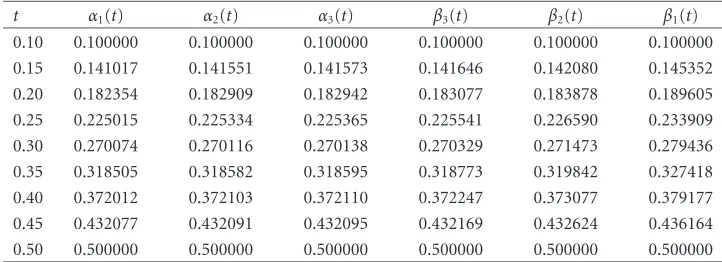
whenever 0.1≤u≤0.5. Hence all the hypotheses ofTheorem 3.2are satisfied and we can apply the given iterates. Now using the nonlinear finite-difference methods for BVPs and Mathematica we can derive theα,β-iterates inTable 4.2.
Table 4.2. Table of threeα,β-iterates of (4.5).
t α1(t) α2(t) α3(t) β3(t) β2(t) β1(t)
0.10 0.100000 0.100000 0.100000 0.100000 0.100000 0.100000 0.15 0.141017 0.141551 0.141573 0.141646 0.142080 0.145352 0.20 0.182354 0.182909 0.182942 0.183077 0.183878 0.189605 0.25 0.225015 0.225334 0.225365 0.225541 0.226590 0.233909 0.30 0.270074 0.270116 0.270138 0.270329 0.271473 0.279436 0.35 0.318505 0.318582 0.318595 0.318773 0.319842 0.327418 0.40 0.372012 0.372103 0.372110 0.372247 0.373077 0.379177 0.45 0.432077 0.432091 0.432095 0.432169 0.432624 0.436164 0.50 0.500000 0.500000 0.500000 0.500000 0.500000 0.500000
0.5
0.4
0.3
0.2
0.1 u
0.1 0.2 0.3 0.4 0.5 0.6 t
Figure 4.2
Remark 4.3. Note that the interval in the above example is due to the fact that f andg satisfies the hypothesis ofTheorem 3.2on the specific interval chosen.
5. Conclusion
We have used iterates of nonlinearity of order 2 when the forcing function is the sum of 2-hyperconvex and 2-hyperconcave. We develop two sequences depending on the type of the lower and upper solutions, which converge rapidly (order 3) to the unique solution of (3.1). We demonstrate the application of the results with numerical applications.
References
[1] R. E. Bellman,Methods of Nonlinear Analysis. Vol. 1, Mathematics in Science and Engineering, vol. 61-I, Academic Press, New York, 1970.
[2] R. E. Bellman and R. E. Kalaba, Quasilinearization and Nonlinear Boundary-Value Problems, Modern Analytic and Computional Methods in Science and Mathematics, vol. 3, American El-sevier, New York, 1965.
[4] A. Cabada and J. J. Nieto,Rapid convergence of the iterative technique for first order initial value problems, Applied Mathematics and Computation87(1997), no. 2-3, 217–226.
[5] ,Quasilinearization and rate of convergence for higher-order nonlinear periodic boundary-value problems, Journal of Optimization Theory and Applications108(2001), no. 1, 97–107. [6] S. Heikkil¨a and V. Lakshmikantham,Monotone Iterative Techniques for Discontinuous Nonlinear
Differential Equations, Monographs and Textbooks in Pure and Applied Mathematics, vol. 181, Marcel Dekker, New York, 1994.
[7] G. S. Ladde, V. Lakshmikantham, and A. S. Vatsala,Monotone Iterative Techniques for Nonlinear Differential Equations, Monographs, Advanced Texts and Surveys in Pure and Applied Mathe-matics, vol. 27, Pitman, Massachusetts, 1985.
[8] V. Lakshmikantham and J. J. Nieto, Generalized quasilinearization iterative method for initial value problems, Nonlinear Studies2(1995), 1–9.
[9] V. Lakshmikantham and A. S. Vatsala,Generalized Quasilinearization for Nonlinear Problems, Mathematics and Its Applications, vol. 440, Kluwer Academic, Dordrecht, 1998.
[10] V. B. Mandelzweig,Quasilinearization method and its verification on exactly solvable models in quantum mechanics, Journal of Mathematical Physics40(1999), no. 12, 6266–6291.
[11] V. B. Mandelzweig and F. Tabakin,Quasilinearization approach to nonlinear problems in physics with application to nonlinear ODEs, Computer Physics Communications141(2001), no. 2, 268– 281.
[12] T. Melton and A. S. Vatsala,Generalized quasilinearization and higher order of convergence for first order initial value problems, to appear in Dynamic Systems & Applications.
[13] R. N. Mohapatra, K. Vajravelu, and Y. Yin,Extension of the method of quasilinearization and rapid convergence, Journal of Optimization Theory and Applications96(1998), no. 3, 667–682. [14] M. Sokol and A. S. Vatsala,A unified exhaustive study of monotone iterative method for initial
value problems, Nonlinear Studies8(2001), no. 4, 429–438.
[15] I. H. West and A. S. Vatsala,Generalized monotone iterative method for initial value problems, Applied Mathematics Letters17(2004), no. 11, 1231–1237.
Tanya G. Melton: Department of Mathematics, University of Louisiana at Lafayette, Lafayette, LA 70504-1010, USA
E-mail address:[email protected]
A. S. Vatsala: Department of Mathematics, University of Louisiana at Lafayette, Lafayette, LA 70504-1010, USA