EXPERIMENTAL MODELS AND INSTRUMENTAL SURVEYS
FOR RISK ASSESSMENT IN HYGIENE AND EPIDEMIOLOGY
UDC 613.6+665.71
DOI: 10.21668/health.risk/2017.4.12.eng
CHANGES IN THE NERVOUS SYSTEM STATE AND PERIPHERAL BLOOD PARAMETERS UNDER BENZENE INTOXICATION DURING AN EXPERIMENT R.A. Orujov, R.E. Dzhafarova
Azerbaijan Medical University, 23 Bakikhanova Str., Baku, AZ1022, Azerbaijan
Benzene is a widely spread chemical health risk factor. Our research goal was to examine the nervous system state and the blood system state under benzene intoxication during an experiment. An acute experiment was per-formed on 45 white mice with 5-fold poisoning with benzene; a chronic one was perper-formed on 72 rabbits being under inhalation exposure to benzene during 4 months, its concentrations increasing and fluctuating. We deter-mined the following blood parameters: number of reticulocytes, eosinophils, basocytes, and erythrocytes; erythro-cytes sedimentation rate; blood clotting period; blood clot retraction; plasma re-calcification period; plasma toler-ance to heparin; prothrombin time; prothrombin index; fibrinogen concentration; blood fibrinolytic activity; ace-tylcholine and choline esterase contents. We also determined adrenalin, noradrenalin, dopamine, and dihydroxyphenylalanine contents in urine.
Acute experiments results revealed that one-time exposure to benzene exerted a narcotic effect on the cen-tral nervous system which had an excitation phase and inhibition phase. Under a repeat exposure to benzene animals' drug intoxication was shorter. And here neutrophils / leucocytes gradient first increased to 139.5 % from its standards value and then when down under consequent intoxications.
We detected relevant changes in morphological picture of animals' peripheral blood and their central and vegetative nervous system under chronic exposure to intermittent and increasing benzene concentrations.
So, our research revealed that effects exerted by benzene in small concentrations led to apparent shifts in white blood and catecholamines (adrenalin, noradrenalin, dopamine, and dihydroxyphenylalanine). We also de-tected certain signs that catecholamines endogenous reserves (dihydroxyphenylalanine ) were depleted and, and also signs of eosinophils-basocytes dissociation; such prognostic signs were considered to be unfavorable as it was exactly at that moment of time (the 4th month of poisoning) when substantial changes (leucopenia, granulopenia, lymphopenia, and monocytopenia) occurred in blood. Fluctuating benzene concentrations exerted more apparent toxic effects in comparison with simply increasing toxicant concentrations.
Key words: benzene poisoning, intoxication, nervous system, drug intoxication, hemogram, catechola-mines, acetylcholine, choline esterase.
Oil-refinery and petrochemical plants tend to have a lot of potentially hazardous chemicals in working areas air; these chemicals are chemical risk factors both for workers employed at these enterprises and population in general [12, 15].
Petrol, acetone and benzene are the most widely used chemicals among those
produced by petrochemical industry. Ben-zene is the most toxic substance [5, 10]. It exerts effects close to those of drugs on the central nervous system (CNS) when it is in high concentrations; and it can become a poison for blood and blood-making organs when it is introduced chronically in low doses [13, 14, 17]. It is also known, that,
__________________________
Ó Orujov R.A., Dzhafarova R.E., 2017
Ragim A. Orujov – Candidate of Medical Sciences, Associate Professor at Children and Teenagers Hygiene and Occupational Hygiene Department (e-mail: [email protected]; tel.: +9 (9450) 551-68-32).
depending on concentrations penetrating a body, benzene can cause various patholog-ical reactions. And clinpatholog-ical signs can be absent during a long period of time but im-pacts exerted by benzene on a body are tru-ly dangerous in terms of long-term effects as they can lead to leucosis, genetic disor-ders, and depletion of overall adaptive and protective responses complex [12, 15].
Nowadays, a correlation between the leukocytic reaction and neurohumoral and endocrine changes in a body is established [9, 14]. Thus, when the sympathetic nerv-ous system is excited, leukocytes, eosino-phils, and neutrophils grow in number; and when adaptive adrenal cortex hormones are active, eosinophils number drops by 50% or more [4, 9]. It is considered to be correct to make judgments on mineral cor-ticoids activity as per value of neutrophils to leukocytes ratio [9, 17].
Allowing for this strong correlation be-tween the neuro-endocrine system state and the peripheral blood, we set our research goal: to examine a state of these two sys-tems under an acute and chronic intoxica-tion with benzene
Data and methods. We performed acute and chronic experiments on two groups of laboratory animals (white mice and rabbits).
An acute experiment was performed on 45 non-linear white mice grown in the vi-varium of the Scientific Research Center at Azerbaijan Medical University. Animals weighed 18-22 grams and were divided into 2 groups: the first one was intact animals, the second underwent inhalation poisoning with benzene with repeating 2-day breaks.
72 rabbits of "chinchilla" species un-derwent chronic benzene poisoning. The intoxication was done daily during 4 months, 4 hours a day with one day a week
which was free from it, and there was 1-month recovery period after the poisoning was over. Average poisoning benzene con-centration in chambers was equal to 1240±82 mg/m3. The experimental animals were divided into 3 groups: group 1 was poisoned with growing benzene concentra-tions, group 2 was exposed to intermittent concentrations, and group 3 was a reference one, without any exposure to benzene.
We applied benzene PFA (pure for analysis) as our poisoning substance (State Standard 5055-75)1. Benzene concentra-tions in poisoning chambers were checked regularly via air analysis. Air in chambers was constantly mixed via ventilation systems.
We introduced 0.25 of threshold ben-zene concentration each 15 minutes to achieve growing concentrations mode al-lowing for benzene hazardous effects threshold being equal to 2000 mg/m3 [13].
To achieve benzene intermittent con-centrations, we introduced benzene into chambers each 30 minutes in various quan-tities, to make concentrations fluctuate sig-nificantly. Sometimes a chamber was open for 20 minutes ventilating. And here con-centrations sequences changed every day during 12 days (Table 1), and then were re-peated in the same order during 4 months.
Blood tests were taken in the morning, before feeding, from an ear border vein (rabbits) and from a caudal vein (mice). Re-ticulocytes number was calculated in prepa-rations dyed with brilliant cresyl-violet via Pappenheim technique. To make chamber calculation of eosinophils, we diluted blood with a liquid offered by I.S. Piralashvili, basocytes chamber calculation was per-formed as per M.P. Vilchinskiy's modifica-tion [2].
__________________________
1State Standard 5955-75. BENZENE reagents: The USSR State Standard. Available at:
T a b l e 1 Animals poisoning with intermittent
ben-zene concentrations
Poisoning days
Benzene concentrations in a chamber, shares from threshold
1 0,25 2,0 0 5,25 0,5 0 6,0 0 2,0 2 5,0 0 1,75 0 4,0 0,25 0 4,5 0,5 3 4,5 0,25 0 3,75 0 0,5 0 1,5 5,5 4 2,0 0 4,5 0 2,5 0 5,0 0,25 1,75 5 1,75 0,25 0 4,75 0 1,25 0 6,0 2,0 6 1,25 6,0 0 0,25 0 5,5 0 2,0 1,0 7 0,25 0 2,5 0 4,75 1,5 0 3,75 3,25 8 0,5 1,25 0 5,75 0 2,5 0 1,5 4,5 9 4,75 0 1,25 0 4,5 0 1,5 2,25 1,75 10 2,0 0,25 0 6,75 0 4,0 0 0,5 2,5 11 4,0 0 0,25 0 5,75 0,5 1,5 0 4,0 12 0,25 4,75 1,0 0 3,75 0 1,25 0 5,0
We also examined erythrocytes sedi-mentation rate and erythrocytes acid re-sistance. The latter was determined as per I.A. Terskov and I.I.Gitelzon technique, modificaiton by A.I. Vorobiyov [2]; ace-tylcholine (AC), as per S.Hestrin technique [16], choline esterase (CE), as per E.Sh.Matlin technique [7]. We applied tri-oxyindole fluorimetric technique for de-termining adrenaline (A), noradrenalin (NA), dopamine (D), and dihydroxy-phenylalanine (DHPA) in a single urine portion [13]. To get insight into the blood coagulating system state, we determined blood coagulation time (BCT), blood clot retraction (BCR), plasma re-calcification time (PRT), plasma tolerance to heparin (PTH), prothrombin time and prothrombin index, fibrinogen concentration, and blood fibrinolytic activity (FA) [1, 6].
Beyond experiments, all the animals were kept and fed under the same condi-tions. All the experiments on the animals were performed in full conformity with "European Convention for the protection of
vertebrate animals used for experimental and other scientific purposes" (Strasburg, March 18, 1986)2.
We detected statistically significant dis-crepancies between the compared groups with Student's parametric criterion. Cause-and-effect relations between exposure fac-tors and their effects were revealed via mul-ti-factor correlation analysis and other math-ematical statistics techniques.
Results and discussion. Results
ob-tained in acute experiments revealed that a single exposure to benzene exerted a nar-cotic effect on the central nervous system which was characterized with excitation and inhibition phases. A repeated exposure to benzene involved shorter periods during which animals suffered from narcotic in-toxication. For example, after the 5th expo-sure, intoxication time decreased from 34.60±3.05 minutes to 12.27±3.71 minutes and it can be considered signs of adaption to benzene effects which evolved in the animals [9, 10].
T a b l e 2 Leuko-formula elements picture under
sin-gle and repeated exposure to benzene (in % of the background taken as 100)
Leukocytes
Exposure mode Single
expo-sure
Repeated exposure
Leukocytes 73,70 86,70
Eosinophils 41,20 60,0
Neutrophils 87,60 98,30
Lymphocytes 62,80 86,30
Neutrophils/Leukocytes
(N/L) 139,50 81,10
Table 2 comprises data reflecting changes in a blood picture under various benzene exposure modes; as we can see from it, after narcotic effects pass, an
au-__________________________
2European convention for the protection of vertebrate animals used for experimental and other scientific
thentic decrease in leukocytes number and their specific forms occurs. A considera-ble decrease in leukocytes number makes for neutrophils/leukocyte (N/L) gradient growth up to 139.5% of the background level.
We detected changes in blood com-ponents after the repeated exposure to the toxicant; these changes were different from the initial parameters before the first poisoning. There was an increase in leu-kocytes number with simultaneous N/L gradient fall. Absolute number of eosino-phils returned to its initial value before the first poisoning (Table 2).
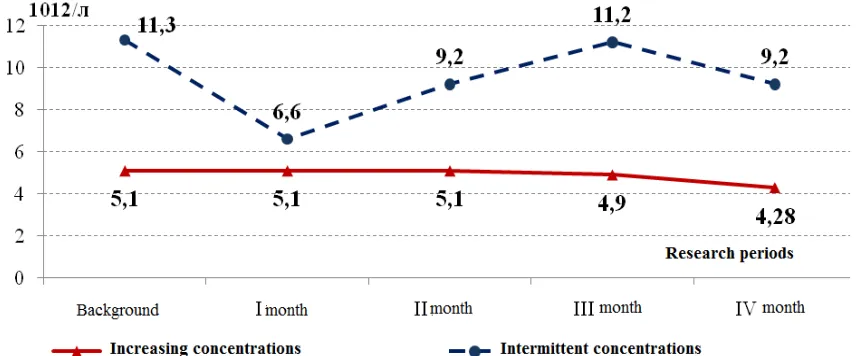
A significant decrease in erythrocytes number (Figure 1) and hemoglobin was detected in the morphological picture of animals (rabbits)' peripheral blood under chronic exposure to intermittent and in-creasing benzene concentrations. This de-crease was more significant during the first month of chronic poisoning with in-termittent concentrations.
By the end of the observations period the red blood composition somehow got back to normal as erythrocytes number was close to background values and to the same parameter in animals from the ref-erence group (it as equal to 9.20±0.30х1012/l in the experimental an-imals; 10,40±0,15х1012/l, in the reference group animals; background level was equal to 11,30±0,40х1012/l).
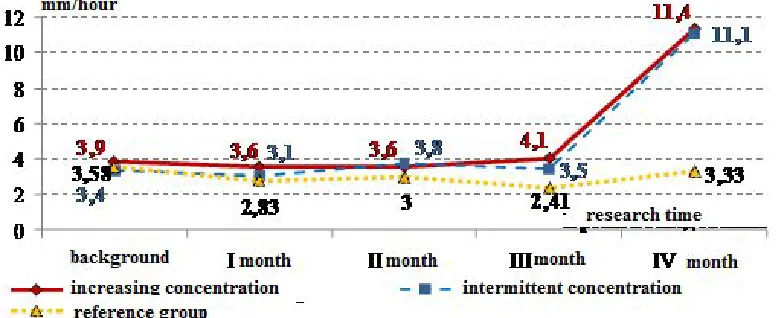
The animals from this group also had a decrease in overall erythrocytes sedimen-tation rate which became more apparent by the end of the fourth month under chronic exposure to benzene (Figure 2).
Together with certain quantitative changes, our research revealed a number of qualitative shifts in the red blood pic-ture, their evidence being changes in erythrocytes acid resistance which can be seen in acid erythrograms deviations to the right. These changes appeared at the end of the second month and it proved young and more acid-resistant erythro-cytes occurred in the peripheral blood.
Figure 1. Dynamics of erythrocytes number changes in animals' peripheral blood under various modes of exposure to small benzene concentrations.
Figure 2. Dynamics of changes in overall erythrocytes sedimentation rate in animals' peripheral blood under chronic inhalation poisoning with benzene
(The parameters are authentic against the reference group (р<0.05)
As we can see from Table 3, a month animals' exposure to benzene caused a 61.8% decrease in eosinophils/basocytes gradient due to a drastic growth in baso-cytes number (187.70%, р<0.01), while eo-sinophils number increased only slightly (107.70%, р<0.05).
T a b l e 3 Dynamics in blood coagulation system
pa-rameters and eosinophils/basocytes association
Parameters
Research periods and parameters values (in % from the initial level) I
month II month
III month
IV month Eosinophils/basocytes61,80 110,20 100,0 112,40 Blood clot retraction 123,1* 128,4* 140,4* 140,0* Blood coagulation
time 112,70 125,50* 144,50* 147,50* Plasma
re-calcification time 109,30 101,20 107,60 106,70 Prothrombin time 04,50 94,0 97,80* 94,0 Prothrombin index 94,10 102,30 99,30 101,20 Plasma tolerance to
heparin 115,40 97,60 145,9* 178,8* Note: * – means these parameters are authen-tically different from the reference group (р < 0,02).
The above-mentioned changes were mostly accompanied with blood clot
retrac-tion growth (123.1%, р<0.02). We also ob-served a trend for longer blood coagulation time (112.7%, р<0.02) and plasma re-calcification time (109.3%, р<0.02).During the subsequent experimental months, there was a gradual growth in blood coagulation time (125.50-147.50%, р<0.001) and blood clot retraction (128.4-140.0%, р<0.01), but plasma tolerance to heparin increased only after 3 months (145.9%-178.8%, р<0.02) (Table 3). These data prove that blood an-ticoagulation properties grow steadily. But still, we didn't detect any bleeding which was specific for benzene, given all the de-tected changes in the blood coagulation system; absence of eosinophils-basocytes dissociation fully corresponds to the situa-tion. The latter can be explained by a growth in eosinophils number.
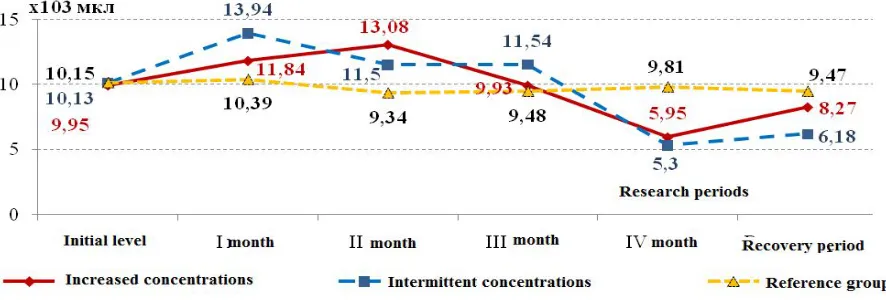
The biggest deviations in leukocytes number from the initial value occurred dur-ing the second month of exposure to in-creased benzene concentrations; the number grew from 9.95 to 13.08 х103 µl (Figure 3). By the end of the 4th month of poisoning leukocytes number decreased to 5.95±0.49
Figure 3. Dynamics of changes in animals' leukocytes in peripheral blood exposed to chronic benzene poisoning (The parameters are authentic against the reference group (р<0.01)
The parameters recovered up to their initial level during a month after poisoning stopped; it proves that all the occurred chang-es are reversible.
Shifts in leukocytic formula of the an-imals from the second group were more apparent. Thus, wave-like changes in leuko-cytes and their specific elements content under exposure to benzene in intermittent concentrations were accompanied with a growth in leukocytes number during the first month of poisoning (from 10.13 to 13.94 х103 µl). By the end of the observations we detect-ed a significant decrease in leukocytes num-ber in the experimental rabbits (5.30 х103 µl). We should note that statistically authentic low leukocytes level (against the reference one) at the end of a monthly recovery period (initial level was 10.13±0.60 х103 µl, level during a recovery period was 6.18±0.73х103 µl) can be an evidence that animals body reactivity decreased considerably under exposure to intermittent benzene concentrations.
Changes in leukocytic formula pa-rameters occurred at the end of the first month of poisoning. These changes were an increase in neutrophils number (neutro-philic leukocytosis with a shift to the left), as well as lymphocytosis and monocytosis. By the end of the poisoning period shifts in leukocytic formula of experimental
ani-mals were quite the opposite: we detected absolute neutropenia, lymphocytopenia, and monocytopenia. 1 months after, when the animals no longer contacted benzene, we didn't detect full recovery in the param-eters (they didn't return to their initial lev-els) and it could be an evidence that a re-covery period was too short, or body reac-tivity decreased too significantly.
So, we examined leukocytic reaction which occurred in the experimental ani-mals as a response to benzene impacts un-der various intoxications modes; our exam-ination revealed that intermittent benzene concentrations exerted more apparent im-pacts in comparison with growing toxicant concentrations mode. Thus, authentic de-crease in leukocytes number which corre-sponds to the 3rd and 4th months of poi-soning under both intoxication modes did-n't disappear in those animals which were exposed to intermittent benzene concentra-tions. Consequently, concentrations which fluctuated during poisoning caused more considerable changes in animals' bodies and it resulted in adaptation mechanisms depletion.
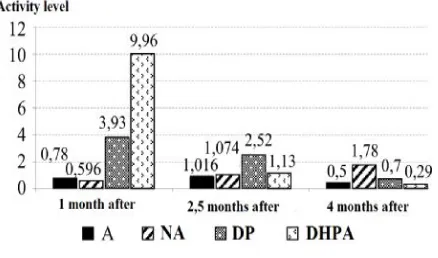
de-tected that reactive changes in the sympa-thoadrenal system are characterized with a certain activity of catecholamines biosyn-thesis, secretion, elimination, and metabo-lism, which varies in different periods of exposure to intermittent benzene concen-trations. The first stage in the reaction oc-curred during the 1st experimental month and was characterized with a synchronous sympathoadrenal system (SAS) activation when adrenaline, noradrenalin, dopamine, and DHPA excretion with urine grew (Fig-ure 4). Sympathetic nervous system activi-ty in experimental rabbits grew more sub-stantially at this stage as noradrenalin quantity (noradrenalin being a basic sym-pathetic nervous system mediator) grew faster than that of adrenaline and it led to a relative decrease in A/NA ratio.
By the end of the exposure period we detected the second stage in the reaction which could be determined as secretory-sympathetic activity dissociation phase. Here we detected a further growth in NA
concentration, certain relative decrease in adrenalin, dopamine, and DHPA level in urine.
SAS reserves and precursors level in urine increased initially at the first stage but them at the second one we observed signs of DHPA (endogenous catechola-mine reserve) depletion (Figure 4).
Figure 4. Contents of catecholamines and their precursors in daily rabbits' urine under chronic exposure to intermittent benzene con-centrations (А is adrenaline, NA is
noradrena-lin, DP is dopamine, DHPA is dihydroxy-phenylalanine)
T a b l e 4 Acetylcholine content and choline esterase activity in rabbits exposed
to small benzene concentrations Animals groups and
poi-soning modes Observation periods, months AC, µg% Examined parameters and their values IC, µg/min LC, µg/min
I. Increased concentrations
Initial level (background) 0,20 ± 0,02 0,89 ± 0,05 0,29 ± 0,05 1 month after 0,33 ± 0,04 0,66 ± 0,06 0,38 ± 0,10 2 months after 0,46 ± 0,03 0,92 ± 0,03 0,32 ± 0,02 3 months after 0,49 ± 0,03 0,98 ± 0,04 0,20 ± 0,01 4 months after 0,40 ± 0,02 0,99 ± 0,08 0,19 ± 0,01
II. Intermittent concentra-tions
Initial level (background) 0,22 ± 0,03 0,94 ± 0,14 0,28 ± 0,04 1 month after 0,34 ± 0,05 0,69 ± 0,09 0,44 ± 0,12 2 months after 0,50 ± 0,06 1,14 ± 0,04 0,32 ± 0,02 3 months after 0,51 ± 0,04 1,26 ± 0,08 0,21 ± 0,01 4 months after 0,46 ± 0,04 1,08 ± 0,12 0,18 ± 0,01
Reference
We determined parasympathetic nerv-ous system activity simultanenerv-ously with sympathetic nervous system activity as these two systems are interconnected. Par-asympathetic nervous system activity be-came apparent through increase in acetyl-choline concentration in blood, higher ace-tylcholine esterase and lower butyrylcholine esterase. By the end of the observation period butyrylcholine esterase activity fell but acetylcholine (AC) level still remained high (Table 4).
Our research results and other authors' works [8,12,13,17] reveal that a primary body reaction to toxic effects exerted by benzene appears in the peripheral blood sys-tem which, in its turn, gives information on the sympathetic nervous system state. So, a primary body reaction to endogenous irrita-tion can be seen in the sympathetic nervous system excitation with a corresponding in-crease in blood sympathetic activity. This primary increase in blood sympathetic activi-ty gives an impulse to a compensatory
reac-tion of the parasympathetic nervous system and other corrective systems [9,15].
So, impacts exerted by benzene in small concentrations caused changes in some regu-latory systems of experimental animals' bod-ies. The most apparent and earliest shifts were detected in the white blood and cate-cholamines (adrenaline, noradrenalin, dopa-mine, and DHPA). The detected signs of catecholamines and DHPA endogenous re-serves depletion as well as eosinophils-basocyte dissociation are unfavorable as it is exactly at this period (the 4th poisoning month) when significant changes in blood occur, namely leucopenia, neutropenia, lymph- and monocytopenia. And here inter-mittent benzene concentrations exert more apparent toxic effects in comparison with growing toxicant concentrations. Leukocytes quantity which decreased during the 3rd and 4th poisoning months didn't recover to its initial levels during a recovery period in an-imals who were exposed to intermittent ben-zene concentrations.
References
1. Balandina A.N., Panteleev M.A., Ataullakhanov F.I. Sistema svertyvaniya krovi I ee regulyatsiya [Blood clotting system and its regulation]. Priroda, 2011, no. 3, pp. 32–38 (in Rus-sian).
2. Vil'chinskii M.P. Uproshchennaya metodika izbiratel'noi okraski bazofil'nykh granulotsi-tov krovi [Simplified methodology for selective stain of blood basocyte granulocytes].
Labora-tornoe delo, 1972, no. 1, pp. 58–59 (in Russian).
3. Vorob'ev A.I. Izuchenie kislotoustoichivosti eritrotsitov v gematologicheskoi klinike [Examination of erythrocytes resistance to acid in a hematological clinic]. Aktual'nye voprosy
gematologii, 1960, no. 2, pp. 314–316 (in Russian).
4. Zyubina L.Yu., Shpagina L.A., Panacheva L.A. Professional'no obuslovlennye gemo-patii i professional'nye zabolevaniya krovi [Industrially mediated hemopathies and occupational diseases of blood]. Meditsinatruda i promyshlennayaekologiya, 2008, no. 11, pp. 15–20 (in Rus-sian).
5. Kutsenko S.A. Osnovy toksikologii [Basics of toxicology]. St. Petersburg, 2004, 570 p. (in Russian).
clot-ting system examination: methodical guidelines]. Moscow, ATGPSS, Publ., 2011, 15 p. (in Russian).
7. Matlina E.Sh., Prikhozhan V.M. K metodike opredeleniya kholinesterazy v krovi [On methodology for choline esterase detection in blood]. Laboratornoe delo, 1961, no. 6, pp. 10–12 (in Russian).
8. Mikhailova I.V. Otsenka vozdeistviya benzola i khroma na faktory estestvennoi re-zistentnosti v eksperimente [Impact assessment of benzene and chrome on the natural resistance factors in the experiment]. Rossiiskii immunologicheskii zhurnal, 2014, vol. 8, no. 3 (17), pp. 454–457 (in Russian).
9. Orujov R.A. Nekotorye pokazateli adaptatsionnykh sdvigov organizma pri povtornykh ostrykh intoksikatsiyakh uglevodorodami [Specific parameters of adaptation shifts in a body un-der repeat acute intoxications with hydrocarbons]. Zdorov'e, 2014, no. 3, pp.112–117 (in Rus-sian).
10. Orujov R.A. Razlichie v deistvii promyshlennykh narkotikov na primere benzola, ben-zina i atsetona [Differences in effects exerted by industrial drugs on the examples of benzene, petrol, and acetone]. Azmedzhurnal, 2014, no. 2, pp. 95–98 (in Russian).
11. Piralashvili I.S. K metodike podscheta eozinofilov v perifericheskoi krovi [On meth-odology for calculating eosinophils in peripheral blood]. Laboratornoe delo, 1962, no. 3, pp. 20–22 (in Russian).
12. Yang J., Bai W.n, Niu P., Tian L., Gao A. Aberrant hypomethylated STAT3 was iden-tified as a biomarker of chronic benzene poisoning through integrating DNA methylation and mRNA expression data. Experimental and Molecular Pathology, 2014, vol. 96, no. 3, pp. 346– 353.
13. Wen H., Yuan L., Wei C., Zhao Y., Qian Y., Ma P., Ding S., Yang X., Wang X. Ef-fects of combined exposure to formaldehyde and benzene on immune cells in the blood and spleen in Balb/c mice. Environmental Toxicology and Pharmacology, 2016, vol. 45, pp. 265– 273.
14. Hestrin S. The relation acetylcholine and other carbocholine acidi derivatwes with hy-droxylamine and its analytical application. J. biol. Chem, 1949, vol.180, no.1, pp. 249–251.
15. Kerzic P.J. [et al.]. Analysis of hydroquinone and catechol in peripheral blood of ben-zene-exposed workers. Chemico-Biological Interactions, 2010, vol. 184, pp. 182–188.
16. Geering B., Stoeckle Ch.., Conus S., Hans-Uwe S. Living and dying for inflammation: neutrophils, eosinophils, basophils.Trends in Immunology, 2013, vol. 34, no. 8, pp. 398–409.
17. Rizzo M. [et al.]. Cortisol levels and leukocyte population values in transported and exercised horses after acupuncture needle stimulation. Journal of Veterinary Behavior: Clinical
Applications and Research, 2017, vol. 18, pp. 56–61.
Orujov R.А., Dzhafarova R.E.Changes in the nervous system state and peripheral blood
parameters under benzene intoxication during an experiment. Health Risk Analysis, 2017, no. 4, pp. 108–116. DOI: 10.21668/health.risk/2017.4.12.eng