Original Article
COMPARATIVE EVALUATION OF THE EFFECT OF DIFFERENT TYPES
OF CHEWING GUMS ON SALIVARY PH-AN INVIVO STUDY
Rani Somani, * Shipra Jaidka, ** Deepti Jawa Singh, *** Prabhav Chauhan
†* Professor & Head, Department of Pedodontics & Preventive Dentistry, DJ College of Dental Sciences & Research, Modinagar, Uttar Pradesh, India
** Professor, Department of Pedodontics & Preventive Dentistry, DJ College of Dental Sciences & Research, Modinagar, Uttar Pradesh, India
***Reader, Department of Pedodontics & Preventive Dentistry, DJ College of Dental Sciences & Research, Modinagar, Uttar Pradesh , India
†Post Graduate Student, Department of Pedodontics & Preventive Dentistry, DJ College of Dental Sciences & Research, Modinagar, Uttar Pradesh, India
_________________________________________________________________________
ABSTRACTAIMS: The present study was done with the aims and objective to comparatively evaluate the effect of various chewing gums (sugarfree gum & sugared gum) on salivary pH.
METHOD: The study was done on 90 children 6-12yrs of age. Subjects were divided equally into two groups-the experimental group and the control group. The experimental group was further divided into two –the one group chewing the sugarfree gum and the one group chewing the sugar containing gum. The pH of the saliva was noted with the help of pH meter before chewing, and subsequently after chewing at intervals of 5 minutes,10 minutes and 15 minutes after chewing gum respectively. RESULTS: The results showed that the there was significant difference in the oral cavity pH when compared between sugarfree and sugar containing gum.
CONCLUSION: Thus it can be illustrated that the sugarfree gum is a food of choice in promoting salivary flow therby reducing the acidogenicity of oral cavity and resulting in reduction of caries.
KEYWORDS: Chewing gums; saliva, pH; dental caries
INTRODUCTION
An ounce of prevention is better than a pound of cure. The dental caries is once such disease which can be prevented if appropriately and timely diagnosed. It is the most common disease affecting children worldwide. The formation of dental caries is a process in which the mineral tissue of the teeth is dissolved by acid produced by microbes. It is not merely a simple
demineralization; rather it is considered as a dynamic process including demineralization by the organic acids originated from microorganisms and further remineralization by saliva components.[1] A reduction in pH below critical pH i.e 5.5 is associated with demineralization and thus increase in pH above critical pH is usually associated with remineralization.[2] As seen after every meal there is a decrease in the pH of saliva and to overcome this decrease in pH certain substances have been introduced which when chewed increases the pH of saliva to a safe level. There are number of food items that regulate salivary flow rate and effect the acidogenicity of saliva like some medicines, lollipops, toffees, acidic candies and more recently the chewing gums. Chewing gum is a food which is widely liked especially by children. Usually chewing gums contain high level of sugars which favours the process of demineralization. Apart from this chewing of gums repeatedly stimulate saliva production thus increasing its buffering action. Thus to overcome this negative effects of sugars in chewing gums, recently sugarfree chewing gums have been introduced to negate the effect of fermentable carbohydrates in the sugar containing gums.[2] Furthermore it has been well established that sugarfree chewing gum has an anticariogenic effect. Such effect is ascribed to the action of two factors, that are, saliva stimulation through the chewing process and integration of dietary polyols.[3] Xylitol is one such substance that has been used as a substitute for refined white sugar for more than 30 years. Xyltol has been approved by the food and drug administration since the 1960’s and is safe for children. Since then it has been used as a sweetener in various food and food
Table 1: Mean percentage variation of salivary pH at different time intervals in various groups
GROUPS BASELINE pH (Mean)
% INCREASE OF SALIVARY pH IMMEDIATELY AFTER CHEWING
(Mean)
% INCREASE OF SALIVARY
pH AFTER 5 MIN OF CHEWING
(Mean)
% INCREASE OF SALIVARY pH AFTER 10
MIN OF CHEWING
(Mean)
% INCREASEOF SALIVARY pH AFTER 15 MIN OF CHEWING
(Mean)
Group A
(Control) 7.22 9% 9% 7% 5%
Group B (Sugared Gum)
6.78 -3% -5% -1% 2%
Group C (Sugarfree
Gum)
6.86 4% 16% 16% 14%
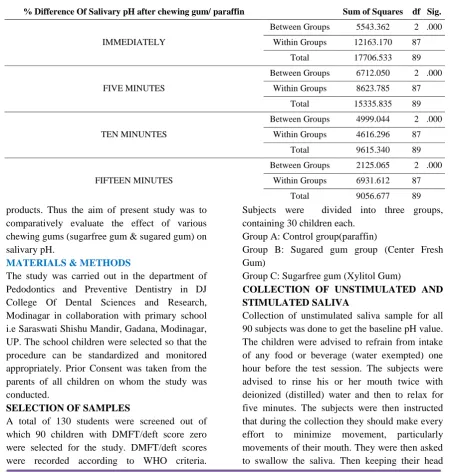
Table 2: Distribution of variance between the groups using Anova test
% Difference Of Salivary pH after chewing gum/ paraffin Sum of Squares df Sig.
IMMEDIATELY
Between Groups 5543.362 2 .000
Within Groups 12163.170 87
Total 17706.533 89
FIVE MINUTES
Between Groups 6712.050 2 .000
Within Groups 8623.785 87
Total 15335.835 89
TEN MINUNTES
Between Groups 4999.044 2 .000
Within Groups 4616.296 87
Total 9615.340 89
FIFTEEN MINUTES
Between Groups 2125.065 2 .000
Within Groups 6931.612 87
Total 9056.677 89
products. Thus the aim of present study was to comparatively evaluate the effect of various chewing gums (sugarfree gum & sugared gum) on salivary pH.
MATERIALS & METHODS
The study was carried out in the department of Pedodontics and Preventive Dentistry in DJ College Of Dental Sciences and Research, Modinagar in collaboration with primary school i.e Saraswati Shishu Mandir, Gadana, Modinagar, UP. The school children were selected so that the procedure can be standardized and monitored appropriately. Prior Consent was taken from the parents of all children on whom the study was conducted.
SELECTION OF SAMPLES
A total of 130 students were screened out of which 90 children with DMFT/deft score zero were selected for the study. DMFT/deft scores were recorded according to WHO criteria.
Subjects were divided into three groups, containing 30 children each.
Group A: Control group(paraffin)
Group B: Sugared gum group (Center Fresh Gum)
Group C: Sugarfree gum (Xylitol Gum)
COLLECTION OF UNSTIMULATED AND STIMULATED SALIVA
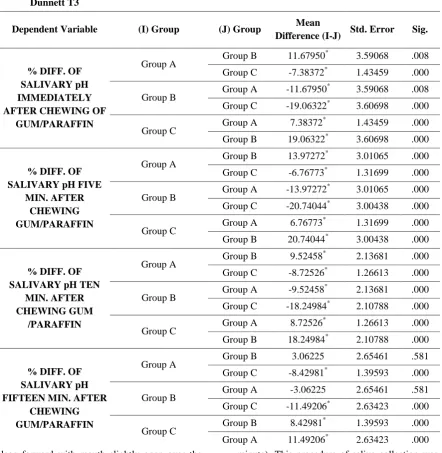
Table 3: Intercomparison of mean percentage variation of salivary pH of different groups at various time intervals
Dunnett T3
Dependent Variable (I) Group (J) Group Mean
Difference (I-J) Std. Error Sig.
% DIFF. OF SALIVARY pH IMMEDIATELY AFTER CHEWING OF
GUM/PARAFFIN
Group A Group B 11.67950
* 3.59068 .008
Group C -7.38372* 1.43459 .000
Group B Group A -11.67950
* 3.59068 .008
Group C -19.06322* 3.60698 .000
Group C Group A 7.38372
*
1.43459 .000
Group B 19.06322* 3.60698 .000
% DIFF. OF SALIVARY pH FIVE
MIN. AFTER CHEWING GUM/PARAFFIN
Group A Group B 13.97272
* 3.01065 .000
Group C -6.76773* 1.31699 .000
Group B Group A -13.97272
* 3.01065 .000
Group C -20.74044* 3.00438 .000
Group C Group A 6.76773
* 1.31699 .000
Group B 20.74044* 3.00438 .000
% DIFF. OF SALIVARY pH TEN
MIN. AFTER CHEWING GUM
/PARAFFIN
Group A Group B 9.52458
* 2.13681 .000
Group C -8.72526* 1.26613 .000
Group B Group A -9.52458
*
2.13681 .000
Group C -18.24984* 2.10788 .000
Group C Group A 8.72526
*
1.26613 .000
Group B 18.24984* 2.10788 .000
% DIFF. OF SALIVARY pH FIFTEEN MIN. AFTER
CHEWING GUM/PARAFFIN
Group A Group B 3.06225 2.65461 .581 Group C -8.42981* 1.39593 .000
Group B Group A -3.06225 2.65461 .581 Group C -11.49206* 2.63423 .000
Group C Group B 8.42981
* 1.39593 .000
Group A 11.49206* 2.63423 .000 lean forward with mouth slightly open over the
test tube and funnel, 10 ml of saliva was collected. While for the collection of stimulated saliva in various groups, all of 30 subjects in each group were first instructed to sit motionless. After that a chewing gum or a cylindrical block of paraffin of 1.5 cm height and 1cm diameter was given to them to simulate the size of chewing gum. They were asked to chew it for 2 minutes. After every one minute, subjects were asked to spit saliva into the tube without swallowing by keeping the head lean forward over the funnel. The subjects spitted out, kept chewing (after first minute), spitted out, kept chewing (after second
minute). This procedure of saliva collection was stopped after 10ml of saliva was collected. Then subjects spitted out the chewing gum/paraffin and the collection of stimulated saliva was repeated for all the groups after 5 minutes, 10 minutes and at 15 minutes and salivary pH recorded with the help of digital pH meter (Fig. 1).
CALIBRATION OF THE pH METER
reading if required adjusted to pH 7. The bulb was again dipped in a solution of pH buffered at 4 to check if the reading displayed is correct, otherwise re calibration was done.
RECORDING OF SALIVARY PH
To record the pH of the saliva, the bulb of the electrode was dipped in the test tube containing the saliva and the pH obtained was displayed immediately as a digital reading on the body of the pH meter. Thus for various groups the salivary pH of unstimulated (baseline) and stimulated saliva was calculated (Fig. 2).
RESULTS
Collected data was tabulated & statistically analysed using Anova test and Dunnett test. It was found out that the mean percentage values of salivary pH increased in group A (control group) and Group C (sugarfree gum) and decreased in group B (sugared gum). It increased to a maximum of 1% in Group A (control group) and 5% in the Group C (sugarfree gum). While in group B it decreased to 1% (Table 1). When the intercomparison of various groups was done using Anova test. The mean percentage variation of salivary pH was compared between different groups. The mean pH between experimental and control groups was found to be significant at p>0.05 at all time intervals (Table 2). However when the intercomparison of groups was done using dunnett test. The intercomparison of mean percentage difference showed highly significant results in all the groups except when mean percentage difference of salivary pH post 15 minutes from baseline pH was compared between group A (control group) and group B (sugared gum) (Table 3).
DISCUSSION
Dental caries is a multifactorial disease that results from the interaction between the bacterial biofilm, the environment (e.g., diet, saliva composition and flow rate, fluoride exposure) and the tooth structure. Thus there are four Essential Factors in the etiology of dental caries (Keyes, 1960) which are, the presence of a susceptible host tissue i.e., the tooth, Microflora with a cariogenic potential, a suitable local substrate to meet the requirements of the pathogenic flora and presence of all these factors at a suitable period of Time.[4] So if we aim to reduce the occurrence of any one factor we would be able to reduce dental caries drastically. Oral cavity is a battle ground of
promote mineralisation but rather can be directly cariogenic through sustained release of sucrose.7 In the present study it was found that the mean percentage value of salivary pH increased in the sugarfree chewing gum group (14%) and control group (5%) from the measured baseline pH and decreased in sugared chewing gum group (1%) from measured baseline pH. This was observed because when patients chew sugarfree chewing gum, the increased volume and flow of saliva helps to dilute and clear plaque acids that can initiate the demineralization process. In addition, an increase in salivary flow rate buffers and raises salivary pH, thus reducing the potential time that demineralization of teeth can occur in an acidic environment. Moreover with sugarfree chewing gum the presence of fermentable carbohydrate is also not there and the sugar substitute such as xylitol is added which is non-fermentable and thus reducing the acid production and fall in pH. The increase in salivary volume and flow of saliva was also seen in control group, however there is less increase in bicarbonate ions as a consequence of its less stimulatory effect.[12] While with the sugared chewing gum this stimulatory effect is over rided by the simultaneous presence of the fermentable carbohydrates like sucrose which is easily metabolized by bacteria to form plaque acids, with unfavorable consequences on the salivary pH.[8] This is similar to the results seen in a study done by Shikhar Kumar et al., in which they compared the effect of sugarfree and sugared gum on the pH of saliva and found out that the chewing of sugarfree gum effectively raises the pH of saliva while the sugared gum decreased it. When intergroup comparisons between the experimental groups were made it was found out that the mean pH fall or rise was found to be significant at p>0.05 at all time intervals. This is
because of the fact that sugarfree chewing gum raises the pH of saliva whereas the sugared chewing gum decreased it thus making the large difference in the values obtained.
CONCLUSION
Following conclusions were drawn from the study:
1. The acidogenic potential of sugared chewing gum was more as compared to sugarfree chewing gum.
2. Both sugarfree and sugared chewing gum affects the salivary pH significantly.
3. Chewing paraffin wax raises salivary pH but not as effectively as the sugarfree gum. 4. There was significant increase in the salivary
pH on chewing sugarfree chewing gum from measured baseline value.
5. Significant decrease in the salivary pH was observed after chewing sugared chewing gum from measured baseline value.
Thus it is concluded that the sugarfree gums can be used as a caries preventive agent when used as an adjunct in the diet.
CONFLICT OF INTEREST & SOURCE OF FUNDING
The author declares that there is no source of funding and there is no conflict of interest among all authors.
BIBLIOGRAPHY
1. Biria M, Malekafzali B, Kamel V. Comparison of the Effect of Xylitol Gum- and Mastic- chewing on the Remineralization Rate of Caries-like Lesions. Journal of Dentistry, Tehran University of Medical Sciences, Tehran, Iran 2009;6(1).
2. Edgar WM, Higham SM, Manning RH. Saliva stimulation and caries prevention. Adv Dent Res 1994;8(2).
Comparative evaluation of the effects of xylitol and sugar-free chewing gums on salivary and dental plaque pH in children. J Indian Soc Pedod Prev Dent 2013;31:240-4 4. Nikiforuk G. Understanding Dental Caries.
Published 1985.
5. Gopinath VK, Arzreanne AR. Saliva as a Diagnostic Tool for Assessment of Dental Caries. Archives of Orofacial Sciences 2006;1:57-9.
6. Walsh LJ. Clinical Aspects Of Salivary Biology For The Dental Clinician. Journal Of Minimum Intervention In Dentistry. 2008.
7. Saliva Collection and Handling Advice. 3rd edition. LLC Salimetrics. 2013.
8. Llop MR. Effects of xylitol chewing gum on salivary flow rate, pH, buffering capacity and presence of Streptococcus Mutans in saliva. European Journal Of Paediatric Dentistry. 2010;11(1).
9. Felipe M, Carrasco CG. Effect of Xylitol Chewing Gum on Dental Plaque, Saliva Flow and Saliva Buffer Capacity in Chilean Youngsters. Int J Odontostomat. 2013;7(1). 10. Ahmadi-Motamayell, Goodarzi M, Hendi
SS, Abdolsamadi N. Evaluation of salivary flow rate, pH, buffering capacity, calcium and total protein levels in caries free and caries active adolescence. Journal of Dentistry and Oral Hygiene 2013;6.
11. Widowati W, Akbar SH, Tin MH. The changing pattern of saliva pH after consuming different types of sweeteners (sucrose and malitol). International Medical Journal Malaysia 2013;12(2).