Vol. 14, 2018, 35-44
ISSN: 2349-0632 (P), 2349-0640 (online) Published 31 August 2018
www.researchmathsci.org
DOI: http://dx.doi.org/10.22457/jmi.v14a5
Journal of
Evolutionary Game Analysis on the Strategy Selection of
Sharing Bicycle Enterprises and Users
Yongfei Li and Guoshun Ma
College of Mathematics and Statistics, Northwest Normal University Lanzhou 730070, China
Corresponding author. Email: [email protected]
Received 8 August 2018; accepted 30 August 2018
Abstract. The rapid development of shared bicycles has brought great convenience for people to travel. At the same time, many problems have appeared. The non-standard use of users and over deployment of enterprises have caused very serious consequences. Based on the evolutionary game theory, the replicated dynamic equations of shared bicycle enterprises and users are established according to the different delivery modes of enterprise, we obtained the evolutionary stable strategy of different choices for enterprises and users, and analyzed the evolutionary stability strategy under different conditions.
Keywords: sharing bicycle; evolutionary game; replicated dynamic; evolutionary stability strategy
1. Introduction
for vandalism and illegal cycling, At the same time, sharing bicycle enterprises only consider their own interests, large-scale distribution of bicycles to occupy the market, ignoring the cooperation between enterprises, and ultimately result in over-investment, waste of resources, some impact to normal traffic order in the city. In this realistic situation, the most important issue is to consider how to achieve a win-win situation between the shared bicycle enterprises and users? How to form an orderly competition between enterprises and the like.
At present, many scholars have discussed the above game problems. Li [2,3] took OFO and Mobike as an example, using NPV and IRR models to research and analyze the shared bicycle market, and got the conclusion that the monopoly market is not conducive to maximizing the utility of social resources and the sustainable development of the market. Ding [4-6] discussed the selection of competitive strategies of shared bicycle enterprises, concluded that the irrational competition among shared bicycle enterprises eventually caused the Prisoner's Dilemma, and the integration of idle bicycles by the Internet could exert the sharing advantage. Dai [7] analyzed the game and equilibrium of the shared bicycle market and obtained the game equilibrium among the enterprises, users and the market. It was put forward that under the premise of reasonable guidance of government and cooperation among enterprises, sharing bicycle would have a good development prospect. Li [8,9] studied the current situation and countermeasures of the development of shared bicycle in China, and proposed that users, enterprises and governments should play their respective roles in order to jointly guarantee the orderly development of the shared bicycle. Liu [10] made a research and analysis on the development of shared bicycles, and proposed that shared bicycles should improve their own management and development mode in order to give better play to their market value. Zhou [11] combined with the actual situation of shared bicycle use in Kunming city studied the influencing factors of shared bicycle user satisfaction, and through the data analysis of the questionnaire, proposed that the shared bicycle platform should promptly solve the problem of bicycle distribution and service maintenance. Li [12,13] used PEST model and SWOT-PEST matrix to conduct a comprehensive analysis of the internal and external factors of the shared bicycle, and proposed that the current shared bicycle should make "force" from the aspects of policy, social resources, management and planning so as to create a shared bicycle health development of the market environment.
and Users
model of sharing bicycle enterprises and users based on the evolutionary game theory, and analyzes the equilibrium solution that when enterprises use limited and large-scale delivery strategies respectively, and the users adopt the strategy of illegal use and non-illegal use. We are aim to reduce the number of bicyclists who use bicycles illegally and guide and enable enterprises to rationally deliver bicycles through the common efforts of both sharing bicycle enterprises and users. At the same time, it will also provide a theoretical basis for the government and enterprises to take reasonable and effective supervision measures.
2. Model
2.1. The basic assumptions of the model
There are two types of participants in the model, one is the shared bicycle enterprise, and its strategy choices are "large-scale delivery" and "limited delivery", which are denoted as
and respectively; the other is the user and his strategy choices are " illegal use " and " non-illegal use ", which are denoted as and ,where the illegal use mainly refers to keeping bicycle for one’s own, deliberate sabotage and illegal parking of the users, Both of them are limited rational decision makers.
We suppose that is the cost of large-scale delivery bicycles of enterprise, the cost of limited-delivery bicycles must be less than , so we assume > > 0. is the profits of enterprise; When an enterprise chooses limited delivery of bicycles, the probability that the destructive behavior will increase because the user may think that the number of bicycles that the enterprise puts in is not enough to meet their actual requirements. We suppose R is the Additional risk that the limited delivery of enterprise may take than the large-scale delivery, and R > 0. Bicycle will be worn in the course of use, if damaged, may suffer more than normal use, where we assume that V is the extra depreciation loss due to using the bicycle illegally of users.
We let is the user’s profit obtained by using bicycles illegally, is the profit that users do not use bicycles illegally. Because sharing bike platform penalizes users for illegal use, such as credit deductions, restricted use, blacklisting, etc. We assume that E is a penalty for users who violate the usage rules. δis the probability that a user will be reported by a third party as a result of the use illegal, 0 ≤ δ ≤ 1. In fact, people are still less aware of the maintenance of shared objects and the image of the city. Here, it is assumed that users are more inclined to a large number of bicycles, λis the user satisfaction with the number of bicycle, 0 < < 1.
2.2 Establishment of model
1 −
the limited delivery strategy,where, are all functions of time t. We get the payoff matrix of the two sides of games, as shown in Table 1:
Table 1: Payoff matrix
User Enterprise
Large-scale distribution Limited delivery Illegal
use Non-illegal
use
δ − !" + 1 − $,
δ − − % + !"+
1 − $ − − %"
,−
δ − !" + 1 − $,
δ − − % − & + !" +
1 − $ − − % − &"
λ,−
The expected profits of illegal use and non-illegal use for users and the average profit of population are ', ' and '( respectively:
' = *$ − !" + 1 − $+ + 1 − *$ − !" + 1 − $+ = − $!
' = + 1 − λ= − +
'(= '+ 1 − '= − $!" + 1 − − +
The replicated dynamic equation of user’s population choose the illegal use strategy is:
F =-.-/= '− '(" = 1 − * − 1 + − λ− $!+(1) Let F = 0, we get = 0, = 1, ∗=123613453612
2 ;
The expected profits of large-scale distribution and limited delivery for enterprises and the average profit of population are', ' and '( respectively:
' = *δ − − % + !" + 1 − $ − − %"+ + 1 − − "
= − % − + $!
' = *δ − − % − & + !" + 1 − $ − − % − &"+ + 1 − − "
= − % − − & + $!
'(= '+ 1 − '
= − % − + $!"+1 − − % − − & + $!"
The replicated dynamic equation of enterprise’s population choose the large-scale distribution strategy is:
F =-7-/= '− '(" = 1 − & + − "(2)
Letting F = 0,we get = 0, = 1,and ∗=8938: 9.There are 5 fixed points in
dynamic system(1)-(2):
0,0、1,1、1,0、0,1 and ∗, ∗ = ;8938: 9,123613453612
and Users
2.3. The analysis of model
(1) The user's profit and evolutionary equilibrium:
When ≥ − $!, There are instability points (0,0) and (1,1), stability point (1,
0) and (0,1), and saddle point ∗, ∗ = ;89:389,123613453612
2 <in this system, This is
due to0 ≤ ∗=123613453612
2 ≤ 1, so 1 − ≥ − $! − , That is ≥
− $!.If < − $!, then Fx > 0. We defineM = − − $!", which means that the final profit difference between the non-illegal use and illegal use bicycles of user. When − $! > 0, we have> − $! > 0, here M > 0.
When > ∗,we have* − 1 + − λ− $!+ < 0, @A0 < 0, @A1 > 0. According to the judgment theorem of stability of differential equation, then ∗= 0 is an ESS. From this we can see that when the profit difference M > 0, and > ∗, That is, when most enterprises choose the strategy of large-scale distribution bicycles, most users tend to choose , because in this case, users know that if they choose , which is not good for both, the end result of dynamic evolution is that all user populations Choose , so we can determine that ∗= 0 is an ESS.
When < ∗, we have * − 1 + − λ− $!+ > 0, @A0 > 0, @A1 <
0. According to the judgment theorem of stability of differential equation, ∗= 1 is an ESS. That is, all user populations will choose .
Dynamic phase diagram of the two cases shown in Figure 1:
Figure 1: M>0 dynamic phase diagram
For − $! < 0, we have < − $! < 0, in which case M < 0 for ∗ to exist.
When > ∗,we have* − 1 + − λ− $!+ > 0, @A0 > 0, @A1 < 0. According to the judgment theorem of stability of differential equation, ∗= 1 is an ESS. That is, all user populations will be tend to choose .
When < ∗, we have* − 1 + − λ− $!+ < 0, @A0 < 0, @A1 >
0. According to the judgment theorem of stability of differential equation, ∗= 0 is an
0 1
B BC
> ∗
0 1
B BC
40
D
Dynamic phase diagram of the two cases shown in Figure 2:
Figure 2: M <0 dynamic phase diagram
(2) The enterprise's profit and evolutionary equilibrium:
Similarly, for the existence of ∗=8938: 9, that is 0 < ∗< 1, we have & > −
. R is the additional risk that the limited-delivery of enterprises can make bicycles more damaged than the large-scale delivery may undertake, − represents the difference between the cost of large-scale and limited delivery of enterprises, where we only consider
− > 0, because if − < 0, that is, the cost of large-scale delivery of enterprise is less than the cost of limited delivery bicycle, this situation is difficult to be established in reality, There is no any practical significance in analyzing this situation and we will not discuss it in this article. We let N = R + − , and define N is the risk tolerance level of an enterprise.
When − > 0, we have R > − > 0, here N > 0.
When > ∗, we have R + − > 0, @A0 > 0, @A1 < 0. From the judgment theorem of stability of differential equation we can see that ∗= 1 is an ESS. At this time, all enterprise populations will be tend to choose .
When < ∗, we have R + − < 0, @A0 < 0, @A1 > 0. From the judgment theorem of stability of differential equation, we can see that ∗= 0 is an ESS. Since enterprise risk tolerance N > 0, enterprises will first choose the strategy of limited delivery bicycles, but at this time most users tend to choose the strategy of non-illegal use bicycles, in this case, the development of shared bicycles is healthy and stable, Enterprises and users to achieve the ideal win-win results.
Dynamic phase diagram of the two cases shown in Figure 3,
0 1
B BC
> ∗
0 1
B BC
< ∗
0 1
B BC
0 1
and Users
Figure 3: N> 0 dynamic phase diagram 2.4. Evolutionary game analysis
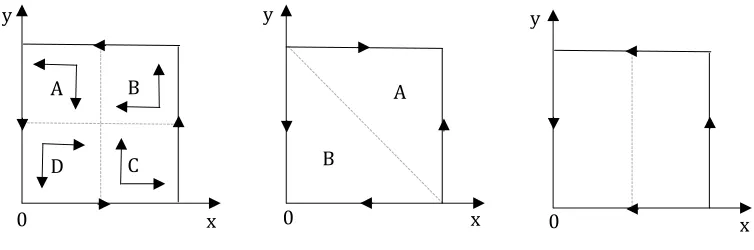
Based on the above analysis results, we make the evolution phase diagrams of M> 0, N> 0 (state I) and M <0, N> 0 (state II), as shown in Figure 4.
Figure 4: Evolution phase diagram
It can be seen from the analysis of state I that the optimal evolutionary stability strategy (0,0) can not be obtained regardless of the initial state of the game. That is, all four strategies in areas A,B,C and D are not evolutionary stable strategy of game. Therefore, state I is the transition period of the game. At this stage, although the strategic choices of the two sides of the game depend on each other, we can make the game evolve to the ideal state by adopting different measures. Deflecting δ and E separately for y*, we get
F∗ F$ = 35
3612< 0, F∗GF! =36134 2 < 0
G . Therefore, increasing δ and E can
increase the area of area A and area B, so that the state I evolve to state III, so, we should first increase supervision and publicity to the public, give full play to the leading role of public opinion, and at the same time, formulate corresponding reward mechanisms to stimulate the public's enthusiasm for supervision. Second, we should increase penalties for users' irregularities so as to restrain users from illegal behaviors, so that the shared bicycle market will develop healthily and steadily.
For the state II analysis, the system will converge to (1, 1) when the initial state of the game is within the region A (the upper right of the line connecting point (1, 0) and (0, 1),the system will converge to (0,0) when the initial state of the game is within the region B (the
B
A
x 0
y
Ⅱ x
y
0
Ⅲ x
0 y
C D
B A
When the system tends to (0,0) points, that is, the enterprise chooses limited delivery strategy and the user chooses non-illegal use strategy. At this moment, the shared bicycle market will develop in an effective and ideal direction.
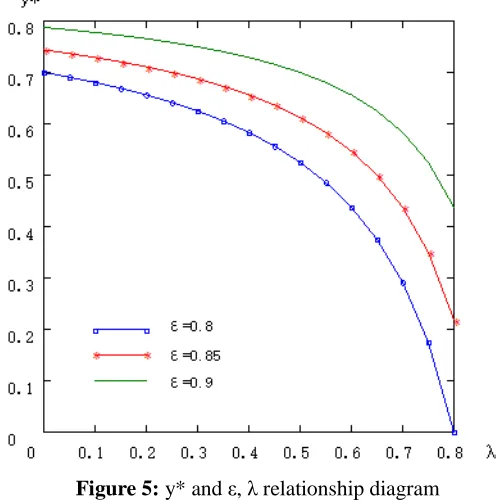
However, because of the current people's awareness of maintaining the city image is relatively weak, so the state III is difficult to achieve. Based on the above conclusions, we use MATLAB software to state III for numerical analysis of user punishments, satisfaction and third-party reporting rate Impact on the choice of enterprises strategy. Here we
let ε =121345
2 , which represents the profit ratio of the user to choose two strategies, and the value of ε = 0.8, ε = 0.85, ε = 0.9, the relationship among them as shown in Figure 5, y * and λ are negatively correlated, therefore, the improvement of the user's awareness of city image maintenance is very important for enterprises to choose the limited delivery strategy. Moreover, the smaller ε, the faster the enterprise tends to choose the limited delivery strategy, because the smaller ε, the greater the benefits for users who choose the non-illegal use strategy. It can be seen from this that reducing user irregularities not only requires greater penalties, encourage public monitoring and reporting, but also to improve the user awareness of maintaining the city image.
Figure 5: y* and ε, λ relationship diagram
3. Conclusions and recommendations
and Users
under different strategic choices of both parties, and obtained the optimal strategies under different situations. The analysis results tell us that there is interdependence of the strategic choices between enterprises and users, and there are many influencing factors in the evolutionary stability strategy of each decision maker. The results of the analysis in this paper have some guiding significance for the development of shared bicycle.
Combined with the results of the analysis, we present the following suggestions: First, to increase penalties and reduce sabotage. For vandalism, according to own, illegal parking and other behaviors, the sharing bicycle platforms should be combined with the transport sectors use more means to increase penalties to restrict user behavior; second, to encourage public oversight, improve user quality. Actively guide the public to standardize the use of bicycles, at the same time, through incentives and other ways to stimulate public enthusiasm for supervision and reporting, thereby enhancing the possibility of penalties for violations and vandalism, and promote civilized use of bicycles. Third, to promote a reasonable distribution of enterprises to maintain the beautiful image of city. Government departments should coordinate the delivery of the number of bicycle enterprises, to avoid causing the bicycle idle and waste.
Acknowledgement. This research was financially supported by the National Natural Science Foundation of China (Grant NO. 71761031).
REFERENCES
1. B.Wu, Sharing economy research, Advanced Science and Industry Research Center. Proceedings of 2017 4th International Conference on Advanced Education Technology and Management Science(AETMS 2017)[C], Advanced Science and Industry Research Center, 2017.
2. M.Li, Share cycling market research and analysis, Finance and Economics, 5 (2017) 121-123.
3. Y.Wu and D.Zhu, Bicycle sharing based on PSS-EPR coupling model: exemplified by bicycle sharing in China, Procedia CIRP, (2017) 64.
4. D.Maosen and R.Ruyuan, Analysis of competitive cycling strategies for shared cyclists based on game theory, Modern Commercial, 20 (2017)107-108.
5. D.Çelebi, A.Yörüsün and H.Işık, Bicycle sharing system design with capacity allocations, Transportation Research, Part B, (2018) 114.
6. Cyrille Médard de Chardon, Geoffrey Caruso, Isabelle Thomas, Bicycle sharing system ‘success’ determinants, Transportation Research, Part A, (2017) 100.
country's shared bicycle, Science and Technology Economic Market, 9 (2017) 185-186.
9. S.Mete, Z.A.Cil and E.Özceylan, Location and coverage analysis of bike- sharing stations in university campus, Business Systems Research Journal, 9 (2018) 2. 10. Y.Liu, Research and analysis of shared bicycle development, Time Finance, 8 (2017)
251 + 254.
11. S.Zhou, Study on the influencing factors of the shared bicycle user satisfaction - a case study of Kunming, Logistics Technology, 4 (2017) 35-39.
12. K.Li, Study on the countermeasures of urban shared bicycle development from the perspective of shared economy, City, 3 (2017) 66-69.
13. Y.Wang, A.Matthew, B.T.Hazen and M.Dresner, Be green and clearly be seen: How consumer values and attitudes affect adoption of bicycle sharing, Transportation Research Part F: Psychology and Behaviour, (2018) 58.