Influence of the Interfernce Due to Co-Existence
of Bluetooth and Wi-Fi Transmissions
Er.Gurpreet kaur
Dr.Dalveer kaurM.Tech Student Assistant Professor Department of ECE Department of ECE
PTU University Campus,Punjab Technical University ,India PTU University Campus,Punjab Technical University ,India
Abstract
There are various emerging technologies in the field of wireless communcation which are communication, operated on unlicensed ISM (Inductrial, Scientific and Medical). Therefore, they lead to interference due to coexistence on same frequenc y band such as Bluetooth and Wi-Fi. The growth of devices within 10 meters is growing on day by day as the advancements in technologies. But the interference is a big issuse in the case of voice transmission , as the Bluetooth supports both transmission of data and voice using ACL and SCO packets reapectively. In this paper we investigate the inference in voice packets using Connection Oriented Repeated Transmission for SCO links. For sake of experimental verification , we provide a comprehensive simulation results using Matlab simulink.
Keywords: SCO, Bluetooth, 802.11, Interference, ACL, Celluler system
_______________________________________________________________________________________________________
I.
I
NTRODUCTIONThe advancements in the wireless technologies make the world comfortable. These comforts transformed our daily life iin such a situation that nobody can imagine to live without cellphones, internets , computers etc. The wireless networks are getting interconnected these devices through adding up more and more nodes into each minute . There is the celluler phone which is latest and modern example of emerging technologies in which both the most popular technologies IEEE802.11 and Bluetooth exist These technologies uses radio frequency for communication . Unfortunately , IEEE802.11 and Bluetooth both operated on unlicensed and uncontrolled 2.4 GHz ISM frequency band . There are various versions of 802.11 available like 802.11a, 802.11b, 802.11g,802.11n . But we consider the 802.11b ,operated on 2.4 GHz as shown in figure 1.
II.
S
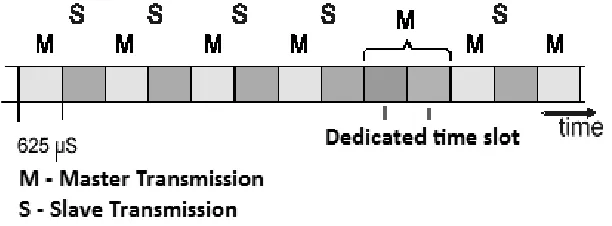
PECIFICATIONS OF BLUETOOTH TECHNOLOGYBluetooth is a technology that used for replacing short distance cables . It supports both data and voice packet transmission with a data rate of 1 Mbps through radio channel . Bluetooth is a PAN ( Personal Area Network ) having operating range is 10 meter s. Bluetooth tranmitted power is low about 1mw. It uses GFSK modulation to control the spectral width of the transmitted signal as well the 1600 hops occurred in one second during transmission of data . FHSS ( Frequency Hopping Spread Spectrum ) is used to reduce the effect of interference from other devices. The interference problem can be recovered or avioded using various co-existing techniques. The Bluetooth transmission slots are presented in figure 2. In this paper we consider Connection Oriented Repeated Transmission for SCO links to reduce the impact of interference n voice packets.
Fig. 2: Bluetooth time Slot
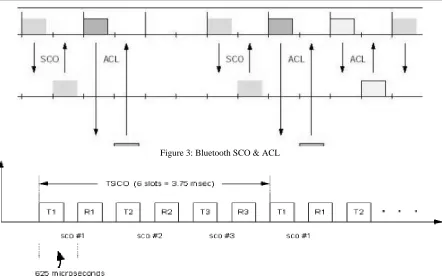
A TDD ( Time Division Duplexing ) is used to divide the channel into slices of 625 s as in figure 5. A new frequency hop is used for each slot. Bluetooth supports both the voice and data transmission uses SCO ( Synchronized Connection Oriented ) and ACL ( Asynchronized Connectionless Link ) respectivley. SCO link is established between a master and a slave device in a piconet as in figure 3. The first row shows the master slots and the second row is of slave device 1 and third row of slave 2 device as in figure 3.
SCO link uses reserved time slots for voice transmission . Bluetooth master device uses the reserved time slots to maintain the connection and transmission of information . An ACL link is used for data transmission and it can establish between one master and sever slave devices in a piconet . ACL packets are communicated in free time slots after SCO transmission. ACL packets occupy upto 1,3 and 5 time slots.
SCO LINK FOR VOICE PACKET TRANSMISSION A.
Figure 3: Bluetooth SCO & ACL
Figure 4: Bluetooth SCO voice slot
A master device ( transmitter ) starts and controls SCO link . Maximum of three SCO links can be maintained by a master device at same time . At a aacurate time when master device transmitts SCO packet in a slot , the slave sends back in the next or following slot. It shows that the packet transmission is symmetric that means data rate is same in both directions and length of Bluetooth SCO packet is always one time slot. There is one important thing that thereis no acknowledgement for SCO link . SCO packet communicate in reverse slots at regular time intervals like two, four or six slots .
There are various types of SCO voice packets like HV1, HV2, and HV3. HV1 carries 10 data bytes and is transmitted every 2 slots, HV2 carries 20 data bytes and is transmitted every 4 slots and HV3 carries 30 data bytes and is transmitted every 6 slots .The data rate of HV1, HV2, HV3 packets are 64Kbps. HV1 and HV2 uses 1/3 and 2/3 rate Forward error correcting (FEC) mechanisms respectively. There is no FEC in HV3.
Figure 5: Asynchronous Connection Less (ACL) link
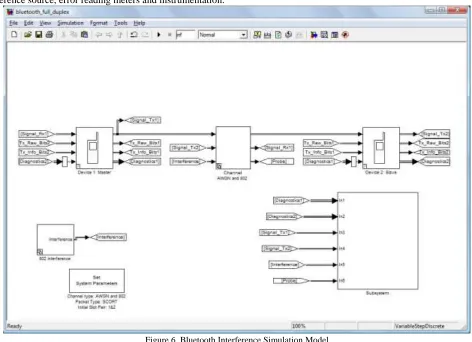
full duplex communication mode. We have used two similar devices , each with a transmitter and a receiver. One of them should be set as master and the other is slave. Other than two Bluetooth devices, we also have an 802.11b packet generating block as an interference source, error reading meters and instrumentation.
Figure 6. Bluetooth Interference Simulation Model
In the first step there is a need to build a transmitter of Bluetooth and then the AWGN channel is used because of its own specifications and then the Bluetooth receiver is have to be made . One thing is most important the Wi-Fi interfere model is used only not the whole system because there is only the impact of interference is detecting on Bluetooth system.
Transmitter Design A.
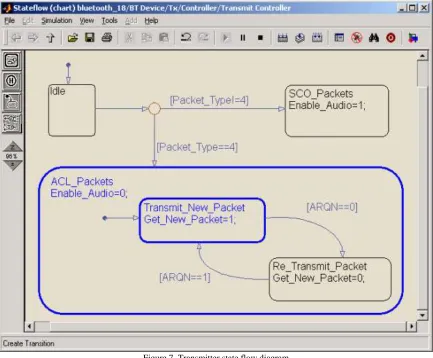
Figure 7. Transmitter state flow diagram
If it is in "Transmit_blank_Packet" ARQN is one, it stays in that particular state and transmits another new packet. If ARQN is zero, it shifts to the "Re_Transmit_Packet". This simulation model uses frame based processing. It can transmit samples having high number of frames in each step of the simulation. This technique enables quick simulation of digital systems. In this particular model, a top sample rate of 100 MHz is used.
Figure 7 shows the state flow diagram of the data transmission. When the “ACL_packets” is entered the transition to “Transmit_blank_packet” will happen. The “Enable_Audio = 0" & "Get_blank_Packet = 1" actions activates to disable audio and to generate a new data packet.
When the next time slot is about to transmit, the transmitter will check the status of ARQN bit returned from the receiving device. If it is in "Transmit_blank_Packet" ARQN is one, it stays in the state and transmits another new packet. If ARQN is zero, it shifts to the "Re_Transmit_Packet". If the transmitter is in “Re_Transmit_Packet", and ARQN is one, it shifts to “Transmit_blank_Packet" else it will not shift and will stay in "Re_Transmit_Packet".
RECEIVER DESIGN B.
Figure 8. Receiver state flow diagram
A DM1 packet will be checked for integrity. The receiver performs a HEC. The PIN, Header address is also verified. The receiver makes sure the packet is new and is not a duplicate. It also checks the CRC. If all these checks are correct, the packet will be accepted else the packet will be rejected. This happens in the case of a repeated packet arriving or in the case of its CRC failing. This flow diagram is implemented in State flow semantics as shown in Figure 8. This image has been captured during a simulation, illustrates the animation provided with State flow which highlights the decision path (in bold) through the flow chart.
AWGN CHANNEL AND WI-FI INTERFER MODEL C.
Figure 9. 802.11b Interference Source added
IV.
C
O-
EXIATENCE SOLUTION–
CONNECTION ORIENTED REPEATED TRANSMISSION FOR SCO LINK FORVOICE TRANSMISSION
The coexistence task group working on coexistence has suggested the use of a special voice packet to fight interference. The Connection Oriented with Repeated Transmission for SCO link, this voice packet achieves more robust transmission by replacing bit-level redundancy with packet-level redundancy.
It works by repeating the transmission of the same packet three times in one SCO interval. It does not have any error correction and is transmitted every second time slot. As the same packet is being transmitted three times in a row, only one voice link will be there which is a full duplex link. If interference destroys the transmission during first slot, there are still three other slots or have opportunities to communicate the packet. This provides an improvement for frame-error rate (FER) in an interference scenario. It does not affect the BER of the payload.
V.
E
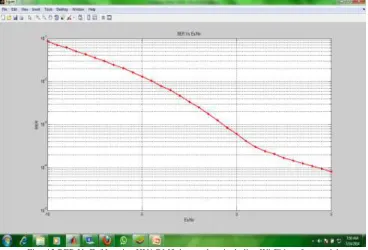
XPERIMENTS AND RESULTSUsing the Bluetooth simulation model including Wi-Fi interfere model, we perform a series of tests to evaluate the performance of a Bluetooth system under interference. We used DM5 packet type to check the performance of ACL pakcet for data transmission. The HV1 packet is used to evaluate SCO voice transmission performance. Finally we used new voice packet type Connection Oriented Repeated Transmission for SCO link to calculate the BER (Bit Error Rate) of the received signal for better performance.
Figure 10. Bluetooth system throughput with respect to the distance between Bluetooth master and Bluetooth receiver
Figure 10 depicts the Bluetooth system throughput. The throughput (in kbps) has been evaluated by varying the distance between the Bluetooth device and the Wi-Fi interference source. It should be noted in Figure 10 that a consistent values of throughput is achieved with respect to a constant increase in the distance between the Bluetooth master and slave devices. From Figure 10, we can see that the throughput of a Bluetooth system is about 128 kbps without 802.11b interference source.
Fig : 11 BER Vs Es/No using HV1 and DM5 packets without Wi-Fi interfere model
Our analysis shows that the situation gets worse as more and more devices come into play .Such a situation calls for the urgency of congestion free network. Techniques such as Connection Orientation Repeated Transmission for SCO voice packets are a big leap in the future for such networks.
Fig : 12 BER Vs Es/No using HV1 DM5 data packets including Wi-Fi interfere model
R
EFERENCES[1] Golmie, N.; Dyck, R. E.; Soltanian, A. (2001). Interference of Bluetooth and IEEE 802.11:simulation modeling and performance evaluation, Proceedings of the 4th ACM International Workshop on Modeling, Analysis and Simulation of Wireless and Mobile Systems, pp. 11- 18.
[2] Golmie, N.; Dyck, R. E.; Soltanian, A. ; Tonnerre, A. ; Rébala, O. (2003). Interference evaluation of Bluetooth and IEEE 802.11b systems, Journal of Wireless Networks, Vol. 9, Issue 3, pp. 201 – 211.
[3] Song, M.; Shetty, S.; Gopalpet, D. (2007). Coexistence of IEEE 802.11b and Bluetooth: an integrated performance analysis, Mobile Networks and Applications, Vol. 12, Issue 5, pp. 450 –459.
[4] Wadhwa, M.; Song, M. (2006). Performance of IEEE 802.11b devices in the presence of adaptive frequency hopping enabled Bluetooth devices, Proceedings of the 4th IEEE International Conference on Information Technology: Research and Education, pp.74- 48.
[5] Subramanian, V.; Ramakrishnan, K.; Kalyanaraman, S.; Lusheng, J. (2006). Impact of interference and capture effects in 802.11 wireless networks on TCP, Proceedings of the 2nd International Workshop on Wireless Traffic Measurements and Modeling
[6] Mathew, A.; Chandrababu, N.; Elleithy, K.; Rizvi, S. (2009). IEEE 802.11 & Bluetooth interference: simulation and coexistence, 7th Annual Conference on Communication Networks and Services Research, pp. 217 - 223.
[7] Matthew, B. (2009). Wi-Fi (IEEE 802.11b) and Bluetooth coexistence issues and solutions for the 2.4 GHz ISM band, Texas Instruments.
[8] Cordeiro, C.; Abhyankar, S.; Toshiwal, R.; Agarwal, R. (2003). A novel architecture and coexistence method to provide global access to/from Bluetooth WPANs by IEEE 802.11 WLANs, Proceedings of IEEE International Perform Computer Communication, pp 23-30.
[9] Chek, M.; Kwok, Y. (2007). Design and evaluation of practical coexistence management schemes for Bluetooth and IEEE 802.11b systems, International Journal of Computer and Telecommunications Networking, Vol.51, No.8, pp. 2086 – 2103.
[10] N. Golmie, R. E. Van Dyck, and A. Soltanian, “ Interference of Bluetooth and IEEE 802.11: Simulation Modeling and Performance” National Institute of Standards and Technology.
[11] Matthew B. Shoemake, Ph.D., “Wi-Fi (IEEE 802.11b) and Bluetooth Coexistence Issues and Solutions for the 2.4 GHz ISM Band” Texas Instruments. [12] Tsung-Chuan Huang and Shao-Hsien Chiang, “Coexistence Mechanisms for Bluetooth SCO Link and IEEE 802.11 WLAN”.
[13] Mladen Russo, Dinko Begušić, Nikola Rožić, Maja Stella, “Speech recognition over Bluetooth ACL and SCO Links: A Comparison
[14] Steve Shellhammer, Symbol Technologies, “SCORT - An Alternative to the Bluetooth SCO Link for Voice Operation in an InterferenceEnvironment” [15] Peter Dziwior.,“Specifications of the Bluetooth System, Core v1.1,www.bluetooth.org”